From Surf Wiki (app.surf) — the open knowledge base
Moonshine
High-proof liquor, generally made illicitly

High-proof liquor, generally made illicitly
| Field | Value |
|---|---|
| name | Moonshine |
| type | Whisky |
| abv | At least 40% |
| proof | At least 80° |
| colour | Clear to off-white depending on ingredients |
| ingredients | Grain (mashing), sugar (fermented water, kilju) |
Moonshine is high-proof liquor, traditionally made or distributed illegally. The name was derived from a tradition of distilling the alcohol at night to avoid detection. In the first decades of the 21st century, commercial distilleries have adopted the term for its outlaw cachet and have begun producing their own legal "moonshine", including many novelty flavored varieties, that are said to continue the tradition by using a similar method or locale of production.
In 2013, moonshine accounted for about one-third of global alcohol consumption.
Terminology
Different languages and countries have their own terms for moonshine .
Fractional crystallization
The ethanol may be concentrated in fermented beverages by means of freezing. For example, the name applejack derives from the traditional method of producing the drink, jacking, the process of freezing fermented cider and then removing the ice, increasing the alcohol content. Starting with the fermented juice, with an alcohol content of less than ten percent, the concentrated result can contain 25–40% alcohol by volume (ABV).
Moonshine stills
.jpg)
In some countries, moonshine stills are illegal to sell, import, and own without permission. However, enthusiasts explain on internet forums how to obtain equipment and assemble it into a still. To cut costs, stainless steel vessels are often replaced with plastic stills, vessels made from polypropylene that can withstand relatively high heat.
- A column still, or a spiral still, can achieve a vapor alcohol content of 95% ABV.
- Moonshine is usually distilled to 40% ABV, and seldom above 66% based on 48 samples. For example, conventional pot stills commonly produce 40% ABV, and top out between 60% and 80% ABV after multiple distillations. However, ethanol can be dried to 95% ABV by heating 3A molecular sieves such as 3A zeolite.
The preferred heat source for plastic stills or spiral stills is sous vide sticks; these control temperature, time, and circulation, and are therefore preferred over immersion heaters. Multiple units can be used to increase the wattage. Also, sous vide sticks, commonly sold in 1200 W and generally temperature regulated up to 90 C (ethanol boils at 78 C), will evaporate the ethanol faster than an immersion heater, commonly sold in 300 W. Electrical injury may occur if immersion heaters are modified, such as if a 35 C thermostat is removed from an aquarium heater (because doing so may break its waterproofing), or if an immersion heater is disassembled from an electric water boiler.
Evaporation stills
Plastic still
A plastic still is a device for distillation specially adapted for separating ethanol and water. Plastic stills are common because they are cheap and easy to manufacture. The principle is that a smaller amount of liquid is placed in an open smaller vessel inside a larger one that is closed. A cheap 100 W immersion heater is typically used as heat source, but a thermal immersion circulator, like a sous vide stick is ideal because it comes with a temperature controller. The liquid is kept heated at about 50 C which slowly evaporates the ethanol to 40% ABV that condense on the inner walls of the outer vessel. The condensation that accumulates in the bottom of the vessel can then be diverted directly down through a filter containing activated carbon. The final product has approximately twice as much alcohol content as the starting liquid and can be distilled several times if stronger distillate is desired. The method is slow, and is not suitable for large-scale production.
Boiling stills
Fractional distillation
Main article: Fractional distillation
Column still
Main article: Column still
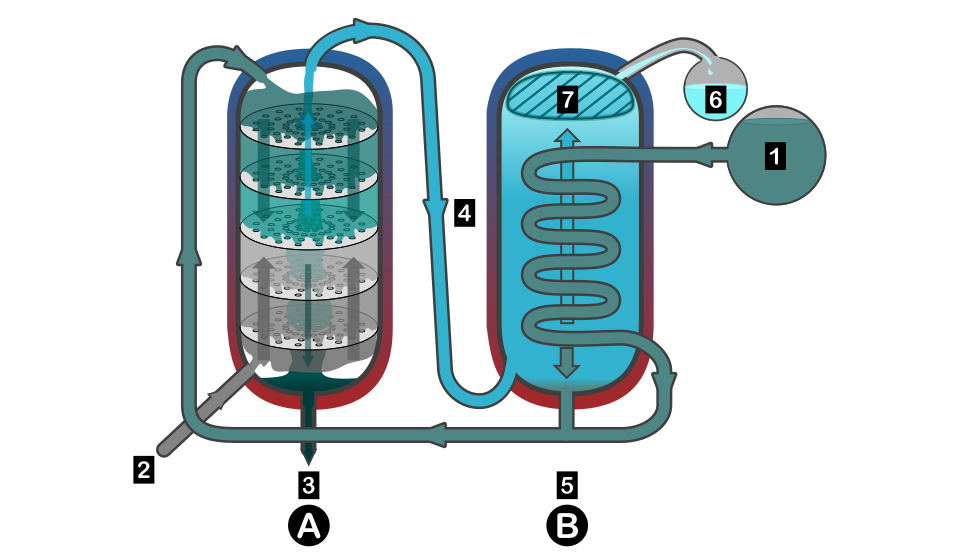
|Analyzer* |Rectifier* |Wash |Steam |Liquid out |Alcohol vapor |Recycled less volatile components |Most volatile components |Condenser
A column still, also called a continuous still, patent still or Coffey still, is a variety of still consisting of two columns. A column still can achieve a vapor alcohol content of 95% ABV.
Spiral still
A spiral still is a type of column still with a simple slow air-cooled distillation apparatus, commonly used for bootlegging. Column and cooler consist of a 5 ft copper tube wound in spiral form. The tube first goes up to act as a simple column, and then down to cool the product. Cookware usually consists of a 30 L plastic wine bucket. The heat source is typically a thermal immersion circulator (commonly runs at 1200 W), like a sous vide stick because it is hard to find 300 W immersion heaters, and it is risky to disassemble the immersion heater from an electric water boiler because it may cause electrical injury. The spiral burner is popular because, despite its simple construction and low manufacturing cost, it can provide 95% ABV.
Pot still
Main article: Pot still
A pot still is a type of distillation apparatus or still used to distill flavored liquors such as whisky or cognac, but not rectified spirit because they are poor at separating congeners. Pot stills operate on a batch distillation basis (as opposed to a Coffey or column stills, which operate on a continuous basis). Traditionally constructed from copper, pot stills are made in a range of shapes and sizes depending on quantity and style of spirit. Geographic variations in still design exist, with certain kinds popular in parts of Appalachia, a region known for moonshine distilling.
Spirits distilled in pots commonly have 40% ABV, and top out between 60 and 80% after multiple distillations.
Safety

Poorly produced moonshine can be contaminated, mainly from materials used in the construction of the still. Stills employing automotive radiators as condensers are particularly dangerous; in some cases, glycol produced from antifreeze can be a problem.
The head that comes immediately after the foreshot (the initial product of the still) typically contains small amounts of other undesirable compounds, such as acetone and various aldehydes. Fusel alcohols are other undesirable byproducts of fermentation that are contained in the "aftershot," and are also typically discarded.
Alcohol concentrations at higher strengths (the GHS identifies concentrations above 24% ABV as dangerous) are flammable and therefore dangerous to handle. This is especially true during the distilling process, when vaporized alcohol may accumulate in the air to dangerous concentrations if adequate ventilation is not provided.
Adulterated moonshine
Contaminated moonshine can occur if proper materials and techniques are not used. The prolonged consumption of impure moonshine may cause renal disease, primarily from increased lead content.
Heavy metals
Analysis of Georgia moonshine samples revealed potentially toxic levels of copper, zinc, lead, and arsenic. A review of twelve arsenic poisoning cases found contaminated moonshine responsible for about half, suggesting it may be a significant source in some areas.
Lead
Radiators used as condensers may contain lead at the plumbing joints, and their use has resulted in blindness or lead poisoning from tainted liquor. This was a deadly hazard during the Prohibition-era United States. Consumption of lead-tainted moonshine is a serious risk factor for saturnine gout, a very painful but treatable medical condition that damages the kidneys and joints. A 2004 Virginia study found that of 48 samples of illicitly distilled moonshine seized by law enforcement, 60% of the samples had lead levels above the EPA water guideline of 15 ppb.
The incidence of impure moonshine has been documented to significantly increase the risk of renal disease among those who regularly consume it, primarily from increased lead content.
Methanol
Contamination is still possible by unscrupulous distillers using cheap methanol to increase the apparent strength of the product. Moonshine can be made both more palatable and perhaps less dangerous by discarding the "foreshot" – the first 50 - of alcohol that drip from the condenser. Because methanol vaporizes at a lower temperature than ethanol, it is commonly assumed that the foreshot contains most of the methanol, if any, from the mash. However, research shows that methanol is present until the very end of the distillation run. Despite this, distillers will usually collect the foreshots until the temperature of the still reaches 80 C.
Outbreaks of methanol poisoning have occurred from methanol accidentally produced in moonshine production or deliberately used to strengthen it.
Purification
In modern times, reducing methanol with the absorption of a molecular sieve is a practical method for production.
Methanol safety by fermentation ingredient
- Grain starches: Methanol is not produced in toxic amounts by fermentation of sugars from grain starches.
- Methanol is produced in the fermentation of fruits via the action of pectin methylesterase, while of regulatory concern this does not typically exceed toxic levels and poisonings typically occur from methanol addition (e.g. as a lacing agent).
Tests
Alcohols

The Lucas test in alcohols is a test to differentiate between primary, secondary, and tertiary alcohols. It can be used to detect the levels of fusel alcohols.
Strength
A quick estimate of the alcoholic strength, or proof, of the distillate (the ratio of alcohol to water) is often achieved by shaking a clear container of the distillate. Large bubbles with a short duration indicate a higher alcohol content, while smaller bubbles that disappear more slowly indicate lower alcohol content.
A more reliable method is to use an alcoholmeter or hydrometer. A hydrometer is used during and after the fermentation process to determine the potential alcohol percentage of the moonshine, whereas an alcoholmeter is used after the product has been distilled to determine the volume percent or proof.
Misconceptions

A common folk test for the quality of moonshine was to pour a small quantity of it into a spoon and set it on fire. The theory was that a safe distillate burns with a blue flame, but a tainted distillate burns with a yellow flame. Practitioners of this simple test also held that if a radiator coil had been used as a condenser, then there would be lead in the distillate, which would give a reddish flame. This led to the mnemonic, "Lead burns red and makes you dead," or simply, "Red means dead."
Legality
Manufacturing of spirits through distilling, fractional crystallization, etc. outside a registered distillery is illegal in many countries.
USA
Currently in the United States, there are five states that allow the production of moonshine for personal consumption (Alaska, Arizona, Maine, Massachusetts, Missouri, and New Hampshire). Additionally, North Dakota law permits the production of moonshine for personal consumption up to the federally legal amountwhich is zero gallons; entailing that production of any amount is illegal.
| States | Legality |
|---|---|
| Alaska | Personal use only |
| Arizona | Must have a permit for personal use/register still |
| Maine | Produce up to 24 proof gallons of distilled spirits per person over 21 per year |
| Massachusetts | Personal use on own property only |
| Missouri | Personal use up to 200 USgal per year |
| New Hampshire | Liquor that is produced from 100/200 gallons of beer or wine per individual/household per year |
| North Dakota | Only up to federally-allowed amount (zero gallons) |
History


Traditionally, moonshine usually is a clear, unaged whiskey, made with barley mash in Scotland and in Ireland, and made with maize corn mash in the United States. The word moonshine originated in the 18th century, in the British Isles, as a result of excise tax laws, and became an American English usage in the post–Independence U.S. after the Tariff of 1791 (Excise Whiskey Tax of 1791) outlawed un-registered distilleries, which provoked the Whiskey Rebellion (1791–1794), wherein for four years the Excise Whiskey Tax went unpaid by the tax rebels by way of violent protest. The Excise Whiskey Tax was law until 1802, upon repeal of the Tariff of 1791.
In the 19th century, the Revenue Act of 1861 and the Revenue Act of 1862 levied heavy taxes upon the distilleries producing vinous spirits, which taxation increased the number of illegal distilleries, which then increased police actions by the IRS agents despatched to collect taxes from distilleries; the agents were known as Revenuers. Illegal distilling accelerated during the Prohibition era (1920–1933), which mandated a total ban on alcohol production under the Eighteenth Amendment of the Constitution. Since the amendment was repealed in 1933, laws focus on evasion of taxation on any type of spirits or intoxicating liquors. Applicable laws were historically enforced by the Bureau of Alcohol, Tobacco, Firearms and Explosives of the US Department of Justice, but are now usually handled by state agencies.
Etymology
The earliest known instance of the term "moonshine" being used to refer to illicit alcohol dates to the 1785 edition of Grose's Dictionary of the Vulgar Tongue, which was published in England. Prior to that, "moonshine" referred to anything "illusory" or to literally the light of the moon. The U.S. Government considers the word a "fanciful term" and does not regulate its use on the labels of commercial products; as such, legal moonshines may be any type of spirit, which must be indicated elsewhere on the label.
Prohibition in the United States
Main article: Prohibition in the United States
In Prohibition-era United States, moonshine distillation was done at night to deter discovery. While moonshiners were present in urban and rural areas around the United States after the Civil War, moonshine production concentrated in Appalachia because the limited road network made it easy to evade revenue officers and because it was difficult and expensive to transport corn crops. As a study of farmers in Cocke County, Tennessee, observes: "One could transport much more value in corn if it was first converted to whiskey. One horse could haul ten times more value on its back in whiskey than in corn." Moonshiners such as Maggie Bailey of Harlan County, Kentucky, Amos Owens of Rutherford County, North Carolina, and Marvin "Popcorn" Sutton of Maggie Valley, North Carolina, became legendary.
Once the liquor was distilled, drivers called "runners" or "bootleggers" smuggled moonshine liquor across the region in cars specially modified for speed and load-carrying capacity. The cars were ordinary on the outside but modified with souped-up engines, extra interior room, and heavy-duty shock absorbers to support the weight of the illicit alcohol. After Prohibition ended, the out-of-work drivers kept their skills sharp through organized races, which led to the formation of the National Association for Stock Car Auto Racing (NASCAR). Several former "runners," such as Junior Johnson, became noted drivers in the sport.
Some varieties of maize corn grown in the United States were once prized for their use in moonshine production. One such variety used in moonshine, Jimmy Red corn, a "blood-red, flint-hard 'dent' corn with a rich and oily germ," almost became extinct when the last grower died in 2000. Two ears of Jimmy Red were passed on to "seed saver" Ted Chewning, who saved the variety from extinction and began to produce it on a wider scale.
There have been modern-day attempts on the state level to legalize home distillation of alcohol, similar to how some states have been treating cannabis, despite there being federal laws prohibiting the practice. For example, the New Hampshire state legislature has tried repeatedly to pass laws allowing unlicensed home distillation of small batches. In 2023, Ohio introduced legislation to do the same, with other states likely to follow.
References
Sources
- Davis, Elaine. Minnesota 13: "Wet" Wild Prohibition Days (2007)
- Rowley, Matthew. Moonshine! History, songs, stories, and how-tos (2007)
- Watman, Max. Chasing the White Dog: An Amateur Outlaw's Adventures in Moonshine (2010)
- King, Jeff. The Home Distiller's Workbook: Your Guide to Making Moonshine, Whisky, Vodka, Rum and So Much More! (2012)
References
- Kosar, Kevin. (15 April 2017). "Moonshine: A Global History". Reaktion Books.
- "moonshine".
- "moonshine".
- (2019). "Modern Moonshine : The Revival of White Whiskey in the Twenty-First Century". West Virginia University Press.
- Ken Albala. (2010). "Applejack". ABC-CLIO.
- Michael Foley, ''Drinking with the Saints: The Sinner's Guide to a Holy Happy Hour'' (2015, {{ISBN. 1621573834): Perhaps the most interesting option is applejack, the first distilled liquor native to North America and a great favorite among the colonists. [Now] usually a blend of apple brandy and neutral spirits that retains the flavor of the apples[.]
- Sanborn Conner Brown, ''Wines & Beers of Old New England: A How-to-do-it History'' (1978, {{ISBN. 0874511488)
- "Spiralbrännaren".
- (2004). "Analysis of Moonshine for Contaminants". Journal of Toxicology. Clinical Toxicology.
- (September 1997). "Ethanol-Water Adsorption on Commercial 3A Zeolites: Kinetic and Thermodynamic Data". Brazilian Journal of Chemical Engineering.
- (1984). "Desiccant efficiency in solvent and reagent drying 8. molecular sieve column drying of 95% ethanol: An application of hygrometry to the assay of solvent water content". Journal of Chemical Technology and Biotechnology. Chemical Technology.
- (21 October 2009). "Adsorption/Desorption of Water and Ethanol on 3A Zeolite in Near-Adiabatic Fixed Bed". Industrial & Engineering Chemistry Research.
- (21 October 2009). "Adsorption/Desorption of Water and Ethanol on 3A Zeolite in Near-Adiabatic Fixed Bed". Industrial & Engineering Chemistry Research.
- (1984). "Desiccant efficiency in solvent and reagent drying 8. molecular sieve column drying of 95% ethanol: An application of hygrometry to the assay of solvent water content". Journal of Chemical Technology and Biotechnology. Chemical Technology.
- "Making Moonshine: The Dummies' Guide". Copper Moonshine Still Kits - Clawhammer Supply.
- "Hazardous Goods Management".
- "Risk of End Stage Renal Disease Associated with Alcohol Consumption". Oxford Journals.
- (November 1980). "Trace element content of moonshine.". Archives of Environmental Health.
- (February 1980). "Moonshine-related arsenic poisoning.". Archives of Internal Medicine.
- (December 2016). "Why Your Copper Moonshine Still Needs To Be Lead Free – Whiskey Still Company".
- (May 2013). "Saturnine gout, redux: a review". The American Journal of Medicine.
- Loghman-Adham M. (September 1997). "Renal effects of environmental and occupational lead exposure". Environ. Health Perspect..
- Holstege, Christopher P.. (2004). "Analysis of Moonshine for Contaminants". Journal of Toxicology: Clinical Toxicology.
- Spaho, Nermina. (28 June 2017). "Distillation Techniques in the Fruit Spirits Production". Distillation - Innovative Applications and Modeling.
- (November 2012). "Application to Include Fomepizole on the WHO Model List of Essential Medicines".
- Hui-Ling Ma. (15 April 2006). "Study on Method of Decreasing Methanol in Apple Pomace Spirit". Food Science.
- (28 April 2021). "Methanol Mitigation during Manufacturing of Fruit Spirits with Special Consideration of Novel Coffee Cherry Spirits.". Molecules.
- (2021). "The impact of unrecorded alcohol use on health: What do we know in 2020?". J. Stud. Alcohol Drugs.
- "Moonshine".
- "Maine LD631 {{!}} 2025-2026 {{!}} 132nd Legislature".
- "New Hampshire HB1624 {{!}} 2024 {{!}} Regular Session".
- "Moonshine Legal States 2023".
- (17 June 2015). "Exploding moonshine: The new golden age of outlaw liquor".
- Guy Logsdon, [[Oklahoma Historical Society]]. "Moonshine". [[Oklahoma State University]].
- "TTBGov - Whiskey Rebellion".
- Joyce, Jaime. (10 June 2014). "Moonshine: A Cultural History of America's Infamous Liquor". MBI Publishing Company.
- (22 October 2013). "The Kings County Distillery Guide to Urban Moonshining : How to Make and Drink Whiskey". Abrams Books.
- Sumich, Jason. "It's All Legal Until You Get Caught: Moonshining in the Southern Appalachians". Appalachian State University.
- (8 December 2005). "'Queen of the Mountain Bootleggers' Maggie Bailey".
- Motsinger, Carol. (November 10, 2014). "New Movie Focuses on WNC Moonshiner Popcorn Sutton". [[Asheville Citizen-Times]].
- Billock, Jennifer. "How Moonshine Bootlegging Gave Rise to NASCAR".
- (2009). "The American South: A History, Volume II". Rowman & Littlefield.
- Neimark, Jill. (2 January 2018). "From Hooch To Haute Cuisine: A Nearly Extinct Bootlegger's Corn Gets A Second Shot". [[NPR]].
- (January 2, 2018). "Should Home Distilling Be Legal In N.H.? Lawmakers To Vote Wednesday".
- "S.B. No. 13".
This article was imported from Wikipedia and is available under the Creative Commons Attribution-ShareAlike 4.0 License. Content has been adapted to SurfDoc format. Original contributors can be found on the article history page.
Ask Mako anything about Moonshine — get instant answers, deeper analysis, and related topics.
Research with MakoFree with your Surf account
Create a free account to save articles, ask Mako questions, and organize your research.
Sign up freeThis content may have been generated or modified by AI. CloudSurf Software LLC is not responsible for the accuracy, completeness, or reliability of AI-generated content. Always verify important information from primary sources.
Report