From Surf Wiki (app.surf) — the open knowledge base
Montgomery, Alabama
Capital city of Alabama, United States
Capital city of Alabama, United States
| Field | Value |
|---|---|
| official_name | Montgomery |
| settlement_type | State capital |
| nicknames | "The Gump", "Birthplace of the Civil Rights Movement", "Cradle of the Confederacy" |
| motto | "Capital of Dreams" |
| image_skyline | {{multiple image |
| border | infobox |
| total_width | 280 |
| caption_align | center |
| image_style | border:1; |
| perrow | 1/2/2/2 |
| image1 | Aerial view of Montgomery, Alabama LCCN2011646683.jpg |
| caption1 | Montgomery along the Alabama River |
| image2 | Alabama State Capitol, Montgomery, South view 20160713 1.jpg |
| caption2 | Alabama State Capitol |
| image3 | Montgomery December 2018 44 (Dexter Avenue King Memorial Baptist Church).jpg |
| caption3 | Dexter Avenue Baptist Church |
| image4 | First_White_House_of_the_Confederacy,_Montgomery,_North_view_20160713_1.jpg |
| caption4 | First White House of the Confederacy |
| image5 | Alabama_World_War_Memorial,_part_of_the_Alabama_Archives_and_History_Museum,_Montgomery,_Alabama_LCCN2010637591.tif |
| caption5 | Archives and History Museum |
| image6 | Commerce St, Downtown Montgomery 20160713 1.jpg |
| caption6 | Commerce Street, downtown |
| image7 | Federal Building and US Court House, Montgomery 20160713 1.jpg |
| caption7 | Frank M. Johnson Jr. Federal Building |
| image_flag | Flag of Montgomery, Alabama.svg |
| image_seal | City of Montgomery Great Seal.png |
| image_blank_emblem | Montgomery, AL Logo.pngclass=skin-invert |
| blank_emblem_type | Logo |
| coordinates | |
| mapframe | yes |
| mapframe-zoom | 10 |
| mapframe-point | none |
| pushpin_map | Alabama#USA |
| pushpin_map_caption | Location within Alabama##Location within the United States |
| pushpin_label | Montgomery |
| pushpin_relief | yes |
| subdivision_type | Country |
| subdivision_name | United States |
| subdivision_type1 | State |
| subdivision_name1 | Alabama |
| subdivision_type2 | County |
| subdivision_name2 | Montgomery |
| government_type | Mayor–Council |
| leader_party | D |
| leader_title | Mayor |
| leader_name | Steven L. Reed |
| established_title | Incorporated |
| established_date | December 3, 1819 |
| named_for | Richard Montgomery |
| unit_pref | Imperial |
| area_footnotes | |
| area_total_km2 | 420.28 |
| area_land_km2 | 414.03 |
| area_water_km2 | 6.25 |
| area_total_sq_mi | 162.27 |
| area_land_sq_mi | 159.86 |
| area_water_sq_mi | 2.41 |
| population_as_of | 2020 |
| population_est | 195287 |
| pop_est_as_of | 2023 |
| pop_est_footnotes | |
| population_footnotes | |
| population_total | 200603 |
| population_density_km2 | 475.8 |
| population_density_sq_mi | 1232 |
| population_rank | US: 133rd |
| AL: 3rd | |
| population_urban | 254348 (US: 159th) |
| population_density_urban_km2 | 676.8 |
| population_density_urban_sq_mi | 1,752.9 |
| population_metro | 385460 (US: 142nd) |
| population_density_metro_km2 | 54.83 |
| population_density_metro_sq_mi | 142.0 |
| timezone | Central (CST) |
| utc_offset | −6 |
| timezone_DST | CDT |
| utc_offset_DST | −5 |
| elevation_footnotes | |
| elevation_m | 73 |
| elevation_ft | 240 |
| postal_code_type | ZIP Codes |
| postal_code | |
| area_code | 334 |
| blank_name | FIPS code |
| blank_info | 01-51000 |
| blank1_name | GNIS feature ID |
| blank1_info | 0165344 |
| website |
| mapframe-zoom = 10 | mapframe-point = none AL: 3rd
Montgomery is the capital city of the U.S. state of Alabama and the seat of Montgomery County. It was named for Continental Army Major-General Richard Montgomery and stands beside the Alabama River on the Gulf Coastal Plain.
The population was 200,603 at the 2020 census. It is the third-most populous city in the state, after Huntsville and Birmingham, and the 133rd-most populous in the United States. The Montgomery metropolitan area's population in 2022 was 385,460; it is the fourth-largest in the state and 142nd among U.S. metropolitan areas.
The city was incorporated in 1819 as a merger of two towns situated along the Alabama River. It replaced Tuscaloosa as the state capital in 1846, representing the shift of power to the south-central area of Alabama with the growth of cotton as a commodity crop of the Black Belt and the rise of Mobile as a mercantile port on the Gulf Coast. In February 1861, Montgomery was chosen the first capital of the Confederate States of America, which it remained until the Confederate seat of government moved to Richmond, Virginia, in May of that year. In the middle of the 20th century, Montgomery was a major center of events and protests in the Civil Rights Movement, including the Montgomery bus boycott and the Selma to Montgomery marches.
In addition to housing many Alabama government agencies, Montgomery has a large military presence, due to Maxwell Air Force Base. It has three public universities (Alabama State University, Troy University (Montgomery campus), and Auburn University at Montgomery), two private post-secondary institutions (Faulkner University and Huntingdon College), high-tech manufacturing (particularly Hyundai Motor Manufacturing Alabama), and many cultural attractions, such as the Alabama Shakespeare Festival, the Montgomery Museum of Fine Arts, and the National Memorial for Peace and Justice.
Montgomery has also been recognized nationally for its downtown revitalization and new urbanism projects. It was one of the first cities in the nation to implement SmartCode Zoning.
History
Main article: History of Montgomery, Alabama
Prior to European colonization, the east bank of the Alabama River was inhabited by the Alibamu tribe of Native Americans. The Alibamu and the Coushatta, who lived on the west side of the river, were descended from the Mississippian culture. This civilization had numerous chiefdoms throughout the Midwest and South along the Mississippi and its tributaries, and had built massive earthwork mounds as part of their society about 950–1250 AD. Its largest location was at Cahokia, in present-day Illinois east of St. Louis.
The historic tribes spoke mutually intelligible Muskogean languages, which were closely related. Present-day Montgomery is built on the site of two Alibamu towns: Ikanatchati (Ekanchattee or Ecunchatty or Econachatee), meaning "red earth;" and Towassa, built on a bluff called Chunnaanaauga Chatty. The first Europeans to travel through central Alabama were Hernando de Soto and his expedition, who in 1540 recorded going through Ikanatchati and camping for one week in Towassa.
The next recorded European encounter occurred more than a century later, when an English expedition from Carolina went down the Alabama River in 1697. The first permanent European settler in the Montgomery area was James McQueen, a Scots trader who settled there in 1716. He married a high-status woman in the Coushatta or Alabama tribe. Their mixed-race children were considered Muskogean, as both tribes had a matrilineal system of property and descent. The children were always considered born into their mother's clan, and gained their status from her people.
In 1785, Abraham Mordecai, a war veteran from a Sephardic Jewish family of Philadelphia, Pennsylvania, established a trading post. The Coushatta and Alabama had gradually moved south and west in the tidal plain. After the French were defeated by the British in 1763 in the Seven Years' War and ceded control of their lands, these Native American peoples moved to parts of present-day Mississippi, Louisiana, and Texas, then areas of Spanish rule, which they thought more favorable than British-held areas. By the time Mordecai arrived, Creek had migrated into and settled in the area, as they were moving away from Cherokee and Iroquois warfare to the north. Mordecai married a Creek woman. When her people had to cede most of their lands after the 1813-14 Creek War, she joined them in removal to Indian Territory. Mordecai brought the first cotton gin to Alabama.
The Upper Creek were able to discourage most white immigration until after the conclusion of the Creek War. Following their defeat by General Andrew Jackson in August 1814, the Creek tribes were forced to cede 23 million acres to the United States, including remaining land in today's Georgia and most of today's central and southern Alabama. In 1816, the Mississippi Territory (1798–1817) organized Montgomery County. Its former Creek lands were sold off the next year at the federal land office in Milledgeville, Georgia.
The first group of white settlers to come to the Montgomery area was headed by General John Scott. This group founded Alabama Town about 2 mi downstream on the Alabama River from present-day downtown Montgomery. In June 1818, county courts were moved from Fort Jackson to Alabama Town. Alabama was admitted to the Union in December 1819.
Soon after, Andrew Dexter Jr. founded New Philadelphia, the present-day eastern part of downtown. He envisioned a prominent future for his town; he set aside a hilltop known as "Goat Hill" as the future site of the state capitol building. New Philadelphia soon prospered, and Scott and his associates built a new town adjacent, calling it East Alabama Town. Originally rivals, the towns merged on December 3, 1819, and were incorporated as the town of Montgomery, named for Richard Montgomery, an American Revolutionary War general.

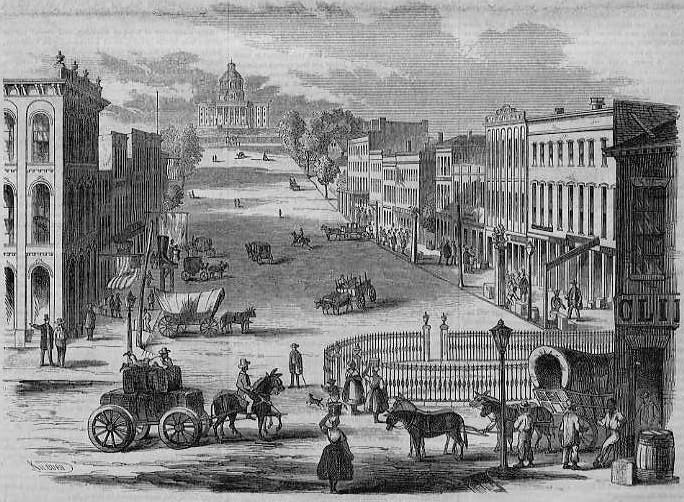
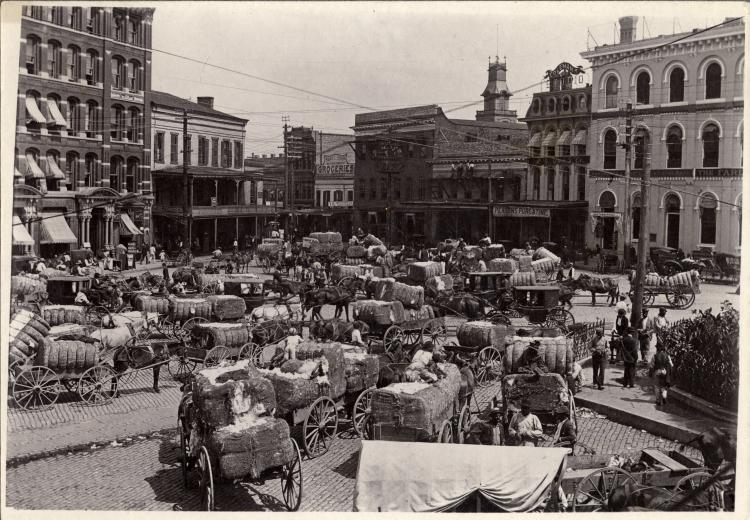
Slave traders used the Alabama River to deliver enslaved laborers to planters, to work the cotton. Buoyed by the revenues of the cotton trade at a time of high market demand, the newly united Montgomery grew quickly. In 1822, the city was designated as the county seat. A new courthouse was built at the present location of Court Square, at the foot of Market Street (now Dexter Avenue). Court Square had one of the largest slave markets in the South. The state capital was moved from Tuscaloosa to Montgomery, on January 28, 1846.
As state capital, Montgomery began to influence state politics, and it would also play a prominent role on the national stage. Beginning February 4, 1861, representatives from Alabama, Georgia, Florida, Louisiana, Mississippi, and South Carolina met in Montgomery, to attend the Southern ConventionSouthern Convention, which would form the Confederate States of America. Montgomery was named the first capital of the nation, and Jefferson Davis was inaugurated as president on the steps of the State Capitol. The capital was later moved to Richmond, Virginia in 1861 after that state joined the Confederacy since Richmond was larger and more developed than Montgomery for supporting the needs of a national capital.
On April 12, 1865, following the Battle of Selma, Major General James H. Wilson captured Montgomery for the Union.
In 1886 Montgomery became the first city in the United States to install citywide electric streetcars along a system that was nicknamed the Lightning Route. Residents followed the streetcar lines to settle in new housing in what were then "suburban" locations.

On February 12, 1945, a devastating and deadly tornado struck the western portion of the city. The tornado killed 26 people, injured 293 others, and caused a city-wide blackout which lasted for hours. The United States Weather Bureau would describe this tornado as "the most officially observed one in history".
In the post-World War II era, returning African-American veterans were among those who became active in pushing to regain their civil rights in the South: to be allowed to vote and participate in politics, to freely use public places, to end segregation. According to the historian David Beito of the University of Alabama, African Americans in Montgomery "nurtured the modern civil rights movement."
In separate action, integrated teams of Freedom Riders rode South on interstate buses. In violation of federal law and the constitution, bus companies had for decades acceded to state laws and required passengers to occupy segregated seating in Southern states. Opponents of the push for integration organized mob violence at stops along the Freedom Ride. In Montgomery, there was police collaboration when a white mob attacked Freedom Riders at the Greyhound Bus Station in May 1961. Outraged national reaction resulted in the enforcement of desegregation of interstate public transportation.
Martin Luther King Jr. returned to Montgomery in 1965. Local civil rights leaders in Selma had been protesting Jim Crow laws and practices that raised barriers to blacks registering to vote. Following the shooting of a man after a civil rights rally, the leaders decided to march to Montgomery to petition Governor George Wallace to allow free voter registration. The violence they encountered from county and state highway police outraged the country. The federal government ordered National Guard and troops to protect the marchers. Thousands more joined the marchers on the way to Montgomery, and an estimated 25,000 marchers entered the capital to press for voting rights. These actions contributed to Congressional passage of the Voting Rights Act of 1965, to authorize federal supervision and enforcement of the rights of African Americans and other minorities to vote.
On February 7, 1967, a devastating fire broke out at Dale's Penthouse, a restaurant and lounge on the top floor of the Walter Bragg Smith apartment building (now called Capital Towers) at 7 Clayton Street downtown. Twenty-six people died.
In recent years, Montgomery has grown and diversified its economy. Active in downtown revitalization, the city adopted a master plan in 2007; it includes the revitalization of Court Square and the riverfront, renewing the city's connection to the river. Many other projects under construction include the revitalization of Historic Dexter Avenue, pedestrian and infrastructure improvements along the Selma to Montgomery National Historic Trail, and the construction of a new environmental park on West Fairview Avenue.
Geography

Montgomery is located at .
According to the United States Census Bureau, the city has a total area of 162.27 sqmi, of which 159.86 sqmi is land and 2.41 sqmi (0.52%) is water. The city is built over rolling terrain at an elevation of about 220 ft above sea level.
Cityscape
Downtown Montgomery lies along the southern bank of the Alabama River, about 6 mi downstream from the confluence of the Coosa and Tallapoosa rivers. The most prominent feature of Montgomery's skyline is the 375 ft, RSA Tower, built in 1996 by the Retirement Systems of Alabama. Other prominent buildings include 60 Commerce Street, 8 Commerce Street, and the RSA Dexter Avenue Building. Downtown also contains many state and local government buildings, including the Alabama State Capitol. The Capitol is located atop a hill at one end of Dexter Avenue, along which also lies the Dexter Avenue Baptist Church, where Martin Luther King Jr. was pastor. Both the Capitol and Dexter Baptist Church are recognized as National Historic Landmarks by the U.S. Department of the Interior. Other notable buildings include RSA Dexter Avenue, RSA Headquarters, Alabama Center for Commerce, RSA Union, and the Renaissance Hotel and Spa.
One block south of the Capitol is the First White House of the Confederacy, the 1835 Italianate-style house in which President Jefferson Davis and family lived while the Confederate capital was in Montgomery. Montgomery's third National Historic Landmark is Union Station. Passenger train service to Montgomery ceased in 1989. Today Union Station is part of the Riverfront Park development, which includes an amphitheater, a riverboat dock, a river walk, and Riverwalk Stadium.
The completion of a 112000 ft2 space in 2007, the Convention Center, has encouraged growth and activity in the downtown area and attracted more high-end retail and restaurants. Three blocks east of the Convention Center, Old Alabama Town showcases more than 50 restored buildings from the 19th century. The Riverwalk is part of a larger plan to revitalize the downtown area and connect it to the waterfront. The plan includes urban forestry, infill development, and façade renovation to encourage business and residential growth.
Other downtown developments include historic Dexter Avenue, which will be the center of a Market District. A$6 million streetscape project is improving its design. Maxwell Boulevard is home to the newly built Wright Brothers Park. High-end apartments are planned for this area. The Bell Building, located across from the Rosa Parks Library and Museum, is being redeveloped for mixed-use retail and residential space.
The National Memorial for Peace and Justice opened in downtown Montgomery on April 26, 2018. Founded by the Equal Justice Initiative, it acknowledges the historic past of racial terrorism and lynching in America.
South of downtown, across Interstate 85, lies Alabama State University. ASU's campus was built in Colonial Revival architectural style from 1906 until the beginning of World War II. Surrounding ASU are the Garden District and Cloverdale Historic District. Houses in these areas date from around 1875 until 1949, and are in Late Victorian and Gothic Revival styles. Huntingdon College is on the southwestern edge of Cloverdale. The campus was built in the 1900s in Tudor Revival and Gothic Revival styles. ASU, the Garden District, Cloverdale, and Huntingdon are all listed on the National Register of Historic Places as historic districts.
Montgomery's east side is the fastest-growing part of the city. Development of the Dalraida neighborhood, along Atlanta Highway, began in 1909, when developers Cook and Laurie bought land from the Ware plantation. A Scotsman, Georgie Laurie named the area for Dál Riata, a 6th-7th century Gaelic overkingdom; a subsequent misspelling in an advertisement led to the current spelling. The first lots were sold in 1914. The city's two largest shopping malls (Eastdale Mall and The Shoppes at Eastchase), as well as many big-box stores and residential developments, are on the east side.
The area is also home of the Wynton M. Blount Cultural Park. This 240 acre park contains the Alabama Shakespeare Festival and Montgomery Museum of Fine Arts.
Revitalization
Montgomery has been recognized nationally for its continuing downtown revitalization. In the early 2000s, the city constructed the Montgomery Biscuits minor league baseball stadium and Riverfront Park. Following those developments, hundreds of millions of dollars have been invested by private companies that have adapted old warehouses and office buildings into loft apartments, restaurants, retail, hotels, and businesses. The demand for downtown living space has risen, as people want to have walkable, lively neighborhoods. More than 500 apartment units are under construction, including The Heights on Maxwell Boulevard, The Market District on Dexter Avenue, the Kress Building on Dexter Avenue, The Bell Building on Montgomery Street, and a new complex by the convention center. Additionally, Montgomery has recently opened a 50 million dollar white water park on July 7, located off Maxwell Boulevard.
Climate
Montgomery has a humid subtropical climate (Köppen Cfa), with short, mild winters, warm springs and autumns, and long, hot, humid summers. The daily average temperature in January is 46.6 °F, and there are 3.4 days of sub 20 °F lows; 10 °F and below is extremely rare. The daily average in July is 81.8 °F, with highs exceeding 90 °F on 86 days per year and 100 °F on 3.9. Summer afternoon heat indices, much more often than the actual air temperature, are frequently at or above 100 °F. The diurnal temperature variation tends to be large in spring and autumn. Rainfall is well-distributed throughout the year, though February, March and July are the wettest months, while October is significantly the driest month. Snowfall occurs only during some winters, and even then is usually light. Substantial snowstorms are rare, but do occur approximately once every 10 years. Extremes range from -5 °F on February 13, 1899 to 107 °F on July 7, 1881.
Thunderstorms bring much of Montgomery's rainfall. These are common during the summer months but occur throughout the year. Severe thunderstorms – producing large hail and damaging winds in addition to the usual hazards of lightning and heavy rain – can occasionally occur, particularly during the spring. Severe storms also bring a risk of tornadoes. Sometimes, tropical disturbances – some of which strike the Gulf Coast as hurricanes before losing intensity as they move inland – can bring very heavy rains. |Jan record high F = 83 |Feb record high F = 86 |Mar record high F = 90 |Apr record high F = 94 |May record high F = 99 |Jun record high F = 106 |Jul record high F = 107 |Aug record high F = 106 |Sep record high F = 106 |Oct record high F = 102 |Nov record high F = 91 |Dec record high F = 85 |year record high F = 107 |Jan avg record high F = 75.6 |Feb avg record high F = 78.8 |Mar avg record high F = 84.7 |Apr avg record high F = 87.4 |May avg record high F = 93.1 |Jun avg record high F = 96.9 |Jul avg record high F = 98.3 |Aug avg record high F = 98.9 |Sep avg record high F = 95.7 |Oct avg record high F = 90.1 |Nov avg record high F = 82.7 |Dec avg record high F = 77.6 |year avg record high F = 99.6 |Jan avg record low F = 19.1 |Feb avg record low F = 23.6 |Mar avg record low F = 28.8 |Apr avg record low F = 37.3 |May avg record low F = 47.3 |Jun avg record low F = 60.1 |Jul avg record low F = 66.7 |Aug avg record low F = 64.2 |Sep avg record low F = 53.0 |Oct avg record low F = 37.3 |Nov avg record low F = 26.7 |Dec avg record low F = 23.2 |year avg record low F = 17.1 |Jan record low F = 0 |Feb record low F = −5 |Mar record low F = 17 |Apr record low F = 28 |May record low F = 40 |Jun record low F = 48 |Jul record low F = 59 |Aug record low F = 56 |Sep record low F = 39 |Oct record low F = 26 |Nov record low F = 13 |Dec record low F = 5 |year record low F = -5 |Jan dew point C = 1.6 |Feb dew point C = 2.7 |Mar dew point C = 6.8 |Apr dew point C = 11.1 |May dew point C = 15.8 |Jun dew point C = 19.4 |Jul dew point C = 21.5 |Aug dew point C = 21.3 |Sep dew point C = 18.4 |Oct dew point C = 11.9 |Nov dew point C = 7.5 |Dec dew point C = 3.6
Demographics
|align-fn=center 2020 Census
.png)
2020 census
| Race / Ethnicity (NH = Non-Hispanic) | title=P004 Hispanic or Latino, and Not Hispanic or Latino by Race – 2000: DEC Summary File 1 – Montgomery city, Alabama | url=https://data.census.gov/table/DECENNIALSF12000.P004?q=p004&g=160XX00US0151000 | publisher=United States Census Bureau | access-date=January 7, 2024 | archive-date=January 7, 2024 | archive-url=https://web.archive.org/web/20240107204856/https://data.census.gov/table/DECENNIALSF12000.P004?q=p004&g=160XX00US0151000 | url-status=live }} | title=P2: Hispanic or Latino, and Not Hispanic or Latino by Race – 2010: DEC Redistricting Data (PL 94-171) – Montgomery city, Alabama | url=https://data.census.gov/table?q=p2&g=160XX00US0151000&tid=DECENNIALPL2010.P2 | publisher=United States Census Bureau | access-date=June 26, 2023 | archive-date=June 26, 2023 | archive-url=https://web.archive.org/web/20230626190348/https://data.census.gov/table?q=p2&g=160XX00US0151000&tid=DECENNIALPL2010.P2 | url-status=live }} | % 2000 | % 2010 |
|---|---|---|---|---|---|---|---|---|---|---|---|---|---|---|---|---|
| White alone (NH) | 94,868 | 74,227 | 57,071 | 47.07% | ||||||||||||
| Black or African American alone (NH) | 99,631 | 116,001 | 120,349 | 49.43% | ||||||||||||
| Native American or Alaska Native alone (NH) | 468 | 449 | 322 | 0.23% | ||||||||||||
| Asian alone (NH) | 2,120 | 4,580 | 7,171 | 1.05% | ||||||||||||
| Pacific Islander alone (NH) | 66 | 79 | 105 | 0.03% | ||||||||||||
| Other race alone (NH) | 173 | 184 | 648 | 0.09% | ||||||||||||
| Mixed race or Multiracial (NH) | 1,758 | 2,246 | 5,268 | 0.87% | ||||||||||||
| Hispanic or Latino (any race) | 2,484 | 7,998 | 9,669 | 1.23% | ||||||||||||
| Total | 201,568 | 205,764 | 200,603 | 100.00% |
As of the 2020 census, there were 200,603 people, 82,835 households, and 49,303 families residing in the city. There were 93,920 housing units.
2010 census
As of the 2010 census, there were 205,764 people, 81,486 households, out of which 29% had children under the age of 18 living with them. The racial makeup of the city was 37.3% White, 56.6% Black, 2.2% Asian, 0.2% Native American, 0.1% Pacific Islander, 2.2% from other races, and 1.3% from two or more races. 3.9% of the population were Hispanic or Latino of any race. Non-Hispanic Whites were 36.1% of the population in 2010, down from 66% in 1970. The population density varies in different parts of the city; East Montgomery (Taylor Rd and East), the non-Hispanic White population is 74.5%, African American 8.3%, Latino 3.2%, other non-white races carry 2.7% of the population.
The city population was spread out, with 24.9% under the age of 18, 11.7% from 18 to 24, 27.3% from 25 to 44, 24.2% from 45 to 64, and 11.8% who were 65 years of age or older. The median age was 34 years. For every 100 females, there were 88.6 males. For every 100 females age 18 and over, there were 84.5 males. The median income for a household in the city was $41,380, and the median income for a family was $53,125. Males had a median income of $40,255 versus $33,552 for females. The per capita income for the city was $23,139. About 18.2% of families and 21.6% of the population were below the poverty line, including 34.8% of those under age 18 and 8.4% of those age 65 or over.
Economy
Montgomery's central location in Alabama's Black Belt has long made it a processing hub for commodity crops such as cotton, peanuts, and soybeans. In 1840 Montgomery County led the state in cotton production, and by 1911, the city processed 160,000–200,000 bales of cotton annually. Montgomery has also had large metal fabrication and lumber production sectors.
Due to its location along the Alabama River and extensive rail connections, Montgomery has been and continues to be a regional distribution hub for a wide range of industries. Since the late 20th century, it has diversified its economy, achieving increased employment in sectors such as healthcare, business, government, and manufacturing. Today, the city's Gross Metropolitan Product is $12.15 billion, representing 8.7% of the gross state product of Alabama.
According to Bureau of Labor Statistics data from October 2008, the largest sectors of non-agricultural employment were: Government, 24.3%; Trade, Transportation, and Utilities, 17.3% (including 11.0% in retail trade); Professional and Business Services, 11.9%; Manufacturing, 10.9%; Education and Health Services, 10.0% (including 8.5% in Health Care & Social Assistance); Leisure and Hospitality, 9.2%; Financial Activities, 6.0%, Natural Resources, Mining and Construction, 5.1%; Information, 1.4%; and Other services 4.0%. Unemployment for the same period was 5.7%, 2.5% higher than October 2007. The city also draws in workers from the surrounding area; Montgomery's daytime population rises 17.4% to 239,101.
Top employers
According to the city's 2022 Comprehensive Annual Financial Report, the largest employers in the city are:
| Number | Company/Organizations | Product/Service | Employees |
|---|---|---|---|
| 1 | Maxwell-Gunter Air Force Base | Military Base | 12,280 |
| 2 | State of Alabama | State Government | 10,315 |
| 3 | Montgomery Public Schools | Public Schools | 4,524 |
| 4 | Baptist Health | Hospitals/Clinics | 4,300 |
| 5 | Hyundai Motor Manufacturing Alabama | Automobile Manufacturing | 3,530 |
| 6 | ALFA Companies | Insurance Companies | 2,568 |
| 7 | City of Montgomery | Local Government | 2,500 |
| 8 | Business & Enterprise Systems | Software Development | 1,350 |
| 9 | Jackson Hospital & Clinic, Inc. | Hospitals/Clinics | 1,300 |
| 10 | Koch Foods | Poultry Processing | 1,250 |
| 11 | MOBIS Alabama | Automobile Manufacturing | 1,010 |
| 12 | Baptist Medical Center South | Hospitals/Clinics | 980 |
| 13 | Rheem Water Heaters | Water Heater Manufacturing | 920 |
| 14 | UPS | Distribution/Logistics | 850 |
| 15 | Glovis Alabama, LLC | Warehousing and Logistics | 832 |
| 16 | Convergent Outsourcing, Inc. | Customer Contact Center | 736 |
| 17 | Montgomery County Commission | Local Government | 700 |
| 18 | Alabama Power Company | Utility | 660 |
| 19 | Auburn University at Montgomery | University | 576 |
| 20 | Glovis America | Logistics | 545 |
According to the Living Wage Calculator, the living wage for the city is US$19.73 per hour (or $41,038 per year) for an individual and $37.14 per hour ($77,251 per year) for a family of four. These are slightly lower than the state averages of $20.15 per hour for an individual and $41.11 for a family of four. US$7.25 per hour minimum wage in Alabama.
Health care
Montgomery serves as a hub for healthcare in the central Alabama and Black Belt region. Hospitals located in the city include Baptist Medical Center South on South East Boulevard, Baptist Medical Center East next to the campus of Auburn University Montgomery on Taylor Road, and Jackson Hospital, which is located next to Oak Park off interstate 85. Montgomery is also home to two medical school campuses: Baptist Medical Center South (run by University of Alabama at Birmingham) and Jackson Hospital (run by Alabama Medical Education Consortium).
Law and government
Montgomery operates under a Mayor–council government system. The mayor and council members are elected to four-year terms. The current mayor is Steven Reed, who was elected as the city's first African-American mayor in a runoff election which was held on October 8, 2019. The city is served by a nine-member city council, elected from nine single-member districts of equal size population.
As the seat of Montgomery County, the city is the location of county courts and the county commission, elected separately. Montgomery is the capital of Alabama, and hosts numerous state government offices, including the office of the Governor, the Alabama Legislature, and the Alabama Supreme Court.
At the federal level, Montgomery is part of Alabama's 2nd, 7th, and 3rd Congressional district, currently represented by Barry Moore, Terri Sewell, and Mike Rogers, respectively. The 7th represents most of Western Montgomery, the 2nd Southern and Northern Montgomery, and the 3rd Eastern Montgomery.
Crime
According to the Uniform Crime Report statistics compiled by the Federal Bureau of Investigation (FBI) in 2022, there were 522 violent crimes and 2,636 property crimes per 100,000 residents. Of these, the violent crimes consisted of 18 murders, 9 forcible rapes, 141 robberies and 354 aggravated assaults, while 562 burglaries, 1,773 larceny-thefts, 301 motor vehicle thefts and 0 acts of arson defined the property offenses.
According to the city, there were 75 homicides in 2023.
Montgomery's violent crime rates compare unfavorably to other large cities in the state. In 2009, Montgomery's crime rates were favorable compared to other large Alabamian cities such as Huntsville, Mobile, and Birmingham. However, crime rose in the 2010s and early 2020s, leading to a record high of over 320 shooting victims and over 77 homicide victims in 2021. In 2022 Montgomery's violent crime rate was 514 per 100,000, earning only a crime score rating of 9/100. For property crimes, Montgomery's average is similar to Alabama's other large cities, but higher than the overall state and national averages.
Recreation
Montgomery has more than 1,600 acres of parkland, which are maintained and operated by the City of Montgomery Parks and Recreation Department. The department also operates 24 community centers, a skate park, two golf courses (Lagoon Park and Gateway Park), Cramton Bowl Stadium and Multiplex, two tennis centers (Lagoon Park and O'Conner), 65 playgrounds, 90 baseball/softball fields, 24 soccer fields including the Emory Folmar Soccer Facility, and one riverboat.
Culture
Montgomery has one of the biggest arts scenes of any mid-sized city in America. The Winton M. Blount Cultural Park (named for Winton M. Blount) in east Montgomery is home to the Montgomery Museum of Fine Arts. The museum's permanent collections include American art and sculpture, Southern art, master prints from European masters, and collections of porcelain and glass works. The Society of Arts and Crafts operates a co-op gallery for local artists.
Montgomery Zoo holds more than 500 animals, from five continents, in 40 acre of barrier-free habitats. The Hank Williams Museum contains one of the largest collections of Williams memorabilia in the world. The Museum of Alabama serves as the official state history museum and is located in the Alabama Department of Archives and History building downtown. This museum was renovated and expanded in 2013 in a $10 million project that includes technological upgrades and many new exhibits and displays. The W. A. Gayle Planetarium, operated by Troy University, is one of the largest in the southeast United States and offers tours of the night sky and shows about current topics in astronomy. The planetarium was upgraded to a full-dome digital projector in 2014.
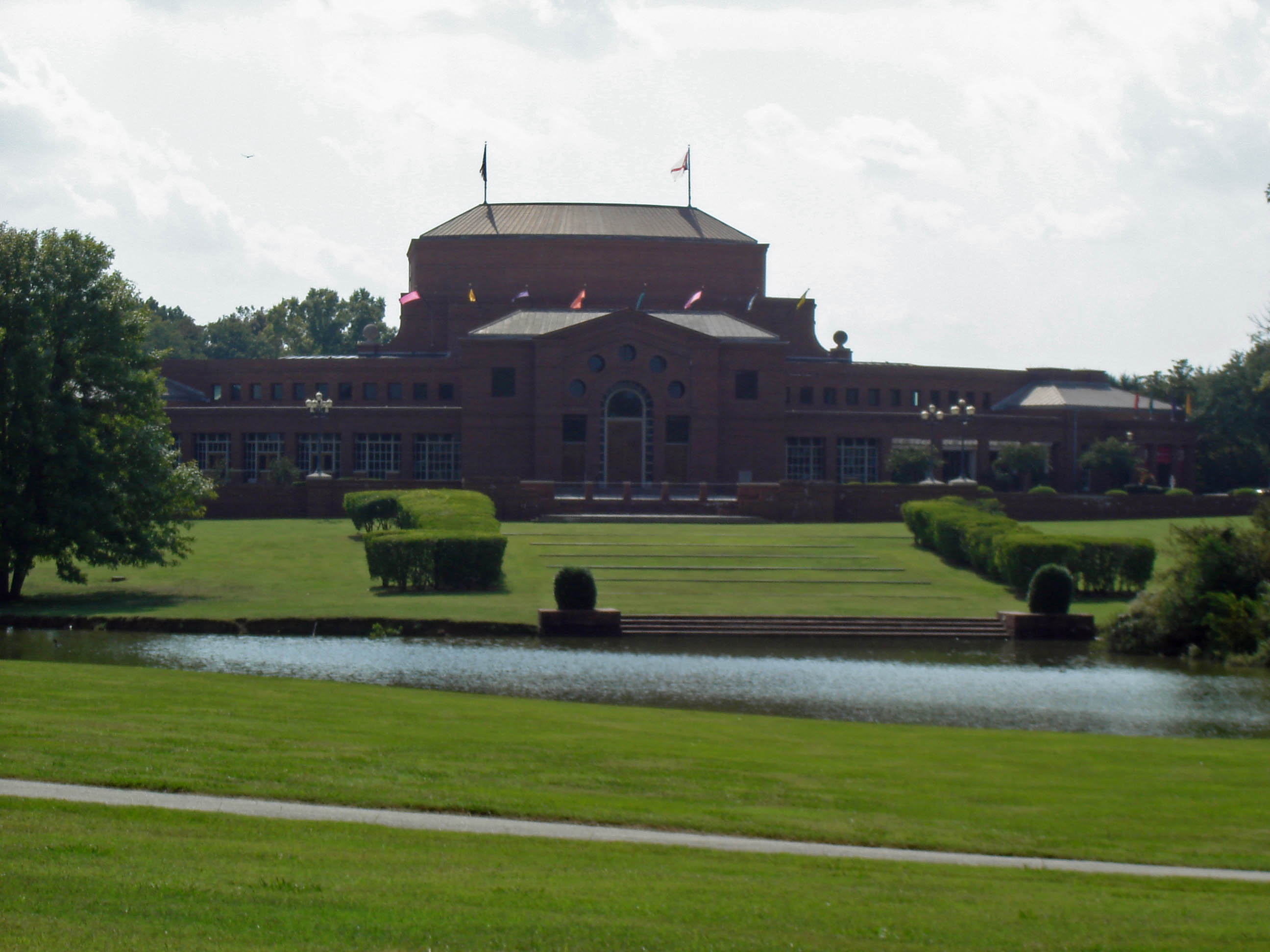
Blount Park also contains the Alabama Shakespeare Festival's Carolyn Blount Theatre. The Shakespeare Festival presents year-round performances of both classic plays and performances of local interest, in addition to works of William Shakespeare. The 1200-seat Davis Theatre for the Performing Arts, on the Troy University at Montgomery campus, opened in 1930 and was renovated in 1983. It houses the Montgomery Symphony Orchestra, Alabama Dance Theatre and Montgomery Ballet, as well as other theatrical productions. The Symphony has been performing in Montgomery since 1979. The Capri Theatre in Cloverdale was built in 1941, and today shows independent films. The 1800-seat state-of-the-art Montgomery Performing Arts Center opened inside the newly renovated convention center downtown in 2007. It hosts a range of performances, from Broadway plays to concerts, and performers such as B. B. King, Gregg Allman, and Merle Haggard.
Numerous musical performers have roots in Montgomery: Toni Tennille of the duo The Captain and Tennille, jazz singer and pianist Nat King Cole, country singer Hank Williams, blues singer Big Mama Thornton, Melvin Franklin of The Temptations, and guitarist Tommy Shaw of Styx.
Author and artist Zelda Sayre was born in Montgomery. In 1918, she met F. Scott Fitzgerald, then a young soldier stationed at an Army post nearby. The house where they lived when first married is today operated as the F. Scott and Zelda Fitzgerald Museum. Poet Sidney Lanier lived in Montgomery and Prattville immediately after the Civil War, while writing his novel Tiger Lilies.
In addition to those notable earlier musicians, some of the rock bands from Montgomery have achieved national success since the late 20th century. Locals artists Trust Company were signed to Geffen Records in 2002. Hot Rod Circuit formed in Montgomery in 1997 under the name Antidote, but achieved success with Vagrant Records after moving to Connecticut.
Sports
Montgomery is home of the Montgomery Biscuits baseball team. The Biscuits play in the Class AA Southern League. They are affiliated with the Tampa Bay Rays, and play at Montgomery Riverwalk Stadium. Riverwalk Stadium hosted the NCAA Division II National Baseball Championship from 2004 until 2007. The championship had previously been played at Paterson Field in Montgomery from 1985 until 2003. Riverwalk Stadium has also been host to two Southern League All-Star games in 2006 and 2015.

The Yokohama Tire LPGA Classic women's golf event is held at the Robert Trent Jones Golf Trail at Capitol Hill in nearby Prattville. Garrett Coliseum was the home of the now-defunct Montgomery Bears indoor football team.
Montgomery is also the site of sporting events hosted by the area's colleges and universities. The Alabama State University Hornets play in NCAA Division I competition in the Southwestern Athletic Conference (SWAC). The football team plays at Hornet Stadium, the basketball teams play at the Dunn-Oliver Acadome, and the baseball team plays at the ASU Baseball Complex, which opened in 2010. Auburn University at Montgomery (AUM) fields teams in NCAA Division II competition. Huntingdon College participates at the NCAA Division III level and Faulkner University is a member of the NAIA and is a nearby rival of AUM. The Blue–Gray Football Classic was an annual college football all-star game held from 1938 until 2001. In 2009, the city played host to the first annual Historical Black College and University (HBCU) All-Star Football Bowl played at Cramton Bowl. Montgomery has also hosted to the Southern Intercollegiate Athletic Conference (SIAC) football championship and the Camellia Bowl. Montgomery annually hosts the Max Capital City Classic inside Riverwalk Stadium which is a baseball game between rivals Auburn University and the University of Alabama.
Several successful professional athletes hail from Montgomery, including Pro Football Hall of Famer Bart Starr and two-time Olympic gold medalist in track and field Alonzo Babers.
Civic organizations
Montgomery has many active governmental and nonprofit civic organizations. City funded organizations include the Montgomery Clean City Commission (a Keep America Beautiful Affiliate) which works to promote cleanliness and environmental awareness. BONDS (Building Our Neighborhoods for Development and Success) which works to engage citizens about city/nonprofit programs, coordinates/assists neighborhood associations, and works to promote neighborhood and civic pride amongst Montgomery residents.
A number of organizations are focused on diversity relations and the city's rich civil rights history. Leadership Montgomery provides citizenship training. Bridge Builders Alabama works with high school youth to promote diversity and civic engagement. The group One Montgomery was founded in 1983 and is a forum for networking of a diverse group of citizens active in civic affairs. Montgomery is also home to The Legacy Museum, Civil Rights Memorial, The National Memorial for Peace and Justice, Freedom Monument Sculpture Park, Freedom Rides Museum, the National Center for the Study of Civil Rights and African-American Culture, and the Rosa Parks Library and Museum.
Education


Most of the city of Montgomery and Montgomery County are served by the Montgomery Public Schools system. As of 2022, there were 26,381 students enrolled in the system, and 1,412 teachers employed. The system manages 32 elementary schools, 13 middle schools, and 10 high schools as well as 6 magnet schools, 1 alternative school, and 2 special education centers. Montgomery is one of the only cities in Alabama to host three public schools with International Baccalaureate programs. In 2007, Forest Avenue Academic Magnet Elementary School and in 2015, Bear Exploration Center were named a National Blue Ribbon School. In 2022, LAMP High School was named the No. 7 magnet school in the United States and No. 1 public high school in the state of Alabama on U.S. News & World Reports list. Three other Montgomery Public Schools high schools were also on the list, the most of any public school system in the state (Brewbaker Technology Magnet, and George Washington Carver High School).
Maxwell Air Force Base is zoned to Department of Defense Education Activity (DoDEA) schools for grades K-8. For high school, Maxwell AFB residents are zoned to Montgomery Public Schools facilities: residents of the main base are zoned to Carver High, while residents of the Gunner Annex are zoned to Dr. Percy L. Julian High School. Residents may attend magnet schools.
Montgomery is home to 28 private schools, including notable (former) segregation academies such as Montgomery Academy (Alabama).
The Montgomery City-County Public Library operates eleven public libraries in locations throughout the city and county.
The city is home to Alabama's oldest law library, the Supreme Court and State Law Library, founded in 1828. Located in the Heflin-Torbert Judicial Building, the Law Library owns a rare book collection containing works printed as early as 1605.
Montgomery has been the home of Alabama State University, a historically black university, since the Lincoln Normal University for Teachers relocated from Marion in 1887. Today, ASU is the second largest HBCU in Alabama enrolling nearly 5,000 students from 42 U.S. states and 7 countries. The public Troy University maintains a 3,000 student population campus in downtown Montgomery that houses the Rosa Parks Library and Museum. Another public institution, Auburn University at Montgomery, with an enrollment of nearly 5,000 mostly from the Montgomery area, is in the eastern part of the city. Montgomery's Baptist Medical Center South also hosts a branch of the University of Alabama at Birmingham medical school on its campus on the Eastern Boulevard.
Montgomery also is home to several private colleges: Faulkner University, which has an enrollment of 2,952 (fall 2023), is a Church of Christ-affiliated school which is home to the Thomas Goode Jones School of Law; Huntingdon College, which has a current student population of approximately 1,100 and is affiliated with the United Methodist Church; and Amridge University.
Several two-year colleges have campuses in Montgomery, including H. Councill Trenholm State Technical College
Maxwell Air Force Base is the headquarters for Air University, the United States Air Force's center for professional military education. Branches of Air University based in Montgomery include the Squadron Officer School, the Air Command and Staff College, the Air War College, and the Community College of the Air Force.
Media
The morning newspaper, the Montgomery Advertiser, began publication as The Planter's Gazette in 1829. It is the principal newspaper of central Alabama and is affiliated with the Gannett. In 1970, then publisher Harold E. Martin won the Pulitzer Prize for special reporting while at the Advertiser. The Alabama Journal was a local afternoon paper from 1899 until April 16, 1993, when it published its last issue before merging with the morning Advertiser.
Montgomery is served by seven local television stations: WNCF 32 (ABC), WSFA 12 (NBC), WCOV 20 (Fox), WBMM 22 (CW), WAIQ 26 (PBS), WMCF-TV 45 (TBN), WFRZ-LD 33 (Religious and Educational). In addition, WAKA 8 (CBS), licensed to Selma but operating out of Montgomery, and WBIH 29 (independent) located in Selma, and WIYC 67 (AMV) is licensed to Troy. Montgomery is part of the Montgomery-Selma Designated Market Area (DMA), which is ranked 118th nationally by Nielsen Media Research. Charter Communications and Knology provide cable television service. DirecTV and Dish Network provide direct broadcast satellite television including both local and national channels to area residents.
The Montgomery area is served by eight AM radio stations: WMSP, WMGY, WZKD, WTBF, WGMP, WAPZ, WLWI, and WXVI; and nineteen FM stations: WJSP, WAPR, WELL, WLBF, WTSU, WVAS, WLWI, WXFX, WQKS, WWMG, WVRV, WJWZ, WBAM, WALX, WHHY, WMXS, WHLW, WZHT, and WMRK. Montgomery is ranked 150th largest by Arbitron.
NOAA Weather Radio station KIH55 broadcasts weather and hazard information for Montgomery and vicinity.
Transportation
Two interstate highways run through Montgomery. Interstate 65 is the primary north–south freeway through the city leading between Birmingham and Huntsville to the north and Mobile to the south. Montgomery is the southern terminus of Interstate 85, another north–south freeway (though running east–west in the city), which leads northeast to Atlanta and Charlotte. The major surface street thoroughfare is a loop consisting of State Route 152 in the north, U.S. Highway 231 and U.S. Highway 80 in the east, U.S. Highway 82 in the south, and U.S. Highway 31 along the west of the city. The Alabama Department of Transportation is planning the Outer Montgomery Loop to connect Interstate 85 near Mt. Meigs to U.S. Highway 80 southwest of the city. Upon completion of the loop, it will carry the I-85 designation while the original I-85 into the city center will be redesignated I-685.
Montgomery Area Transit System (The M) provides public transportation with buses serving the city. The system has 32 buses providing an average of 4500 passenger trips daily. The M's ridership has shown steady growth since the system was revamped in 2000; the system served over 1 million passenger trips in 2008. Greyhound Lines operates a terminal in Montgomery for intercity bus travel in the downtown Intermodal Transit Facility.
Montgomery Regional Airport, also known as Dannelly Field, is the major airport serving Montgomery. It serves primarily as an Air National Guard base and for general aviation, but commercial airlines fly to regional connections to Atlanta, Dallas–Fort Worth and Charlotte.
Passenger rail service to Montgomery was enhanced in 1898 with the opening of Union Station. Service continued until 1979, when Amtrak terminated its Floridian route. Amtrak returned from 1989 until 1995 with the Gulf Breeze, an extension of the Crescent line.
According to the 2016 American Community Survey, 84.3% of working city of Montgomery residents commuted by driving alone, 8.8% carpooled, 0.4% used public transportation, and 0.6% walked. About 3.5% used all other forms of transportation, including taxicab, motorcycle, and bicycle. About 5.9% of working city of Montgomery residents worked at home. Despite the high level of commuting by automobile, 8.5% of city of Montgomery households were without a car in 2015, which increased to 11% in 2016. The national average was 8.7 percent in 2016. Montgomery averaged 1.62 cars per household in 2016, compared to a national average of 1.8 per household.
Notable people
Main article: List of people from Montgomery, Alabama
Sister city
Montgomery has one sister city:
- ITA Pietrasanta, Lucca, Tuscany, Italy
Notes
References
References
- "City of Montgomery: Capital of Dreams Video". Montgomeryal.gov.
- "Municipalities of Alabama Incorporation Dates". Alabama League of Municipalities.
- "2023 U.S. Gazetteer Files". United States Census Bureau.
- "Zip Code Lookup". USPS.
- {{GNIS. 0165344
- "Explore Census Data". [[United States Census Bureau]].
- "Find a County". National Association of Counties.
- [[David Beito. Beito, David]] (May 2, 2009) [http://archive.lewrockwell.com/orig8/beito6.html Something is Rotten in Montgomery] {{Webarchive. link. (June 19, 2015, ''[[LewRockwell.com]]'')
- "Montgomery County, Alabama History". [[Montgomery County, Alabama]].
- (1921). "History of Alabama and Dictionary of Alabama Biography". S. J. Clarke.
- "Montgomery, Alabama". Goldring / Woldenberg Institute of Southern Jewish Life.
- [http://www.legislature.state.al.us/misc/history/acts_and_journals/Acts_Oct_Dec_1819/Page12_pg101-110.html An act to incorporate the town of Montgomery in the county of Montgomery. ] {{webarchive. link. (November 29, 2002 Approved December 3, 1819. Alabama Legislative Acts. Annual Session, Oct – Dec 1819. Pages 110-112. Access Date: January 5, 2014.)
- Lewis, Herbert J.. (August 31, 2007). "Encyclopedia of Alabama".
- [[#refOwen. Owen]], p. 1038
- Neeley, Mary Ann Oglesby. (November 6, 2008). "Encyclopedia of Alabama".
- link. (January 13, 2016 . Athens, Georgia: University of Georgia Press. {{ISBN). 9780865549449. Retrieved July 22, 2013.
- [[Bruce Catton. Catton, Bruce]] (1967) [1961] ''The Coming Fury''. New York: Pocket Books. pp.205-206
- (2010). "Neither Carpetbaggers nor Scalawags: Black Officeholders During the Reconstruction of Alabama, 1867-1878". NewSouth Books.
- (1993). "Significant tornadoes, 1680–1991: A Chronology and Analysis of Events". Environmental Films.
- (October 1946). "The Tornado at Montgomery, Alabama, February 12, 1945". American Meteorological Society.
- Hare, Ken. "Montgomery Bus Boycott: The story of Rosa Parks and the Civil Rights Movement".
- (May 21, 2011). "Honoring Freedom Riders at an Old Bus Station". The New York Times.
- "Montgomery Downtown Plan and SmartCode". Dover, Kohl, and Partners.
- (February 12, 2011). "US Gazetteer files: 2010, 2000, and 1990". [[United States Census Bureau]].
- "AirNav: KMGM – Montgomery Regional Airport (Dannelly Field)".
- "RSA Towers, Montgomery". Emporis, Inc..
- National Park Service. (November 2007). "National Historic Landmarks Survey: List of National Historic Landmarks by State".
- "RSA | Dexter Avenue Building". Rsarealestate.com.
- Nolin, Jill. (August 23, 2008). "Harriott II's coming". [[Montgomery Advertiser]].
- "City of Montgomery: Riverfront Facilities". City of Montgomery.
- "Meetings & Groups: New Convention Center". Montgomery Convention and Visitor Bureau.
- "Montgomery Market District". Montgomery Market District.
- Davis, Bethany. (January 8, 2014). "New luxury apartments coming to Montgomery's Maxwell Blvd". Apmobile.worldnow.com.
- Campbell Robertson. (April 25, 2018). "A Lynching Memorial Is Opening. The Country Has Never Seen Anything Like It.". [[The New York Times]].
- "History". Alabama State University.
- "National Register of Historical Places – ALABAMA (AL), Montgomery County". nationalregisterofhistoricalplaces.com.
- "The Campus". Huntingdon College.
- "Montgomery Housing Market Ranks 5th in the U.S.". Alabama Real EstateRama.
- Wright, Carolyn. (July 13, 2014). "Early ads boast of fine living in 'Dalriata' neighborhood". [[Montgomery Advertiser]].
- "Welcome to Eastdale Mall, Montgomery, Alabama".
- "The Shoppes at EastChase".
- "Montgomery Convention and Visitor Bureau".
- "Montgomery Advertiser".
- (2004). "Climatography of the United States No. 20 (1971–2000)". [[National Oceanic and Atmospheric Administration]].
- "Montgomery Alabama Cold Weather Facts". The National Weather Service..
- "Daily Averages for Montgomery, AL (36104)". The Weather Channel Interactive, Inc..
- "NowData – NOAA Online Weather Data". National Oceanic and Atmospheric Administration.
- "Station: Montgomery AP, AL". National Oceanic and Atmospheric Administration.
- "Station: Montgomery Airport, AL". National Oceanic and Atmospheric Administration.
- "Comparative Climatic Data For the United States Through 2018". NOAA.
- "City and Town Population Totals: 2020–2023". United States Census Bureau.
- "Census of Population and Housing". United States Census Bureau.
- "P004 Hispanic or Latino, and Not Hispanic or Latino by Race – 2000: DEC Summary File 1 – Montgomery city, Alabama". United States Census Bureau.
- "P2: Hispanic or Latino, and Not Hispanic or Latino by Race – 2010: DEC Redistricting Data (PL 94-171) – Montgomery city, Alabama". United States Census Bureau.
- "P2: Hispanic or Latino, and Not Hispanic or Latino by Race – 2020: DEC Redistricting Data (PL 94-171) – Montgomery city, Alabama". United States Census Bureau.
- "US Census Bureau, Table P16: Household Type". United States Census Bureau.
- Charles C. Mitchell. "History of Alabama Cotton".
- {{cite EB1911
- (March 1, 2006). "The Role of Metro Areas in the U.S. economy". U.S. Conference of Mayors.
- (December 19, 2008). "Montgomery, AL Economy at a Glance". [[Bureau of Labor Statistics]].
- (March 4, 2024). "City of Montgomery 2022 Comprehensive Annual Financial Report".
- "MGM Employers". Montgomery Area Chamber of Commerce.
- "Living Wage Calculation for Montgomery County, Alabama". [[Massachusetts Institute of Technology]].
- "Living Wage Calculation for Alabama". [[Massachusetts Institute of Technology]].
- "Wage and Hour Division: State Minimum Wage Laws". [[United States Department of Labor]].
- (November 12, 2019). "Steven Reed sworn-in as Montgomery's first black mayor". WFSA.
- (October 10, 2019). "Steven Reed makes history as Montgomery's first black mayor".
- (January 1, 2024). "Montgomery homicides were 75 in 2023". [[WAKA]].
- (December 16, 2021). "More than 300 People Shot in Montgomery in 2021".
- (December 21, 2021). "Montgomery Reaches 75 Homicides in 2021".
- "Montgomery, AL Crime Rate".
- (March 1, 1948). "Recreation, Sports, Culture". Funinmontgomery.com.
- "Museum Collections". [[Montgomery Museum of Fine Arts]].
- "About SAC's Gallery – About the Society of Arts & Crafts".
- "About the Zoo-Mann Museum". City of Montgomery, Alabama.
- "The Hank Williams Museum".
- "Museum of Alabama". Museum.alabama.gov.
- "Troy: W. A. Gayle Planetarium".
- "About Us". [[Alabama Shakespeare Festival]].
- "A Bit of History". [[Troy University]].
- "Welcome to the Montgomery Symphony Orchestra".
- "Capri Theatre Montgomery, AL". Capri Community Film Society.
- "American Masters. Hank Williams". [[PBS]].
- "Alabama Music Hall of Fame Tommy Shaw".
- Milford, Nancy. (1970). "Zelda: A Biography". [[Harper & Row]].
- "F. Scott and Zelda Fitzgerald Museum". Montgomery Convention Center and Visitor Bureau.
- Henry, Susan Copeland. "Sidney Lanier (1842–1881)". Georgia Humanities Council and the [[University of Georgia Press]].
- (January 2008). "Official 2008 NCAA Baseball Records Book". [[National Collegiate Athletic Association]].
- "LPGA.com".
- "Blue-Gray All-Star Classic Games". College Football Data Warehouse.
- McMurphy, Brett. (August 19, 2013). "Bowl created for MAC, Sun Belt". ESPN.
- "Bart Starr". [[Pro Football Hall of Fame]].
- "Alonzo Babers Biography and Statistics". Sports-Reference.com.
- "See and do | Montgomery Alabama | Convention & Visitors Bureau".
- (July 5, 2022). "2020 Census – School District Reference Map: Montgomery County, AL". [[United States Census Bureau]].
- "Montgomery Public Schools".
- "2007 No Child Left Behind – Blue Ribbon Schools: All Public Elementary Schools". US Department of Education.
- (2022). "America's Best High Schools: Magnet Schools List". U.S. News & World Report website.
- "Home". [[Department of Defense Education Activity]].
- "Maxwell AFB Community". Department of Defense Education Activity.
- "Schools K-12 – Montgomery, AL Private Schools".
- "About ASU".
- "About Auburn University at Montgomery".
- (November 2023). "Faulkner University – Discover Faulnker".
- "About Huntington College".
- "About Trenholm State: History".
- "USAF Air University".
- "Local Television Market Universe Estimates". nielsenmedia.com.
- "Arbitron Radio Market Rankings: Spring 2011". arbitron.com.
- "Senator Richard C. Shelby".
- "Montgomery Area Transit System".
- "Chart FY 08.pdf".
- "Bus stations and stops in Montgomery, AL". Greyhound Bus Lines.
- "Canceled flights: Continental drops Montgomery routes".
- "Floridian".
- "Gulf Breeze".
- "Means of Transportation to Work by Age". Census Reporter.
- (December 9, 2014). "Car Ownership in U.S. Cities Data and Map". Governing.
- (April 26, 2009). "Montgomery, "Sister City" celebration starting Wednesday".
- (April 29, 2009). "Montgomery now has a sister city".
This article was imported from Wikipedia and is available under the Creative Commons Attribution-ShareAlike 4.0 License. Content has been adapted to SurfDoc format. Original contributors can be found on the article history page.
Ask Mako anything about Montgomery, Alabama — get instant answers, deeper analysis, and related topics.
Research with MakoFree with your Surf account
Create a free account to save articles, ask Mako questions, and organize your research.
Sign up freeThis content may have been generated or modified by AI. CloudSurf Software LLC is not responsible for the accuracy, completeness, or reliability of AI-generated content. Always verify important information from primary sources.
Report