From Surf Wiki (app.surf) — the open knowledge base
Mont Ventoux
Mountain in France

Mountain in France
| Field | Value |
|---|---|
| name | Mont Ventoux |
| photo | Mont Ventoux 090927.jpg |
| photo_caption | South side of the summit of Mont Ventoux |
| elevation_m | 1910 |
| prominence_m | 1148 |
| prominence_ref | |
| range | periphery of the Alps |
| location | Vaucluse, France |
| map | France |
| label_position | left |
| coordinates | |
| coordinates_ref | |
| first_ascent | Prior to Jean Buridan; probably ancient |
| easiest_route | Hike |
Mont Ventoux (; ) is a mountain in the Provence region of southern France, located some 20 km northeast of Carpentras, Vaucluse. On the north side, the mountain borders the department of Drôme. At 1910 m, it is the highest mountain in the region and has been nicknamed the "Beast of Provence", the "Giant of Provence", or "The Bald Mountain". It has gained fame through its inclusion in the Tour de France cycling race; in 2009 it was the scene of the first penultimate-day mountain top finish in the Tour de France.
Mont Ventoux, although geologically part of the Alps, is often considered to be separate from them, due to the lack of mountains of a similar height nearby. It stands alone to the north of the Luberon range, separated by the Monts de Vaucluse, and just to the east of the Dentelles de Montmirail, its foothills. The top of the mountain is bare limestone without vegetation or trees, which makes the mountain's barren peak appear from a distance to be snow-capped all year round (its snow cover actually only lasts from December to April). Its isolated position overlooking the valley of the Rhône ensures that it dominates the entire region and can be seen from a long distance away on a clear day.
Etymology
Venteux means windy in French. In the 10th century, the names Mons Ventosus and Mons Ventorius were used interchangeably. The mistral has created wind speeds at the summit as high as 320 km/h. The wind blows over the mountains at 90 km/h for roughly 240 days a year. The road over the mountain is often closed due to high winds, especially the col des tempêtes ("storm pass") just before the summit.
History
Humans have probably scaled Mount Ventoux since prehistory. The first recorded ascent was by the influential 14th‑century French scholastic philosopher Jean Buridan who is recorded climbing Mont Ventoux before 1334 while on his way to the papal court in Avignon "in order to make some meteorological observations". The Italian poet Petrarch wrote a possibly fictional account of an ascent accompanied by his brother on 26 April 1336, in his Ascent of Mont Ventoux.
In the 15th century, a chapel was constructed on the top and dedicated to the Holy Cross.
In 1882, a meteorological station was constructed on the summit, but it is no longer in use. This observatory had been planned in 1879, along with a carriage road for access.

In the 1960s, a 50 m telecommunications mast was built.
From 1902 to 1976, the Mont Ventoux Hill Climb for car and motorcycle took place on the roads of the Mont.
Flora and fauna

Originally forested, Mont Ventoux was systematically stripped of trees from the 12th century onwards to serve the demands of the shipbuilders of the naval port of Toulon. Some areas have been reforested since 1860 with a variety of hardwood trees (such as holm oaks and beeches) as well as coniferous species, such as Atlas cedars and larches. A little higher, junipers are common.
The mountain comprises the species boundary or ecotone between the flora and fauna of northern and southern France. Some species, including various types of spiders and butterflies, are unique to Mont Ventoux. It is a good place to spot the short-toed snake eagle (Circaetus gallicus).
Its biological distinctiveness was recognised by UNESCO in 1990 when the Réserve de Biosphère du Mont Ventoux was created, protecting an area of 200,150 acres on and around the mountain.
Climate
|Jan record high C = 12.7 |Feb record high C = 14.7 |Mar record high C = 17.0 |Apr record high C = 20.0 |May record high C = 26.9 |Jun record high C = 33.4 |Jul record high C = 30.0 |Aug record high C = 32.1 |Sep record high C = 24.7 |Oct record high C = 19.6 |Nov record high C = 16.1 |Dec record high C = 14.0 |Jan record low C = −15.0 |Feb record low C = −18.0 |Mar record low C = −13.0 |Apr record low C = −9.0 |May record low C = −4.7 |Jun record low C = −0.5 |Jul record low C = 1.5 |Aug record low C = 3.2 |Sep record low C = −1.8 |Oct record low C = −8.0 |Nov record low C = −11.0 |Dec record low C = −14.9 | access-date = August 29, 2023}}}}
Road cycling
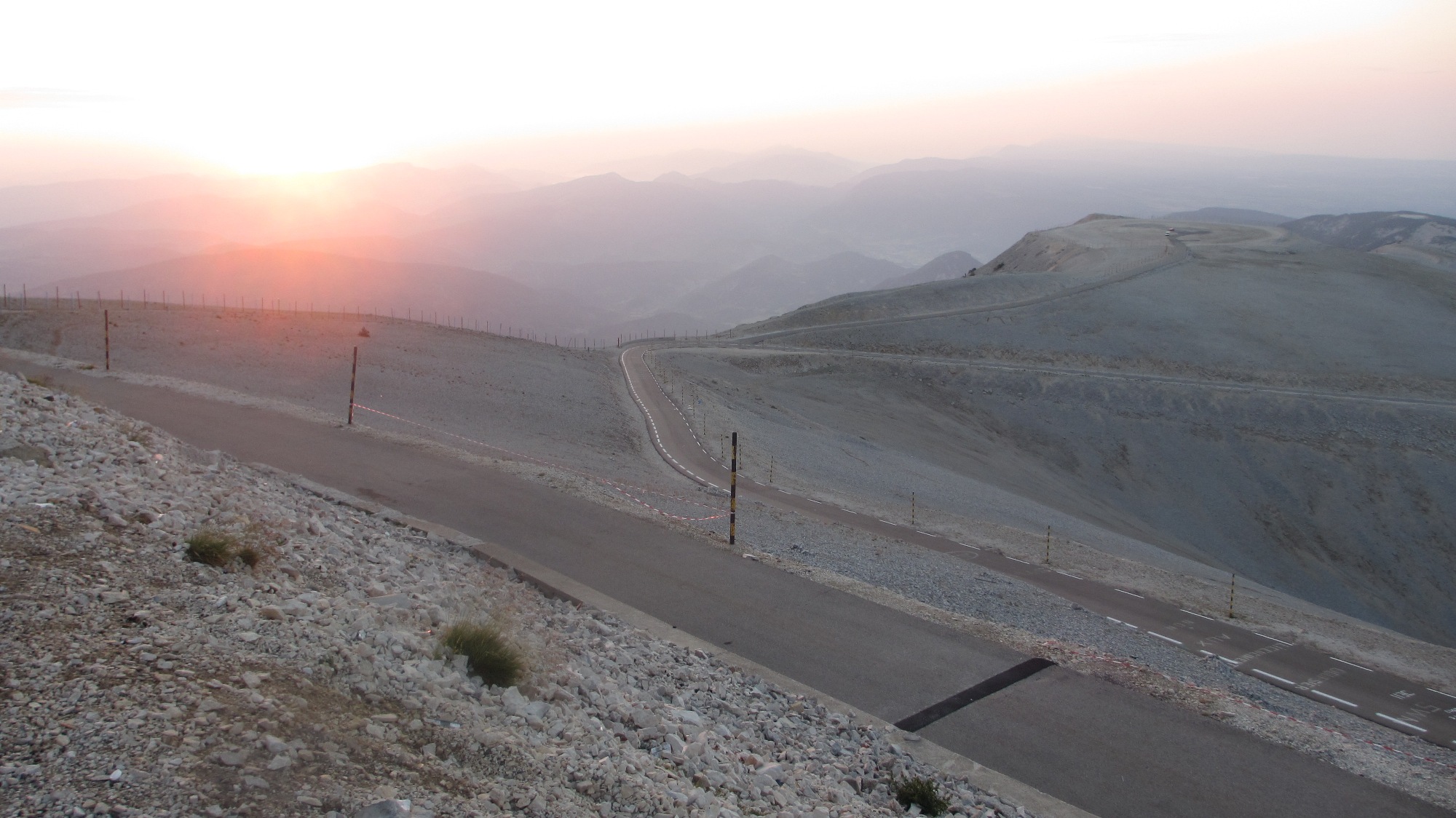
In road bicycle racing, the mountain can be climbed by three routes.
- From the South: climb starts in Bédoin: 1617 m over 21.8 km. This is regarded as the most difficult ascent, and is ranked by PJAMM Cycling as the 3rd most difficult bike climb in France. The road to the summit has an average gradient of 7.43%. Until Saint-Estève, the climb is 3.9% over 5.8 km, but the remaining 16 km has an average gradient of 8.9%. To serve as a comparison the climb of Alpe d'Huez is about 13.8 km at an average gradient of 7.9%. The last kilometres may have strong, violent winds. The ride takes to hours for trained amateur riders. Professional riders take 60 to 75 minutes. The fastest time so far recorded has been that of Tadej Pogacar in Stage 16 of the 2025 Tour de France: 53min 47s. The time was measured from Bédoin for the first time in the 1958 Tour de France, in which Charly Gaul was the fastest at 62 min 9 s.
- From the Northwest: climb starts in Malaucène: 1570 m over 21.5 km. About equal in difficulty as the Bédoin ascent, but better sheltered against the wind.
- From the East: climb starts in Sault: 1210 m over 26 km. The easiest route. After Chalet Reynard (where the "lunar landscape" of the summit starts), the climb is the same as the Bédoin ascent. Average gradient of 4.4%.
Every year there are amateur races to climb the mountain as quickly and often as possible in 24 hours, the Ventoux Masterseries and "Les Cinglés du Mont Ventoux". Cyclists can become a member of the Cinglés du Mont Ventoux Club by ascending all 3 sides of the mountain in a single day. Within this club there are other even more difficult challenges such as the Galériens which is 4 ascents in 24 hours of Ventoux including a forest path as the 4th ascent, the Bicinglés which is 6 ascents, all 3 sides twice in 24 hours and is 8800m of elevation which is roughly equivalent to the elevation of Mount Everest. Beyond this there are unofficial and extremely challenging variants such as the Tricinglés which is an extension of the bicinglés and is all 3 sides three times in 24 hours, total of 9 ascents of Ventoux in a single day. On 16 May 2006, Jean-Pascal Roux from Bédoin broke the record of climbs in 24 hours, with eleven climbs, all of them from Bédoin.
Tour de France
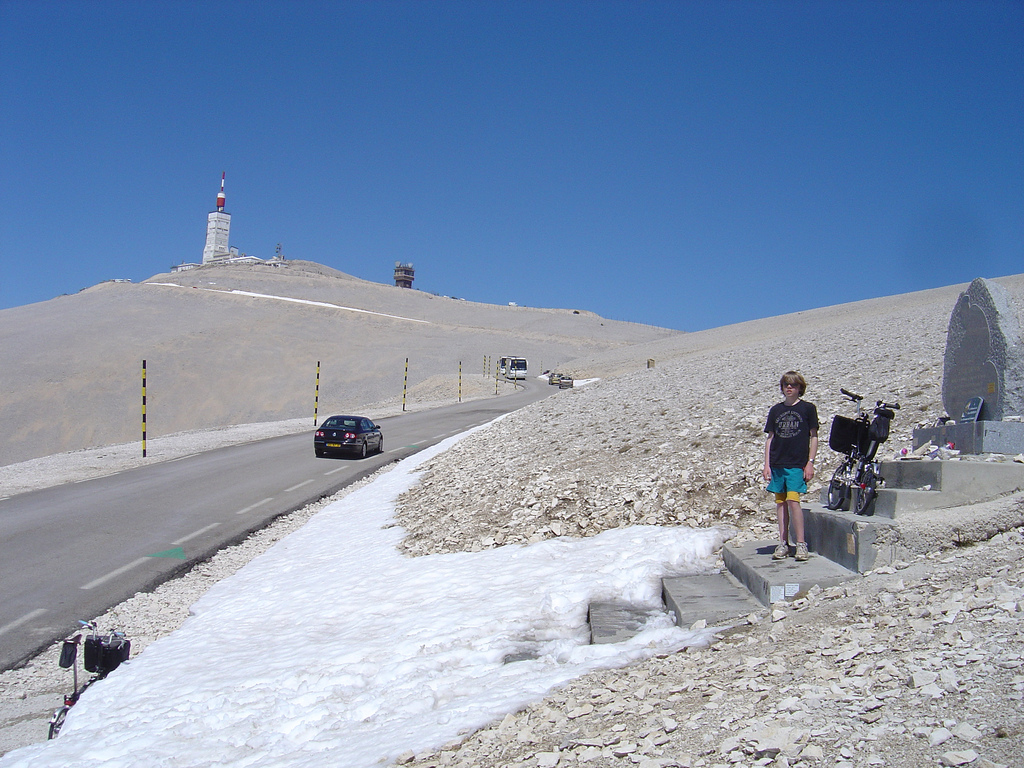
Mont Ventoux is the scene of one of the most grueling climbs in the Tour de France bicycle race, which has ascended the mountain eighteen times since 1951. The followed trail mostly passes through Bédoin. Its fame as a scene of great Tour dramas has made it a magnet for cyclists around the world.
British cyclist Tom Simpson died on the mountain on 13 July 1967 from heat exhaustion caused by a combination of factors, including dehydration (caused by lack of fluid intake and diarrhœa), use of amphetamines, and alcohol, although there is still speculation as to the exact cause of his death. He began to wildly weave across the road before he fell down. He was delirious and asked spectators to put him back on the bike, which he rode to within a kilometre of the summit before collapsing dead, still clipped into his pedals. Amphetamines were found in his jersey and bloodstream. There is a memorial to Simpson near the summit, which has become a shrine to fans of cycling, who often leave small tokens of remembrance there. In 1970, Eddy Merckx rode himself to the brink of collapse while winning the stage. He received oxygen, recovered, and won the Tour. In 1994, Eros Poli, not known for his climbing ability, stole away at the beginning of the day's stage, built up a substantial time gap from the peloton, and was first over the Ventoux and eventual stage winner despite losing a minute of his lead per kilometre of the ascent.
Tour de France stage finishes

The race has finished at the summit of Mont Ventoux ten times. The finish line is at 1910 m, although in 1965, 1967, 1972 and 1974 the finish was lower, at 1895 m.

In September 2008, it was announced by Claude Haut, the president of the Vaucluse province, that in 2009 the Tour de France would visit Mont Ventoux after a seven-year absence. Unusually, the riders climbed the mountain on the second-to-last day of the race, on 25 July 2009, prior to transferring to Paris for the traditional parade on the Champs-Élysées. It was next featured in the 100th Tour de France in 2013 on Stage 15.
In 2016, the stage to Mont Ventoux was shortened by 6 km the day before, after a weather forecast of high winds at the summit. The stage then finished at Chalet Reynard at 1435 m, with approximately 10 km of ascent up the mountain. This stage also featured a motorcycle-induced crash which damaged Chris Froome's bike, prompting him to jog some 100 metres up the mountain until he was able to get a neutral service bike (as his team car was too far back at the time), which did not fit him properly.
Stage 16 of the 2025 Tour de France ended at the summit of Mont Ventoux and was won by Frenchman Valentin Paret-Peintre.
:{| class="wikitable" style="text-align:center;"
| +Tour de France stages with summit finishes on Mont Ventoux |
|---|
| !Year |
| !Stage |
| !Start of stage |
| !Distance (km) |
| !Category |
| !Stage winner |
| !General classification leader |
| !Tour de France winner |
| - |
| 1958 |
| 18 |
| Bédoin |
| 21.5 (ITT) |
| 1 |
| - |
| 1965 |
| 14 |
| Montpellier |
| 173 |
| 1 |
| - |
| 1970 |
| 14 |
| Gap |
| 170 |
| 1 |
| - |
| 1972 |
| 11 |
| Carnon-Plage |
| 207 |
| 1 |
| - |
| 1987 |
| 18 |
| Carpentras |
| 36.5 (ITT) |
| HC |
| - |
| 2000 |
| 12 |
| Carpentras |
| 149 |
| HC |
| - |
| 2002 |
| 14 |
| Lodève |
| 221 |
| HC |
| - |
| 2009 |
| 20 |
| Montélimar |
| 167 |
| HC |
| - |
| 2013 |
| 15 |
| Givors |
| 242.5 |
| HC |
| - |
| 2016 |
| 12 |
| Montpellier |
| 178 |
| HC |
| - |
| 2025 |
| 16 |
| Montpellier |
| 171.5 |
| HC |
| } |
Other appearances in the Tour
The race has also crossed the summit eight times.
:{| class="wikitable" style="text-align:center;" |- !Year !Stage !Category !Start !Finish !Leader at the summit |- | 1951 | 18 | 1 | Montpellier
| Avignon |
|---|
| 1952 |
| 14 |
| 1 |
| Aix-en-Provence |
| Avignon |
| - |
| 1955 |
| 11 |
| 1 |
| Marseille |
| Avignon |
| - |
| 1967 |
| 13 |
| 1 |
| Marseille |
| Carpentras |
| - |
| 1974 |
| 12 |
| 1 |
| Savines-le-Lac |
| Orange |
| - |
| 1994 |
| 15 |
| HC |
| Montpellier |
| Carpentras |
| - |
| 1 |
| - |
| HC |
| } |
| In 1951, the approach to the summit was from Malaucène. In 2021, the first ascent was from Sault, whilst the second was from Bédoin. In all other years, the approach has been from Bédoin. |
Tour de France Femmes
Stage 7 of the 2026 Tour de France Femmes will end at the summit of Mont Ventoux.
Climb from Bédoin
The climb by bike from Bédoin to Mont Ventoux is one of the toughest in professional cycling. The figure for the average gradients per kilometre can be found in many books and websites on cycling. The average gradient of the total climb and also the average gradients per kilometre differ slightly, depending on the source of the information. Accurate measurements result in an average gradient for the total climb of 7.43%, based on a horizontal distance of 21.765 km and an ascent of 1617 m. The actual distance ridden is 21.825 km.
The average gradients in each kilometre are as follows:
:{| class="wikitable" style="text-align:center;" |- !Kilometre !Average gradient !Kilometre !Average gradient |- | 1 || 1.9% || 12 || 10.1% |- | 2 || 2.8% || 13 || 9.2% |- | 3 || 3.8% || 14 || 9.4% |- | 4 || 5.8% || 15 || 8.8% |- | 5 || 5.6% || 16 || 6.9% |- | 6 || 3.1% || 17 || 6.6% |- | 7 || 8.6% || 18 || 6.8% |- | 8 || 9.4% || 19 || 7.4% |- | 9 || 10.5% || 20 || 8.3% |- | 10 || 10.1% || 21 || 9.1% |- | 11 || 9.3% || 22 || 10.0% |}
Transcontinental Race
Mont Ventoux was used as the first checkpoint in the 2015 Transcontinental Race, which is a non-stop, unsupported bicycle race across Europe.
Skiing
There are two small ski stations on the mountain: "Mont Serein" on the north side, and "Chalet Reynard" on the south. High winds and the modest elevation tend to limit the ski season. Weather conditions are such that the northern slope is often icy, leading to a saying among people of the surrounding region regarding the challenges of skiing the mountain: Qui skie au Ventoux, skie partout (If you can ski Ventoux, you can ski anywhere).
References
References
- {{cite peakbagger
- (17 July 2013). "Ascending the "Beast"".
- (13 July 2013). "Taking on Mont Ventoux: The Giant of Provence that stands squarely in front of Britain's Chris Froome this weekend". Mirror.
- "Mont Ventoux".
- Moody, Ernest A.. "Jean Buridan". Dictionary of Scientific Biography.
- Kimmelman, Michael. (6 June 1999). "NOT Because it's There". [[New York Times]].
- Cassirer, Ernst. (January 1943). "Some Remarks on the Question of the Originality of the Renaissance". University of Pennsylvania Press.
- (August 1998). "Petrarch: The Ascent of Mount Ventoux". Fordham University.
- (6 November 1879). "Notes". Nature.
- "France - Top Bike Climbs". PJAMM Cycling Inc.
- [http://www.clubcinglesventoux.org/en/ Club des Cinglés du Mont-Ventoux]
- (16 May 2006). "Record de la montée du Ventoux en 24 heures : le live". Velo101.com.
- Peter Hymas. (13 July 2011). "Tour de France Gallery: Mont Ventoux". Future Publishing Limited.
- Barry Ryan. (6 July 2021). "Chris Froome returns to Mont Ventoux riding a different kind of Tour de France". Future Publishing Limited.
- Ryan, Barry. (13 July 2016). "Tour de France: Ventoux stage shortened due to risk of 100km/h winds". Cycling News.
- "Ventoux Looming on the Horizon".
This article was imported from Wikipedia and is available under the Creative Commons Attribution-ShareAlike 4.0 License. Content has been adapted to SurfDoc format. Original contributors can be found on the article history page.
Ask Mako anything about Mont Ventoux — get instant answers, deeper analysis, and related topics.
Research with MakoFree with your Surf account
Create a free account to save articles, ask Mako questions, and organize your research.
Sign up freeThis content may have been generated or modified by AI. CloudSurf Software LLC is not responsible for the accuracy, completeness, or reliability of AI-generated content. Always verify important information from primary sources.
Report