From Surf Wiki (app.surf) — the open knowledge base
Mons Meg
Famous medieval bombard

Famous medieval bombard
| Field | Value | |
|---|---|---|
| name | Mons Meg | |
| image | MonsMeg.JPG | |
| image_size | 300 | |
| caption | Mons Meg with its 175 kg cannon balls | |
| origin | Mons, Hainault, Wallonia | |
| type | Cannon | |
| <!-- Type selection --> | is_ranged | yes |
| is_bladed | no | |
| is_explosive | no | |
| is_artillery | yes | |
| is_vehicle | no | |
| is_missile | no | |
| is_UK | ||
| used_by | Kingdom of Scotland | |
| wars | ||
| designer | Jehan Cambier | |
| production_date | June 1449 | |
| variants | ||
| weight | 6.6 t | |
| length | 406 cm | |
| part_length | 280 cm | |
| diameter | 20 in | |
| crew | ||
| cartridge_weight | 175 kg | |
| sights |
Mons Meg is a medieval bombard in the collection of the Royal Armouries, on loan to Historic Environment Scotland and located at Edinburgh Castle in Scotland. It has a barrel diameter of 20 in, making it one of the largest cannons in the world by calibre.
Mons Meg was built in 1449 on the orders of Philip the Good, Duke of Burgundy, and sent by him as a gift to James II, King of Scots, in 1454. The bombard was employed in sieges until the middle of the 16th century, after which it was only fired on ceremonial occasions. In 1680 the barrel burst, rendering Mons Meg unusable. The gun remained in Edinburgh Castle until 1754 when, along with other unused weapons in Scotland, it was taken to the Tower of London. Sir Walter Scott and others campaigned for its return, which was effected in 1829. Mons Meg has since been restored and is now on display within the castle.
Construction
The bombard was manufactured from 25 longitudinal staves of iron, held together with iron hoops shrunk into place, to form one piece. A separate breech for loading is screw-fitted into the rear of the barrel. The barrel is attached to the powder chamber by means of a groove on the powder chamber into which lugs on the end of the barrel staves fit, and then bound permanently together by the hoops. The powder chamber itself is made from small pieces of iron hammer-welded together to make a solid wrought-iron forging. Mons Meg has a diameter of 19 in, one of the largest ever built, weighs 15366 lb and is 13 ft in length.
History


Mons Meg was constructed by Jehan Cambier, artillery maker to the Duke of Burgundy. It was tested at Mons in the County of Hainault in what is now Belgium, in June 1449; the duke did not take delivery of the Mons Meg until 1453. He gave the bombard to Scotland's King James II in 1457 as a sign of his support for the Scottish king, whose marriage he had helped negotiate.
An alternative legend about its manufacture is that it was built by a local blacksmith for the siege of Threave Castle in the Stewartry of Kirkcudbright. According to this tale, which was lent credence by Sir Walter Scott, when King James arrived at Threave to besiege the Earl of Douglas, the Clan MacLellan presented him with this bombard. The first shot fired is said to have passed clean through the castle, severing the hand of Margaret, Countess of Douglas, on the way. The gun was subsequently named after "Mollance", the lands given to the blacksmith for his service and "Meg", the name of his wife. Later historians have not taken this legend particularly seriously, not least because of the improbability that such a weapon could be forged by a village smith, as well as there being ample provenance showing its history.
The 20 in cannon accepted stone balls that weighed 175 kg. In April 1497, John Mawer elder, one of the castle gunners, made new wheels for Mons Meg and the bombards. The cannon was drawn down the Royal Mile to the sound of minstrels playing, placed on a new carriage or "cradle" and taken to assault Norham Castle in August 1497. Regent Albany brought Mons Meg to Stirling Castle in August 1515 to threaten Margaret Tudor, who kept her son James V of Scotland in the castle.
In early years the gun, like the other royal cannon, was painted with red lead to keep it from rusting, which cost 30 shillings in June 1539. From the 1540s Meg was retired from service and was fired only on ceremonial occasions from Edinburgh Castle. When it was fired on 3 July 1558, soldiers were paid to find and retrieve the shot from Wardie Muir, near the Firth of Forth, a distance of two miles. The salute marked the solemnisation of the marriage of Mary, Queen of Scots, to the French Dauphin.
The gun was fired on 30 October 1680 to celebrate a visit by James, Duke of Albany and York (later King James VII), but the barrel burst. An English cannoneer had loaded the charge and many Scots believed that the damage was done on purpose out of jealousy, because the English had no cannon as big as this. The incident was also seen as a bad omen for the future King.
The cannon was left outside Foog's Gate at Edinburgh Castle. It was next taken, with other disused ordnance, to the Tower of London in 1754, as a result of the disarming acts against Jacobites aimed at removing weapons or spare cannon from the reach of rebellious folk. It was returned to the castle in 1829 by order of George IV after a series of campaigns by Sir Walter Scott and the Society of Antiquaries of Scotland. Following a restoration, it sits outside St Margaret's Chapel. During Edinburgh's annual Hogmanay celebrations, Mons Meg is fired at the start of the firework display, although the effect is largely theatrical and the gun is not discharged.
Naming
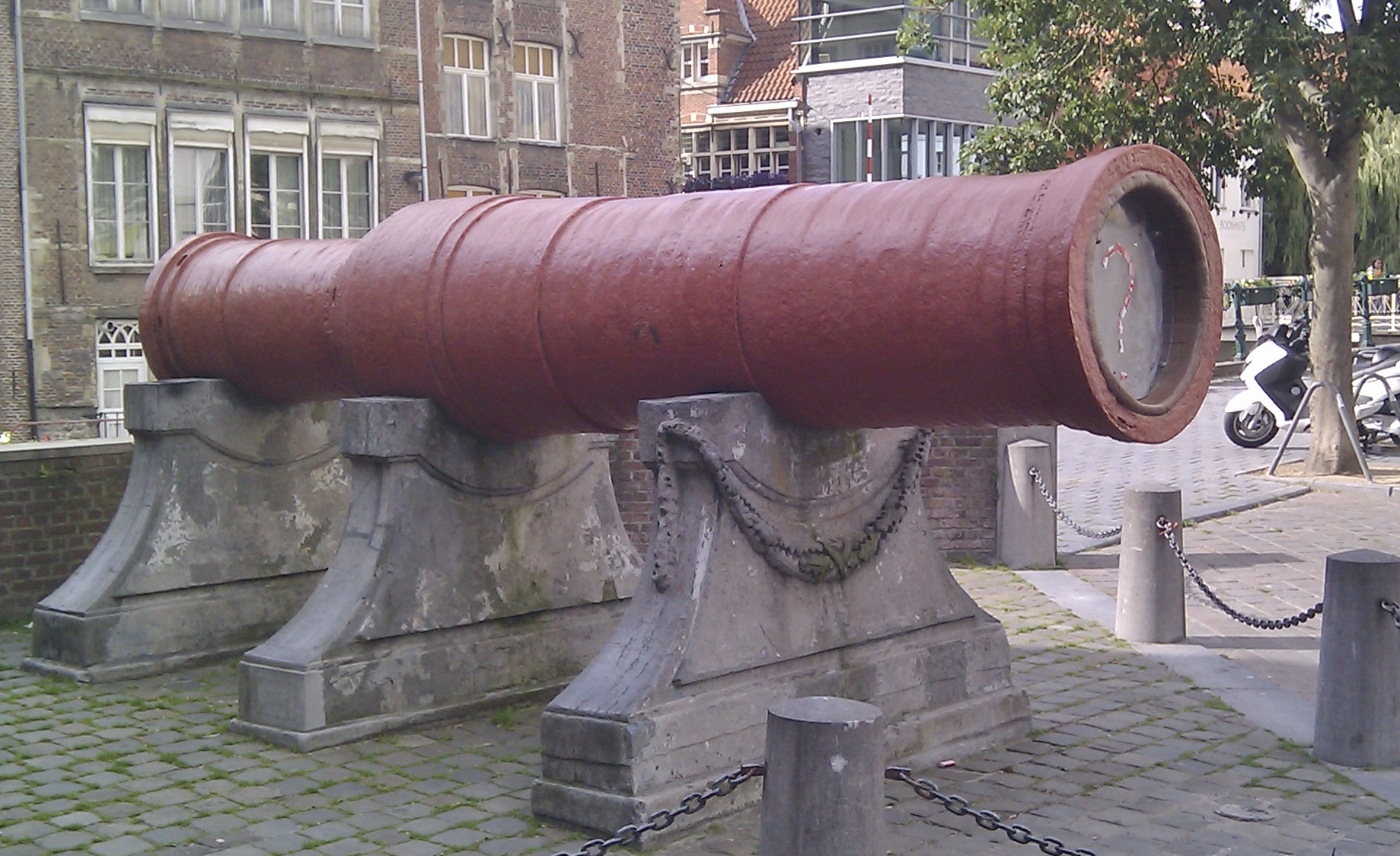
The gun is not called "Mons Meg" in any contemporary references until 1678. In 1489, she first appears in record as "Monss" and in the painter's account of 1539 she is called; "Monce in the castell", the only piece with an individual name. In 1650 she was noted as "Muckle Meg". "Meg" may either be a reference to Margaret of Denmark, queen of James III of Scotland, or simply an alliteration, while Mons was one of the locations where the cannon was tested. McKenzie records that this class of artillery was known as a murderer and Mons Meg was certainly described as such. Mons Meg was made in the town of Mons (now the Walloon French-speaking part of Belgium) or Bergen (in Dutch as in those days it was part of Flanders). Three cannons were founded: one resides in Edinburgh, one in the Flemish town of Ghent at the Friday Market, and one in France (but that one disappeared ages ago). The one in Ghent can be visited today, undamaged. The cannon is named "Dulle Griet" which translates into "Mad Meg".
Evolution of the carriage

For a while in its early days, the gun sat on a plain box without any wheels. Evidently, when Mons Meg was removed from Edinburgh Castle in 1754, its carriage had long since rotted away. A contemporary account describes her as lying "on the ground" near the innermost gate to the castle. Presumably the Ordnance Board fabricated a new carriage after her arrival at the Tower. In 1835, after the return of Mons Meg to Edinburgh Castle, the London-made carriage rotted away too and fabrication of a cast-iron replacement was undertaken; the new carriage weighed three-and-a-half tons and cost £53. Mons Meg is now mounted on a reproduction of the carriage depicted in a carving of 1500 on a wall of Edinburgh Castle, built in 1934 at a cost of £178 and paid for by the Lord Provost of Edinburgh.
References
Sources
- Gaier, Claude (1967) The Origin of Mons Meg. Journal of the Arms and Armour Society London V(12) 425–431
- Grose, Francis (1801) Military Antiquities respecting a History of the English Army from the Conquest to the Present Time. T. Egerton and G. Kearsley London, UK
- Hewitt, J (1853) Mons Meg the ancient bombard, preserved at Edinburgh castle. Archeological Journal 10 25–32
- Lead, Peter (1984) Mons Meg: A Royal Cannon. Mennock Publishing Cheshire, UK
- Lead, Peter (2021) Mons Meg - a symbol of Scotland. Catrine: Stenlake Publishing Ltd
- McKenzie, Agnes Mure (1948). Scottish Pageant 1513–1625. Edinburgh : Oliver & Boyd.
- Norris, John (2003) Early Gunpowder Artillery 1300–1600 Motorbooks International
- Paul, James Balfour, Sir (1915–1916) Ancient Artillery. With Some Notes on Mons Meg. Proceedings of the Society of Antiquaries of Scotland 50 191–201
- Sands, Kathleen (1999) Though one of the best-documented of medieval bombards, Mons Meg was the subject of exaggeration and legend Military History. 16(3) 22–23
- Scott, Walter, Sir (1817) Waverley Novels, Rob Roy (Notes G) Edinburgh
- {{citation
- Smith, Robert D and Brown, Ruth Rhynas Bombards- Mons Meg and her sisters Royal Armouries Monograph 1
References
- "Loans out". Royal Armouries.
- (1859). "Elementary Lectures on artillery". John Boddy.
- "Technique: Hoop and Band". [[Royal Armouries]].
- "Bombard and carriage—Mons Meg—1449". Royal Armouries.
- (1989). "Bombards: Mons Meg and her sisters". Royal Armouries.
- (April 2016). "The ballistic performance of the bombard Mons Meg". Defence Technology.
- Bradbury, Jim. (1992). "The Medieval Siege". Boydell & Brewer.
- "Edinburgh Castle, Mons Meg {{!}} Canmore".
- Morvern French & Roger Mason, 'Art, Artefacts, Artillery', Alexander Fleming & Roger Mason, ''Scotland and the Flemish People'' (John Donald, 2019), pp. 110-2.
- McGladdery, Christine. (2015). "James II". Birlinn Ltd.
- (1853). "The Ancient Bombard, Preserved at Edinburgh Castle". The Archaeological Journal.
- McGladdery, Christine. (2015). "James II". Birlinn Ltd.
- Thomas Dickson, ''Accounts of the Treasurer'', vol. 1 (Edinburgh, 1877), pp. 328, 347–350.
- J. S. Brewer, ''Letters and Papers, Henry VIII'', 2:1 (London, 1864), clxxix, 209 no. 788.
- ''Accounts of the Treasurer of Scotland'', vol. 7 (Edinburgh, 1907), 222.
- ''Accounts of the Lord High Treasurer of Scotland'', vol. 1 (Edinburgh, 1877), ccxxiii footnote; vol. 10 (Edinburgh, 1913), lxxv–lxxvi, 367.
- Chambers, Robert (1885). ''Domestic Annals of Scotland''. Edinburgh : W & R Chambers. p. 329.
- (3 February 2009). "'Shannon the Cannon' – Edinburgh's District Gunner". Ministry of Defence.
- ''Accounts of the Lord High Treasurer of Scotland'', vol. 1, Edinburgh (1877), ccxx–ccxxiii, 115.
- McKenzie, Page 319
- Blair, Claude (1967) "A New Carriage for Mons Meg" ''Journal of the Arms and Armour Society London'' V(12) pages 431–452
- Lead, Peter. (2021). "Mons Meg - a symbol of Scotland". Stenlake Publishing Ltd.
- (19 January 2015). "Mons Meg Cannon at Edinburgh Castle to have a 'MOT'".
This article was imported from Wikipedia and is available under the Creative Commons Attribution-ShareAlike 4.0 License. Content has been adapted to SurfDoc format. Original contributors can be found on the article history page.
Ask Mako anything about Mons Meg — get instant answers, deeper analysis, and related topics.
Research with MakoFree with your Surf account
Create a free account to save articles, ask Mako questions, and organize your research.
Sign up freeThis content may have been generated or modified by AI. CloudSurf Software LLC is not responsible for the accuracy, completeness, or reliability of AI-generated content. Always verify important information from primary sources.
Report