From Surf Wiki (app.surf) — the open knowledge base
Monitor lizard
Genus of reptiles

Genus of reptiles
- Euprepiosaurus
- Hapturosaurus
- Odatria
- Papusaurus
- Philippinosaurus
- Polydaedalus
- Psammosaurus
- Solomonsaurus
- Soterosaurus
- Varanus For species, see text Monitor lizards are lizards in the genus Varanus, the only extant genus in the family Varanidae. They are native to Africa, Asia, and Oceania, and one species is also found in the southern United States as an invasive species. About 80 species are recognized.
Monitor lizards have long necks, powerful tails and claws, and well-developed limbs. The adult length of extant species ranges from 20 cm in some species such as Varanus sparnus, to over 3 m in the case of the Komodo dragon, though the extinct megalania (Varanus priscus) may have reached lengths of more than 7 m. Most monitor species are terrestrial, but many are also arboreal or semiaquatic. While most monitor lizards are carnivorous, eating smaller reptiles, fish, birds, insects, small mammals, and eggs, a few species also eat fruit and vegetation.
Etymology
The generic name Varanus is derived from the Arabic word ورل waral (Standard Arabic, colloquially ورر [warar] or ورن [waran]), from a common Semitic root ouran, waran, warar or waral, meaning "lizard beast".
In English, they are known as "monitors" or "monitor lizards". The earlier term "monitory lizard" became rare by about 1920. The name may have been suggested by the occasional habit of varanids to stand on their two hind legs and to appear to "monitor", or perhaps from their supposed habit of "warning people of the approach of venomous animals". But all of these explanations for the name "monitor" postdate Linnaeus giving the scientific name Lacerta monitor to the Nile monitor in 1758, which may have been based on a mistaken idea by Linnaeus that the German word Waran (borrowed from Arabic) was connected to warnen (to warn), leading him to incorrectly Latinize it as monitor ('warner' or 'adviser').
Austronesian languages spoken across Southeast Asia, where varanids are common, have a large number of slightly related local names for them. They are usually known as biawak (Malay, including Indonesian standard variety), bayawak (Filipino), binjawak or minjawak or nyambik (Javanese), or variations thereof. Other names include hokai (Solomon Islands); bwo, puo, or soa (Maluku); halo (Cebu); galuf or kaluf (Micronesia and the Caroline Islands); batua or butaan (Luzon); alu (Bali); hora or ghora (Komodo group of islands); phut (Burmese); and guibang (Manobo).
In South Asia, they are known as mni in Meitei, mwpou in Boro, mr (घोरपड) in Marathi, ta (உடும்பு) in Tamil and udumbu (ഉടുമ്പ്) in Malayalam, bho in Bhojpuri, gohi (गोहि) in Maithili, in Sinhala as තලගොයා / කබරගොයා (si), in Telugu as uḍumu (ఉడుము), in Kannada as mni (ಉಡ), in Punjabi and Magahi as goh (गोह), in Assamese as gui xaap, in Odia as godhi (ଗୋଧି), and in Bengali as (bn) (গোসাপ) or (bn) (গুইসাপ), as goh (गोह) in Hindi, and godhā (गोधा) in Sanskrit.
The West African Nile monitor is known by several names in Yoruba, including yo, yo, and yo. In Serer and amongst the Wolofized Serers of Kaolack, it is known as mbossé (or mboose in Serer) or bar in Wolof (pronounced barrr with a long "R"). Mbossé is the tutelary and traditional totem of the city of Kaolack, (formerly part of the Serer precolonial Kingdom of Saloum, now part of modern-day Senegal). The mbossé is also one of the totems of the noble Joof family born of Guelwar matrilineage, which is one of the many Serer maternal clans. The mbossé or mbosseh (in Gambian English) is one of the Serer religious festivals, and should not be confused with the mythical and sacred tree mbos―enshrined in Serer religion and Serer cosmogony―where the mbossé (the lizard) takes its name.
Due to confusion with the large New World lizards of the family Iguanidae, the lizards became known as "goannas" in Australia. Similarly, in South African English, they are referred to as leguaans, or likkewaans, from the Dutch term for the Iguanidae, leguanen.
Distribution
The various species cover a vast area, occurring through Africa, the Indian subcontinent, to China, the Ryukyu Islands in southern Japan, south to Southeast Asia to Thailand, Malaysia, Brunei, Indonesia, the Philippines, New Guinea, Australia, and islands of the Indian Ocean and the South China Sea. They have also been introduced outside of their natural range, for instance, the West African Nile monitor is now found in South Florida. Monitor lizards also occurred widely in Europe in the Neogene, with the last known remains in the region dating to the Middle Pleistocene.
Habits and diet
Most monitor lizards are almost entirely carnivorous, consuming prey as varied as insects, crustaceans, arachnids, myriapods, molluscs, fish, amphibians, reptiles, birds, and mammals. Most species feed on invertebrates as juveniles and shift to feeding on vertebrates as adults. Deer make up about 50% of the diet of adult Komodo dragons, the largest monitor species. In contrast, three arboreal species from the Philippines, Varanus bitatawa, V. mabitang, and V. olivaceus, are primarily fruit eaters.
Biology
Monitor lizards are considered unique among animals in that its members are relatively morphologically conservative, yet show a very large size range. However, finer morphological features such as the shape of the skull and limbs do vary, and are strongly related to the ecology of each species.{{cite journal|doi= 10.1371/journal.pone.0130625 |article-number= e0130625 |doi-access= free
Like snakes, monitor lizards have highly forked tongues that act as part of the "smell" sense, where the tips of the tongue carry molecules from the environment to the a sensory organ in the skull called the Jacobson's organ. The forked apparatus allows for these lizards to sense boundaries in the molecules they collect, almost smelling in "stereo". While most reptiles possess taste buds, monitor lizards and likely snakes as well completely lack taste buds. Merten's water monitor, the most aquatically adapted monitor species, is uniquely capable of using its sense of smell underwater to locate and capture prey.
Monitor lizards are oviparous, laying from seven to 38 eggs, which they often cover with soil or protect in a hollow tree stump. Some species, including the Komodo dragon, are capable of parthenogenesis.
Venom
Anatomical and molecular studies indicate that most if not all varanids are venomous. Unlike snakes, monitor lizard venom glands are situated in their lower jaw. The venom of monitor lizards is diverse and complex, as a result of the diverse ecological niches monitor lizards occupy.
For example, many species have anticoagulant venom, disrupting clotting through a combination of fibrinogenolysis and blocking platelet aggregation. Amongst them, arboreal species, such as the tree monitors and the banded monitor, have by far the strongest fibrinogenolytic venom. As a result, wounds from monitor lizard bites often bleed more than they would if they were simply lacerations. Venom may also cause hypotension.
In some species such as the Komodo dragon and the desert monitor, venom also induces a powerful neurotoxic effect. In the latter species for instance, envenomation causes immediate paralysis in rodents (but not birds) and lesser effects of the same nature in humans.
Metabolism
Monitor lizards maintain large territories and employ active-pursuit hunting techniques that are reminiscent of similar-sized mammals. The highly active nature of monitor lizards has led to numerous studies on the metabolic capacities of these lizards. The general consensus is that monitor lizards have the highest standard metabolic rates of all extant reptiles.
Monitor lizards have a high aerobic scope that is afforded, in part, by their heart anatomy. Whereas most reptiles are considered to have three-chambered hearts, the hearts of monitor lizards – as with those of boas and pythons – have a well developed ventricular septum that completely separates the pulmonary and systemic sides of the circulatory system during systole. This allows monitor lizards to create mammalian-equivalent pressure differentials between the pulmonary and systemic circuits, which in turn ensure that oxygenated blood is quickly distributed to the body without also flooding the lungs with high-pressure blood.
Intelligence

At least some species of monitors are known to be able to count; studies feeding rock monitors varying numbers of snails showed that they can distinguish numbers up to six. Nile monitors have been observed to cooperate when foraging; one animal lures the female crocodile away from her nest, while the other opens the nest to feed on the eggs. The decoy then returns to also feed on the eggs. Komodo dragons at the National Zoo in Washington, DC, recognize their keepers and seem to have distinct personalities. Blue and green tree monitors in British zoos have been observed shredding leaves, apparently as a form of play.
Human uses
As pets
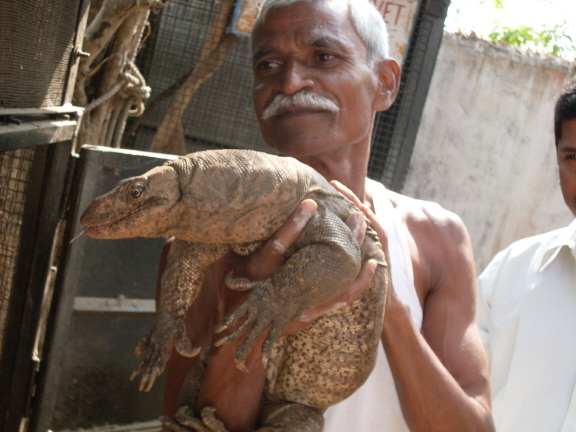
Monitor lizards have become a staple in the reptile pet trade. The most commonly kept monitors are the savannah monitor and Ackie dwarf monitor, due to their relatively small size, low cost, and relatively calm dispositions with regular handling. Among others, black-throated, Timor, Asian water, Nile, mangrove, emerald tree, black tree, roughneck, Dumeril's, peach-throated, crocodile, and Argus monitors have been kept in captivity.
Traditional medicines
Monitor lizards are poached in some South- and Southeast Asian countries, as their organs and fat are used in some traditional medicines, although there is no scientific evidence as to their effectiveness.

The dried and dyed hemipenes of Bengal monitors, and less often yellow and water monitors, are frequently trafficked and illegally sold in India and online under the deceptive term 'Hatha Jodi', where it is claimed to be the root of a supposed rare Himalayan plant in order to fool buyers and retailers, and to disguise the trade from wildlife authorities. Sellers advertise 'Hatha Jodi' as having the tantric power to bring wealth, power and contentment. A pair of hemipenes may sell at a value of up to US$250. In India, the body oil of monitor lizards is sold for thousands of Indian rupees to residents in metropolitan cities as a treatment for rheumatism.
Monitor lizard meat, particularly the tongue and liver, is eaten in parts of India and Malaysia and is supposed to be an aphrodisiac.
Consuming raw blood and flesh of monitor lizards has been reported to cause eosinophilic meningoencephalitis, as some monitors are hosts for the parasitic nematode Angiostrongylus cantonensis.
Leather
"Large-scale exploitation" of monitor lizards is undertaken for their skins, which are described as being "of considerable utility" in the leather industry. In Papua New Guinea, monitor lizard leather is used for membranes in traditional drums (called kundu), and these lizards are referred to as kundu palai or "drum lizard" in Tok Pisin, the main Papuan trade language. Monitor lizard skins are prized in making the resonant part of serjas (Bodo folk sarangis) and dotaras (native strummed string instruments of Assam, Bengal and other eastern states). The leather is also used in making a Carnatic music percussion instrument called the kanjira.
Food
The meat of monitor lizards is eaten by some tribes in India, Nepal, the Philippines, Australia, South Africa, and West Africa as a supplemental meat source. Both meat and eggs are also eaten in Southeast Asian countries such as Vietnam and Thailand as a delicacy.
Conservation
According to IUCN Red List of threatened species, most of the monitor lizards species fall in the categories of least concern, but the population is decreasing globally. All but five species of monitor lizards are classified by the Convention on International Trade in Endangered Species of Wild Fauna and Flora under Appendix II, which is loosely defined as species that are not necessarily threatened with extinction but may become so unless trade in such species is subject to strict regulation to avoid use incompatible with the survival of the species in the wild. The remaining five species – the Bengal, yellow, desert, and clouded monitors and the Komodo Dragon– are classified under CITES Appendix I, which outlaws international commercial trade in the species.{{Cite web |access-date=2011-09-28 |archive-date=2016-04-12 |archive-url=https://web.archive.org/web/20160412165446/http://www.asean-wen.org/index.php?option=com_docman&Itemid=80
The yellow monitor is protected in all countries in its range except Bhutan, Nepal, India, Pakistan, and Bangladesh.
In Kerala, Andhra Pradesh, Karnataka, Telangana and all other parts of South India, catching or killing of monitor lizards is banned under the Protected Species Act.
Evolution
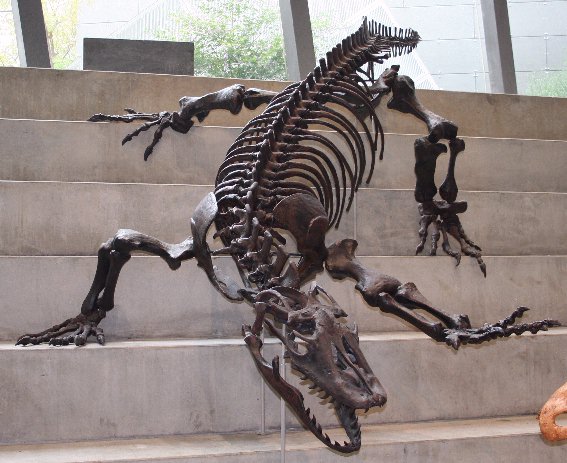
Varanus is the only living genus of the family Varanidae. Varanids last shared a common ancestor with their closest living relatives, earless "monitors", during the Late Cretaceous. The oldest known varanids are from the Late Cretaceous of Mongolia. During the Eocene, the varanid Saniwa occurred in North America. The closest known relative of Varanus is Archaeovaranus from the Eocene of China, suggesting that the genus Varanus is of Asian origin. The oldest fossils of Varanus date to the early Miocene.
Many of the species within the various subgenera also form species complexes with each other:
Euprepriosaurus
-
V. indicus species complex (V. indicus, V. cerambonensis, V. caerulivirens, V. colei, V. obor, V. lirugensis, V. rainerguentheri, V. zugorum)
-
V. doreanus species complex (V. doreanus, V. finschi, V. semotus, V. yuwonoi)
-
V. jobiensis species complex (V. jobiensis) Odatria
-
V. acanthurus species complex (V. acanthurus, V. baritji, V. primordius, V. storri)
-
V. timorensis species complex (V. timorensis, V. auffenbergi, V. scalaris, V. similis, V. tristis) Varanus
-
V. gouldii species complex (V. gouldii, V. rosenbergi, V. panoptes) Polydaedalus
-
V. exanthematicus species complex (V. exanthematicus, V. albigularis, V. yemenensis)
-
V. niloticus species complex (V. niloticus, V. stellatus) Empagusia
-
V. bengalensis species complex (V. bengalensis, V. nebulosus) Soterosaurus
-
V. salvator species complex (V. salvator, V. cumingi, V. nuchalis, V. togianus, V. marmoratus)
The tree monitors of the V. prasinus species complex (V. prasinus, V. beccarii, V. boehmei, V. bogerti, V. keithhornei, V. kordensis, V. macraei, V. reisingeri, V. telenesetes) were once in the subgenus Euprepriosaurus, but as of 2016, form their own subgenus Hapturosaurus.
V. jobiensis was once considered to be a member of the V. indicus species complex, but is now considered to represent its own species complex.
| [[File:Varanus phylogeny as of Brennan et al 2020 (UPDATE 5).jpg | frameless | 647x647px]] |
|---|
Taxonomy

_(Photo_by_Xavier_MALLERET)_(24237560651).jpg)
'*Genus *Varanus'''''
:Species marked with are extinct
- **V. bolkayi
- **V. darevskii
- V. emeritus (=V. salvadorii?)
- **V. hooijeri
- **V. hofmanni
- **V. lungui
- **V. marathonensis
- **V. mokrensis
- **V. pronini
- **V. rusingensis
- **V. semjonovi
- **V. sivalensis
- V. tyrasiensis (=V. hofmanni?)
Subgenus Empagusia:

- V. bengalensis, Bengal monitor
- V. dumerilii, Dumeril's monitor, brown roughneck monitor
- V. flavescens, golden monitor, yellow monitor, short-toed monitor
- V. nebulosus, clouded monitor

Subgenus Euprepiosaurus:
- V. bennetti, Bennett's long-tailed monitor
- V. caerulivirens, turquoise monitor
- V. cerambonensis, Ceram monitor
- V. colei Kei Islands monitor
- V. doreanus, blue-tailed monitor
- V. douarrha, New Ireland monitor
- V. finschi, Finsch's monitor
- V. indicus, mangrove monitor
- V. jobiensis, peach-throated monitor
- V. juxtindicus, Rennell Island monitor
- V. lirungensis, Talaud mangrove monitor
- V. louisiadensis, Louisiade monitor
- V. melinus, quince monitor
- V. obor, sago monitor
- V. rainerguentheri Rainer Günther's monitor
- V. semotus, Mussau Island blue-tailed monitor
- V. tanimbar, Tanimbar monitor
- V. tsukamotoi, Mariana monitor
- V. yuwonoi black-backed mangrove monitor, tricolor monitor
- V. zugorum, silver monitor, Zug's monitor

Subgenus Hapturosaurus:
- V. beccarii, black tree monitor
- V. boehmei, golden-spotted tree monitor
- V. bogerti, Bogert's monitor
- V. keithhornei, canopy goanna, blue-nosed tree monitor, Nesbit River monitor
- V. kordensis, Biak tree monitor
- V. macraei, blue-spotted tree monitor
- V. prasinus, emerald tree monitor
- V. reisingeri yellow tree monitor
- V. telenesetes, mysterious tree monitor, Rossell tree monitor


Subgenus Odatria:
- V. acanthurus, spiny-tailed monitor, ridge-tailed monitor, Ackie's dwarf monitor
- V. a. acanthurus, spiny-tailed monitor
- V. a. brachyurus, common spiny-tailed monitor
- V. auffenbergi, Auffenberg's monitor, peacock monitor
- V. brevicauda, short-tailed monitor
- V. bushi, Pilbara stripe-tailed monitor, Bush's monitor
- V. caudolineatus, stripe-tailed monitor
- V. citrinus, Gulf ridge-tailed monitor
- V. eremius, rusty desert monitor, pygmy desert monitor
- V. gilleni, pygmy mulga monitor
- V. glauerti, Kimberley rock monitor
- V. glebopalma, twilight monitor, black-palmed rock monitor
- V. hamersleyensis, Hamersley Range rock monitor
- V. insulanicus, Groote Eylandt monitor
- V. i. baritji, black-spotted ridge-tailed monitor
- V. kingorum, Kings' rock monitor
- V. mitchelli, Mitchell's water monitor
- V. ocreatus, Storr's monitor
- V. pilbarensis, Pilbara rock monitor
- V. primordius northern blunt-spined monitor
- V. scalaris, banded tree monitor
- V. semiremex rusty monitor
- V. similis, Similis monitor, spotted tree monitor
- V. sparnus, Dampier Peninsula monitor
- V. storri, eastern Storr's monitor
- V. timorensis, Timor monitor
- V. tristis
- V. t. tristis, black-headed monitor
- V. t. orientalis, freckled monitor
Subgenus Papusaurus
- V. salvadorii, crocodile monitor
Subgenus Philippinosaurus:
- V. bitatawa, northern Sierra Madre forest monitor, butikaw, bitatawa
- V. mabitang, Panay monitor, mabitang
- V. olivaceus, Gray's monitor, butaan
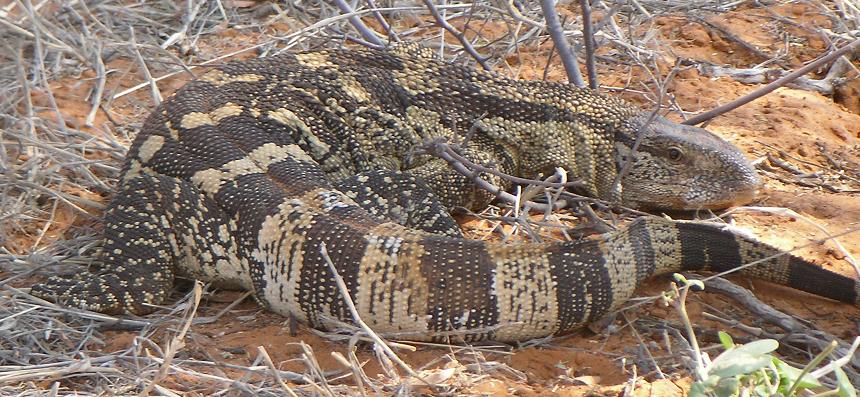

Subgenus Polydaedalus:
- V. albigularis, rock monitor, white-throated monitor
- V. a. albigularis, white-throated monitor
- V. a. angolensis, Angolan monitor
- V. a. microstictus, black-throated monitor
- V. exanthematicus, savannah monitor, Bosc's monitor
- V. niloticus, Nile monitor
- V. stellatus, West African Nile monitor
- V. ornatus, ornate monitor
- V. yemenensis, Yemen monitor

.jpg)
Subgenus Psammosaurus:
- V. griseus, desert monitor
- V. g. griseus, desert monitor, grey monitor
- V. g. caspius, Caspian monitor
- V. g. koniecznyi, Indian desert monitor, Thar desert monitor
- V. nesterovi, Nesterov's desert monitor
Subgenus Solomonsaurus:
- V. spinulosus, spiny-necked mangrove monitor, Solomon Islands spiny monitor

Subgenus Soterosaurus:
- V. bangonorum, Bangon monitor
- V. cumingi, Cuming's water monitor, yellow-headed water monitor
- V. dalubhasa, Enteng's monitor
- V. marmoratus, marbled water monitor, Philippine water monitor
- V. nuchalis large-scaled water monitor
- V. palawanensis, Palawan water monitor
- V. rasmusseni Rasmussen's water monitor
- V. rudicollis, black roughneck monitor
- V. salvator, Asian water monitor
- V. s. salvator, Sri Lankan water monitor
- V. s. andamanensis, Andaman water monitor
- V. s. bivittatus, two-striped water monitor, Javan water monitor
- V. s. macromaculatus, Southeast Asian water monitor
- V. s. ziegleri, Ziegler's water monitor
- V. samarensis, Samar water monitor
- V. togianus, Togian water monitor
.jpg)
Subgenus Varanus:
- V. giganteus, perentie
- V. gouldii, Gould's monitor, sand monitor, sand goanna
- V. komodoensis, Komodo dragon
- V. mertensi, Mertens' monitor
- V. panoptes
- V. p. panoptes, Argus monitor
- V. p. horni, Horn's monitor
- V. p. rubidus, yellow-spotted monitor
- **V. priscus, megalania
- V. rosenbergi, Rosenberg's monitor, heath monitor
- V. spenceri, Spencer's monitor
- V. varius, lace monitor
References
References
- (2023-05-23). "Monitor {{!}} lizard {{!}} Britannica".
- Bauer, Aaron M.. (1998). "Encyclopedia of Reptiles and Amphibians". Academic Press.
- Robert George Sprackland. (1992). "Giant lizards". T.F.H. Publications.
- [https://books.google.com/ngrams/graph?content=monitory+lizard%2F%28monitory+lizard%2Bmonitor+lizard%29&year_start=1800&year_end=2000&corpus=15&smoothing=3&share=&direct_url=t1%3B%2C%28monitory%20lizard%20/%20%28monitory%20lizard%20%2B%20monitor%20lizard%29%29%3B%2Cc0 Google ngrams]
- [[Horatio Nelson]], Matthew Henry Barker, ''The Life of Nelson Revised and Illustrated. With Original Anecdotes, Notes, Etc. By the Old Sailor'', 1836 [https://books.google.com/books?id=PapWAAAAcAAJ&pg=PA35 p. 35]
- Heinrich Zimmern. (1915). "Akkadische Fremdwörter als Beweis für babylonischen Kultureinfluss". Universität Leipzig.
- (2010). "*''bayawak'': monitor lizard, ''Varanus'' spp. (esp. ''V. salvator'')". Max Planck Institute for Evolutionary Anthropology.
- Mark K. Bayless. (2004). "The local names of Pacific monitor lizards (Sauria: Varanidae) of Oceania & Indo-Malaysia, excluding Australia". Micronesia.
- [[Maren Gaulke]]. (1992). "Taxonomy and biology of Philippine water monitors (''Varanus salvator'')". The Philippine Journal of Science.
- (1966). "A comparative dictionary of the Indo-Aryan languages". Oxford university press.
- Kesteloot, Lilyan, ''Dieux d'eau du Sahel: Voyage à travers les mythes de Seth à Tyamaba.'' Editions L'Harmattan, 2007, p. 11, {{ISBN
- (1999). "Histoire d'Afrique: les enjeux de mémoire". Karthala.
- [[Cheikh Anta Diop. Diop, Cheikh Anta]], ''The Cultural Unity of Black Africa: The Domains of Patriarchy and of Matriarchy in Classical Antiquity.'' Third World Press, 1978, p. 190, {{ISBN. 9780883780497
- {{in lang. fr Niang, Mor Sadio, [in] ''Ethiopiques'' numéro 31" - révue socialiste de culture négro-africaine 3e trimestre, [[Institut Fondamental d'Afrique Noire. IFAN]], (1982) [http://ethiopiques.refer.sn/spip.php?article905] {{Webarchive. link. (24 December 2013.)
- Yong, Ed. (20 April 2016). "Florida's Dragon Problem".
- (4 March 2017). "The last European varanid: demise and extinction of monitor lizards (Squamata, Varanidae) from Europe". Journal of Vertebrate Paleontology.
- (2004). "Varanoid Lizards of the World". Indiana University Press.
- (1981). "The Behavioral Ecology of the Komodo Monitor". University Press of Florida.
- Greene, Harry W.. (1986). "Diet and Arboreality in the Emerald Monitor, Varanus Prasinus, with Comments on the Study of Adaptation". Field Museum of Natural History.
- (2010). "A spectacular new Philippine monitor lizard reveals a hidden biogeographic boundary and a novel flagship species for conservation". Biology Letters.
- (2002). "Tracing the diet of the monitor lizard Varanus mabitang by stable isotope analyses (d15N, d13C)". Naturwissenschaften.
- Pianka, E.R.. (1995). "Evolution of Body Size: Varanid Lizards as a Model System". The American Naturalist.
- (2009). "Evolutionary relationships of sprint speed in Australian varanid lizards". Journal of Zoology.
- Sack, Jeffrey D.. (2022-08-01). "True Facts: Snake and Lizard Tongues". The American Biology Teacher.
- (2017-07-11). "Gross Morphological Structure of Digestive System in Water Monitor Lizard Varanus salvator (Squamata: Varanidae)". Walailak Journal of Science and Technology.
- Young, Bruce A.. (1997). "On the Absence of Taste Buds in Monitor Lizards (Varanus) and Snakes". Journal of Herpetology.
- (2005). "Diet and foraging behaviour of the semi-aquatic Varanus mertensi (Reptilia:Varanidae)". Wildlife Research.
- https://indonesiaindonesia.com/f/37477-sejarah-pulau-komodo/ (in [[Indonesian language. Indonesian]])
- Smith, Kerri. (2006). "Dragon virgin births startle zoo keepers". Nature.
- (May 2019). "Varanid Lizard Venoms Disrupt the Clotting Ability of Human Fibrinogen through Destructive Cleavage". Toxins.
- Zima, Yuliya. (December 2019). "On the Toxicity of the Bite of the Caspian Gray Monitor Lizard (Varanus griseus caspius)". Biawak.
- King, D., Green, B., Knight, F. (1999). ''Monitors: The Biology of Varanid Lizards.'' Florida. Krieger Publishing Company.
- Pianka, E.R., Vitt, L.J. (2003). ''Lizards: Windows to the Evolution of Diversity.'' California. University of California Press.
- (1978). "Aerobic Metabolism of the Lizard ''Varanus exanthematicus'': Effects of Activity, Temperature, and Size". Journal of Comparative Physiology B.
- (2003). "Ventricular Haemodynamics in ''Python molurus'': Separation of Pulmonary and Systemic Pressures". The Journal of Experimental Biology.
- King, Dennis & Green, Brian. 1999. ''Goannas: The Biology of Varanid Lizards''. University of New South Wales Press. {{ISBN. 0-86840-456-X, p. 43.
- Pianka, E.R.; King, D.R. and King, R.A. (2004). ''Varanoid Lizards of the World.'' Indiana University Press.
- (2019). "Play behaviour by captive tree monitors, Varanus macraei and Varanus prasinus". Herpetological Bulletin.
- (7 July 2017). "How Lizard Genitalia Became a Black Market Craze".
- (4 July 2017). "Visakhapatnam: Monsoon activates monitor lizard poaching".
- (2018). "What's in a name? Wildlife traders evade authorities using code words". Oryx.
- (2018). "Hatha Jodi: An Illegal Trade of Misused Scientific Facts or Blindfolded Myths and Beliefs?". Biawak.
- (2006). "Case series of eosinophilic meningoencephalitis from South India". Annals of Indian Academy of Neurology.
- [http://themalaysianlife.blogspot.com/2009/04/eating-biawak.html Eating Biawak]. The Malaysian Life (April 2009)
- (2017-01-08). "Meats We Also Eat". The Telegraph India.
- (2014). "Protected species outside the protected areas: People's attitude, threats and conservation of the Yellow Monitor (''Varanus flavescens'') in the Far-western Lowlands of Nepal". Journal for Nature Conservation.
- Side, Sonny. (5 June 2019). "Eating a DINOSAUR in Asia!!! RARE Mekong Delta Food you will only find here!".
- (2014). "Status and habitat ecology of the Yellow Monitor, ''Varanus flavescens'', in the Southeastern part of Kanchanpur District, Nepal". Herpetological Conservation and Biology.
- (2022-03-28). "A new stem-varanid lizard (Reptilia, Squamata) from the early Eocene of China". Philosophical Transactions of the Royal Society B: Biological Sciences.
- (1997-03-07). "Recommendations of the Nomenclature Committee".
- Böhme, Wolfgang. (2019-11-23). "The Kei Islands Monitor Lizard (Squamata: Varanidae: Varanus: Euprepiosaurus) as a Distinct Morphological, Taxonomic, and Conservation Unit". Russian Journal of Herpetology.
- BÖHME, WOLFGANG. (2003). "Checklist of the living lizards of the world (family Varanidae)". Zool. Verh. Leiden.
- Koch, Andre. (2010). "Updated checklist of the living monitor lizards of the world (Squamata: Varanidae)". Bonn Zoological Bulletin.
- Koch, Andre. (2010-05-06). "Unravelling The Underestimated Diversity Of Philippine Water Monitor Lizards (Squamata: Varanus Salvator Complex), With The Description Of Two New Species And A New Subspecies". Zootaxa.
- Mendyk, Robert. (2018). "An Annotated Bibliography of Captive Reproduction in Monitor Lizards (Varanidae: Varanus). Part III. Soterosaurus". Biawak.
- Weijola, Valter. (2019-03-14). "A molecular phylogeny for the Pacific monitor lizards (Varanus subgenus Euprepiosaurus) reveals a recent and rapid radiation with high levels of cryptic diversity". Zoological Journal of the Linnean Society.
- (2021). "Phylogenomics of Monitor Lizards and the Role of Competition in Dictating Body Size Disparity". Systematic Biology.
- Molnar, Ralph E.. (2004). "Varanoid Lizards of the World". Indiana University Press.
- (2004). "Varanoid Lizards of the World". Indiana University Press.
- (2018-12-05). "Revision of Varanus marathonensis (Squamata, Varanidae) based on historical and new material: morphology, systematics, and paleobiogeography of the European monitor lizards". PLOS ONE.
- (2018-07-15). "A new species of Varanus (Anguimorpha: Varanidae) from the early Miocene of the Czech Republic, and its relationships and palaeoecology". Journal of Systematic Palaeontology.
- [[:fr:Thomas Ziegler (zoologiste). Ziegler, Thomas]]; [[:fr:Andreas Schmitz. Schmitz, Andreas]]; Koch, Andre; [[:de:Wolfgang Böhme (Zoologe). Böhme, Wolfgang]] (2007). "A review of the subgenus ''Euprepiosaurus'' of ''Varanus'' (Squamata: Varanidae): morphological and molecular phylogeny, distribution and zoogeography, with an identification key for the members of the ''V. indicus'' and the ''V. prasimus'' species groups". ''Zootaxa'' '''1472''': 1-28.
- (2020). "Taxonomy of Micronesian monitors (Reptilia: Squamata: Varanus): endemic status of new species argues for caution in pursuing eradication plans". Royal Society Open Science.
- (2023). "Two new species of monitor lizards (Squamata: ''Varanus'') endemic to the Louisiade and Tanimbar archipelagos". Journal of Natural History.
- (2010). "A new melanistic species of monitor lizard (Reptilia: Squamata: Varanidae) from Sanana Island, Indonesia". Zootaxa.
- (2016). "A new blue-tailed Monitor lizard (Reptilia, Squamata, Varanus) of the Varanus indicus group from Mussau Island, Papua New Guinea". ZooKeys.
- [http://reptile-database.reptarium.cz/species?genus=Varanus&species=keithhornei&search_param=%28%28genus%3D%27Varanus%27%2Cexact%29%29 ''Varanus keithhornei''], The Reptile Database
- [http://reptile-database.reptarium.cz/species?genus=Varanus&species=prasinus&search_param=%28%28genus%3D%27Varanus%27%2Cexact%29%29 ''Varanus prasinus''], The Reptile Database
- Eidenmüller, Bernd; Wicker, Rudolf (2005). "''Eine weitere neue Waranart aus dem'' Varanus prasinus-''Komplex von den Insel Misol, Indonesian'' ". ''Sauria'' '''27''' (1): 3-8. (''Varanus reisingeri'', new species). (in German).
- (2022-08-01). "Between a rock and a dry place: phylogenomics, biogeography, and systematics of ridge-tailed monitors (Squamata: Varanidae: Varanus acanthurus complex)". Molecular Phylogenetics and Evolution.
- Bucklitsch, Yannick. (2016-08-17). "Scale Morphology and Micro-Structure of Monitor Lizards (Squamata: Varanidae: Varanus spp.) and their Allies: Implications for Systematics, Ecology, and Conservation". Zootaxa.
- Brendan M. Lynch. (2015-01-12). "Undercover researchers expose two new species of lizard for sale on Philippine black market". KU {{!.
- Koch, André; Gaulke, Maren; Böhme, Wolfgang (2010). "Unravelling the underestimated diversity of Philippine water monitor Lizards (Squamata: ''Varanus salvator'' complex), with description of two new species and a new subspecies". ''Zootaxa'' '''2446''': 1-54. (''Varanus rasmusseni'', new species, p. 28).
- [http://reptile-database.reptarium.cz/species?genus=Varanus&species=rasmusseni&search_param=%28%28genus%3D%27Varanus%27%29%28species%3D%27rasmusseni%27%29%29 ''Varanus rasmusseni''], The Reptile Database
This article was imported from Wikipedia and is available under the Creative Commons Attribution-ShareAlike 4.0 License. Content has been adapted to SurfDoc format. Original contributors can be found on the article history page.
Ask Mako anything about Monitor lizard — get instant answers, deeper analysis, and related topics.
Research with MakoFree with your Surf account
Create a free account to save articles, ask Mako questions, and organize your research.
Sign up freeThis content may have been generated or modified by AI. CloudSurf Software LLC is not responsible for the accuracy, completeness, or reliability of AI-generated content. Always verify important information from primary sources.
Report