From Surf Wiki (app.surf) — the open knowledge base
Mongolian death worm
Legendary creature in the Gobi Desert
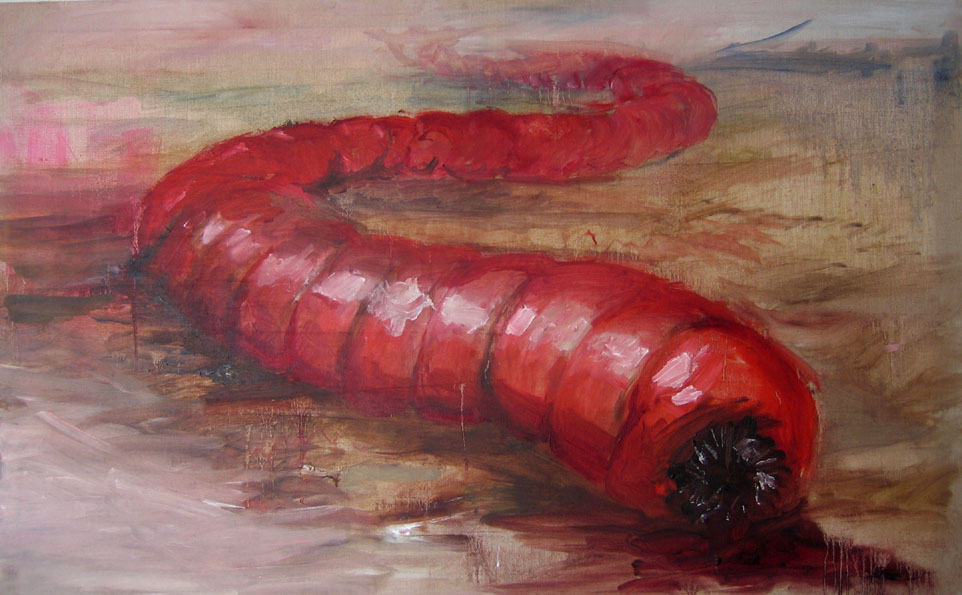
Legendary creature in the Gobi Desert
.JPG)
The Mongolian death worm (, olgoi-khorkhoi, "large intestine-worm") is a creature alleged to exist in the Gobi Desert. Investigations into the legendary creature have been pursued by amateur cryptozoologists and credentialed academics alike, but little evidence has been found to support its existence. It can be considered a cryptid or a mythological animal.
Tales of the creature first came to Western attention as a result of Roy Chapman Andrews's 1926 book On the Trail of Ancient Man. The American paleontologist described second-hand tales of the monster that he heard at a gathering of Mongolian officials: "None of those present ever had seen the creature, but they all firmly believed in its existence and described it minutely."
In 1983, a specimen of Tartar sand boa (Eryx tataricus) was shown to locals who claimed to have seen "olgoi-khorkhoi" and they confirmed that this was the same animal.
Appearance
In On the Trail of Ancient Man, Andrews cites Mongolian prime minister Damdinbazar, who in 1922 described the worm:
In 1932, Andrews published this information again in the book The New Conquest of Central Asia, adding: "It is reported to live in the most arid, sandy regions of the western Gobi." Andrews, however, did not believe in the creature's existence.
The worm is said to inhabit the western or southern Gobi. In the 1987 book Altajn Tsaadakh Govd, Ivan Mackerle cites a Mongolian legend which described the creature as travelling underground, creating waves of sand on the surface which allow it to be detected. It is said it can kill at a distance, either by spraying a venom at its prey or by means of electric discharge. It primarily lives and burrows underground, only rarely coming to the surface. Some reports suggest the creature emerges after rainfall and lives near sources of water.
Investigations
The animal was the basis of a short story, (1944), by Russian paleontologist and science fiction writer Ivan Yefremov, written under the impression of Andrews's book. In 1946–49 Yefremov was studying fossils in the Gobi desert and wrote that he heard the legend of olgoi-khorkhoi many times, but nobody claimed to have seen it.
In 1990 and 1992, Ivan Mackerle led small groups of companions into the Gobi Desert to search for the worm. Inspired by Frank Herbert's novel Dune, in which giant fictional sandworms could be brought to the surface by rhythmic thumping, Mackerle constructed a motor-driven "thumper" and even used small explosions to try to find it.
In 2005, zoological journalist Richard Freeman of the Centre for Fortean Zoology mounted an expedition to hunt for the death worm but came up empty-handed. Freeman's conclusion was that the tales of the worm's powers had to be apocryphal, and that reported sightings likely involved an unknown species of worm lizard or amphisbaena.
Reality-television series Destination Truth conducted an expedition from 2006 to 2007.
A New Zealand television entertainment reporter, David Farrier of TV3 News, took part in an expedition in August 2009 but came up empty-handed as well. He conducted interviews with locals claiming to have seen the worm and mentioned on his website that the sightings peaked in the 1950s.
Popular culture
- The worm is commonly cited as the inspiration for the Graboids, the monstrous villains of the Tremors film franchise.
- Mongolian Death Worm is a 2010 television film that aired on May 8, 2010, on the Syfy channel.
- Monster of the Week includes an example adventure in which three Mongolian Death Worms hatch from a crate of museum samples, and will begin multiplying rapidly if not caught by the hunters.
- Ark: Survival Evolved contains a creature in its expansion Scorched Earth called the "Death Worm" with an in-game scientific name of "Khorkoi Arrakis" alluding to both the Mongolian Death Worm and the Sandworm from Dune.
- The manga series Dandadan includes a minor storyline depicting an unusually large Mongolian Death Worm mistaken for another cryptid, the tsuchinoko, sustained by sacrifices made by the in-universe Kita family for 200 years.
- In One Piece, Saint Shepherd Ju Peter, one of the Five Elders, can transform into a creature resembling the Mongolian Death Worm.
- In Heroes of Might and Magic 3 Horn of the Abyss mod, there is a level 5 creature that can be upgraded from a Sandworm to an Olgoi-khorkhoi.
References
References
- Andrews, Roy Chapman. (1926). "On The Trail Of Ancient Man".
- (29 March 2012). "Ах, Гоби! Путешествие по Монголии в поисках легенды".
- (2017). "Земноводные Монголии". КМК.
- Andrews, Roy Chapman. (1932). "The New Conquest of Central Asia: a narrative of the explorations of the Central Asiatic expeditions in Mongolia and China, 1921–1930".
- (8 January 2013). "Olgoi-Khorkhoi: The Mongolian Death Worm".
- Radford, Benjamin. (21 June 2014). "Mongolian Death Worm: Elusive Legend of the Gobi Desert".
- Harris, Daniel. (2007-06-26). "The Mongolian death worm".
- (July 12, 2006). "The monster detectives: on the trail of the Ninki-Nanka". [[The Independent]].
- Efremov, Ivan Antonovich. (1992). "Собрание сочинений в шести томах : Дорога Ветров; На краю Ойкумены.".
- Davis, Lauren. (2009-07-28). "The Hunt for the Mongolian Death Worm Begins Anew". io9.
- (July 28, 2009). "David Farrier goes on hunt for Mongolian Death Worm".
- (July 27, 2009). "New Zealanders Embark on Hunt for Mongolian Death Worm".
- (January 9, 2009). "Digitising, the NZPA Report… & photos.".
This article was imported from Wikipedia and is available under the Creative Commons Attribution-ShareAlike 4.0 License. Content has been adapted to SurfDoc format. Original contributors can be found on the article history page.
Ask Mako anything about Mongolian death worm — get instant answers, deeper analysis, and related topics.
Research with MakoFree with your Surf account
Create a free account to save articles, ask Mako questions, and organize your research.
Sign up freeThis content may have been generated or modified by AI. CloudSurf Software LLC is not responsible for the accuracy, completeness, or reliability of AI-generated content. Always verify important information from primary sources.
Report