From Surf Wiki (app.surf) — the open knowledge base
Monarchism
Advocacy of a monarch or monarchical rule

Advocacy of a monarch or monarchical rule
]]
Monarchism is the advocacy of the system of monarchy or monarchical rule. A monarchist is an individual who supports this form of government independently of any specific monarch, whereas one who supports a particular monarch is a royalist. Conversely, the opposition to monarchical rule is referred to as republicanism.
History
Monarchical rule is among the oldest political institutions. The similar form of societal hierarchy known as chiefdom or tribal kingship is prehistoric. Chiefdoms provided the concept of state formation, which started with civilizations such as Mesopotamia, Ancient Egypt and the Indus Valley civilization. In some parts of the world, chiefdoms became monarchies.
In the 17th and 18th centuries, the Enlightenment began. This resulted in new anti-monarchist ideas which resulted in several revolutions such as the 18th century American Revolution and the French Revolution which were both additional steps in the weakening of power of European monarchies.
Africa
Central Africa
Ethiopia
In 1974, one of the world's oldest monarchies was abolished in Ethiopia with the fall of Emperor Haile Selassie.
Asia
China
For most of its history, China was organized into various dynastic states under the rule of hereditary monarchs. Beginning with the establishment of dynastic rule by Yu the Great , and ending with the abdication of the Xuantong Emperor in AD 1912, Chinese historiography came to organize itself around the succession of monarchical dynasties. Besides those established by the dominant Han ethnic group or its spiritual Huaxia predecessors, dynasties throughout Chinese history were also founded by non-Han peoples.
Japan

The emperor of Japan or , literally "ruler from heaven" or "heavenly sovereign", is the hereditary monarch and head of state of Japan. The Imperial Household Law governs the line of imperial succession. The emperor is personally immune from prosecution and is also recognized as the head of the Shinto religion, which holds the emperor to be the direct descendant of the sun goddess Amaterasu. According to tradition, the office of emperor was created in the 7th century BC, but modern scholars believe that the first emperors did not appear until the 5th or 6th centuries AD. During the Kamakura period from 1185 to 1333, the shōguns were the de facto rulers of Japan, with the emperor and the imperial court acting as figureheads. In 1867, shogun Tokugawa Yoshinobu stepped down, restoring Emperor Meiji to power. The Meiji Constitution was adopted In 1889, after which the emperor became an active ruler with considerable political power that was shared with the Imperial Diet. After World War II, the 1947 Constitution of Japan was enacted, defining the emperor as the symbol of the Japanese state and the unity of the Japanese people. The emperor has exercised a purely ceremonial role ever since.
Europe
Austria-Hungary
Main article: Monarchism in German-speaking countries
Following the collapse of Austria-Hungary, the Republic of German-Austria was proclaimed. The Constitutional Assembly of German Austria passed the Habsburg Law, which permanently exiled the Habsburg family from Austria. Despite this, significant support for the Habsburg family persisted in Austria. Following the Anschluss of 1938, the Nazi government suppressed monarchist activities. By the time Nazi rule ended in Austria, support for monarchism had largely evaporated.
France
Main article: Monarchism in France
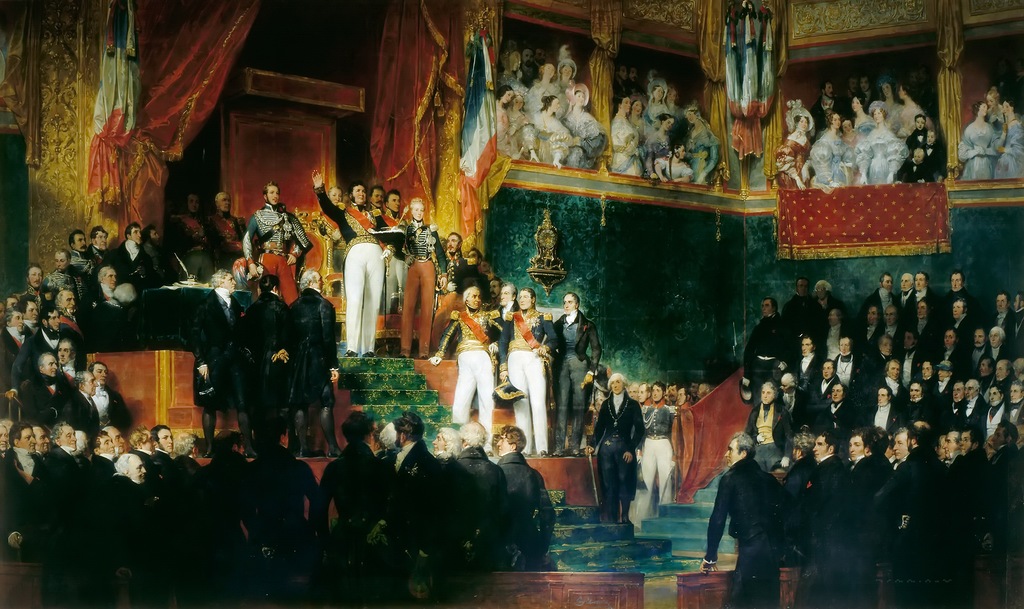
France was ruled by monarchs from the establishment of the Kingdom of West Francia in 843 until the end of the Second French Empire in 1870, with several interruptions.
Classical French historiography usually regards Clovis I, King of the Franks (), as the first king of France. However, historians today consider that such a kingdom did not begin until the establishment of West Francia, during the dissolution of the Carolingian Empire in the 800s.
Germany
Main article: Monarchism in German-speaking countries
In 1920s Germany, a number of monarchists gathered around the German National People's Party (founded in 1918), which demanded the return of the Hohenzollern monarchy and an end to the Weimar Republic; the party retained a large base of support until the rise of Nazism in the 1930s, as Adolf Hitler staunchly opposed monarchism.
Italy
The aftermath of World War II saw the return of monarchist and republican rivalry in Italy, where a referendum was held on whether the state should remain a monarchy or become a republic. The republican side won the vote by a narrow margin, and the modern Republic of Italy was created.
Spain
After the 1931 Spanish local elections, King Alfonso XIII voluntarily left Spain and republicans proclaimed a Second Spanish Republic. |author-link1 = Julián Casanova |translator-last1 = Douch |translator-first1 = Martin |translator-link1 = |orig-date = 2007 |publication-date = 2010 |access-date = 10 September 2022 After the assassination of opposition leader José Calvo Sotelo in 1936, right-wing forces banded together to overthrow the Republic. During the Spanish Civil War of 1936 to 1939, General Francisco Franco established the basis for the Spanish State (1939–1975). In 1938, the autocratic government of Franco claimed to have reconstituted the Spanish monarchy in absentia (and in this case ultimately yielded to a restoration, in the person of King Juan Carlos).
In 1975, Juan Carlos I became King of Spain and began the Spanish transition to democracy. He abdicated in 2014, and was succeeded by his son Felipe VI.
United Kingdom
In England, royalty ceded power to other groups in a gradual process. In 1215, a group of nobles forced King John to sign Magna Carta, which guaranteed the English barons certain liberties and established that the king's powers were not absolute. King Charles I was executed in 1649, and the Commonwealth of England was established as a republic. Highly unpopular, the republic was ended in 1660, and the monarchy was restored under King Charles II. In 1687–88, the Glorious Revolution and the overthrow of King James II established the principles of constitutional monarchy, which would later be worked out by Locke and other thinkers. However, absolute monarchy, justified by Hobbes in Leviathan (1651), remained a prominent principle elsewhere.
Following the Glorious Revolution, William III and Mary II were established as constitutional monarchs, with less power than their predecessor James II. Since then, royal power has become more ceremonial, with powers such as refusal to assent last exercised in 1708 by Queen Anne. Once part of the United Kingdom (1801–1922), southern Ireland rejected monarchy and became the Republic of Ireland in 1949. Support for a ceremonial monarchy remains high in Britain. Queen Elizabeth II (), possessed wide support from the U.K.'s population. The current monarch of Britain is: Charles III. He assumed the throne on September 8th 2022, with the coronation on May 6th 2023.
North America
Costa Rica
The struggle between monarchists and republicans led to the Costa Rican civil war of 1823. Costa Rican monarchists include Joaquín de Oreamuno y Muñoz de la Trinidad, José Santos Lombardo y Alvarado, and José Rafael Gallegos Alvarado. in 1822, Costa Rican monarchists were loyal to Emperor Agustín de Iturbide of the First Mexican Empire.
Honduras
.svg)
After the independence of the general captaincy of Guatemala from the Spanish empire, Honduras joined the First Mexican Empire for a brief period. These were divided between the annexationists, made up mostly of illustrious Spanish-descendant families and members of the conservative party who supported the idea of being part of an empire, and the liberals who wanted Central America to be a separate nation under a republican system.
Mexico
Main article: Monarchism in Mexico
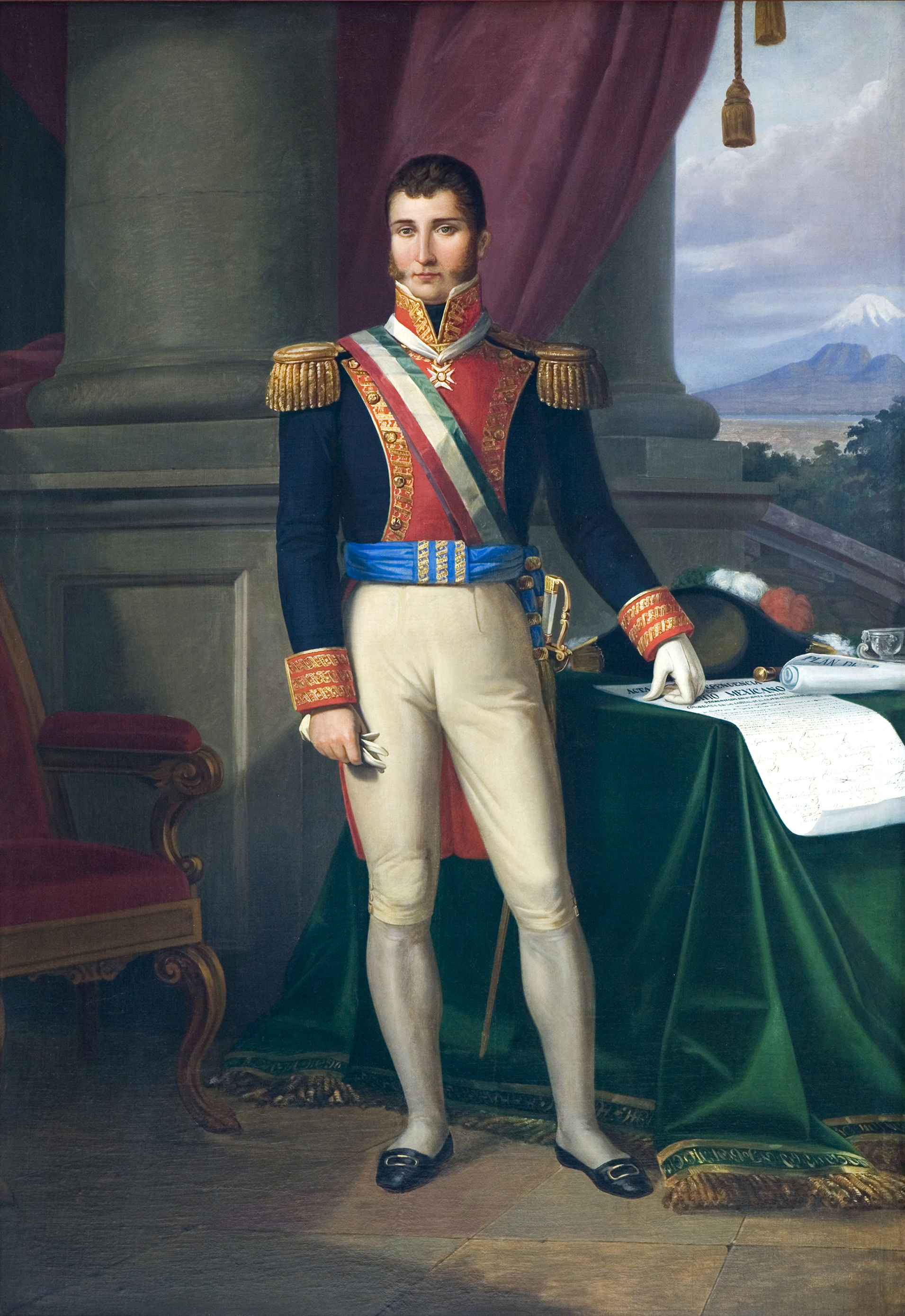
After obtaining independence from Spain, the First Mexican Empire was established under Emperor Agustín I. His reign lasted less than one year, and he was forcefully deposed. In 1864, the Second Mexican Empire was formed under Emperor Maximilian I. Maximilian's government enjoyed French aid, but opposition from America, and collapsed after three years. Much like Agustín I, Maximilian I was deposed and later executed by his republican enemies. Since 1867, Mexico has not possessed a monarchy.
Today, some Mexican monarchist organizations advocate for Maximilian von Götzen-Iturbide or Carlos Felipe de Habsburgo to be instated as the Emperor of Mexico.
Nicaragua
The miskito ethnic group inhabits part of the Atlantic coast of Honduras and Nicaragua, by the beginning of the 17th century the said ethnic group was reorganized under a single chief known as Ta Uplika, for the reign of his grandson King Oldman I this group had a very close relationship With the English, they managed to turn the Mosquitia coast into an English protectorate that would decline in the 19th century until it completely disappeared in 1894 with the abdication of Robert II.
Currently, the Miskitos who are shot between the two countries have denounced the neglect of their communities and abuses committed by the authorities. As a result of this, in Nicaragua several Miskito people began a movement of separatism from present-day Nicaragua and a re-institution of the monarchy.
United States
Main article: Monarchism in the United States
After the U.S. declared its independence, the form of government by which it would operate still remained unsettled. At least two of America's Founding Fathers, Alexander Hamilton and Nathaniel Gorham, believed that America should be an independent monarchy. Various proposals to create an American monarchy were considered, including the Prussian scheme which would have made Prince Henry of Prussia king of the United States. Hamilton proposed that the leader of America should be an elected monarch, while Gorham pushed for a hereditary monarchy. U.S. military officer Lewis Nicola also desired for America to be a monarchy, suggesting George Washington accept the crown of America, which he declined. All attempts ultimately failed, and America was founded a Republic.
Since the ratification of the constitution, support for monarchy has possessed a generally low popularity, though it has increased slightly over time. In 1950, 3% of Americans said it would be a good idea for America to possess a royal family, while 93% thought it would be bad. This question was re-asked in 1999, where 11% of Americans answered that in favor of a royal family would be good for the United States and 87% against. A 2013 CNN poll found that 13% of Americans would be open to the United States possessing a royal family again. A 2018 poll asking if America would be better or worse if it possessed a constitutional monarchy had 11% of Americans answering better and 36% answering worse. A 2021 poll by YouGov found that 5% of Americans would consider it a good thing for the United States to have a monarchy (7% support among men and 4% support among women), with 69% answering that it would be a bad thing. In the YouGov poll, African Americans were most likely to answer positively in favor of a monarchy at 10% support. In 2023 another poll was conducted which found 12% of Americans favored monarchy in the United States while 63% remained opposed.
South America
Brazil
Main article: Monarchism in Brazil
From gaining its independence in 1822 until 1889, Brazil was governed as a constitutional monarchy with a branch of the Portuguese Royal Family serving as monarchs. Prior to this period, Brazil had been a royal colony which had also served briefly as the seat of government for the Portuguese Empire following the occupation of that country by Napoleon Bonaparte in 1808. The history of the Empire of Brazil was marked by brief periods of political instability, several wars that Brazil won, and a marked increase in immigration which saw the arrival of both Jews and Protestants who were attracted by Brazil's reputation for religious tolerance. The final decades of the Empire under the reign of Pedro II saw a remarkable period of relative peace both at home and internationally, coupled with dramatic economic expansion, the extension of basic civil rights to most people and the gradual restriction of slavery, culminating in its final abolition in 1888. It is also remembered for its thriving culture and arts. However, Pedro II had little interest in preserving the monarchy and passively accepted its overthrow by a military coup d'état in 1889 resulting in the establishment of a dictatorship known as the First Brazilian Republic.
Current monarchies
Main article: List of current monarchs of sovereign states
The majority of current monarchies are constitutional monarchies. In a constitutional monarchy the power of the monarch is restricted by either a written or unwritten constitution, this should not be confused with a ceremonial monarchy, in which the monarch holds only symbolic power and plays very little to no part in government or politics. In some constitutional monarchies the monarch does play a more active role in political affairs than in others. In Thailand, for instance, King Bhumibol Adulyadej, who reigned from 1946 to 2016, played a critical role in the nation's political agenda and in various military coups. Similarly, in Morocco, King Mohammed VI wields significant, but not absolute power.
Liechtenstein is a democratic principality whose citizens have voluntarily given more power to their monarch in recent years.
There remain a handful of countries in which the monarchy is an absolute monarchy. The majority of these countries are oil-producing Arab Islamic monarchies like Saudi Arabia, Bahrain, Qatar, Oman, and the United Arab Emirates. Other strong monarchies include Brunei and Eswatini.
| Country | Sovereign |
|---|---|
| Andorra | Co-Prince Emmanuel Macron |
| Co-Prince Josep-Lluís Serrano Pentinat | |
| Antigua and Barbuda | King Charles III |
| Australia | |
| Bahamas | |
| Belize | |
| Canada | |
| Grenada | |
| Jamaica | |
| New Zealand | |
| Papua New Guinea | |
| Saint Kitts and Nevis | |
| Saint Lucia | |
| Saint Vincent and the Grenadines | |
| Solomon Islands | |
| Tuvalu | |
| United Kingdom | |
| Bahrain | King Hamad bin Isa |
| Belgium | King Philippe |
| Bhutan | King Jigme Khesar Namgyel |
| Brunei | Sultan Hassanal Bolkiah |
| Cambodia | King Norodom Sihamoni |
| Denmark | King Frederik X |
| Eswatini | King Mswati III |
| Japan | Emperor Naruhito |
| Jordan | King Abdullah II |
| Kuwait | Emir Mishal Al-Ahmad |
| Lesotho | King Letsie III |
| Liechtenstein | Prince Hans-Adam II |
| Luxembourg | Grand Duke Guillaume V |
| Malaysia | Sultan Ibrahim |
| Monaco | Sovereign Prince Albert II |
| Morocco | King Mohammed VI |
| Kingdom of the Netherlands | King Willem-Alexander |
| Norway | King Harald V |
| Oman | Sultan Haitham bin Tariq |
| Qatar | Emir Tamim bin Hamad Al Thani |
| Saudi Arabia | King Salman |
| Spain | King Felipe VI |
| Sweden | King Carl XVI Gustaf |
| Thailand | King Vajiralongkorn |
| Tonga | King Tupou VI |
| United Arab Emirates | Sheikh Mohamed bin Zayed Al Nahyan |
| Vatican City | Pope Leo XIV |
Political philosophy
Otto von Habsburg advocated a form of constitutional monarchy based on the primacy of the supreme judicial function, with hereditary succession, mediation by a tribunal is warranted if suitability is problematic.
Non-partisanship
British political scientist Vernon Bogdanor justifies monarchy on the grounds that it provides for a nonpartisan head of state, separate from the head of government, and thus ensures that the highest representative of the country, at home and internationally, does not represent a particular political party, but all people. Bogdanor also notes that monarchies can play a helpful unifying role in a multinational state, noting that "In Belgium, it is sometimes said that the king is the only Belgian, everyone else being either Fleming or Walloon" and that the British sovereign can belong to all of the United Kingdom's constituent countries (England, Scotland, Wales, and Northern Ireland), without belonging to any particular one of them.
Private interest
Thomas Hobbes wrote that the private interest of the monarchy is the same with the public. The riches, power, and humour of a monarch arise only from the riches, strength, and reputation of his subjects. An elected Head of State is incentivised to increase his own wealth for leaving office after a few years whereas a monarch has no reason to corrupt because he would be cheating himself.
Wise counsel
Thomas Hobbes wrote that a monarch can receive wise counsel with secrecy while an assembly cannot. Advisors to the assembly tend to be well-versed more in the acquisition of their own wealth than of knowledge; are likely to give their advices in long discourses which often excite men into action but do not govern them in it, moved by the flame of passion instead of enlightenment. Their multitude is a weakness.
Long termism
Thomas Hobbes wrote that the resolutions of a monarch are subject to no inconsistency save for human nature; in assemblies, inconsistencies arise from the number. For in an assembly, as little as the absence of a few or the diligent appearance of a few of the contrary opinion, "undoes today all that was done yesterday".
Civil war reduction
Thomas Hobbes wrote that a monarch cannot disagree with himself, out of envy or interest, but an assembly may and to such a height that may produce a civil war.
Liberty
The International Monarchist League, founded in 1943, has always sought to promote monarchy on the grounds that it strengthens popular liberty, both in a democracy and in a dictatorship, because by definition the monarch is not beholden to politicians.
British-American libertarian writer Matthew Feeney argues that European constitutional monarchies "have managed for the most part to avoid extreme politics"—specifically fascism, communism, and military dictatorship—"in part because monarchies provide a check on the wills of populist politicians" by representing entrenched customs and traditions. Feeny notes that European monarchies—such as the Danish, Belgian, Swedish, Dutch, Norwegian, and British—have ruled over countries that are among the most stable, prosperous, and free in the world.
Socialist writer George Orwell argued a similar point, that constitutional monarchy is effective at preventing the development of fascism.
"The function of the King in promoting stability and acting as a sort of keystone in a non-democratic society is, of course, obvious. But he also has, or can have, the function of acting as an escape-valve for dangerous emotions. A French journalist said to me once that the monarchy was one of the things that have saved Britain from Fascism...It is at any rate possible that while this division of function exists a Hitler or a Stalin cannot come to power. On the whole the European countries which have most successfully avoided Fascism have been constitutional monarchies... I have often advocated that a Labour government, i.e. one that meant business, would abolish titles while retaining the Royal Family.’
Erik von Kuehnelt-Leddihn took a different approach, arguing that liberty and equality are contradictions. As such, he argued that attempts to establish greater social equality through the abolishment of monarchy, ultimately results in a greater loss of liberty for citizens. He believed that equality can only be accomplished through the suppression of liberty, as humans are naturally unequal and hierarchical. Kuehnelt-Leddihn also believed that people are on average freer under monarchies than they are under democratic republics, as the latter tends to more easily become tyrannical through ochlocracy. In Liberty or Equality, he writes:
There is little doubt that the American Congress or the French Chambers have a power over their nations which would rouse the envy of a Louis XIV or a George III, were they alive today. Not only prohibition, but also the income tax declaration, selective service, obligatory schooling, the fingerprinting of blameless citizens, premarital blood tests—none of these totalitarian measures would even the royal absolutism of the seventeenth century have dared to introduce.
Hans-Hermann Hoppe also argues that monarchy helps to preserve individual liberty more effectively than democracy.
Natural desire for hierarchy
In a 1943 essay in The Spectator, "Equality", British author C.S. Lewis criticized egalitarianism, and its corresponding call for the abolition of monarchy, as contrary to human nature, writing, A man's reaction to Monarchy is a kind of test. Monarchy can easily be 'debunked'; but watch the faces, mark well the accents, of the debunkers. These are the men whose tap-root in Eden has been cut: whom no rumour of the polyphony, the dance, can reach—men to whom pebbles laid in a row are more beautiful than an arch...Where men are forbidden to honour a king they honour millionaires, athletes, or film-stars instead: even famous prostitutes or gangsters. For spiritual nature, like bodily nature, will be served; deny it food and it will gobble poison.
Political accountability
Oxford political scientists Petra Schleiter and Edward Morgan-Jones wrote that in monarchies, it is more common to hold elections than non-electoral replacements.
Notable works
Notable works arguing in favor of monarchy include
- Abbott, Tony (1995). The Minimal Monarchy: And Why It Still Makes Sense For Australia
- Alighieri, Dante (c. 1312). De Monarchia
- Aquinas, Thomas (1267). De Regno, to the King of Cyprus
- Auslin, Michael (2014). America Needs a King
- Balmes, Jaime (1850). European Civilization: Protestantism and Catholicity Compared in their Effects on the Civilization of Europe
- Bellarmine, Robert (1588). De Romano Pontifice, On the Roman Pontiff
- Bodin, Jean (1576). The Six Books of the Republic
- Bogdanor, Vernon (1997). The Monarchy and the Constitution
- Bossuet, Jacques-Bénigne (1709). Politics Drawn from the Very Words of Holy Scripture
- Charles I of England (1649). Eikon Basilike
- Coulombe, Charles A. (2016). Star-Spangled Crown: A Simple Guide to the American Monarchy
- Chateaubriand, François-René de (1814). Of Buonaparte, and the Bourbons, and of the Necessity of Rallying Round Our Legitimate Princes
- Cram, Ralph Adams (1936). Invitation to Monarchy
- Filmer, Robert (1680). Patriarcha
- Hobbes, Thomas (1651). Leviathan
- Hermann-Hoppe, Hans (2001). Democracy: The God That Failed
- — (2014). From Aristocracy to Monarchy to Democracy: A Tale of Moral and Economic Folly and Decay
- James VI and I (1598). The True Law of Free Monarchies
- — (1599). Basilikon Doron
- Jean, Count of Paris (2009). Un Prince Français
- Kuehnelt-Leddihn, Erik von (1952). Liberty or Equality: The Challenge of Our Times
- — (2000). Monarchy and War
- Maistre, Joseph de (1797). Considerations on France
- Pius VI (1793). Pourquoi Notre Voix
- Scruton, Roger (1991). A Focus of Loyalty Higher Than the State
- Ségur, Louis Gaston Adrien de (1871). Vive le Roi!
- Vegas Latapiè, Eugenio (1983). Memorias politicas. El suicidio de la monarquia y la Segunda Republica
- Whittle, Peter (2011). Monarchy Matters
Support for monarchy
Current monarchies
| Country | Polling firm/source | Sample size | Percentage of supporters | Date conducted | Ref. | |||
|---|---|---|---|---|---|---|---|---|
| Antigua and Barbuda | Lord Ashcroft Polls | 510 | 45% | February and March 2023 | title=The monarchy: the view from the "Commonwealth realms" | url=https://lordashcroftpolls.com/2023/05/the-monarchy-the-view-from-the-commonwealth-realms/ | work=Lord Ashcroft Polls | date=5 May 2023}} |
| Australia | Essential | 1,125 | 48% | April 2023 | ||||
| Belgium | IVOX | 1,000 | 58% | September 2017 | ||||
| Canada | Nanos Research | 1,001 | 48% | June 2022 | ||||
| Denmark | Gallup | 86% | 2014 | |||||
| Jamaica | Lord Ashcroft Polls | 510 | 40% | February and March 2023 | ||||
| Japan | Mainichi Shimbun | 74% | April 2019 | |||||
| Lesotho | Afrobarometer | 75% | June 2018 | |||||
| Morocco | Le Monde | 1,108 | 91% | March 2009 | ||||
| Netherlands | EenVandaag | 59% | 2025 | |||||
| New Zealand | Lord Ashcroft Polls | 2,012 | 44% | February and March 2023 | ||||
| Norway | Nettavisen | 20,000 | 85% | 2022 | ||||
| Saint Vincent | Government constitutional referendum | 52,262 | 56.3% | November 2009 | ||||
| Spain | Spain | 65.7% | January 2024 | |||||
| Sweden | Novus | 73% | January 2023 | |||||
| Thailand | Suan Dusit Rajabhat University | 5,700 | 75% | October 2020 | ||||
| Tuvalu | Government constitutional referendum | 1,939 | 64.9% | April 2008 | ||||
| United Kingdom | Ipsos | 2,166 | 81% | May 2024 |
Former monarchies
The following is a list of former monarchies and their percentage of public support for monarchism.
| Country | Claimant or most recent royal house | Polling firm/source | Sample size | Percentage of supporters | Date conducted | Ref. |
|---|---|---|---|---|---|---|
| Austria | Habsburg-Lorraine | 20% | ||||
| Barbados | Windsor | University of the West Indies | 500 | 12% | November 2021 | |
| Brazil | Orléans-Braganza | Círculo Monárquico Brasileiro | 188 | 32% | September 2019 | |
| Croatia | Habsburg-Lorraine | Consilium Regium Croaticum | 1,759 | 41% | 2019 | |
| Czechia | Habsburg-Lorraine | MEDIAN.EU | 1,015 | 10% | August 2021 | |
| France | Bourbon/Orléans/Bonaparte | Le Figaro | ~1,000 | 44% | September 2022 | |
| Georgia | Bagrationi | Doctrina | 560 | 30% | July 2015 | |
| Germany | Hohenzollern | IamExpat | 1,041 | 14% | 2023 | |
| Greece | Schleswig-Holstein-Sonderburg-Glücksburg | Tatler | 31.2% | April 2023 | ||
| Hungary | Habsburg-Lorraine | Azonnali | 3,541 | 46% | May 2021 | |
| Iran | Pahlavi | Empirical Research and Forecasting Institute | 2, 639 | 60.4% | February 2023 | |
| Italy | Savoy | Piepoli institute | 15% | 2018 | ||
| Libya | Senussi | Cambridge MENAF | 50-55% | February 2022 | ||
| Lithuania | Urach | Delfi | 1,104 | 8.3% | November 2006 | |
| Mexico | Iturbide/Habsburg-Lorraine | Parametría | 7.6% | July 2014 | ||
| Nepal | Gorkha | Interdisciplinary Analysts | 3,000 | 49% | January 2008 | |
| Poland | Wettin | wPolityce.pl | 1,067 | 14% | April 2021 | |
| Portugal | Braganza-Coburg | Marktest Group | ~1,000 | 19.7% | September 2010 | |
| Romania | Romania | Cotidianul | 35.4% | December 2023 | ||
| Russia | Holstein-Gottorp-Romanov | Russian Public Opinion Research Center | ~1,800 | 28% | March 2017 | |
| Serbia | Karađorđević | Blic | 1,615 | 49.8% | July 2015 | |
| South Korea | Yi | Naver News | 1,000 | 40.4% | 2010 | |
| Turkey | Osman | MetroPOLL | 1,691 | 3% | October 2023 | |
| United States | Brunswick-Lüneburg | YouGov | 1,500 | 12% | May 2023 |
Notable monarchists
Main article: List of monarchists
Several notable public figures who advocated for monarchy or are monarchists include:
Arts and entertainment
- Honoré de Balzac, French novelist & playwright
- Fyodor Dostoevsky, Russian novelist & essayist
- Pedro Muñoz Seca, Spanish playwright
- George MacDonald, British theologian and writer
- C.S. Lewis, British theologian and writer
- J.R.R. Tolkien, British writer
- T.S. Eliot, American-British poet & writer
- Salvador Dalí, Spanish artist
- Hergé, Belgian cartoonist
- Éric Rohmer, French filmmaker
- Yukio Mishima, Japanese author
- Joan Collins, English actress & author
- Stephen Fry, English actor & author
Clergy
- Thomas Aquinas, Italian Catholic priest & theologian
- Robert Bellarmine, Italian Cardinal & theologian
- Jacques-Bénigne Bossuet, French Bishop & theologian
- Jules Mazarin, Italian Cardinal & minister
- André-Hercule de Fleury, French Cardinal & minister
- Pius VI, Italian Pope & ruler of the Papal States
- Fabrizio Ruffo, Italian Cardinal & treasurer
- Ercole Consalvi, Italian Cardinal Secretary of State
- Pelagio Antonio de Labastida y Dávalos, Mexican Archbishop & Regent of the Second Mexican Empire
- Louis Gaston Adrien de Ségur, French Bishop & writer
- Louis Billot, French priest & theologian
- Pius XII, Italian Pope & sovereign of Vatican City
- József Mindszenty, Hungarian Cardinal & Prince-primate
Philosophy
- Dante Alighieri, Italian poet & philosopher
- Jean Bodin, French political philosopher
- Robert Filmer, English political theorist
- Thomas Hobbes, English philosopher
- Joseph de Maistre, Savoyard philosopher & writer
- Juan Donoso Cortés, Spanish politician & political theologian
- Søren Kierkegaard, Danish philosopher & theologian
- Charles Maurras, French author & philosopher
- Kang Youwei, Chinese political thinker & reformer
- Ralph Adams Cram, American architect & writer
- Erik von Kuehnelt-Leddihn, Austrian political scientist & philosopher
- Vernon Bogdanor, British political scientist & historian
- Roger Scruton, English philosopher & writer
- Hans Hermann-Hoppe, German-American political theorist
- Charles A. Coulombe, American historian & author
- Plinio Corrêa de Oliveira, Brazilian philosopher and writer
Politics
- François-René de Chateaubriand, French historian & Ambassador
- Manuel Belgrano, Argentinian politician
- Klemens von Metternich, Austrian Chancellor
- Miguel Miramón, Mexican President & military general
- Otto von Bismarck, German Chancellor
- Juan Vázquez de Mella, Spanish politician & political theorist
- Panagis Tsaldaris, Greek Prime Minister
- Winston Churchill, British Prime Minister of the U.K.
- Călin Popescu-Tăriceanu, Romanian Prime Minister
- Salome Zourabichvili, Georgian President
- Tony Abbott, Australian Prime Minister
- Antônio Henrique Cunha Bueno, Brazilian politician
Monarchist movements and parties
- Action Française
- Alfonsism
- Alliance Royale
- Australian Monarchist League
- Australians for Constitutional Monarchy
- Bonapartism
- Black-Yellow Alliance
- Carlism
- Cavalier
- Chouannerie
- Conservative-Monarchist Club
- Constantian Society
- Constitutionalist Party of Iran
- Druk Phuensum Tshogpa
- Hawaiian sovereignty movement
- Hovpartiet
- International Monarchist League
- Jacobitism
- Koruna Česká (party)
- Legality Movement
- Legitimism
- Liberal Democratic Party of Russia
- Loyalism
- Loyalist (American Revolution)
- Miguelist
- Monarchist League of Canada
- Monarchist Party of Russia
- Monarchy New Zealand
- Movement for the Restoration of the Kingdom of Serbia
- Nouvelle Action Royaliste
- Orléanism
- People's Alliance for Democracy
- Rastriya Prajatantra Party
- Royal Stuart Society
- Royalist Party
- Sanfedismo
- Serbian Renewal Movement
- Sonnō jōi
- Tradition und Leben
- Traditionalist Communion
- Ultra-royalist
Criticism
Main article: Criticism of monarchy
Criticism of monarchy can be targeted against the general form of government—monarchy—or more specifically, to particular monarchical governments as controlled by hereditary royal families. For example, Montesquieu often criticized the French monarchy and its institutions, with the belief that they were forms of despotism. Monarchies in Europe and their underlying concepts, such as the Divine Right of Kings, were often criticized during the Age of Enlightenment, which notably paved the way to the French Revolution and the proclamation of the abolition of the monarchy in France. Earlier, the American Revolution had seen the Patriots suppress the Loyalists and expel all royal officials.
The twentieth century, beginning with the 1917 February Revolution in Russia and accelerated by two world wars, saw many European countries replace their monarchies with republics, while others replaced their absolute monarchies with constitutional monarchies.
Notes
References
ja:君主主義
References
- Webster's Encyclopedic Unabridged Dictionary of the English Language, 1989 edition, p. 924.
- Bohn, H. G.. (1849). "The Standard Library Cyclopedia of Political, Constitutional, Statistical and Forensic Knowledge".
- "Definition of Republic".
- "The definition of republic".
- "Sumerian King List".
- Conrad Phillip Kottak. (1991). "Cultural Anthropology". McGraw-Hill.
- (1986). "Topics in West African History". Longman Group.
- (21 February 2020). "Enlightenment".
- "A beginner's guide to the Age of Enlightenment (article)".
- (2025-05-27). "Ethiopia - Haile Selassie, Imperialism, Revolution {{!}} Britannica".
- (2012). "The Wiley-Blackwell Companion to Chinese Religions". John Wiley & Sons.
- (2008). "Musing with Confucius and Paul: Toward a Chinese Christian Theology". James Clarke & Company Limited.
- (2009). "Medicine and Society in Late Imperial China: A Study of Physicians in Suzhou, 1600–1850". Peter Lang.
- (2002). "夏、商、周之前还有个虞朝". Hebei Academic Journal.
- (9 November 2019). "远古时期的"古唐朝"?比夏朝还早1600年,如被证实历史或将改写".
- (2013). "Encyclopedia of the World's Minorities". Routledge.
- "Tennō".
- Kanʼichi Asakawa. ''[https://archive.org/details/bub_gb_K1MuAAAAYAAJ/page/n36 The early institutional life of Japan: a study in the reform of 645 A.D.]''. Tokyo: Shueisha (1903), p. 25. "We purposely avoid, in spite of its wide usage in foreign literature, the misleading term ''Mikado''. If it be not for the natural curiosity of the races, which always seeks something novel and loves to call foreign things by foreign names, it is hard to understand why this obsolete and ambiguous word should so sedulously be retained. It originally meant not only the Sovereign, but also his house, the court, and even the State, and its use in historical writings causes many difficulties which it is unnecessary to discuss here in detail. The native Japanese employ the term neither in speech nor in writing. It might as well be dismissed with great advantage from sober literature as it has been for the official documents."
- "最高裁判所判例集 事件番号 平成1(行ツ)126".
- Hoye, Timothy. (1999). ''Japanese Politics: Fixed and Floating Worlds,'' p. 78; "According to legend, the first Japanese emperor was Jinmu. Along with the next 13 emperors, [[Emperor Jimmu. Jimmu]] is not considered an actual, historical figure. Historically verifiable Emperors of Japan date from the early sixth century with [[Emperor Kinmei. Kinmei]]."
- Henshall, Kenneth. (2013). "Historical Dictionary of Japan to 1945". Scarecrow Press.
- [[Louis-Frédéric
- Totman, Conrad. (1966). "Political Succession in The Tokugawa Bakufu: Abe Masahiro's Rise to Power, 1843–1845". Harvard Journal of Asiatic Studies.
- "Meiji Constitution {{!}} 1889, Japan". Encyclopedia Britannica.
- "The Constitution of Japan".
- Oda, Hiroshi. (2009). "Japanese Law". Oxford University Press.
- Wasserman, Janek. (2014). "Österreichische Aktion: Monarchism, Authoritarianism, and the Unity of the Austrian Conservative Ideological Field during the First Republic". Central European History.
- (1996). "Clovis chez les historiens". Librairie Droz.
- Sewell, Elizabeth Missing. (1876). "Popular History of France". [[Longman]].
- Asmuss, Burkhard. (27 January 2023). "Die Deutschnationale Volkspartei (DNVP)".
- [http://www.gazzettaufficiale.it/do/gazzetta/downloadPdf?dataPubblicazioneGazzetta=19460620&numeroGazzetta=134&tipoSerie=FO&tipoSupplemento=GU&numeroSupplemento=0&estensione=pdf&edizione=90 Gazzetta Ufficiale n. 134 del 20 giugno 1946]
- "Costa Rica - Independence, Democracy, Nature | Britannica".
- "BBC Mundo - América Latina - los miskitos luchan por su independencia".
- Hamilton, Alexander (1962). The Papers of Alexander Hamilton, Volume 9. New York: Columbia University Press. {{ISBN. 0-231-08903-1
- Krauel, Richard. (October 1911). "Prince Henry of Prussia and the Regency of the United States, 1786". The American Historical Review.
- Carlson, Darren K.. (6 February 2002). "Queen Elizabeth: 50 Years of Public Opinion".
- NCC Staff. (22 July 2013). "Despite royal buzz, Americans would still pass on a monarchy".
- McCullogh, J.J.. (22 May 2018). "Americans Are Royally Confused about Monarchy".
- (10 April 2021). "American Monarchy a Good Thing". YouGov.
- "Three in five Americans say it would be bad for the U.S. to have a monarchy {{!}} YouGov".
- "Enciclopédia Barsa". Encyclopædia Britannica do Brasil.
- "Untitled Document".
- Otto von Habsburg [http://www.worldfreeinternet.us/archive/arc15.htm "Monarchy or Republic?"]. ("Excerpted from The Conservative Tradition in European Thought, Copyright 1970 by Educational Resources Corporation.")
- Bogdanor, Vernon. (6 December 2000). "The Guardian has got it wrong".
- Feeney, Matthew. (July 25, 2013). "The Benefits of Monarchy".
- Orwell, George. ''Spring 1944 Partisan Review''
- (2014). "Liberty or Equality: The Challenge of Our Time". The Mises Institute.
- [[David Gordon (philosopher)
- C.S. Lewis. (26 August 1943). "Equality".
- Matthews, Dylan. (13 July 2013). "Shut up, royal baby haters. Monarchy is awesome.". The Washington Post.
- (5 May 2023). "The monarchy: the view from the "Commonwealth realms"". Lord Ashcroft Polls.
- (15 May 2023). "Support for a Republic". Essential Research.
- (17 September 2017). "Kwart van de Belgen wil republiek in plaats van monarchie". HLN.be.
- Otis, Daniel. (1 June 2022). "Majority of Canadians want Queen to apologize for residential schools: survey". Nanos Research.
- (7 January 2022). "What do the Danes think of their Royal Family and what role does the Danish Monarchy have?". YourDanishLife.
- (2019-05-03). "74% back emperor as symbol of state defined by current Constitution: Mainichi poll". Mainichi Daily News.
- (11 June 2018). "'We need the king!' Lesotho fed up with politicians' mistakes". TimesLive.
- (8 March 2009). "Government bans Le Monde opinion poll on royalty".
- "Steun voor de monarchie". EenVandaag.
- (5 May 2023). "The monarchy: the view from the "Commonwealth realms"". Lord Ashcroft Polls.
- (2024-01-06). "Sociometric Survey (Jan 6): 58,6% support the Monarchy".
- (2023). "TV4".
- (25 October 2020). "Strength of support for the monarchy being seen this week as political unrest deepens into standoff". Thai Examiner.
- (30 April 2008). "Tuvaluans vote against Republic".
- (11 November 2018). "A century after Austrian-Hungarian Empire's fall, some nostalgic for monarchy". EFE, S.A..
- (21 December 2021). "Survey shows support for republic". Barbados Today.
- (27 September 2019). "CMB Pesquisa de conhecimento e opinião pública".
- Thomas, Mark. "Two-fifths of Croatians want a return to the monarchy". The Dubrovnik Times.
- (2023-03-22). "Češi a monarchie - průzkum - Médium.cz".
- Keiger, John. (2023-09-20). "Why is France so fascinated by the royals?".
- Kikacheishvili, Tamar. (17 April 2017). "Georgia: Five-Year-Old Prince Prepares to Reign". Eurasianet.
- Wedia. (23 March 2023). "8 percent of Germans want a monarchy".
- Zampounis, Christos. (2023-03-06). "As he celebrates his 57th birthday, Tatler asks; what does the future hold for Crown Prince Pavlos of Greece?".
- (2023-08-28). "Győztek a Habsburgok: az Azonnali olvasóinak 46 százaléka újra királyságot szeretne {{!}} Azonnali".
- Life, Kayhan. (2023-03-19). "A Survey by a US-Based Research Institute Shows Iranians Support Reza Pahlavi".
- "Emanule Filiberto: "Politici? Sono dei parac***"". Occhio, il Savoia vuole fare il re".
- Cousins, Michel. (2022-02-27). "Research group calls for restoration of 1951 constitution and Senussi monarchy".
- "Apklausa: Lietuvos gyventojai nenorėtų monarchijos".
- "¿Qué opinan los mexicanos de la Monarquía?". Parametría.
- (3 April 2008). "In Nepal, Long-Lived Monarchy Fades From View". The New York Times.
- (3 May 2021). "Sondaż "wPolityce": 14 proc. chciałoby w Polsce monarchii parlamentarnej, przeciw tej koncepcji 57 proc.".
- "Jovens mais republicanos?".
- (I.R.). (2023-12-11). "Sondaj INSCOP: Ce cred românii despre Monarhie".
- Galanina, Angelina. (23 March 2017). "Россияне против монархии". National Media Group.
- (2015-07-27). "ANKETA Da li Srbija treba da bude monarhija?".
- "황실 복원…찬성 41% vs 반대 23%".
- (November 2023). "MetroPOLL anketi: "Türkiye'nin nabzı, Atatürk, cumhuriyet ve laiklik diye atıyor"".
- (5 May 2023). "Three in five Americans say it would be bad for the U.S. to have a monarchy". YouGov.
- "Balzac: A Fight Against Decandence and Materialism".
- Brody, Richard. (24 March 2021). "Looking Behind Éric Rohmer's Cinematic Style".
- (21 January 2012). "Joan Collins so happy with husband".
- Stephen, Fry. (30 June 2017). "Happy Birthday, America. One Small Suggestion". The New York Times.
- Aquinas, Thomas. ''De Regno, to the King of Cyprus''
- Bellarmine, Robert. "On the Roman Pontiff".
- Bossuet, Jacques-Bénigne. ''[[Politics Drawn from the Very Words of Holy Scripture]]''
- Pius VI, ''Pourquoi Notre Voix''
- Coulombe, Charles A.. (2003). "A History of the Popes: Vicars of Christ". MJF Books.
- White, Steven F.. (2020). "Modern Italy's Founding Fathers: The Making of a Postwar Republic". Bloomsbury Publishing.
- Mammarealla, Giuseppe. (1966). "Italy After Fascism A Political History 1943–1965". Notre Dame: University of Notre Dame Press.
- Alighieri, Dante. ''[[De Monarchia]]''
- Filmer, Robert. (1680). "Patriarcha".
- Sommerville, J.P.. (1992). "Thomas Hobbes: Political Ideas in Historical Context". MacMillan.
- Beum, Robert (1997). "Ultra-Royalism Revisited", ''Modern Age'', Vol. 39, No. 3, p. 305.
- Garff, Joachim. "Søren Kierkegaard: A Biography".
- "Charles Maurras on the French Revolution · Liberty, Equality, Fraternity".
- Cram, Ralph Adams. (1936). "Invitation to Monarchy".
- Bogdanor, Vernon. (6 December 2000). "The Guardian has got it wrong". [[The Guardian]].
- (1991-06-16). "'A Focus of Loyalty Higher Than the State : The monarchy created peace in Central Europe, and its loss precipitated 70 years of conflict.' by Roger Scruton".
- Hermann-Hoppe, Hans. "Democracy: The God that Failed".
- Chateubriand. ''Of Buonaparte, and the Bourbons, and of the Necessity of Rallying Round Our Legitimate Princes''
- (18 December 2017). "Monarhia salvează PSD. Tăriceanu şi Bădălău susţin un referendum pe tema monarhiei. Când ar avea loc acesta".
- Civil Georgia. (2007-10-08). "Civil.Ge - Politicians Comment on Constitutional Monarchy Proposal".
- Pearlman, Johnathan. (7 September 2013). "Ten things you didn't know about Tony Abbott". Telegraph Media Group Limited.
- (2015). "Abbott's Gambit: The 2013 Australian Federal Election". ANU Press.
- (2001). "Montesquieu's Science of Politics: Essays on the Spirit of Laws". Bloomsbury Publishing PLC.
- (January 1971). "Bulletin of the Atomic Scientists".
- (April 2004). "Monarchies 1000-2000". Reaktion Books.
This article was imported from Wikipedia and is available under the Creative Commons Attribution-ShareAlike 4.0 License. Content has been adapted to SurfDoc format. Original contributors can be found on the article history page.
Ask Mako anything about Monarchism — get instant answers, deeper analysis, and related topics.
Research with MakoFree with your Surf account
Create a free account to save articles, ask Mako questions, and organize your research.
Sign up freeThis content may have been generated or modified by AI. CloudSurf Software LLC is not responsible for the accuracy, completeness, or reliability of AI-generated content. Always verify important information from primary sources.
Report