From Surf Wiki (app.surf) — the open knowledge base
Moesia Prima
Roman and Byzantine province in the Balkans

Roman and Byzantine province in the Balkans
| Field | Value | |
|---|---|---|
| native_name | ||
| conventional_long_name | Provincia Moesia Prima | |
| common_name | Moesia Prima | |
| subdivision | Province | |
| nation | the Roman Empire | |
| era | Late Antiquity | |
| capital | Viminacium | |
| title_leader | ||
| image_map | Roman_SPQR_banner.svg | |
| image_map_caption | Roman Empire | |
| life_span | ca. 293 – ca. 602 | |
| year_start | ca. 293 | |
| event_start | Administrative reform | |
| year_end | ca. 602 | |
| event_end | Conquered by the Slavs |
Moesia Prima (; Latin: Moesia; ) was a frontier province of the Late Roman Empire, situated in the central parts of present-day Serbia, along the south bank of the Danube River. Its provincial capital was Viminacium, near modern Kostolac in Serbia).
History
The province of Moesia Prima was created at the end of the 3rd century during administrative reforms of Roman emperor Diocletian (284–305) who divided the province of Moesia Superior in two separate provinces: Moesia Prima to the north and Dardania to the south.
Sometime in 293–294, emperor Diocletian traveled through Moesia Superior and came to its capital Viminacium. During that visit he created a new province under the name Moesia Superior Margensis or Moesia Prima. The term Margensis was used in reference to the name of Margus River that runs through the province. Diocletian also registered that the inhabitants of province wrote in Latin, as opposed to Greek in the southern regions.
At first, the province of Moesia Prima belonged to the Diocese of Moesia. Probably under the emperor Constantine I (306–337), the Diocese of Moesia was split in two, forming the Diocese of Dacia in the north and Diocese of Macedonia in the south. The province of Moesia Prima became part of Diocese of Dacia, that belonged to the Praetorian prefecture of Illyricum.
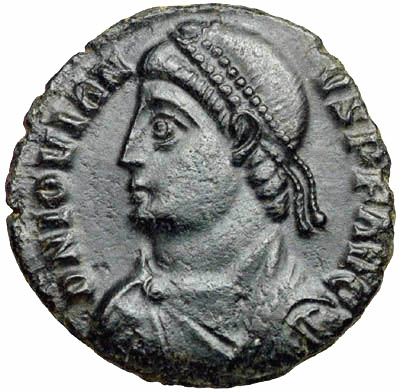
The emperor Jovian (363-364) who reestablished Christianity as the official religion of the Roman Empire was born in Moesia Prima, in Singidunum. In his early career, later to become Roman emperor, Theodosius I served as military commander of Moesia Prima in 373. In 382 the Roman emperors Theodosius I and Gratian met in Viminacium, the capital of Moesia Prima, during the Gothic Wars.
The Danubian border of Moesia Prima was protected by the fortifications of the limes. Two Roman legions were stationed in the province: Legio IV Flavia Felix in Singidunum and Legio VII Claudia in Viminacium. The seat of Praefectus legionis septimae Claudiae was in the frontier fortress of Cuppae (Golubac, Serbia).
As a frontier province, Moesia Prima was under constant threat of barbaric invasions. In the middle of the 5th century the province was devastated by the Huns of Attila who took Singidunum and Viminacium in 441. The province was later invaded by various Germanic tribes like Ostrogoths, Gepids, Heruli and others.
Major efforts to secure the province were undertaken in the time of Justinian I (527–565) who rebuilt Viminacium and Singidunum around 535, restoring the frontier fortresses to their former military importance.
In 535, emperor Justinian I (527-565) created the Archbishopric of Justiniana Prima as a regional primacy with ecclesiastical jurisdiction over all provinces of the Diocese of Dacia, including the province of Moesia Prima.
Throughout the 6th century, Moesia Prima was often invaded by Slavs. The province was also invaded but the Avars who took Singidunum and Viminacium during the war of 582-584. During emperor Maurice's military campaigns against Avars and Slavs, Moesia Prima served as a base of military operations.
After the fall of emperor Maurice in 602, Byzantine defenses in Moesia Prima finally collapsed. At the very beginning of the 7th century, Avars and Slavs sacked and burned Singidunum and Viminacium to the ground and the interior of the fallen province Moesia Prima was finally settled by the Slavic Serbs.
Cities and towns

The chief towns of Moesia Prima were: Viminacium (sometimes called municipium Aelium; modern Kostolac) and Singidunum (Belgrade).
References
Sources
- Procopius. Edited by H. B. Dewing. 7 vols. Loeb Classical Library. Cambridge, Mass.: Harvard University Press and London, Hutchinson, 1914–40. Greek text and English translation.
- Maurice's Strategikon: Handbook of Byzantine Military Strategy. translated by George T. Dennis. Philadelphia 1984, Reprint 2001.
- Fischer Weltgeschichte, Band 13, "Byzanz" (pp. 139ff.). Franz Georg Maier, Frankfurt a. M. (1973)
References
- (2006). "Oxford BBC Guide to Pronunciation". Oxford University Press.
- Daniel Jones. (2006). "Cambridge Pronouncing Dictionary". Cambridge University Press.
- "C. Suetonius Tranquillus, Vitellius Maximilian Ihm, Ed.". perseus.tufts.eud.
- "Lives behind the Laws: The World of the Codex Hermogenianus".
- "Theodosius".
- "Barbarians Within the Gates of Rome: A Study of Roman Military Policy and the Barbarians, ca. 375–425 A.D.".
- [[Notitia Dignitatum]] Or. XLI.
- Curta (2001), Compare also ''Byzanz'' in ''Fischer Weltgeschichte.''
This article was imported from Wikipedia and is available under the Creative Commons Attribution-ShareAlike 4.0 License. Content has been adapted to SurfDoc format. Original contributors can be found on the article history page.
Ask Mako anything about Moesia Prima — get instant answers, deeper analysis, and related topics.
Research with MakoFree with your Surf account
Create a free account to save articles, ask Mako questions, and organize your research.
Sign up freeThis content may have been generated or modified by AI. CloudSurf Software LLC is not responsible for the accuracy, completeness, or reliability of AI-generated content. Always verify important information from primary sources.
Report