From Surf Wiki (app.surf) — the open knowledge base
Modular lambda function
Symmetric holomorphic function
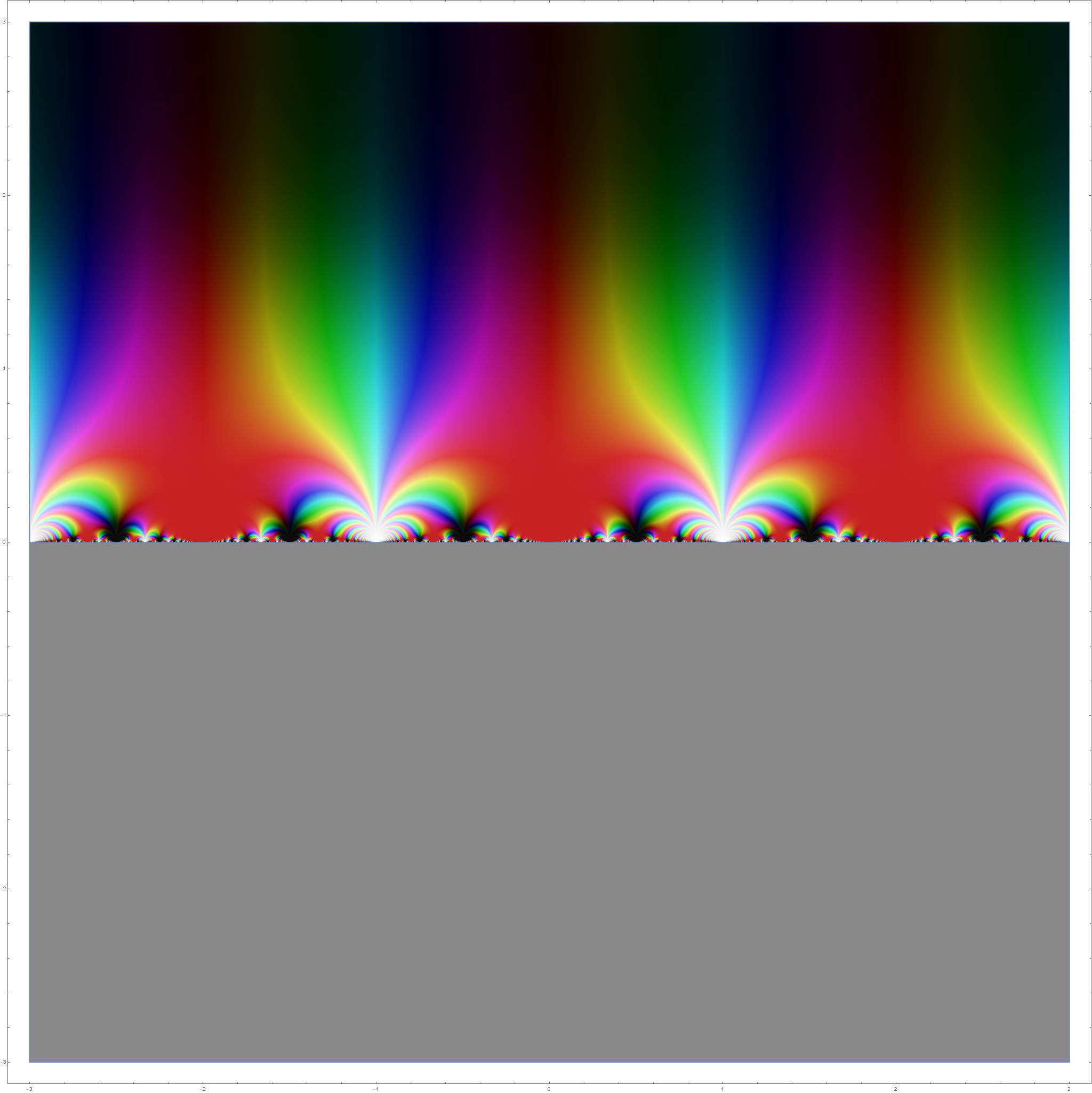
Symmetric holomorphic function
In mathematics, the modular lambda function λ(τ)\lambda(\tau) is not a modular function (per the Wikipedia definition), but every modular function is a rational function in \lambda(\tau). Some authors use a non-equivalent definition of "modular functions". is a highly symmetric holomorphic function on the complex upper half-plane. It is invariant under the fractional linear action of the congruence group Γ(2), and generates the function field of the corresponding quotient, i.e., it is a Hauptmodul for the modular curve X(2). Over any point τ, its value can be described as a cross ratio of the branch points of a ramified double cover of the projective line by the elliptic curve \mathbb{C}/\langle 1, \tau \rangle, where the map is defined as the quotient by the [−1] involution.
The q-expansion, where q = e^{\pi i \tau} is the nome, is given by:
: \lambda(\tau) = 16q - 128q^2 + 704 q^3 - 3072q^4 + 11488q^5 - 38400q^6 + \dots.
By symmetrizing the lambda function under the canonical action of the symmetric group S3 on X(2), and then normalizing suitably, one obtains a function on the upper half-plane that is invariant under the full modular group \operatorname{SL}_2(\mathbb{Z}), and it is in fact Klein's modular j-invariant.

Modular properties
The function \lambda(\tau) is invariant under the group generated by
: \tau \mapsto \tau+2 \ ;\ \tau \mapsto \frac{\tau}{1-2\tau} \ .
The generators of the modular group act by
: \tau \mapsto \tau+1 \ :\ \lambda \mapsto \frac{\lambda}{\lambda-1} , ; : \tau \mapsto -\frac{1}{\tau} \ :\ \lambda \mapsto 1 - \lambda \ .
Consequently, the action of the modular group on \lambda(\tau) is that of the anharmonic group, giving the six values of the cross-ratio:
: \left\lbrace { \lambda, \frac{1}{1-\lambda}, \frac{\lambda-1}{\lambda}, \frac{1}{\lambda}, \frac{\lambda}{\lambda-1}, 1-\lambda } \right\rbrace \ .
Relations to other functions
It is the square of the elliptic modulus, that is, \lambda(\tau)=k^2(\tau). In terms of the Dedekind eta function \eta(\tau) and theta functions,
: \lambda(\tau) = \Bigg(\frac{\sqrt{2},\eta(\tfrac{\tau}{2})\eta^2(2\tau)}{\eta^3(\tau)}\Bigg)^8 = \frac{16}{\left(\frac{\eta(\tau/2)}{\eta(2\tau)}\right)^8 + 16} =\frac{\theta_2^4(\tau)}{\theta_3^4(\tau)}
and,
: \frac{1}{\big(\lambda(\tau)\big)^{1/4}}-\big(\lambda(\tau)\big)^{1/4} = \frac{1}{2}\left(\frac{\eta(\tfrac{\tau}{4})}{\eta(\tau)}\right)^4 = 2,\frac{\theta_4^2(\tfrac{\tau}{2})}{\theta_2^2(\tfrac{\tau}{2})}
where
:\theta_2(\tau) =\sum_{n=-\infty}^\infty e^{\pi i\tau (n+1/2)^2}
:\theta_3(\tau) = \sum_{n=-\infty}^\infty e^{\pi i\tau n^2}
:\theta_4(\tau) = \sum_{n=-\infty}^\infty (-1)^n e^{\pi i\tau n^2}
In terms of the half-periods of Weierstrass's elliptic functions, let [\omega_1,\omega_2] be a fundamental pair of periods with \tau=\frac{\omega_2}{\omega_1}.
: e_1 = \wp\left(\frac{\omega_1}{2}\right), \quad e_2 = \wp\left(\frac{\omega_2}{2}\right),\quad e_3 = \wp\left(\frac{\omega_1+\omega_2}{2}\right)
we have
: \lambda = \frac{e_3-e_2}{e_1-e_2} , .
Since the three half-period values are distinct, this shows that \lambda does not take the value 0 or 1.
The relation to the j-invariant is
: j(\tau) = \frac{256(1-\lambda(1-\lambda))^3}{(\lambda(1-\lambda))^2} = \frac{256(1-\lambda+\lambda^2)^3}{\lambda^2 (1-\lambda)^2} \ .
which is the j-invariant of the elliptic curve of Legendre form y^2=x(x-1)(x-\lambda)
Given m\in\mathbb{C}\setminus{0,1}, let :\tau=i\frac{K{1-m}}{K{m}} where K is the complete elliptic integral of the first kind with parameter m=k^2. Then :\lambda (\tau)=m.
Modular equations
The modular equation of degree p (where p is a prime number) is an algebraic equation in \lambda (p\tau) and \lambda (\tau). If \lambda (p\tau)=u^8 and \lambda (\tau)=v^8, the modular equations of degrees p=2,3,5,7 are, respectively, :(1+u^4)^2v^8-4u^4=0, :u^4-v^4+2uv(1-u^2v^2)=0, :u^6-v^6+5u^2v^2(u^2-v^2)+4uv(1-u^4v^4)=0, :(1-u^8)(1-v^8)-(1-uv)^8=0. The quantity v (and hence u) can be thought of as a holomorphic function on the upper half-plane \operatorname{Im}\tau0: :\begin{align}v&=\prod_{k=1}^\infty \tanh\frac{(k-1/2)\pi i}{\tau}=\sqrt{2}e^{\pi i\tau/8}\frac{\sum_{k\in\mathbb{Z}}e^{(2k^2+k)\pi i\tau}}{\sum_{k\in\mathbb{Z}}e^{k^2\pi i\tau}}\ &=\cfrac{\sqrt{2}e^{\pi i\tau/8}}{1+\cfrac{e^{\pi i\tau}}{1+e^{\pi i\tau}+\cfrac{e^{2\pi i\tau}}{1+e^{2\pi i\tau}+\cfrac{e^{3\pi i\tau}}{1+e^{3\pi i\tau}+\ddots}}}}\end{align} Since \lambda(i)=1/2, the modular equations can be used to give algebraic values of \lambda(pi) for any prime p.For any prime power, we can iterate the modular equation of degree p. This process can be used to give algebraic values of \lambda (ni) for any n\in\mathbb{N}. The algebraic values of \lambda(ni) are also given by\operatorname{sl}a\varpi is algebraic for every a\in\mathbb{Q}. :\lambda (ni)=\prod_{k=1}^{n/2} \operatorname{sl}^8\frac{(2k-1)\varpi}{2n}\quad (n,\text{even}) :\lambda (ni)=\frac{1}{2^n}\prod_{k=1}^{n-1} \left(1-\operatorname{sl}^2\frac{k\varpi}{n}\right)^2\quad (n,\text{odd}) where \operatorname{sl} is the lemniscate sine and \varpi is the lemniscate constant.
Lambda-star
Definition and computation of lambda-star
The function \lambda^*(x) (where x\in\mathbb{R}^+) gives the value of the elliptic modulus k, for which the complete elliptic integral of the first kind K(k) and its complementary counterpart K(\sqrt{1-k^2}) are related by following expression:
:\frac{K\left[\sqrt{1-\lambda^(x)^2}\right]}{K[\lambda^(x)]} = \sqrt{x}
The values of \lambda^*(x) can be computed as follows:
:\lambda^*(x) = \frac{\theta^2_2(i\sqrt{x})}{\theta^2_3(i\sqrt{x})}
:\lambda^*(x) = \left[\sum_{a=-\infty}^\infty\exp[-(a+1/2)^2\pi\sqrt{x}]\right]^2\left[\sum_{a=-\infty}^\infty\exp(-a^2\pi\sqrt{x})\right]^{-2}
:\lambda^*(x) = \left[\sum_{a=-\infty}^\infty\operatorname{sech}[(a+1/2)\pi\sqrt{x}]\right]\left[\sum_{a=-\infty}^\infty\operatorname{sech}(a\pi\sqrt{x})\right]^{-1}
The functions \lambda^* and \lambda are related to each other in this way:
:\lambda^*(x) = \sqrt{\lambda(i\sqrt{x})}
Properties of lambda-star
Every \lambda^* value of a positive rational number is a positive algebraic number:
:\lambda^*(x) \in \overline{\mathbb{Q}}_+ \quad \forall x\in\mathbb{Q}^+.
K(\lambda^(x)) and E(\lambda^(x)) (the complete elliptic integral of the second kind) can be expressed in closed form in terms of the gamma function for any x\in\mathbb{Q}^+, as Selberg and Chowla proved in 1949.
The following expression is valid for all n \in \mathbb{N}:
:\sqrt{n} = \sum_{a = 1}^{n} \operatorname{dn}\left[\frac{2a}{n}K\left[\lambda^\left(\frac{1}{n}\right)\right];\lambda^\left(\frac{1}{n}\right)\right]
where \operatorname{dn} is the Jacobi elliptic function delta amplitudinis with modulus k.
By knowing one \lambda^* value, this formula can be used to compute related \lambda^* values:
:\lambda^(n^2x) = \lambda^(x)^n\prod_{a=1}^{n}\operatorname{sn}\left{\frac{2a-1}{n}K[\lambda^(x)];\lambda^(x)\right}^2
where n\in\mathbb{N} and \operatorname{sn} is the Jacobi elliptic function sinus amplitudinis with modulus k.
Further relations:
:\lambda^(x)^2 + \lambda^(1/x)^2 = 1
:[\lambda^(x)+1][\lambda^(4/x)+1] = 2
:\lambda^(4x) = \frac{1-\sqrt{1-\lambda^(x)^2}}{1+\sqrt{1-\lambda^(x)^2}} = \tan\left{\frac{1}{2}\arcsin[\lambda^(x)]\right}^2
:\lambda^(x) - \lambda^(9x) = 2[\lambda^(x)\lambda^(9x)]^{1/4} - 2[\lambda^(x)\lambda^(9x)]^{3/4}
\begin{align} & a^{6}-f^{6} = 2af +2a^5f^5, &\left(a = \left[\frac{2\lambda^(x)}{1-\lambda^(x)^2}\right]^{1/12}\right) &\left(f = \left[\frac{2\lambda^(25x)}{1-\lambda^(25x)^2}\right]^{1/12}\right) \ &a^{8}+b^{8}-7a^4b^4 = 2\sqrt{2}ab+2\sqrt{2}a^7b^7, &\left(a = \left[\frac{2\lambda^(x)}{1-\lambda^(x)^2}\right]^{1/12}\right) &\left(b = \left[\frac{2\lambda^(49x)}{1-\lambda^(49x)^2}\right]^{1/12}\right) \
& a^{12}-c^{12} = 2\sqrt{2}(ac+a^3c^3)(1+3a^2c^2+a^4c^4)(2+3a^2c^2+2a^4c^4), &\left(a = \left[\frac{2\lambda^(x)}{1-\lambda^(x)^2}\right]^{1/12}\right) &\left(c = \left[\frac{2\lambda^(121x)}{1-\lambda^(121x)^2}\right]^{1/12}\right) \
& (a^2-d^2)(a^4+d^4-7a^2d^2)[(a^2-d^2)^4-a^2d^2(a^2+d^2)^2] = 8ad+8a^{13}d^{13}, &\left(a = \left[\frac{2\lambda^(x)}{1-\lambda^(x)^2}\right]^{1/12}\right) &\left(d = \left[\frac{2\lambda^(169x)}{1-\lambda^(169x)^2}\right]^{1/12}\right) \end{align}
Lambda-star values of integer numbers of 4n-3-type:
:\lambda^*(1) = \frac{1}{\sqrt{2}}
:\lambda^*(5) = \sin\left[\frac{1}{2}\arcsin\left(\sqrt{5}-2\right)\right]
:\lambda^*(9) = \frac{1}{2}(\sqrt{3}-1)(\sqrt{2}-\sqrt[4]{3})
:\lambda^*(13) = \sin\left[\frac{1}{2}\arcsin(5\sqrt{13}-18)\right]
:\lambda^*(17) = \sin\left{\frac{1}{2}\arcsin\left[\frac{1}{64}\left(5+\sqrt{17}-\sqrt{10\sqrt{17}+26}\right)^3\right]\right}
:\lambda^*(21) = \sin\left{\frac{1}{2}\arcsin[(8-3\sqrt{7})(2\sqrt{7}-3\sqrt{3})]\right}
:\lambda^*(25) = \frac{1}{\sqrt{2}}(\sqrt{5}-2)(3-2\sqrt[4]{5})
:\lambda^*(33) = \sin\left{\frac{1}{2}\arcsin[(10-3\sqrt{11})(2-\sqrt{3})^3]\right}
:\lambda^*(37) = \sin\left{\frac{1}{2}\arcsin[(\sqrt{37}-6)^3]\right}
:\lambda^*(45) = \sin\left{\frac{1}{2}\arcsin[(4-\sqrt{15})^2(\sqrt{5}-2)^3]\right}
:\lambda^*(49) = \frac{1}{4}(8+3\sqrt{7})(5-\sqrt{7}-\sqrt[4]{28})\left(\sqrt{14}-\sqrt{2}-\sqrt[8]{28}\sqrt{5-\sqrt{7}}\right)
:\lambda^*(57) = \sin\left{\frac{1}{2}\arcsin[(170-39\sqrt{19})(2-\sqrt{3})^3]\right}
:\lambda^*(73) = \sin\left{\frac{1}{2}\arcsin\left[\frac{1}{64}\left(45+5\sqrt{73}-3\sqrt{50\sqrt{73}+426}\right)^3\right]\right}
Lambda-star values of integer numbers of 4n-2-type:
:\lambda^*(2) = \sqrt{2}-1
:\lambda^*(6) = (2-\sqrt{3})(\sqrt{3}-\sqrt{2})
:\lambda^*(10) = (\sqrt{10}-3)(\sqrt{2}-1)^2
:\lambda^*(14) = \tan\left{\frac{1}{2}\arctan\left[\frac{1}{8}\left(2\sqrt{2}+1-\sqrt{4\sqrt{2}+5}\right)^3\right]\right}
:\lambda^*(18) = (\sqrt{2}-1)^3(2-\sqrt{3})^2
:\lambda^*(22) = (10-3\sqrt{11})(3\sqrt{11}-7\sqrt{2})
:\lambda^*(30) = \tan\left{\frac{1}{2}\arctan[(\sqrt{10}-3)^2(\sqrt{5}-2)^2]\right}
:\lambda^*(34) = \tan\left{\frac{1}{4}\arcsin\left[\frac{1}{9}(\sqrt{17}-4)^2\right]\right}
:\lambda^*(42) = \tan\left{\frac{1}{2}\arctan[(2\sqrt{7}-3\sqrt{3})^2(2\sqrt{2}-\sqrt{7})^2]\right}
:\lambda^*(46) = \tan\left{\frac{1}{2}\arctan\left[\frac{1}{64}\left(3+\sqrt{2}-\sqrt{6\sqrt{2}+7}\right)^6\right]\right}
:\lambda^*(58) = (13\sqrt{58}-99)(\sqrt{2}-1)^6
:\lambda^*(70) = \tan\left{\frac{1}{2}\arctan[(\sqrt{5}-2)^4(\sqrt{2}-1)^6]\right}
:\lambda^*(78) = \tan\left{\frac{1}{2}\arctan[(5\sqrt{13}-18)^2(\sqrt{26}-5)^2]\right}
:\lambda^*(82) = \tan\left{\frac{1}{4}\arcsin\left[\frac{1}{4761}(8\sqrt{41}-51)^2\right]\right}
Lambda-star values of integer numbers of 4n-1-type:
:\lambda^*(3) = \frac{1}{2\sqrt{2}}(\sqrt{3}-1)
:\lambda^*(7) = \frac{1}{4\sqrt{2}}(3-\sqrt{7})
:\lambda^*(11) = \frac{1}{8\sqrt{2}}(\sqrt{11}+3)\left(\frac{1}{3}\sqrt[3]{6\sqrt{3}+2\sqrt{11}}-\frac{1}{3}\sqrt[3]{6\sqrt{3}-2\sqrt{11}}+\frac{1}{3}\sqrt{11}-1\right)^4
:\lambda^*(15) = \frac{1}{8\sqrt{2}}(3-\sqrt{5})(\sqrt{5}-\sqrt{3})(2-\sqrt{3})
:\lambda^*(19) = \frac{1}{8\sqrt{2}}(3\sqrt{19}+13)\left[\frac{1}{6}(\sqrt{19}-2+\sqrt{3})\sqrt[3]{3\sqrt{3}-\sqrt{19}}-\frac{1}{6}(\sqrt{19}-2-\sqrt{3})\sqrt[3]{3\sqrt{3}+\sqrt{19}}-\frac{1}{3}(5-\sqrt{19})\right]^4
:\lambda^*(23) = \frac{1}{16\sqrt{2}}(5+\sqrt{23})\left[\frac{1}{6}(\sqrt{3}+1)\sqrt[3]{100-12\sqrt{69}}-\frac{1}{6}(\sqrt{3}-1)\sqrt[3]{100+12\sqrt{69}}+\frac{2}{3}\right]^4
:\lambda^*(27) = \frac{1}{16\sqrt{2}}(\sqrt{3}-1)^3\left[\frac{1}{3}\sqrt{3}(\sqrt[3]{4}-\sqrt[3]{2}+1)-\sqrt[3]{2}+1\right]^4
:\lambda^*(39) = \sin\left{\frac{1}{2}\arcsin\left[\frac{1}{16}\left(6-\sqrt{13}-3\sqrt{6\sqrt{13}-21}\right)\right]\right}
:\lambda^*(55) = \sin\left{\frac{1}{2}\arcsin\left[\frac{1}{512}\left(3\sqrt{5}-3-\sqrt{6\sqrt{5}-2}\right)^3\right]\right}
Lambda-star values of integer numbers of 4n-type:
:\lambda^*(4) = (\sqrt{2}-1)^2
:\lambda^*(8) = \left(\sqrt{2}+1-\sqrt{2\sqrt{2}+2}\right)^2
:\lambda^*(12) = (\sqrt{3}-\sqrt{2})^2(\sqrt{2}-1)^2
:\lambda^*(16) = (\sqrt{2}+1)^2(\sqrt[4]{2}-1)^4
:\lambda^*(20) = \tan\left[\frac{1}{4}\arcsin(\sqrt{5}-2)\right]^2
:\lambda^*(24) = \tan\left{\frac{1}{2}\arcsin[(2-\sqrt{3})(\sqrt{3}-\sqrt{2})]\right}^2
:\lambda^*(28) = (2\sqrt{2}-\sqrt{7})^2(\sqrt{2}-1)^4
:\lambda^*(32) = \tan\left{\frac{1}{2}\arcsin\left[\left(\sqrt{2}+1-\sqrt{2\sqrt{2}+2}\right)^2\right]\right}^2
Lambda-star values of rational fractions:
:\lambda^*\left(\frac{1}{2}\right) = \sqrt{2\sqrt{2}-2}
:\lambda^*\left(\frac{1}{3}\right) = \frac{1}{2\sqrt{2}}(\sqrt{3}+1)
:\lambda^*\left(\frac{2}{3}\right) = (2-\sqrt{3})(\sqrt{3}+\sqrt{2})
:\lambda^*\left(\frac{1}{4}\right) = 2\sqrt[4]{2}(\sqrt{2}-1)
:\lambda^*\left(\frac{3}{4}\right) = \sqrt[4]{8}(\sqrt{3}-\sqrt{2})(\sqrt{2}+1)\sqrt{(\sqrt{3}-1)^3}
:\lambda^*\left(\frac{1}{5}\right) = \frac{1}{2\sqrt{2}}\left(\sqrt{2\sqrt{5}-2}+\sqrt{5}-1\right)
:\lambda^*\left(\frac{2}{5}\right) = (\sqrt{10}-3)(\sqrt{2}+1)^2
:\lambda^*\left(\frac{3}{5}\right) = \frac{1}{8\sqrt{2}}(3+\sqrt{5})(\sqrt{5}-\sqrt{3})(2+\sqrt{3})
:\lambda^*\left(\frac{4}{5}\right) = \tan\left[\frac{\pi}{4}-\frac{1}{4}\arcsin(\sqrt{5}-2)\right]^2
Ramanujan's class invariants
Ramanujan's class invariants G_n and g_n are defined as :G_n=2^{-1/4}e^{\pi\sqrt{n}/24}\prod_{k=0}^\infty \left(1+e^{-(2k+1)\pi\sqrt{n}}\right), :g_n=2^{-1/4}e^{\pi\sqrt{n}/24}\prod_{k=0}^\infty \left(1-e^{-(2k+1)\pi\sqrt{n}}\right), where n\in\mathbb{Q}^+. For such n, the class invariants are algebraic numbers. For example
:g_{58}=\sqrt{\frac{5+\sqrt{29}}{2}}, \quad g_{190}=\sqrt{(\sqrt{5}+2)(\sqrt{10}+3)}.
Identities with the class invariants include
:G_n=G_{1/n},\quad g_{n}=\frac{1}{g_{4/n}},\quad g_{4n}=2^{1/4}g_nG_n.
The class invariants are very closely related to the Weber modular functions \mathfrak{f} and \mathfrak{f}_1. These are the relations between lambda-star and the class invariants:
:G_n = \sin{2\arcsin[\lambda^(n)]}^{-1/12} = 1\Big /\left[\sqrt[12]{2\lambda^(n)}\sqrt[24]{1-\lambda^*(n)^2}\right]
:g_n = \tan{2\arctan[\lambda^(n)]}^{-1/12} = \sqrt[12]{[1-\lambda^(n)^2]/[2\lambda^*(n)]}
:\lambda^*(n) = \tan\left{ \frac{1}{2}\arctan[g_n^{-12}]\right} = \sqrt{g_n^{24}+1}-g_n^{12}
Other appearances
Little Picard theorem
The lambda function is used in the original proof of the Little Picard theorem, that an entire non-constant function on the complex plane cannot omit more than one value. This theorem was proved by Picard in 1879. Suppose if possible that f is entire and does not take the values 0 and 1. Since λ is holomorphic, it has a local holomorphic inverse ω defined away from 0,1,∞. Consider the function z → ω(f(z)). By the Monodromy theorem this is holomorphic and maps the complex plane C to the upper half plane. From this it is easy to construct a holomorphic function from C to the unit disc, which by Liouville's theorem must be constant.
Moonshine
The function \tau\mapsto 16/\lambda(2\tau) - 8 is the normalized Hauptmodul for the group \Gamma_0(4), and its q-expansion q^{-1} + 20q - 62q^3 + \dots, where q=e^{2\pi i\tau }, is the graded character of any element in conjugacy class 4C of the monster group acting on the monster vertex algebra.
Footnotes
References
Notes
Other
-
Borwein, J. M. and Borwein, P. B. Pi & the AGM: A Study in Analytic Number Theory and Computational Complexity. New York: Wiley, pp. 139 and 298, 1987.
-
Conway, J. H. and Norton, S. P. "Monstrous Moonshine." Bull. London Math. Soc. 11, 308-339, 1979.
-
Selberg, A. and Chowla, S. "On Epstein's Zeta-Function." J. reine angew. Math. 227, 86-110, 1967.
References
- Chandrasekharan (1985) p.115
- Chandrasekharan (1985) p.109
- Chandrasekharan (1985) p.110
- Chandrasekharan (1985) p.108
- Chandrasekharan (1985) p.63
- Chandrasekharan (1985) p.117
- Rankin (1977) pp.226–228
- (1987). "Pi and the AGM: A Study in Analytic Number Theory and Computational Complexity". Wiley-Interscience.
- (1829). "Fundamenta nova theoriae functionum ellipticarum".
- (1987). "Pi and the AGM: A Study in Analytic Number Theory and Computational Complexity". Wiley-Interscience.
- (1949). "On Epstein's Zeta Function (I).". Proceedings of the National Academy of Sciences.
- "On Epstein's Zeta-Function".
- (6 June 1997). "Ramanujan's class invariants, Kronecker's limit formula, and modular equations". Transactions of the American Mathematical Society.
- (1999). "Autour du nombre Pi". HERMANN.
- Chandrasekharan (1985) p.121
- Chandrasekharan (1985) p.118
This article was imported from Wikipedia and is available under the Creative Commons Attribution-ShareAlike 4.0 License. Content has been adapted to SurfDoc format. Original contributors can be found on the article history page.
Ask Mako anything about Modular lambda function — get instant answers, deeper analysis, and related topics.
Research with MakoFree with your Surf account
Create a free account to save articles, ask Mako questions, and organize your research.
Sign up freeThis content may have been generated or modified by AI. CloudSurf Software LLC is not responsible for the accuracy, completeness, or reliability of AI-generated content. Always verify important information from primary sources.
Report