From Surf Wiki (app.surf) — the open knowledge base
Mizuhopecten yessoensis
Species of mollusc
_(15152229484).jpg)
Species of mollusc
Patinopecten yessoensis (Jay, 1857) Mizuhopecten yessoensis (Yesso scallop, giant Ezo scallop) is a species of marine bivalve mollusks in the family Pectinidae, the scallops. Its name Yesso/Ezo refers to its being found north of Japan.
Its tissues bioaccumulate algal yessotoxins and are studied extensively.
Description
The Yesso scallop (Mizuhopecten yessoensis) is a cold water marine bivalve species. The valves have a convex center with a smooth exterior shell. On one side it is white and on the other dark brown.
Habitat
The Yesso scallop is widely distributed along the cold coast of Northern Japan. Scallop cultivation is located in the northern islands of Honshu and Hokkaido, with the Sea of Okhotsk, Saroma Lake and Funka Bay in Hokkaido accounting for more than 80% of the scallop production during the period of 1991 to 2002.
Ecology and behavior
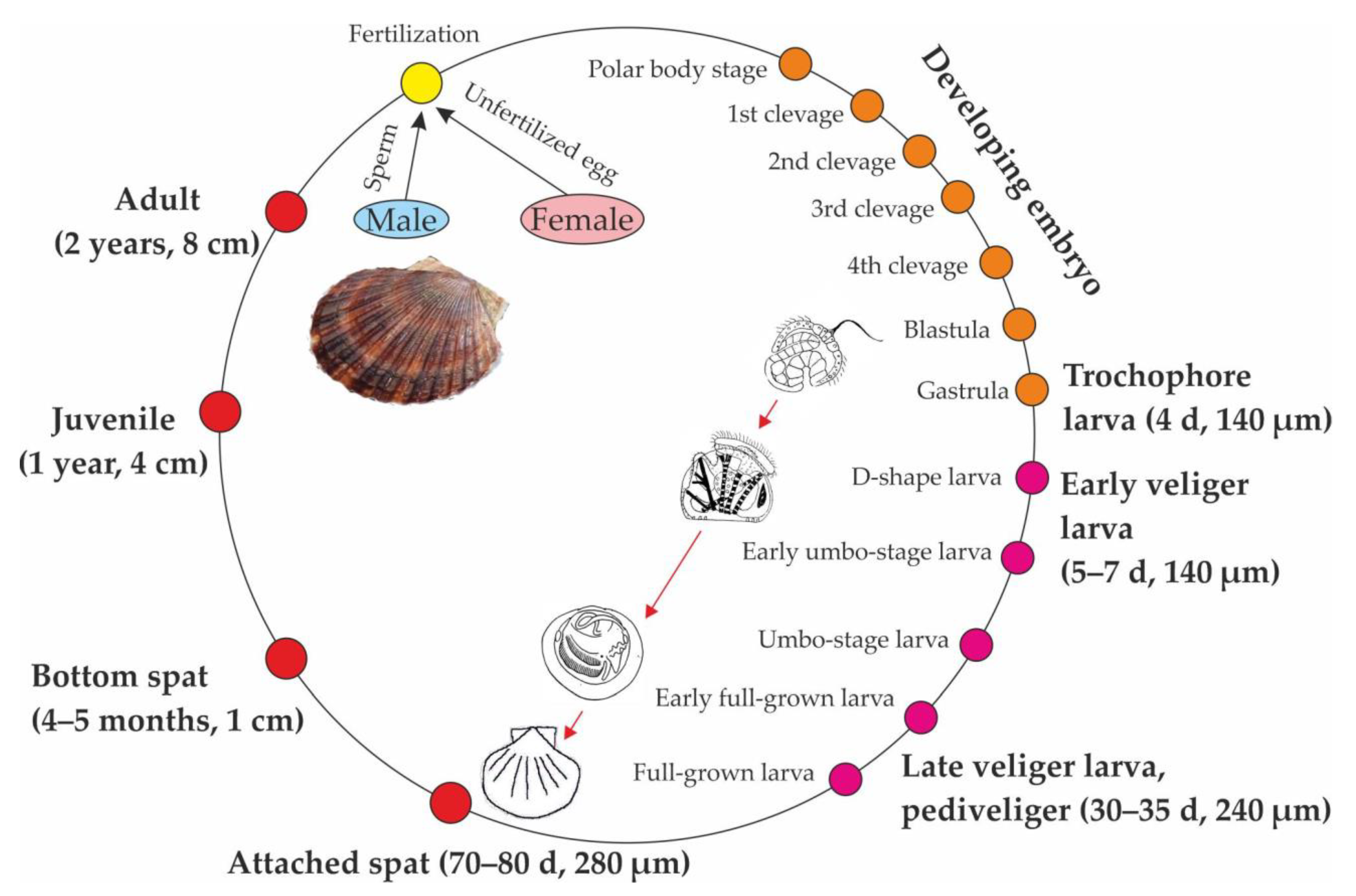
Temperature plays a key role in the timing of spawning and larvae settlement of the Yesso scallop. Generally, the scallops spawn between May 1 to June 9 over the span of 10 days. It was found that the timing for the commencement of spawning is shifted to a later date when the surface temperature of the water remains below 0°C for a prolonged period. In addition, lower temperatures throughout April could potentially influence the onset timing of scallop spawning. Furthermore, the shortening of pre-spawning period (dates between the surface water temperature rise above zero to May 1) may be another contributing factor to the later dates of spawning. On the other hand, the timing of scallop spat settlement is closely related to water temperature too; the colder the pre-spawning period, the later the larvae settlement. The commencement of the Yesso Scallop larvae settlement is typically between June 4 to July 5 over the period of 15 days. The upper limit for scallop development was found to be 18°C.
Development
The growth of scallops also varies with the water temperature. When the water is warm and below 18°C, the scallops tend to grow most rapidly between the age of 2 and 4. On the other hand, they often reach the peak of their growing ability between 3 and 5 years of age in colder environments. Consequently, it was established that the Japanese scallop Mizuhopecten yessoensis experiences the lowest mortality rate between the age of 2 and 5. Starting from the age of 6 to 7, the mortality rate rises dramatically.[[File:Yesso scallop total production thousand tonnes 1950-2022.svg|thumb|Capture (blue) and aquaculture (green) production of Yesso scallop (Mizuhopecten yessoensis) in thousand tonnes from 1950 to 2022, as reported by the [[Food and Agriculture Organization|FAO]]]]
Predation
The main predators of the Yesso scallops are the sea stars Asterias amurensis and Distolasterias nipon. The scallops are preyed on one after the other, and it was found that smaller scallops are preferred over larger ones. Scallops found in warmer waters are also more likely to be preyed upon. Due to the morphological differences between D. nipon and A. amurensis, D. nipon had a much greater influence on the predation of the Yesso scallops.
Diet
The scallops depend on sinking organic matter for food, with detritus being their main source of food. These organic matter are from rivers being drained nearby. Another source of food for the scallops are dissolved organic carbon from phytoplankton production.
As food
In Japan, it is known as hotate-gai, and the adductor muscle is eaten raw as sashimi and sushi. In China, it is sometimes dried to make conpoy, usually described as "Japanese conpoy".
File:Aomori prefecture Hiranai town Mutsu Bay scallops IMG 6913.jpg|Raw adductor muscles from scallops in Mutsu Bay File:寿司めいじん, 廣島, Hiroshima (6238401358).jpg|As sushi File:Dried japanese scallops.jpg|Dried conpoy in Singapore
References
References
- (2015-04-09). "Characterization of the mantle transcriptome of yesso scallop (Patinopecten yessoensis): identification of genes potentially involved in biomineralization and pigmentation". PLOS ONE.
- (November 2008). "GIS-based multi-criteria evaluation models for identifying suitable sites for Japanese scallop (Mizuhopecten yessoensis) aquaculture in Funka Bay, southwestern Hokkaido, Japan". Aquaculture.
- (2022-05-19). "Biological Aspects, Fisheries, and Aquaculture of Yesso Scallops in Russian Waters of the Sea of Japan". MDPI AG.
- (December 2020). "The Effects of Water Temperature on the Timing of Spawning and Spat Settlement of the Yesso Scallop (Mizuhopecten yessoensis Jay, 1857) in Minonosok Cove (Posyet Bay, Peter the Great Bay, Sea of Japan)". Russian Journal of Marine Biology.
- (May 1996). "Mortality of late juvenile and adult stages of the scallop Mizuhopecten yessoensis (Jay)". Aquaculture.
- "Fisheries and Aquaculture - Global Production".
- (September 2019). "Interactions between predatory sea stars ( Asterias amurensis and Distolasterias nipon ) and Japanese scallops ( Mizuhopecten yessoensis ) and implications for scallop seeding in mariculture". Aquaculture Research.
- (August 2007). "Isotopic Determination of Japanese Scallop Patinopecten (Mizuhopecten) Yessoensis (Jay) Tissues Shows Habitat-Related Differences in Food Sources". Journal of Shellfish Research.
This article was imported from Wikipedia and is available under the Creative Commons Attribution-ShareAlike 4.0 License. Content has been adapted to SurfDoc format. Original contributors can be found on the article history page.
Ask Mako anything about Mizuhopecten yessoensis — get instant answers, deeper analysis, and related topics.
Research with MakoFree with your Surf account
Create a free account to save articles, ask Mako questions, and organize your research.
Sign up freeThis content may have been generated or modified by AI. CloudSurf Software LLC is not responsible for the accuracy, completeness, or reliability of AI-generated content. Always verify important information from primary sources.
Report