From Surf Wiki (app.surf) — the open knowledge base
Mittag-Leffler function
Mathematical function
Mathematical function
In mathematics, the Mittag-Leffler functions are a family of special functions. They are complex-valued functions of a complex argument z, and moreover depend on one or two complex parameters.
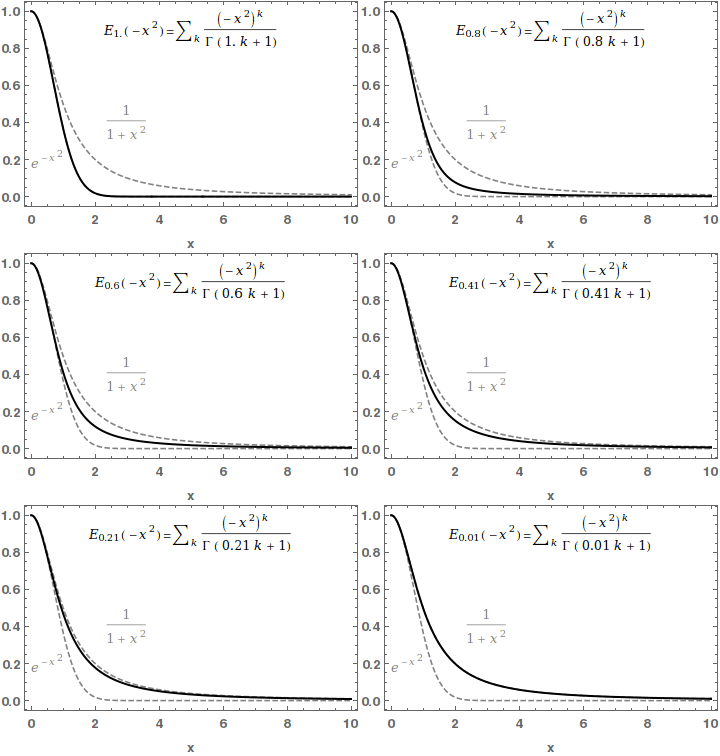
The one-parameter Mittag-Leffler function, introduced by Gösta Mittag-Leffler in 1903, can be defined by the Maclaurin series
:E_{\alpha} (z) = \sum_{k=0}^\infty \frac{z^k}{\Gamma(\alpha k + 1)},
where \Gamma(x) is the gamma function, and \alpha is a complex parameter with \operatorname{Re}\left(\alpha \right) 0.
The two-parameter Mittag-Leffler function, introduced by Wiman in 1905, is occasionally called the generalized Mittag-Leffler function. It has an additional complex parameter \beta, and may be defined by the series
:E_{\alpha, \beta} (z) = \sum_{k=0}^\infty \frac{z^k}{\Gamma(\alpha k + \beta)},
When \beta=1, the one-parameter function E_\alpha = E_{\alpha,1} is recovered.
In the case \alpha and \beta are real and positive, the series converges for all values of the argument z, so the Mittag-Leffler function is an entire function. This class of functions are important in the theory of the fractional calculus.
See below for three-parameter generalizations.
Some basic properties
For \alpha 0 , the Mittag-Leffler function E_{\alpha,\beta}(z) is an entire function of order 1/\alpha, and type 1 for any value of \beta. In some sense, the Mittag-Leffler function is the simplest entire function of its order. The indicator function of E_{\alpha}(z) is h_{E_\alpha}(\theta)=\begin{cases}\cos\left(\frac{\theta}{\alpha}\right),&\text{for }|\theta|\le\frac 1 2 \alpha\pi;\0,&\text{otherwise}.\end{cases} This result actually holds for \beta\neq1 as well with some restrictions on \beta when \alpha=1.
The Mittag-Leffler function satisfies the recurrence property (Theorem 5.1 of )
:E_{\alpha,\beta}(z)=\frac{1}{z}E_{\alpha,\beta-\alpha}(z)-\frac{1}{z \Gamma(\beta-\alpha)}, from which the following asymptotic expansion holds : for 0 and \mu real such that \frac{\pi\alpha}{2} then for all N\in\mathbb{N}^*, N\neq 1, we can show the following asymptotic expansions (Section 6. of ):
-as ,|z|\to+\infty, |\text{arg}(z)|\leq \mu:
:E_{\alpha}(z) = \frac{1}{\alpha} \exp(z^{\frac{1}{\alpha}}) - \sum\limits_{k=1}^{N} \frac{1}{z^k, \Gamma(1-\alpha k)} + O\left(\frac{1}{z^{N+1}}\right),
-and as ,|z|\to+\infty, \mu\leq|\text{arg}(z)|\leq\pi:
:E_{\alpha}(z) = - \sum\limits_{k=1}^N \frac{1}{z^k\Gamma(1-\alpha k)} + O\left(\frac{1}{z^{N+1}}\right).
A simpler estimate that can often be useful is given, thanks to the fact that the order and type of E_{\alpha,\beta}(z) is 1/\alpha and 1, respectively: :|E_{\alpha,\beta}(z)|\le C\exp\left(\sigma|z|^{1/\alpha}\right) for any positive C and any \sigma1.
Special cases
For \alpha=0, the series above equals the Taylor expansion of the geometric series and consequently E_{0,\beta}(z)=\frac{1}{\Gamma(\beta)}\frac{1}{1-z}.
For \alpha=1/2,1,2 we find: (Section 2 of )
Error function:
:E_{\frac{1}{2}}(z) = \exp(z^2)\operatorname{erfc}(-z).
Exponential function: :E_{1}(z) = \sum_{k=0}^\infty \frac{z^k}{\Gamma (k + 1)} = \sum_{k=0}^\infty \frac{z^k}{k!} = \exp(z).
Hyperbolic cosine: :E_{2}(z) = \cosh(\sqrt{z}), \text{ and } E_{2}(-z^2) = \cos(z).
For \beta=2, we have
:E_{1,2}(z) = \frac{e^z-1}{z}, :E_{2,2}(z) = \frac{\sinh(\sqrt{z})}{\sqrt{z}}.
For \alpha=0,1,2, the integral
:\int_0^z E_{\alpha}(-s^2) , {\mathrm d}s
gives, respectively: \arctan(z), \tfrac{\sqrt{\pi}}{2}\operatorname{erf}(z), \sin(z).
Mittag-Leffler's integral representation
The integral representation of the Mittag-Leffler function is (Section 6 of )
:E_{\alpha,\beta}(z)=\frac{1}{2\pi i}\oint_C \frac{t^{\alpha-\beta}e^t}{t^\alpha-z} , dt, \Re(\alpha)0, \Re(\beta)0,
where the contour C starts and ends at -\infty and circles around the singularities and branch points of the integrand.
Related to the Laplace transform and Mittag-Leffler summation is the expression (Eq (7.5) of with m=0)
:\int_0^{\infty}e^{-t z} t^{\beta-1} E_{\alpha,\beta}(\pm r, t^\alpha) ,dt = \frac{z^{\alpha-\beta}}{z^{\alpha}\mp r}, \Re(z)0, \Re(\alpha)0, \Re(\beta)0.
Three-parameter generalizations
One generalization, characterized by three parameters, is
E_{\alpha,\beta}^\gamma(z)=\left ( \frac{1}{\Gamma(\gamma)} \right )\sum\limits_{k=1}^\infty \frac{\Gamma(\gamma + k)z^k}{k! \Gamma(\alpha k + \beta ) },
where \alpha, \beta and \gamma are complex parameters and \Re(\alpha)0.
Another generalization is the Prabhakar function
E_{\alpha, \beta}^{\gamma}(z) = \sum_{k=0}^{\infty} \frac{(\gamma)_k z^k}{k!\Gamma(\alpha k + \beta)},
where (\gamma)_k is the Pochhammer symbol.
Applications of Mittag-Leffler function
One of the applications of the Mittag-Leffler function is in modeling fractional order viscoelastic materials. Experimental investigations into the time-dependent relaxation behavior of viscoelastic materials are characterized by a very fast decrease of the stress at the beginning of the relaxation process and an extremely slow decay for large times, i.e. it takes a long time to approach a constant asymptotic value. Therefore, many Maxwell elements are required to describe relaxation behavior to sufficient accuracy. This results in a difficult optimization problem in order to identify the large number of material parameters required. On the other hand, over the years, the concept of fractional derivatives has been introduced into the theory of viscoelasticity. Among these models, the fractional Zener model was found to be very effective for predicting the dynamic nature of rubber-like materials using only a small number of material parameters. The solution of the corresponding constitutive equation leads to a relaxation function of the Mittag-Leffler type. It is defined by the power series with negative arguments. This function represents all essential properties of the relaxation process under the influence of an arbitrary and continuous signal with a jump at the origin.
Notes
- R Package 'MittagLeffleR' by Gurtek Gill, Peter Straka. Implements the Mittag-Leffler function, distribution, random variate generation, and estimation.
References
References
- Mittag-Leffler, M.G.: Sur la nouvelle fonction E(x). C. R. Acad. Sci. Paris 137, 554–558 (1903), and several more papers in the following years.
- Haubold,H J and Mathai,A M and Saxena,R K, [https://onlinelibrary.wiley.com/doi/epdf/10.1155/2011/298628 J Appl Math 2011, 298628]
- Anders Wiman, Über den Fundamentalsatz in der Teorie [sic] der Funktionen E_a(x), Acta Math 29, 191-201 (1905).
- Weisstein, Eric W.. "Mittag-Leffler Function".
- (1962). "Integral Functions". Cambridge Univ. Press.
- (2014). "Mittag-Leffler Functions, Related Topics and Applications: Theory and Applications". Springer Berlin Heidelberg.
- Pritz, T. (2003). Five-parameter fractional derivative model for polymeric damping materials. Journal of Sound and Vibration, 265(5), 935-952.
- Nonnenmacher, T. F., & Glöckle, W. G. (1991). A fractional model for mechanical stress relaxation. Philosophical magazine letters, 64(2), 89-93.
This article was imported from Wikipedia and is available under the Creative Commons Attribution-ShareAlike 4.0 License. Content has been adapted to SurfDoc format. Original contributors can be found on the article history page.
Ask Mako anything about Mittag-Leffler function — get instant answers, deeper analysis, and related topics.
Research with MakoFree with your Surf account
Create a free account to save articles, ask Mako questions, and organize your research.
Sign up freeThis content may have been generated or modified by AI. CloudSurf Software LLC is not responsible for the accuracy, completeness, or reliability of AI-generated content. Always verify important information from primary sources.
Report