From Surf Wiki (app.surf) — the open knowledge base
Mitsubishi Minicab
| Field | Value |
|---|---|
| name | Mitsubishi Minicab |
| image | Mitsubishi Minicab 2000.jpg |
| manufacturer | Mitsubishi Motors |
| Suzuki (seventh generation onwards) | |
| aka | Mitsubishi/CMC Veryca (Taiwan) |
| Mitsubishi Jetstar (Indonesia) | |
| Mitsubishi L100 | |
| Mitsubishi Multicab (Philippines) | |
| Nissan Clipper | |
| Suzuki Carry (2014–present) | |
| production | 1966–present |
| assembly | Japan: Kurashiki, Okayama (Mizushima plant) |
| class | Microvan |
| Kei truck | |
| Light commercial vehicle | |
| body_style | Van |
| Pickup truck | |
| related | Mitsubishi Town Box |
| engine | 359 cc ME24 two-stroke I2 |
| 359 cc 2G10 two-stroke I2 | |
| predecessor | Mitsubishi 360 |
Suzuki (seventh generation onwards) Mitsubishi Jetstar (Indonesia) Mitsubishi L100 Mitsubishi Multicab (Philippines) Nissan Clipper Suzuki Carry (2014–present) Kei truck Light commercial vehicle Pickup truck 359 cc 2G10 two-stroke I2
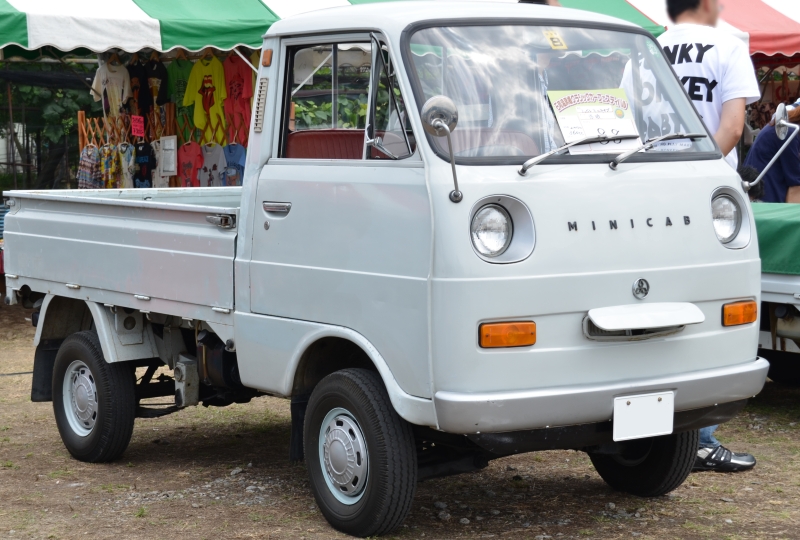
The Mitsubishi Minicab is a kei truck and microvan, built and sold in Japan by Japanese automaker Mitsubishi Motors since 1966. In Japan, it was sold at a specific retail chain called Galant Shop. It was also sold by China Motor Corporation (CMC) in Taiwan as the CMC Veryca, starting in 1985. A battery electric model of the Minicab, called the Minicab MiEV, is sold in the Japanese market since December 2011.
Since February 2014, the Mitsubishi Minicab is a rebadged Suzuki Carry, except for the Minicab MiEV/EV.
First generation
The Minicab cabover pickup truck was launched in 1966 to replace the 360 trucklet, which by this time had adopted the same model name as the Minica sedan. Codenamed LT30, it shared the sedan's air cooled, two-stroke, 359-cc ME24 engine, and was available with cargo gates on three sides to simplify loading and unloading. A van version was introduced in 1968, available in four different equipment levels. The T30 truck was replaced in 1971 by the new Minicab EL, but the van was kept in production (now also called the Minicab EL) and updated with a dummy grille and headlight surround. The air-cooled T30V with its 26 PS engine was kept in production until 1976, with no further modifications except a 1974 adjustment to fit larger license plates. The better-equipped Super Deluxe version received a version of the ME24 engine with 30 PS. About 224,766 first-generation Minicabs were built.
Second generation

In 1971, the Minicab underwent its first model change, with the Minicab EL offering a new interior and a longer cargo bed. Called the T130, it was only available in truck form, with the old LT30 van soldiering on until the third generation was introduced in 1976. The ME24 engine produced 30 PS in all T130 versions, which included a standard bed and a dropside bed with either Standard, DeLuxe, or Super DeLuxe equipment. Ride quality was improved with the adoption of a front wishbone and rear leaf spring suspension. The EL received all new bodywork with tiny rectangular headlamps.
A panel van was added to the Minicab truck lineup in 1972, when it also became the Minicab W with the new water-cooled 2G10 engine (hence the W). This model carries the T131 chassis code, and is easily identified by its reworked front end, reverting to round headlights. It also carries a prominent "W" on the front, beneath the left headlight. The grille was altered and the headlights made larger, yet in 1973, with the "W" replaced by a "Minicab" script. For 1975, the Minicab received an emissions-cleaned engine using Mitsubishi MCA technology, still with 28 PS. Nearly 210,000 second-generation Minicabs were built, making it the slowest-selling generation. The third generation, however, was mostly a heavily modified T130.
{{anchor|third|L012|L013|L015|Wide}} Third generation
| April 1976 – May 1984 | 1977–1986 (Indonesia) Yangmei, Taiwan Front-engine, four-wheel-drive | 471 cc 2G22 I2 | 546 cc 2G23/G23B I2 | 644 cc 2G24 I2
In April 1976, the third-generation Minicab was introduced. In keeping with the changes in vehicle tax regulations, the Minicab 5 (L012) featured an increase in length, and adopted the enlarged 471-cc Vulcan S engine from the car line, still with the same maximum power as the 360. It also incorporated new features such as a windscreen defroster, a central console box, and a central ventilation system. This engine did not take full advantage of the new regulations, which allowed up to 550 cc, and was only used in a short-lived group of interim models.
It was modified again in April 1977, when it was widened and received a full 546-cc engine and the new name "Minicab Wide 55" (L013). Power was increased marginally to 29 PS. It continued until 1979, when the grille was altered and power was increased by two horsepower. This model was thoroughly updated in 1981, when the engine was changed to the timing belt-equipped G23B, producing the same 31 PS as the version it replaced. At the same time, the name was changed back to simply "Minicab", dropping "Wide 55" from the name as the market was now considered to be aware of the increase in body size and engine capacity. At the same time, the chassis code was switched to L015. Beginning in November 1981. the export-market L100 received the 2G24, a 644 -cc version of the new engine. These cars received small "650" badging at the front. In 1982, the flat-floor van model adopted a double-walled construction to offer a flat, open cargo area. The four-wheel drive (4WD) model was also introduced in 1982, when the range received a minor facelift. Overall, 768,393 third-generation Minicabs (L012, L013, L015) were built.
For some export markets, such as Chile and Argentina, this version was known as Mitsubishi L100, correlating with the L200 truck and L300 vans.
In China the third generation was built and sold as both the Shenwei SYW 1010 and as the Liuzhou Wuling LZ 110. The LZ 110 was available as a van or as a truck, and had Mitsubishi's larger 800 cc engine as fitted to certain other Mitsubishi export versions.
File:Mitsubishi Minicab 5.jpg|Original Minicab 5 truck, narrower and with a different front panel (1976–1977) File:Mitsubishi Minicab Wide 55 301.JPG|First facelift Minicab Wide 55 truck (1977–1979) File:Mitsubishi-Minicabwide55.JPG|Second facelift Minicab Wide 55 Van XL (1979–1981)
{{anchor|U10|U11|Fourth}} Fourth generation
| June 1984 – January 1991 | 1990–2009 (China) | 1987–1991 (Indonesia) | Japan: Kurashiki, Okayama (Mizushima) | China: Liuzhou (SAIC-GM-Wuling) | Indonesia: Cikarang, West Java (MMKI) | Taiwan: Yangmei Front-engine, four-wheel-drive | 546 cc G23B I2 | 548 cc 3G81 I3 | 548 cc 3G81 SC I3 | 657 cc 3G83 I3 | 993 cc CB20 I3 (Indonesia)
Further model range updates have been in parallel with the Minica. In June 1984, the range was updated, becoming the fourth-generation U11/12 series (2WD/4WD). Although improvements were made to enhance the Minicab's commercial applications, the most noticeable changes were made to support personal leisure activities. Angular headlamps played an important role in the Minicab's styling, along with larger windows to improve visibility. A rear window wiper, electronic locking rear gate, and power brakes were adopted. Mitsubishi offered 15 front- and 4WD van model variations and 10 truck variations. Better-equipped, more passenger-oriented four-seater van models were initially sold as Minicab Estate; in January 1989 this was renamed the Minicab Bravo. This generation (collectively referred to as the U10) was built until November 1990, eventually reaching the U19 chassis code. In total, 707,348 fourth-generation Minicabs were built.

Additional models went on sale in February 1985, and it received a small facelift in September of that year. In February 1986, the van range received two additions: a 2WD automatic and a dual-range, five-speed 4WD model. The car did not take full advantage of the new rules, as it was a rather short-lived interim model, and supercharged versions continued to use the smaller engine until they were discontinued in 1990. Those received a "G" at the end of the chassis codes, meaning that a 4WD supercharged van would now be the U15VG, and so on.
.JPG)
The fourth-generation Minicab incorporated many class-leading features, such as an automatic free-wheel hub adopted on all 4WD models, while 2WD models had a turning radius of 3.7 m. The estate models featured the first sliding sunroof in their class. In 1987, the Minicab became the first manufacturer to offer a supercharged kei truck. It was also marketed in the United States for off-road purposes only, where it was sold as the "Mighty Mits". These offered left-hand drive and a 30 hp version of the 550-cc 3G81 engine. A variety of versions were on offer, with or without doors, with all-terrain wheels, and with an available high roof.
In China the fourth generation Minicab was built and sold as the Wuling LZW 1010 for the commercial variants and the Wuling LZW 6330 for the passenger variant from 1990 to 2009.
Mitsubishi Jetstar
From 1987 until 1990, a wider version with a longer rear end was built and sold in Indonesia as the "Jetstar". Rumor said, the name of "Jetstar" came from the combination of "jet" (Daihatsu Hijet) and "star" (Mitsubishi's three-diamond emblem that looks like a star).
This Indonesian built Minicab was powered by a 993-cc, three-cylinder Daihatsu engine (CB20) from the Daihatsu Hijet. This occurred because in 1981, the government declared that no engine built in Indonesia was to be of less than 1.0-L displacement by 1985. As the result, manufacturers of local microvans and trucks scrambled to install larger engines. At that time, though, Mitsubishi did not have an engine of suitable displacement and instead used an engine from Daihatsu. In 1991 the Jetstar was replaced by the Mitsubishi Colt T120SS, based on the eighth-generation Suzuki Carry.
CMC Varica and CMC Veryca
Main article: CMC Veryca
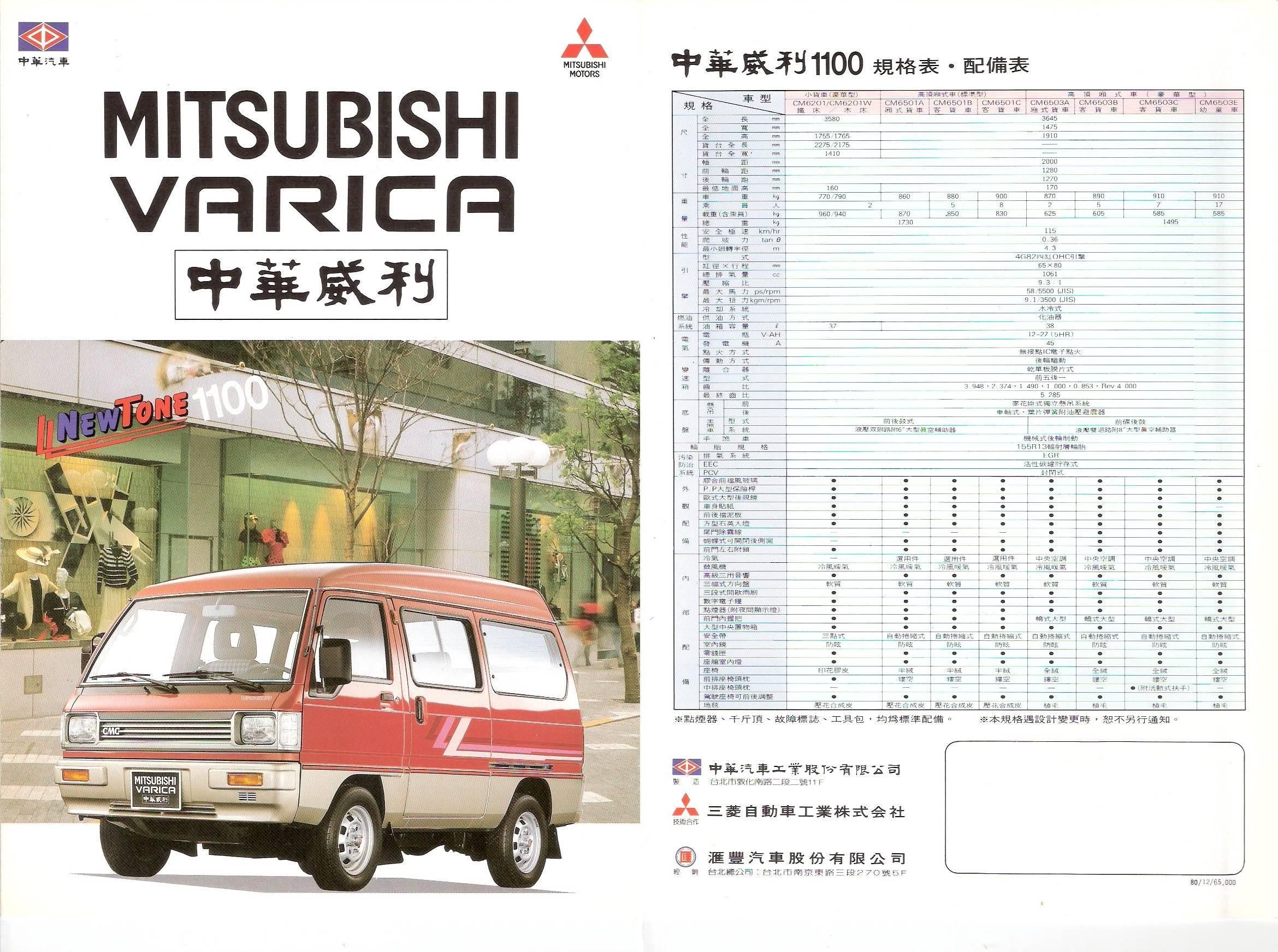
In Taiwan, long-wheelbase iterations of the fourth-generation Minicab were also available with a variety of bodywork. The Taiwanese version (built by China Motor Corporation) was called the CMC Varica (中華威利, Zhōnghuá Wēi Lì) and was available with a 1061-cc 4G82 engine with 58 PS. Overall length was up to 3645 mm, with a wheelbase lengthened to 1475 mm right in front of the rear axle. Top speed was 115 km/h. The Varica's nose was also extended somewhat.
The CMC Varica was imported to the United States by Cushman and sold as the Type G, also known as the Cushman White Truck or White Van.
File:CMC Varica van at Alley 4, Lane 155, Section 3, Bade Road 20101211.jpg|Pre-facelift CMC Verica 1100DX van File:CMC Varica truck left side at Baifu Park 20110628.jpg|First facelift CMC Verica 1100DX truck File:CMC Varica 1200 van right-front.jpg|Second facelift CMC Verica 1200 van
{{anchor|U40|fifth}} Fifth generation
Front-engine, four-wheel-drive | 657 cc 3G83 I3 | 657 cc 3G83 12V I3 | 657 cc 3G83 DOHC 15V I3 | 657 cc 3G83 DOHC 15V turbo I3 | 659 cc 4A30 16V I4 | 659 cc 4A30 DOHC 20V turbo I4 3-speed automatic Van/Bravo: 1920 mm | Truck: 650-790 kg | Van: 720-850 kg | Bravo: 780-990 kg
A larger and completely redesigned Minicab (U40-series) was released in February 1991 to take full advantage of tax regulations allowing for increased dimensions and engine capacity of kei cars. Three new 660-cc engines were introduced - a four-valve, SOHC unit; a five-valve, DOHC unit (Bravo only); and a two-valve, SOHC unit. The high-roof truck model was discontinued; Van models were two-seaters only in the Japanese market. Four-speed manual transmissions were typical on the Minicab Truck at first, with the five-speed being reserved for the top TL model. A three-speed automatic was also optional on the Minicab TD truck. Across the range, 66 model variations were possible. Vans and Trucks originally shared a taillight design. The two-valve engine was only available in the absolute base model, the TU, which was also the only version equipped with 10-inch wheels and drum brakes up front as well as at the rear. Power output is 38 and at 5,500 and 6,000 rpm respectively for the two-valve and the four-valve units. The Minicab received minor improvements in January 1992 in the form of better waterproofing for the electrics and in January 1993 the five-speed manual became standard fitment on all models except the base version with 10-inch wheels.
In February 1994, the fifth generation Minicab received some exterior changes. The headlamps were changed to SAE standard square lamps, replacing the original round units. The trip meter which had been installed on the top grade versions (TL truck, CL van) was discontinued, leaving only an odometer. In addition, the tail lamp design of the van has been changed to a dedicated original type. The Bravo received a new halogen headlight design fitted into the same opening as those of the Minicab, but cut off at the bottom. In January 1996 the Minicab underwent a second minor change and was now equipped with the same halogen lights as used on the Bravo since 1994 (some work-oriented versions like the dump truck and the panel van continued to use the earlier design). The steering wheel was changed to a two-spoke unit borrowed from the base Minica. The very basic Minicab truck Type V arrived in May 1996, using the same carburetted four-valve engine, 12-inch wheels, and front disc brakes as the rest of the range but with the earlier, rectangular headlights (1994 design) and a four-speed manual transmission on both the 2WD and the 4WD models. A fuel injected engine with 48 PS was introduced on the better equipped vans and trucks in October 1997, eventually spreading down the range. Simultaneously, to allow the price to be kept down during a time of economic stagnation, the Type V reverted to the original carburetted two-valve engine and was now also available as a Van. In all, 723,772 fifth-generation Minicabs were built.
Bravo
The new Bravo (no longer using the "Minicab" moniker) came fitted with unusual, concave, oval headlights. At the time of introduction, the lower end of the Bravo range received the 12-valve carburetted engine as also used in the Minicab trucks and vans, while more expensive versions were equipped with a fuel injected version with five valves per cylinder which was never offered on the commercial line. Outputs are 42 and respectively. In January 1992, a turbocharged, 64 PS version of the 15-valve engine was made available in the new MZ-G and MZ-R models. In January 1994, the new 4A30 four-cylinder engine replaced the 3G83 in all but the lowest-priced versions, which kept the old carburetted 12-valve version. The 16-valve single-cam model was available either carburetted or fuel injected and produces either 44 or. The twin-cam, 20-valve "GT" model was only offered with fuel injection, turbocharger, and an intercooler but claimed power remained at the 64 PS limit to which Japanese manufacturers had agreed. From August 1997, the Bravo lineup also included a new variant, the retro-styled Bravo Route 66.
File:MITSUBISHI Minicab 42TD- 04.jpg|Minicab TD truck (initial model, 1991–1994) File:Mitsubishi Minicab 009.JPG|Fifth generation Minicab Van (second facelift) File:Mitsubishi Minicab 546.jpg|Minicab CL van; rear view File:1996-1999 Mitsubishi Minicab Truck rear.jpg|1996–1999 Minicab truck (second facelift) File:Mitsubishi Bravo 211.jpg|Mitsubishi Bravo 660 MZ-G High-roof 4WD (initial model) File:Mitsubishi Bravo 001.JPG|Mitsubishi Bravo Super Aero Roof Super Exceed (U43V, 1994 facelift model)
{{anchor|Sixth|U60|U6|U62}}Sixth generation
Nissan Clipper Nissan NT100 Clipper (2012–2013) Nissan NV100 Clipper (2012–2013) | February 1999-February 2014 | December 2011–present (MiEV/EV) Indonesia: Cikarang, West Java (MMKI) Pickup truck Front-engine, four-wheel-drive | 657 cc 3G83 12V I3 | 657 cc 3G83 12V turbo I3 3-speed automatic Van: 2390 mm | Truck: 700-860 kg | Van: 860-1030 kg | MiEV: 1110 kg
The sixth-generation Minicab (U60-series) was introduced in February 1999, now sporting a new semi-front design. By April 1999, a "wagon" version called the Town Box was introduced. The unusual front design, with its trapezoidal headlights, was quickly changed for a more squared off look in December 2000. 419,070 petrol-engined U60s were built,
Mitsubishi Minicab 601.jpg|Sixth generation Minicab Van, pre-facelift File:MitsubishiMinicab2007interior.jpg|Interior (early) File:Mitsubishi Motors Minicab MiEV cockpit.jpg|Interior (late; Minicab MiEV) File:Mitsubishi Minicab Van CL 4WD U62V.JPG|Mitsubishi Minicab CL van front view File:Mitsubishi Minicab Van CL 4WD U62V Rear.JPG|Mitsubishi Minicab CL van rear view File:NISSAN CLIPPER VAN.jpg|Nissan Clipper front view File:NISSAN CLIPPER VAN rear.jpg|Nissan Clipper rear view File:CMC Veryca Magic left-head 20130912.jpg|Fourth-generation CMC Veryca van pre-facelift front view File:CMC Veryca Magic Exceed van right-end.jpg|Fourth-generation CMC Veryca van pre-facelift rear view File:CMC Veryca of Duskin RAH-5903 20131125.jpg|Fourth-generation CMC Veryca facelift van front view File:2013 CMC Veryca 1.3 van right-end.JPG|Fourth-generation CMC Veryca facelift van rear view
{{anchor|Minicab MiEV|Minicab EV|MiEV}} Minicab MiEV/EV
_demo-car.jpg)
Mitsubishi began testing of the Minicab MiEV in Japan in October 2010.
The Y4F1 traction motor in the Minicab MiEV has a rated output of 30 kW at 2500–6000 rpm and 196 Nm at 0–300 rpm. It is available with one of two traction storage battery options: 10.5 kW-hr (yielding a range of 100 km on the JC08 mode) and 16.0 kW-hr with an extended range of 150 km. Payload capacity is approximately the same as the regular Minicab, at 350 kg with two occupants.
Mitsubishi picked up early orders for 100 units from major delivery company Yamato Transport in May of that year. The commercial-use electric vehicle is available with a lower range than that of the i-MiEV, in a bid to reduce costs. The price is aimed for less than (about ) after subsidies. With government subsidies, the starting price was and for the 10.5 and 16.0 kW-hr versions, respectively; without, prices were and , respectively. and a total of 4,544 units have been sold in Japan through October 2013. A truck version of the Minicab MiEV was launched in January 2013, and sales totaled 536 units through October 2013. In 2019, Japan Post ordered a total of 1,200 units, to be put into service by the end of March 2021.
While the Mitsubishi MiEV was discontinued, the Minicab MiEV remains in production on the old Minicab platform in Mitsubishi's Mizushima plant. In February 2023, Mitsubishi announced plans to produce the model in Indonesia. Mitsubishi Motors Krama Yudha Indonesia began selling the Mitsubishi Minicab MiEV as Mitsubishi L100 EV since 16 February 2024. Now called the Minicab EV ("MiEV" was deemed confusing), it was revived in Japan in December 2023, along with its Nissan-badged Clipper EV sibling. The model code was also changed, from ZAB-U68V to ZAB-U69V, to reflect the update in capacity to a 20.0 kW-hr battery. Maximum power is 42 PS, torque 20 kgm, and range is 180 km.
Mitsubishi Minicab MiEV, Japan Post, front left.jpg|Mitsubishi Minicab MiEV of Japan Post (van) File:Mitsubishi Motors Minicab MiEV Truck (Prototype).jpg|Mitsubishi Minicab MiEV (truck prototype) Mitsubishi MINICAB EV CD 4-Seater (ZAB-U69V-HLDDF) front.jpg|2024 Mitsubishi Minicab EV (CD 4-seater)
Nissan Clipper
Mitsubishi also manufactured a badge-engineered version of the Minicab pickup on behalf of Nissan, which sold it as the Nissan Clipper (a badge originally used on a larger range of Prince and Nissan trucks). The trucks were called NT100 Clippers, and vans were NV100s. The Minicab/Clipper competed in the Japanese market with the Honda Acty, Subaru Sambar, Daihatsu Hijet, and Suzuki Carry. The Minicab and Clipper were both facelifted in July 2012, to meet new safety regulations. Following Mitsubishi's announcement that they would stop manufacturing their own kei trucks for 2014, Nissan stopped selling the rebadged Minicab in November 2013. Since then, both Mitsubishi and Nissan rely on the Suzuki Carry/Every range for their entry in the keitora class. In 2024, the badge-engineered version of the Minicab was revived as the electric vehicle version of the Clipper Minivan.
Seventh generation
Main article: Suzuki Carry
The seventh-generation Mitsubishi Minicab is a rebadged Suzuki Carry or Every; it was introduced in February 2014. The vans (DS64V) were available for only one year, as the Every on which they were based was just about to be replaced. Mitsubishi also offered the more passenger-oriented Suzuki Every Wagon (same chassis code), differing mostly in terms of equipment and engines, but with a redesigned rear, reviving the Mitsubishi Town Box badge, which had lain dormant for a few years. The truck range (chassis code DS16T) remains in production as a result of Suzuki deciding to let the two model lines diverge.
File:Mitsubishi Minicab-Van Bravo 4WD 03100.jpg|Seventh-generation Mitsubishi Minicab Van Bravo 4WD (2014) File:Mitsubishi Minicab-Truck M 4WD 3AT.JPG|Mitsubishi Minicab Truck M 4WD (2014-current) File:Bookmobile of Happo Town.jpg
Eighth generation
Main article: Suzuki Carry
The eighth-generation Mitsubishi Minicab (DS17V, van only) was introduced in March 2015, and is also a rebadged Suzuki Every. The Every Wagon-based Town Box was changed simultaneously.
File:Mitsubishi Minicab-Van Bravo Turbo 4WD DS17V 0724.JPG|Mitsubishi Minicab Van Bravo Turbo 4WD File:Mitsubishi Minicab Van E in Silky Silver Metallic, rear right.jpg|Rear view
References
References
- "Minicab". Mitsubishi-Motors.co.za.
- (1972-10-23). "自動車ガイドブック: Japanese motor vehicles guide book 1972—73". [[Japan Automobile Manufacturers Association]].
- "40th Anniversary minicab". Mitsubishi Motors.
- (1971-10-29). "自動車ガイドブック: Japanese motor vehicles guide book '71—'72". [[Japan Automobile Manufacturers Association]].
- Schaefers, Martin. "History of Japanese Kei Class Minivans and Trucks". Far East Auto Literature.
- "Cushman White Truck Parts". Mini Truck Parts.
- (September 1991). "主要部品カタログ MINICAB". Mitsubishi Motors.
- (1990-10-25). "自動車ガイドブック". [[Japan Automobile Manufacturers Association]].
- Fourie, Louis F.. (29 December 2016). "On a Global Mission: The Automobiles of General Motors International". Friesen Press.
- (14 December 2015). "Mitsubishi Jetstar".
- Salamun, Untung. (March 1984). "MPU larisnya seperti pisang goreng". P.T. Dinamika Dharma.
- (1991). "Mitsubishi Varica ''New Tone'' 1100 ''(catalog)''". Old Car Manual Project.
- "ミニキャブトラック TU(三菱)[4MT]のカタログ詳細情報". Nextage.jp.
- (2023-08-22). "Minicab-MiEV Lahir dari Pabrik Mitsubishi Xpander Mulai Desember 2023".
- Kobayashi, Takashi. (November 24, 2023). "三菱自動車、新型軽商用EV「ミニキャブ EV」説明会 モーター、バッテリなど新たに一充電走行距離は180kmに". Impress Corporation.
- Lienert, Paul. "Mitsubishi To Unveil Plug-In Hybrid Concept: 2011 Tokyo Auto Show". Edmunds Inside Line.
- "Tokyo Motor Show 2011: Minicab MiEV". Mitsubishi Motors.
- (November 24, 2011). "Mitsubishi Motors to Launch New MINICAB-MiEV Commercial Electric Vehicle in Japan - Prices start from ¥1,730,000 after application of eco-car subsidy -". Mitsubishi Motors Corporation.
- Munday, Stephen. (26 May 2011). "Yamato Takyubin Delivery Co. Orders 100 Minicab-MiEV Vans". Integrity Exports.
- Reynolds, Isabel. (21 January 2011). "Mitsubishi Motors to use Toshiba battery in EV: report". Reuters.
- "Mitsubishi Motors starts taking orders for Minicab-MiEV commercial mini EV". [[Mitsubishi Motors]] Australia.
- Loveday, Eric. (11 December 2011). "Mitsubishi to Launch Electric Mini Truck in 2012". PluginCars.com.
- (28 November 2013). "三菱 i-MiEVなどの2013年10月度 販売実績". Electric Vehicle News.
- Kane, Mark. (10 June 2013). "Mitsubishi's Pure Electric Vehicle Sales Tumbling in Japan as Outlander PHEV Dominates". InsideEVs.com.
- "ミニキャブ・ミーブトラック(三菱)の歴代モデル・グレード別カタログ情報". Proto Corporation.
- (13 November 2019). "Japan Post to Introduce 1,200 EVs for Delivery Services". Nippon Communications Foundation.
- (2023-02-16). "Mitsubishi Motors Begins Production of Minicab-MiEV, a Kei-Car Class Commercial EV, in Indonesia in 2024, the First Local Production of the Vehicle Outside Japan". Mitsubishi Motors.
- "Sah, Mobil Listrik Mitusbishi L100 EV Sudah Bisa Dibeli | AutoFun".
- (10 August 2006). "Mitsubishi supplies Nissan with mini-vehicles". AM Online.
This article was imported from Wikipedia and is available under the Creative Commons Attribution-ShareAlike 4.0 License. Content has been adapted to SurfDoc format. Original contributors can be found on the article history page.
Ask Mako anything about Mitsubishi Minicab — get instant answers, deeper analysis, and related topics.
Research with MakoFree with your Surf account
Create a free account to save articles, ask Mako questions, and organize your research.
Sign up freeThis content may have been generated or modified by AI. CloudSurf Software LLC is not responsible for the accuracy, completeness, or reliability of AI-generated content. Always verify important information from primary sources.
Report