From Surf Wiki (app.surf) — the open knowledge base
Mitro Bahini order of battle
Order of battle

Order of battle
The Indian Army had no standby force ready in 1971 with the specific task of attacking East Pakistan, one of the many reasons why India did not immediately intervene after Pakistan launched Operation Searchlight in March 1971. Indian Army's Eastern Command was tasked with defending the northern and eastern borders and fighting the insurgencies in Nagaland, Mizoram and Naxalites in West Bengal at that time.
Mukti Bahini, aided by the Indian army through Operation Jackpot, led the struggle against the Pakistan Army while the Indian Army readied for intervention. General M. A. G. Osmani, Commander-in-Chief Bangladesh Forces, had divided Mukti Bahini forces into 11 geographical sectors for command and control purpose. Mukti Bahini forces numbered 30,000 regular soldiers (including 3 brigades containing 8 infantry battalions and 3 artillery batteries) and at least 100,000 guerrillas by December 1971.
The Indian Army Eastern Command assembled two existing infantry corps, the IV Corps and the XXXIII Corps, for operations in Bangladesh, and created a new corps (II Corps) besides reorganising the 101 Communication Zone as a combat formation. On 21 November 1971, the Indian and Bangladesh forces were put under a joint command structure India Bangladesh force in the eastern theatre, led by Lieutenant General Jagjit Singh Aurora, and this force came to be known as Mitro Bahini. In addition to 29 battalions of the Border Security Force (BSF), Mukti Bahini guerrillas operating near the border or awaiting deployment in camps inside India were organised into infantry companies and attached to various Indian formations.
Indian Army Eastern Command
HQ: Fort William, Kolkata
GOC-in-C (Indian Army): Lieutenant General Jagjit Singh Aurora
COS: Major General JFR Jacob
Director Military Operations: Major General Inderjit Singh Gill, MC
Director Operation Jackpot: Lieutenant General B.N. 'Jimmy' Sirkar
Bangladesh Forces Liaison: Group Captain A.K. Khandkar, HQ: 8, Theater Road, Kolkata
Units attached to Eastern Command but outside Bangladesh operational area:
From IV Corps:
- 2nd Infantry Division in North eastern border
- 5th Infantry Division in North eastern border
From XXXIII Corps:
- 17th Mountain division in Sikkim
- 27th Mountain division in Kalimpong, North Bengal
Airborne forces attached to Eastern Command:
- 50th (Independent) Parachute Brigade CO: Brigadier Mathew Thomas
- 2nd battalion Parachute Regiment (2 Para) (in airborne role) CO: Lieutenant Colonel Kulwant Singh Pannu
- 7th battalion Parachute Regiment (7 Para) CO: Lieutenant Colonel RP Singh (KIA)
- 8th battalion Parachute Regiment (8 Para) CO: Lieutenant Colonel Afsir Karim
- 17 Para Field Regiment CO: Lieutenant Colonel Khanna
- 60 Para Medical Company CO: Lieutenant Colonel M Kumar
Eastern Command Reserve:
- 6th Mountain division less brigade HQ: Cooch Bihar GOC: Major General P.C. Reddy
- 2 Engineer Regiments and bomb disposal group
Bengal Area
GOC: Major General J.P. Chowdhury HQ: Kolkata
- 1st battalion 3rd Gurkha Rifles (1/3 GR)
- 11th battalion Bihar Regiment (11 Bihar)
- 12th battalion Garhwal Rifles (12 Garh Rif)
- Engineers and bomb disposal units
Western Sector
Area of Operation: Khulna, Jessore, Kushtia and Faridpur districts
II Corps
GOC: Lieutenant General T.N. 'Tappy' Raina HQ: Krishnanagar, West Bengal
- 50th (Independent) Parachute Brigade – Brig M. Thomas, less 2 Para battalion group in airborne role
- 8th Mountain Artillery Brigade
- 58th, 68th and 263rd Engineering Regiments
9th Infantry Division
GOC: Major General Dalbir Singh
- 32 Infantry Brigade – Brigadier M Tewari
- 42 Infantry Brigade – Brigadier J. M. Jhoria
- 350 Infantry Brigade – Brigadier H. S. Sandhu
- 9th Artillery Brigade
- 45th Cavalry (PT-76s)
- 102nd Engineer Regiment
- Mukti Bahini Sector #9 – Major Jalil
4th Mountain Division
GOC: Major General M.S. Barar HQ: Krishnanagar
- 7th Mountain Brigade – Brigadier Zail Singh
- 41st Mountain Brigade – Brigadier Tony Michigan
- 62nd Mountain Brigade - Brigadier Rajinder Nath
- 4th Mountain Artillery Brigade
- Mukti Bahini Sector #8 – Lieutenant Colonel M.A. Manzoor
North Western Sector
Area of Operation: Rajshahi, Bogra, Dinajpur and Rangpur districts
Corps: XXXIII
GOC: Lieutenant General M. L. Thapan HQ: Siliguri, West Bengal
- Corps Artillery Brigade
- 471st Engineering Brigade – Colonel Suri
- 235th Engineering Regiment
- 2 Para battalion Group in airborne role to parachute over Tangail to capture Poongli Bridge on 11 Dec, Bn gp consisting of:
- A field battery of 17 Para Field Regiment
- A section of 411 Para Field Company
- A surgical team of 60 Para Medical Company
- MF Brigade – Brigadier Prem Singh
- Mukti Bahini Sector #7 – Lieutenant Colonel Q.N. Zaman
- 71st Mountain Brigade – Brigadier P. N. Kathpalia
- Mukti Bahini Sector #6 – Wing Commander Mohammad K. Bashar
20th Mountain Division
GOC: Maj. Gen. Lachman Singh HQ: Balurghat, West Bengal
- 66th Mountain Brigade – Brigadier G. S. Sharma
- 165th Mountain Brigade – Brigadier R. S. Pannu
- 202nd Mountain Brigade – Brigadier F. P. Bhatty
- 3rd Armoured Brigade (63rd Cavalry (T-55s) and 69th Armoured Regiment (PT-76s) – Brigadier G. Singh Sidhu
- 20th Mountain Artillery Brigade
- 13th Engineering Regiment
- 340th Mountain Brigade Group – Brigadier Joginder Singh
- 97th Mountain Regiment
6th Mountain Division
(Eastern Command HQ Reserve) GOC: Major General P. C. Reddy HQ: Cooch Bihar, West Bengal
- 9th Mountain Brigade – Brigadier Tirit Varma
- 99th Mountain Brigade -
- 6th Mountain Artillery Brigade
- 51st Engineer Regiment
North Eastern Sector
Area of Operation: Mymensingh and Tangail districts
101st Communication Zone
GOC: Major General Gurbax Singh Gil HQ: Guwahati, Assam
- 312 Air Defence Brigade
- 342 Independent Air Defence Brigade
- 56th Mountain Regiment plus Engineers
- 95th Mountain Brigade – Brigadier Hardev Singh Kler
- FJ Sector Brigade – Brigadier Sant Singh
- Mukti Bahini Sector #11 – Lieutenant Colonel Abu Taher
- 167th Infantry Brigade – Brigadier Irani (allotted after 8 December 1971)
- 5th Mountain Brigade (allotted after 8 December 1971)
Eastern Sector
Area of Operation: Sylhet, Comilla, Noakhali & Chittagong districts
IV Corps
GOC Lieutenant General Sagat Singh HQ: Agartala, Tripura
- IV Corps Artillery Brigade
- Three Independent Tank Squadrons
- 4th, 62nd, 234th Engineer Regiments and support elements
8th Mountain Division
GOC: Major General K. V. Krishna Rao
- Echo Force Brigade – Brigadier Wadeker
- Mukti Bahini Sector #5 – Major Mir Shawkat Ali
- 59th Mountain Brigade – Brigadier C. A. Quinn
- 81st Mountain Brigade – Brigadier R. C. V. Apte
- 2nd Mountain Artillery Brigade
- Mukti Bahini Sector #4 – Lieutenant Colonel C.R. Dutta
57th Mountain Division
GOC: Major General B.F. Gonsalves
- Mukti Bahini S Force Brigade – Lieutenant Colonel K.M. Shafiullah
- 311th Mountain Brigade – Brigadier Mishra
- 73rd Mountain Brigade – Brigadier Tuli
- 61st Mountain Brigade – Brigadier Tom Pande
- 57th Mountain Artillery Brigade
- Mukti Bahini Sector #3 – Maj. A. N. Nuruzzaman
- Mukti Bahini Sector #2 – Maj. A.T.M Haider
- 15th Engineering Regiment
23rd Mountain Division
GOC: Major General R.D. Hira
- 301st Mountain Brigade – Brigadier H. S. Sodhi
- 181st Mountain Brigade – Brigadier Y. C. Bakshi
- 83rd Mountain Brigade – Brigadier B. S. Sandhu
- 23rd Mountain Artillery Brigade
- Kilo Force Brigade – Brigadier Ananda Swaroop containing:
- Mukti Bahini Sector #1 – Major Rafiqul Islam
- Mukti Bahini K Force Brigade – Major Salek Chowdhury
- Mizo Range Hills Brigade
[[Indian Air Force]] Eastern Air Command
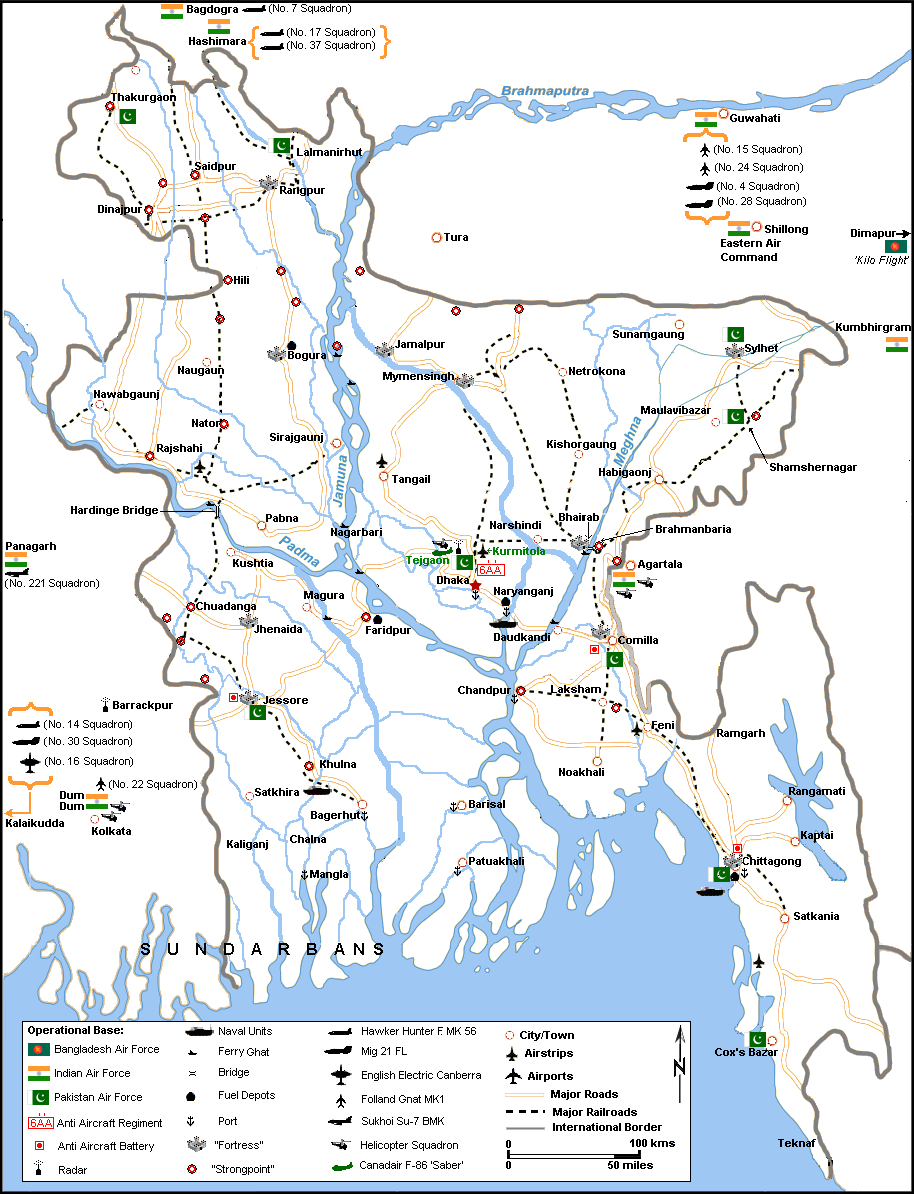
AOC-in-C: Air Marshal H. C. Dewan, Temporary advanced HQ at Fort William
Prior to 1971, Indian Air Force had two command centers dealing with the East, Eastern Air Command (HQ Shillong) responsible for the North Eastern Border, and the Central Air Command (HQ Allahabad), looking after areas south of the Ganges river. Air Chief Marshal Pratap Chandra Lal formed an advance HQ at Fort William after consultation with Major General Jacob to coordinate operations with the army before the start of the war.
Western Sector:
- No. 7 Squadron IAF (Battle Axes): Hawker Hunter F. MK 56 and 2 F. MK 1 - Bagdogra (WC Ceolho, then WC Suri). The squadron was moved Chamb after 12 December.
- No. 14 Squadron IAF (Bulls): Hawker Hunter F. MK 56 - Kalaikudda (WC Sundersan) - Fighter
- No. 16 Squadron IAF (Rattlers): Canberra - Kalaikudda - (WC Gautum) - Bomber
- No. 22 Squadron IAF (Swifts): Folland Gnat MK 1 Dum Dum, then Kalaikudda, then Calcutta (WC Sikand)
- No. 30 Squadron IAF (Charging Rhinos): Mig 21 FL - Kalaikudda (WC Chudda) - Interceptor
- No. 221 Squadron IAF (Valiants): Su-7 BMK - Panagarh (WC Sridharan) – Fighter/Bomber
- No. 104 Helicopter Squadron, IAF (Alluitte 3) and (Mi-4) Helicopter
North East and North Western Sector: AOC-in-C: Air Vice Marshal Devasher HQ: Shillong
- No. 4 Squadron IAF (Oorials): Mig 21 FL - Gauhati (Wing Commander JV Gole)
- No. 15 Squadron IAF (Flying Lancers): Folland Gnat - Gauhati then Agortala (WC Singh)
- No. 17 Squadron IAF (Golden Arrows): Hawker Hunter F MK 56 - Hashimara (WC Chatrath)
- No. 37 Squadron IAF (Black Panthers): Hawker Hunter F MK 10 - Hashimara (WC Kaul)
- No. 24 Squadron IAF (Hunting Hawks): Folland Gnat Gauhati (WC Bhadwar)
- No. 28 Squadron IAF (First Supersonics): Mig 21FL Gauhati (WC Bishnu)
- No. 105 Helicopter Unit, IAF (Mi-4) and No. 121 Helicopter Flight, IAF (Alouette III) - Agartala
[[Bangladesh Air Force]]: ''Kilo Flight''
CO: Flight Lieutenant Sultan Mahmud HQ: Dimapur, Nagaland, then Agartala
This unit was formed by Bengali pilots and technicians defecting from the Pakistan Air Force. Flying light aircraft donated by India, they launched attacks on depots and communication lines on 2 December 1971, before the start of the war. The unit relocated to Agartala and then Shamshernagar after 3 December 1971.
References
Sources
References
- Jacob, Lt. Gen. JFR, ''Surrender at Dacca: Birth of A Nation'', p60
- Jacob, Lt. Gen. JFR, "Surrender at Dacca: Birth of A Nation’’, p75
- Islam, Maj. Rafiqil, ''A Tale of Millions'', p314
- Salik, Siddiq, ''Witness to Surrender'', p123
- Islam, Maj. Rafiqul, ''A Tale of Millions'', p313
- Islam, Maj. Rafiqul, ''A Tale of Millions'', p318
- Jacob, Lt. Gen. JFR, ''Surrender at Dacca: Birth of A Nation'', p196
This article was imported from Wikipedia and is available under the Creative Commons Attribution-ShareAlike 4.0 License. Content has been adapted to SurfDoc format. Original contributors can be found on the article history page.
Ask Mako anything about Mitro Bahini order of battle — get instant answers, deeper analysis, and related topics.
Research with MakoFree with your Surf account
Create a free account to save articles, ask Mako questions, and organize your research.
Sign up freeThis content may have been generated or modified by AI. CloudSurf Software LLC is not responsible for the accuracy, completeness, or reliability of AI-generated content. Always verify important information from primary sources.
Report