From Surf Wiki (app.surf) — the open knowledge base
Missouri University of Science and Technology
Public university in Rolla, Missouri, US

Public university in Rolla, Missouri, US
| Field | Value |
|---|---|
| name | Missouri University of |
| Science and Technology | |
| image | Missouri University of Science and Technology emblem.png |
| image_size | 150 |
| motto | Salus populi suprema lex esto (Latin) |
| mottoeng | Let the welfare of the people be the supreme law |
| established | |
| type | Public research university |
| academic_affiliations | |
| endowment | $604,010,199 (2024) |
| chancellor | Mohammad Dehghani |
| provost | John Harris |
| students | 6,456 (2023) |
| undergrad | 5,324 (2023) |
| postgrad | 1,132 (2023) |
| faculty | 327 (full-time, fall 2021) |
| administrative_staff | 742 (full-time, fall 2021) |
| city | Rolla, Missouri |
| country | United States |
| campus | Rural/College Town, 284 acre |
| former_names | Missouri School of Mines and Metallurgy (1870–1964) |
| University of Missouri at Rolla (1964–1968) | |
| University of Missouri–Rolla (1968–2008) | |
| colors | Silver, gold and green |
| sporting_affiliations | NCAA Division II – GLVC |
| nickname | Miners |
| mascot | Joe Miner |
| website | |
| logo | Missouri st logo horiz.png |
| logo_size | 250 |
| parent | University of Missouri System |
| accreditation | HLC |
| free_label | Newspaper |
| free | Missouri Miner |
Science and Technology University of Missouri at Rolla (1964–1968) University of Missouri–Rolla (1968–2008)
The Missouri University of Science and Technology (Missouri S&T or S&T) is a public research university in Rolla, Missouri, United States. It is a member institution of the University of Missouri System. Most of its 6,456 students (2023)
History

Engineering and agricultural education was a rarity in American higher education in 1860, but that changed dramatically in 1862, when the Morrill Land-Grant Acts passed Congress. The law gave generous deeds of public land to states that created schools with programs in engineering and scientific agriculture. Debates over the Civil War and reconstruction slowed progress in Missouri, but finally in 1870 the obvious importance of mining in the state, as well as agriculture, forced the legislature to create the Missouri School of Mines and Metallurgy in Rolla as part of the state system, and a new agricultural program at the University of Missouri in Columbia.
It became the first technological learning institution west of the Mississippi River. Early in its history, the School of Mines was focused primarily on mining and metallurgy. Rolla is located close to the Southeast Missouri Lead District which produces about 70% of the U.S.' primary supply of lead, as well as significant amounts of the nation's zinc.
The school was founded under the auspices of the University of Missouri in Columbia in order to take advantage of the Morrill Land-Grant Acts to "teach such branches of learning as are related to agriculture and the mechanic arts, in such manner as the legislatures of the States may respectively prescribe, in order to promote the liberal and practical education of the industrial classes in the several pursuits and professions in life." The act endowed Missouri a federal land grant of 30,000 acres for each of the state's two senators and nine representatives at the time—or 330,000 acre. The endowment said that the land could not be sold for less than $1.25/acre and as such was a minimum endowment of $412,500 for Missouri. There was an intense debate in the state over the location and number of schools before it was finally decided to have one school in Columbia and a branch in the mining area of southeast Missouri.
Iron County (Ironton) and Phelps County (Rolla) made bids for the school, with Phelps County winning in 1870. Classes began on November 23, 1871, in a new building that the city of Rolla had just built. The college had an enrollment of 28 undergraduates and three graduates in 1874. The college bought what is now called the "Rolla Building" for $25,000 in January 1875. Following a $2 million renovation in 1995, that building is now used as the Mathematics and Statistics Department's library, chair's office, part of the main office, and other faculty offices.

Initially, the school only offered degrees in civil engineering, metallurgy, and mining engineering. However, by the late 1920s, the school had added degrees in ceramic engineering, chemical engineering, electrical engineering, and mechanical engineering. The school became home to Missouri's first operational nuclear reactor in 1961.
In 2018, the school was approved by the state's Coordinating Board for Higher Education for designation as "highly selective" in its undergraduate admission criteria, joining only Truman State University among the state's public universities at that level. As such, first-time, full-time students seeking degrees are generally only admitted if they have a "percentile score" of 140 points or greater, a combination of their high school class and college testing (ACT or SAT) percentile ranks. Missouri Department of Higher Education guidelines state that schools in this category may admit up to ten percent of students with lower percentile scores, and will automatically admit those with an ACT (or equivalent SAT) score of 27 or better.
Chancellors
The naming structure for the head of the university has changed reflecting its changes through the years. The head currently reports to the University of Missouri System.
The chancellor lives on campus at the Chancellor's Residence. It was constructed in 1889 as the "Club House" dormitory, then converted to a room house before becoming the Missouri State Geological Survey headquarters and finally the residence for the then-director in 1905.
Mohammad Dehghani of Stevens Institute of Technology began his service as chancellor in 2019. Dehghani had previously held leadership positions at the Lawrence Livermore National Laboratory, the Applied Physics Laboratory, and the Johns Hopkins University Systems Institute, at which he was a founding director.
- Charles Penrose Williams, director, 1871–77
- Charles Edmund Wait, director, 1877–88
- William Holding Echols, director, 1888–91
- Elmo Golightly Harris, director, 1891–93
- Walter Buck Richards, director, 1893–97
- George E. Ladd, director, 1897–07
- Lewis Emmanuel Young, director, 1907–13
- Leon Ellis Garrett, acting director, 1913–15
- Durward Copeland, director, 1915
- Austin Lee McRae, director, 1915–20
- Charles Herman Fulton, director, 1920–37
- William Reuel Chedsey, director, 1937–41
- Curtis L. Wilson, dean, 1941–63
- Merl Baker, Dean 1963–1964, chancellor 1964–73 Dudley Thompson, acting chancellor, 1973–74
- Raymond L. Bisplinghoff, chancellor, 1974–76 Jim C. Pogue, interim chancellor, 1977–78
- Joseph M. Marchello, chancellor, 1978–85 John T. Park, interim chancellor, 1985–86
- Martin C. Jischke, chancellor, 1986–91
- John T. Park, chancellor (initially interim), 1991–2000
- Gary Thomas, chancellor, 2000–05
- John F. Carney III, chancellor, 2005 – August 2011 Warren K. Wray, interim chancellor, September 2011 – March 2012
- Cheryl B. Schrader, chancellor, April 2012 – May 2017 Christopher G. Maples, interim chancellor, May 2017 – July 2019
- Mohammad Dehghani, chancellor, August 2019 – present
Military service
Military service has long been a tradition at the college. Beginning with the American Civil War, students and faculty have served in all major American conflicts.
Civil War
Three individuals, James Abert, George D. Emerson, and Robert W. Douthat, served in the American Civil War and as faculty.
World War I
When the United States entered World War I in April, 1917, a total of 65 members of the university, students and faculty, entered into the service for First Officers Training Camp. Almost half of the enrolled student population was involved in The Great War in some capacity, as the total enrollment was 186, down from 301 students. In total, nine men from the university sacrificed their lives. Two men received the Distinguished Service Cross from General John J. Pershing. One man, H. F. Allison, is credited with the first shot fired in France from a member of the American Expeditionary Force.
Inter-war years
In 1920, the college started its Reserve Officer Training Corps. An integral part of university life, at least half of all students made ROTC a part of their curriculum from 1924 to 1940. Of the 931 students enrolled in 1940, 534 were also ROTC Cadets.
WWII
After the bombing of Pearl Harbor, students sought to immediately enlist. The 1941–42 administration, including Curtis Laws Wilson, instead encouraged the student body to finish their training as that would make them more useful to the military.
Changes in hierarchy and name
Until 1964, the school was considered an offsite department of MU's School of Agriculture and Mechanical Arts, reporting to the main campus in Columbia (although it began fielding sports teams in 1935 in the Mid-America Intercollegiate Athletics Association). As such, its presiding officer was originally called a director (1871–1941), then a dean (1941–1964). In 1963 the University of Missouri System was created with the additions of standalone campuses in Kansas City and St. Louis. A year later, MSM was upgraded to an autonomous standalone campus as the University of Missouri at Rolla and its presiding officer, like that of its sister schools, was granted the title of chancellor. The curriculum was expanded to include most of the science and engineering disciplines, as well as social sciences and liberal arts such as psychology and history. In 1968, the campus name was slightly altered to the University of Missouri–Rolla, thus conforming to the naming scheme of the other three campuses. Business and management programs were gradually added in the following years. On January 1, 2008, UMR became known as Missouri University of Science and Technology or Missouri S&T for short.
In making the case for changing the name, then Chancellor John F. Carney III noted that Rolla in 2007 was "one of the few technological research universities in the nation. A technological research university (polytechnic university or institute of technology) may be defined as one in which a majority of students are enrolled in engineering, the sciences, business or mathematics; the graduate and research programs in those fields are robust; and exceptional academic programs in the liberal arts, humanities and social sciences complement and provide context to the technological strengths of the institution."
He noted that more than 70 percent of its enrollment was in engineering and more than 90 percent was in engineering, business, science and math—significantly higher than engineering schools such as the Massachusetts Institute of Technology, Georgia Institute of Technology, and Rensselaer Polytechnic Institute. He noted "The university's name, however, does not reflect the distinctive nature of the campus. Often, UMR is viewed as a 'satellite' or 'branch' campus due to its name or as a 'feeder' campus for the University of Missouri-Columbia (commonly referred to as the University of Missouri). This branch-campus designation hinders many of our efforts to achieve national recognition and a strong reputation as a technological research university."
He noted, "Of the 1.1 million seniors in the nation who took the ACT in 2006, only 551 non-Missouri seniors – or .05 percent – sent their scores to UMR." He also noted that the school's acronym of UMR got it confused with the University of Minnesota Rochester.
Among the other names considered were: Missouri University of Science and Engineering, Missouri Technological University, and Missouri Science and Engineering University.
Historic $300 million gift
In October 2020, the university received the largest single gift to any university, public or private, in the state of Missouri. The $300 million gift from June and Fred Kummer established a new foundation to establish the Kummer Institute for Student Success, Research and Economic Development. The gift also will establish a new college of innovation and entrepreneurship at Missouri S&T, develop new areas for research, provide scholarships and fellowships for students, and bolster the Rolla region's economy.
Campus
Altman Hall
Originally a dormitory building, Altman Hall now houses student and university organizations including the KMNR radio station, the Missouri Miner student newspaper, the Rollamo yearbook, the SPECTRUM campus organization in support of sexual orientations and gender identities, and a ResLife residential life downtown campus office. The building is named after William Altman, an alumnus killed in World War II.
Bertelsmeyer Hall
Bertelsmeyer Hall is located at the intersection of 11th street and State Street. It was named after James E. Bertelsmeyer (BS ChemE 1966), who contributed $5 million towards its construction. The building was dedicated in 2014 and is the current home of the Chemical and Biochemical Engineering Department.

Castleman Hall
Castleman Hall, completed in 1991, is a 55,000 sqft home for the alumni and development offices, and the music and theater departments. Featuring a 660-seat performing arts center, the building occupies the city block between Main and State Streets, and Tenth and Eleventh Streets. The alumni and music offices had been in Harris Hall since the 1970s.
Curtis Laws Wilson Library

The Curtis Laws Wilson Library is the main academic library on campus. Wilson served as dean of the school from 1941 to 1963.
The basement of the library is home to several campus organizations, including:
- Video Communications Center, which provides video services to the university and produces distance education courses.
- State Historical Society of Missouri, Research Center – Rolla, which provides access to records and papers relating to area individuals, families, and organizations
- University Archives, which houses the historical, legal and cultural records of the university
Farrar Hall
Farrar Hall served for decades as a dormitory building and was used as quarantine housing during the COVID-19 pandemic. In June 2022, the marketing and communications office reported its relocation to Farrar Hall. In July 2023, the building became a temporary home for the graduate education office. Farrar Hall is named after university alumnus William Farrar who was killed in World War II.

Harris Hall
Harris Hall opened in 1940 after Director William Chedsey was able to secure $80,000 from the Works Progress Administration and $50,000 in state funding. Harris Hall housed the Civil degree program for nearly two decades. As of April 2021, parts of the building are used by the Army ROTC Stonehenge Battalion, and Air Force ROTC Detachment 442. The building is named after Elmo Golightly Harris, one of the university's first directors, and the first chair of the department of civil engineering. Harris also led the first class held in the building.[[File:Havener Student Center at Missouri S&T.jpg|thumb|171x171px|Havener Center at Missouri S&T]]
Innovation Lab
Opened in 2024, the Innovation Lab is a dynamic space designed to encourage creativity, collaboration and discovery among students. It includes a Makers Studio, the Student Success Center, an outdoor terrace, active learning classrooms, a spacious atrium, and spaces for students to meet, think and create.
Leach Theatre
Leach Theatre is located in Castleman Hall and has a maximum seating capacity of 650 audience members. The theatre was opened in 1991 and hosts approximately 100 events each academic year, including touring performances of groups such as the St. Louis Symphony Orchestra, the Russian National Ballet, Stomp, as well as off-Broadway shows such as Cats, Evita, and 42nd Street.
Millennium Arch
The university developed a new way to make deep cuts in granite and worked with artist Edwina Sandys who used the method to create the Millennium Arch sculpture. The Arch is a single trilithon with the stylized silhouettes of a man and a woman cut from the two uprights. The figures cut from the uprights stand nearby as freestanding statues. The work, which is located on 10th Street facing Castleman Hall, was developed as a project of the High Pressure Waterjet Laboratory of the Rock Mechanics & Explosive Research Center at Missouri S&T.[[File:umr stonehenge.jpg|right|Missouri S&T Stonehenge, next to U.S. Highway 63 (Bishop Avenue)|thumb|204x204px]]
Missouri S&T Stonehenge
Missouri S&T Stonehenge is a partial reconstruction of the original Stonehenge monument located on Salisbury Plain, in southern England. Missouri S&T's version of the ancient structure is located on the northwest corner of campus, and was dedicated on June 20, 1984, during the summer solstice. It features a 50 ft diameter ring of 30 stones around a horseshoe of five trilithons through which various sightings of sunrise and sunset can be made. About 160 tons of granite were used to construct the monument. The rock was cut by Missouri S&T's water jet cutter equipment, which used two waterjets cutting at a pressure of 15,000 pounds of force per square inch (103 MPa), slicing across the surface just like a conventional saw. The cutter moved at a speed of about 10 feet per minute (50 mm/s) and cut between one-quarter and one-half inch (6 and 13 mm) on each pass.
After completion, Missouri S&T Stonehenge received an award from the National Society of Professional Engineers for being one of 1985's Ten Outstanding Engineering Achievements.
Nuclear reactor
Main article: Missouri University of Science and Technology Nuclear Reactor
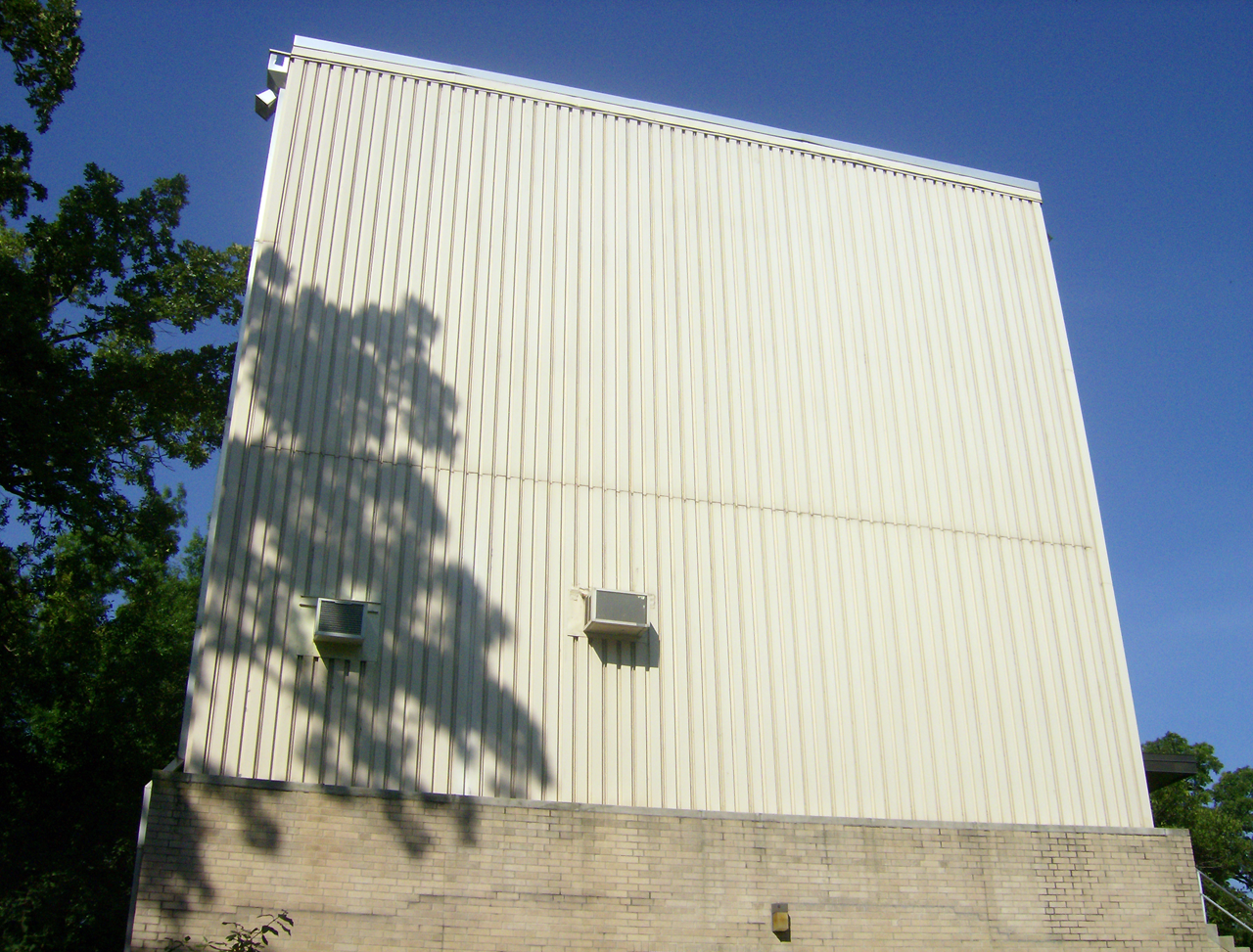
The school operates the 200 kW Missouri S&T nuclear reactor on-campus for educational, training, and research purposes. It became the first nuclear reactor to have become operational in Missouri, and first achieved criticality in 1961.

Parker Hall
The construction of Parker Hall was completed in 1912. The building housed the campus library until the opening of the Curtis Laws Wilson Library. Parker Hall is one of three buildings (the Rolla Building and Norwood Hall being the other two) that are from the school's first 50 years. As of April 2021, Parker Hall holds the Visitor Center, Admissions Office, Registrar, Student Financial Assistance, Accounting and Cashier's Office, and administrative offices.
Jack Carney Puck and Plaza
The Jack Carney Puck and Plaza is a small, circular stage in the center of the campus. It is used for many student events, and is particularly active during St. Patrick's Day festivities. Reconstruction of the area around the Puck began in late 2020 to renovate the landmark in honor of former Chancellor John F. "Jack" Carney III.
Schrenk Hall
Built in 1938, Schrenk Hall is home to the Chemistry and Biological Sciences departments. The building's west wing was added in 1973. Walter T. Schrenk, after whom the building is named, was a chemistry professor from 1923 to 1961 and a former department chair.
Solar Village

Officially opened in December 2010, the Solar Village consists of four entries by Missouri S&T in the U.S. Department of Energy Solar Decathlon. Students, staff, faculty, and donors of Missouri S&T designed, constructed, and competed homes in each of the first four Decathlons including the Solar House in 2002, the Prairie House in 2005, the Solar House in 2007, and the Show-Me House in 2009. In 2012, the Solar Village was one of two highlights in a video short that won recognition from Second Nature and a Climate Leadership Award for the campus. In 2014, the Solar Village was expanded to include a microgrid system and an electric car charging station. In 2016, Missouri S&T announced a second, EcoVillage, composed of Decathlon entries including the 2013 Chameleon House and the 2015 Nest Home.
Straumanis-James Hall
Straumanis-James Hall houses the Missouri S&T Materials Research Center. The building, which honors Martin E. Straumanis and William "Bill" James, includes about 30,000 square feet of laboratory and office space. Research conducted here led directly to the founding of two successful companies, Brewer Science and Mo-Sci. Patents for research conducted in Straumanis-James Hall produce more than 90% of the campus revenue from licensing.
Kummer Student Design Center
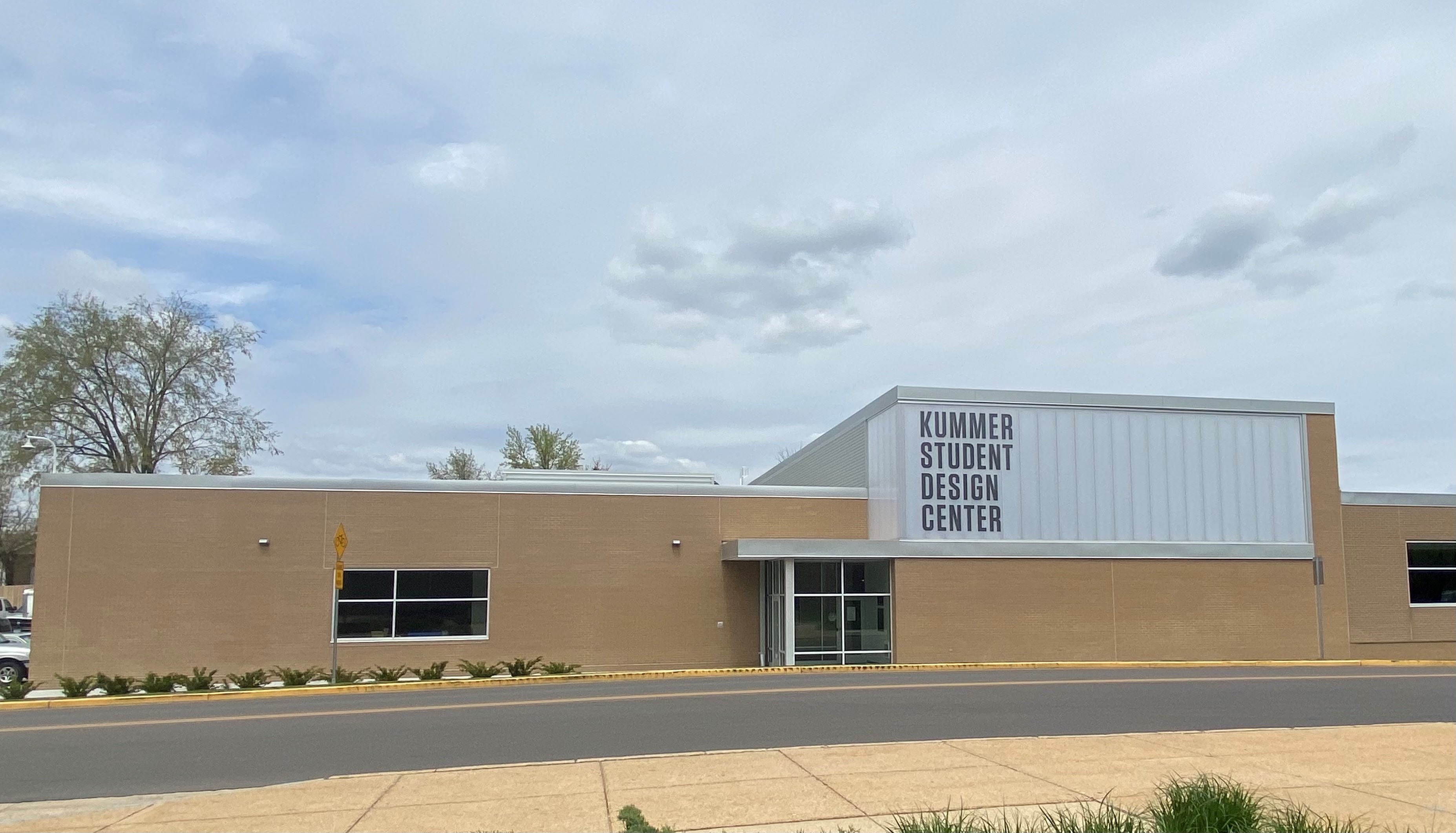
The Kummer Design Center was dedicated on May 20, 2011. A privately funded $2.75 million project, it was named after Fred and June Kummer who donated $1.25 million. Fred Kummer is an alumnus of the university. The 23,000 sqfoot building was originally a Holsum Bread Bakery and afterward a Student Rec Center.
The Kummer Design Center is at 1051 N Bishop Avenue in Rolla, and is home to the Student Design and Experiential Learning Center (SDELC), which contains offices, a conference room, a machine shop, and labs, including a computer lab, and an iGEM lab. Approximately twelve hundred university students support twenty design teams at the SDELC, and have 24/7 access to the building. These students may then apply their design team experiences toward university-required experiential learning. The Kummer Design Center is also home to American Pie Company and Spoon Me (frozen yogurt) fast food restaurants.
In April 2019, a Mars Rover designed by S&T's Mars Rover Team broke ground on an expansion for the Kummer Design Center. The expansion, by Brinkmann Constructors, added 8,000 sqft of new labs, manufacturing, and fabrication bays and expanded the waterjet, welding, and composites labs, doubling the size of the previous SDELC. The expansion's highest-level donors were Richard and Nancy Arnold, Brinkmann Constructors, Roger and Karen LaBoube, and Fred and June Kummer. The expansion was dedicated on September 11, 2020, to a virtual audience.
At the start of the COVID-19 pandemic, students and staff used the design center to make PPE for Phelps Health and other surrounding medical facilities. The design center used 3D printers to generate prototype face shield brackets and face masks, and some of the prototype files were released to the public for printing.
Design teams
- The Baja SAE design team designs, builds, and races an off-road vehicle each year. The team competes against other universities at international events.
- The Combat Robotics Design Team is one of the newest design teams, as it began in 2018, in the Student Design Center. The team designed and built its first robot, Ankle Grinder, in 2020 and will compete for the first time on March 20, 2021, at the Norwalk Havoc Competition in Norwalk, Connecticut.
- The Missouri S&T Chem E Car team designs and constructs small chemical-reaction-powered cars that are used in regional competitions. The designed car must be stopped by a timed chemical reaction and the goal of competitions is to see which car can be the most precise and stop at the given distance (15–30 m), solely using chemistry.
- The Missouri S&T Concrete Canoe team designs and constructs a concrete canoe and races it on a lake in regional and national competitions. The team has participated in concrete canoe competitions since the 1970s. The entire project, including fundraising and construction, is completed by the students. The team took third place in 2004.
- Missouri S&T's chapter of Engineers Without Borders has four ongoing international projects in Guatemala, Ecuador, and Bolivia. Over one hundred students are part of a team that works to develop sustainable solutions to engineering problems, such as lack of access to drinking water, in developing countries.
- Each year the Formula Electric team designs, builds, and races an electric formula-style race car. The team was founded in 2012 and started to compete in 2015. In 2017, the team finished overall 4th, the best they have ever done. For the 2017–2018 season, the team lost its title sponsor.
- The Missouri S&T Formula SAE team constructs a small formula-style race car every year, suitable for mass production and sale to weekend autocrossers. The team competes in Brooklyn, Michigan, against more than 100 other teams from universities around the world. The vehicle's cost, sales presentation, engineering design, acceleration, braking and racing performance all factor into its final score. The team has placed in the top ten in eight of the past twelve competitions, including first-, second- and fourth-place finishes.
- The Missouri S&T Human Powered Vehicle Team demonstrates its members' engineering excellence via a human-powered vehicle. The team promotes alternative energy technology while providing future engineers with hands-on experience in applying classroom knowledge. Through intercollegiate competition, this project hopes to foster leadership, teamwork, and the continuous advancement of technologies for the betterment of humanity. The team competes annually at the American Society of Mechanical Engineers Human Powered Vehicle Challenge in both west and east coast competitions. The team has placed among the top two overall in 14 of 16 competitions, and holds the female sprint record of 41.8 mph and male sprint record of 48.6 mph. In 2010, the team swept both the East and West Coast competitions and placed first in every event: Design, Male Drag Race, Female Drag Race and the Endurance Race, giving the team 1st Place Overall and National Speed Class Champions. In 2015, the team placed second overall in the ASME West Competition and first overall in the ASME East Competition, in the speed class.
- The S&T Mars Rover design team finished in first place at the 2017 international University Rover Challenge competition held June 1–3, 2017, in Hanksville, Utah. Missouri S&T's Mars Rover, named Gryphon, was designed and built by the students. The team developed custom circuitry for the rover, machined the aluminum and carbon-fiber support structure, developed durable wheels for terrain mobility, and 3-D printed gears used in the rover.
- Every year the Miner Aviation team designs, builds, and flies a remote-controlled plane for the American Institute of Aeronautics and Astronautics Design/Build/Fly competition (AIAA DBF). The team was founded in 1999 and first competed in the 2000–2001 competition year. The team was originally named the Advanced Aero Vehicle Group and later changed their name to the Miner Aviation Student Design team during the 2016–2017 competition year. In their first year, they finished 2nd place overall in the Open Class. In the 2002–2003 competition year they finished 1st place overall in the Open Class. They started to compete in the Advanced Class in the 2009–2010 competition year.
- Every two years the Motorcycle Design Team designs, builds, and races a motorbike, competing against universities across the world at the Motorland Aragon racetrack in Alcaniz, Spain.
- Every year the Multirotor Design Team competes in the International Aerial Robotics Competition (IARC). Competitions repeat each year until a team completes the competition. The team designs, builds, and programs drones. The team has also partnered with the Rocket Design team to compete in the Argonia Cup.
- The Rocket Design Team used to compete in the Spaceport America Cup which is designed around the Intercollegiate Rocket Engineering Competition (IREC). The team designed and built a rocket each year for the competition. The team first started competing in 2015. 2019 was the first year they made two rockets. Since 2023, rather than compete in the Spaceport America Cup, the team has pursued their stated goal of launching a rocket to space. Since 2019, the team has had a liquid rocket project, focused on producing liquid engines. They successfully hot fired their Typhon engine in 2022, and launched their first liquid rocket, Phounix, in 2025, becoming the 20th collegiate rocket team in the world to do so.
- The Missouri S&T Satellite Project (M-SAT) team began as an Aerospace engineering course (AE301 Spacecraft Design) when NASA held a contest for a two-year development and build project (Nanosat program) that had to accomplish its goals in the harsh environment of space. After taking third place in Nanosat-4, the team continued perfecting its twin satellites for spaceflight and entry into the Nanosat-6 competition. During this cycle, the team was awarded "Best Outreach" for its work at encouraging an interest by local school students in STEM-related fields. The team placed second during Nanosat-7, beating rival MIT. With their legacy twin-satellite design and feedback from the AFRL sponsors, the team went on to win Nanosat-8 in 2015.
- Missouri S&T's Solar Car team has met with much success. Every two years, the team constructs a single-passenger car, its top covered with solar cells, that runs exclusively on solar power. The car houses lithium ion batteries, which are much lighter than conventional lead-acid batteries. Every time the car is rebuilt, changes make it lighter and more efficient. The team regularly enters solar car races in the United States and occasionally enters international races. The car claimed first place in Sunrayce '99, first place in the 2000 Formula Sun Grand Prix, fourth place in the Australian World Solar Challenge in 2001, second place in the 2001 American Solar Challenge, and first place in the 2003 American Solar Challenge. In 2016, the team placed fourth in the American Solar Challenge after not participating for six years.
- The Missouri S&T Solar House Team, designs and builds a house that is completely sustained by energy collected directly from the sun. After the house is built on campus, it is disassembled and transported to Washington, D.C. for the Solar Decathlon, a month-long competition. The Solar House Team placed 11th overall in both 2007 and 2009 out of a total of 20 teams. The team is one of only three teams to compete in four decathlons, and one of two teams to compete in four consecutive decathlons. The 2011 Decathlon is the first in which Missouri S&T did not participate, but the Solar House Team was back in the 2013 Decathlon in Irvine, California. The team took first place in the Energy Balance category at the 2005 competition. At the 2002 competition the team took first place in Refrigeration, second place in Energy Balance and third in Hot Water. In 2002 and 2005, the Missouri S&T team took 9th place out of 14 teams and 7th place out of 18 teams respectively. After competition, the homes are returned to the Solar Village on the S&T campus where they are rented as student housing.
- The Steel Bridge Design Team has competed since 2002. The AISC Student Steel Bridge Competition Committee releases new rules at the beginning of each school year. Participating teams are required to design and build a 1:10 scale steel bridge every year. Due to COVID-19, the competition was canceled in 2020. The team has advanced to nationals in 2003, 2004, 2008, 2013, 2014, 2016, 2018, 2019, and 2021–2025. Its best finish thus far was 5th in 2025.
- The Underwater Robotics Team designs, builds, programs, and tests robots that are meant to operate underwater. They compete in the Marine Advanced Technology Education remotely operated vehicles (MATE ROV) competition.
Former buildings
- The Jackling Gymnasium opened in 1915 and was named after Daniel C. Jackling, a successful alumnus who previously gave $1500 to improve the athletic field that was also later named after him. The Jackling Gym was a two-story building; the first floor had a 20 by swimming pool and lockers, while the second floor had a 70 by gymnasium. A gallery above the gym had seats to watch basketball games and a running track. After the end of World War II, the gym also housed about two dozen student-athletes in rooms around the pool and basketball court. These students became known as the "Jackling Jocks" and were housed in the building over a period of 15 years. In August 1965, the gymnasium was to be destroyed due to safety concerns. The Jackling Gymnasium was the first building on campus to be demolished. The Curtis Laws Wilson Library was built on the Jackling Gymnasium's former site. The Gale Bulman Building was built in 1969 as a replacement for the Jackling Gymnasium.
- Built in 1885, the Old Chemistry Building was the second building on campus after the Rolla Building. The Old Chemistry Building burned to the ground in 1969.
- The Quadrangle dormitory buildings were built with a $500,000 allotment from a Missouri bond issue approved in the mid-1950s. The original four buildings and an accompanying cafeteria were named after university alumni who were killed in World War II, as was a fifth building added in the mid-1960s. As newer student housing was built, use of the Quadrangle was phased out. All but two of the buildings – now used by university offices and student organizations – were razed and replaced with a parking lot in the late 2010s.
Off-campus
Electromagnetic Compatibility Laboratory
The Electromagnetic Compatibility (EMC) Laboratory supports related research.
Experimental mine
This limestone mine is located near the main campus and is used for the teaching and research activities of the Department of Mining Engineering. The facilities, which cover 25 acres, include the mine and adjacent surface dolomite quarries. The mine supports student competition teams, such as the mine rescue team, and the annual "Haunted Mine" Halloween event. The mine has been used by the school since 1921.
Academics
Rankings
Recent school rankings include:
- Missouri S&T was ranked No. 5 in the country for "best colleges for engineering majors" by Money (2022).
- Missouri S&T was ranked No. 4 among public universities for "return on investment, career opportunities, and internship opportunities for students" by The Princeton Review (2021).
- Missouri S&T was ranked No. 1 for Missouri's best value college by SmartAsset "with an average starting salary for new graduates of $67,300. Tuition at the University is $9,246 and students receive an average of $8,274 in scholarships and grants." (2020)
- Missouri S&T was ranked No. 42 in the United States for "40-year return on investment, or net present value (NPV) with an average return of $1,548,000 for a bachelor's degree recipient" by the Center on Education and the Workforce (2019).
- Missouri S&T was ranked No. 25 in the "top 25 STEM-centric schools" by Forbes (2018).
- Missouri S&T was ranked No. 3 in the "top 10 places to get an engineering degree in the U.S." by USA Today (2016).
- Business Insider ranked Missouri S&T No. 5 among the "most underrated colleges in America" (2015).
Organization
The university is divided into three colleges, each of which contains multiple departments.
The College of Arts, Sciences, and Education (CASE) has 11 departments:
- Air Force ROTC
- Arts, Languages, and Philosophy
- Biological Sciences
- Chemistry
- English and Technical Communication
- History and Political Science
- Mathematics and Statistics
- Military Science (Army ROTC)
- Physics
- Psychological Science
- Teacher Education and Certification
The College of Computing and Engineering (CEC) has 9 departments:
- Chemical and Biochemical Engineering
- Civil, Architectural, and Environmental Engineering
- Computer Science
- Electrical and Computer Engineering
- Geosciences, Geological, and Petroleum Engineering
- Materials Science and Engineering
- Mechanical and Aerospace Engineering
- Mining and Explosives Engineering
- Nuclear Engineering and Radiation Science
The Kummer College of Innovation, Entrepreneurship and Economic Development (Kummer College) has 3 departments:
- Business and Information Systems
- Economics
- Engineering Management and Systems Engineering
Student engineering projects
The Student Design & Experiential Learning Center (SDELC) was established in 2000 to better support the various multi-disciplinary student design teams. In 2004, the center's mission expanded to provide experiential learning in academic courses, identify and support student service learning projects within the curriculum, and support ad hoc student teams in specialty academic events involving multi-disciplinary student research.
By 2006, the SDELC had expanded to ten student design teams. The center's expanded mission involved better funding and offering support and resources to multi-disciplinary project teams that had a research base to their activities. The SDELC provided academic credit opportunities in the form of three, one-hour classes on design, leadership and communication. The center also offers a half-credit course on experiential design through the Residential College (RC) program which has a per-semester enrollment of over 100 students engaged in hands-on learning projects. The SDELC's student design teams, research teams and projects, and academic courses are the foundation of experiential learning at Missouri S&T.
Athletics
Main article: Missouri S&T Miners
The Missouri S&T athletic teams are named the Miners and Lady Miners. The university is a member of the Division II level of the National Collegiate Athletic Association (NCAA), primarily competing in the Great Lakes Valley Conference (GLVC) for most of its sports since the 2005–06 academic year, while its men's swimming team competes in the New South Intercollegiate Swim Conference (NSISC). The Miners and Lady Miners previously competed in the Mid-America Intercollegiate Athletics Association (MIAA) from 1935–36 to 2004–05; and in the Missouri College Athletic Union (MCAU) of the National Association of Intercollegiate Athletics (NAIA) from 1924–25 to 1932–33.
Missouri S&T competes in 17 intercollegiate varsity sports (10 for men, 7 for women): Men's sports include baseball, basketball, cross country, football, golf, soccer, swimming, track & field (indoor and outdoor) and volleyball; women's sports include basketball, cross country, soccer, softball, track & field (indoor and outdoor), volleyball and spirit squad. Former sports included women's golf. As of July 2022, men's volleyball became the 17th varsity sport in the 2023 spring season (2022–23 school year).
;Notes:
History
The team name comes from the university's history as a mining school. Intercollegiate competition began with a baseball game in 1892, with the first football game in the following year.
Club and intramural sports
Club sports associated with Missouri S&T include ultimate frisbee, lacrosse, rugby union, roller hockey, trap and skeet, tennis, baseball, and water polo.
Intramural sports have a large following at the Missouri S&T. With over 60 men's teams and over 10 women's teams, sports are arranged into divisions. 30 different sports are contested each year: golf, softball, swimming, ultimate, flag football, billiards, badminton, volleyball, racquetball, bowling, basketball, table tennis, tennis, track, weightlifting, and soccer.
Student life
| Race and ethnicity | Total | Economic diversity | |||
|---|---|---|---|---|---|
| White | {{bartable | 75 | % | 2 | background:cyan}} |
| Hispanic | {{bartable | 6 | % | 2 | background:green}} |
| Unknown | {{bartable | 6 | % | 2 | background:grey}} |
| Asian | {{bartable | 4 | % | 2 | background:orange}} |
| Black | {{bartable | 3 | % | 2 | background:purple}} |
| International student | {{bartable | 3 | % | 2 | background:#008080}} |
| Two or more races | {{bartable | 3 | % | 2 | background:violet}} |
| Low-income | {{bartable | 21 | % | 2 | background:red}} |
| Affluent | {{bartable | 79 | % | 2 | background:black}} |
The Missouri S&T event calendar includes current campus events.
There are over 200 student organizations at Missouri S&T, including student government, professional societies, community service organizations, and religious and cultural groups.
Student media
The student-run newspaper at Missouri S&T, The Missouri Miner, is published every Thursday during the school year and can be read online, with ongoing digitization of each issue since the first in 1915. In February 2007, the paper threatened to sue the school because the university cut funding. After a one-school-year break for many reasons including a funding cut, The Missouri Miner continued publication in the fall semester of 2009.
Production of the university's RollaMo yearbook is handled by undergraduate students. [[File:Missouri S&T W0EEE QSL Card.jpg|thumb|381x381px|[[QSL card]]s for W0EEE amateur radio station]]Amateur radio station, WØEEE, founded in 1923 and run by the Amateur Radio Club, was the first campus club at MSM and is one of the oldest student/college amateur stations in the U.S. Since 1999, the club is located in Emerson Electrical Company Hall.
Two broadcast radio stations are associated with Missouri S&T: KMNR, previously known as KMSM, is a student-run, freeform radio station whose music playlist varies with the mood and inclination of the DJ, with some playing caller requests. Every year KMNR hosts two concerts – Freakers Ball in the fall and MasqueRave (formerly Glitter Ball) in the spring. KMST, previously known as KUMR, is a member-supported public radio station, typically playing classical, bluegrass and jazz and National Public Radio programs. On July 16, 2007, KUMR officially changed its call letters to KMST, in advance of the change of name from "University of Missouri–Rolla" to the "Missouri University of Science and Technology". In 2017, KMST's broadcast operations were transferred to the University of Missouri–St. Louis.
Greek life
Approximately 22% of the undergraduate student body are reported to belong to a social Greek organization. There are a total of more than twenty fraternities and sororities.
The first fraternity established at the Missouri School of Mines and Metallurgy – in 1903 – was the Gamma Xi chapter of Sigma Nu. It is the fraternity's 62nd chapter, and remains active at Missouri S&T.
The Beta-Eta chapter of Tau Kappa Epsilon – the fraternity's 55th chapter – was founded at the Missouri School of Mines and Metallurgy in 1947. It remains active at Missouri S&T and has a chartered alumni association. As of fall 2022, the chapter had initiated 1,259 members and received 69 international awards.
University housing
The university offers several residence halls and apartment-style units for those who choose to live on campus. Most are to the north and northwest, along with a complex of efficiency suites near downtown Rolla.
Traditions
St. Patrick's Day is the largest annual celebration since its namesake is the patron saint of engineers.{{cite web |archive-url=https://web.archive.org/web/20010423193752/http://www.herr.alfred.edu/special/archives/traditions/patrick.shtml |url-status=dead |archive-date=April 23, 2001 |access-date=April 3, 2007 |access-date=April 14, 2007
Notable faculty
Main article: List of Missouri University of Science and Technology faculty
Notable alumni
Main article: List of Missouri University of Science and Technology alumni
Notes
References
References
- "About Us". University of Missouri System.
- "UM Seal Guidelines and History". Curators of the University of Missouri.
- (September 7, 2018). "University of Missouri System Style Guide". Curators of the University of Missouri.
- (June 30, 2024). "University Advancement".
- "Office of the Provost".
- "Missouri University of Science and Technology Enrollment Grid–Undergraduate/Graduate Totals by College 2013–2023". Missouri University of Science and Technology.
- "Faculty and Staff Data, Faculty and Staff Headcount Demographics". [[University of Missouri System]].
- [http://colleges.usnews.rankingsandreviews.com/best-colleges/missouri-university-of-science-%26-technology-2517 Missouri University of Science & Technology], ''[[U.S. News & World Report]]''
- "Missouri S&T – Color".
- "Joe Miner".
- "Miner Athletics Logos: Joe Miner Mascot".
- Rogen, Jessica. (February 14, 2025). "Carnegie Foundation gives top research nod to 11 universities in Missouri and Illinois".
- Harry J. Eisenman, "Origins of engineering education in Missouri", ''Missouri Historical Review'' (1969) 63#4 pp 451–460.
- (2004). "Southeast Missouri Mining and Milling". [[Doe Run Company]].
- {{USC. 7. 304
- "Full text of "History Of The University Of Missouri School Of Mines And Metallurgy 1871 1946"".
- "Rolla Building History". Web.mst.edu.
- Gragg, Larry Dale, Forged in Gold: Missouri S&T’s First 150 Years (Marceline, MO, 2020), 2, 13.
- "General Facts and Information About Missouri S&TR, Nuclear Reactor". Missouri University of Science and Technology.
- (June 8, 2018). "Missouri S&T designated as highly selective". Columbia Daily Tribune.
- Careaga, Andrew. (June 7, 2018). "Missouri S&T moves to 'highly selective' admissions status". Missouri University of Science and Technology.
- "Missouri School of Mines & Metallurgy University of Missouri – Rolla Directors, Deans and Chancellors". University of Missouri–Rolla.
- "A History of Leadership". Missouri University of Science and Technology.
- "Through the Years: MSM/UMR/Missouri S&T History Facts". Archives.mst.edu.
- Careaga, Andrew. (May 16, 2019). "Nationally regarded engineer and academic leader chosen for chancellor at Missouri S&T". Missouri University of Science and Technology.
- Potter, Sarah. (November 6, 2019). "In inaugural State of the University address, Chancellor Dehghani promotes S&T as "destination of choice"". Missouri University of Science and Technology.
- James, Kristen. (January 19, 2012). "Missouri S&T Announces New Chancellor". [[KOMU-TV]].
- (January 19, 2012). "Missouri S&T names new chancellor". [[St. Louis Post-Dispatch]].
- "Schrader takes the helm". Missouri S&T.
- Careaga, Andrew. (March 6, 2017). "Missouri S&T chancellor accepts Wright State presidency". Missouri S&T.
- Careaga, Andrew. (April 28, 2017). "Christopher Maples named interim chancellor-designate". Missouri S&T.
- Careaga, Andrew. (August 1, 2019). "Dr. Mohammad Dehghani joins Missouri S&T as chancellor". Missouri S&T.
- Gragg, Larry Dale. (2020). "Forged in gold : Missouri S&T's first 150 years".
- Ebmeyer, Ernest (1920). ''War Records''. Rolla, Mo: University of Missouri. School of Mines and Metallurgy. p. 3.
- (1983). "UM-Rolla: A History of MSM/UMR". University of Missouri Printing Services.
- Gragg, Larry Dale (2020). ''Forged in gold : Missouri S&T's first 150 years''. Missouri University of Science and Technology, University of Missouri--Rolla, University of Missouri at Rolla, University of Missouri. School of Mines and Metallurgy. [Marceline, Mo.?]. p. 158. {{ISBN. 978-1-7349627-0-3. [[OCLC (identifier). OCLC]] 1202414459
- (August 10, 2017). "History of the University of Missouri School of Mines and Metallurgy, 1871–1946".
- (1891). "James Sidney Rollins, memoir – William Benjamin Smith – Google Books".
- (April 6, 2007). "Curators approve UMR name change". Missouri S&T Office of Public Relations.
- "Missouri S&T, Index". Chancellor.mst.edu.
- Carney III, John F.. (November 2006). "The Case for a Name Change". University of Missouri–Rolla.
- Bernard, Blythe. (October 13, 2020). "Missouri S&T in Rolla receives $300 million donation, largest in state history for a university".
- "Altman Hall Events Calendar".
- Ehrhard, Peter. (October 9, 2014). "Bertelsmeyer Hall dedication to be held Oct. 17". Missouri S&T.
- Allinder, Maridel. (November 26, 2014). "Bertelsmeyer Hall: A bright future. A bold vision.".
- Careaga, Andrew. (August 1991). "Castleman Hall".
- (August 1978). "Homecoming Alumni Band / Alumni Services Expanded".
- "Curtis Laws Wilson Library". Missouri University of Science and Technology.
- "Video Communications Center". Missouri University of Science and Technology.
- "Rolla Research Center".
- "Archives". Missouri University of Science and Technology.
- "Quarantine and Isolation: Quarantine Spaces".
- Crull, Kimber. (June 1, 2022). "Relocation of offices".
- Crull, Kimber. (July 26, 2023). "Graduate education moves to Farrar Hall".
- Gragg, Larry Dale. (2020). "Forged in gold : Missouri S&T's first 150 years". Walsworth Publishing.
- "Army ROTC Stonehenge Battalion".
- "Air Force ROTC".
- Limback, Mindy. (August 16, 2013). "Name that building".
- "Look Inside S&T's new Innovation Lab". Missouri University of Science and Technology.
- "About Leach Theater". Missouri University of Science and Technology.
- [http://rockmech.mst.edu/stonehenge/ Missouri S&T Stonehenge Website] {{webarchive. link. (October 12, 2008)
- [http://rockmech.mst.edu/stonehenge/answerspage4.html Missouri S&T Stonehenge FAQ page] {{webarchive. link. (April 12, 2009)
- "Missouri S&T Nuclear Reactor".
- "General Facts and Information about Missouri S&T Reactor".
- (2020-08-26). "S&T's first building: the Rolla Building".
- "Parker Hall – Events Calendar".
- "Visitor Map".
- (December 3, 2020). "Puck and plaza construction underway".
- Stoltz, Mary Helen. (June 17, 2015). "Missouri S&T to renovate Schrenk Hall".
- (December 23, 2010). "Solar Village Tour". Rolla Daily News.
- (December 31, 2002). "The Decathlon is Over. Now What? How much influence the Solar Decathlon has had on architecture or sustainable technology is difficult to gauge". Architect: The Magazine of the American Institute of Architects.
- (December 31, 2002). "University of Missouri–Rolla: Leading the Way". U.S. Department of Energy.
- (December 31, 2005). "University of Missouri–Rolla: Building on the Past". U.S. Department of Energy.
- (December 31, 2007). "University of Missouri–Rolla: Returning to the Neighborhood". U.S. Department of Energy.
- (December 31, 2009). "Team Missouri: Showing the World the Possibilities of Solar". U.S. Department of Energy.
- (June 16, 2013). "S and T Campus to Celebrate Climate Leadership Award with Ice Cream Social". Rolla Daily News.
- (July 18, 2014). "Microgrid Unveiled at Solar Village". Rolla Daily News.
- (April 15, 2016). "S and T's second solar housing complex named EcoVillage". Rolla Daily News.
- (July 18, 2023). "Dr. Martin E. Straumanis: a pioneer of materials research".
- (May 24, 2011). "Introducing the Kummer Student Design Center".
- Buckner, John. (August 31, 2017). "S&T's Kummer Design Center: maker hive for success". The Rolla Daily News.
- "Common Ground Newsletter Fall 2016".
- (April 29, 2019). "Missouri S&T breaks ground on expansion, doubling the space for student design teams".
- "Common Ground Newsletter".
- "Student Design and Experiential Learning Center".
- "Common Ground".
- (August 5, 2021). "Rolla chamber holds ribbon cutting for American Pie Company". The Rolla Daily News.
- (March 8, 2010). "Grand design: the Kummer Student Design Center".
- (November 2, 2018). "Design-build construction of multi-tenant facility at Missouri S&T".
- (Fall 2020). "Kummer Design Center Expands". Missouri University of Science and Technology.
- (September 11, 2020). "Missouri S&T dedicates expansion of Kummer Student Design Center". Missouri S&T.
- Careaga, Andrew. (March 23, 2020). "Campus rallies to 3-D print protective medical gear".
- "Baja SAE".
- Madden, Levi. (July 21, 2020). "Looking Forward to a Real Season – Battlebots".
- "Ankle Grinder (2019–2020) – Battlebots".
- "Chem E Car".
- (April 18, 2008). "Concrete Canoe Archives". Missouri S&T.
- "Missouri S&T EWB Chapter". Engineers Without Borders USA Missouri S&T Chapter.
- "Formula SAE Electric – Design. Build. Race. Repeat.".
- "About – Formula SAE Electric".
- "SAE Collegiate Design Series". SAE International.
- "HPVC Results". ASME.
- "Human Powered Vehicle Challenge: Results".
- (August 2015). "Rose-Hulman and Missouri S&T win top Human Powered Vehicle honors". Mechanical Engineering-CIME.
- Ehrhard, Peter. (May 11, 2015). "Missouri S&T's HPVC team wins national competition".
- Careaga, Andrew. (June 4, 2017). "Missouri S&T team wins international Mars rover competition". Missouri University of Science and Technology.
- "Miner Aviation".
- "Team History".
- "Miner Motorcycle".
- "Hangar – Multirotor Robot Design Team".
- "Multirotor Robot".
- "Rocket Design".
- "About Us – Missouri S&T Rocket Design Team".
- Callier, Maria. (January 25, 2011). "Nanosat-6 Flight Competition Review Winners Announced and Nanosat-7 Competition Begins". Wright-Patterson Air Force Base.
- Fulps, Linda. (March 26, 2013). "If it ain't broke ...". Missouri University of Science and Technology.
- Ehrhard, Peter. (January 30, 2015). "Missouri S&T satellite team wins national Air Force competition". Missouri S&T.
- "S&T Solarhouse Team". Solarhouse.mst.edu.
- (October 23, 2007). "UMR's solar house is heading home". Missouri S&T Office of Public Relations.
- "2009 Current Standings".
- "2002–2020 Steel Bridges {{!}} Steel Bridge Design Team".
- "Steel Bridge Design Team".
- Studyvin, Laura. (June 2, 2025). "Missouri S&T Steel Bridge Design Team places fifth in national competition".
- "Underwater Robotics".
- (September 18, 2020). "Missouri S&T Magazine, August 1965".
- ''To Supreme Council and Chapters of Alpha Chi Sigma From Epsilon Pi Omicron''. Rolla, Missouri: School of Mines and Metallurgy University of Missouri. 1936. p. 9.
- "MSM Alumnus". ''MSM Alumnus''. University of Missouri – Rolla: 16–17. December 1974 – via ISSUU.
- Stoltz, Mary Helen. (August 16, 2016). "S&T's newest living-learning facility opens Aug. 22". Missouri S&T.
- "Electromagnetic Compatibility Laboratory".
- "Missouri S&T Experimental Mine".
- Mulhere, Kaitlin. (June 7, 2022). "The 10 Best Colleges for Engineering Majors".
- "Top 20 Best Career Placement (Public Schools)". [[The Princeton Review]].
- Careaga, Andrew. (April 21, 2021). "Princeton Review Rates Missouri S&T High for ROI, Career Placement, Internships". Missouri University of Science and Technology.
- Rizvic, Veneta. (September 8, 2020). "These are the Best Value Colleges in Missouri, Illinois". [[American City Business Journals.
- RDN Reports. (November 15, 2019). "The Million-dollar Degree: Missouri S&T Tops in State, Says Georgetown ROI Study". [[The Rolla Daily News]].
- Coudriet, Carter. (August 21, 2018). "Top 25 STEM Colleges 2018".
- Stockwell, Carly. (November 18, 2016). "The Top 10 Schools in the U.S. for an Engineering Degree". [[USA Today]].
- Hair, Calley. (February 10, 2015). "Ranking the 50 most 'underrated' colleges in the U.S.". USA Today.
- "Academics".
- "College of Arts, Sciences, and Education".
- "College of Computing and Engineering".
- "Kummer College of Innovation, Entrepreneurship and Economic Development".
- "Student Design & Experiential Learning Center". Missouri University of Science and Technology.
- "Missouri S&T, Truman State Lead NSISC Championships". Collegeswimming.com. February 10, 2011. Retrieved April 10, 2011, and Gragg, Larry Dale, Forged in Gold: Missouri S&T’s First 150 Years (Marceline, MO, 2020), 181.
- (August 17, 2021). "Missouri S&T to add men's volleyball for 2022–23 athletic season". Missouri S&T Miners.
- "Miner Threat Ultimate". Miner Threat.
- "Missouri S&T Trap and Skeet". Missouri S&T Trap and Skeet.
- "Missouri S&T Club Baseball". Missouri S&T Club Baseball.
- "Missouri University of Science and Technology: Athletics". [[Peterson's]].
- "College Scorecard: Missouri University of Science and Technology". [[United States Department of Education]].
- "Calendar of Events". Missouri University of Science and Technology.
- "Listing of Recognized Student Organizations (RSOs) and Design Teams".
- "The Missouri Miner". Missouri S&T.
- (February 15, 2007). "Student Newspaper at Missouri–Rolla Threatens to Sue Over Big Budget Cut". [[The Chronicle of Higher Education]].
- "RollaMO Application for Employment".
- "W0EEE Web Server". Missouri S&T Amateur Radio Club.
- "Club History".
- "Fraternity and Sorority Life". Missouri University of Science and Technology.
- "Fraternities". Missouri University of Science and Technology.
- Technology, Missouri University of Science and. "Interfraternity Council IFC History - Interfraternity Council".
- "About Us - Chapter Listing - Active Chapters & Colonies - Sigma Nu Fraternity, Inc.".
- "About Us - Chapter Listing - Dormant Chapters - Sigma Nu Fraternity, Inc.".
- (2022-09-14). "ΣΝ - ΓΞ".
- "Beta-Eta Alumni Association at Missouri University of Science and Technology". [[Tau Kappa Epsilon]].
- "Beta-Eta Chapter at Missouri University of Science and Technology". [[Tau Kappa Epsilon]].
- "Living Options".
- (September 15, 2008). "Bronzing St. Pat".
- Ehrhard, Peter. (February 21, 2018). "Missouri S&T prepares for 110th St. Pat's celebration".
- "History: St. Pat's Celebration Committee".
- Careaga, Andrew. (November 23, 2007). "Go ask Alice? We would if we could".

This article was imported from Wikipedia and is available under the Creative Commons Attribution-ShareAlike 4.0 License. Content has been adapted to SurfDoc format. Original contributors can be found on the article history page.
Ask Mako anything about Missouri University of Science and Technology — get instant answers, deeper analysis, and related topics.
Research with MakoFree with your Surf account
Create a free account to save articles, ask Mako questions, and organize your research.
Sign up freeThis content may have been generated or modified by AI. CloudSurf Software LLC is not responsible for the accuracy, completeness, or reliability of AI-generated content. Always verify important information from primary sources.
Report