From Surf Wiki (app.surf) — the open knowledge base
Missouri State Capitol
State capitol building of the U.S. state of Missouri

State capitol building of the U.S. state of Missouri
| Field | Value |
|---|---|
| name | Missouri State Capital Building and Grounds |
| nrhp_type | cp |
| image | MissouriCapitol.jpg |
| image_size | 280 |
| location | 201 West Capitol Avenue, Jefferson City, Missouri |
| coordinates | |
| locmapin | Missouri#USA |
| mapframe | yes |
| mapframe-marker | building |
| mapframe-zoom | 12 |
| mapframe-caption | Interactive map showing the location of Missouri State Capitol |
| map_width | 280 |
| built | |
| architect | Tracy and Swartwout |
| architecture | Classical Revival |
| added | |
| area | 3 acres |
| refnum | 69000096 |
| mapframe-marker = building | mapframe-zoom = 12 |mapframe-caption = Interactive map showing the location of Missouri State Capitol The Missouri State Capitol is the home of the Missouri General Assembly and the executive branch of government of the U.S. state of Missouri. Located in Jefferson City at 201 West Capitol Avenue, it is the third capitol to be built in the city. (The previous two were demolished after they were damaged by fire.) The domed building, designed by the New York City architectural firm of Tracy and Swartwout, was completed in 1917.
The capitol’s dome is the first thing travelers see when approaching Jefferson City from the north. In addition to the state Senate and House of Representatives, the capitol also contains offices of the governor, lieutenant governor, secretary of state, state treasurer, state auditor, and some administrative agencies.
It is individually listed on the National Register of Historic Places and is a contributing property in the Missouri State Capitol Historic District. The capitol is Jefferson City's leading tourist attraction. It is a destination for school groups who arrive by busloads, particularly during General Assembly sessions. Students fill the galleries to watch the Senate and House of Representatives in action.
Description
Exterior and gardens
The exterior of the Missouri State Capitol is notable for its architectural features: the Baroque dome, loosely modeled after St. Peter’s basilica in Rome, rising 238 ft above ground level, topped by sculptor Sherry Fry’s bronze statue of Ceres, the Roman goddess of agriculture; the eight 48 ft columns on the south portico; the six 40 ft columns on the north portico; the 30 ft-wide grand staircase; and the bronze entrance doors, each 13 x 18 ft—at the time, the largest cast since the Roman era.
The north facade is embellished by a frieze sculpted by Hermon Atkins MacNeil illustrating the history of Missouri, a theme continued on the south facade by the artist Alexander Stirling Calder. The figures in the pediment over the main entrance were sculpted by Adolph Alexander Weinman.
Statuary is a prominent feature of the capitol’s grounds: heroic allegorical bronze figures sculpted by Robert Aitken (representing Missouri's two great rivers—the Mississippi and the Missouri), and a 13 ft tall statue of Thomas Jefferson made by James Earle Fraser dominate the south entrance. The Sciences and The Arts Fountains, each with four representative figures, adorn the south lawn.
Sculptor Karl Bitter’s bronze relief, depicting the signing of the Louisiana Purchase by Livingston, Monroe and Marbois, and Weinman’s Fountain of the Centaurs are features of the north grounds.
Interior


The capitol’s first floor, home of the State Museum, is embellished with mural paintings and statuary. A prime attraction is a series of murals painted by Thomas Hart Benton in the House Lounge. The grand staircase is flanked by large heroic bronze statues of Meriwether Lewis and William Clark, and the third-floor rotunda is the site of the Hall of Famous Missourians, a group of bronze busts of prominent Missourians honored for their achievements and contributions to the state.
A whispering gallery high within the dome, and a small viewing platform on the dome's roof beneath the statue of Ceres, are areas normally not open to the public except for school tours and other special tours.
History
The present capitol, completed in 1917 and occupied the following year, is the third capitol in Jefferson City and the sixth in Missouri history.
Previous capitols
The first seat of state government was housed in the Mansion House, located at Third and Vine Streets in St. Louis and the second one was in the Missouri Hotel located at Main and Morgan Streets in St. Charles. St. Charles was designated as the temporary capital of the new 24th State in 1821 and remained the seat of government for five more years until 1826.
It was decided that the capitol should be located more in the center of the state and specifically that it should be located on the Missouri River within 40 mi of the mouth of the Osage River. A group was sent out to survey various locations. The present location on top of the bluffs in current Jefferson City was chosen because it afforded the best view of the Missouri River of any place which they had seen within the limits prescribed by the Constitution.
The fourth state capitol (and the first in Jefferson City) was made out of brick, two stories tall, measured approximately 40 x 60 ft, and took two years to complete. It was built for approximately $18,500 (). It was called the "Governor's House and State Capitol." This building burned a decade later in 1837. The site is now occupied by the present-day Missouri Governor's Mansion. It was designed by Stephen Hills (1771-1844), and modeled on his similar designs for the earlier first Pennsylvania State Capitol (1821-1897), built of red brick Federal style of architecture in Harrisburg, Pennsylvania on the east bank of the Susquehanna River. Architect Hills also designed other structures in the state such as the Academic Hall of the University of Missouri at Columbia; the remnant ruins of "The Columns" of six Greek Ionic style columns that still stand that survived the 1892 fire that destroyed the historic building are now the campus's landmark columns at the David R. Francis Quadrangle on the University's grounds.
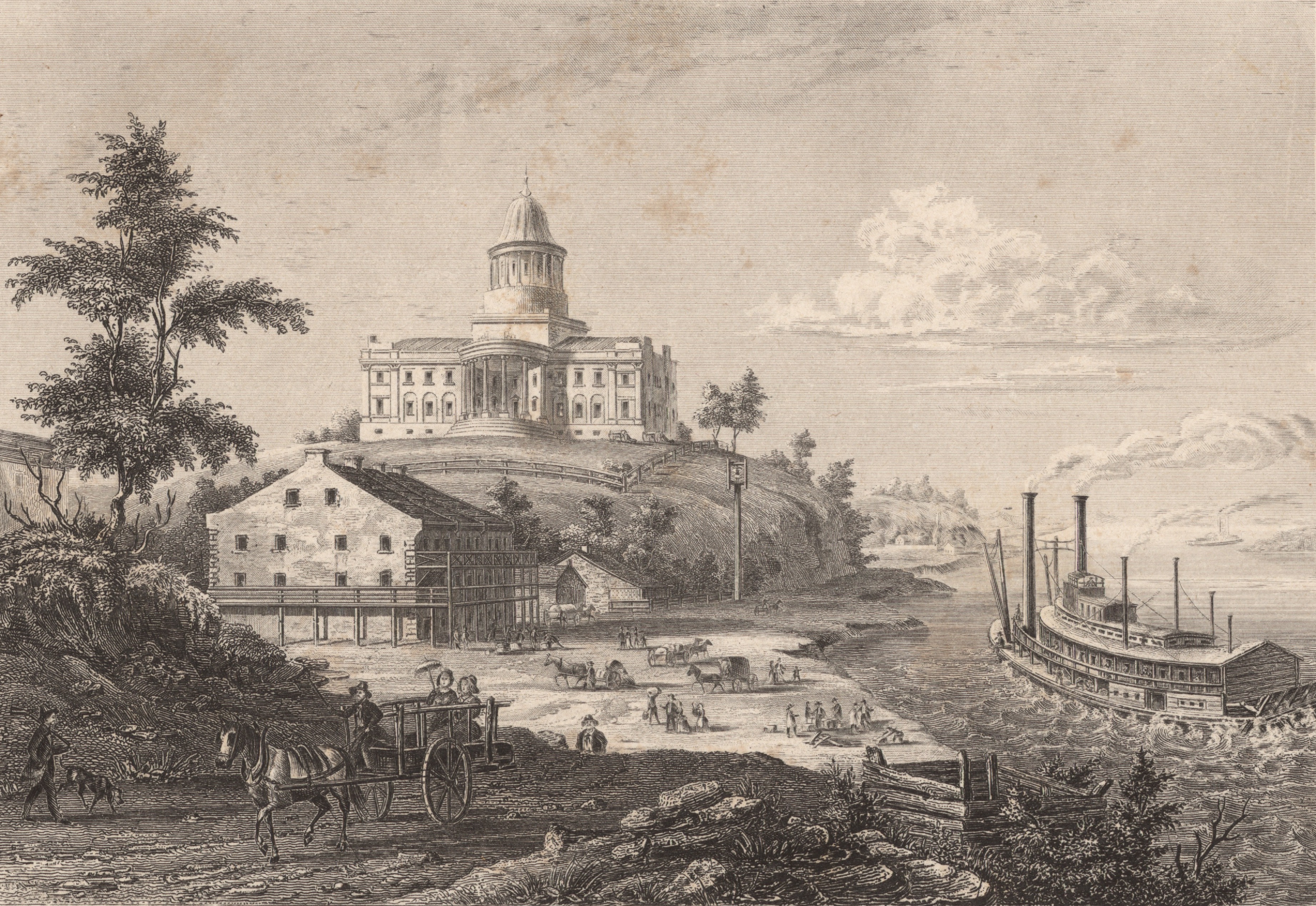
The fifth capitol (which was at the current site) was completed in 1840 as designed by Stephen Hills for approximately $350,000 (), with some controversies and claims that there were bribes and kickbacks. This building also burned after 71 years on February 5, 1911 when it was struck by lightning. This building was approximately 50000 sqft and by 1911, was far too small to meet the then current needs of the legislators in the 1910s. Missouri State Senator William Warner (1840-1916), was quoted saying, "I have no tears to shed over the fact that the building has been destroyed as it was totally inadequate and not in keeping with the requirements of our great state". He died just before the new massive huge replacement State Capitol was completed and dedicated the following year in 1917.
Current capitol

It was also decided that the architect would be selected from a design competition; names were redacted from the submissions so that there would be no local favoritism. A total of 69 architectural firms submitted for the competition, from which a short list of 11 were chosen. Tracy & Swarthout from New York City was ultimately selected.
The building is symmetrical in plan, giving equal symbolic weight to both legislative chambers of the House of Representatives and the state Senate (though the interiors and decoration of the two chambers differ greatly). The style makes many historical references to the national United States Capitol on Capitol Hill in Washington, D.C., as well as to ancient Greek and Roman temples; however, the typical column capital top is a unique variation on the canonical Corinthian style capital, replacing the acanthus leaves with local flora.
The stone for the exterior is a dense marble from Carthage, Missouri. Some of the finer details have eroded after 100 years of freeze and thaw weather climate cycles. The state has committed $30 million to study, restore, and prevent further deterioration. The building measures five stories high, 437 ft long, 300 ft wide in the center, and 200 ft wide in the wings. The dome is 238 ft high and the height of the wings is 88 ft. It includes 500000 sqft of floor space.
Rotunda chandelier incident

In November 2006, the 9000 lb dome chandelier, which had been lowered almost to the floor for maintenance, fell the remaining five feet. The chandelier was damaged by the impact and by the ornamental chains that fell on it. It was sent to a St. Louis company for repairs. Nearly a full year later, the chandelier was returned to Jefferson City and raised in the capitol. The upper lights were also restored, after they had been turned off for four decades due to light damage to the mural above. Created in 1918 by the Guth Lighting Company of St. Louis for a cost of $5,000 (), the chandelier cost $500,000 () to be restored.
Sources
- Hunter, Marie Nau, Missouri and Mississippi: Robert Ingersoll Aitken's Sculpture in Jefferson City, Missouri, Master's Thesis, University of Missouri-Columbia, 1996
- Kvaran & Lockley A Guide to the Architectural Sculpture of America, unpublished manuscript
- Pickard, John, The Missouri State Capitol: Report of the Capitol Decoration Commission, 1917–1928, Capitol Decoration Committee, Jefferson City Missouri, 1928
References
References
- {{NRISref|version=2010a}}
- "Stephen Hills (1771-1844)". Pennsylvania Capitol Preservation Committee.
- "Majesty Restored – Capitol Restoration Project Reaches Completion – Missouri Senate — 2021".
- "Missouri's State Capital". Missouri Secretary of State.
- (April 10, 1969). "Missouri State Capitol Building and Grounds". Missouri Department of Natural Resources.
- (June 23, 1969). "Missouri State Capitol Building and Grounds". National Park Service.
- Sarah D. Wire. (November 7, 2007). "Capitol chandelier raised almost a year after falling". Missouri Digital News.
- (November 12, 2006). "4,500-pound chandelier damaged in Missouri capitol mishap". Southeast Missourian.
This article was imported from Wikipedia and is available under the Creative Commons Attribution-ShareAlike 4.0 License. Content has been adapted to SurfDoc format. Original contributors can be found on the article history page.
Ask Mako anything about Missouri State Capitol — get instant answers, deeper analysis, and related topics.
Research with MakoFree with your Surf account
Create a free account to save articles, ask Mako questions, and organize your research.
Sign up freeThis content may have been generated or modified by AI. CloudSurf Software LLC is not responsible for the accuracy, completeness, or reliability of AI-generated content. Always verify important information from primary sources.
Report