From Surf Wiki (app.surf) — the open knowledge base
Missile Defense Agency
Agency of the US Defense Department

Agency of the US Defense Department
| Field | Value |
|---|---|
| agency_name | Missile Defense Agency |
| logo_width | 150px |
| logo_caption | Logo |
| seal | Seal of the U.S. Missile Defense Agency.svg |
| seal_width | 150px |
| formed | |
| preceding1 | Strategic Defense Initiative |
| preceding2 | Ballistic Missile Defense Organization |
| jurisdiction | Federal government of the United States |
| headquarters | Headquarters Command Center, Fort Belvoir, Virginia |
| employees | Approx. 2500 (3000 with non-MDA support personnel) (2016) |
| budget | $9.187 billion (FY 2021) |
| parent_agency | Department of Defense |
| chief1_name | Lt Gen Heath Collins |
| chief1_position | Director |
| chief2_name | Maj Gen D. Jason Cothern |
| chief2_position | Deputy Director |
| website |
The Missile Defense Agency (MDA) is a component of the United States Department of Defense responsible for developing a comprehensive defense against ballistic missiles. It had its origins in the Strategic Defense Initiative (SDI) which was established in 1983 by Ronald Reagan and which was headed by Lt. General James Alan Abrahamson. Under the Strategic Defense Initiative's Innovative Sciences and Technology Office headed by physicist and engineer Dr. James Ionson, the investment was predominantly made in basic research at national laboratories, universities, and in industry. These programs have continued to be key sources of funding for top research scientists in the fields of high-energy physics, advanced materials, nuclear research, supercomputing/computation, and many other critical science and engineering disciplines—funding which indirectly supports other research work by top scientists, and which was most politically viable to fund from appropriations for national defense. It was renamed the Ballistic Missile Defense Organization in 1993, and then renamed the Missile Defense Agency in 2002. The current director is Lieutenant General Heath A. Collins.
Rapid changes in the strategic environment due to the rapid dissolution of the Soviet Union led, in 1993, to Bill Clinton focusing on theater ballistic missiles and similar threats, and renaming it the Ballistic Missile Defense Organization, BMDO. With another change to a more global focus made by George W. Bush, in 2002 the organization became the Missile Defense Agency.
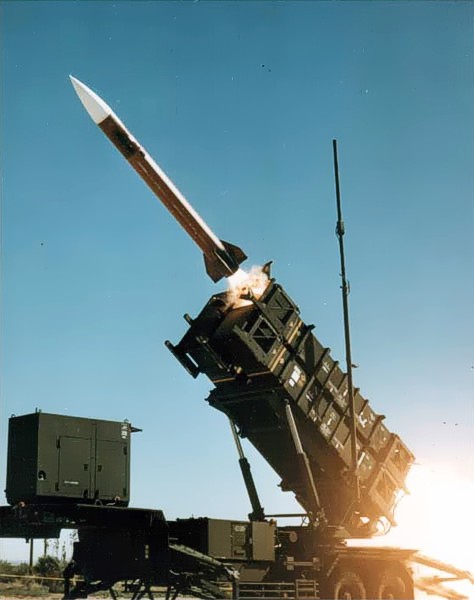
The Missile Defense Agency is partially or wholly responsible for the development of several ballistic missile defense (BMD) systems, including the Patriot PAC-3, Aegis BMD, THAAD and the Ground-Based Midcourse Defense system with a cost of $246 billion.
They also led the development of numerous other projects, including the Multiple Kill Vehicle and the newer Multi-Object Kill Vehicle, the Kinetic Energy Interceptor and the Airborne Laser. As the inheritor of the SDI and BMDO work, the MDA continues to fund fundamental research in high-energy physics, supercomputing/computation, advanced materials, and many other science and engineering disciplines.
Mission statement
The MDA currently publishes the following mission statement:
The National Defense Authorization Act is cited as the original source of the MDA's mission:
International mission
.jpg)
Ballistic Missile Defense Systems (BMDS) must be capable of operating in different regions of the world to ensure the success of the MDA mission. The International Strategy was approved by the MDA Director in 2007. The general strategy for international efforts is: :Outreach: Communicate the importance of missile defense by promoting worldwide BMDS by sharing information with allies and partners. :Capability and Interoperability: Identify and integrate U.S and partner systems to create global missile defense system. Promote interoperability among allies. :Technology: Identify and evaluate possible international technology in support of BMDS capabilities. :Investment: Identify and execute investment opportunities with allies and partners. :Workforce: Shape a qualified workforce to execute the MDA International Strategy.
As of 2017 MDA was working on facilities in Germany, Romania, Poland, Japan, Qatar, Saudi Arabia and the United Arab Emirates.
Potential threats against the United States
Ballistic missile systems using advanced liquid- or solid-propellant propulsion are becoming more mobile, accurate and capable of striking targets over longer distances and are proliferating worldwide.
- Iran currently has short- and medium- range missiles with guidance systems. Iran's launch of a medium range, solid fuel ballistic missile demonstrates its ability to hit targets in Israel and southern Europe. Iran also successfully launched the Safir Space Launch Vehicle on Feb 2, 2009. It was then speculated that development of an ICBM was not far behind. Intelligence reports that a missile could have been built sometime between 2010 and 2015 perhaps using help from Russian and North Korean technology. Iran also recently developed a hypersonic ballistic missile in 2022, which can move fifteen times the speed of sound and can reach U.S. and European targets, as well as the U.S. mainland, in 15 minutes.
- North Korea currently deploys a Nodong ballistic missile capable of hitting Japan and South Korea, and is developing a new intermediate-range ballistic missile (IRBM) which could reach Guam and the Aleutian Islands. They also successfully demonstrated the staging and separation technologies required to launch a Taepo-Dong 2 ICBM, which has the capability to reach the United States. The Taepodong missile was first tested in 2006, and failed 40 seconds into midflight. North Korean missiles are notoriously unreliable, and many of the DPRK's missile tests have failed, including the most recent Taepodong-2 launches in 2009 and 2012, and a failed launch of the BM25 Musudan in 2016. On 1 January 2017, North Korea announced its final preparation for a test of an ICBM, for the first time. On 6 March 2017, North Korea launched four missiles from Tongchang-ri, a known long-range missile site at 7:36 a.m. local time, one of which landed in the Sea of Japan, with the remaining three missiles landing in Japan's economic zone. On July 4, 2017 North Korea launched a ballistic missile that had the potential to be an ICBM. It flew through space and landed in the Sea of Japan. "The launch continues to demonstrate that North Korea poses a threat to the United States and our allies," a Pentagon statement said.
- Syria has been identified as a host for short-range ballistic missiles (as it acquires equipment from North Korea and Iran).
Defense of Guam
MDA planned in 2023 to use multiple technologies to defend Guam.
Categories
MDA divides its systems into four phases: boost; ascent; mid-course; and terminal. Each of these corresponds to a different phase of the threat ballistic missile flight regime. Each phase offers different advantages and disadvantages to a missile defense system (see missile defense classified by trajectory phase), and the geography of each defended area dictates the types of systems which can be employed. The resultant flexible and layered defense approach concept is believed to improve overall defense effectiveness. The more opportunities a system has to neutralize a threat (e.g., by shooting down a missile), the better the chance of success.
Activities have also been categorized as fulfilling the goals of one of five "blocks". For example, "block 4.0" was stated as "Defend Allies and Deployed Forces in Europe from Limited Iranian Long-Range Threats and Expand Protection of U.S. Homeland". It included the US missile defense complex in Poland to be constructed, and the European Mid-course Radar (EMR), currently located at the Ronald Reagan Ballistic Missile Defense Test Site at Kwajalein Atoll, which was to have been modified and relocated to the Czech Republic.
On 17 September 2009, the Obama administration scrapped the "block 4.0" plan, in favor of a new so-called "European Phased Adaptive Approach" (EPAA).
Boost phase
Can intercept all ranges of missiles, but the missile boost phase is only from one to five minutes. It is the best time to track the missile because it is bright and hot. The missile defense interceptors and sensors must be in close proximity to the launch, which is not always possible. This is the most desirable interception phase because it destroys the missile early in flight at its most vulnerable point and the debris will typically fall on the launching nations' territory.
Ascent phase
This is the phase after powered flight but before the apogee. It is significantly less challenging than boost phase intercepts, less costly, minimizes the potential impact of debris, and reduces the number of interceptors required to defeat a raid of missiles.
Midcourse phase
This phase begins after the booster burns out and begins coasting in space. This can last as long as 20 minutes. Any debris remaining will burn up as it enters the atmosphere. Ground-based missile defense systems can defend from long-range and intermediate-range ballistic missiles in this phase. Mobile elements can defend against medium and short ranged missiles in midcourse.
Terminal phase
This phase is the last chance to intercept the warhead. This contains the least-desirable Interception Point (IP) because there is little room for error and the interception will probably occur close to the defended target.
Defenses
Boost phase defense
Research and development:
- Kinetic Energy Interceptor (KEI) – In December 2003, MDA awarded a contract to Northrop Grumman for developing and testing. It will have to be launched from a location not too far from the launch site of the target missile (and is therefore less suitable against large countries), it has to be fired very soon after launch of the target, and it has to be very fast itself (6 km/s). In 2009, the Department of Defense and MDA determined the technological issues were excessive and cancelled the program, allocating no funding for it in its later budget submission.
- Boeing YAL-1 Airborne Laser (ABL) – Team ABL proposed and won the contract for this system in 1996. A high-energy laser mounted on a converted 747 airliner was used to intercept a test target in January 2010, and the following month, successfully destroyed two test missiles. While the program has been cancelled due to concerns about its practicality with present technology (while successful the system was still extremely short ranged, likely needing to fly in heavily defended space to make an interception) the YAL-1 served to demonstrate the potential of such a system. The capabilities of being deployed rapidly to any part of the world and of intercepting a large number of missiles would make a future system extremely attractive. However, the entire concept was deemed infeasible and cancelled without successors in December 2011.
- Network Centric Airborne Defense Element (NCADE) – On September 18, 2008 Raytheon announced it had been awarded a $10 million contract to continue research and development of NCADE, a missile defense system based on the AIM-120 AMRAAM.
- Golden Dome, multi-layer missile defense system for the United States, intended to detect and destroy ballistic, hypersonic, and cruise missiles before they launch or during flight.
One can distinguish disabling the warheads and just disabling the boosting capability. The latter has the risk of "shortfall": damage in countries between the launch site and the target location.
See also APS report.
Ascent phase defense
Research and development:
-
Ascent-Phase intercept System (API) – Emerging intercept technologies are being developed and designed to defeat launched missiles in their ascent phase. This phase is after the boost phase and prior to the threat missile's apogee (midcourse). The Ascent phase intercept program is still classified so there is little information on it.
-
Golden Dome
Midcourse (ballistic) phase defense
In use:
- Ground-Based Midcourse Defense (GMD)
- Aegis Ballistic Missile Defense System (Aegis BMD) Research and development:
- Multiple Kill Vehicle (MKV, originally Miniature Kill Vehicle): the Department of Defense has canceled the MKV program in 2009, however a similar program restarted in August 2015, when Raytheon, Boeing, and Lockheed Martin were contracted to design a Multi-Object Kill Vehicle concept.
Hypersonic glide phase defense
Research and development: ::This section included material from United States Army Futures Command GPIBy 2021, the Missile Defense Agency (MDA) realized that it almost had a countermeasure to hypersonic boost-glide weapons, by using existing data on the adversary hypersonic systems which were gathered from existing US satellite and ground-based sensors.{{cite web
- {{cite web
- {{cite web
- {{cite web
- Glide Phase Interceptor, in Sep 2024, Northrup Grumman was selected to continue development on the Glide Phase Interceptor, a new missile defense asset designed to take down hypersonic weapons during the glide phase of the flight.
- Golden Dome
Terminal phase defense
In use:
- Terminal High Altitude Area Defense (THAAD)
- PATRIOT Advanced Capability-3 (PAC-3)
- Arrow missile, a joint effort between the U.S. and Israel Research and development:
- Medium Extended Air Defense System (MEADS), co-developmental program of the United States Department of Defense, Germany and Italy.
- Golden Dome
List of directors
| No. | Director | Term | Service branch | Portrait | Name | Took office | Left office | Duration | Director, Strategic Defense Initiative Organization | Director, Ballistic Missile Defense Organization | Director, Missile Defense Agency | |||||
|---|---|---|---|---|---|---|---|---|---|---|---|---|---|---|---|---|
| order = 1 | image = James Alan Abrahamson.jpg | Lieutenant General]] | officeholder = James A. Abrahamson | officeholder_sort = Abrahamson, James Alan | officeholder_note = | born_year = 1933 | died_year = | term_start = March 27, 1984 | term_end = January 31, 1989 | 1984 | 03 | 27 | 1989 | 01 | 31}} | 75px]] |
| U.S. Air Force | ||||||||||||||||
| order = 4 | image = Portrait of U.S. Army Lt. Gen. Malcolm R. O'Neill.jpg | military_rank = Lieutenant General | Malcolm R. O'Neill]] | officeholder_sort = O'Neill, Malcolm Ross | officeholder_note = | born_year = 1940 | died_year = | term_start = November 22, 1993 | term_end = August 1, 1996 | 1993 | 11 | 22 | 1996 | 08 | 01}} | 75px]] |
| U.S. Army | ||||||||||||||||
| order = 6 | image = Ron Kadish.JPG | military_rank = Lieutenant General | officeholder = Ronald T. Kadish | officeholder_sort = Kadish, Ronald T. | officeholder_note = | born_year = 1948 | died_year = | term_start = January 2, 2002 | term_end = July 2, 2004 | 2002 | 01 | 02 | 2004 | 07 | 02}} | 75px]] |
| U.S. Air Force |
References
References
- "MDA Breaks Ground on New Headquarters Facility".
- . (2016). ["Missile Defense Agency Notification and Federal Employee Antidiscrimination and Retaliation Act (NoFEAR) Fiscal Year 2016 Report"](https://www.mda.mil/global/documents/pdf/FY16_No_Fear_Annual_Report.pdf). *Missile Defense Agency*.
- . (2020). ["Missile Defense Agency Budget Estimates Overview Fiscal Year (FY) 2021"](https://www.mda.mil/global/documents/pdf/budgetfy21.pdf). *Missile Defense Agency*.
- "MDA Leadership". Missile Defense Agency.
- (November 5, 1985). "SDIO Funds Research". MIT: The Tech.
- (June 3, 1988). "Special Presentation: Innovative Science and Technology Programs". SPIE – Digital Library.
- (April 1987). "Star War's Inc.". Inc. Magazine.
- (June 1988). "Washington's Ins & Outs: Ionson and Mense Leave SDIO". Physics Today.
- (May 1988). "Low Profile for SDI Work on Campus". The Scientist Magazine.
- (November 1985). "Ionson Counters SDI Dispute". MIT: The Tech.
- (October 1985). "Ionson Defends SDI Program". MIT: The Tech.
- 85-25: National Policy on Transfer of Scientific, Technical and Engineering Information, Security Innovation for Estate Protection
- (January 23, 2019). "MDA History".
- (December 5, 2023). "Lieutenant General Heath A. Collins is confirmed as the Director, Missile Defense Agency". Missile Defense Agency.
- Sherman, Jason. (2024-11-01). "MDA pegs cost of Missile Defense System at $246B, prioritizes SM-3 Bk IIA over IB".
- MDA (2019). Our Mission. Retrieved on 2019-12-21 from https://www.mda.mil/about/mission.html.
- (October 2023). "Testing: Building Confidence". Missile Defense Agency }}{{Dead link.
- (24 May 2017). "New US Missile Defence Agency Bases To Be Constructed Around World". Digitalwriters Media Pvt. Ltd..
- (26 January 2010). "Ballistic Missile Defense Review, 26 Jan 2010".
- (2009-09-28). "Iran tests longest range missiles". BBC News.
- Hildreth, Steven A.. (2008-07-21). "Iran's Ballistic Missile Programs: An Overview". Congressional Research Service.
- (27 July 2017). "U.S. says Iran rocket test breaches U.N. resolution".
- Motamedi, Maziar. "Iran has a hypersonic missile. What does that mean?".
- (2009-05-27). "North Korea's missile programme". BBC News.
- (28 August 2015). "The 100th Missile Defense Brigade: A decade of transformation and mission success.".
- [https://www.nknews.org/2016/06/on-north-koreas-failed-musudan-launch/ On North Korea’s failed Musudan launch] {{Webarchive. link. (2018-11-06 accessdate=2016-06-03)
- [https://wwwjapan PM Abe: North Korea launched four ballistic missiles .nytimes.com/2017/01/01/world/asia/north-korea-intercontinental-ballistic-missile-test-kim-jong-un.html Choe Sang-Hun, (1 Jan 2017) "North Korea Will Test Intercontinental Ballistic Missile, Kim Says" ''New York Times'']{{Dead link. (April 2020)
- [https://www.reuters.com/article/us-northkorea-missiles-idUSKBN16C0YUJapan PM Abe: North Korea launched four ballistic missiles]{{dead link. (July 2021)
- [https://www.washingtonpost.com/world/north-korea-launches-another-missile-perhaps-one-that-can-reach-us/2017/03/05/943010ee-96e2-4ff4-83aa-2fe09cd65831_story.html ''Washington Post'' North Korea launches another missile, perhaps one that can reach U.S.] accessdate=2017-03-05
- Barbara Starr and Ryan Browne. (4 July 2017). "As US, SK drill, Tillerson seeks action on NK". CNN.
- Ashley Roque [https://breakingdefense.com/2023/03/missile-defense-agency-details-evolving-incremental-vision-for-guam-air-defenses/ (16 March 2023) Missile Defense Agency details evolving, ‘incremental’ vision for Guam air defenses] C2BMC; IBCS; LRDR, AN/TPY-6, LTAMDS, Sentinel Radars; Aegis Ashore in trailers, THAAD, IFPC Inc 2 using AIM-9X Sidewinder +2nd missile TBD;
- DoD [https://www.war.gov/News/Transcripts/Transcript/Article/3328637/missile-defense-agency-officials-hold-a-press-briefing-on-president-bidens-fisc/ (14 Mar 2023) Missile Defense Agency Officials Hold a Press Briefing on President Biden's Fiscal 2024 Missile Defense Budget]
- Colin Demarest [https://www.c4isrnet.com/electronic-warfare/023/03/28/electronic-warfare-is-new-frontier-for-us-missile-defense-agency/ (28 Mar 2023) Electronic warfare is 'new frontier' for US Missile Defense Agency]{{Dead link. (October 2023)
- Micah Hanks [https://thedebrief.org/breakthrough-ballistic-missile-intercept-demonstrated-by-u-s-missile-defense-agency-in-aegis-weapon-system-breakthrough-ballistic-missile-intercept-demonstrated-by-u-s-missile-defense-agency-in-aegis/ (3 Apr 2023) BREAKTHROUGH BALLISTIC MISSILE INTERCEPT DEMONSTRATED BY U.S. MISSILE DEFENSE AGENCY IN AEGIS SYSTEM TEST] FTM-31Ea "first Aegis Baseline 9 Weapon System (9.C2.0, or BMD 5.1) intercept of a medium-range ballistic missile with the upgraded SM-6 Dual" salvo of Standard Missile-6 Dual IIs, also called 'RIM-174 Standard Extended Range Active Missile' ERAM
- "Ballistic Missile Defense System". GlobalSecurity.
- G. Lewis and T. Postol. (May–June 2008). "The European missile defense folly". [[Bulletin of the Atomic Scientists]].
- (2011-05-03). "United States European Phased Adaptive Approach (EPAA) and NATO Missile Defense". [[U.S. Department of State]].
- (May 2009). "Kinetic Energy Interceptors Program Element 0603886C Budget Item Justification".
- [http://www.mda.mil/news/gallery_abl.html Airborne Laser (ABL) 2010] {{webarchive. link. (2010-01-28 . US Missile Defense Agency, January 10, 2010. Retrieved: January 25, 2010.)
- (Feb 12, 2010). "U.S. successfully tests airborne laser on missile". [[Reuters]].
- "Boeing YAL-1 Airborne Laser impacted by Pentagon spending priorities". Flight Image of the Day.
- (Sep 18, 2008). "Raytheon Awarded $10 million to Develop New Missile Defense Interceptor". Raytheon.
- (2025-10-29). "Inside Trump's Golden Dome: High-stakes debate over missile-defense shield".
- "MDA Awards Spots to Over 1,000 Contractors on $151B SHIELD Contract for Golden Dome".
- "Airborne Intercept". RAND Corporation.
- "MDA Seeks $368 Million for New Ascent-Phase Intercept System".
- Parcover, Grace. (2025-12-11). "We Might Regret Golden Dome's Greatest Ambition".
- (Apr 27, 2009). "President's Budget Submission for Program Element 0603894C".
- "Raytheon takes next step toward defining Multi-Object Kill Vehicle concept". PR News Wire.
- "Northrop selected to develop anti-hypersonic Glide Phase Interceptor".
- Trevithick, Joseph. (2025-01-28). "Weaponizing Space Key To Trump's Iron Dome Missile Defense Shield Vision". The War Zone.
This article was imported from Wikipedia and is available under the Creative Commons Attribution-ShareAlike 4.0 License. Content has been adapted to SurfDoc format. Original contributors can be found on the article history page.
Ask Mako anything about Missile Defense Agency — get instant answers, deeper analysis, and related topics.
Research with MakoFree with your Surf account
Create a free account to save articles, ask Mako questions, and organize your research.
Sign up freeThis content may have been generated or modified by AI. CloudSurf Software LLC is not responsible for the accuracy, completeness, or reliability of AI-generated content. Always verify important information from primary sources.
Report