From Surf Wiki (app.surf) — the open knowledge base
Mishkenot Sha'ananim
First Jewish neighbourhood built outside of the Old City walls in Jerusalem
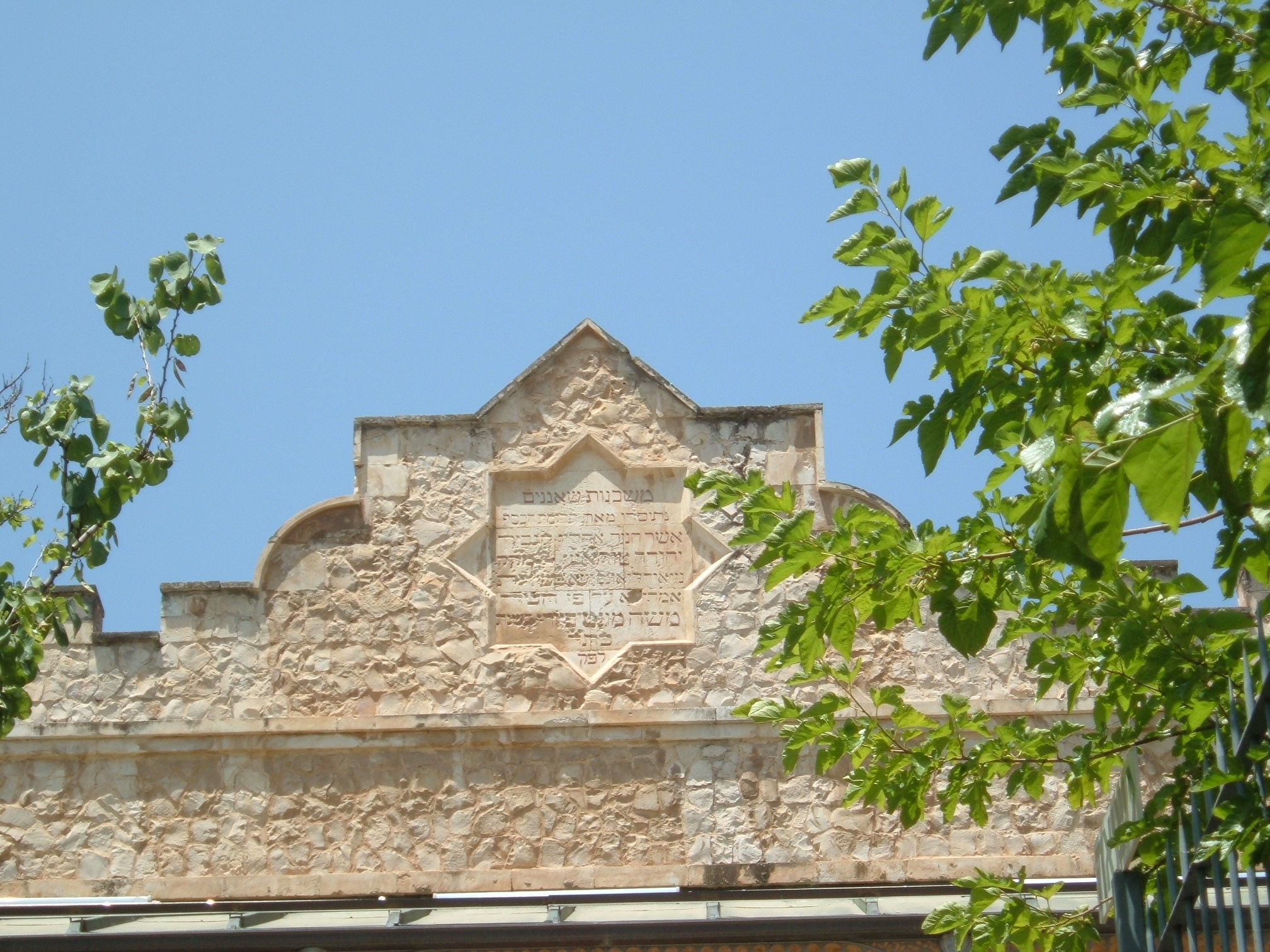
First Jewish neighbourhood built outside of the Old City walls in Jerusalem
| Field | Value |
|---|---|
| name | Mishkenot Sha'ananim |
| native_name | |
| settlement_type | Neighborhood of Jerusalem |
| image_skyline | שכונת משכנות שאננים וטחנת הרוח. צולם מכיוון העיר העתיקה.jpg |
| imagesize | 300px |
| image_caption | View of Mishkenot Sha'ananim from the Old City of Jerusalem |
| subdivision_type | Country |
| subdivision_name | Israel |
| subdivision_type1 | District |
| subdivision_name1 | Jerusalem District |
| subdivision_type2 | City |
| subdivision_name2 | Jerusalem |
| established_title | Founded |
| established_date | 1860 |
| founder | Sir Moses Montefiore |
| area_code_type | Area code |

Mishkenot Sha'ananim (, lit. Peaceful Dwellings) was the first Jewish settlement built outside the walls of the Old City of Jerusalem, on a hill directly across Mount Zion. It was built in 1859–1860. This guesthouse was one of the first structures to be built outside the Old City, the others being Kerem Avraham, the Schneller Orphanage, Bishop Gobat school, and the Russian Compound.
History
Ottoman period
Mishkenot Sha'ananim was built by British Jewish banker and philanthropist Sir Moses Montefiore in 1860, after he acquired the land from the Governor of Jerusalem, Ahmad Agha Duzdar.
On the night of 1 January 1873, Aaron Hershler was standing guard at the Montefiore Windmill, when a group of Arab Muslims from Silwan attempted to rob his family's home in Mishkenot Sha'ananim. Hershler took chase and was shot 12 times. He died in the hospital on 5 January and was buried on the Mount of Olives. Seventy-five years after his death, Hershler was recognized by the Israel Defense Forces as the first "national martyr" in the Jewish-Arab conflict. He is one of approximately three dozen Jews killed during Ottoman-ruled Palestine, who are commemorated as part of Israeli's annual Yom Hazikaron memorial day.
It was built as an almshouse, paid for by the estate of an American Jewish businessman from New Orleans, Judah Touro. Since it was outside the walls and open to Bedouin raids, pillage and general banditry rampant in the region at the time, the Jews were reluctant to move in, even though the housing was luxurious compared to the derelict and overcrowded houses in the Old City. The name of the neighborhood was taken from the Book of Isaiah: "My people will abide in peaceful habitation, in secure dwellings and in peaceful resting places" (). It later became part of Yemin Moshe, which was established in 1892–1894.
Jordanian period

After the 1948 Arab–Israeli War, when the Old City was captured by the Arab Legion, Mishkenot Sha'ananim bordered on no man's land in proximity to the armistice line with the Kingdom of Jordan, and many residents of the Yemin Moshe quarter left in the wake of sniper attacks by Jordanian Arab Legionnaires. Only the poorest inhabitants remained, turning the complex into a slum.
Restoration after 1967
The no-man's-land bordering Mishkenot Sha'ananim was captured by Israel during the 1967 War, together with the rest of Eastern and Old Jerusalem.
In 1973, Mishkenot Sha'ananim was turned into an upscale guesthouse for internationally acclaimed authors, artists and musicians visiting Israel. Apart from guesthouse facilities, it is now a convention center and home of the Jerusalem Music Center. The music center was inaugurated by Pablo Casals shortly before his death.
The Jerusalem Center for Ethics was established in Mishkenot Sha'ananim in 1997. Yitzhak Zamir has been heading the board of directors since his retirement as justice of the Israeli Supreme Court in 2001. File:16-03-30-Jerusalem-Innenstadt-RalfR-DSCF7571.jpg|Etzioni Flame File:16-03-30-Jerusalem-Innenstadt-RalfR-DSCF7584.jpg|Montefiore Windmill File:16-03-30-Jerusalem-Innenstadt-RalfR-DSCF7586.jpg|Ha-Takhana File:16-03-30-Jerusalem Mishkenot Sha’ananim-RalfR-DSCF7637.jpg|Jerusalem as the Center of the World by David Breuer-Weil (after the Bünting Clover Leaf Map), in Teddy Kollek Park (2016)
References
References
- (1996). "Mishkenot Sha'ananim: From Alms House to Cultural Centre - Jerusalem's First Building Outside the Old City's Wall". [[Ministry of Foreign Affairs (Israel)]].
- (2001). "Jerusalem and Its Environs: Quarters, Neighborhoods, Villages, 1800-1948". [[Wayne State University Press]].
- [https://archive.org/details/diariesofsirmose02montiala/page/50/mode/2up Diaries of Sir Moses and Lady Montefiore : comprising their life and work as recorded in their diaries from 1812 to 1883, Volume 2], pages 51–52: “Ahhmed Agha Dizdar, who had been Governor of Jerusalem during the reign of Mohhammad Ali, and who since the year 1839 had stood in friendly relations with Sir Moses, was the owner of the land in question. When Sir Moses broached the subject of the purchase to him, his answer was: "You are my friend, my brother, the apple of my eye, take possession of it at once. This land I hold as an heirloom from my ancestors. I would not sell it to any person for thousands of pounds, but to you I give it without any money: it is yours, take possession of it." " I myself, my wife, and children, we all are yours." And this was his reply to Sir Moses day after day, whenever he was asked the price for which he would sell the said property. Ultimately, after a whole day's most friendly argument, which almost exhausted all my stock of Arabic phraseology (having acted as interpreter between him and Sir Moses), he said to me: "You are my friend, my brother; by my beard, my head, I declare this is the case. Tell Sir Moses to give me a souvenir of one thousand pounds sterling, and we will go at once to the Ckadee."
- (2023-04-23). "Iconic Jerusalem windmill commemorates 1873 death of Jew who was guarding it". [[Times of Israel]].
- (2007). "Reapproaching Borders: New Perspectives on the Study of Israel-Palestine". [[Rowman & Littlefield]].
- Dudman, Helga. (1982). "Street People". [[The Jerusalem Post]]/[[Carta Jerusalem.
- "Yemin Moshe and Mishkenot Sha'ananim". Pinhas Baraq for [[The Jewish Agency for Israel]]'s Department for Jewish Zionist Education.
- Klein, Menachem. (2014). "Lives in Common: Arabs and Jews in Jerusalem, Jaffa and Hebron". [[Oxford University Press]].
- "Israel and the Palestinians: Key Maps". [[BBC News]].
- "Konrad Adenauer Conference Center of Mishkenot Sha'ananim".
- [https://web.nli.org.il/sites/nli/english/library/globalforum/members/pages/itzhak_zamir.aspx Itzhak Zamir] at the National Library of Israel homepage. Posted before 2019, accessed 23 Aug. 2021.
This article was imported from Wikipedia and is available under the Creative Commons Attribution-ShareAlike 4.0 License. Content has been adapted to SurfDoc format. Original contributors can be found on the article history page.
Ask Mako anything about Mishkenot Sha'ananim — get instant answers, deeper analysis, and related topics.
Research with MakoFree with your Surf account
Create a free account to save articles, ask Mako questions, and organize your research.
Sign up freeThis content may have been generated or modified by AI. CloudSurf Software LLC is not responsible for the accuracy, completeness, or reliability of AI-generated content. Always verify important information from primary sources.
Report