From Surf Wiki (app.surf) — the open knowledge base
Mirror therapy
Treatment for some kinds of pain

Treatment for some kinds of pain
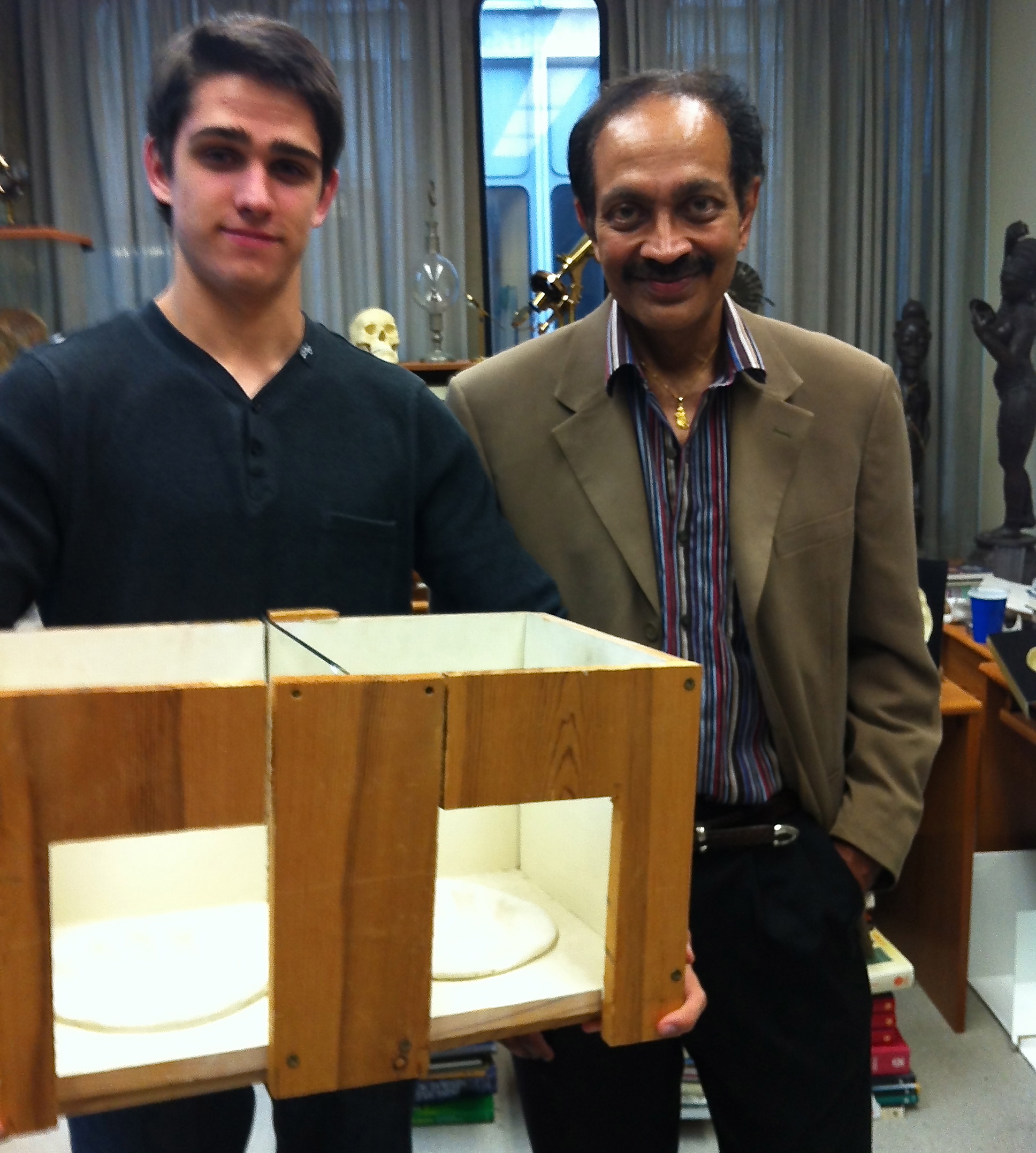
Mirror therapy (MT) or mirror visual feedback (MVF) is a therapy for pain or disability that affects one side of the patient more than the other side. It was invented in the 1990s by Vilayanur S. Ramachandran to treat post-amputation patients who had phantom limb pain (PLP). Ramachandran created a visual (and psychological) illusion of two intact limbs by putting the patient's affected limb into a "mirror box," with a mirror down the center (facing toward a patient's intact limb).
The patient then looks into the mirror on the side with the good limb and makes "mirror symmetric" movements, as a symphony conductor might, or as a person does when they clap their hands. The goal is for the patient to imagine regaining control over a missing limb. Because the subject is seeing the reflected image of the good limb moving, it appears as if the phantom limb is also moving. Through the use of this artificial visual feedback, it becomes possible for the patient to "move" the phantom limb and to unclench it from potentially painful positions.
Mirror therapy has expanded beyond its origin in treating phantom limb pain to the treatment of other kinds of one-sided pain or disability, for instance, hemiparesis in post-stroke patients and limb pain in patients with complex regional pain syndrome.
Post-amputation phantom limb pain
Based on the observation that phantom limb patients were much more likely to report paralyzed and painful phantoms if the actual limb had been paralyzed prior to amputation (for example, due to a brachial plexus avulsion), Ramachandran and Rogers-Ramachandran proposed the "learned paralysis" hypothesis of painful phantom limbs. Their hypothesis was that every time the patient attempted to move the paralyzed limb, they received sensory feedback (through vision and proprioception) that the limb did not move. This feedback stamped itself into the brain circuitry through a process of Hebbian learning so that, even when the limb was no longer present, the brain had learned that the limb (and subsequent phantom) was paralyzed.
Ramachandran created the mirror box to relieve pain by helping an amputee imagine motor control over a missing limb. Mirror therapy is now also widely used for the treatment of motor disorders such as hemiplegia or cerebral palsy. As Deconick et al. state in a 2014 review, the mechanism of improved motor control and pain relief may differ from the mechanism of pain relief. Deconick et al., who reviewed only the effects of MVF on sensorimotor control, found that MVF can exert a strong influence on the motor network, mainly through increased cognitive penetration in action control.
Although there has been much research on MVF, authors of many review articles complain about the poor methodology often used, for example, small sample sizes or lack of control groups. For this reason, one 2016 review (based on a review of 8 studies) concluded that the level of evidence was insufficient to recommend MT as a first-line treatment for phantom limb pain.
A 2018 review (based on 15 studies conducted between 2012 and 2017 out of a pool of 115 publications) also criticized the quality of many reports on mirror therapy (MT) but concluded that "MT seems to be effective in relieving PLP, reducing the intensity and duration of daily pain episodes. It is a valid, simple, and inexpensive treatment for PLP."
A 2018 literature review of phantom limb pain stated that mirror therapy reduced pain in randomized controlled trials.
Post-stroke hemiparesis
Treatment with mirror therapy soon expanded beyond its origin in treating phantom limb pain to treatment of other kinds of one-sided pain and loss of motor control, for example in stroke patients with hemiparesis. In 1999 Ramachandran and Eric Altschuler expanded the mirror technique from amputees to improving the muscle control of stroke patients with weakened limbs.
A review article published in 2016 concluded that "Mirror therapy (MT) is a valuable method for enhancing motor recovery in poststroke hemiparesis."
According to a 2017 review of fifteen studies that compared mirror therapy to conventional rehabilitation for the recovery of upper-limb function in stroke survivors, mirror therapy was more successful than CR in promoting recovery.
A 2018 review based on 1685 patients recovering from hemiplegic stroke found mirror therapy provided significant pain relief, while improving motor functions and activities of daily living (ADL).
Thirteen out of seventeen randomized controlled trials found that MT was beneficial for post-stroke patients' legs and feet, according to a 2019 review paper.
Despite considerable research, as of 2016 the underlying neural mechanisms of mirror therapy (MT) for stroke were still unclear. As Deconick et al. state in a 2014 review, the mechanism of improved motor control may differ from the mechanism of pain relief.
Complex regional pain syndrome
Mirror therapy is also a recommended therapy for complex regional pain syndrome (CRPS).
Virtual reality
Virtual reality and robotics can also provide the visual illusion of regaining control of a damaged limb, but with no advantages over standard mirror therapy.
Notes
References
References
- (2016). "'It's All Done with Mirrors': V.S. Ramachandran and the Material Culture of Phantom Limb Research". Medical History.
- https://www.researchgate.net/publication/338306618_Mirror_therapy
- (2012). "Mirror Therapy for Phantom Limb Pain". The Korean Journal of Pain.
- Ramachandran, V.S., Blakeslee, S.: "Phantoms in the Brain: Probing the Mysteries of the Human Mind", 1998, William Morrow & Company, {{ISBN. 0-688-15247-3
- Wilson, Cassandra. (2010). "The Effectiveness of Mirror Therapy in the Treatment of Post-amputation Phantom Limb Pain".
- (August 26, 2014). "Reflections on Mirror Therapy: A Systematic Review of the Effect of Mirror Visual Feedback on the Brain". Neurorehabilitation and Neural Repair.
- (2016). "The effects of mirror therapy on pain and motor control of phantom limb in amputees: A systematic review". Annals of Physical and Rehabilitation Medicine.
- (November 14, 2018). "Effectiveness of mirror therapy in phantom limb pain: A literature review". Neurologia.
- (2018). "Phantom limb pain: A literature review". Chin J Traumatol.
- (12 June 1999). "Rehabilitation of hemiparesis after stroke with a mirror". The Lancet.
- Kamal Narayan Arya, Underlying neural mechanisms of mirror therapy: Implications for motor rehabilitation in stroke, Neurology India,2016, Volume64, Issue 1, Pages 38-44 [http://www.neurologyindia.com/article.asp?issn=0028-3886;year=2016;volume=64;issue=1;spage=38;epage=44;aulast=Arya]
- (2017). "Systematic review of mirror therapy compared with conventional rehabilitation in upper extremity function in stroke survivors". Australian Occupational Therapy Journal.
- (October 15, 2018). "Effect of Mirror Therapy on Recovery of Stroke Survivors: A Systematic Review and Network Meta-analysis.". Neuroscience.
- (2019). "The Efficacy of Lower Extremity Mirror Therapy for Improving Balance, Gait, and Motor Function Poststroke: A Systematic Review and Meta-Analysis". J Stroke Cerebrovasc Dis.
- Rossiter, Borrelli, Borchert, Bradbury, Ward:[https://www.ncbi.nlm.nih.gov/pubmed/25326511 "Cortical mechanisms of mirror therapy after stroke"], Neurorehabil Neural Repair. 2015 Jun;29(5):444-52
- (2013). "Mirror therapy for Complex Regional Pain Syndrome (CRPS)—A literature review and an illustrative case report". Scandinavian Journal of Pain.
- (July 30, 2015). "Not all smoke and mirrors: mirror therapy for Complex regional pain syndrome". BMJ.
- (2018). "Do Robotics and Virtual Reality Add Real Progress to Mirror Therapy Rehabilitation? A Scoping Review". Rehabilitation Research and Practice.
This article was imported from Wikipedia and is available under the Creative Commons Attribution-ShareAlike 4.0 License. Content has been adapted to SurfDoc format. Original contributors can be found on the article history page.
Ask Mako anything about Mirror therapy — get instant answers, deeper analysis, and related topics.
Research with MakoFree with your Surf account
Create a free account to save articles, ask Mako questions, and organize your research.
Sign up freeThis content may have been generated or modified by AI. CloudSurf Software LLC is not responsible for the accuracy, completeness, or reliability of AI-generated content. Always verify important information from primary sources.
Report