From Surf Wiki (app.surf) — the open knowledge base
Mir Docking Module
Russian storage and crew access module for the Shuttle-Mir Program

Russian storage and crew access module for the Shuttle-Mir Program
| Field | Value |
|---|---|
| module | Mir Docking Module |
| module_image | Docking Module (STS-74).jpg |
| module_image_caption | The docking module seen in the payload bay of the on STS-74, prior to docking with Mir. |
| station | Mir |
| launch | 12 November 1995 |
| launch_vehicle | (STS-74) |
| docked | 15 November 1995 |
| reentry | 23 March 2001 |
| mass | 6134 kg |
| length | 4.7 m |
| diameter | 2.2 m |
| stats_ref | |
| configuration_image | Mir Docking Module drawing.svg |
| configuration_caption | The docking module shown isolated in its basic configuration. Various additional external fixtures are not shown. |
The Mir Docking Module, formally known as the Stykovochnyy Otsek (SO; ; designation: 316GK), was the sixth module of the Russian space station Mir, launched in November 1995 aboard the . The module, built by Energia, was designed to help simplify space shuttle dockings to Mir during the Shuttle-Mir program, preventing the need for the periodic relocation of the Kristall module necessary for dockings prior to the compartment's arrival. The module was also used to transport two new photovoltaic arrays to the station, as a mounting point for external experiments, and as a storage module when not in use for dockings.
Development
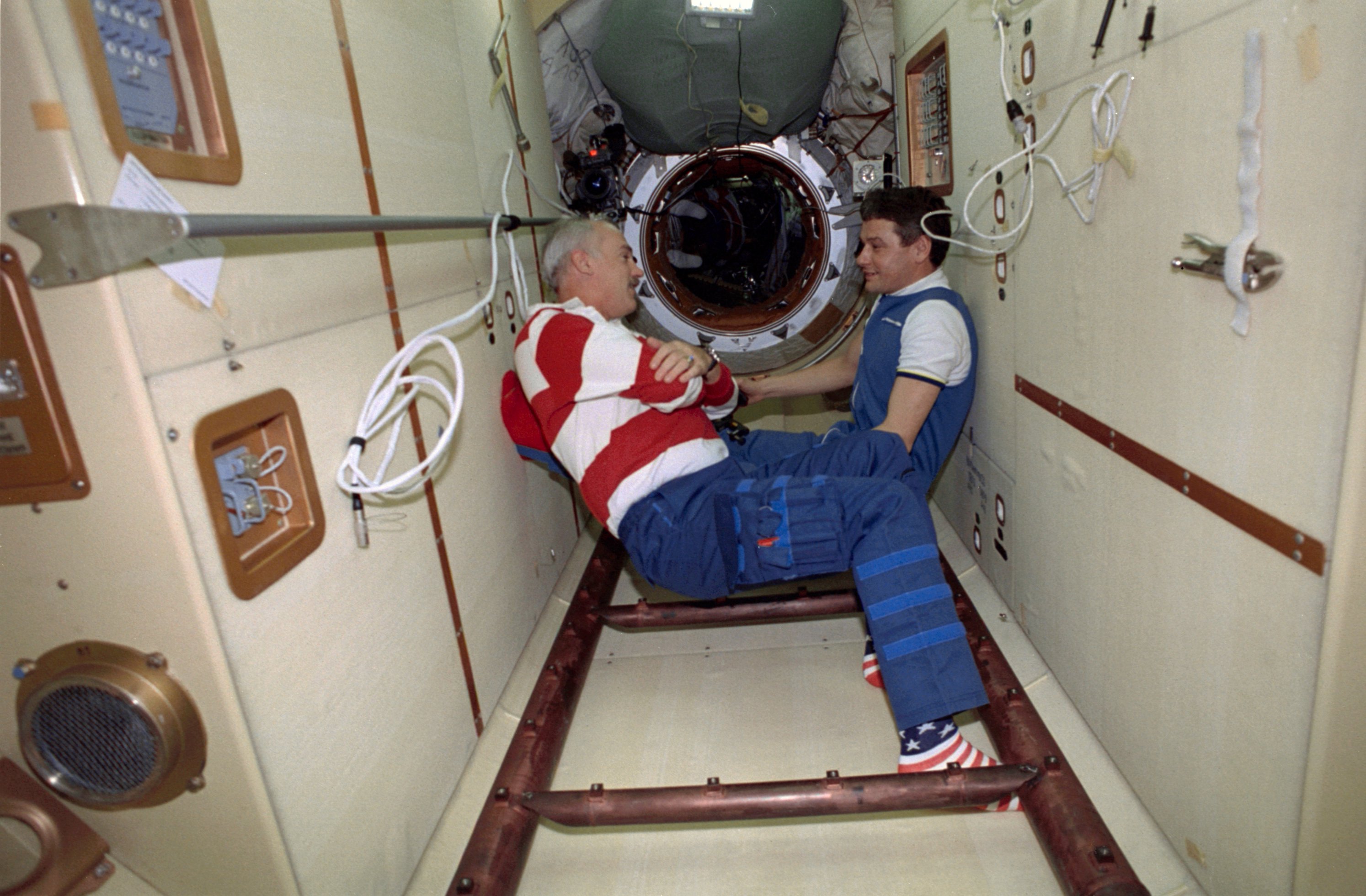


The docking module originated in the 1992 design version of the cancelled Mir-2 space station, which featured a combined docking compartment and airlock to facilitate docking missions during the Soviet Buran space shuttle programme (this module, SO-1, was eventually incorporated into the Russian Orbital Segment of the International Space Station as Pirs). When the Shuttle-Mir programme began, engineers realised that in order to enable US space shuttles to dock to Mir, the Kristall module would have to be relocated to the forward port of the core module and back to its own lateral port each time a shuttle docked, a process which was not only time consuming but would also be entirely reliant on *Kristall'''s Lyappa arm, which, should it fail, would prevent any further shuttle missions to the station. Adding a small extension to Kristall, however, would provide the shuttles the clearance they needed to dock without necessitating the relocation of the module on each occasion, and it was decided to base the design of the new module loosely on that of the *Mir''-2 docking compartment.
Discussions on providing a docking module for the Shuttle-Mir programme began in May 1993 and approval was granted on 1 November, with the draft plan being developed by December. The module consisted of what were essentially two Soyuz TM-16 type Soyuz orbital modules cut in half, with a cylindrical central portion mounted in the center of the two halves which incorporated docking apparatus (the other two halves were not used). An APAS-89 docking port was mounted on each end. Mounting points were also provided for two boxes (containing new solar arrays) and other external experiments, and the module was provided with its own thermal control, television transmission, and telemetry systems. Rather than being covered in a newly-manufactured white thermal blanket, the module was flown with an unusual orange blanket, which was selected from pre-existing stock for financial reasons. Development of the simplified module was given priority over the more complex Mir-2 type SO-1, and the flight model, the first to make use of NASA's new Space Station Processing Facility, was delivered to Kennedy Space Center on 7 June 1995 alongside the new solar arrays which were to be launched with it.
The module was launched aboard the on 12 November 1995 on mission STS-74 and both the module and Atlantis docked to Mir on 15 November, leaving STS-71 as the only Shuttle-Mir docking mission requiring Kristall to be relocated.
The module resembles the pressure hull for the cancelled Science Power Platform intended for Mir-2 and the International Space Station, the test article for which was turned into the Rassvet Mini-Research Module 1 and launched in 2010 aboard Atlantis, on mission STS-132.
Solar arrays and MEEP
Main article: Mir Environmental Effects Payload
In addition to simplifying space shuttle docking missions, *Mir'''s docking module was also used as a carrier for two new photovoltaic arrays, mounted to the module in boxes, which were later deployed on Kvant-1 during spacewalks. The first, the Mir Cooperative Solar Array, was jointly designed by NASA and Russia in order to test designs for the future International Space Station. The array was 42 m2 in area, and provided 6.7 kW of power when installed on the station during expedition EO-21 in 1996. The array consisted of 42 US-built panels arranged in a 2.7 m (9 ft) wide and 18 m (59 ft) long array mounted to a Russian-built frame, and was instrumented to provide data for models being used to design the solar arrays for the ISS. The second array was the Russian-built MSB array, which had originally been intended to be launched as part of Priroda before the redesign of the module deleted it. It was installed on Kvant-1 during EVA 5 of EO-24, replacing the *Kristall'' array which had previously been mounted there.
The module was also used as a mounting point for the Mir Environmental Effects Payload (MEEP), a set of four experiments intended to study the effects of space debris impacts and exposure to the space environment on a variety of materials. The materials used in the experiments were being considered for use on the ISS, and by exposing them at a similar orbital altitude to that flown by the station, the experiments provided an assessment of the performance of those materials in a similar space environment. MEEP also fulfilled the need to examine the occurrence and effects of man-made debris and natural micrometeoroids through capture and impact studies. The experiments were installed on the docking module during STS-76, and retrieved during STS-86.
Docking missions
| Orbiter | Mission | Date docked (UTC) | Date undocked (UTC) | Notes | ||||
|---|---|---|---|---|---|---|---|---|
| STS-74 | 14 November 1995 07:17 | 18 November 1995 08:15:44 | The module was docked to Atlantis'''s orbiter docking system by the orbiter's SRMS robotic arm on 14 November, then both Atlantis'' and the module docked to the station the next day. | |||||
| STS-76 | 24 March 1996 02:34:05 | 29 March 1996 01:08:03 | The crew of Atlantis installed the Mir Environmental Effects Payload (MEEP) on the exterior of the docking module. | |||||
| STS-79 | 19 September 1996 03:13:18 | 24 September 1996 01:31:34 | title=STS-79 | publisher=NASA | accessdate=18 April 2011 | url=http://www.nasa.gov/mission_pages/shuttle/shuttlemissions/archives/sts-79.html | date=23 November 2007}} | |
| STS-81 | 15 January 1997 03:54:49 | 20 January 1997 02:15:44 | title=STS-81 | publisher=NASA | accessdate=18 April 2011 | url=http://www.nasa.gov/mission_pages/shuttle/shuttlemissions/archives/sts-81.html | date=23 November 2007}} | |
| STS-84 | 17 May 1997 02:33:20 | 22 May 1997 01:03:56 | title=STS-84 | publisher=NASA | accessdate=18 April 2011 | url=http://www.nasa.gov/mission_pages/shuttle/shuttlemissions/archives/sts-84.html | date=23 November 2007}} | |
| STS-86 | 27 September 1997 19:58 | 3 October 1997 17:28:15 | The crew of Atlantis retrieved the Mir Environmental Effects Payload (MEEP) from the exterior of the docking module. | |||||
| STS-89 | 24 January 1998 20:14:15 | 29 January 1998 16:56 | title=STS-89 | publisher=NASA | accessdate=18 April 2011 | url=http://www.nasa.gov/mission_pages/shuttle/shuttlemissions/archives/sts-89.html | date=23 November 2007}} | |
| STS-91 | 4 June 1998 16:58 | 8 June 1998 16:01 | title=STS-91 | publisher=NASA | accessdate=18 April 2011 | url=http://www.nasa.gov/mission_pages/shuttle/shuttlemissions/archives/sts-89.html | date=23 November 2007}} |
References
References
- Hendrickx, Bart. (2000). "The History of Mir 1986–2000". [[British Interplanetary Society]].
- Wade, Mark. (5 March 2011). "Mir-Shuttle Docking Module". Encyclopedia Astronautica.
- Zak, Anatoly. (26 January 2010). "Mir: Docking compartment". Russian Space Web.
- Harland, David. (30 November 2004). "The Story of Space Station Mir". Springer-Verlag New York Inc.
- Linenger, Jerry. (1 January 2001). "Off the Planet: Surviving Five Perilous Months Aboard the Space Station Mir". McGraw-Hill.
- (1 April 2010). "STS-74". NASA.
- (1 May 1997). "Mir Cooperative Solar Array". NASA.
- (March 1996). "STS-76 Mir Environmental Effects Payload (MEEP)". NASA.
- Jim Dumoulin. (29 June 2001). "STS-76 Mission Summary". NASA.
- Jim Dumoulin. (29 June 2001). "STS-86 Mission Summary". NASA.
- (23 November 2007). "STS-79". NASA.
- (23 November 2007). "STS-81". NASA.
- (23 November 2007). "STS-84". NASA.
- (23 November 2007). "STS-89". NASA.
- (23 November 2007). "STS-91". NASA.
This article was imported from Wikipedia and is available under the Creative Commons Attribution-ShareAlike 4.0 License. Content has been adapted to SurfDoc format. Original contributors can be found on the article history page.
Ask Mako anything about Mir Docking Module — get instant answers, deeper analysis, and related topics.
Research with MakoFree with your Surf account
Create a free account to save articles, ask Mako questions, and organize your research.
Sign up freeThis content may have been generated or modified by AI. CloudSurf Software LLC is not responsible for the accuracy, completeness, or reliability of AI-generated content. Always verify important information from primary sources.
Report