From Surf Wiki (app.surf) — the open knowledge base
Mir-2
Proposed Russian space station
Proposed Russian space station
| Field | Value |
|---|---|
| station | Mir-2 |
| station_image | Mir-2 concept.jpg |
| station_image_caption | One concept of Mir-2 |
| crew | 2-3, up to 6 (two longstay typical) |
| status | Canceled, project converted into International Space Station |
| mass | 90,000 kg |
| length | 59.3 m |
| width | 36.2 m |
| height | 17.7 m |
| perigee | 350 km |
| apogee | 450 km |
| inclination | 64.8 deg |
the proposed space station
Mir-2 was a Soviet space station project which began in February 1976. Some of the modules built for Mir-2 have been incorporated into the International Space Station (ISS). The project underwent many changes, but was always based on the DOS-8 base block space station core module, built as a back-up to the DOS-7 base block used in the Mir station. The DOS-8 base block was eventually used as the Zvezda module of the ISS. Its design lineage extends back to the original Salyut stations.{{cite web | access-date = 12 February 2011 | access-date = 12 February 2011 | access-date = 12 February 2011
Project history
The evolution of the ''Mir''-2 project
1981 to 1987: KB Salyut Mir-2
The prototype of the central module was as Polyus. Mir-2 would be capable of docking at least four modules in ordinary operation.
December 14, 1987: NPO Energia Mir-2
Designated as OSETS (Orbital Assembly and Operations Centre). The station would be built in a 65 degree orbit and consist of 90 ton modules.
- Launch 1 – DOS 8, providing housing for the assembly crew.
- Launch 2 – 90 ton module.
- Launch 3 – Truss and solar arrays.
- Launches 4 to 6 – additional 90 ton modules.
1991: "Mir-1.5"
This would involve launch of the DOS-8, after which the Buran shuttle would grapple the module, rendezvous with Mir, and attach it to the old DOS-7 base block. This plan was later altered so that DOS-8 would maneuver and dock itself to Mir. It would remain attached for two years.
1992: "Mir-2"
The station would consist of the DOS-8 core module and a cross beam called the NEP (Science Power Platform). This was equipped with MSB retractable solar panels, Sfora thruster packages and small scientific packages.
Four 3 to 4 ton modules were planned:
- Docking Module - with the APDS universal androgynous docking system, and a side hatch for space walks
- Resource Module - Equipped with gyrodynes for orienting the station and a passive docking port for docking of Soyuz or Progress ferry spacecraft
- Technology Module - with materials experiments
- Biotechnology Module
November 1993: International Space Station built around Mir-2
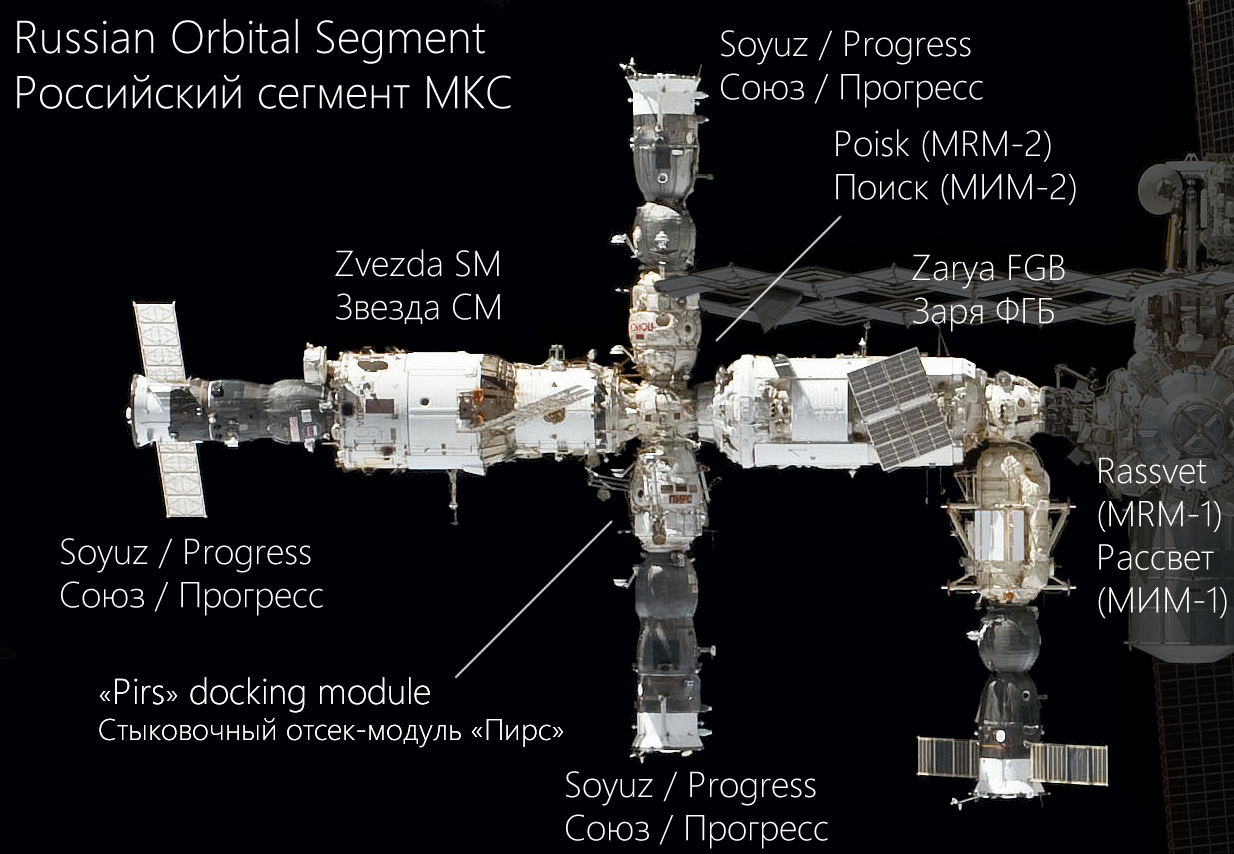
Russian elements of the International Space Station include:
- Zarya FGB, the first element launched. This was a US-funded TKS-derived propulsion module built by KB Salyut.
- Zvezda Service Module - this is the DOS-8 block, which was launched as the third major ISS module in July 2000.
- SO-1 Pirs - one of the docking modules originally designed for Buran/Mir-2 was added to the station in September 2001, and later deorbited in July 2021 to make room for Nauka.
- SO-2 Poisk - a module similar to Pirs. Poisk also provides extra space for scientific experiments, and power-supply outlets and data-transmission interfaces for external scientific payloads.
- Rassvet - the only module delivered by NASA shuttle, in a barter exchange for the launch 'owed' for Zarya. Rassvet was built from a test article for the pressurized shell portion of NEP. It is used for cargo storage, science, and as a docking port for visiting spacecraft.
- Nauka FGB-2 - this is Russia's largest module and only module dedicated wholly to science, and was launched in July 2021, with the European Robotic Arm attached.
- Prichal UM - the 'nodal module', meant to host four additional laboratory and power modules and a docking port as part of the since-cancelled OPSEK plan. It launched in November 2021.
References
References
- "Mir-2". Astronautix.
This article was imported from Wikipedia and is available under the Creative Commons Attribution-ShareAlike 4.0 License. Content has been adapted to SurfDoc format. Original contributors can be found on the article history page.
Ask Mako anything about Mir-2 — get instant answers, deeper analysis, and related topics.
Research with MakoFree with your Surf account
Create a free account to save articles, ask Mako questions, and organize your research.
Sign up freeThis content may have been generated or modified by AI. CloudSurf Software LLC is not responsible for the accuracy, completeness, or reliability of AI-generated content. Always verify important information from primary sources.
Report