From Surf Wiki (app.surf) — the open knowledge base
Mini-Shinkansen
Conversion of track gauge for use by Shinkansen trains

Conversion of track gauge for use by Shinkansen trains
Mini-Shinkansen is the name given to the concept of converting existing narrow gauge railway lines to to allow operation of Shinkansen services in Japan. While the track gauge is widened, the original loading gauge is retained, requiring the use of specially designed Shinkansen rolling stock with a narrower cross-section, leading to the "mini-Shinkansen" designation.
Unlike purpose-built high-speed Shinkansen lines, mini-Shinkansen routes are constrained by their legacy infrastructure to maximum operating speed of 130 km/h. Two mini-Shinkansen routes have been constructed: the Yamagata Shinkansen, which opened in 1992, and the Akita Shinkansen, which opened in 1997. Both connect to the high-speed Tōhoku Shinkansen for direct service to and from Tokyo.
Concept
The mini-Shinkansen concept was first considered by Japanese National Railways (JNR), but was not formally proposed until November 1987, following the formation of East Japan Railway Company (JR East). The concept involves regauging existing narrow gauge lines to the used on the Shinkansen network, to allow through-running on a main high-speed Shinkansen line. While the track gauge is widened, the loading gauge remains unchanged, requiring specialized rolling stock with a narrower 2.945 m cross-section, compared to the standard 3.35 m width.
To compensate for the narrower car bodies, these trains generally have 2×2 seating in ordinary class, compared with the 2×3 configuration of typical Shinkansen trains, and are fitted with retractable gap fillers that flip up at main line Shinkansen stations to bridge the gap between the train and the platform.
Mini-Shinkansen sets are capable of high-speed operation on Shinkansen tracks—up to 320 km/h for the E6 series—either on their own or coupled to full-sized Shinkansen sets. On converted narrow-gauge lines, they operate at conventional speeds of around 130 km/h, although track improvements can enable higher speeds where feasible.
Yamagata Shinkansen

Main article: Yamagata Shinkansen
The first mini-Shinkansen route was the Yamagata Shinkansen, converted from the a 87.1 km section of the Ōu Main Line between Fukushima on the Tohoku Shinkansen and Yamagata in Yamagata Prefecture. Conversion work began in 1988, and Yamagata Shinkansen services commenced on 1 July 1992, operated by a new fleet of 400 series trains operating Yamabiko services. Trains ran at up to 240 km/h on the Tōhoku Shinkansen section and 130 km/h on the Yamagata Shinkansen section. Following the success of the initial conversion, a further 61.5 km of track was re-gauged to reach Shinjō, opening on 4 December 1999. The introduction of E8 series trains on the line in 2024 increased the maximum operating speed on the Tōhoku Shinkansen section to 300 km/h.
Akita Shinkansen
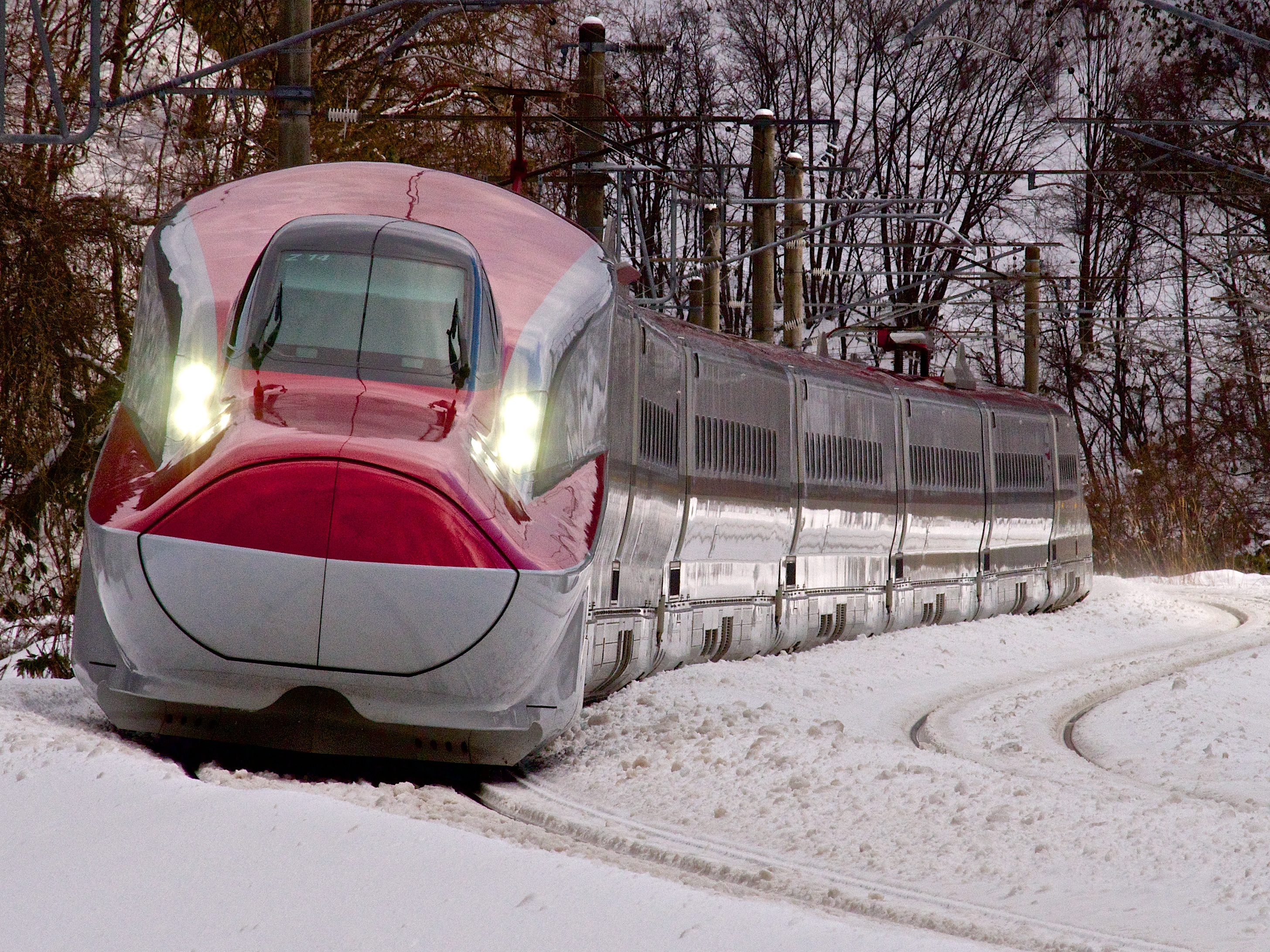
Main article: Akita Shinkansen
Following the success of the Yamagata Shinkansen, a second mini-Shinkansen route was developed from Morioka in Iwate Prefecture, then the northern terminus of the Tōhoku Shinkansen, to Akita in Akita Prefecture. This involved regauging the 75.6 km Tazawako Line from Morioka to Ōmagari and 51.7 km of the Ōu Main Line from Ōmagari to Akita. The Akita Shinkansen opened on 22 March 1997 with E3 series trains operating Komachi services. The introduction of E6 series trains on the line in 2013 enabled the maximum operating speed on the Tōhoku Shinkansen section to be increased to 320 km/h in 2014.
Rolling stock

The following rolling stock has been built for use on mini-Shinkansen lines:
- 400 series, Yamagata Shinkansen (in service 1992–2010)
- E3 series, Akita Shinkansen (in service 1997–2014) and Yamagata Shinkansen (since 1999)
- E926 East i, track and overhead wire inspection train (since 2001)
- E955 Fastech 360Z, experimental test train (2006–2008)
- E6 series, Akita Shinkansen (since 2013)
- E8 series, Yamagata Shinkansen (since 2024)
References
References
- Semmens, Peter. (1997). "High Speed in Japan: Shinkansen – The World's Busiest High-speed Railway". Platform 5 Publishing.
- (13 March 2024). "Class E8 Shinkansen enters commercial service".
- Walton, John. (2024-10-10). "JR East’s new E8 Shinkansen impresses with speed and interior design".
- Semmens, Peter. (1997). "High Speed in Japan: Shinkansen – The World's Busiest High-speed Railway". Platform 5 Publishing.
- Yamanouchi, Shūichirō. (2002). "東北・上越新幹線". JTB Can Books.
This article was imported from Wikipedia and is available under the Creative Commons Attribution-ShareAlike 4.0 License. Content has been adapted to SurfDoc format. Original contributors can be found on the article history page.
Ask Mako anything about Mini-Shinkansen — get instant answers, deeper analysis, and related topics.
Research with MakoFree with your Surf account
Create a free account to save articles, ask Mako questions, and organize your research.
Sign up freeThis content may have been generated or modified by AI. CloudSurf Software LLC is not responsible for the accuracy, completeness, or reliability of AI-generated content. Always verify important information from primary sources.
Report