From Surf Wiki (app.surf) — the open knowledge base
Milton, Georgia
City in Fulton County, Georgia, United States
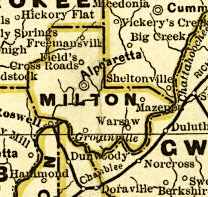
City in Fulton County, Georgia, United States
| Field | Value | |
|---|---|---|
| <!-- Basic info ----------------> | official_name | Milton, Georgia |
| native_name | ||
| settlement_type | City | |
| motto | "Named best quality of life in Georgia" | |
| image_skyline | Milton Public Library, Milton, GA Oct 2017.jpg | |
| image_caption | Milton Public Library | |
| image_flag | Flag of Milton, Georgia.png | |
| image_seal | Seal of Milton, Georgia.png | |
| image_blank_emblem | Logo of Milton, Georgia.svg | |
| blank_emblem_type | Logo | |
| image_map | {{maplink | |
| frame | yes | |
| plain | yes | |
| frame-align | center | |
| frame-width | 280 | |
| frame-height | 280 | |
| frame-coord | SWITCH:######### | |
| zoom | SWITCH:10;9;6;3 | |
| type | SWITCH:shape-inverse;shape;point;point | |
| marker | city | |
| fill | #606060 | |
| fill-opacity | SWITCH:0;0.5;0.5;0.5 | |
| stroke-width | 2 | |
| stroke-color | #606060 | |
| id2 | SWITCH:Q3260721;Q486633;Q1428;Q30 | |
| type2 | shape-inverse | |
| stroke-width2 | 2 | |
| stroke-color2 | #606060 | |
| stroke-opacity2 | SWITCH:0;1;1;1 | |
| switch | Milton;Fulton County;Georgia;the United States}} | |
| pushpin_label_position | left | |
| pushpin_mapsize | ||
| subdivision_type | Country | |
| subdivision_name | United States | |
| subdivision_type1 | State | |
| subdivision_name1 | Georgia | |
| subdivision_type2 | County | |
| subdivision_name2 | Fulton | |
| subdivision_name4 | ||
| leader_title | Mayor | |
| leader_name | Peyton Jamison | |
| leader_title1 | ||
| established_title | Incorporated | |
| established_date | December 1, 2006 | |
| established_title2 | ||
| established_title3 | ||
| established_date3 | ||
| unit_pref | Imperial | |
| area_footnotes | ||
| area_total_km2 | 101.29 | |
| area_land_km2 | 99.72 | |
| area_water_km2 | 1.56 | |
| area_total_sq_mi | 39.11 | |
| area_land_sq_mi | 38.50 | |
| area_water_sq_mi | 0.60 | |
| area_water_percent | 1.6 | |
| area_blank1_sq_mi | ||
| population_as_of | 2020 | |
| population_total | 41296 | |
| population_density_km2 | 414.10 | |
| population_density_sq_mi | 1072.51 | |
| population_density_blank1_sq_mi | ||
| timezone | EST | |
| utc_offset | -5 | |
| timezone_DST | EDT | |
| utc_offset_DST | -4 | |
| coordinates | ||
| elevation_footnotes | ||
| elevation_ft | 942 | |
| <!-- Area/postal codes & others --------> | postal_code_type | ZIP codes |
| postal_code | 30004, 30009 | |
| area_codes | 770, 678 | |
| blank_name | FIPS code | |
| blank_info | 13-51670 | |
| blank1_name | GNIS feature ID | |
| blank1_info | 2404269 | |
| website |
| frame-align = center | frame-width = 280 | frame-height = 280 | frame-coord = SWITCH:######### | fill-opacity = SWITCH:0;0.5;0.5;0.5 | stroke-width = 2 | stroke-color = #606060 | stroke-width2 = 2 | stroke-color2 = #606060 | stroke-opacity2 = SWITCH:0;1;1;1 Milton is a city in Fulton County, Georgia, United States, located about 30 miles (48 km) north of downtown Atlanta. Incorporated on December 1, 2006, the population was 41,296 as of the 2020 census. Milton is one of the wealthiest cities in the state of Georgia and is known for its high quality of life, excellent schools, and affluent community.
The city is named after Revolutionary War hero John Milton, who is also the namesake of the former Milton County that included modern-day Milton between 1857 and 1931. With over 39 square miles of land, much of it agriculturally zoned, Milton is characterized by its rural and equestrian heritage, spacious residential lots, and a small-town feel combined with the amenities of a metropolitan area. It is bordered by Cherokee and Forsyth counties, as well as the cities of Roswell and Alpharetta.
History
Early Inhabitants and European Settlement (1000-1832)
The lands of what is now Milton, Georgia, were once the domain of the Cherokee Nation, whose presence in Georgia dates back over 10,000 years. This indigenous group, speaking an Iroquoian language, cultivated a society with a strong kinship system, with their social life revolving around village structures, ceremonial mounds, and agricultural practices, notably corn farming. The arrival of European settlers from coastal Georgia, the Carolinas, and beyond brought new dynamics to the region. These early settlers engaged in trade with the Cherokee and, at times, intermarried, creating a blended frontier society. However, the relationship between the two groups became increasingly strained due to escalating demands for land by state and federal governments, a situation exacerbated by the discovery of gold in nearby Dahlonega in 1828. The subsequent desire for land acquisition led to the tragic Trail of Tears in 1832, mandated by President Andrew Jackson, which forcibly removed the Cherokee from Georgia to designated territories in present-day Oklahoma.
Agrarian Beginnings and Milton County (1832-1932)
Following the Cherokee removal, the State of Georgia implemented a land lottery system, with the final lottery in 1832 involving the territory that would become Milton. Settlers drawn by the prospect of land ownership began to populate the area, converting the dense forests into farmland and pastures. The agricultural landscape was dotted with small subsistence farms and a few larger plantations, with cotton emerging as a significant cash crop alongside the production of fruits, vegetables, and livestock. The community's roots deepened with the establishment of Milton County in 1857, named after John Milton, an American Revolutionary War hero and politician. Despite the county's initial opposition to secession, the broader state sentiment led Georgia into the Civil War, profoundly affecting the local population.
At the turn of the 20th century, the area remained mostly forested and agricultural – the exception being small villages and crossroads with general stores and trading posts, mills and gins, churches, a few schools, and inns at the intersections of horse and carriage routes. While fruits and vegetables were grown, and cattle and pig farms existed, many people continued to raise cotton as a cash crop. The advent of the automobile and the establishment of Highway 9 in the 1920s began to bridge the distance between Milton and the expanding world beyond its borders. Despite these connections, the county faced insurmountable financial pressures from the Great Depression, the boll weevil infestation, and a prolonged drought. These challenges led to the dissolution of Milton County in 1932, with its territory being absorbed into Fulton County.
An Era of Change and Growth (1932-2005)
The area retained its rural character for decades, even as the rest of North Georgia, particularly Atlanta, experienced explosive growth. People in the area tended to keep the same types of jobs, agriculture, and daily schedules as they had before the counties merged. Homes tended to be few and far between, racial segregation remained a reality, and the community revolved largely around churches, schools, and gathering spots like general stores and baseball diamonds.
However, as Atlanta's population tripled between 1910 and 1960 and more roads were built and paved, people began settling further from Georgia's capital city. The construction of State Route 400 and other infrastructure projects gradually brought more residents and development to the region, yet Milton managed to preserve its pastoral identity, in part due to zoning that favored larger, septic-dependent lots conducive to horse farms and rural living.
Creation of the City of Milton (2005-2006)
After the turn of the 21st century, a movement for local governance emerged, driven by the belief that the needs of the northernmost part of Fulton County were not adequately prioritized by distant county officials. The legislative process to establish a city began in earnest when Georgia State Representative Jan Jones introduced the bill for the city of Milton in January 2005 with the intent of moving the bill forward in January 2006. This gave residents one full year to consider all the ramifications of cityhood before the bill could become law. A City of Milton Citizens' Committee helped coordinate information and research.
On March 9, 2006, the bill establishing the new city of Milton (HB 1470) resoundingly passed both in the Georgia House of Representatives (127–21) and in the Georgia State Senate (49–0). At 2 p.m. on Wednesday, March 28, Governor Sonny Perdue signed the bill into law. A ballot referendum was approved by 85 percent of voters on July 18 to create the city of Milton.
On August 4, Governor Perdue appointed a five-person commission to serve as the interim government of Milton (composed of Ron Wallace, Brandon Beach, Gregory Mishkin, Dan Phalan and Cecil Pruitt). The city's first general election for Mayor and City Council was held on Tuesday, November 7, 2006. Joe Lockwood won the first mayoral election. The city of Milton was officially incorporated and adopted Fulton County's existing ordinances on December 1, 2006.
Cityhood and Renewed Growth (2007-present)
Working initially out of converted commercial office spaces, city leaders began forging Milton's unique identity as it transitioned to local governance. Plans were set in motion to launch Milton's own police services on May 1, 2007, and fire department 16 days later. At the same time, city officials created the city code, developed community programs, conducted community events, and moved into city-owned properties, including a newly built city hall (opened 2017) and its Public Safety Complex (opened 2020).
Joe Lockwood served as mayor for Milton's first 15 years, succeeded by Peyton Jamison. Milton is also led by city managers who oversee all municipal operations as well as the effective, efficient execution and enforcement of city laws and ordinances.
While Milton's government evolved, the city's population grew. The U.S. Census measured Milton's population at 32,661 in 2010; ten years later, the Census counted 41,296 residents – a more than 26% increase.
Geography
Milton occupies the northern tip of Fulton County—bounded on the south by the cities of Roswell and Alpharetta, on the east by Forsyth County and Alpharetta, and on the north and west by Cherokee County. The city's latest Comprehensive Plan divides Milton into eight "character areas" that each have, to some degree, their own unique attributes; they are Arnold Mill, Bethany, Birmingham, Central Milton, Crabapple, Deerfield, Milton Lakes and Sweetapple.
The two major north–south roads that run through Milton are State Route 9 (in the city's southeast) and State Route 372 (more central), which is also known as Birmingham Highway. State Route 140 (Arnold Mill Road) is on the southwest part of Milton.
According to the U.S. Census Bureau, the city of Milton has a total area of 101.4 km2, of which 99.8 km2 is land and 1.6 km2, or 1.59%, is water. The elevation ranges from 950 to above sea level.
, the US Postal Service recognizes Milton as a valid alias for ZIP code 30004, which is served from the Alpharetta post office.
Demographics
| Race / Ethnicity (NH = Non-Hispanic) | title=P2: Hispanic or Latino, and Not Hispanic or Latino by Race – 2010: DEC Redistricting Data (PL 94-171) – Milton city, Georgia | url=https://data.census.gov/cedsci/table?q=p2&g=160XX00US1351670&tid=DECENNIALPL2010.P2 | website=United States Census Bureau | access-date= }} | Pop 2020 | % 2010 | % 2020 |
|---|---|---|---|---|---|---|---|
| White alone (NH) | 23,653 | 25,802 | 72.42% | 62.48% | |||
| Black or African American alone (NH) | 2,865 | 3,882 | 8.77% | 9.40% | |||
| Native American or Alaska Native alone (NH) | 59 | 74 | 0.18% | 0.18% | |||
| Asian alone (NH) | 3,380 | 6,446 | 10.35% | 15.61% | |||
| Native Hawaiian or Pacific Islander alone (NH) | 9 | 10 | 0.03% | 0.02% | |||
| Other race alone (NH) | 153 | 247 | 0.47% | 0.60% | |||
| Mixed race or Multiracial (NH) | 583 | 1,821 | 1.79% | 4.41% | |||
| Hispanic or Latino (any race) | 1,959 | 3,014 | 6.00% | 7.30% | |||
| Total | 32,661 | 41,296 | 100.00% | 100.00% |
As of the 2020 United States census, there were 41,296 people, 13,540 households, and 10,366 families residing in the city.
Milton is one of the wealthiest cities in the state of Georgia with a median household income of $142,845 and $178,317 for families. Between 2018 and 2022, 74% of people in Milton owned their home. The median sold home price as of September 2024 is $1,179,000. Approximately 3.8% of the population lives below the poverty line. The vast majority of Milton is part of the ZIP code 30004, which has a median household income of $136,124.
Government
The city is represented in the Georgia House of Representatives by Jan Jones of the 47th District and Chuck Martin of the 49th District both Jones and Martin are Republicans. The city is represented in Georgia State Senate by Jason Dickerson of the 21st District a Republican and is represented in Fulton County Commission by Bob Ellis of District 2 a Republican.
Education
Public schools
The city is served by Fulton County Schools.
Elementary schools
- Birmingham Falls Elementary School
- Cogburn Woods Elementary School
- Crabapple Crossing Elementary School
- Summit Hill Elementary School
Middle schools
- Hopewell Middle School
- Northwestern Middle School
High schools
- Cambridge High School
- Milton High School
Private schools
- Chandler Academy (K-8)
- King's Ridge Christian School (K-12)
- Mill Springs Academy (K-12)
- St. Francis Schools (K-12)
Transportation
Major highways
- [[Image:Georgia 9.svg|25px]] State Route 9
- [[Image:Georgia 140.svg|25px]] State Route 140
- [[Image:Georgia 400.svg|25px]] State Route 400
- [[Image:Georgia 372.svg|25px]] State Route 372
Pedestrians and cycling
- Big Creek Greenway (Proposed)
Notable people
- Dylan Cease (b. 1995), Major League Baseball (MLB) pitcher for the Toronto Blue Jays
- Brian Littrell (b. 1972), American singer and member of the Backstreet Boys
- Gary Rossington (1952–2023), Guitarist & co-founder of Lynyrd Skynyrd
References
References
- "City of Milton Mayoral Page". City of Milton, GA.
- "2020 U.S. Gazetteer Files". United States Census Bureau.
- {{GNIS. 2404269
- "Making of An Equestrian Community".
- "History of Milton {{!}} Milton, GA".
- "Georgia Governor Sonny Perdue - Governor Perdue Announces Johns Creek and Milton Appointments".
- "About Milton {{!}} Milton, GA".
- "Milton, GA - U.S. Census Data".
- "The City of Milton Comprehensive Plan Update 2016".
- "Geographic Identifiers: 2010 Census Summary File 1 (G001), Milton city, Georgia". U.S. Census Bureau.
- "Census of Population and Housing". Census.gov.
- "P2: Hispanic or Latino, and Not Hispanic or Latino by Race – 2010: DEC Redistricting Data (PL 94-171) – Milton city, Georgia".
- "P2: Hispanic or Latino, and Not Hispanic or Latino by Race – 2020: DEC Redistricting Data (PL 94-171) – Milton city, Georgia".
- "Ranking: N. Fulton city is the richest in Georgia". ajc.
- "Milton, Georgia Population 2024".
- "Milton, GA Housing Market: 2024 Home Prices & Trends".
- "30004 Georgia Income Statistics {{!}} Current Census Data for Zip Codes".
- "Area Schools {{!}} Milton, GA".
- (2024-10-25). "Home - Birmingham Falls Elementary School".
- (2024-11-05). "Home - Cogburn Woods Elementary School".
- (2024-11-05). "Home - Crabapple Crossing Elementary School".
- (2024-10-25). "Home - Summit Hill Elementary School".
- (2024-10-21). "Home - Hopewell Middle School".
- (2024-10-23). "Home - Northwestern Middle School".
- (2024-10-23). "Home - Cambridge High School".
- (2024-11-05). "Home - Milton High School".
- "WELCOME".
- "King's Ridge Christian School {{!}} Private College Preparatory School {{!}} GA".
- "Serving LD / ADHD Students in Metro Atlanta {{!}} Mill Springs Academy".
- "Saint Francis Schools {{!}} A Private School In Roswell and Milton, GA".
- "Big Creek Greenway Connection Concept Study - City of Milton, GA".
- "Inside Backstreet Boy Brian Littrell and Wife Leighanne's 'Magnificent' Chateau of 20 Years".
This article was imported from Wikipedia and is available under the Creative Commons Attribution-ShareAlike 4.0 License. Content has been adapted to SurfDoc format. Original contributors can be found on the article history page.
Ask Mako anything about Milton, Georgia — get instant answers, deeper analysis, and related topics.
Research with MakoFree with your Surf account
Create a free account to save articles, ask Mako questions, and organize your research.
Sign up freeThis content may have been generated or modified by AI. CloudSurf Software LLC is not responsible for the accuracy, completeness, or reliability of AI-generated content. Always verify important information from primary sources.
Report