From Surf Wiki (app.surf) — the open knowledge base
Mil Mi-2
Utility helicopter family by Mil

Utility helicopter family by Mil
| Field | Value |
|---|---|
| name | Mi-2 |
| image | Mil mi-2(modified).jpg |
| caption | Mi-2 of the Polish Air Force |
| type | Utility helicopter |
| design_group | Mil Moscow Helicopter Plant |
| builder | PZL-Świdnik |
| first_flight | 22 September 1961 |
| introduction | 1965 |
| status | In service |
| primary_user | Soviet Air Force (historical) |
| more_users | Polish Armed Forces |
| Aeroflot (historical) | |
| produced | 1964–1998 |
| number_built | 5,497 |
| developed_from | Mil Mi-1 |
| variants | PZL Kania |
Aeroflot (historical)
The Mil Mi-2 (NATO reporting name: Hoplite) is a small, three rotor blade Soviet-designed multi-purpose helicopter developed by the Mil Moscow Helicopter Plant, designed in the early 1960s and produced exclusively by WSK "PZL-Świdnik" in Poland. Nearly 5,500 were made by the time production stopped in 1999, and it remains in service globally.
Design and development
The Mi-2 was produced exclusively in Poland, in the WSK PZL-Świdnik factory in Świdnik.
The first production helicopter in the Soviet Union was the Mil Mi-1, modelled along the lines of the S-51 and Bristol Sycamore and flown by Mikhail Mil's bureau in September 1948. During the 1950s it became evident, and confirmed by American and French development, that helicopters could be greatly improved with turbine engines. S. P. Isotov developed the GTD-350 engine and Mil used two of these in the far superior Mi-2.
The twin shaft-turbine engines used in the Mi-2 develop 40% more power than the Mi-1's piston engines, for barely half the engine weight, with the result that the payload was more than doubled. The Mi-2 fuselage was extensively altered from its predecessor, with the engines mounted overhead. However, the external dimensions remained similar.
The Mil-built prototype first flew in the Soviet Union on 22 September 1961, after which the final development and the production of the project was transferred to Poland in 1964. The first Świdnik-built example flew on 4 November 1965; this was the only Soviet-designed helicopter to be built solely outside the Soviet Union. PZL-Świdnik produced a total of 5,497 helicopters, about a third for military users. The factory also developed fiberglass rotor blades, and developed the wide-body Mi-2M seating 10 passengers instead of eight. Most typical role-change kits include four stretchers for air ambulance usage, or aerospraying or cropdusting applications.
In Poland, several specialized military variants were also developed in early 1970s for support or training roles, with 23 mm autocannon, machine guns and/or two 57 mm rocket pods, four 9K11 Malyutka anti-tank missiles or Strela-2 AA missiles.
Operational history
The Mi-2 was first introduced into the Soviet Air Force in 1965. The Mi-2 is used by mainly former Soviet and Eastern Bloc countries, although it was also purchased by the armed forces of Mexico and Myanmar.
Most of the armed Mi-2 variants were used by Poland. Some were also used by the former East Germany (with 7.62 mm machine gun and 57 mm unguided rocket armament only).
North Korea still maintains a large active fleet of Mi-2s.
During the 2022 Russian invasion of Ukraine, Russian forces were recorded capturing three Mi-2 helicopters in Kherson International Airport.
The helicopter is also used to spray agricultural chemicals by private owners in Ukraine. Two people were killed in a crash in 2021 near Zaive, in the region of Mykolaiv. Another two people died in a crash of Kharkiv Air Force University (203rd Training Aviation Brigade) Mi-2 crash in September 2024.
On 26 October 2024, a medical Mi-2 helicopter crashed in Kirov region in Russia, killing all four aboard, including a pilot, a doctor, and two paramedics.
As of 8 March 2025, Ukraine has lost six Mi-2 helicopters, including three which were captured by Russian forces.
Variants
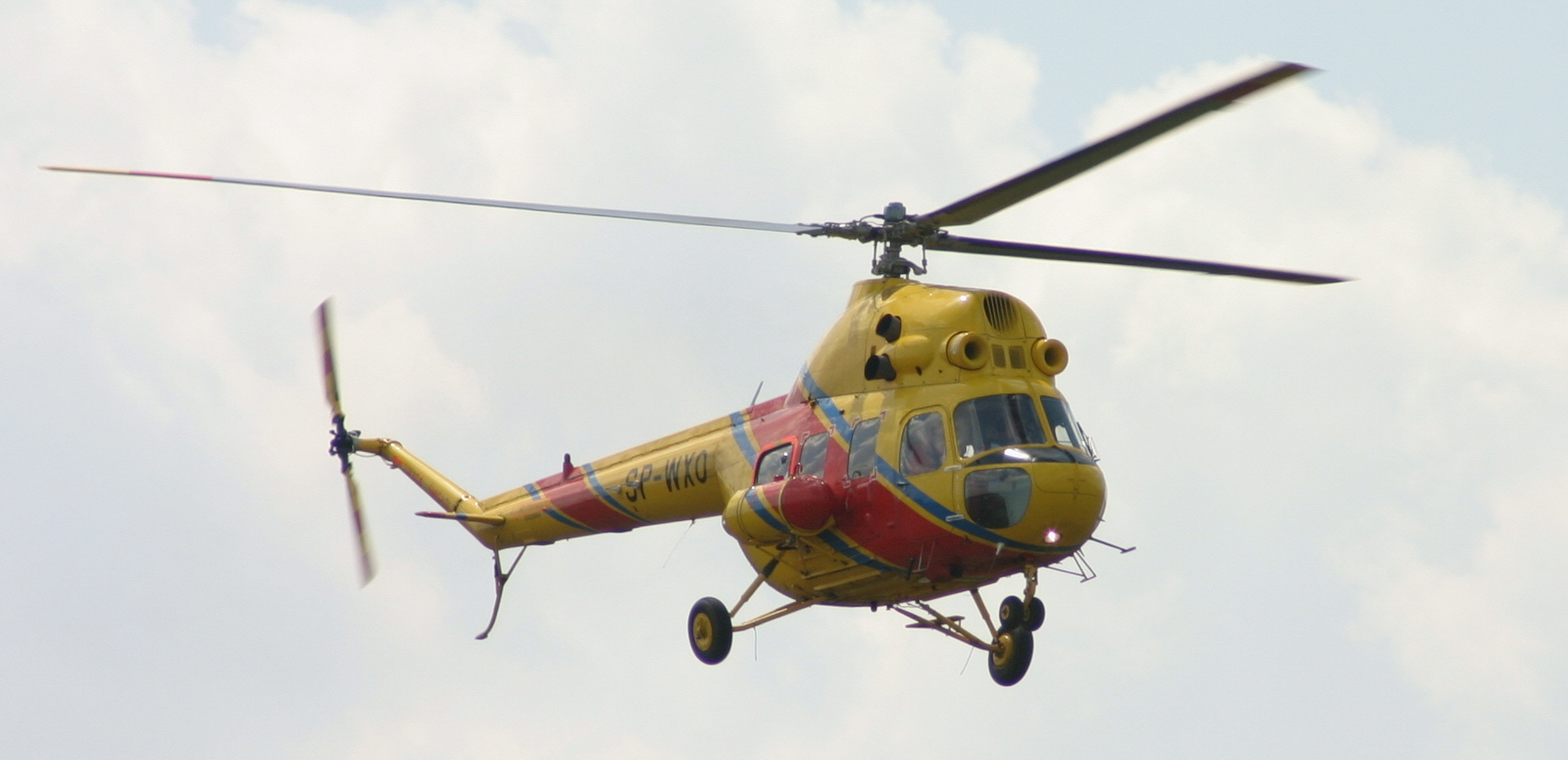
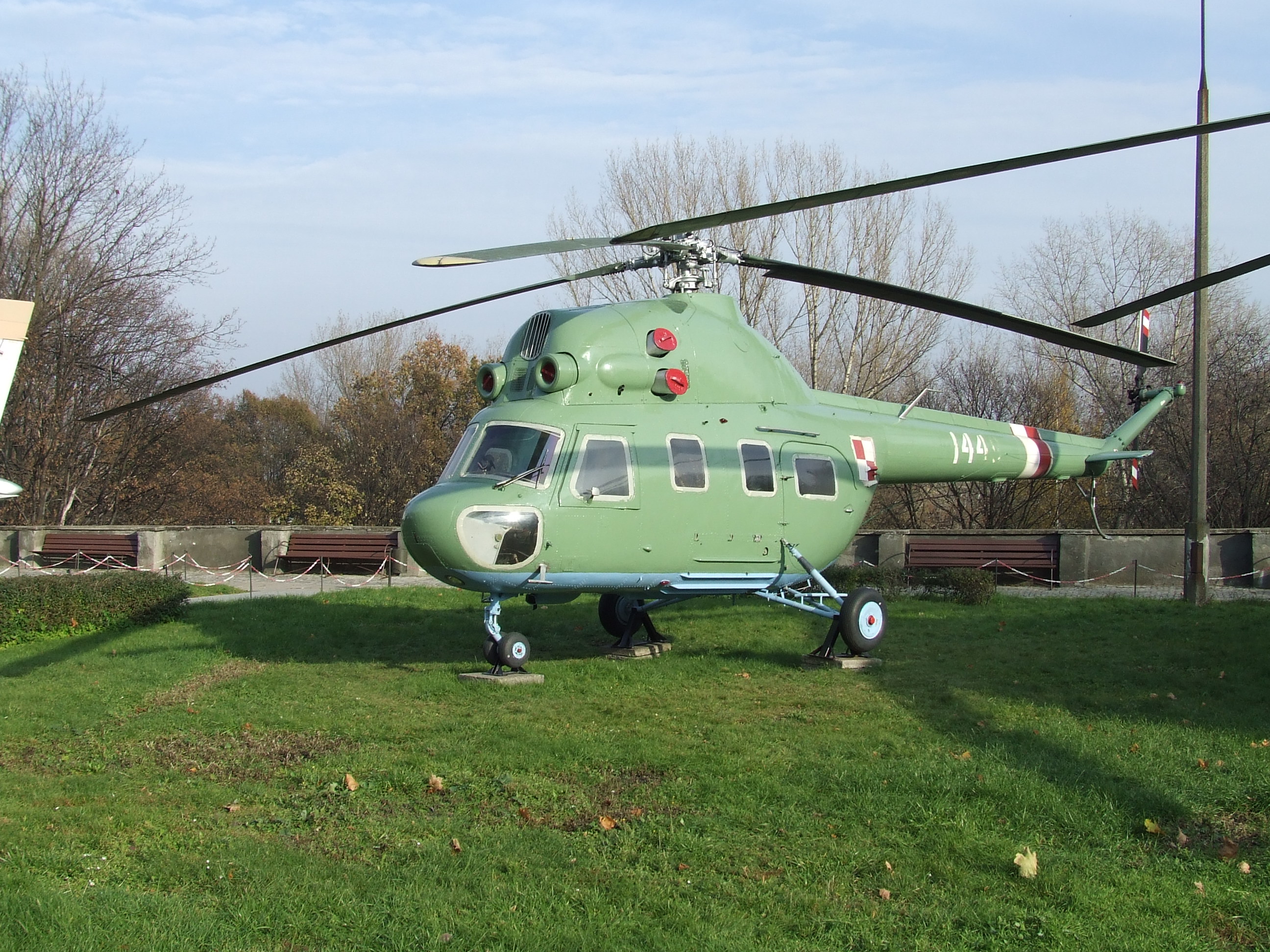

;V-2 :First prototype. ;V-2V :Armament prototype. ;Mi-2 Platan :Aerial minelayer version with 20 tube launchers on external pods and in left cab door, each for six or nine mines. 18 converted for Polish Army starting from 1989. ;Mi-2A ;Mi-2B :Upgraded export version for the Middle East, fitted with improved systems and navigational aids. ;Mi-2Ch Chekla :Chemical reconnaissance / smokescreen layer version. ;Mi-2D Przełącznik :Aerial command post equipped with R-111 radio. ;Mi-2FM :Survey version. ;Mi-2P :Passenger / cargo version, with accommodation for 6 passengers. ;Mi-2R :Agricultural version. ;Mi-2RL :Land rescue/ambulance version. ;Mi-2RM :Sea rescue version equipped with electric winch for two people and dropped rafts. ;Mi-2Ro :Reconnaissance version equipped with cameras. ;UMi-2Ro :Reconnaissance trainer version. ;Mi-2RS Padalec ('Slowworm') :Chemical and biohazard reconnaissance version. ;Mi-2S :Air ambulance version, equipped to carry four stretcher, plus an attendant. ;Mi-2Sz :Dual-control training version. ;Mi-2T :Cargo/utility version. ;Mi-2U :Dual-control training version. ;Mi-2US :Armed version fitted with a fixed 23mm NS-23 cannon, 4 × 7.62mm PKT machine gun pods and optional cabin PK machine gun. 30 built for the Polish Army in 1972-73. Similar without a cannon built for East Germany. ;Mi-2URN Żmija ('Viper') :Armed variant with a fixed 23mm NS-23 gun and two 16×57mm S-5 unguided rocket pods Mars-2. Optional 7,62mm PK machine gun window-mounted. 7 built for Polish Army in 1973 and 18 rebuilt from Mi-2US. Similar without a cannon built for East Germany. ;Mi-2URP Salamandra ('Salamander') :Anti-tank variant, armed with 23mm NS-23 gun, optional window-mounted 7.62mm PK machine gun, and 4 × AT-3 Sagger (9M14M Malutka) wire-guided missiles on external weapons racks and 4 × additional missiles in the cargo compartment. Two rebuilt and 44 built for Polish Army in 1975-84. ;Mi-2URP-G Gniewosz ('Smooth snake') :Mi-2URP with additional 4 × AA missiles Strzała-2 (Strela 2) in two Gad rocket launchers. Six rebuilt in 1988. ;Mi-2 Plus :Upgraded Mi-2 with uprated GTD-350W2 engines, all-composite rotor blades, new avionics and other modifications. ;Mi-3 :Planned Mi-2 derivative that lacked suitable engines for the program to continue. ;Mi-2MSB or MSB-2 Nadia ('Hope') :Modernized by Motor Sich to passenger-transport version for the civil aviation. ;Mi-2MSB-V or MSB-2MO :Modernized by Motor Sich for Ukrainian Air Force. Original engine replaced with AI-450M 465 hp engine, armed with rocket and machine gun pods, IR-jamming system and flares dispenser for defence against MANPADS.
Operators
;[[File:Mil Mi-2 Users.png|thumb|Map with Mi-2 users in blue]]
- Algerian Air Force ;
- Armenian Air Force ;
- Azerbaijani Air Force ;
- Belarusian Air Force ;
- Air Force of the Democratic Republic of the Congo ;
- Indonesian Navy
- Indonesian Police ;
- Libyan Air Force ;
- Myanmar Air Force ;
- North Korean Air Force ;
- Peruvian Army ;
- Total six, all in civilian companies. The Sky company (former Star Aerospace and also former Star Airline) has four; one borrowed, three bought. The companies Pearl Korea and Heliworld have one each. ;
- Russian Aerospace Forces ;
- Senegal Air Force ;Transnistria
- Armed Forces of Transnistria ;
- Ukrainian Army
- Ukrainian Naval Aviation
- Ukrainian Air Guard ;
- United States Army
- University of Iowa
Former operators
;
- Bulgarian Air Force ;
- Cuban Air Force ;Czechoslovakia Czechoslovakia
- Czech Air Force ;
- Djiboutian Air Force ;
- Estonian Air Force ;
- East German Air Force (48 Mi-2 in 1972-1990, including Grenztruppen)
- Grenztruppen ;
- German Air Force (25 in 1991-1995)
- German State Police ;Ghana
- Ghana Air Force ;
- Hungarian Air Force
- Hungarian Police ;
- Latvian Air Force ;
- Lithuanian Air Force ;Liberia
- Justice Air Wing ;
- Mexican Navy ;
- Mongolian Air Force ;
- Nicaraguan Air Force ;[[File:Polish Mi-2 (cropped)).jpg|thumb|A Polish Mi-2 on takeoff]]
.jpg)
- Polish Air Force
- Polish Army
- Polish Border Guard
- Polish Navy ;
- Russian Army ;
- Slovak Air Force ;
- Aeroflot
- Soviet Air Force
- Soviet Army Aviation
- Militsiya ;
- Syrian Arab Air Force The Syrian government of Al-Assad fell to rebels in late 2024, and the Syrian Arab Air Force was dismantled. It was re-established as Syrian Air Force, but the revolution, and the Israeli air strikes that followed it, wrecked havoc in the inventory of the Air Force. In late 2025, the World Air Forces publication by FlightGlobal, which tracks the aircraft inventories of world's air forces and publishes its counts annually, removed all Syrian Air Force's aircraft from their World Air Forces 2026 report. It is thus questionable if the Syrian Air Force has any flying aircraft in their inventory, and in particular, any Mil Mi-2, as of December 2025. ;
- Ukrainian Air Force ;
- Yugoslav People's Army
Specifications (Mi-2T)

|prime units?=met General characteristics
|max takeoff weight kg=3700 |max takeoff weight note= Powerplant
- Blade section: NACA 23012M Performance -- |never exceed speed kmh= |never exceed speed note= |disk loading kg/m2=22.41 |fuel consumption kg/km= |power/mass=0.0806 kW/kg
References
- Hoyle, Craig and Fafard, Antoine. "World Air Forces Directory". Flight International, 10–16 December 2019, Volume 196, issue 5716. pp. 26–54.
- Mondey, David, Encyclopedia of The World's Commercial and Private Aircraft. Crescent Books, New York NY, 1981. p. 245, "WSK-Swidnik Mi-2 Hoplite"
- Taylor, John W. R. Jane's All The World's Aircraft 1982–83. London: Jane's Yearbooks, 1982. .
- Mi-2 DataBase
- Mi-2 Photo Gallery
References
- Hitchens, Frank. (2024). "Rotorcraft: Helicopters, Gyrocopters, and Proprotors". Andrews UK Limited.
- "History".
- Chant, Christopher. (June 3, 2014). "A Compendium of Armaments and Military Hardware (Routledge Revivals)". [[Taylor & Francis]].
- "Mil Mi-2".
- (March–April 1999). "NRD-owskie Mi-2". Magnum-X.
- Embraer, In association with. "2024 World Air Forces directory".
- (18 August 2022). "Russia Captured Three Of Ukraine's Smallest Helicopters. So Ukraine's Allies Sent Three Replacements.". Forbes.
- (17 July 2021). "2 killed in helicopter crash in Ukraine".
- (1 September 2024). "Ukrainian Air Force Mi-2 of the 203rd Training Aviation Brigade crashed".
- (28 October 2024). "Russia Loses Two Military Helicopters in One Day".
- Oryx. "List Of Aircraft Losses During The Russian Invasion Of Ukraine".
- Il'yashenko, Matviy. "First flight of upgraded helicopter Mi-2MSB - Motor Sich".
- Il'yashenko, Matviy. "The Mi-2 upgraded helicopter passed an altitude of 7 thousand meters. - Motor Sich".
- Karpenko, A.V.. "Modernized helicopter Mi-2MSB (Ukraine)".
- "Ukrainian Military Helicopters - Modernization And Development Plans".
- (October 2015). "Mi-2MSB - Ukrainian Combat Variant Of The Mi-2 Helicopter".
- Hoyle and Farfad ''Flight International'' 10–16 December 2019, p. 33.
- (2022). "World Air Forces 2022". Flightglobal.
- TEMPO Edisi 19-25 Maret 2007 (pp. 36-37)
- ANGKASA No.07 Edisi April 2007 (p. 16)
- Hoyle and Farfad ''Flight International'' 10–16 December 2019, p. 44.
- Hoyle and Farfad ''Flight International'' 10–16 December 2019, p. 45.
- Hoyle and Farfad ''Flight International'' 10–16 December 2019, p. 46.
- "ATIS 항공기술정보시스템(need to manually type and search the aircraft model in "검색".)".
- Hoyle and Farfad ''Flight International'' 10–16 December 2019, pp. 47–48.
- Hoyle and Farfad ''Flight International'' 10–16 December 2019, p. 48.
- Hoyle and Farfad ''Flight International'' 10–16 December 2019, p. 52.
- "ВМС отримали перший Мі-2МСБ. 08.02.2021".
- (15 February 2023). "The Military Balance 2023". Routledge.
- "United States Army Threat Systems Management Office (TSMO)". [[Angelfire]].
- "Operator Performance Labs". opl.uiowa.edu.
- (1999). "The Military Balance 1999-2000". Oxford University Press.
- "Bulgarian (PZL-Swidnik) Mi-2". Demand media.
- "Cuba Air Force Aircraft Types". aeroflight.co.uk.
- (2018). "World Air Forces 2018". Flightglobal Insight.
- "Djibouti Air Force Aircraft Types". xairforces.net.
- "Mil Mi-2 datbase". helicopter-database.de.
- "Polizei Mil Mi-2 (PZL-Swidnik)". Demand media.
- "Hungary Police Aviation". aeroflight.co.uk.
- "Hungary Police Mil Mi-2". Demand media.
- Hoyle and Farfad ''Flight International'' 10–16 December 2019, p. 43.
- "Lithuania - Air Force Mil Mi-2". jetphotos.net.
- "Mexican Armada". aeroflight.co.uk.
- [http://www.worldairforces.com/countries/mongolia/mon.html World Air Forces - Historical Listings Mongolia (MON)] {{webarchive. link. (2012-09-05 . worldairforces.com. Retrieved on 2013-08-27.)
- "World Air Forces 2013". Flightglobal Insight.
- International Institute for Strategic Studies (IISS). (2023). "The Military Balance 2023". The Military Balance.
- "Mi-2 Helicopter. History of Development".
- "Mi-2 DataBase". helicopter-database.de.
- "Aeroflot Mil Mi-2". jetphotos.net.
- Hoyle and Farfad ''Flight International'' 10–16 December 2019, p. 50.
- Hoyle, Craig. (2025). "World Air Forces 2026". [[FlightGlobal]].
- (24 December 2021). "The Military Balance 2014". Routledge.
- "Yugoslavian use of Mil Mi-2 in military and air ambulance use".
- Taylor 1982, pp. 169–170.
- "The Incomplete Guide to Airfoil Usage".
This article was imported from Wikipedia and is available under the Creative Commons Attribution-ShareAlike 4.0 License. Content has been adapted to SurfDoc format. Original contributors can be found on the article history page.
Ask Mako anything about Mil Mi-2 — get instant answers, deeper analysis, and related topics.
Research with MakoFree with your Surf account
Create a free account to save articles, ask Mako questions, and organize your research.
Sign up freeThis content may have been generated or modified by AI. CloudSurf Software LLC is not responsible for the accuracy, completeness, or reliability of AI-generated content. Always verify important information from primary sources.
Report