From Surf Wiki (app.surf) — the open knowledge base
Mil Mi-14
Helicopter in the Soviet Union

Helicopter in the Soviet Union
| Field | Value |
|---|---|
| name | Mi-14 |
| image | File:Manewry NATO Noble Mariner (cropped).jpg |
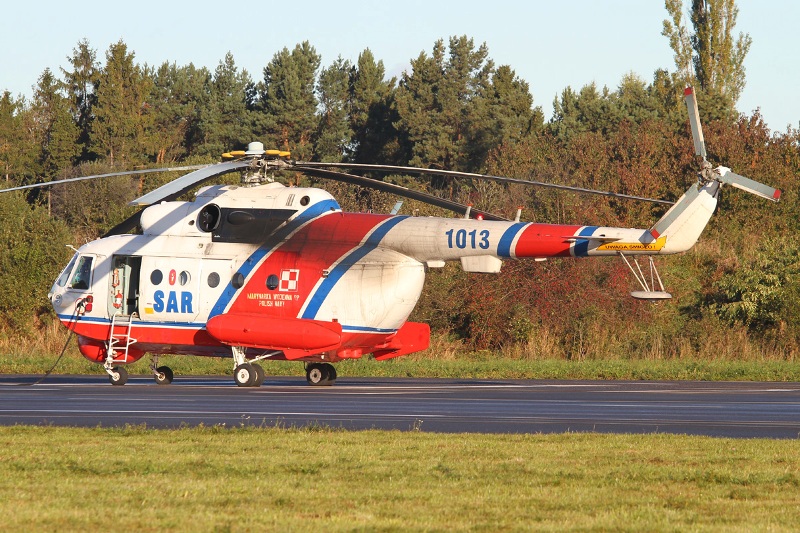
| caption | Polish Navy Mil Mi-14PL in 2011 |
| type | Anti-submarine helicopter |
| manufacturer | Mil Moscow Helicopter Plant |
| first_flight | 1 August 1967 |
| introduction | 1976 |
| status | In service |
| primary_user | Soviet Navy |
| more_users | Russian Navy |
| Ukrainian Navy | |
| Polish Navy | |
| produced | 1969-1986 |
| number_built | 273 |
| developed_from | Mil Mi-8 |
| national_origin | Soviet Union |
Ukrainian Navy Polish Navy
The Mil Mi-14 (, NATO reporting name: Haze) is a Soviet shore-based nuclear-capable amphibious anti-submarine helicopter derived from the earlier Mi-8.
Design and development
Formal development of an anti-submarine warfare (ASW) version of the Mil Mi-8 transport helicopter was authorised by the Soviet Communist Party Central Committee and Council of Ministers in April 1965, with the objective of replacing the Mil Mi-4 in the short-range, shore based anti-submarine role. The new helicopter was required to have an endurance of 2 hours on station at a radius of 222 km from base.
The new design (with the internal designation V-14) differed from the Mi-8 in having a boat-like hull similar to the Sea King, allowing it to operate off the water, and a retractable four-point undercarriage, with the mainwheels retracting into large sponsons on the rear of the fuselage. The helicopter was to be powered by two Klimov TV3-117MT turboshaft engines. A watertight weapons bay is fitted to the centreline of the fuselage allowing internal carriage of a single torpedo or eight depth charges, while a radome housing a search radar is fitted beneath the nose.
The Mi-14 has a crew of four: a pilot, a copilot, an onboard technician, and a weapon system operator. The Mi-14PL anti-submarine version is equipped with a radar, a dipping sonar and a magnetic anomaly detector.
The first prototype V-14, converted from a Mi-8 and powered by the older and less powerful Klimov TV2-117 engines, flew on 1 August 1967. Development was slowed by problems with the helicopter's avionics and due to reliability problems with the TV3-117 engines, with production at Kazan not starting until 1973, and the helicopter (now designated Mi-14) entering service on 11 May 1976.
In January 2016, Russian Helicopters confirmed to Russian News Agency TASS that no final decision to revive production had been taken, but market demand, feasibility studies – including with Moscow's defence ministry – and funding sources were under review. The programme remains a “priority” for Russian Helicopters. The company suggested the Mi-14 would appeal to civil operators in Russia's far north and those supplying the oil and gas industry, alongside the nation's armed forces. Out of the almost 300 Mi-14s produced at Kazan Helicopters between 1973 and 1986, it is estimated that just 44 examples remain in active service.
Variants
;V-14 :Prototype of the Mi-14 helicopter. ;Mi-14PL (NATO Haze-A) :Anti-submarine warfare helicopter, equipped with towed APM-60 MAD, OKA-2 sonobuoys and a retractable Type 12-M search radar, armed with either a single AT-1 or APR-2 torpedo, one Skat nuclear depth bomb or eight depth charges. A single Mi-14PL was used to carry out trials with the Kh-23 (NATO designation AS-7 Kerry) air-to-surface missile but this modification does not seem to have entered service. ;Mi-14PLM :Improved anti-submarine warfare version with Os'minog ASW suite, with new search radar, dipping sonar and digital computer. Limited use. ;Mi-14PŁ/R :Polish conversion of two Mi-14PŁ (Polish designation for Mi-14PL) to search and rescue version, with ASW equipment removed, developed in 2010. ;Mi-14BT (NATO Haze-B) :Mine sweeping helicopter with ASW systems removed and equipped for towing Mine Countermeasures sleds. 25–30 built, with six exported to East Germany and two to Bulgaria. ;Mi-14PS (NATO Haze-C) :Search and rescue version with search lights and sliding doors with hoist. ;Mi-14PX :Search and rescue training helicopter for the Polish Navy (unofficial designation). One Polish Mi-14PŁ helicopter was temporarily converted into the Mi-14PX, then converted back in 1996. ;Mi-14PZh
,_static_display,_Radom_AirShow_2005,_Poland.jpg)
:Amphibious firebuster version of Mi-14BT. Conversion price about USD1M. ;Mi-14GP :Conversion of Mi-14PL to 24–26 seat civil passenger transport.
Operational history
As part of the Syrian civil war, starting from 2013, Syrian Navy Mi-14 helicopters were used as improvised bombers to drop naval mines and barrel bombs on large area targets from high altitude, mostly cities held by opposing forces. On 22 March 2015, one crashed with its pilot killed on the spot after capture and the rest of the crew captured.
On 7 May 2022, Ukraine confirmed that Colonel Ihor Bedzay, the deputy head of the Ukrainian Navy, was killed when his Mi-14PS was shot down by a Russian Su-35. A video emerged, claimed shot on 7 May 2022, showing a Su-27 family fighter engaging a Mi-14 with its 30 mm gun.
Operators
By 1991, about 230 had been delivered, with exports to many Soviet allies including Bulgaria, Cuba, East Germany, Libya, Poland, and Syria.
Current operators
;
- Georgian Air Force ;
- Libyan Air Force

;
- Polish Navy
;
- Congolese Navy ;
- Ukrainian Naval Aviation - operated by 10th Naval Aviation Brigade

;
- Yemen Air Force
Former operators
;
- Bulgarian Navy ;
- Cuban Air Force ;
- East German Navy [[File:Mil Mi-14BT, S9-TAJ, Aerotec International.jpg|thumb|right|Mi-14BT at Aerotec International]] ;
- Ethiopian Air Force ;
- German Navy ;
- Pakistan Navy ;
- Russian Naval Aviation ;South Yemen
- People's Democratic Republic of Yemen Air Force ;
- Soviet Naval Aviation ;
- Syrian Arab Air Force
- Syrian Navy The Syrian government of Al-Assad fell to rebels in late 2024, and the Syrian Arab Air Force was dismantled. It was re-established as Syrian Air Force, but the revolution, and the Israeli air strikes that followed it, wrecked havoc in the inventory of the Air Force. In late 2025, the World Air Forces publication by FlightGlobal, which tracks the aircraft inventories of world's air forces and publishes its counts annually, removed all Syrian Air Force's aircraft from their World Air Forces 2026 report. It is thus questionable if the Syrian Air Force has any flying aircraft in their inventory, and in particular, any Mil Mi-14, as of December 2025. ;
- Yugoslav Air Force
Possible Operators
;
- Korean People's Army Air Force claimed to be an operator by some sources but described as a mistake by others.
Specifications (Mi-14PL)

|prime units?=met General characteristics
|max takeoff weight kg=14000 |max takeoff weight note= Powerplant
- **Blade section:**NACA 23012 Performance -- |never exceed speed kmh= |never exceed speed note= |disk loading kg/m2= |fuel consumption kg/km= |power/mass= |thrust/weight= Armament --
- torpedoes, bombs or depth charges
References
Notes
Citations
Bibliography
- Gunston, Bill. The Osprey Encyclopedia of Russian Aircraft 1875–1995. London: Osprey, 1995. .
- Mladenov, Alexander. "Cutting through the Haze". Air International, March 2001, pp. 184–188. ISSN 0306-5634.
- Mladenov, Alexander. "Cutting through the Haze: Part 2". Air International, April 2001, pp. 244–247. ISSN 0306-5634.
References
- (31 March 2017). "[Actu] Le Mil Mi-14 ne veut pas mourir!".
- Mladenov ''Air International'' March 2001, pp. 184–186.
- Mladenov ''Air International'' March 2001, p. 186.
- Gunston 1995, p. 238.
- (12 January 2016). "Russian Helicopters still analysing revival of Mi-14 amphibian". FlightGlobal.
- Mladenov ''Air International'' March 2001, pp. 187–188.
- Mlandenov ''Air International'' March 2001, p. 188.
- Mladenov ''Air International'' April 2001, p. 244.
- Adam Gołąbek, Andrzej Wrona, ''Śmigłowce Mi-14PŁ/R w służbie'', in: Lotnictwo Nr. 7/2011, pp. 40–47 (in Polish).
- Mladenov ''Air International'' April 2001, p. 245.
- Mladenov ''Air International'' April 2001, p. 246.
- (16 January 2015). "The Syrian Arab Air Force, Beware of its Wings".
- (22 March 2015). "Video shows Syrian Navy Mi-14 anti-submarine helicopter (About to) crash land near Idlib".
- (2 April 2015). "Video filmed inside Syrian Navy anti-submarine warfare helicopter before it crashed leaked on Youtube".
- (9 June 2022). "Russian Sukhoi Fighter 'Hunts Down' A Ukrainian Mi-14 Chopper; Incident Gets Caught On Camera — Watch".
- (10 May 2022). "A brave Ukrainian colonel died".
- (8 June 2022). "Watch a Russian Flanker Engage a Low Flying Ukrainian Mi-14 Helicopter in the Odesa Oblast".
- (2018). "World Air Forces 2018". Flightglobal Insight.
- (2013). "World Air Forces 2013". Flightglobal Insight.
- "Volksmarine Mil Mi-14 "Haze"".
- (2016-03-22). "Lithuanian company to help maintain Ethiopian Air Force aircraft". defenceWeb.
- "Marineflieger Mil Mi-14 "Haze"".
- (2017). "Hot Skies Over Yemen, Volume 1". Helion & Company Publishing.
- "World Air Forces 1987 pg. 86". flightglobal.com.
- Hoyle, Craig. (2025). "World Air Forces 2026". [[FlightGlobal]].
- "World Air Forces 1997 pg. 71". flightglobal.com.
- Mitzer, Stijn. (2020). "The Armed Forces of North Korea: On the Path of Songun". Helion & Company.
- (1992). "Jane's all the world's aircraft 1992–93". Jane's Information Group.
- "The Incomplete Guide to Airfoil Usage".
- "Mi-14 Haze".
This article was imported from Wikipedia and is available under the Creative Commons Attribution-ShareAlike 4.0 License. Content has been adapted to SurfDoc format. Original contributors can be found on the article history page.
Ask Mako anything about Mil Mi-14 — get instant answers, deeper analysis, and related topics.
Research with MakoFree with your Surf account
Create a free account to save articles, ask Mako questions, and organize your research.
Sign up freeThis content may have been generated or modified by AI. CloudSurf Software LLC is not responsible for the accuracy, completeness, or reliability of AI-generated content. Always verify important information from primary sources.
Report