From Surf Wiki (app.surf) — the open knowledge base
Mikoyan MiG-29
Soviet twin-engine jet fighter aircraft

Soviet twin-engine jet fighter aircraft
| Field | Value |
|---|---|
| name | MiG-29 |
| image | File:VVS 100th IMG 0691 (7727464290) (cropped).jpg |
| caption | A Russian Air Force MiG-29S |
| type | Air superiority fighter, multirole fighter |
| national_origin | Soviet Union |
| design_group | Mikoyan |
| first_flight | 6 October 1977 |
| introduction | August 1983 |
| status | In service |
| produced | 1981–2019 |
| primary_user | Russian Aerospace Forces |
| more_users | Indian Air Force |
| Algerian Air Force | |
| Ukrainian Air Force | |
| number_built | 1,600 |
| variants | Mikoyan MiG-29M |
| Mikoyan MiG-29K | |
| Mikoyan MiG-35 |
Algerian Air Force Ukrainian Air Force Mikoyan MiG-29K Mikoyan MiG-35
The Mikoyan MiG-29 (; NATO reporting name: Fulcrum) is a twin-engine fighter aircraft designed in the Soviet Union. Developed by the Mikoyan design bureau as an air superiority fighter during the 1970s, the MiG-29, along with the larger Sukhoi Su-27, was developed to counter U.S. fighters such as the McDonnell Douglas F-15 Eagle and the General Dynamics F-16 Fighting Falcon. The MiG-29 entered service with the Soviet Air Forces in 1983.
While originally oriented towards combat against any enemy aircraft, many MiG-29s have been furnished as multirole fighters capable of performing a number of different operations, and are commonly outfitted to use a range of air-to-surface armaments and precision munitions. The MiG-29 has been manufactured in several major variants, including the multirole Mikoyan MiG-29M and the navalised Mikoyan MiG-29K; the most advanced member of the family to date is the Mikoyan MiG-35. Later models frequently feature improved engines, glass cockpits with HOTAS ("hands-on-throttle-and-stick")-compatible flight controls, modern radar and infrared search and track (IRST) sensors, and considerably increased fuel capacity; some aircraft have also been equipped for aerial refueling.
Following the dissolution of the Soviet Union, the militaries of multiple ex-Soviet republics have continued to operate the MiG-29, the largest of them being the Russian Aerospace Forces. The Russian Aerospace Forces wanted to upgrade its existing fleet to the modernised MiG-29SMT configuration, but financial difficulties have limited deliveries. The MiG-29 has also been a popular export aircraft; more than 30 nations either operate or have operated the aircraft. Flight Global estimates that 809 MiG-29s, of all types, are in service with air forces, making it the 5th most common active fighter.
Development
Origins
In the mid-1960s, the United States Air Force (USAF) encountered difficulties over the skies of Vietnam. Supersonic fighter bombers that had been optimized for low altitude bombing, like the F-105 Thunderchief, were found to be vulnerable to older MiG-17s and more advanced MiGs which were much more maneuverable. In order to regain limited air superiority, the US refocused on air combat using the F-4 Phantom multirole fighter, while the Soviet Union developed the MiG-23 in response. Towards the end of the 1960s, the USAF started the "F-X" program to produce a fighter dedicated to air superiority, which led to the McDonnell Douglas F-15 Eagle being ordered for production in late 1969.
At the height of the Cold War, a Soviet response was necessary to avoid the possibility of the Americans gaining a serious technological advantage over the Soviets, thus the development of a new air superiority fighter became a priority. In 1969, the Soviet General Staff issued a requirement for a Perspektivnyy Frontovoy Istrebitel (PFI, roughly "Advanced Frontline Fighter"). Specifications were extremely ambitious, calling for long range, good short-field performance (including the ability to use austere runways), excellent agility, Mach 2+ speed, and heavy armament. The Russian aerodynamics institute TsAGI worked in collaboration with the Sukhoi design bureau on the aircraft's aerodynamics.
By 1971, however, Soviet studies determined the need for different types of fighters. The PFI program was supplemented with the Perspektivnyy Lyogkiy Frontovoy Istrebitel (LPFI, or "Advanced Lightweight Tactical Fighter") program; the Soviet fighter force was planned to be approximately 33% PFI and 67% LPFI. PFI and LPFI paralleled the USAF's decision that created the "Lightweight Fighter" program and the General Dynamics F-16 Fighting Falcon and Northrop YF-17. The PFI fighter was assigned to Sukhoi, resulting in the Sukhoi Su-27, while the lightweight fighter went to Mikoyan. Detailed design work on the resultant Mikoyan Product 9, designated MiG-29A, began in 1974, with the first flight taking place on 6 October 1977. The pre-production aircraft was first spotted by United States reconnaissance satellites in November of that year; it was dubbed Ram-L because it was observed at the Zhukovsky flight test center near the town of Ramenskoye.
The workload split between TPFI and LPFI became more apparent as the MiG-29 filtered into frontline service with the Soviet Air Forces (Russian: Voenno-Vozdushnye Sily [VVS]) in the mid-1980s. While the heavy, long range Su-27 was tasked with the more exotic and dangerous role of deep air-to-air sweeps of NATO high-value assets, the smaller MiG-29 directly replaced the MiG-23 in the frontal aviation role.
Introduction and improvements
In the West, the new fighter was given the NATO reporting name "Fulcrum-A" because the pre-production MiG-29A, which should have logically received this designation, remained unknown in the West at that time. The Soviet Union did not assign official names to most of its aircraft, although nicknames were common. Unusually, some Soviet pilots found the MiG-29's NATO reporting name, "Fulcrum", to be a flattering description of the aircraft's intended purpose, and it is sometimes unofficially used in Russian service.
The MiG-29 was widely exported in downgraded versions, known as MiG-29 9-12A for Warsaw Pact and MiG-29 9-12B for non-Warsaw Pact nations, with less capable avionics and no capability for delivering nuclear weapons.
In the 1980s, Mikoyan developed the improved MiG-29S to use longer range R-27E air-to-air missiles. It added a dorsal 'hump' to the upper fuselage to house a jamming system and some additional fuel capacity. The weapons load was increased to 4000 kg with airframe strengthening. These features were included in new-built fighters and upgrades to older MiG-29s.

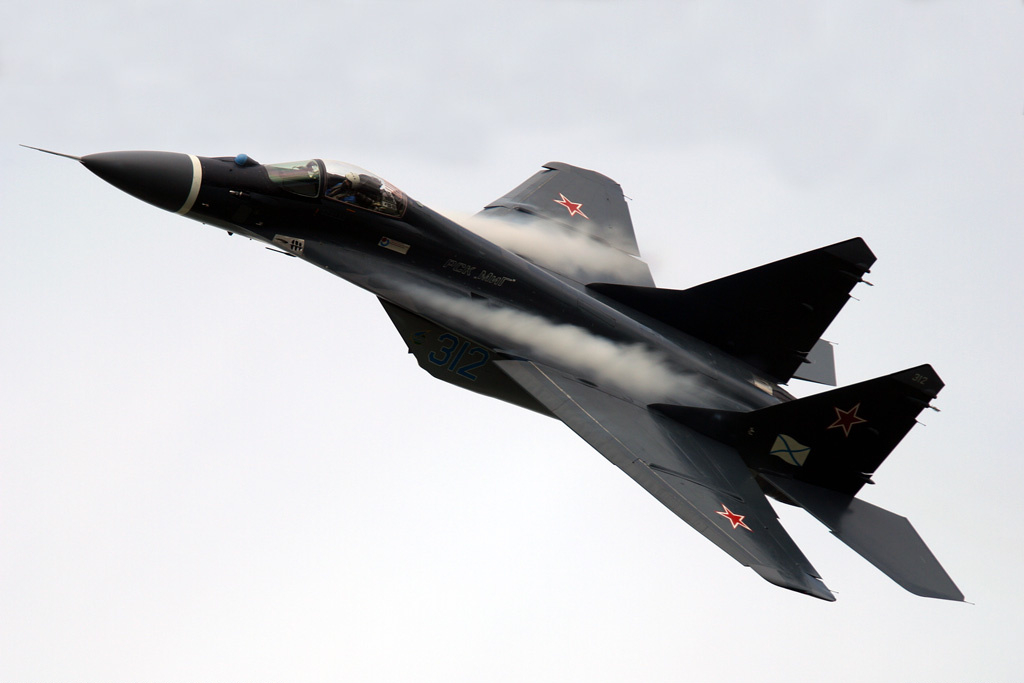
Refined versions of the MiG-29 with improved avionics were fielded by the Soviet Union, but Mikoyan's multirole variants, including a carrier-based version designated MiG-29K, were never produced in large numbers. Development of the MiG-29K carrier version was suspended for over a decade before being resumed; the type went into service with the Indian Navy's INS Vikramaditya, and Russian Navy's Admiral Kuznetsov class aircraft carrier. Mikoyan also developed improved versions MiG-29M and MiG-29SMT.
.jpg)
There have been several upgrade programmes conducted for the MiG-29. Common upgrades include the adoption of standard-compatible avionics, service life extensions to 4,000 flight hours, safety enhancements, greater combat capabilities and reliability.
Replacement
On 11 December 2013, Russian deputy prime minister Dmitry Rogozin revealed that Russia was planning to build a new fighter to replace the MiG-29. The Sukhoi Su-27 and its derivatives were to be replaced by the Sukhoi Su-57, but a different design was needed to directly replace the lighter MiGs. A previous attempt to develop a MiG-29 replacement, the MiG 1.44 demonstrator, failed in the 1990s. The concept came up again in 2001 with interest from India, but they later opted for a variant of the Su-57. Air Force commanders have hinted at the possibility of a single-engine airframe that uses the Su-57's engine, radar, and weapons primarily for Russian service. This has since been revealed to be the Sukhoi Su-75 Checkmate. Meanwhile, in Russian service, the MiG-29 has been largely replaced by the Sukhoi Su-30SM, representing a loss in market share of the MiG-29 series to the Sukhoi heavier platforms.
Design

Sharing its origins in the original PFI requirements issued by TsAGI, the MiG-29 has broad aerodynamic similarities to the Sukhoi Su-27, but with some notable differences. The MiG-29 has a mid-mounted swept wing with blended leading-edge root extensions (LERXs) swept at around 40°; there are swept tailplanes and two vertical fins, mounted on booms outboard of the engines. Automatic slats are mounted on the leading edges of the wings; they are four-segment on early models and five-segment on some later variants. On the trailing edge, there are maneuvering flaps and wingtip ailerons.
The MiG-29 has hydraulic controls and a SAU-451 three-axis autopilot but, unlike the Su-27, no fly-by-wire control system. Nonetheless, it is very agile, with excellent instantaneous and sustained turn performance, high-alpha capability, and a general resistance to spins. The airframe consists primarily of aluminum with some composite materials, and is stressed for up to 9 g (88 m/s²) maneuvers. The controls have "soft" limiters to prevent the pilot from exceeding g and alpha limits, but the limiters can be disabled manually.
Powerplant, performance and range
Main article: Klimov RD-33

_(cropped).png)
The MiG-29 has two widely spaced Klimov RD-33 turbofan engines, each rated at 50 kN dry and 81.3 kN in afterburner. The space between the engines generates lift, thereby reducing effective wing loading, hence improving maneuverability. The engines are fed through intake ramps fitted under the leading-edge extensions (LERXs), which have variable ramps to allow high-Mach speeds. Due to their relatively short combustor, the engines produce noticeably heavier smoke than their contemporaries. As an adaptation to rough-field operations, the main air inlet can be closed completely and the auxiliary air inlet on the upper fuselage can be used for takeoff, landing and low-altitude flying, preventing ingestion of ground debris. Thereby the engines receive air through louvers on the LERXs which open automatically when intakes are closed. However the latest variant of the family, the MiG-35, eliminated these dorsal louvers, and adopted the mesh screens design in the main intakes, similar to those fitted to the Su-27.
The MiG-29 has a ferry range of 1500 km without external fuel tanks, and 2100 km with external tanks. The internal fuel capacity of the original MiG-29 (Fulcrum-A) is 4300 L distributed between six internal fuel tanks, four in the fuselage and one in each wing. The internal fuel capacity of the MiG-29 (Fulcrum-C) is 4540 L due to a larger #1 fuselage tank. For longer flights, this can be supplemented by a 1500 L centreline drop tank on the Fulcrum-A and two 1150 L underwing drop tanks on later production batches. In addition, newer models have been fitted with port-side inflight refueling probes, allowing much longer flight times by using a probe-and-drogue system.
Cockpit

The cockpit features a conventional centre stick and left hand throttle controls. The pilot sits in a Zvezda K-36DM ejection seat.
The cockpit has conventional dials, with a head-up display (HUD) and a Shchel-3UM helmet mounted display, but no HOTAS capability. Emphasis seems to have been placed on making the cockpit similar to the earlier MiG-23 and other Soviet aircraft for ease of conversion, rather than on ergonomics. Nonetheless, the MiG-29 does have substantially better visibility than most previous Soviet jet fighters, thanks to a high-mounted bubble canopy. Upgraded models introduce "glass cockpits" with modern liquid-crystal (LCD) multi-function displays (MFDs) and true HOTAS.
Sensors
The baseline MiG-29 9.12 has a Phazotron RLPK-29 radar fire control system which includes the N019N019 Sapfir 29 look-down/shoot-down coherent pulse-Doppler radar and the Ts100.02-02 digital computer.

The N019 radar was not a new design, but rather a development of the Sapfir-23ML architecture used on the MiG-23ML. During the initial design specification period in the mid-1970s, Phazotron NIIR was tasked with producing a modern radar for the MiG-29. To speed development, Phazotron based its new design on work undertaken by NPO Istok on the experimental "Soyuz" radar program. Accordingly, the N019 was originally intended to have a flat planar array antenna and full digital signal processing, for a detection and tracking range of at least 100 km against a fighter-sized target. Prototype testing revealed this could not be attained in the required timeframe and still fit within the MiG-29's nose. Rather than design a new radar, Phazotron reverted to a version of the Sapfir-23ML's twisted-polarization cassegrain antenna and traditional analog signal processors, coupled with a new NII Argon-designed Ts100 digital computer to save time and cost. This produced a working radar system, but inherited the weak points of the earlier design, plaguing the MiG-29's ability to detect and track airborne targets at ranges available with the R-27 and R-77 missiles.

The N019 was further compromised by Phazotron designer Adolf Tolkachev's betrayal of the radar to the CIA, for which he was executed in 1986. In response to all of these problems, the Soviets hastily developed a modified N019M Topaz radar for the upgraded MiG-29S aircraft. However, VVS was reportedly still not satisfied with the performance of the system and demanded another upgrade. The latest upgraded aircraft, MiG-29M, offered the N010 Zhuk-M, which has a planar array antenna rather than a dish, improving range, and a much superior processing ability, with multiple-target engagement capability and compatibility with the Vympel R-77 (or RVV-AE).
Armament
_(cropped).png)
Armament for the MiG-29 includes a single GSh-30-1 30 mm cannon in the port wing root. This originally had a 150-round magazine, which was reduced to 100 rounds in later variants, which only allows a few seconds of firing before running out of ammo. Original production MiG-29 aircraft cannot fire the cannon when carrying a centerline fuel tank as it blocks the shell ejection port. This was corrected in the MiG-29S and later versions.
Three pylons are provided under each wing (four in some variants), for a total of six (or eight). The inboard pylons can carry either a 1150 L fuel tank, one Vympel R-27 (AA-10 "Alamo") medium-range air-to-air missile, or unguided bombs or rockets. Some Soviet aircraft could carry a single nuclear bomb on the port inboard station. The outer pylons usually carry R-73 (AA-11 "Archer") dogfight air to air missiles, although some users still retain the older R-60 (AA-8 "Aphid"). A single 1500 L tank can be fitted to the centerline, between the engines.
The US has supplied AGM-88 HARM missiles to Ukraine. It appears that they are fired from MiG-29s. It was only disclosed after Russian forces showed footage of a tail fin from one of these missiles. U.S. Under Secretary of Defense for Policy Colin Kahl has said this: "I would just point to two things. One, you know, a lot was made about the MiG-29 issue several months ago, not very much has been noticed about the sheer amount of spare parts and other things that we've done to help them actually put more of their own MiG-29s in the air and keep those that are in the air flying for a longer period of time. And then also, in recent PDA [Presidential Drawdown Authority] packages we've included a number of anti-radiation missiles that can be fired off of Ukrainian aircraft. They can have effects on Russian radars and other things." Soviet era aircraft don't have the computer architecture to accept NATO standard weapons. The interface would be difficult; however with a "crude modification", such as an e-tablet, it would be possible.
Operational history
While the MiG-29's true capabilities could only be estimated from the time it first appeared in 1977 until the mid-1980s, a combination of persistent intelligence and increasing access afforded by the Soviet foreign sales effort allowed a true appreciation of its capabilities. Early MiG-29s were very agile aircraft, capable of rivaling the performance of contemporary F-18 and F-16 aircraft. However, their relatively low fuel capacity relegated them to short-range air defense missions. Lacking HOTAS and an inter-aircraft data link, and requiring a very intensive "heads-down" approach to operating cockpit controls, the early MiG-29 denied pilots the kind of situational awareness routinely enjoyed by pilots operating comparable US aircraft. Analysts and Western pilots who flew examples of the MiG-29 thought this likely prevented even very good pilots from harnessing the plane's full combat capability. Later MiG-29s were upgraded to improve their capabilities. The Soviet Union exported MiG-29s to several countries. Because 4th-generation fighter aircraft require the pilots to have extensive training, air-defense infrastructure, and constant maintenance and upgrades, MiG-29s have had mixed operational history with different air forces.
Soviet Union and successor states
The MiG-29 was first publicly seen in the West when the Soviet Union displayed the aircraft in Finland on 2 July 1986. Two MiG-29s were also displayed at the Farnborough Airshow in Britain in September 1988. The following year, the aircraft conducted flying displays at the 1989 Paris Air Show where it was involved in a non-fatal crash during the first weekend of the show. The Paris Air Show display was only the second display of Soviet fighters at an international air show since the 1930s. Western observers were impressed by its apparent capability and exceptional agility. The only combat service of the MiG-29 in Soviet service was in 1987 and 1988, where they were deployed the 115th GvIAP to Termez Airfield in Turkmenistan in 1987 to cover for Soviet forces in Afghanistan, especially Kabul. This proved effective as - sources disagree about whether it was in August or September - four SU-22M3s of the DRAAF defected and attempted to bomb the capital but were all shot down within minutes of each other by the Fulcrums. Following the disintegration of the Soviet Union, most of the MiG-29s entered service with the newly formed Russian Air Force.
Russia
In July 1993, two MiG-29s of the Russian Air Force collided in mid-air and crashed away from the public at the Royal International Air Tattoo. No one on the ground sustained any serious injuries, and the two pilots ejected and landed safely.
.jpg)
The Russian Air Force grounded all its MiG-29s following a crash in Siberia on 17 October 2008. Following a second crash with a MiG-29 in east Siberia in December 2008, Russian officials admitted that most MiG-29 fighters in the Russian Air Force were incapable of performing combat duties due to poor maintenance. The age of the aircraft was also an important factor as about 70% of the MiGs were considered to be too old to take to the skies. The Russian MiG-29s had not received updates since the collapse of the Soviet Union. On 4 February 2009, the Russian Air Force resumed flights with the MiG-29. However, in March 2009, 91 MiG-29s of the Russian Air Force required repair after inspections due to corrosion; approximately 100 MiGs were cleared to continue flying at the time. The Russian Aerospace Forces started an update of its early MiG-29s to the more current MiG-29SMT standard, but financial difficulties prevented delivery of more than three MiG-29 SMT upgrade to the Russian Aerospace Forces. Instead, the 35 MiG-29SMT/UBTs rejected by Algeria were bought by the Russian Aerospace Forces. Russia placed an order for 16 new-build MiG-29SMTs on 15 April 2014, with delivery expected by 2017.
On 4 June 2015, a MiG-29 crashed during training in Astrakhan. A month later, another MiG-29 crashed near the village of Kushchevskaya in the Krasnodar region with the pilot safely ejecting. A series of accidents in the Russian Aerospace Forces that happened in 2015 were caused mostly by overall increase of flights and training.
On 20 April 2008, Georgian officials claimed a Russian MiG-29 shot down a Georgian Hermes 450 unmanned aerial vehicle and provided video footage from the ill-fated drone showing an apparent MiG-29 launching an air-to-air missile at it. Russia denies that the aircraft was theirs and says they did not have any pilots in the air that day. Abkhazia's administration claimed its own forces shot down the drone with an L-39 aircraft "because it was violating Abkhaz airspace and breaching ceasefire agreements." UN investigation concluded that the video was authentic and that the drone was shot down by a Russian MiG-29 or Su-27 using an R-73 heat seeking missile.
On 16 July 2014, a Ukrainian Su-25 was shot down, with Ukrainian officials stating that a Russian MiG-29 shot it down using a R-27T missile. Russia denied these allegations.
During the first half of September 2017, the Russian Aerospace Forces deployed some MiG-29SMT multirole combat aircraft to Khmeimim Airbase, near Latakia, in western Syria, becoming the first time the modernized version of the baseline Fulcrum jet was deployed to take part in the Syrian Air War. The MiG-29SMT were involved in bombing missions and secondary strategic bombers escort duties.
Two Russian MiG-29s operated by Wagner Group crashed near Sirte, Libya on 28 June 2020 and on 7 September 2020.
Ukraine

Ukraine inherited up to 240 from the Soviet Union in 1991, but over the years several were withdrawn from service, sold to other countries, while others were handed over to museums. Until 2011, approximately 70−80 aircraft were used by the 9th, 40th, 114th, and 204th Brigades, though fewer than 20 were fully mission capable on average. In 2019, it was estimated that Ukraine had only 37 combat ready MiG-29s. After the Russian invasion in February 2022, three Azerbaijani Air Force MiG-29s undergoing overhauls were transferred to the Ukrainian Air Force, bolstering the total of aircraft operated by the 40th and 204th Tactical Aviation Brigades from around 55 to 58.
In April 2014, during the Russian invasion of Crimea, 45 Ukrainian Air Force MiG-29s and 4 L-39 combat trainers were reportedly captured by Russian forces at Belbek air base. Most of the planes appeared to be in inoperable condition. In May, Russian troops dismantled them and shipped them back to Ukraine. On 4 August 2014, the Ukrainian government stated that a number of them had been put back into service to fight in the war in the east of the country.
During the initial days of the war in Donbas in April 2014, the Ukrainian Air Force deployed some jet fighters over the Donetsk region to perform combat air patrols and show of force flights. Probably due to the limited number of jet fighters available, a MiG-29 belonging to the Ukrainian Falcons display team was spotted armed with a full air-to-air load and performing a low altitude fly by. In the evening of 7 August 2014, a Ukrainian Air Force MiG-29MU1, bort number 02 Blue, was shot down by an antiaircraft missile fired by pro-Russian rebels near the town of Yenakievo, and exploded in midair. The pilot ejected safely. On 17 August 2014, another Ukrainian Air Force MiG-29, bort number 53 White, tasked with air to ground duties against separatists' positions was shot down by pro-Russian rebels in the Luhansk region. The Ukrainian government confirmed the downing. The pilot ejected safely and was recovered by friendly forces.

As of 2018, the Lviv State Aircraft Repair Plant began domestically upgrading the MiG-29 to have multirole capability, known as the MiG-29MU2. Development was expected to be completed by 2019 and enter production in 2020. The first upgraded MiG-29 was delivered to the Ukrainian Air Force in July 2020. On 29 May 2020, Ukrainian MiG-29s took part in the Bomber Task Force in Europe with American B-1B bombers for the first time in the Black Sea region. In September 2020, B-52 bombers from the 5th Bomb Wing conducted vital integration training with Ukrainian MiG-29s and Su-27s inside Ukraine's airspace.
_40thTAB.jpg)
During the Russian invasion of Ukraine, Su-27s and MiG-29s were used as air superiority fighters, with ten MiG-29s reported lost on the ground and in the air. In August 2022, a senior U.S. defense official disclosed that the Ukrainians have integrated the AGM-88 HARM missile onto their "MiG aircraft" with video evidence of AGM-88 missiles fired by upgraded Ukrainian MiG-29s released by the Ukrainian Air Force few days later. For a weapon that relies on digital display to fire, the question of how it has been integrated into the MiG-29's analogue displays remains unanswered. The footage shows a commercial GPS having been installed along with a tablet of some kind.
On 13 October 2022, a Ukrainian MiG-29 crashed during a combat mission. Its pilot is claimed to have destroyed a Shahed-136 drone with his cannon, and it is believed the debris from the drone collided with the aircraft and forced the pilot to eject. Ukrainian sources claim that the pilot shot down five drones and two cruise missiles shortly before the crash. The downed MiG-29 was wearing a livery similar to that of the Ukrainian Falcons display team. According to the Ukrainian State Bureau of Investigation: "the jet collided with debris from a destroyed drone, which caused massive damage to it to the point where it crashed near a village in northeast Vinnytsia. The pilot managed to eject and is currently receiving treatment in the hospital." On 20 September 2023, a Ukrainian Air Force MiG-29 was struck by a ZALA Lancet drone at the Dolgintsevo air base near Kryvyi Rih. A second drone was used as a spotter, recording the first Lancet's impact. As of 4 March 2025, 29 Ukrainian MiG-29s have been destroyed and three have been damaged by the Russian forces.
Export
India
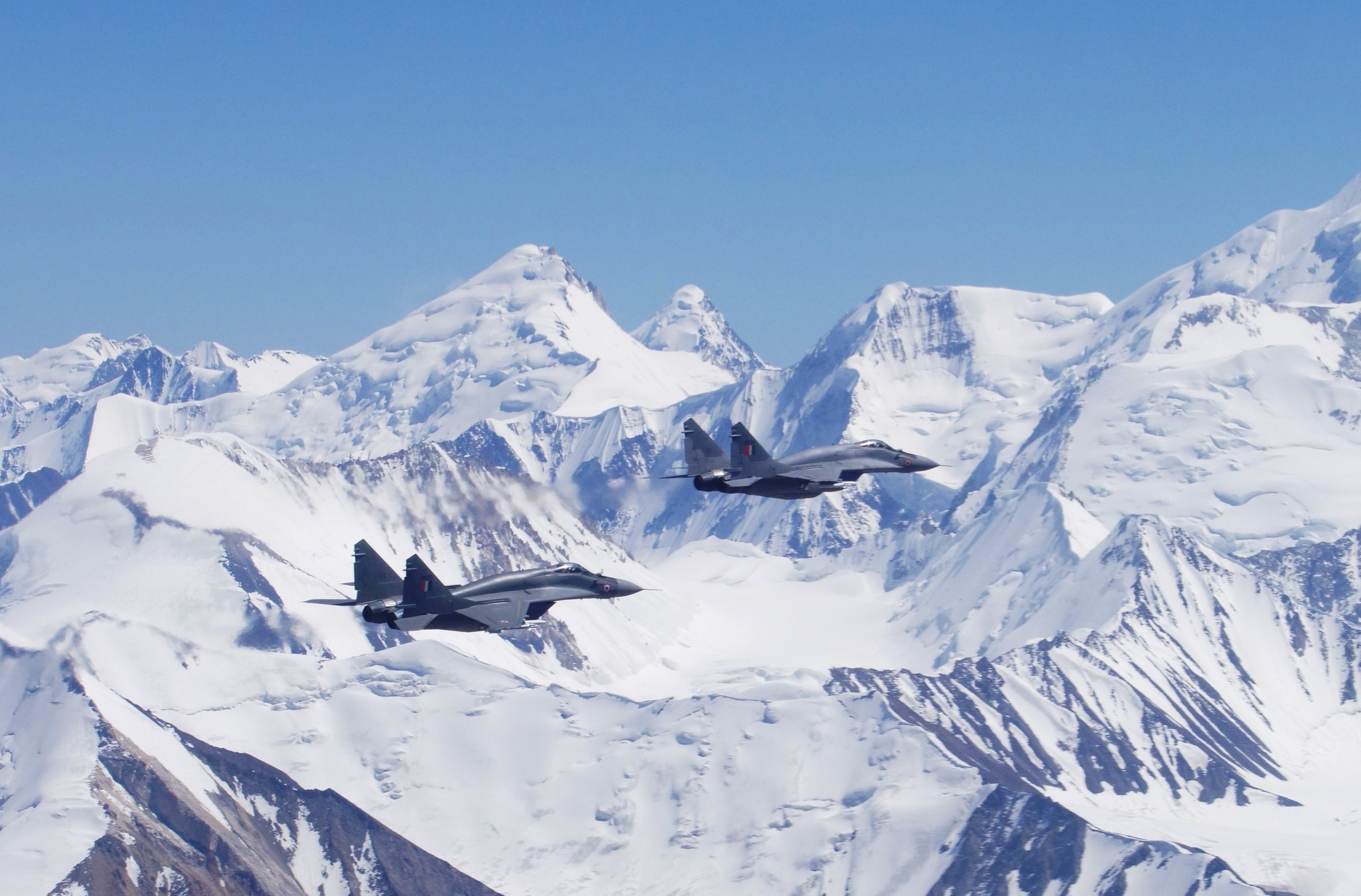
India was the first international customer of the MiG-29, outside of the Warsaw Pact. Despite preference for additional procurement of French made Mirage 2000s for the Indian Air Force (IAF), the Indian government opted for Soviet made MiG-29s. India placed an order for 44 aircraft (40 single-seat MiG-29 9.12Bs and four twin-seat MiG-29UBs) in 1984, and the aircraft was officially inducted into the IAF in 1987. In 1989, an additional order for 20 aircraft was placed, with ten more MiG-29s added in 1994. MiG-29s were extensively used by the IAF during the Kargil War with Pakistan in 1999. They were used to provide escort for the Mirage 2000s attacking targets with laser-guided bombs.
Since its acquisition, the aircraft has undergone a series of modifications with the addition of new avionics, subsystems, turbofan engines and radars. India signed a US$888 million deal with Russia in 2005-06 to upgrade all of its MiG-29s, to extend their operational life by 10-15 years. The upgrade program was planned to be completed in four years, and consisted of retrofitting the aircraft with upgraded avionics including replacing the N-019 radar with Phazatron Zhuk-M radar. Under the deal, the aircraft were also modified to be capable of deploying the R-77 missiles, and enabling mid air refueling to increase endurance. In 2007, Hindustan Aeronautics Limited (HAL) was given a license to manufacture 120 RD-33 series 3 turbofan engines for the upgrade.

In March 2008, India signed a renewed agreement with Russia worth $960 million for upgrading its existing fleet of 69 MiG-29s, which would enable them to operate for another 25 to 40 years. The upgrades to Indian MiG-29s will be to the MiG-29UPG standard, the first six MiG-29s were to be upgraded in Russia with the remaining 63 MiGs to be upgraded by HAL in India. The upgrades included a new weapon control system, improved cockpit ergonomics, DRDO/DARE D-29 electronic warfare system, and upgraded weaponry including air-to-ground missiles and guided bombs. India also awarded a contract to Israel Aircraft Industries to provide avionics and subsystems for the upgrade. India sent the first six of its aircraft to Russia for upgrades in 2008. The first three aircraft were delivered to India in December 2012, more than two years behind schedule.
In March 2009, the IAF expressed concern about the aircraft after 90 Russian MiG-29s were grounded after a crash. In March 2009, the IAF cleared all MiG-29s in its fleet as safe after an extensive inspection. In a disclosure to the Indian Parliament, the Indian defence minister said structural flawed had been identified in the MiG-29s with the possibility of cracks developing in the tail fin due to corrosion. After Russia shared the finding with India, which emerged after the crash of a Russian Air Force MiG-29 in December 2008, a repair and maintenance program was put in place to resolve the issue.

In 2004, India had signed a deal for the acquisition of additional 16 MiG-29Ks for the Indian Navy, to be deployed on INS Vikramaditya, the refurbished aircraft carrier to be purchased from Russia. In January 2010, India and Russia signed a US$1.2 billion deal for the acquisition of additional 29 MiG-29Ks for the Indian Navy, bringing the total number of MiG-29Ks on order to 45. The MiG-29K entered service with the Indian Navy on 19 February 2010.
In 2020, India planned an additional order of 21 MiG-29s, which would be manufactured from airframes built in late 1980s but never assembled, and upgraded these aircraft before delivery to the Indian Air Force before delivery. On 7 August 2024, IAF issued a Request for proposal to upgrade 24 MiG-29s to integrate High Speed Low Drag Bombs with a range of 180 km. The upgrade would include installation of hardware such as bomb racks on external hardpoints, and necessary software for the aircraft, with the entire MiG-29 fleet to be modified in phases.
Yugoslavia and Serbia
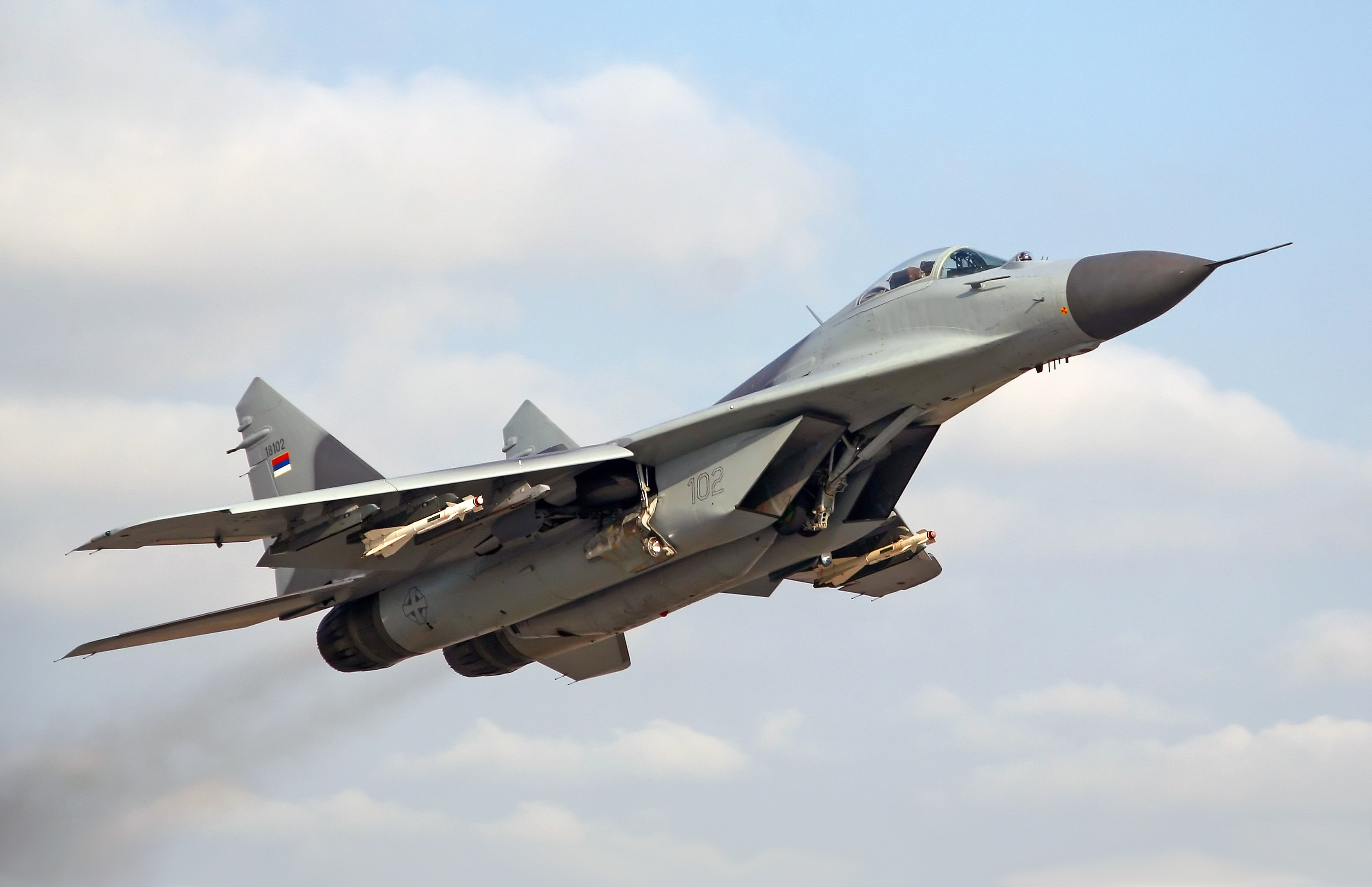
Yugoslavia was the first European country outside the Soviet Union to operate the MiG-29. The country received 14 MiG-29 9.12As and two MiG-29UBs from the USSR in 1987 and 1988. The MiG-29s were put into service with the 127th Fighter Aviation Squadron, based at Batajnica Air Base, north of Belgrade, Serbia.
Yugoslav MiG-29s saw little combat during the breakup of Yugoslavia, and were used primarily for ground attacks. Several Antonov An-2 aircraft used by Croatia were destroyed on the ground at Čepin airfield near Osijek, Croatia in 1991 by a Yugoslav MiG-29, with no MiG-29 losses. At least two MiG-29s carried out an airstrike on Banski Dvori, the official residence of the Croatian Government, on 7 October 1991.
The MiG-29s continued their service in the subsequent Federal Republic of Yugoslavia. Because of the United Nations arms embargo against the country, the condition of the MiG-29s worsened as aircraft were not maintained according to rules and general overhaul scheduled for 1996 and 1997 was not conducted.
Six MiG-29s were shot down during the NATO intervention in the Kosovo War, four by USAF F-15s, one by a USAF F-16, and one by a Royal Netherlands Air Force F-16. However, one aircraft, according to its pilot, was hit by friendly fire from the ground. Another four were destroyed on the ground. One Argentine source claims that a MiG-29 shot down an F-16 on 26 March 1999, but this kill is disputed, as the F-16C in question was said to have crashed in the US that same day.
The Air Force of Serbia and Montenegro continued flying its remaining five MiG-29s at a very low rate after the war. In the spring of 2004, news appeared that MiG-29 operations had ceased, because the aircraft could not be maintained, The small Serbian MiG-29 fleet along with other jets were grounded for four months during the summer of 2014 due to a battery procurement issue.
In November 2016, Russia had agreed to donate six of its MiG-29s free of charge, if Serbia would pay the repair costs of $50 million for them. At the end of January 2017, Serbian defense minister Zoran Đorđević said that Belarus also agreed to donate eight of its MiG-29s to Serbia on a no-pay basis. In early October 2017, Russia completed the delivery of all the six MiG-29s. The aircraft were transferred to Serbia onboard an Antonov An-124 transport aircraft. On 25 February 2019, Belarus formally handed four MiG-29s to the Serbian military during a ceremony held at the 558th Aircraft Repair Plant in Baranavichy. This increased the Serbian Air Force's fleet to 14 MiG-29s. Serbia plans to spend about €180–230 million on modernization of its entire MiG-29 fleet. As of 2021, the Serbian Air Force operates 14 MiG-29s.
Germany
East Germany bought 24 MiG-29s (20 MiG-29As, four MiG-29UBs), which entered service in 1988–1989 in 1./JG3 "Wladimir Komarow" in Preschen in Brandenburg. After the fall of the Berlin Wall in November 1989 and reunification of Germany in October 1990, the MiG-29s and other aircraft of the East German Air Forces of the National People's Army were integrated into the West German Luftwaffe. Initially the 1./JG3 kept its designation. In April 1991 both 1./JG3's MiG-29 squadrons were reorganised into the MiG-29 test wing ("Erprobungsgeschwader MiG-29"), which became JG73 "Steinhoff" and was transferred to Laage near Rostock in June 1993.
.jpg)
The Federation of American Scientists claims the MiG-29 is equal to, or better than the F-15C in short aerial engagements because of the Helmet Mounted Weapons Sight (HMS) and better maneuverability at slow speeds. This was demonstrated when MiG-29s of the German Air Force participated in joint DACT exercises with US fighters. The HMS was a great help, allowing the Germans to achieve a lock on any target the pilot could see within the missile field of view, including those almost 45 degrees off boresight. However, the German pilots who flew the MiG-29 admitted that while the Fulcrum was more maneuverable at slow speeds than the F-15 Eagle, F-16 Fighting Falcon, F-14 Tomcat, and F/A-18 Hornet and its Vympel R-73 dogfight missile system was superior to the AIM-9 Sidewinder of the time, in engagements that went into the beyond visual range arena, the German pilots found it difficult to multi-task locking and firing the MiG-29's Vympel R-27 missile (German MiG-29s did not have access to the more advanced Vympel R-77 that equips more advanced MiG-29 versions) while trying to avoid the longer range and advanced search and track capabilities of the American fighters' radars and AIM-120 AMRAAM. The Germans also stated that the American fighters had the advantage in both night and bad weather combat conditions. The Luftwaffe's assessment of the MiG-29 was that the Fulcrum was best used as a point defense interceptor over cities and military installations, not for fighter sweeps over hostile airspace. This assessment ultimately led Germany to not deploy its MiG-29s in the Kosovo War during Operation Allied Force, though Luftwaffe pilots who flew the MiG-29 admitted that even if they were permitted to fly combat missions over the former Yugoslavia they would have been hampered by the lack of NATO-specific communication tools and identification friend or foe systems.

Beginning in 1993, the German MiGs were stationed with JG73 "Steinhoff" in Laage near Rostock. During the service in the German Air Force, one MiG-29 ("29+09") was destroyed in an accident on 25 June 1996 due to pilot error. By 2003, German Air Force pilots had flown over 30,000 hours in the MiG-29. In September 2003, 22 of the 23 remaining machines were sold to the Polish Air Force for the symbolic price of €1 per item. The last aircraft were transferred in August 2004. The 23rd MiG-29 ("29+03") was put on display at Laage.
Libya
In 2020, it was reported that MiG-29 aircraft was flown by forces aligned with Khalifa Haftar in Libya. On 11 September 2020, United States Africa Command stated that two MiG-29s, operated by Russian speaking personnel, crashed in Libya for unknown reasons, the first on 28 June 2020, the second on 7 September 2020. It was announced that MiG-29s and Su-24s are to be delivered to the Libyan Air Force from Russia.
Peru

The Peruvian Air Force acquired 21 MiG-29S fighters from Belarus in 1997, as part of a package that also included 18 Su-25 attack aircraft. The following year an additional 3 MiG-29 aircraft were acquired from Russia. At the same time, Peru contracted with Mikoyan to upgrade 8 aircraft to the MiG-29SMP standard, with an option to upgrade the remainder of the Peruvian inventory. The Peruvian MiG-29s are based at FAP Captain José Abelardo Quiñones González International Airport in northern Peru, equipping Escuadrón Aéreo 612 (Fighter Squadron 612 "Fighting Roosters").
Poland

The first 12 MiG-29s delivered to Poland were nine MiG-29As and three MiG-29UBs in 1989–1990. The aircraft were based at Mińsk Mazowiecki and used by the 1st Fighter Aviation Regiment, which was reorganized in 2001 as 1 Eskadra Lotnictwa Taktycznego (1. elt), or 1st Tactical Squadron (TS). In 1995–1996, 10 used examples were acquired from the Czech Republic (nine MiG-29As, one MiG-29UB). After the retirement of its MiG-23s in 1999, and MiG-21s in 2004, Poland was left for a time with only these 22 MiG-29s in the interceptor role.
Of the 22 MiG-29s Poland received from the German Air Force in 2004, a total of 14 were overhauled and taken into service. They were used to equip the 41st Tactical Squadron (41. elt), replacing its MiG-21s. As of 2008, Poland was the biggest NATO MiG-29 user. Poland had 31 active MiG-29s (25 MiG-29As, six MiG-29UBs) as of 2017. They are stationed with the 1st Tactical Squadron at the 23rd Air Base near Mińsk Mazowiecki and the 41st TS at the 22nd Air Base near Malbork.
There have been unconfirmed reports that Poland has at one point leased a MiG-29 from its own inventory to Israel for evaluation and the aircraft has since been returned to Poland, as suggested by photographs of a MiG-29 in Israeli use. Three Polish MiG-29As were reported in Israel for evaluation between April and May 1997 in the Negev Desert. On 7 September 2011, the Polish Air Force awarded a contract to the WZL 2 company to modernise its MiG-29 fleet to be compatible with Polish F-16s.
Four MiG-29s from 1. elt participated in the Baltic Air Policing mission in 2006, while 41. elt aircraft did so in 2008, 2010 and 2012. Polish MiG-29s played the aggressor role in the NATO Tactical Leadership Programme (TLP) joint training program in Albacete in 2011, 2012 and 2013.
On 18 December 2017, a MiG-29 crash-landed in a forest near the 23rd Air Base while performing a landing approach. The pilot did not eject, but survived the crash with minor injuries. This was the first crash of a MiG-29 during its nearly three decades long operational history in the Polish Air Force. On 6 July 2018, another MiG-29 crashed near Pasłęk, with its pilot dying in an ejection attempt. Technical issues are suspected to have played a role in the crash. Another crash followed on 4 March 2019. This time the pilot ejected and survived.
On 8 March 2022, Poland announced a willingness to transfer their operational fleet of MiG-29 aircraft to the US via the Ramstein Air Base, in exchange for aircraft of a similar role and operational capability, with the intent of transferring the MiG-29s to Ukraine to use in the 2022 Russian invasion of Ukraine.
On 16 March 2023, Polish President Andrzej Duda announced that Poland would transfer four operational MiG-29s to Ukraine, with the understanding that additional aircraft would be delivered after servicing and preparation. Poland is the first NATO country to provide Ukraine with fighter aircraft.
On 13 April, German Defence Minister Boris Pistorius announced that Germany had approved the transfer of five MiG-29s to Ukraine. German approval was necessary because these aircraft belonged to the German Democratic Republic, which were then transferred to Poland in 2004.
Iraq
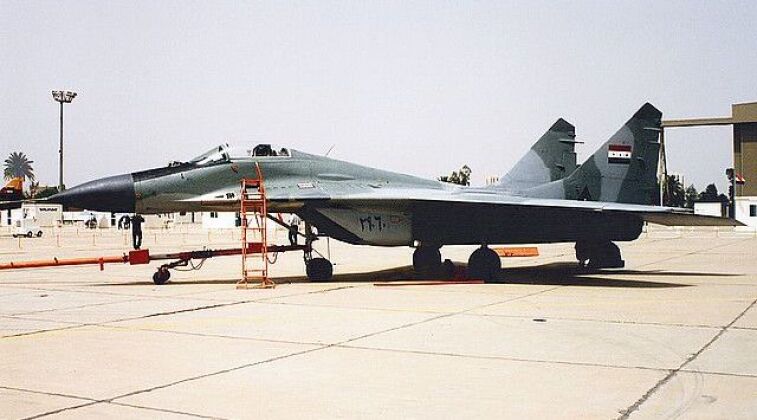
Iraq received a number of MiG-29 fighters and used them to engage Iranian equivalent opponents during the later stages of the Iran–Iraq War.
By August 1990, at the time of the Invasion of Kuwait, the Iraqi Air Force had received 37 MiG-29 (9.12B) Fulcrum-As. Iraq was reportedly unsatisfied that they did not receive the R-73 and R-27T missiles that Coalition intelligence had assessed as a great threat, instead receiving R-60MK missiles. As a result, they did not order any more aircraft. Iraq was reportedly able to modify their MiG-29s to carry both drop tanks and the TMV-002 Remora ECM pod.
MiG-29s saw combat in the 1991 Persian Gulf War with the Iraqi Air Force. Five MiG-29s were shot down by USAF F-15s. Some sources reported that one British Panavia Tornado, ZA467, was shot down in northwestern Iraq by a MiG-29 UK sources claim this Tornado to have crashed on 22 January on a mission to Ar Rutbah. Another Tornado is also claimed by an Iraqi MiG-29, this time, and IDS variant belonging to the AMI from either the 4th or 5th Fighter Squadron, again using an R-60 missile. Other Iraqi air-to-air kills are reported in Russian sources, where the US claims other cases of combat damage, such as a B-52 which the US claims was hit by friendly fire, when an AGM-88 high-speed, anti-radiation missile (HARM) homed on the fire-control radar of the B-52's tail gun; the bomber returned to base and was subsequently renamed "In HARM's Way". It is believed that an F-111 Aardvark was hit by a missile fired by a MiG-29 but it was able to return to base. A MiG-29 from the 4th or 5th TFS also had a less fortunate kill against a friendly aircraft, a MiG-23ML using a R-27R missile on the 17th of January, 1991. This case of fratricide was not the first of this type, but a MiG-29 of the 5th TFS shot down another MiG-29 of the same unit using an R-60MK in April 1988, though the circumstances are not entirely known.
Iraq's original fleet of 37 MiG-29s was reduced to 12 after the Gulf War. One MiG-29 was damaged, and seven were reportedly flown to Iran. The remaining 12 aircraft were withdrawn from use in 1995 because the engines needed to be overhauled but Iraq could not send them off for that work.
After the American-led 2003 invasion of Iraq and disbandment of the Ba'athist Iraqi Army in May of the same year, the remaining Soviet-made and Chinese-made fighters of the Iraqi Air Force had been decommissioned.
Syria
Syria was one of the first export customers of the MiG-29, receiving them before most of the Warsaw Pact nations did, with the Syrian Defence Minister Mustafa Tlass allegedly seeking up to 150 MiG-29s. The very first Fulcrums arrived in Syria in June or July 1987, a batch of 16, and many more were delivered into the later 1980s. A total of 48 MiG-29As and UBs were delivered in the original batches, and a further 16 were reportedly delivered in the middle to late 1990s, reportedly airframes built for Iraq in 1990-91 but undelivered due to sanctions and the Gulf War. These were upgraded to an unknown standard.
Syrian Arab Air Force MiG-29s have sometimes encountered Israeli fighter and reconnaissance aircraft. Two Israeli F-15Cs reportedly shot down two MiG-29As on 2 June 1989 under unclear circumstances. Some reports claim that between 1990 and 1991, several air battles occurred between the Syrians and the Israelis and one MiG-29 at least is reported to have been lost in those engagements, with Israeli losses claimed by unreported and unverified. Further reports claim that on 14 September 2001 two Syrian Air Force MiG-29s were shot down by two Israeli F-15Cs while the MiGs were intercepting an Israeli reconnaissance aircraft off the coast of Lebanon. However, both Syria and Israel deny that this occurred, yet unofficial sources continue to hold that an engagement did take place, with the names of the Syrian pilots given being Maj. Arshad Midhat Mubarak, and Capt. Ahmad al-Khatab and both were reported rescued from the Mediterranean. It is stated that the battle occurred when an Israeli Air Force Boeing 707 SIGINT aircraft, escorted by two F-15Cs armed with advanced Python Mk.IV missiles, was conducting a routine surveillance mission along the Lebanese and Syrian coasts, monitoring telecommunications and radar activity near Tripoli and Hamidiyah. Such missions, conducted twice weekly, were typically shadowed by Syrian interceptors—usually MiG-23s or MiG-29s—that maintained a safe distance and showed no hostile intent. However, at 09:14 that day, two Syrian MiG-29s suddenly turned aggressively toward the Israeli formation, prompting the F-15s to order the 707 to retreat and activate ECM, while reinforcements were scrambled. After warnings on the international distress frequency were ignored, one F-15 shot down the lead MiG-29 with a Python Mk.IV missile, while the second MiG, attempting to retreat, was destroyed by a close-range AIM-9M Sidewinder, both crashing into the Mediterranean .
Syrian MiG-29s entered the Syrian Civil War in late October 2013, attacking Free Syrian Army insurgents with unguided rockets and bombs in Damascus and during the war, MiG-29SM fighters (a deep upgrade by Russia of the platform) were delivered to the SyAAF. A Syrian MiG-29SM crashed on 5 March 2020 near Shayrat Airbase. Marking the first crash of the plane in the Syrian Air Force since 2001. According to avia.pro the aircraft may have been shot down by MANPADS operated by the Syrian Opposition. After the fall of the Assad Ba'athist Regime, the remaining assets of the SyAAF were largely taken over the opposition but the Israelis - who were concerned about the instability with the new regime - destroyed at least 30 MiG-29s as part of Operation Bashan Arrow which involved Israeli Strikes on Syrian Defence Infrastructure including air bases, and the condition of the remaining aircraft is uncertain.
Malaysia

The Royal Malaysian Air Force operated 18 MiG-29N/NUB aircraft from 1995 to 2017 out of its air base in Kuantan. The aircraft were modified to have an improved engine and stronger airframe to meet Malaysian requirements.
In 2009, it was announced that the jets would be gradually phased out by the end of 2010 as a result of increasing maintenance costs, which would save approximately $76 million annually. The Malaysian defence ministry subsequently went back on its position and announced it would keep ten planes in service and only retire the remaining six. In 2013, it was announced that the MiG-29 fleet would be retired by 2015. However, delays with its Multi-Role Combat Aircraft (MRCA) program meant the jets were kept in service and set to be upgraded to extend their lifespan, but these plans ultimately did not materialise and they were finally retired in 2017.
One crashed in 1998 as a result of hydraulic and battery failures, and another in 2004 after its engine caught on fire after takeoff. Both pilots ejected and survived.
North Korea
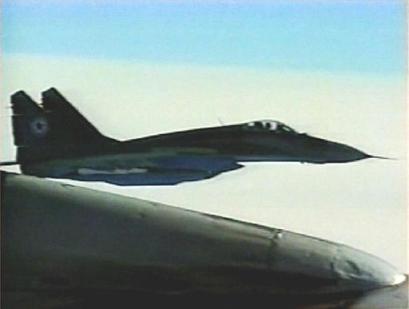
The Korean People's Air Force is believed to operate about 18 MiG-29s which are assigned to the 55th Air Regiment based at Sunchon Air Base. In addition to 13 MiG-29 (9.12B) Fulcrum As and 2 Fulcrum B trainers that were delivered in 1987, North Korea also became the only Cold War export customer and licensed manufacturer of the Fulcrum-C. Called the MiG-29S-13 (9.13B) Fulcrum-C, they were delivered to North Korea from the USSR/Russia between 1991 and 1992 in knock down parts. Only three S-13s were completed due to Russia refusing to supply more parts to North Korea. The first locally built Fulcrum-C flew on 15 April 1993. These were first encountered and photographed by the USAF in March 2003 when a pair of KPAF MiG-29s intercepted an USAF RC-135S Cobra Ball reconnaissance aircraft. On 17 May 2025. North Korean MiG-29 was seen using its new active radar homing missile which resembles the AIM-120 and PL-12. The missile seems to outperform the given Soviet-era MiG-29's radar in terms of range.
Sudan
_MTI-2.jpg)
There have been occasional claims regarding the use of Sudanese Air Force MiG-29s against insurgent forces in Darfur. However, whereas Mi-24 combat helicopters as well as Nanchang A-5 or, more recently, Su-25 ground-attack aircraft have been spotted and photographed on Darfurian airfields, no MiG-29s have been observed. On 10 May 2008, a Darfur rebel group, the Justice and Equality Movement (JEM) mounted an assault on the Sudanese capital. During this action, the JEM shot down a Sudanese Air Force MiG-29 with 12.7 and heavy machine gun fire while it was attacking a convoy of vehicles in the Khartoum suburb of Omdurman. The aircraft was piloted by a Russian mercenary. He was killed in action as his parachute did not open after ejecting. On 14 November 2008 Sudanese Ministry of Defence admitted that Sudan had received 12 MiG-29s from Russia. An anonymous Russian source claimed that the aircraft had been delivered before 2004.
During the brief 2012 South Sudan–Sudan border conflict, on 4 April 2012, Sudan People's Liberation Army (SPLA) claimed the downing of a Sudanese MiG-29 using antiaircraft guns. The Sudan government denied the claim. On 16 April 2012, the SPLA issued a second claim about the downing of a Sudanese MiG-29. It was not clear if this second claim referred to the previous one.
On 15 April 2023, a Sudanese MiG-29 was captured on film firing missiles over Khartoum during a skirmish with paramilitary forces.
On 25 May 2023, a Sudanese MiG-29 was filmed being shot down by the Rapid Support Forces (RSF) over Omdurman. The pilot ejected and survived, although he was wounded and captured.
United States
In 1997, the US purchased 21 Moldovan MiG-29 aircraft under the Nunn–Lugar Cooperative Threat Reduction program. Fourteen were MiG-29S models, which are equipped with an active radar jammer in its spine and are capable of being armed with nuclear weapons. Part of the US' motive to purchase these aircraft was to prevent them from being sold to Iran. This purchase could also provide the tactical fighter communities of the USAF, the USN and the USMC with a working evaluation and data for the MiG-29, and possibly for use in dissimilar air combat training. Such information may prove valuable in any future conflicts and can aid in the design and testing of current and future weapons platforms. In late 1997, the MiGs were delivered to the National Air and Space Intelligence Center (NASIC) at Wright-Patterson Air Force Base in Ohio, though many of the former Moldovan MiG-29s are believed to have been scrapped. Some of these MiG-29s are currently on open display at Nellis AFB, Nevada; NAS Fallon, Nevada; Goodfellow AFB, Texas; and Wright-Patterson AFB, Ohio.
Others
A Cuban MiG-29UB shot down two Cessna 337s belonging to the organisation Brothers to the Rescue in 1996, after the aircraft approached Cuban airspace.
According to some reports, in the 1999 Eritrean-Ethiopian War, a number of Eritrean MiG-29s were shot down by Ethiopian Su-27s piloted by Russian mercenaries. It was reported that local pilots were trained by instructors from those nations. There are also some other reports of Eritrean MiG-29s shooting down two Ethiopian MiG-21s, three MiG-23s. The claim that an Eritrean MiG-29 shot down an Ethiopian Su-25 was later debunked, since the missing Ethiopian Su-25TK was damaged in an accident in May 2000, is actually stored and used for spares at Bishoftu Air Base.
, Jane's Information Group reported the Bangladesh Air Force (BAF) operated 8 MiG-29s (6B & 2UB) though their have a low serviceability rate.
After the end of the 1994 civil war, newly reunified Yemen inherited several intact MiG-29s, bought by South Yemen a few months earlier. In 1995–1996, Yemen also received two additional jets from Kazakhstan. In 2001, a major arms deal including the purchase of up to 36 upgraded MiG-29s was signed, with deliveries starting in June 2002. Equipped with N019MP radar and an advanced fire control system, they became the most advanced combat aircraft in the Yemeni Air force arsenal. They are compatible with Kh-31P and Kh-29T guided air-to-ground missiles, as well as R-77 air-to-air missiles.
Potential operators and failed bids
Before the dissolution of the Soviet Union, Finland had a policy of splitting procurement of armaments between western, eastern and domestic suppliers. The MiG-29 was planned to replace the Finnish Air Force's MiG-21 fighters up to 1988, with test flights having been done.
In the second half of the 1980s, the Soviet Union offered the MiG-29 to Libya. The offer was turned down, as the weapons system and radar of the MiG-29 were assessed as similar to those of the MiG-23MLD already in service with the Libyan Arab Air Force. The MiG-29's price was also deemed much too high.
During 1989–1990, the Soviet Union delivered 49 helicopters and 125 aircraft after the Soviet withdrawal from Afghanistan. The Democratic Republic of Afghanistan additionally requested the MiG-29 for the Afghan Air Force, although this was turned down.
In 1989, Zimbabwe ordered a squadron's worth of MiG-29s to the USSR. Some Air Force of Zimbabwe personnel travelled to Russia for conversion courses, but in 1992 the deal was cancelled, as the geopolitical situation of the region was stabilising.
In December 2008, Russia moved to expand its military influence in the Middle East when it announced it was giving Lebanon 10 fighter jets, that would have been the most significant upgrade of Lebanon's military since the civil war ended almost two decades before. A Russian defence ministry representative said it was giving secondhand MiG-29s to Lebanon for free. This was to be part of a defence cooperation deal that would have included Lebanese military personnel training in Russia. On 29 February 2010, Russia agreed to change the offer to 10 Mi-24 attack helicopters based on a Lebanese request.
In 2021 Russia offered the Argentine Air Force a batch of 15 MiG-29 fighters and another of Su-30 fighters with 12 units and seek also the sale of Yak-130 training jet and Mil Mi-17 helicopters.
Variants
Original Soviet variants

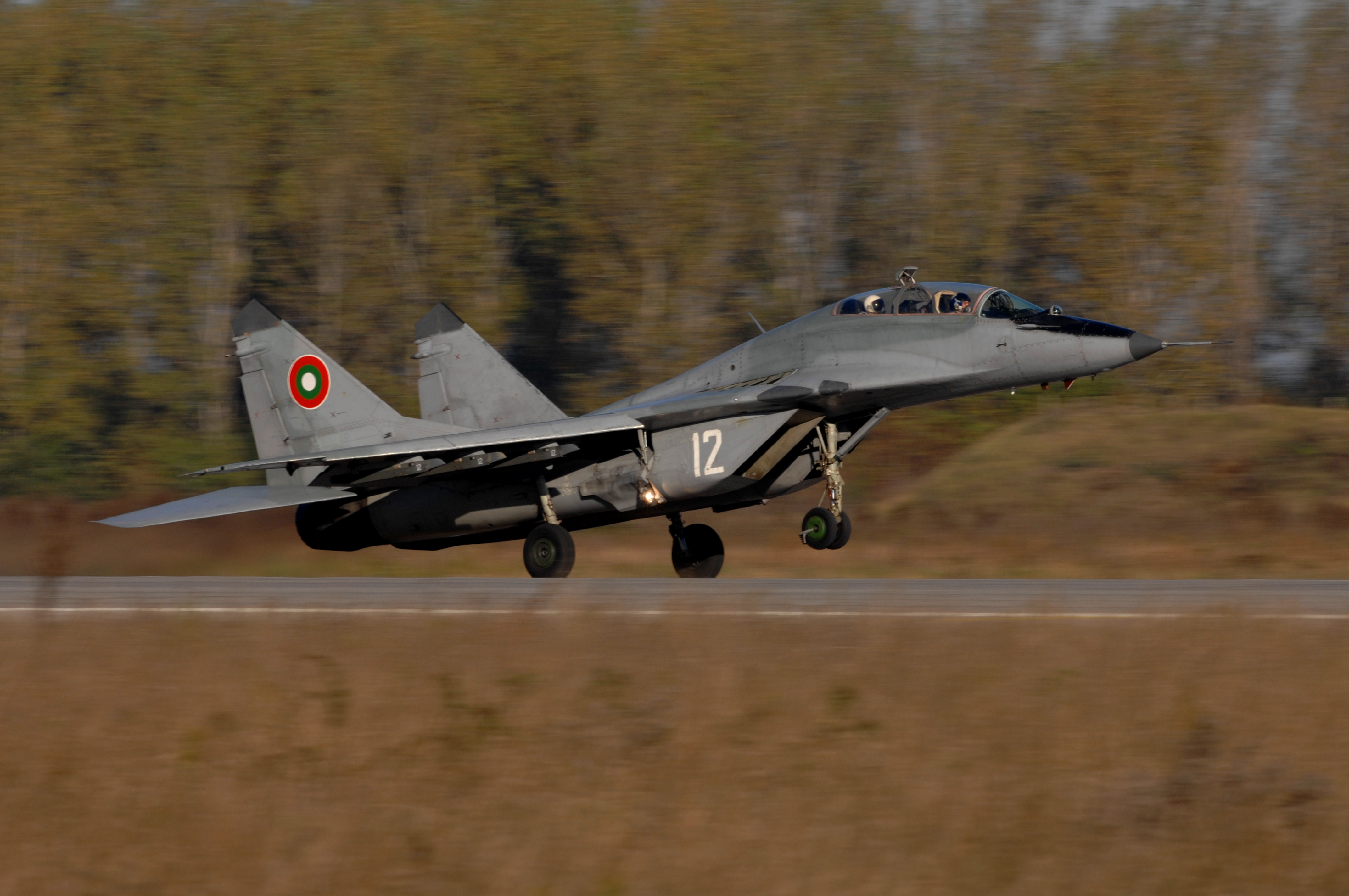
;MiG-29 (Product 9.12) :Initial production version for Soviet Air Force; entered service in 1983. NATO reporting name is "Fulcrum-A". Variant possessed the Phazotron N019 Rubin radar, OEPS-29 optical-electronic sighting system and helmet mounted sight.
;MiG-29 (Product 9.12A) 'Fulcrum-A' :Export variant of the 9.12 for Warsaw Pact countries which included a downgraded RPLK-29E radar, downgraded OEPrNK-29E optoelectronic and navigation systems and older IFF transponders. This variant also lacked the capability to deliver nuclear weapons. Delivered to East Germany, Czechoslovakia, Poland, Sudan, and Romania.
;MiG-29 (Product 9.12B) 'Fulcrum-A' :MiG-29 variant of the 9.12 for non Warsaw Pact countries which included a further downgraded radar and avionics. Delivered to India, Iraq, Syria, North Korea, Cuba, Malaysia, Myanmar and Eritrea.
;MiG-29UB (Product 9.51) :Twin seat training model. Infrared sensor mounted only, no radar. NATO reporting name is "Fulcrum-B".
;MiG-29 (Product 9.13) 'Fulcrum-C' :Update of the initial production version; entered service in 1986. NATO reporting name is "Fulcrum-C". Variant possessed an enlarged dorsal spine to accommodate a larger No.1 fuel tank and the installation of the L-203BE Gardenyia-1 jammer that was lacking on the initial 9.12 version. This enlarged spine earned the 9.13 version and its successors the nickname of "Fatback".
;MiG-29 (Product 9.13B) 'Fulcrum-C' :Export variant of the 9.13 provided to North Korea in semi-knocked down (SKD) kits and built in Panghyon between 1991 and 1992. Like the 9.13, it has the Gardenyia-1 jammer but has downgraded avionics and no IFF. Other sources say the Gardenyia was not delivered to North Korea.
;MiG-29S (Product 9.13S) :The MiG-29S was an update of the original 9.13 model retaining the NATO reporting code "Fulcrum-C" and featured flight control system improvements; a total of four new computers provided better stability augmentation and controllability with an increase of 2° in angle of attack (AoA). An improved mechanical-hydraulic flight control system allowed for greater control surface deflections. The MiG-29S can carry 1150 liter under wing drop tanks and a centerline tank. The inboard underwing hardpoints allow a tandem pylon arrangement for carrying a larger payload of 4000 kg. Overall maximum gross weight was raised to 20000 kg. This version also included new avionics and the new Phazotron N019M radar and Built-In Test Equipment (BITE) to reduce dependence on ground support equipment. Development of this version was initiated due to multiple systems being compromised to the West by Phazotron engineer Adolf Tolkachev. This was the final version of the MiG-29 produced before the collapse of the Soviet Union and only limited numbers were produced.
Upgraded variants based on original airframe
;MiG-29S (Product 9.12S) :Post Soviet upgrade for older 9.12 variants incorporating the changes developed for version 9.13S. ;MiG-29SD (Product 9.12SD) :Export variant of upgraded 9.12S with downgraded versions of radar and avionics.
;MiG-29SE (Product 9.13SE) :Export variant of the 9.13S with slightly downgraded N-019ME radar with multiple target tracking ability and RVV-AE (R-77 missile) compatibility. The first export model MiG-29 with underwing drop tanks; the inner underwing pylons can carry over 500 kg bombs in side by side tandem pairs. Its weapons mix includes R-27T1, R-27ER1 and R-27ET1 medium-range missiles. The aircraft can be fitted with active ECM systems, weapons guidance aids, improved built-in check and training systems. The MiG-29SE can simultaneously engage two air targets.
;MiG-29SM (Product 9.13M) :Similar to the 9.13, but with the ability to carry guided air-to-surface missiles and TV- and laser-guided bombs. NATO reporting code is "Fulcrum-C".
;MiG-29SM (SyAF) :For the Syrian Air Force, and based on the MiG-29SM, except the Syrian MiG-29SM uses the 9.12 airframe. RAC MiG developed a special variant for Syria.

;MiG-29G/MiG-29GT :East German MiG-29A / 29UB upgraded to NATO standards, with work done by MiG Aircraft Product Support GmbH (MAPS), a joint venture company form between MiG Moscow Aviation Production Association and DaimlerChrysler Aerospace in 1993.
;MiG-29AS/MiG-29UBS :Slovak Air Force performed an upgrade on their MiG-29A/-29UB for NATO compatibility. Work is done by RAC MiG and Western firms, starting from 2005. The aircraft now has navigation and communications systems from Rockwell Collins, an IFF system from BAE Systems, new glass cockpit features multi-function LC displays and digital processors and also fitted to be integrate with Western equipment in the future. However, the armaments of the aircraft remain unchanged. 12 out of 21 of the entire MiG-29 fleet were upgraded and had been delivered as of late February 2008.

;MiG-29 Sniper :Upgrade planned for the Romanian Air Force by DASA, Aerostar and Elbit. DASA was responsible for program management, technical support and the test flight program (together with Elbit), Elbit was responsible for developing the avionics package, while Aerostar implemented the upgrades on the aircraft. The first flight occurred on 5 May 2000. The upgrades included the installation of a new modular multirole computer based on the MIL-STD-1553B data bus, upgraded Western avionics, new radio stations, hybrid navigation system composed of an inertial navigation system and coupled with GPS receiver, identification system, two 152 × MFCDs, a Head-Up Display equipped with UFCP front control panel, new RWR, new HOTAS and new ADC. The addition of a new radar and the integration of Western weapons while maintaining Russian ones were also expected. The program halted due to various reasons, along with the retiring of Romanian MiG-29A/UB in 2003, the Romanian Government deciding to further invest in the MiG-21 LanceR program.
,_Russia_-_Air_Force_AN2269907.jpg)
;MiG-29SMT (Product 9.17) :The MiG-29SMT is an upgrade of first-generation MiG-29s (9.12 to 9.13) using enhancements on the MiG-29M. Additional fuel tanks in a further enlarged spine provide a maximum internal flight range of 2100 km. The cockpit has an enhanced HOTAS design, two 152 × colour liquid crystal MFDs and two smaller monochrome LCDs. The MiG-29A lacked an advanced air-to-ground capability, thus the SMT upgrade adds the upgraded Zhuk-ME radar with air-to-ground radar detection and integrates air-to-ground guided weapons. It also has upgraded RD-33 ser.3 engines with afterburning thrust rated at 8300 kgf each. The weapons load was increased to 4500 kg on six underwing and one ventral hardpoints, with similar weapon choices to the MiG-29M. It can also accommodate non-Russian origin avionics and weapons.
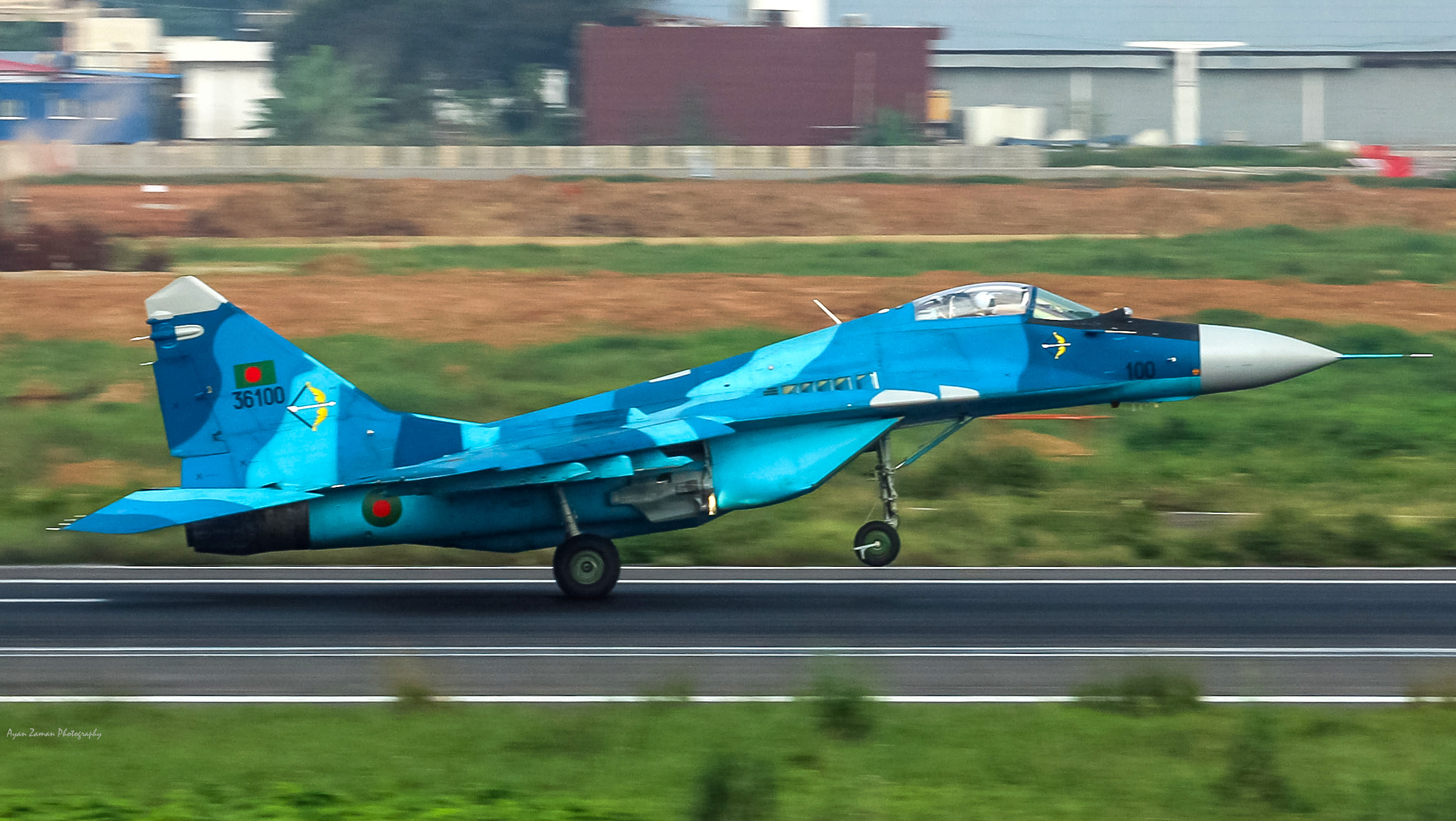
;MiG-29BM :The MiG-29BM (probably Belarusian Modernised, possibly Bolyshaya Modernizaciya – large modernization) is an upgrade conducted by the ARZ-558 aircraft repair plant in Baranovichi, Belarus. It is a strike variant of the MiG-29 and the Belarusian counterpart to the Russian MiG-29SMT. It includes improvements to weapons, radar, as well as adding non-retractable air-air refueling ability. They entered service in 2003 and it is estimated, that ten or so were modernized to BM standard. The Bangladesh Air Force upgraded its MiG-29B similar to BM standard.
;MiG-29UBT (Product 9.51T) :SMT standard upgrade for the MiG-29UB. Namely users, Russia, Algeria and Yemen.
;MiG-29UPG :The UPG was a modified variant intended for upgrdation of the MiG-29Bs used by the Indian Air Force. The version is similar to the SMT variant with an imported avionics suite. It includes Zhuk-M radar, new avionics, an IFR probe, DRDO D-29 electronic warfare system, and enhanced RD-33 series 3 turbofan engines. It made its maiden flight on 4 February 2011.
;MiG-29SMP / MiG-29UBP :The SMP/UBP are upgrades for the Peruvian Air Force MiG-29SE fleet. In August 2008 a contract of US$106 million was signed with RAC MiG for this custom SM upgrade of an initial batch of eight MiG-29, with a provision for upgrading all of Peru's MiG-29s. The single-seat version is designated SMP, whereas the twin-seat version is designated UBP. It features an improved ECM suite, avionics, sensors, pilot interface, and a MIL-STD-1553 databus. The interfaces include improved IRST capabilities for enhanced passive detection and tracking as well as better off-boresight launch capabilities, one MFCD and HOTAS. The N019M1 radar, a heavily modified and upgraded digital version of the N019 radar, replaces the standard N010 Zhuk-M of the MiG-29SMT. The upgrade also includes a structural life-extension program (SLEP), overhauled and upgraded engines, and the addition of an in-flight refuelling probe.
;MiG-29N/NUB :Designation of the export of 16 MiG-29SD and 2 MiG-29UB for the Royal Malaysian Air Force. ;MiG-29MU1 :A Ukrainian modernization of the MiG-29A/S.
;MiG-29MU2 :A further Ukrainian modernization of the MiG-29S, focused on air to ground munitions.
Second-generation variants with modified airframe
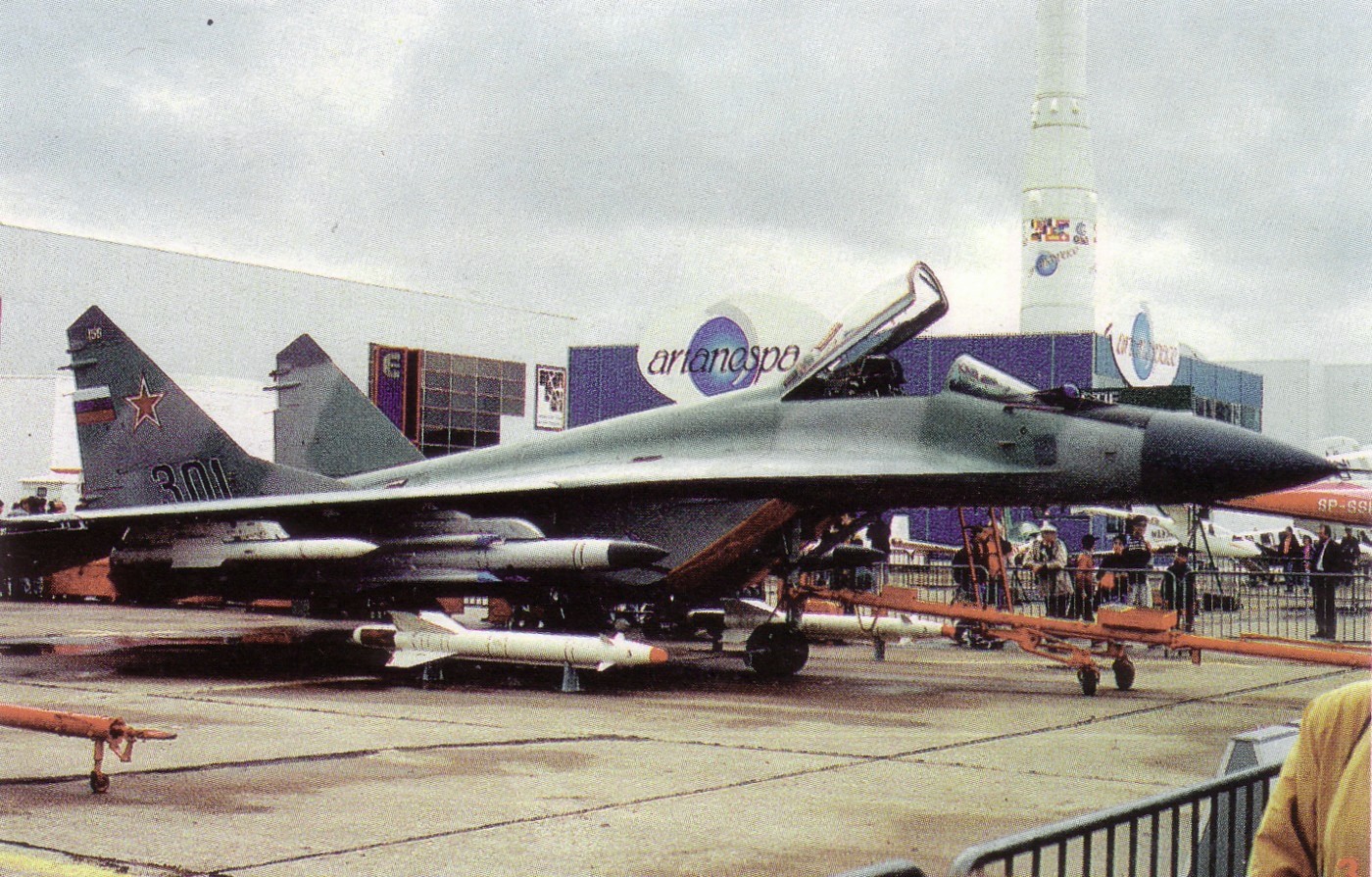
;MiG-29M / MiG-33 (Product 9.15) Main article: Mikoyan MiG-29M
:Advanced multirole variant, with a redesigned airframe, mechanical flight controls replaced by a fly-by-wire system and powered by enhanced RD-33 ser.3M engines. NATO reporting code is "Fulcrum-E".
;MiG-29UBM (Product 9.61) :Two-seat training variant of the MiG-29M. Never built. Effectively continued under the designation 'MiG-29M2'.
;MiG-29M2 / MiG-29MRCA :Two-seat version of MiG-29M. Identical characteristics to MiG-29M, with a slightly reduced ferry range of 1800 km. RAC MiG presented in various air shows, including Fifth China International Aviation and Aerospace Exhibition (CIAAE 2004), Aero India 2005, MAKS 2005. It was once given designation MiG-29MRCA for marketing purpose and now evolved into the current MiG-35.
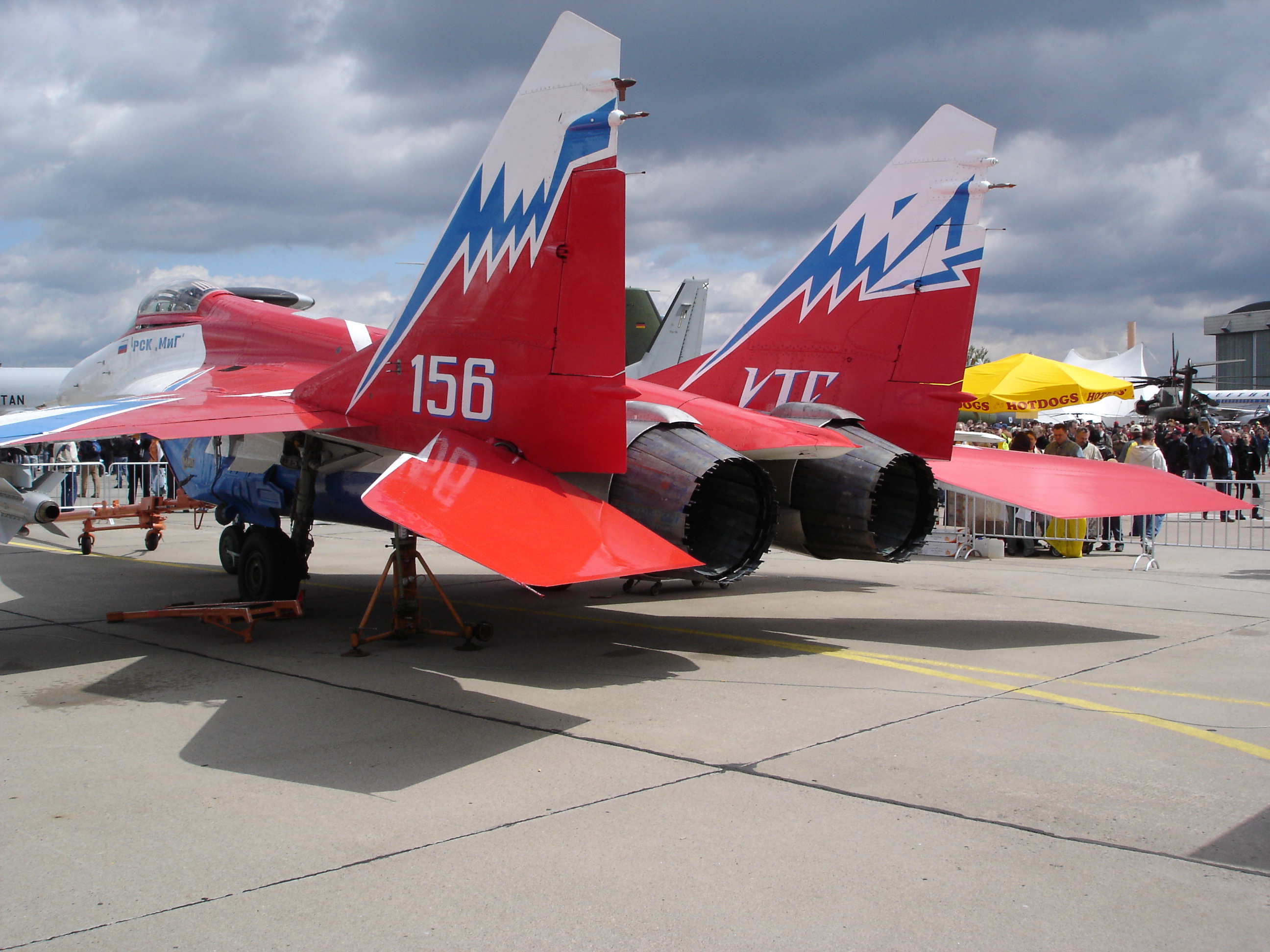
;MiG-29OVTMiG-29OVT :The aircraft is one of the six pre-built MiG-29Ms before 1991, later received thrust vectoring engine and fly-by-wire technology. It served as a thrust-vectoring engine testbed and technology demonstrator in various air shows to show future improvement in the MiG-29M. It has identical avionics to the MiG-29M. The only difference in the cockpit layout is an additional switch to turn on vector thrust function. The two RD-133 thrust-vectoring engines, each features unique 3D rotating nozzles which can provide thrust vector deflection in all directions. However, despite its thrust-vectoring, other specifications were not officially emphasized. It is usually used as an aerobatic demonstrator and has been demonstrated along with the MiG-29M2 in various air shows around the world for potential export.
.jpg)
;MiG-29K (Product 9.31) Main article: Mikoyan MiG-29K
:Naval variant based on MiG-29M, the letter "K" stands for "Korabelnogo bazirovaniya" (deck-based). It features folding wings, arrestor gear, and reinforced landing gear. Originally intended for the Admiral Kuznetsov class aircraft carriers, it had received series production approval from the Russian Ministry of Defence but was grounded in 1992 due to shift in military doctrine and financial difficulties. The MiG Corporation restarted the program in 1999. On 20 January 2004, the Indian Navy signed a contract of 12 single-seat MiG-29K and four two-seat MiG-29KUB. NATO reporting code is "Fulcrum-D".

;MiG-29KUB (Product 9.47) :Identical characteristic to the MiG-29K but with tandem twin seat configuration. The design is to serve as trainer for MiG-29K pilot and is full combat capable. The first MiG-29KUB developed for the Indian Navy made its maiden flight at the Russian Zhukovsky aircraft test centre on 22 January 2007. NATO reporting code is "Fulcrum-D".
(MiG-35)_Russian_Air_Force_ZIA_UUBW_1_(33847794464).jpg)
;MiG-35 Main article: Mikoyan MiG-35
:A development of the MiG-29M/M2 and MiG-29K/KUB. NATO reporting code is "Fulcrum-F".
Operators
Main article: List of Mikoyan MiG-29 operators

.jpg)
_(cropped).jpg)
_Pichugin-1.jpg)

_at_Lviv_International_Airport.jpeg)
_MRD-2.jpg)
Current
;Algeria
- Algerian Air Force – 26 MiG-29s in service in January 2014. 14 MiG-29M/M2s on order. As of 2023 there are 39 MiG-29 fighters and 1 UB trainer available, with 5 on order. ;Azerbaijan
- Azerbaijani Air Forces – 12 MiG-29s and 3 UB trainers operational in 2023. ;Bangladesh
- Bangladesh Air Force – 6 MiG-29SEs (9.12SE) and 2 MiG-29UBs in service as of 2021. Four MiG-29SEs were upgraded for life extension in Belarus. Rest were upgraded in 2021–2022. ;Belarus
- Belarusian Air Force – 33 MiG-29s in inventory as of 2024
;Bulgaria
- Bulgarian Air Force – 11 MiG-29s and 3 MiG-29UB used for conversion training in inventory as of 2025.
;Cuba
- Cuban Revolutionary Air and Air Defense Force – 4 MiG-29s in inventory as of 2023
;Egypt
- Egyptian Air Force – 46 MiG-29Ms delivered by 2021, with some lost on the ground in Sudan. ;India
- Indian Air Force – 61 MiG-29s in service as of 2024.
- Indian Naval Air Arm – 42 MiG-29Ks in service as of 2024 ;Iran
- Islamic Republic of Iran Air Force – 19 MiG-29s in operation as of 2023 according to Flight Global. Iran purchased 20 MiG-29 (9.12B) and 4 MiG-29UB aircraft in 1989. They attempted to purchase 48 more in 1992, but the deal fell through. They had received 9 from Iraq, according to RSK MiG. ;Libya
- Libyan National Army − Some MiG-29s in service as of February 2024. Operated by mercenary pilots. ;Mongolia
- Mongolian Air Force - 6 MiG-29UBs in service as of December 2021. That number fell to 2 operational UBs in 2023. ;Myanmar
- Myanmar Air Force – 31 MiG-29s(6 SE, 20 SM(mod) and 5 UB) in January 2015. 10 are upgraded to MiG-29SM(mod) standard. As of 2023, 28 fighters and 5 UB trainers remain. ;North Korea
- Korean People's Air Force – 18 MiG-29s (6 9.12B, 3 S-13 and 2 UB) as of July 2023. ;Peru
- Peruvian Air Force – 19 MiG-29s in service as of February 2021 Only 6 were available by the end of 2023. ;Poland
- Polish Air Force – 11 MiG-29s and 3 MiG-29UB used for conversion training in service as of 2025. 10 transferred to Ukraine in 2023. ;Russia
- Russian Aerospace Forces – 87 total consisting of 70 MiG-29/MiG-29UB, 15 MiG-29SMT and 2 MiG-29UBT in service as of 2022. At least 256 MiG-29 in service according to World Air Forces as of 2025.
- Russian Naval Aviation – 24 MiG-29Ks ;Serbia
- Serbian Air Force and Air Defence – 14 MiG-29s (5 MiG-29Аs, 3 MiG-29Bs, 3 MiG-29Ss, 3 MiG-29UBs) in inventory as of 2025, 11 of which are modernized to the advanced MiG-29SMT standards while 3 (MiG-29UB) are used as a conversion trainer. ;Sudan
- Sudanese Air Force – 10 fighters and 1 UB trainer in service as of January 2023 ;Turkmenistan
- Turkmen Air Force – 24 MiG-29s in use as of 2023

;Ukraine
- Ukrainian Air Force – Up to 240 inherited from the Soviet Union in 1991. About 58 were operational in 2022. 44 MiG-29s in service along with 9 MiG-29UB trainers . ;United States
- Used by private defense contractor RAVN Aerospace for adversary training services. ;Uzbekistan
- Uzbekistan Air and Air Defence Forces – 60 MiG-29s were operation as of January 2014. ;Yemen
- Yemeni Air Force – 24 in service as of January 2017. 23 reported available in 2023.
Former

;Chad
- Chadian Air Force − Received 3 MiG-29s from Ukraine in 2015. None operational as of 2024. ;Czechoslovakia
- Czechoslovak Air Force – Received 18 MiG-29s and two MiG-29UB aircraft. Although six were capable of delivering nuclear weapons, the necessary equipment for this was removed as per the CFE treaty. All passed onto successor states. ;Czech Republic
- Czech Air Force – Inherited nine MiG-29 and one MiG-29UB. All sold to Poland in 1995 in exchange for 11 W-3A Sokol helicopters. Replaced with Saab JAS 39 Gripen. ;Eritrea
- Eritrean Air Force – 7 MiG-29s in service as of 2022, but none active in 2023 ;East Germany
- Air Forces of the National People's Army – 24 absorbed into the West German Air Force upon reunification ;Germany
- German Air Force – One crashed, one on display, 22 sold to Poland in 2003 for €22 ($). ;Hungary
- Hungarian Air Force – 28 in inventory as of January 2011. Reportedly stored outside. The last fighter was retired in December 2010, at which point only 4 aircraft were still in operational condition. In 2011 the Hungarian government intended to sell six MiG-29 9.12 and two MiG-29UB aircraft. Replaced with JAS 39 Gripen but kept in reserve if needed. In October 2017, the Hungarian Air Force announced that 23 MiG-29s were to be auctioned off including engines and spare parts in November. The online auction had a reservation price of €8.7 million and failed to attract any bidders. This might have been because of an agreement between Hungary and Russia requiring the manufacturer's (Russia's) approval to transfer ownership of the aircraft. ;Ba'athist Iraq
- Iraqi Air Force – Received 37 MiG-29s during Saddam Hussein's era (MiG-29 9.12B and MiG-29UB); these were destroyed or written off and nine were reportedly flown to Iran. ;Israel
- Israeli Air Force – Leased from Poland in 1997. ;Kazakhstan
- Kazakh Air and Air Defence Forces – 23 MiG-29s as of 2023. These were retired in 2023, put up for auction in October 2023, and reportedly sold in April 2024 to the US. It was speculated that these would be transferred to Ukraine as spare parts sources and/or decoys. In a later statement, the Kazakh state-owned weapons importer and exporter Kazspetexport denied such claims, saying that foreign companies were not allowed to bid. ;Malaysia
- Royal Malaysian Air Force – Retired 15 MiG-29N and 2 MiG-29UB in 2017 for lack of spare parts and engine problem. Replaced with Sukhoi Su-30MKM. ;Moldova
- Moldovan Air Force – Not operational, ;Romania
- Romanian Air Force – 17 MiG-29 9.12A and five MiG-29UB were delivered from 1989, 1 MiG-29S received from Moldova in 1992. Retired in 2003. ;Serbia and Montenegro
- Air Force of Serbia and Montenegro – Inherited from Yugoslavia, six destroyed in 1999.
.jpg)
;Slovakia
- Slovak Air Force – Slovakia operated in total 24 MiG-29s. 9 MiG-29 9.12A and 1 MiG-29UB were inherited from Czechoslovakia. From 1993 to 1995 Slovakia ordered 12 additional MiG-29 9.12A and 2 MiG-29UB fighters as compensation for Russian debt. 12 aircraft were upgraded by the Russian Aircraft Corporation MiG and Western companies in 2007 and 2008 to fulfill the NATO requirements, and were maintained by Russian military technicians at Sliač Air Base. They were officially withdrawn from service on 31 August 2022. Slovakia's Foreign Minister Rastislav Káčer has said that his country is prepared to transfer their fleet of MiG-29s to Ukraine. He said: "We have not yet handed [Ukraine] the MiG-29s. But we are ready to do it. We are talking with our NATO partners about how to do it," and such a package would involve "several thousand" missiles. Slovakia transferred the first four of its MiG-29 fighter jets, from 13 to be sent to Ukraine on 24 March 2023. ;South Yemen
- Democratic Republic of Yemen – Received between 6 and 12 MiG-29s from either Moldova and Russia, or Moldova only, in 1994. ;Soviet Union
- Soviet Air Forces – Passed on to successor states. ;Ba'athist Syria
- Syrian Arab Air Force − Had 20 MiG-29s in service with 12 more on order as of January 2017. 29 available as of 2023. After the fall of the Assad regime in 2024, the Israeli Air Force conducted airstrikes destroying the remaining assets to prevent them from falling into the rebels hands. ;Socialist Federal Republic of Yugoslavia
- Yugoslav Air Force – 14 MiG-29 and 2 MiG-29UB, passed on to Serbia and Montenegro.
Aircraft on display
;Czech Republic
- On display at the Prague Aviation Museum in Prague. ;Canada
- One MiG-29UB cockpit on display at Jet Aircraft Museum in London, Ontario, painted in Ukrainian colours. ;Germany
- 29+03 – MiG-29G on display at the Luftwaffenmuseum der Bundeswehr in Berlin.
;Hungary
- One MiG-29 is on display with other older MiG planes and helicopters at The RepTár Museum of Szolnok, Hungary.
;India
- KB-732 – On display as a gate guardian at Ojhar Air Force Station in Nasik, Maharashtra.
- KB-741 – On display at the Technical Type Training (TETTRA) School in Pune, Maharashtra.
;Latvia
- 9-52 – MiG-29UB on display at the Riga Aviation Museum in Riga. This airframe is the second MiG-29UB prototype. After 213 test flights around Moscow between 23 August 1982 and 10 April 1986, it was disassembled and parts of the wings and tails were re-used in prototype (9–16). The remains were shipped to Riga Military Aviation Engineers High School, and later handed over to the Riga Aviation Museum in 1994, where it is currently displayed. The remains of this prototype is in a very bad condition, with open fuselage panels and a partly broken canopy.
;Malaysia
- M43-06 – MiG-29N on display as gate guardian at Al-Sultan Abdullah Camp in Kuantan.
- M43-14 – MiG-29N on display as a monument in Dataran Pahlawan complex, Putrajaya.
;Poland
- MiG-29G on display at the Muzeum Wojska Polskiego in Warsaw.
- MiG-29GT on display at the Polish Aviation Museum in Kraków. This aircraft was sold by Germany to Poland in 2002 and briefly served in the Polish Air Force.
;Romania

- 67 – On display at the National Museum of Romanian Aviation in Bucharest.
;Russia
.jpg)
- On display at the Central Air Force Museum in Monino. Painted as "Blue 01".This airframe is the first prototype MiG-29.
- On display at the Central Air Force Museum in Monino. Painted as "Blue 03".
- 2960710039 – MiG-29 9.13 On display at the Central Air Force Museum in Monino. Painted as "Blue 70".
- 2960718121 – MiG-29 9.13 On display at the Central Air Force Museum in Monino. Painted as "Blue 51".
- On display at the Central Air Force Museum in Monino. Painted as "Blue 18". This airframe is a MiG-29KVP.
- 2960705560 – On display at the Museum of the Great Patriotic War in Moscow. Painted as "Blue 26".
- On display at the Vadim Zadorozhny Technical Museum in Khimki. Painted as "Blue 04".
- On display at the Central Armed Forces Museum in Moscow. Painted as "Red 02",
;Slovakia
- 8605 – MiG-29 9.12A on display in Museum of Aviation in Košice
- 7501 – MiG-29 9.12A on display at Sliač Air Force Base in Sliač. Normally not accessible to public.
- 9308 – MiG-29 9.12A on display in Vojenské historické múzeum Piešťany (Military History Museum Piešťany) in Piešťany.
- 5817 – MiG-29 9.12A on display in Vojenské historické múzeum Piešťany
- 5515 – MiG-29 9.12A on display in Vojenské historické múzeum Piešťany.
;United States

.jpg)
- 2960512124 – MiG-29 9.12 On display at Goodfellow Air Force Base in San Angelo, Texas.
- 2960717458 – MiG-29 9.13 On display at the airpark at Naval Air Station Fallon near Fallon, Nevada.
- 2960717473 – MiG-29 9.13 On display at the Threat Training Facility at Nellis Air Force Base near North Las Vegas, Nevada.
- 2960516761 – MiG-29 9.12 on display in the Cold War Gallery of the National Museum of the United States Air Force at Wright-Patterson Air Force Base in Dayton, Ohio.
- 2960516766 – MiG-29 9.12 On display at the Pima Air and Space Museum in Tucson, Arizona.
- 2960721930 – MiG-29 9.13 On display at the Evergreen Aviation and Space Museum in McMinnville, Oregon.
- 50903012038 – MiG-29UB on display at the National Air and Space Intelligence Center at Wright-Patterson Air Force Base in Dayton, Ohio.
Airworthy
- N29UB – MiG-29UB owned by Jared Isaacman. It was previously owned by the Flying Heritage Collection in Everett, Washington. The aircraft was obtained from Eastern Europe in early 2009. The aircraft has an FAA approved maintenance program and is flyable.
- N129XX – MiG-29UB owned by RAVN Aerospace (formerly Air USA) and located at the Quincy Regional Airport in Quincy, Illinois. This aircraft was purchased by Don Kirlin from Kyrgyzstan. It is available for contract training and flight testing.
- Two MiG-29UBs in flying condition were offered for sale from Eastern Europe in spring 2009. These aircraft come from the same source as the flyable aircraft (N129UB) previously owned by the Historic Flight Foundation and now owned by Jared Isaacman.
Specifications (MiG-29)

|prime units?=met
|max takeoff weight kg=18000 |max takeoff weight note=
|eng1 kn-ab=81.58 |eng1 lbf-ab=18300
|never exceed speed kmh= |never exceed speed note= |minimum control speed kmh= |minimum control speed note= |wing loading kg/m2=403 |fuel consumption kg/km= |thrust/weight=1.09
- S-5
- S-8
- S-24

- 2-4 × R-27R/ER/T/ET/P/EP air-to-air missiles
- 6 × R-60/R-60M AAMs
- 6 × R-73 AAMs (later variants also carry the R-73M, R-74 and R-74M)
- 4 × Astra (Indian Air Force)
- Rampage (Indian Air Force)
- AGM-88 HARM (Integration by Ukrainian Air Force during the [2022 Russian invasion of Ukraine](2022-russian-invasion-of-ukraine))
- 2 × Kh-29T/TE (MiG-29SMT, MiG-29M/M2, MiG-29K/KR and MiG-35 only)
- 6 × R-77 (MiG-29S, MiG-29M/M2 & MiG-29K only)

- 6 × 665 kg bombs
- 4 × FAB-500-M62 500kg general purpose bomb
- 4 × FAB-250-M62 250kg general purpose bomb
- 4 × BETAB-500 500kg concrete piercing bomb
- 4 × KMGU-AO2/PTAB munitions dispenser
- 4 × RBK-500-PTAB/255-PTAB 500kg cluster bomb
- 4 × RBK-250-PTAB/275-AO 250kg cluster bomb
- Smart Anti-Airfield Weapon

- 1 × 1400 L external drop tank
- 2 × 1100 L external drop tank
- Radar depands in variants: N019 family radar or Phazotron Zhuk-M (export designation Zhuk-ME) radar
- OEPS-29 IRST
- SPO-15 'Beryoza' RWR
- DARE D-29 EW system (on MiG-29 UPG)
Accidents and incidents
The Indian air force and navy have purchased 80 and 45 aircraft of their respective variants, and have lost 20 and five aircraft from 1989 to 2024, respectively.
- On 8 May 2020, an IAF MiG-29 from the 223 Squadron crashed near Jalandhar in Punjab with its pilot ejected safely after the aircraft failed to respond.
- On 2 September 2024, a MiG-29 (KBU-3112) of IAF's 47 Squadron crashed during a night training mission in an unpopulated area near Uttarlai of Barmer district in Rajasthan due to technical reasons, and the pilot ejected safely.
- On 4 November 2024, a MiG-29 (KBU-711) of the 28 Squadron crashed enroute from Adampur to Agra during a routine training mission due to technical issues. The aircraft stalled and eventually entered a flat spin before the crash, with the pilot ejecting safely.
In popular culture
Main article: Aircraft in fiction#Mikoyan MiG-29
Please do not add the many minor appearances of the aircraft. This section is only for major cultural appearances where the aircraft plays a MAJOR part in the story line, or has an "especially notable" role in what is listed. A verifiable source proving the appearance's notability may be required. Random cruft, including ALL Ace Combat, Battlefield, and Metal Gear Solid appearances, and ALL anime/fiction lookalike speculation, WILL BE removed.
If your item has been removed, please discuss it on the talk page FIRST. A verifiable source proving the appearance's notability may be required. If a consensus is reached to include your item, a regular editor of this page will add it back. Thank you for your cooperation.--
Notes
References
Bibliography
- .
- .
- Jenkins, Dennis R. McDonnell Douglas F-15 Eagle, Supreme Heavy-Weight Fighter. Arlington, TX: Aerofax, 1998. .
- Lake, Jon. "Mikoyan MiG-29 'Fulcrum'". World Air power Journal. Volume 4, Winter 1990/91. London: Aerospace Publishing. pp. 44–91. . .
- .
- .
- .
- North, David M. *MiG-29 Pilot Report, part 1 Part 2 *
- Spick, Mike, ed. "MiG-29 'Fulcrum'". "The Flanker". Great Book of Modern Warplanes. St. Paul, MN: MBI Publishing, 2000. .
References
- [http://migavia.ru/index.php/en/production/the-mig-29-fighters-family "The MiG-29 fighters family"]. {{Webarchive. link. (19 June 2015. Russian Aircraft Corporation MiG, 8 December 2014. Retrieved: 19 September 2018.)
- 2024 World Air Forces, Flight Global, p. 10.
- "Vietnam summary".
- Jenkins 1998, pp. 9–11.
- Spick 2000, pp. 488–89, 512–13.
- Correll, John T.. (February 2008). "The Reformers".
- Lake ''World Air Power Journal'' Volume 36 Spring 1999, pp. 110–11.
- Lambert 1993, p. 238.
- [[Aleksandr Zuyev (pilot). Zuyev, A.]] and Malcolm McConnell. ''Fulcrum: A Top Gun Pilot's Escape from the Soviet Empire''. Clayton, Victoria, Australia: Warner Books, 1993. {{ISBN. 0-446-36498-3.
- Eden 2004, pp. 310–321.
- (15 April 2014). "Russian Air Force to Receive 16 New MiG Fighters".
- [http://www.flightglobal.com/news/articles/russia-considers-funding-mig-29-successor-394022/ "Russia considers funding MiG-29 successor"] {{Webarchive. link. (17 December 2013 - Flightglobal.com, 11 December 2013)
- (7 February 2007). "Russia Air Force Handbook". International Business Publications.
- Lake 1987, p. 94.
- "MiG-29 Fulcrum Fighter Bomber".
- "MiG-29 Fulcrum Fighter Bomber". Airforce technology.
- Liebermann, Oren. (2022-08-08). "Pentagon acknowledges sending previously undisclosed anti-radar missiles to Ukraine". CNN.
- Trevithick, Joseph. (2022-08-08). "Anti-Radiation Missiles Sent To Ukraine, U.S. Confirms". The Drive.
- Rogoway, Tyler. (2022-08-07). "Anti-Radiation Missiles Sent To Ukraine, U.S. Confirms". The Drive.
- Sotham, John, "Solved: The mystery of the MiG-29", ''Air & Space'', September 2014, pp. 29–35.
- [http://www.strategypage.com/htmw/htatrit/articles/20090721.aspx "More MiG Malfunctions."] {{Webarchive. link. (24 July 2009 ''Strategy Page'', 21 July 2009. Retrieved 14 October 2009.)
- Johnson, Reuben F. [http://www.weeklystandard.com/Content/Public/Articles/000/000/013/788wbhgw.asp "The Paris Air Show Twenty Years On."] {{Webarchive. link. (11 September 2007 ''Weekly Standard'', 18 June 2007. Retrieved 10 March 2009.)
- (Oct 29, 2003). "Afghanistan, 1979-2001; Part 1".
- "1993–1877". Flight global.
- [http://www.turkishweekly.net/news/62151/russian-mig-29-fighter-crashes-in-east-siberia-pilot-dead.html "Russian MiG-29 fighter crashes in East Siberia: Pilot dead."] {{webarchive. link. (27 July 2009 ''The Journal of the Turkish Weekly'', 5 December 2008. Retrieved 28 March 2009.)
- [http://www.flightglobal.com/articles/2009/03/19/324017/corrosion-issue-grounds-one-third-of-russian-air-force-mig-29.html "Corrosion issue grounds one-third of Russian air force MiG-29 fleet."] {{Webarchive. link. (22 March 2009 ''Flight International'', 19 March 2009. Retrieved 14 October 2009.)
- Litovkin, Dmitry. [http://www.izvestia.ru/news/news199808 "У новых истребителей МиГ-29 выявлена коррозия (MiG-29 pilot did everything to his notice)."] {{webarchive. link. (15 March 2009 ''Izvestia'', 23 April 2008. Retrieved 28 March 2009. [https://translate.google.com/translate?u=http%3A%2F%2Fwww.izvestia.ru%2Fnews%2Fnews199808&sl=ru&tl=en&hl=en&ie=UTF-8 (English translation).] {{Webarchive). link. (21 September 2015 Google. Retrieved 14 October 2009.)
- AirForces Monthly, p. 68.
- Isby, David C. "16 Additional MiG-29SMTs for Russia". ''[[Air International]]'', June 2014. Vol. 86, No. 6. p. 8.
- [http://www.defensenews.com/story/defense/air-space/2015/07/12/russian-fleets-crashing-ukraine-nato-fighter-bomber/29962399/ "Op Tempo, Sustainment Flaws Hit Russian Air Force"] {{Webarchive. link. (12 March 2024 . Defense News, 12 July 2015. Retrieved 2 August 2015.)
- [https://www.nytimes.com/aponline/2015/07/03/world/europe/ap-eu-russia-military-crash.html "Russian MiG Fighter Crashes in Southern Russia, Pilot Lives"] New York Times, 3 July 2015. Retrieved 2 August 2015.
- (15 December 2015). "Военная авиация России переживает всплеск авиапроисшествий".
- Long, Helen. [http://news.bbc.co.uk/2/hi/europe/7358761.stm "Russia ‘shot down Georgia drone’."] {{Webarchive. link. (22 April 2008 BBC, 21 April 2008. Retrieved 10 March 2009.)
- Chivers, C.J.. "Russian jet shot down Georgian spy drone, UN says".
- (2014-07-19). "SBU releases more conversations implicating Russia in shooting down Malaysia Airlines flight (Video, Transcript)". KyivPost.
- (2014-07-18). "Spokesman for National Security and Defense Council Information Center: Malaysian Flight MH-17 was outside the range of Ukraine's surface to air defense systems – Ukraine Crisis Media Center". uacrisis.org.
- (17 July 2014). "Russia Rejects 'Absurd' Accusation Over Downed Ukrainian Jet". Radio Free Europe/Radio Liberty.
- Cenciotti, David. (13 September 2017). "Russia Has Deployed Its MiG-29SMT Multirole Combat Aircraft To Syria For The Very First Time".
- "Russia's upgraded MiG-29 fighter jets to test new aircraft armament in Syria".
- (11 September 2020). "Two Russian MiG-29s Have Crashed In Libya According To Top American Intel Official". The Drive.
- (15 March 2019). "Ukraine’s Air Force rebuilds amid war". [[Kyiv Post]].
- (2014-08-04). "Ukrainian Mig-29 Fulcrum evacuated from Crimea, back to operational status". The Aviationist.
- (2014-04-16). "Ukrainian Mig-29 Fulcrum (in display team livery) performs low pass over pro-Russia separatists". The Aviationist.
- (2014-08-07). "Militants down Ukrainian MiG-29 in Donetsk region, crew ejects". Kyiv Post.
- (7 August 2014). "Ukraine: Rebel leader resigns; military jet shot down". CNN.
- Harro Ranter. "ASN Aircraft accident 7-Aug-2014 Mikojan-Gurevic MiG-29 02 Blue".
- (2014-08-17). "Ukrainian fighter plane shot down by pro-Russia rebels". The Guardian.
- (2014-08-17). "Separatists shoot down Ukrainian Mig-29 fighter plane: military". Reuters.
- (2014-08-17). "Pro-Russia separatists have shot down another Ukrainian Mig-29 Fulcrum". The Aviationist.
- (1 June 2018). "Ukrainian MiG-29 Fighter Jet Being Upgraded with Multi-role Capability". Defenseworld.net.
- (31 July 2020). "Ukraine Air Force Receives Upgraded Soviet-era MiG-29". Defenseworld.net.
- Correll, Diana Stancy. (2020-05-29). "B-1Bs complete Bomber Task Force mission with Ukrainian, Turkish aircraft for the first time".
- (4 September 2020). "U.S. Air Force B-52s Integrate with Ukrainian Fighters". United States European Command.
- (15 September 2020). "Bomber Task Force continues European mission push in Black Sea region". United States European Command.
- (28 February 2022). "Ukraine conflict: EU to supply Kyiv with fighter aircraft". [[Jane's Information Group.
- (20 March 2022). "Президент України присвоїв загиблому пілоту з Прикарпаття звання Героя України". Vikna.
- (26 March 2022). "Щодня о 9 ранку на час воєнного стану в Україні проводять хвилину мовчання на згадку про захисників, які віддали свої життя, захищаючи країну від російських загарбників. 26 березня згадаймо льотчика-винищувача з Івано-Франківщини Степана Тарабалка.". Free Radio.
- (8 April 2022). "Історія льотчика-героя Олександра Брінжала".
- (14 March 2022). "У бою під Житомиром загинув український льотчик: він збив один ворожий літак перед загибеллю". 24 TV.
- (15 March 2022). ""Встиг Збити Один": Під Житомиром Під Час Бою З Двома Літаками Окупантів Загинув 28-Річний Льотчик Євген Лисенко З Черкащини". TSN.
- (25 March 2022). "Стало відомо про загибель двох авіаторів, які служили у Луцьку". Suspilne.
- Trevithick, Joseph. (19 August 2022). "Ukrainian MiG-29s Are Firing AGM-88 Anti-Radiation Missiles".
- (30 August 2022). "One of the 🇺🇦 pilots has made a footage of the MiG-29 fighter jets combat operations.🇺🇦 pilot Ivan dedicates this...".
- David Cenciotti. (2022-08-31). "First Footage Of Ukrainian MiG-29 Firing US-delivered Anti-Radiation Missiles Emerges".
- (14 October 2022). "Ukraine Confirms 1st Known Case Of Fighter Jet Going Down To A Kamikaze Drone". Eurasian Times.
- Thomas Newdick. (2022-10-13). "Ukraine Claims MiG-29 Pilot Downed Five Drones Before Ejecting".
- Dylan Malyasov. (2023-09-20). "Russian drone damaged Ukrainian MiG-29 fighter at military airfield". Defence Blog.
- Oryx. "Attack On Europe: Documenting Ukrainian Equipment Losses During The Russian Invasion Of Ukraine".
- Singh, Ramindar. (15 August 1986). "Air defence aircraft MiG 29 to give IAF complete mastery over South Asian skies". [[India Today]].
- "Arms transfer database". [[SIPRI]].
- Kapisthalam, Kaushik. (20 May 2005). "Warplanes Article Index". Strategy page.
- (7 October 2019). "[Actu] L'Inde et les MiG-29". Red Samovar.
- (7 February 2006). "Russia to upgrade Indian MiG-29 jets". [[The Hindustan Times]].
- (8 February 2006). "India's MiG-29 fighter jets to be upgraded by Russia". India Defence.
- (24 January 2007). "India has acquired the right to manufacture Saint-Petersburg’s engines". [[Klimov]].
- Pandit, Rajat. (8 March 2008). "India, Russia ink MiG-29 upgrade deal". [[The Times of India]].
- "Indian MiG-29 upgrade". Take-Off.
- "Development of D-29 System (Internal EW system for MIG-29 Upgrade Aircraft)". [[Defence Research and Development Organisation]].
- "Upgradation of MIG-29 squadrons". [[Press Information Bureau]].
- (21 July 2009). "More MiG Malfunctions". Strategy Page.
- Vladimir Radyuhin. (10 December 2012). "Russia delivers 3 upgraded MiG-29s to India". [[The Hindu]].
- (14 March 2009). "India is worried about its fleet of MiG-29s". App.com..
- (14 March 2009). "India says its MiG-29 safe despite Russian grounding of such aircraft". Xinhua News Agency.
- "Antony spills the beans, says Mig-29 structurally flawed". IBN Live.
- Pandit, Rajat. (18 January 2010). "India, Russia to ink $1.2 bn deal for 29 more MiG-29Ks". [[The Times of India]].
- (19 February 2010). "Indian Navy inducts ‘lethal’ MiG-29K". [[Zee news]].
- "IAF set to place orders for 21 MiG-29 jets from Russia by Dec to shore up aircraft strength". [[The Print]].
- (18 July 2019). "The Case of Indian Acquisition of Mig-29s: Why Buy a 40-Year Old Aircraft?". SLDinfo.
- (14 February 2019). "IAF to immediately buy 21 MiG-29 fighter aircraft to bolster depleting fleet". [[International Business Times]].
- (12 August 2024). "IAF seeks urgent upgradation of MiG-29 fighters to carry long-range, high-speed ground attack missiles". [[The Tribune]].
- "Statement of case for aip manufacture of hsld mk ii missile". Make in India Defence Production.
- {{usurped
- Oppenheim, John and Willem-Jan van der Wolf. ''Global war crimes tribunal collection, Volume 1, Part 1''. Nijmegen, the Netherlands: Global Law Association, 1997, p. 404.
- (9 November 2000). "Case Mig-29". Vreme.
- Lok, Joris Janssen, [http://www.janes.com/defence/news/kosovo/jdw990401_01_n.shtml "How Dutch F-16AMs shot down a Mig-29."] ''[[Jane's Information Group. Jane's]]''. Retrieved 7 September 2009. {{webarchive. link. (9 July 2006)
- (31 January 2019). "F-15 Eagle vs MiG-29 Fulcrum | With "Dozer"".
- "Niko nije rekao neću, drugi deo Predrag Milutinović pilot".
- [http://www.ejection-history.org.uk/Aircraft_by_Type/mig-29.htm "Mikoyan-Gurevich MiG-29 Fulcrum: Losses & Ejections."] {{Webarchive. link. (17 October 2007 ''ejection-history.org.uk'', 17 October 2008. Retrieved 7 September 2009.)
- Генерал Великович на авиашоу (довоенная фотография). 26 марта ему предстояло сбить F-16 (88-0490 [http://artofwar.ru/img/z/zampini_d_f/text_0580/ Генерал Великович на авиашоу (довоенная фотография). 26 марта ему предстояло сбить F-16C (88-0490] {{Webarchive. link. (3 July 2011)
- Dewitte, Lieven.[http://www.f-16.net/news_article229.html "The US Air Force suspended all F-16 fighter flights at Luke Air Force Base."] {{Webarchive. link. (11 October 2011 ''F-16.net,'' 26 March 1999. Quote: "The US Air Force suspended all F-16 fighter flights at Luke Air Force Base.")
- (7 July 2009). "Serbian Fighter Jet Crashes Near Belgrade".
- Vojinovic, Petar. (2 June 2014). "Srbija ostala bez operativnih lovačkih aviona – dežurni par prizemljen zbog nedostatka akumulatora".
- (23 December 2016). "PM tells why Serbia decided to acquire Russian MiG-29s". B92.
- Tomkins, Richard. (30 January 2017). "Belarus donates MiG-29 fighter aircraft to Serbia". United Press International.
- [https://ria.ru/defense_safety/20171004/1506207956.html Россия закончила поставку шести истребителей МиГ-29 в Сербию] {{Webarchive. link. (7 October 2017 RIA Novosti, 4 October 2017.)
- (26 February 2019). "Serbia formally accepted four RAC MiG-29 fighters donated by Belarus during a ceremony at the latter's 558th Aircraft Repair Plant in Baranavichy on 25 February.".
- (25 October 2017). "Serbia receives six MiG-29s donated by Russia". [[Flightglobal]].
- (29 July 2018). "Serbia hopes to be through with MiG-29 modernization by Putin's visit in November".
- (25 February 2019). "Serbia receives 4 more MiG-29 fighter jets from Belarus – The Defense Post".
- Lake ''World Air Power Journal'' Volume 4 Winter 1990/91, p. 86.
- [http://www.flug-revue.rotor.com/FRHeft/FRHeft04/FRH0404/FR0404c.htm MiG-29s leave Luftwaffe] {{webarchive. link. (24 June 2010 – Flug Revue, April 2004)
- [https://fas.org/nuke/guide/russia/airdef/mig-29.htm "MiG-29 Fulcrum (Mikoyan-Gurevich)."] {{Webarchive. link. (4 January 2016 ''FAS''. Retrieved 1 August 2010.)
- Neely, SrA. Dan. [http://aeroweb.lucia.it/rap/RAFAQ/Buzzards.html "Aviano Vigileer: 'Buzzards' Fly With MiG 29s."] ''AeroWeb''. Retrieved 1 August 2010. {{webarchive. link. (4 July 2006)
- [http://www.codeonemagazine.com/archives/1995/articles/jul_95/july2a_95.html#top "Code One, 1995–07."] codeonemagazine.com. Retrieved 30 September 2010. {{webarchive. link. (24 October 2006)
- Lake 1997, p. 70.
- (20 November 2015). "F/A-18 vs. Mig 29 in "Red October" War Games". Discovery Channel.
- "The Truth About the Mig 29". Smithsonian Institution.
- pl] ''lotnictwo''. Retrieved 30 September 2010. {{webarchive. link. (28 September 2007)
- (4 August 2004). "Last of MiG-29s offered by Germany arrive in Poland". AP Worldstream.
- link. (28 September 2007 ''mgfa.de''. Retrieved 1 August 2010.)
- Trevithick, Joseph. (18 June 2020). "Russian MiG-29 And Su-24 Combat Jets Caught In-Flight at Libyan Base in New Satellite Images". The Drive.
- Trevithick, Thomas Newdick and Joseph. (11 September 2020). "Two Russian MiG-29s Have Crashed in Libya According to Top American Intel Official".
- (11 September 2020). "Jared Szuba,"Wagner has already crashed two Russian fighter jets in Libya, AFRICOM says," Al-Monitor, 11 September 2020".
- (16 August 2008). "Ceremonia se realizó en el Grupo Aéreo Nª 6 {{!}} Fuerza Aéra del Perú Firma Contrato Para Reparar MIG29".
- (18 December 2017). "Polish official says pilot of crashed jet saved". [[ABC News (United States).
- (7 September 2011). "Poland Signs $44.5M Deal To Modernize MiG-29s". [[Defense News]].
- (11 March 2005). "Agresorzy powrócili z TLP".
- (19 December 2017). "Polish Air Force MiG-29 Crashes in Minsk Mazowiecki. It's The First Ever Crash Of A Polish Fulcrum". The Aviationist.
- Wilk, Remigiusz. (19 December 2017). "Polish MiG-29 jet fighter crashes". [[Jane's Information Group.
- Durman, Natalia. (2018-07-17). "Katastrofa MiG-29 w Pasłęku. Wiemy, co mogło doprowadzić do tragedii. Nieoficjalne informacje". Wiadomosci.
- (4 March 2019). "Katastrofa wojskowego MiG-a. "Zobaczyłam, jak spada samolot"".
- (8 March 2022). "Statement of the Minister of Foreign Affairs of the Republic of Poland in connection with the statement by the US Secretary of State on providing airplanes to Ukraine".
- (16 March 2023). "Poland to send MiG-29 fighter jets to Ukraine – Will other NATO members follow suit?". DW News.
- (13 April 2023). "Germany approves Poland's request to send MiG-29 jets to Ukraine".
- Cooper, Tom. (2020). "In the claws of the Tomcat: US Navy F-14 Tomcats in Air Combat against Iran and Iraq, 1987–2000". Helion & Co.
- Steve Davies. ''F-15C Eagle Units in Combat'', p. 88. Osprey Combat Aircraft 53.
- (1 July 2012). "один самолет Панавиа «Торнадо» английских ВВС".
- [http://aces.safarikovi.org/victories/victories-iraq-gulf.war.pdf "Iraqi air-air victories during the Gulf War 1991."] {{Webarchive. link. (17 July 2011 safarikovi.org.com, 2004. Retrieved 7 December 2009.)
- link. (9 October 2011 Flight Safety Foundation via aviation-safety.net, 21 December 2009.)
- (16 September 2003). "Iraqi Air-to-Air Victories since 1967".
- Lake 2004, pp. 47–48.
- Roblin, Sebastien. (3 March 2020). "Fail? How Russia's MiG-29 Fulcrum Fighter Isn't as Good as It Looks".
- "Iraqi Air-to-Air Victories since 1967".
- link. (22 July 2011 Defense Technical Information Center via oai.dtic.mil. Retrieved 23 October 2010.)
- Kaplan, Fred. [http://www.slate.com/articles/news_and_politics/war_stories/2007/09/who_disbanded_the_iraqi_army.html "Who disbanded the Iraqi army?"] {{Webarchive. link. (11 December 2011 ''Slate'', 7 September 2007. Retrieved 9 December 2011.)
- "MiG-29 Fulcrum".
- "Israeli Air-to-Air Victories since 1974".
- Cooper, Tom. {{usurped. [https://web.archive.org/web/20081003004730/http://www.acig.org/artman/publish/article_437.shtml "Israeli-Syrian Shadow-Boxing."] ''ACIG'', 30 September 2003. Retrieved 9 September 2025
- [http://www.ejection-history.org.uk/Aircraft_by_Type/mig-29.htm "Ejection history."] {{Webarchive. link. (17 October 2007 ''ejection-history.org.uk''. Retrieved 1 August 2010.)
- [http://www.worldtribune.com/worldtribune/05/breaking2453413.05625.html "Israel downed 2 Syrian MiGs in 2001."] {{Webarchive. link. (17 November 2008 WorldTribune.com. Retrieved 1 August 2010.)
- (2013-10-22). "Syrian Mig-29 Fulcrum jets appear in the skies over Damascus during ground attack missions". The Aviationist.
- "СМИ: Турция сбила сирийский МиГ-29. Видео".
- (9 March 2020). "Spadł syryjski MiG-29. Okoliczności niejasne". Defence24.
- David, Daoud. (17 December 2024). "Israel's Bashan Arrow operation in Syria continues".
- (1995). "CHRONICLE OF EVENTS AND INCIDENTS RELATING TO ASIA WITH RELEVANCE TO INTERNATIONAL LAW: July 1993-June 1994". Brill.
- vasundhara. (2009-10-28). "Malaysia to Phase Out MiG-29N Jets".
- "Malaysia to retain MiG-29s".
- (2023-05-22). "Overhaul in defence procurement process needed to give Malaysia better bang for its buck - Twentytwo13".
- Pocock, Chris. "Malaysia Grounds MiG-29s and Rethinks Future Fighter {{!}} AIN".
- Gosselin-Malo, Elisabeth. (2024-02-21). "Malaysia is becoming wary of its Russian-made weapons".
- "Accident Mikoyan-Gurevich MiG-29N M43-07, Tuesday 9 November 2004".
- "Accident Mikoyan-Gurevich MiG-29N M43-17, Wednesday 2 September 1998".
- (2020). "Armed Forces of North Korea: On the Path of Songun". Helion Publishing.
- [http://www6.atwiki.jp/namacha/pages/230.html "MiG-29戦闘機(ファルクラム)(北朝鮮)" (in Japanese).] {{Webarchive. link. (10 February 2012 Atwiki.jp. Retrieved 5 October 2012.)
- (4 March 2003). "North Korea MiG's Intercept U.S. Jet on Spying Mission". The New York Times.
- Nikolov, Boyko. (2025-05-18). "North Korea's MiG-29 fires new radar-guided missile in bold test".
- "North Korea Unveils New Air-to-Air Missile Resembling China's PL-12".
- [http://www.strategypage.com/htmw/htatrit/articles/20080530.aspx "Russian Fighter Pilot Shot Down In Sudan."] {{Webarchive. link. (1 June 2008 strategypage.com, 30 May 2008. Retrieved 1 August 2010.)
- Ali, Wasil. [http://www.sudantribune.com/spip.php?article27350 "Russia says fighter pilot shot down in Sudan was an ex-military officer."] {{Webarchive. link. (13 May 2015 sudantribune.com, 30 May 2008. Retrieved 1 August 2010.)
- [http://www.worldtribune.com/worldtribune/WTARC/2008/af_sudan0189_05_29.asp "Russian pilots fly Sudan MIGs in Darfour missions."] {{Webarchive. link. (1 June 2008 ''World Tribune'', 29 May 2008. Retrieved 1 August 2010.)
- ''Informacje'' in "Raport - Wojsko Technika Obronność" Nr. 12/2008, p. 62 {{in lang. pl
- [http://allafrica.com/stories/201204050273.html "South Sudan: Nation Guns Down War Plane, Khartoum Denies."] {{Webarchive. link. (11 November 2013 ''Allafrica'', 5 April 2012.)
- [http://www.sudantribune.com/BREAKING-NEWS-SPLA-shoots-down,42284 "SPLA shoots down Khartoum jet fighter over Heglig: officials."] {{Webarchive. link. (7 July 2012 ''Sudan Tribune'', 17 April 2012.)
- "A Sudanese Air Force MiG-29 firing a rocket over Khartoum as fighting continues between the Army & paramilitary forces".
- Abdul, Kazim. (25 May 2023). "Sudan's RSF Shoots Down Russian-Made MiG-29 Fighter Jet over Khartoum: A Stalemate Emerges in the Ongoing Conflict".
- link. (2 October 2006 ''Defense Link''. Retrieved 30 September 2010.)
- [http://www1.umn.edu/humanrts/cases/86-99.html "Cuba."] {{Webarchive. link. (27 December 2007 ''UMN''. Retrieved 1 August 2010.)
- Sander Peeters. "Different African Air-to-Air Victories".
- "II Ethiopian Eritrean War, 1998–2000".
- (10 February 2008). "Ethiopian Eritrean War, 1998–2000".
- "Jane's by IHS Markit". [[Jane's Information Group.
- {{harvnb. Cooper. 2018
- {{harvnb. Cooper. 2018
- "Fighters from East and West - Episode 2".
- "Wings over the Hindu Kush {{!}} Asia@War {{!}} Helion & Company".
- [https://www.theguardian.com/world/2008/dec/18/russia-lebanon-jets-arms-supply "Russia Lebanon jets arms supply."] {{Webarchive. link. (2 February 2017 ''The Guardian''. Retrieved 1 August 2010.)
- (30 October 2014). "Equipping Lebanon's... Government?". Defense Industry Daily.
- (31 January 2021). "Russia reportedly offered MiG-29 and Su-30 fighters to Argentina".
- "Mikoyan-Gurevich MiG-29A".
- Gordon, Yefim. (1999). "Mikoyan MiG-29 Fulcrum - multi-role fighter". MBI Publishing.
- Oryx. (2014-02-19). "Oryx Blog: The KPAF investigated: North Korea's MiG-29s".
- "Russia helps keep Syria's MiG-29s flying".
- [http://mdb.cast.ru/mdb/3-2007/ic/article2/ "Moscow Defense Brief."] {{Webarchive. link. (20 August 2009 ''MDB.Cast.ru''. Retrieved 1 August 2010.)
- (6 June 2000). "MiG-ul 29 Sniper a ajuns la Berlin fara escala". Ziarul de Iași.
- (16 May 2000). "Aerostar/Dasa fly first MiG-29 Sniper upgrade". FlightGlobal.
- (4 August 2011). "Aripi romanesti : MIG 29 in RoAF...". Rumania Military.
- Tudor Curtifan. (25 October 2021). "Armata României, după 30 de ani: De la MiG-29 la F-16. Ce s-a schimbat din 1989 până în prezent".
- [https://web.archive.org/web/20060226171501/http://www.airforceworld.com/fighter/eng/mig29.htm "Mig-29 fighter jet family, Russia"] ''AirForceWorld.com'' Retrieved 23 August 2013.
- [http://www.migavia.ru/eng/military_e/MiG_29_SMT_e.htm "MiG-29SMT, upgraded MiG-29UB aircraft."] {{webarchive. link. (1 March 2011 ''RAC MiG''. Retrieved 1 August 2010.)
- "MiG-29SMT/MiG-29UB upgraded".
- Furtak, Marek (2016). ''MiG-29BM - myśliwiec wielozadaniowy Sił Powietrznych Białorusi''. in: "Lotnictwo" Nr. 1/2016(177), pp. 52–58 (in Polish)
- "Bangladesh plans to upgrade a second batch of MiG-29 fighters".
- "MiG-29UBT Twin-seat multirole combat aircraft".
- link. (10 May 2007 ''Centre for Analysis of Strategies and Technologies''. Retrieved 2 August 2010.)
- [http://mdb.cast.ru/mdb/1-2005/ff/largest_identified/ "Moscow Defense Brief."] {{Webarchive. link. (19 September 2009 ''mdb.cast.ru''. Retrieved 1 August 2010.)
- (11 December 2012). "Russia delivers three upgraded MiG-29 fighter jets to India". [[The New Indian Express]].
- Tiwari, Sakshi. (18 August 2022). "Russia Assures Swift Delivery Of 'UPGraded' MiG-29 UPG Fighters To India After France Delivers All 36 Rafales". Eurasian Times.
- link. (17 August 2008 ''[[Ministry of Defense (Peru)). Ministry of Defense]]'', 12 August 2008. Retrieved 13 August 2008.
- Wojciechowski, Mariusz. [http://www.mars.slupsk.pl/fort/mig/mig-29-pe.htm "MiG-29."] {{Webarchive. link. (15 April 2012 ''mars.slupsk.pl''. Retrieved 28 November 2011)
- link. (30 June 2017 defensa.com, 25 July 2012. Retrieved 25 July 2012.)
- "Yu Jin's Jets".
- "Colours of the MiG-29. Mikoyan & Gurevich MiG-29 camouflage and painting schemes. European countries, Russia, Asia. MiG-29, MiG-29UB, MiG-29SMT, MiG-29K/KUB, MiG-35".
- (21 December 2017). "MiG modernization in liviv".
- (8 August 2022). "Ukraine's Uniquely Upgraded MiG-29 Fulcrum Is Back".
- [http://www.migavia.ru/eng/military_e/MiG_29_M_M2_e.htm MiG-29M / "MiG-29M2."] {{webarchive. link. (3 January 2008 ''RAC MiG''. Retrieved 1 August 2010.)
- [http://english.people.com.cn/200410/27/eng20041027_161780.html "Latest MiG-29 planes to be flown."] {{Webarchive. link. (11 December 2007 ''People's Daily Online''. Retrieved 1 August 2010.)
- link. (8 January 2014 ''Rac MiG''. Retrieved 1 August 2010.)
- {{usurped
- Seaman, Richard. [http://www.richard-seaman.com/Aircraft/AirShows/Maks2005/Highlights/ "MAKS 2005 highlights."] {{Webarchive. link. (31 May 2007 ''richard-seaman.com''. Retrieved 1 August 2010.)
- [http://www.aviapedia.com/fighters/mig-29vft-video-smotr "MiG-29VFT video from “Smotr” TV-series."] {{Webarchive. link. (1 June 2007 ''Aviapedia''. Retrieved 1 August 2010.)
- link. (18 March 2010 ''Rac MiG''. Retrieved 1 August 2010.)
- Modifications were made for the Indian Navy requirement. Production MiG-29K and MiG-29KUB share a two-seater size canopy. The MiG-29K has radar absorbing coatings to reduce [[Radar cross-section. radar signature]]. Cockpit displays consist of wide [[Head-up display. link. (14 April 2005 ''migavia.ru''. Retrieved 1 August 2010.)
- "World Military Aircraft Inventory". ''2014 Aerospace: Aviation Week and Space Technology'', January 2014.
- (2014). "World Air Forces 2014". Flightglobal Insight.
- "MiG-29 on a Roll After Sales Success in Algeria, India".
- "Algerian MiG-29M2 spotted for the first time".
- 2024 World Air Forces, Flight Global, p.12
- 2024 World Air Forces, Flight Global, p.13
- . ["Bangladesh plans to upgrade a second batch of MiG-29 fighters"](https://www.blogbeforeflight.net/2021/03/bangladesh-mig29-modernization.html).
- (2021-01-08). "BAF Starts Process To Modernize Second Batch Of Mig-29".
- International Institute for Strategic Studies (IISS). (2025). "The Military Balance 2025". The Military Balance.
- 2024 World Air Forces, Flight Global, p.16
- Martin, Guy. (29 June 2021). "Egyptian MiG-29 deliveries concluded as Su-35 deliveries begin".
- (17 April 2023). "Egyptian MiG-29s Destroyed In Sudan".
- (2 July 2020). "Amid Ladakh border standoff, Defence ministry to purchase 21 MiG-29s, 12 Su-30 MKI aircraft".
- (2024). "The Military Balance 2024". Taylor & Francis.
- "2023 World Air Forces directory".
- (18 June 2020). "Russian MiG-29 And Su-24 Combat Jets Caught In-Flight At Libyan Base In New Satellite Images". The War Zone.
- (30 December 2021). "Mongolia received four more MiG-29UB combat training fighters from Russia".
- 2024 World Air Forces, Flight Global, p.24
- "World Military Aircraft Inventory". ''2015 Aerospace: Aviation Week and Space Technology'', January 2015
- "Myanmar MiG-29 Upgrade Revealed". ainonline.com.
- 2024 World Air Forces, Flight Global, pp.24-25
- 2024 World Air Forces, Flight Global, p.27
- (8 May 2023). "Poland transfers ten MiG-29 fighter jets to Ukraine".
- (2022-02-15). "The Military Balance 2022". [[IISS]].
- (2025). "World Air Forces 2025". Flightglobal Insight.
- Živojin Banković. (3 May 2022). "Kako je lovac postao viĹĄenamenski borbeni avion: Detalji novog naoruĹžanja na premijeri modernizovanih MiG-ova 29SM - Tango Six". Tangosix.rs.
- "WorldAirForces2017-Landscape.pdf".
- 2024 World Air Forces, Flight Global, p.30
- RAVN Aerospace (formerly Air USA). "Our Aircraft".
- All grounded because of civil war. Many were destroyed on the ground during the Saudi-led Operation Decisive Storm in 2015.{{harvnb. Cooper. 2018
- Guy Martin. (2 June 2014). "Chad receiving MiG-29s". defenceweb.co.za.
- "First of Chad's MIG-29 Arrives In N'Djamena". Open Source IMINT.
- 2024 World Air Forces, Flight Global, p.15
- (24 January 2014). "German Luftwaffe and the MiG-29 Fulcrum | MiGFlug.com Blog". Migflug.com.
- "World Military Aircraft Inventory". ''2011 Aerospace: Aviation Week and Space Technology'', January 2011.
- [http://www.jetfly.hu/rovatok/galeria/vege_ennyi_volt/ "Vége, ennyi volt... (A MiG-29 és üzemeltetőik emlékére)."] {{Webarchive. link. (14 January 2011 ''JETfly Magazin''. Retrieved 5 October 2012.)
- [http://nol.hu/archivum/mig-29-est_vegyenek "MIG-29-est vegyenek!"] {{Webarchive. link. (5 January 2022 nol.hu. Népszabadság, 12 August 2011.)
- (31 October 2017). "Hungary auctions off MiG-29s".
- Kovács, Zsóka. (2019-04-12). "Do you need an MiG-29 fleet? You can get it on sale in Hungary". Daily News Hungary.
- [http://www.defencetalk.com/us-buys-s...raining-18795/ "US buys Su-27 fighters from Ukraine for ‘aggressor’ training."] {{Webarchive. link. (5 January 2022 defencetalk.com, 13 May 2009. Retrieved 1 August 2010.)
- [http://iaf.co.il/5642-35655-en/IAF.aspx "IAF Magazine: The “Sting” has landed"] {{Webarchive. link. (1 February 2014 iaf.co.il)
- (28 October 2023). "117 MiG-31, MiG-29 & Other Russian-Origin Fighter Jets Put Up On Auction By Kazakhstan; Here's Why".
- (27 October 2023). "Kazakhstan sells over 100 military aircraft".
- (29 April 2024). "US buys 81 Soviet-era combat aircraft from Russia's ally costing on average less than $20,000 each, report says".
- (24 April 2024). "Did the US buy old aircraft from Kazakhstan?". Censor.NET.
- (30 April 2024). "Claims that the US bought 81 Soviet-era combat aircraft from a close Russian ally are likely false, experts say". Business Insider.
- Pocock, Chris. "Malaysia Grounds MiG-29s and Rethinks Future Fighter".
- (2021-07-09). "Can Malaysia afford frugality in air force modernisation?".
- "Yu Jin's Jets".
- link. (2 October 2006)
- "Arms Control Association: Arms Control Today: U.S. Buys Moldovan Aircraft to Prevent Acquisition by Iran".
- [http://www.targeta.co.uk/roias.htm "Romanian International Air Show."] {{Webarchive. link. (23 June 2009 targeta.co.uk. Retrieved 1 August 2010.)
- "Trade Registers". [[Stockholm International Peace Research Institute.
- "Káčer: Osemnásť stíhačiek MiG-29 sa zmodernizuje do budúceho roka".
- (29 May 2008). "ILA 2008: Slovakian MiG upgrade debuts at Berlin". [[Flight Global]].
- "Letecká technika Taktického krídla Sliač". lzsliac.mil.sk.
- (6 Jun 2018). "Slovakia: Why is a Nato state using Soviet-designed jets?". BBC News.
- (27 August 2022). "Slovakia's neighbours to patrol its skies, freeing MiG jets for Ukraine".
- Jaroslaw Adamowski. (December 14, 2022). "Slovakia readies transfer of upgraded MiG-29 warplanes to Ukraine". Yahoo! News.
- Sakshi Tiwari. (December 14, 2022). "Finally, A NATO Country Offers Its Fighter Jets To Ukraine; Slovak Minister's Proposal Unlikely To Impress Zelensky". EurAsian Times.
- (23 March 2023). "News digest: Ukrainians in control of four Slovak fighter jets now".
- (2017). "Hot Skies Over Yemen, Volume 1". Helion & Company Publishing.
- {{usurped
- [http://www.novinky.cz/domaci/403825-letecke-muzeum-kbely-laka-na-unikat-slavnou-sovetskou-stihacku-mig-29.html Letecké muzeum Kbely láká na unikát. Slavnou sovětskou stíhačku MiG-29], Novinky CZ, {{Webarchive. link. (27 May 2016 Retrieved 26 May 2016.)
- (August 2006). "Laage without MiG-29!".
- "MiG-29 Spotter´s Collection".
- "Reptár - Szolnoki repülőmúzeum".
- "Preserved Vintage Military and Civilian Aircraft".
- "MiG-29UB". AGK.
- (9 January 2024). "First Fulcrum as Gate Guard".
- (18 October 2024). "RMAF MiG-29 Fighter Jet to be Displayed as Monument at Dataran Pahlawan, Putrajaya".
- "Samolot myśliwski MIG 29".
- "Mikoyan-Gurevich MiG-29GT (UB) (NATO: Fulcrum-B)". NeoServer.
- (1994). "MiG: Fifty Years of Secret Aircraft Design". Naval Institute Press.
- "Do Košíc včera priviezli stíhačku MiG-29". Petit Press.
- (30 December 2006). "MiG-29A 9308 : Československo".
- (30 December 2006). "MiG-29A 5817 : Československo".
- (30 December 2006). "MiG-29A 5515 : Československo".
- (22 May 2013). "MIG-29 receives a new home". Goodfellow Air Force Base.
- (2016-03-03). "NAS Fallon". AeroResource.
- "Nellis AFB Threat Training Facility Aircraft".
- (29 May 2015). "Mikoyan-Gurevich MiG-29A".
- "Fulcrum-A".
- "Aircraft on loan (by Location)".
- "Military Aircraft". Evergreen Museum.
- "FAA Registry [N29UB]". U.S. Department of Transportation.
- "Mikoyan MiG-29UB Fulcrum".
- "FAA Registry [N129XX]". U.S. Department of Transportation.
- Hoffman, Carl. (October 2005). "Building Your Own Air Force, One Mig at a Time".
- "Aircraft".
- link. (18 May 2016 Retrieved 21 June 2016.)
- "MiG-29 Fulcrum Fighter Bomber". Airforce technology.
- "Mig-29". Deagel.
- "Air Force to get 33 new fighter jets, 248 indigenous Astra missiles". Business World.
- [http://www8.janes.com/Search/documentView.do?docId=/content1/janesdata/yb/jau/jau_9123.htm@current&pageSelected=allJanes&backPath=http://search.janes.com/Search&Prod_Name=JAU&keyword= "MiG-29."] ''Jane's Aircraft Upgrades '', Jane's Information Group, subscription article dated 10 July 2009.
- (1 September 1998). "MIG MAPO MiG-29". Flug Revue.
- (27 April 2024). "Indian Air Force, Navy induct air-to-surface Rampage missile in its fleet". The Times of India.
- Stefano D'Urso. (21 August 2022). "Ukrainian MiG-29s Are Hunting Russian Radars With AGM-88 Harm Missiles". The Aviationist.
- Michael Peck. (2022-08-17). "The US Has Quietly Given Ukraine Anti-Radar Missiles to Fight Russia". Business insider.
- (19 June 2025). "India unveils smart desi bomb that can cripple enemy's airfields 100 km away without crossing into hostile". economictimes.indiatimes.com.
- "US hubs become defenders of the earth".
- "MiG-29".
- "Indian Air Force, Indian Army and Naval Aviation Accidents and Incidents". Bharat Rakshak.
- (8 May 2020). "A Mig 29 fighter jet of Indian Air Force crashes in Punjab". Defence Star.
- (2 September 2024). "MiG-29 fighter jet crashes in Rajasthan due to technical snag, pilot safe". [[India Today]].
- (3 September 2024). "MiG-29 Fighter Jet Crashes In Rajasthan, Pilot Safe". [[NDTV]].
- "Video: Air Force's MiG-29 Stalls In Flat Spin Seconds Before It Crashed". [[NDTV]].
- (4 November 2024). "MiG-29 fighter jet crashes near Agra; pilot ejected from plane". [[The Economic Times]].
- (8 November 2024). "MiG-29 fighter jet crash: 85 people questioned, clips capturing incident analysed". [[India Today]].
This article was imported from Wikipedia and is available under the Creative Commons Attribution-ShareAlike 4.0 License. Content has been adapted to SurfDoc format. Original contributors can be found on the article history page.
Ask Mako anything about Mikoyan MiG-29 — get instant answers, deeper analysis, and related topics.
Research with MakoFree with your Surf account
Create a free account to save articles, ask Mako questions, and organize your research.
Sign up freeThis content may have been generated or modified by AI. CloudSurf Software LLC is not responsible for the accuracy, completeness, or reliability of AI-generated content. Always verify important information from primary sources.
Report