From Surf Wiki (app.surf) — the open knowledge base
Mike Mansfield
American politician and diplomat (1903–2001)
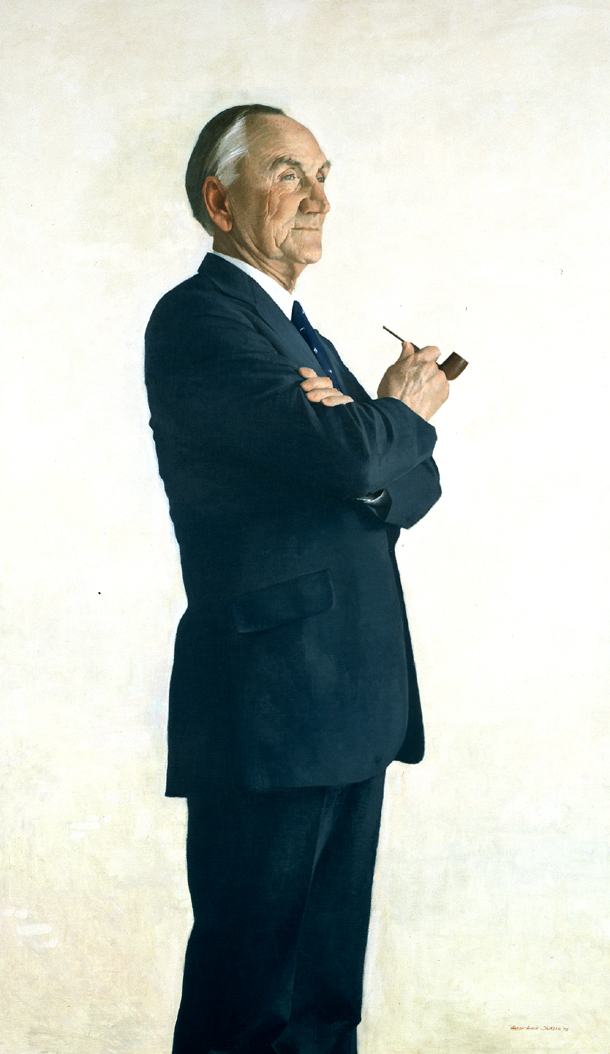
American politician and diplomat (1903–2001)
| Field | Value | ||
|---|---|---|---|
| name | Mike Mansfield | ||
| image | Mike Mansfield 1985 (cropped 3x4).png | ||
| caption | Mansfield in 1985 | ||
| office | 22nd United States Ambassador to Japan | ||
| president | |||
| term_start | June 10, 1977 | ||
| term_end | December 22, 1988 | ||
| predecessor | James Day Hodgson | ||
| successor | Michael Armacost | ||
| office1 | Senate Majority Leader | ||
| 1blankname1 | Whip | ||
| 1namedata1 | |||
| term_start1 | January 3, 1961 | ||
| term_end1 | January 3, 1977 | ||
| predecessor1 | Lyndon B. Johnson | ||
| successor1 | Robert Byrd | ||
| jr/sr2 | United States Senator | ||
| state2 | Montana | ||
| term_start2 | January 3, 1953 | ||
| term_end2 | January 3, 1977 | ||
| predecessor2 | Zales Ecton | ||
| successor2 | John Melcher | ||
| {{Collapsed infobox section begin | Senate positions | titlestyle | border: 1px dashed lightgrey;}} |
| {{Infobox officeholder | embed | yes | |
| office3 | Chair of the Senate Democratic Caucus | ||
| term_start3 | January 3, 1961 | ||
| term_end3 | January 3, 1977 | ||
| predecessor3 | Lyndon Johnson | ||
| successor3 | Robert Byrd | ||
| office4 | Senate Majority Whip | ||
| leader4 | Lyndon Johnson | ||
| term_start4 | January 3, 1957 | ||
| term_end4 | January 3, 1961 | ||
| predecessor4 | Earle Clements | ||
| successor4 | Hubert Humphrey | ||
| state5 | Montana | ||
| district5 | |||
| term_start5 | January 3, 1943 | ||
| term_end5 | January 3, 1953 | ||
| predecessor5 | Jeannette Rankin | ||
| successor5 | Lee Metcalf | ||
| birth_name | Michael Joseph Mansfield | ||
| birth_date | |||
| birth_place | New York City, New York, U.S. | ||
| death_date | |||
| death_place | Washington, D.C., U.S. | ||
| party | Democratic | ||
| restingplace | Arlington National Cemetery | ||
| spouse | |||
| children | 1 | ||
| education | University of Montana (BA, MA) | ||
| University of California, Los Angeles | |||
| signature | Mike Mansfield Signature.svg | ||
| allegiance | United States | ||
| branch | |||
| rank | |||
| serviceyears | |||
| battles | World War I |
| jr/sr2 = United States Senator University of California, Los Angeles Michael Joseph Mansfield (March 16, 1903 – October 5, 2001) was an American Democratic Party politician and diplomat who represented Montana in the United States House of Representatives from 1943 to 1953 and United States Senate from 1953 to 1977. As the leader of the Senate Democratic Caucus from 1961 to 1977, Mansfield shepherded Great Society programs through the Senate; his tenure of exactly sixteen years was the longest of any party leader in Senate history, until the record was broken by Mitch McConnell in 2023.
Born in Brooklyn, New York, Mansfield grew up in Great Falls, Montana. He lied about his age to serve in the United States Navy during World War I. After the war, he became a professor of history and political science at the University of Montana. He won election to the House of Representatives and served on the House Committee on Foreign Affairs during World War II.
In 1952, he defeated incumbent Republican Senator Zales Ecton to take a seat in the Senate. Mansfield served as Senate Majority Whip from 1957 to 1961. Mansfield ascended to Senate Majority Leader after Lyndon B. Johnson resigned from the Senate to become vice president. In the later years of the Vietnam War, he opposed escalation of American involvement and supported President Richard Nixon's plans for Vietnamization.
After retiring from the Senate, Mansfield served as United States Ambassador to Japan from 1977 to 1988. Mansfield is the longest-serving American ambassador to Japan in history. Upon his retirement, he was awarded the nation's highest civilian honor, the Presidential Medal of Freedom. Mansfield also worked as a senior adviser on East Asian affairs to Goldman Sachs.
Early childhood
Michael Joseph (Mike) Mansfield was born on March 16, 1903, in Brooklyn, New York, to Irish immigrant parents, Patrick J. Mansfield and Josephine (née O'Brien) Mansfield. His father worked various jobs, including as a construction worker, hotel porter, and maintenance man, to support the family. In 1910, Josephine died from nephritis.{{cite news |archive-date=January 30, 2013}}
In 1917, at age 14, Mansfield dropped out of school, left home and made his way to a logging camp in Leavenworth, Washington. There, he met members of the Oregon National Guard, who were stationed nearby. They helped him board their troop train as it traveled east to New York, en route to their eventual deployment in Europe. He made it to New York City, where he reunited with his father.
Military service
Wanting to join the war effort during World War I, He went on several overseas convoys on the , but was discharged by the Navy after his real age was discovered.
Mansfield was a Private First Class in the US Marine Corps from 1920 to 1922. He served in the Western Recruiting Division at San Francisco until January 1921, when he was transferred to the Marine Barracks at Puget Sound, Washington. The following month, he was detached to the Guard Company, Marine Barracks, Navy Yard, Mare Island, California. In April, he boarded the USAT Sherman, bound for the Philippines. After a brief stopover at the Marine Barracks at Cavite, he arrived at his duty station on May 5, 1921, the Marine Barracks, Naval Station, Olongapo, Philippine Islands. One year later, Mansfield was assigned to Company A, Marine Battery, Asiatic Fleet. A short tour of duty with the Asiatic Fleet took him along the coast of China before he returned to Olongapo in late May 1922. His service with the Marines established a lifelong interest in Asia.
That August, Mansfield returned to Cavite in preparation for his return to the United States and eventual discharge. On November 9, 1922, Private Mansfield was released from the Marine Corps on the completion of his enlistment. He was awarded the Good Conduct Medal, his character being described as "excellent" during his two years as a Marine.{{cite web|accessdate=February 22, 2025 |url=https://www.usmcu.edu/Research/Marine-Corps-History-Division/People/Whos-Who-in-Marine-Corps-History/Mackie-Ozbourn/The-Honorable-Michael-J-Mansfield/ |title=The Honorable Michael J Mansfield, USMC (deceased)|work=Who's Who in Marine Corps History
Education
Following his return to Montana in 1922, Mansfield worked as a "mucker" and shoveled ore and other waste in the copper mines of Butte for eight years. Having never attended high school, he gained admission to Montana School of Mines (MSM) in Butte by taking their entrance examinations. He attended MSM from 1927 to 1928, studying to become a mining engineer.
In 1928, Mansfield met Maureen Hayes, a local schoolteacher who would become his wife. She encouraged him to pursue further education.{{cite web|accessdate=February 22, 2025
At the University of Montana, Mansfield joined the Alpha Tau Omega fraternity. In 1933, he earned both his high school equivalency and his Bachelor of Arts degree. He continued with graduate studies at UM, while also working part-time in the registrar's office and teaching two courses as a graduate assistant. He earned a Master of Arts degree from UM in 1934 with a thesis titled "American Diplomatic Relations with Korea, 1866–1910."
After completing his graduate studies, Mansfield accepted a position as administrator and professor at UM, teaching courses in Latin American and Far Eastern History,{{cite web|accessdate=February 22, 2025
U.S. Representative
In 1940, Mansfield ran for the Democratic nomination for the House of Representatives in Montana's 1st congressional district but was defeated by Jerry J. O'Connell, a former holder of the seat, in the primary. The general election was won by Republican Jeannette Rankin, who had previously won what was formerly an at-large seat in the House in 1916 and served until her defeat in 1920.
Mansfield served five terms in the House, being re-elected in 1944, 1946, 1948, and 1950. His military service and academic experience landed him a seat on the House Foreign Affairs Committee. He went to China on a special mission for US President Franklin D. Roosevelt in 1944 and served as a delegate to the ninth Inter-American Conference in Colombia in 1948. In 1951, he was appointed by President Harry S. Truman as a delegate to the United Nations' sixth session in Paris. During his House tenure, he also expressed his support for price controls, a higher minimum wage, the Marshall Plan, and aid to Turkey and Greece. He opposed the House Un-American Activities Committee, the Taft–Hartley Act, and the Twenty-second Amendment.
U.S. Senator
In 1952, Mansfield was elected to the United States Senate after he had narrowly defeated the Republican incumbent, Zales Ecton. He served as Senate Majority Whip under Majority Leader Lyndon B. Johnson from 1957 to 1961. In 1961, after Johnson resigned from the Senate to become Vice President, Mansfield was unanimously elected the Democratic floor leader and thus Senate Majority Leader. Serving sixteen years, from 1961 until his retirement in 1977, Mansfield is the longest-serving Majority Leader in the history of the Senate. The Washington Post compared Mansfield's behavior as Majority Leader to Johnson's by saying, "Instead of Johnson's browbeating tactics, Mansfield led by setting an example of humility and accommodation."
Mansfield was critical of US involvement in Laos. On December 28, 1960, he opined that US aid to Laos had produced nothing but "chaos, discontent, armies on the loose, and a large mission of hundreds of officials in Vientiane."
An early supporter of Ngo Dinh Diem, Mansfield altered his opinion on the Vietnam War after a visit to Vietnam in 1962. He reported to John F. Kennedy on December 2, 1962, that US money given to Diem's government was being squandered and that the US should avoid further involvement in Vietnam. He was thus the first American official to comment even mildly negatively on the war's condition.
On September 25, 1963, Mansfield introduced Kennedy during a joint appearance with him at the Yellowstone County Fairgrounds, Kennedy expressing his appreciation afterward and adding, "I know that those of you who live in Montana know something of his character and his high standard of public service, but I am not sure that you are completely aware of what a significant role he has played in the last three years in passing through the United States Senate measure after measure which strengthens this country at home and abroad."
Mansfield delivered a eulogy on November 24, 1963, as President Kennedy's casket lay in state in the Capitol rotunda, saying, "He gave that we might give of ourselves, that we might give to one another until there would be no room, no room at all, for the bigotry, the hatred, prejudice, and the arrogance which converged in that moment of horror to strike him down."
During the Johnson administration, Mansfield, convinced that it was a blunder based on just aims, became a skeptic of US involvement in the Vietnam War. In February 1965, he lobbied against escalating aerial bombardment of North Vietnam in the aftermath of Pleiku, arguing in a letter to the president that Operation Rolling Thunder would lead to a need for "vastly strengthened... American forces."
In 1964, Mansfield, as Senate Majority Leader, filed a procedural motion to have the Civil Rights Act of 1964 discussed by the whole Senate rather than by the Judiciary Committee, which had killed similar legislation seven years earlier. Mansfield voted in favor of the Civil Rights Acts of 1964 and 1968, as well as the 24th Amendment to the U.S. Constitution and the Voting Rights Act of 1965. Mansfield voted in favor of the initial Senate amendment to the Civil Rights Act of 1957 on August 7, 1957, but did not vote on the House amendment to the bill on August 29, 1957. Mansfield did not vote on the Civil Rights Act of 1960 or the confirmation of Thurgood Marshall to the U.S. Supreme Court. Mansfield co-sponsored Mark Hatfield's Neighborhood Government Act, which would have diverted social service provisions to neighborhood levels, and also supported the Comprehensive Child Development Act of 1971 and the Equal Rights Amendment in 1972.
He hailed the new Richard Nixon administration, especially the "Nixon Doctrine" announced at Guam in 1969 that the US would honor all treaty commitments, provide a nuclear umbrella for its allies, and supply weapons and technical assistance to countries where warranted without committing American forces to local conflicts.
In turn, Nixon turned to Mansfield for advice and as his liaison with the Senate on Vietnam. Nixon began a steady withdrawal and replacement of US troops shortly after he took office in January 1969, a policy supported by Mansfield. During his first term, Nixon reduced American forces by 95%, leaving only 24,200 in late 1972; the last ones left in March 1973.
During the economic crisis of 1971, Mansfield was not afraid to reach across the aisle to help the economy:
What we're in is not a Republican recession or a Democratic recession; both parties had much to do with bringing us where we are today. But we're facing a national situation which calls for the best which all of us can produce, because we know the results will be something which we will regret.
Mansfield attended the November 17, 1976, meeting between President-elect Jimmy Carter and Democratic congressional leaders in which Carter sought out support for a proposal to have the president's power to reorganize the government reinstated with potential to be vetoed by Congress.
Mansfield Amendments
Two controversial amendments by Mansfield limiting military funding of research were passed by Congress.
- The Mansfield Amendment of 1969, passed as part of the fiscal year 1970 Military Authorization Act (Public Law 91-121), prohibited military funding of research that lacked a direct or apparent relationship to specific military function. Through subsequent modification the Mansfield amendment moved the Department of Defense toward the support of more short-term applied research in universities. The amendment affected the military, such as research funding by the Office of Naval Research (ONR).
- The Mansfield Amendment of 1973 expressly limited appropriations for defense research through the Advanced Research Projects Agency, which is largely independent of the military, to projects with direct military application. This controversial amendment greatly reduced ARPA funding for many university-based computer projects, thereby forcing many American computer science experts to move to private sector research facilities such as Xerox PARC. However, for that very reason, the amendment is also credited with giving birth to the contemporary computer technology industry.
An earlier Mansfield Amendment, offered in 1971, called for the number of US troops stationed in Europe to be halved. On May 19, 1971, however, the Senate defeated the resolution 61–36.
U.S. ambassador to Japan
Mansfield retired from the Senate in 1976 and was appointed ambassador to Japan in April 1977 by Jimmy Carter, a role that he retained during the Reagan administration until 1988. While serving in Japan, Mansfield was highly respected and was particularly renowned for describing the US-Japan relationship as the "most important bilateral relationship in the world, bar none." Mansfield's successor in Japan, Michael Armacost, noted in his memoirs that for Mansfield, the phrase was a "mantra." While in office, Mansfield also fostered relations between his home state of Montana and Japan. The state capital of Helena is the sister city to Kumamoto, on the island of Kyushu.
Honors
The Maureen and Mike Mansfield Library at the University of Montana, Missoula, is named after him and his wife Maureen, as was his request when informed of the honor. The library also contains the Maureen and Mike Mansfield Center, which is dedicated to Asian studies, international relations, and the preservation and promotion of democracy. The Mike Mansfield Federal Building and United States Courthouse in Butte was renamed in his honor in 2002.
The Montana Democratic Party holds an annual Mansfield-Metcalf Dinner named partially in his honor.
In 1977, Mansfield received the US Senator John Heinz Award for Greatest Public Service by an Elected or Appointed Official, an award given out annually by Jefferson Awards.
In 1977, he was awarded the Laetare Medal by the University of Notre Dame, the oldest and most prestigious award for American Catholics.
On January 19, 1989, Mansfield and Secretary of State George P. Shultz were awarded the Presidential Medal of Freedom by President Ronald Reagan. In his speech, Reagan recognized Mansfield as someone who has "distinguished himself as a dedicated public servant and loyal American." In 1990, he was given both the United States Military Academy, Sylvanus Thayer Award and Japan's Order of the Rising Sun with Paulownia Flowers, Grand Cordon. This is Japan's highest honor for someone who is not a head of state.
In 1999, Missoula's daily newspaper, the Missoulian, chose Mansfield as The Most Influential Montanan of the 20th Century.
Final years and death
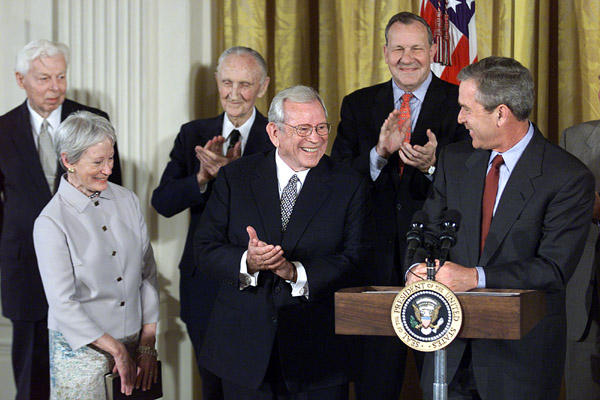
Throughout his later years, Mansfield lived in Washington, D.C., where he remained active, delivering speaking engagements well into his nineties and working from his office at Goldman Sachs until the week before his death.
Mansfield's wife, Maureen, died on September 20, 2000.{{cite web He died from heart failure at Walter Reed Army Medical Center just over one year later, on October 5, 2001, at the age of 98. He was survived by his daughter, Anne Fairclough Mansfield (1939–2013),{{cite web|accessdate=August 16, 2013
The burial plot of Mansfield and his wife can be found in section 2, marker 49-69F of Arlington National Cemetery. His gravemarker reads, "Michael Joseph Mansfield - PVT, US Marine Corps."{{cite web|accessdate=February 22, 2025|url=https://mansfieldfellows.org/establishment/about-mike-mansfield/
Citations
General references
- {{Cite book
- {{Cite book |url-access=registration
- {{Cite book|author=Olson, Gregory A.
- {{Cite book|author=Valeo, Francis R.
- {{Cite book|author=Whalen, Charles and Barbara |url-access=registration
Web
- {{cite web |access-date = April 22, 2006 |url-status = dead |archive-url = https://web.archive.org/web/20070429191832/http://hqinet001.hqmc.usmc.mil/HD/Historical/Whos_Who/Mansfield_MJ.htm |archive-date = April 29, 2007
- {{cite news |access-date=July 19, 2006 |archive-date=October 14, 2004 |archive-url=https://web.archive.org/web/20041014011550/http://www.missoulian.com/specials/mansfield/laidtorest.html |url-status=dead
Interviews
- {{cite interview |interviewer-last = Oberdorfer |interviewer-first = Don |interviewer-link = Don Oberdorfer |access-date = February 23, 2025
References
- Warnock, Eleanor. (April 16, 2012). "End of an Era: Yamamoto, Top 'America Hand' Dies at 76". [[Wall Street Journal]] Japan Real Time.
- (1978). "Charting a New Course: Mike Mansfield and U.S. Asian Policy". Charles E. Tuttle Company.
- Oberdorfer, p. 16
- Oberdorfer, p. 18
- (September 25, 2001). "Oral History Number: 391-022 (pdf)". [[University of Montana]].
- Mansfield interview with Obefdorfer (1998), pp. 6-7
- "Senate Leaders: Mike Mansfield, Quiet Leadership in Troubled Times". [[United States Senate]].
- "MANSFIELD, Michael Joseph (Mike), (1903–2001)". [[Biographical Directory of the United States Congress]].
- "Keesing's Contemporary Archives 1961-1962". Keesing's Publications Limited.
- Glass, Andrew. (December 2, 2013). "Mike Mansfield delivers assessment of Vietnam, Dec. 2, 1962". [[Politico]].
- (September 25, 1963). "382 - Remarks at the Yellowstone County Fairgrounds, Billings, Montana.". American Presidency Project.
- "Eulogies to the Late President Kennedy". John F. Kennedy Fast Facts: Eulogies for President Kennedy.
- Andrew J. Bacevich, ''Washington Rules: America's Path to Permanent War'' (New York: Metropolitan Books, 2010), 103.
- "Recess Reading: An Occasional Feature From The Judiciary Committee: The Civil Rights Act of 1964". United States Senate Committee on the Judiciary.
- "Senate – June 19, 1964". [[United States Government Publishing Office.
- "Senate – March 11, 1968". [[United States Government Publishing Office.
- "Senate – March 27, 1962". [[United States Government Publishing Office.
- "Senate – May 26, 1965". [[United States Government Publishing Office.
- "Senate – August 4, 1965". [[United States Government Publishing Office.
- "Senate – August 7, 1957". [[United States Government Publishing Office.
- "Senate – August 29, 1957". [[United States Government Publishing Office.
- "Senate – April 8, 1960". [[United States Government Publishing Office.
- "Senate – August 30, 1967". [[United States Government Publishing Office.
- "S.2502 - Neighborhood Government Act".
- "TO ADOPT THE CONFERENCE REPORT ON S. 2007.".
- "TO PASS H.J. RES. 208.".
- [http://www.upi.com/Audio/Year_in_Review/Events-of-1971/12295509436546-1/#title "Economic Crisis: 1971 Year in Review, UPI.com"] {{webarchive. link. (2009-05-03)
- Weaver, Warren Jr.. (November 18, 1976). "CARTER ASKS LEADERS OF CONGRESS TO HELP IN A REORGANIZATION". New York Times.
- "Federally funded research, decisions for a decade".
- (1970). "Reverberations from the Mansfield Amendment". Analytical Chemistry.
- "DARPA History".
- (2013). "Education 2.0: The Learning Web Revolution and the Transformation of the School". Routledge.
- (April 7, 1977). "United States Ambassador to Japan - Nomination of Michael J. Mansfield". American Presidency Project.
- "Testimony of Ambassador to Japan-designate John V. Roos before the Senate Foreign Relations Committee, July 23, 2009".
- "Mike Mansfield Quiet Leadership in Troubled Times". United States Senate.
- "The Maureen and Mike Mansfield Library". The University of Montana.
- [https://web.archive.org/web/20120609114010/http://www.gsa.gov/portal/content/155189?pageTypeId=17109&channelPage=/ep/channel/gsaOverview.jsp&channelId=-25241&reason=bldgNameNos&bid=295 General Service Administration page on the Mike Mansfield Federal Building and United States Courthouse].
- [http://www.jeffersonawards.org/pastwinners/national National Winners. public service awards] {{Webarchive. link. (November 24, 2010 . Jefferson Awards.org. Retrieved on August 16, 2013.)
- "Recipients {{!}} The Laetare Medal". University of Notre Dame.
- (January 19, 1989). "Remarks at the Presentation Ceremony for the Presidential Medal of Freedom: January 19, 1989". The American Presidency Project.
- Campi, Alicia. [http://www.mansfieldfdn.org/programs/program_pdfs/us_mongolia.pdf "The Role of Mike Mansfield in Consolidating Mongolia's International Status and in Establishing Diplomatic Relations with the United States,"] {{webarchive. link. (July 27, 2011 The [[Mansfield Foundation]]. May 17, 2007.)
- Doherty, Steve. (1999). "Special for Missoulian Online - The 100 Most Influential Montanans of the Century". [[Missoulian]].
- Rosenbaum, David. (October 6, 2001). "Mike Mansfield, Longtime Leader of Senate Democrats, Dies at 98". [[The New York Times]].
- (October 6, 2001). "A Mansfield century". [[The Billings Gazette]].
This article was imported from Wikipedia and is available under the Creative Commons Attribution-ShareAlike 4.0 License. Content has been adapted to SurfDoc format. Original contributors can be found on the article history page.
Ask Mako anything about Mike Mansfield — get instant answers, deeper analysis, and related topics.
Research with MakoFree with your Surf account
Create a free account to save articles, ask Mako questions, and organize your research.
Sign up freeThis content may have been generated or modified by AI. CloudSurf Software LLC is not responsible for the accuracy, completeness, or reliability of AI-generated content. Always verify important information from primary sources.
Report