From Surf Wiki (app.surf) — the open knowledge base
Midland Main Line
Principal railway line in England
Principal railway line in England
| Field | Value | |
|---|---|---|
| name | Midland Main Line | |
| image | 222015 EMR Meridian DEMU at Cossington 290224.jpg | |
| image_width | 290px | |
| caption | An East Midlands Railway Meridian passing Cossington, in 2024 | |
| image_alt | Engine with passenger carriages approacing on a left turn flanked by a stand of trees taken from an overbridge | |
| type | InterCity, commuter rail, regional rail and heavy rail | |
| system | National Rail | |
| status | Operational | |
| locale | ||
| start | London St Pancras, | |
| end | Sheffield and Nottingham | |
| stations | 37 | |
| open | In stages between 1830s and 1860s | |
| owner | Network Rail | |
| operator | ||
| depot | ||
| stock | ||
| tracks | 2–4 | |
| load_gauge | W6–W8, planned upgrade to W12 | |
| gauge | ||
| electrification | 25 kV 50 Hz AC OHLE | |
| (London St Pancras to Wigston) | ||
| speed | Maximum 125 mph | |
| map | [[File:Midland Main Line.png | 290px]] |
| (Click to expand) | ||
| map_state | uncollapsed |
the railway line in the UK
(London St Pancras to Wigston) (Click to expand)
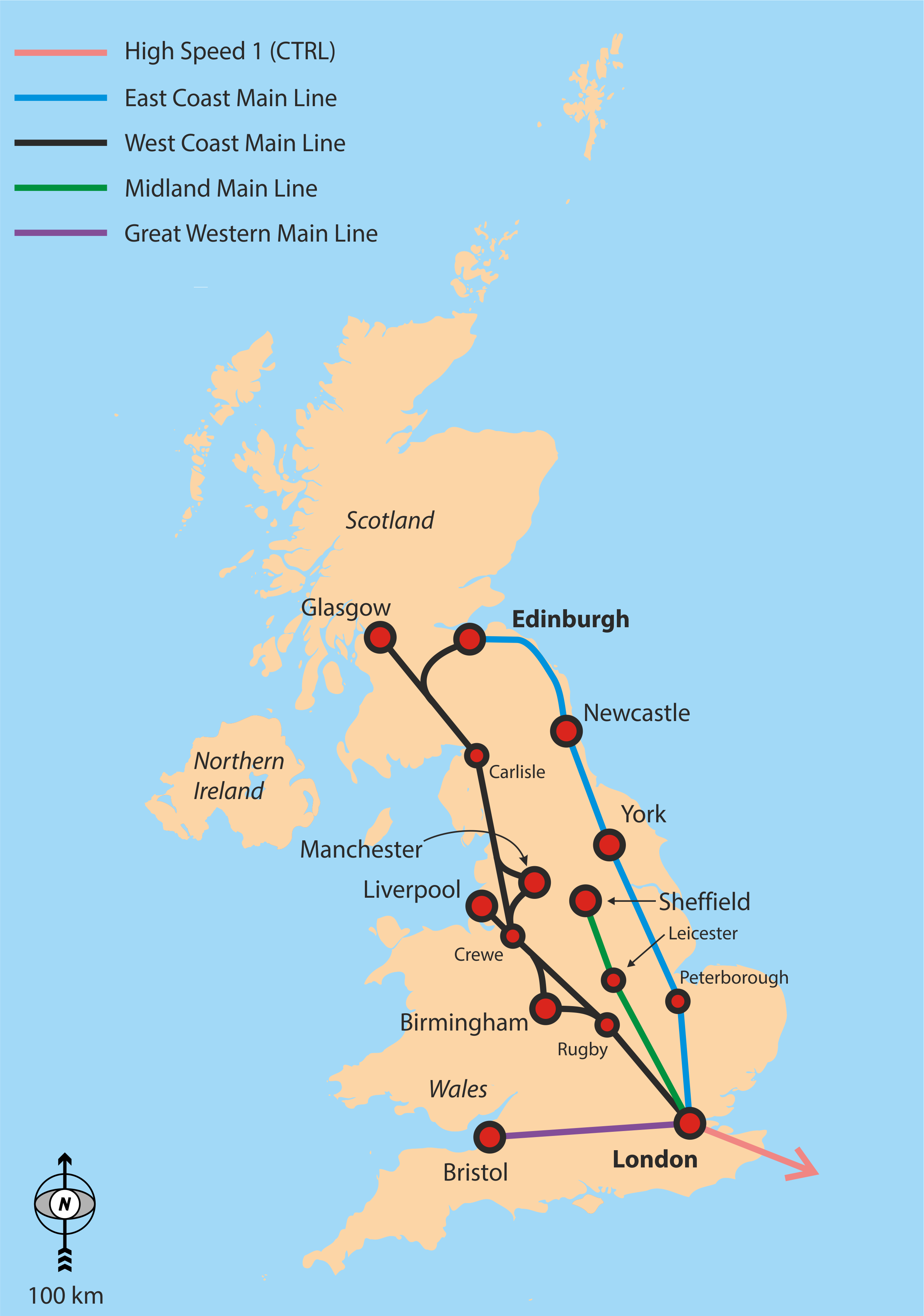
The Midland Main Line (MML) is a major railway line between and , via , and ; a spur of the line terminates at .
Express passenger services on the line are operated by East Midlands Railway. The line is electrified between St Pancras and Wigston, south of Leicester, and the section south of forms a branch of the northern half of the Thameslink network, with a semi-fast service to and other suburban services. A northern part of the route, between Derby and Chesterfield, also forms part of the Cross Country Route operated by CrossCountry. Tracks from Nottingham to , via Barnsley and Sheffield, are shared with Northern Trains. East Midlands Railway also operates regional and local services using parts of the line.
The Midland Main Line is undergoing a major upgrade of new digital signalling and full line electrification from London to Sheffield. High Speed 2 was planned to branch onto the Midland Main Line at .
History
Midland Counties early developments

The Midland Main Line was built in stages between the 1830s and the 1870s. The earliest section was opened by the Midland Counties Railway between Nottingham and Derby on 4 June 1839. On 5 May 1840, the section of the route from Trent Junction to Leicester was opened.
The line at Derby was joined on 1 July 1840 by the North Midland Railway to Leeds Hunslet Lane, via Chesterfield, Rotherham Masborough, Swinton and Normanton.
On 10 May 1844, the North Midland Railway, the Midland Counties Railway and the Birmingham and Derby Junction Railway merged to form the Midland Railway.
Midland Main Line southern extensions
Without its own route to London, the Midland Railway relied upon a junction at , with the London and Birmingham Railway line for access to the capital at . By the 1850s, the junction at Rugby had become severely congested. The Midland Railway employed Thomas Brassey to construct a new route from Leicester to , via , and Bedford. This gave access to London via the Great Northern Railway from Hitchin. The Crimean War resulted in a shortage of labour and finance; only £900,000 () was available for the construction, approximately £15,000 for each mile (. To reduce construction costs, the railway followed natural contours, resulting in many curves and gradients. Seven bridges and one tunnel were required, with 60 ft cuttings at Desborough and Sharnbrook. There are also major summits at Kibworth, Desbrough and at Sharnbrook, where a 1 in 119 gradient from the south over 3 mi takes the line to 340 ft above sea level. This route opened for coal traffic on 15 April 1857, goods on 4 May, and passengers on 8 May. The section between Leicester and Bedford is still part of the Midland Main Line.
While this took some of the pressure off the route through Rugby, the GNR insisted that passengers for London alight at Hitchin, buying tickets in the short time available, to catch a GNR train to finish their journey. James Allport arranged a seven-year deal with the GN to run into Kings Cross for a guaranteed £20,000 a year (). Through services to London were introduced in February 1858.
This line met with similar capacity problems at Hitchin as the former route via Rugby, so a new line was constructed from Bedford to , via which opened on 1 October 1868. The construction of the London extension cost £9 million (equivalent to £ million in ).
As traffic built up, the Midland Railway opened a new deviation just north of on 26 June 1885, to remove the flat crossing of the Rugby and Stamford Railway.
Northernmost sections
Plans by the Midland Railway to build a direct line from Derby to Manchester were thwarted in 1863 by the builders of the Buxton line, who sought to monopolise on the West Coast Main Line.
In 1870, the Midland Railway opened a new route from Chesterfield to Rotherham which went through Sheffield via the Bradway Tunnel.
The mid-1870s saw the Midland line extended northwards through the Yorkshire Dales and Eden Valley, on what is now called the Settle–Carlisle Railway.
Before the line closures of the Beeching era, the lines to and via presented an alternative (and competing) main line from London to Manchester during most years, carrying named expresses such as The Palatine and the Blue Pullman diesel-powered Manchester – London service (the Midland Pullman). Express trains to Leeds and Scotland such as the Thames–Clyde Express mainly used the Midland's corollary Erewash Valley line, returned to it and then used the Settle–Carlisle line. Expresses to , such as The Waverley travelled through and Nottingham.
Under British Railways and privatisation
Most Leicester-Nottingham local passenger trains were taken over by diesel multiple units from 14 April 1958, taking about 51 minutes between the two cities. When the Great Central Main Line closed in 1966, the Midland Main Line became the only direct main line rail link between London, the East Midlands and parts of South Yorkshire.
The Beeching cuts and electrification of the West Coast Main Line brought an end to the marginally longer London–Manchester service, via the Hope Valley Line and Sheffield.
In 1977, the Parliamentary Select Committee on Nationalised Industries recommended considering electrification of more of Britain's rail network; by 1979, BR presented a range of options that included electrifying the Midland Main Line from London to Yorkshire by 2000. By 1983, the line had been electrified from to Bedford, but proposals to continue electrification to Nottingham and Sheffield were not implemented.

The introduction of the High Speed Train in May 1983, following the Leicester area resignalling, brought about an increase of the ruling line speed on the fast lines from 90 mph to 110 mph.
Between 2001 and 2003, the line between Derby and Sheffield was upgraded from 100 mph to 110 mph, as part of Operation Princess, the Network Rail-funded cross-country route upgrade.
In January 2009, a new station, , was opened between and Trent Junction, to act as a park-and-ride station for suburban travellers from East Midlands cities and to serve nearby East Midlands Airport.
Since then, 125 mph running has been introduced on extended stretches. Improved signalling, an increased number of tracks and the revival of proposals to extend electrification from Bedford to Sheffield have contributed to this. Much of this £70 million upgrade, including some line speed increases, came on-line on 9 December 2013 (see below). As of April 2025, the line has been electrified from London St Pancras to Wigston South Junction.
Network Rail route strategy for freight (2007)
Network Rail published a Route Utilisation Strategy for freight in 2007; over the coming years, a cross-country freight route will be developed enhancing the Birmingham to Peterborough Line, increasing capacity through Leicester, and remodelling and Wigston junctions.
Network Rail 2010 route plan

Traffic levels on the Midland Main Line are rising faster than the national average, with continued increases predicted. In 2006, the Strategic Rail Authority produced a Route Utilisation Strategy for the Midland Main Line to propose ways of meeting this demand; Network Rail started a new study in February 2008 and this was published in February 2010.
After electrification, three North Northamptonshire towns, Wellingborough, Kettering and Corby, now have an EMR Connect service into London St Pancras. North Northamptonshire is a major growth area, with over 7,400 new homes planned to be built in Wellingborough and 5,500 new homes planned for Kettering.
Highlights include:
- Work related to line speed increases, removing foot crossings and replacing with footbridges
- Capacity enhancements for freight
- Resignalling of the entire route, completed in 2016, when all signalling will be controlled by the East Midlands signalling centre in Derby
- Rebuilding Bedford and Leicester stations
- Accessibility enhancements at , , Loughborough, , Luton and by 2015
- Upgraded approach signalling (flashing yellow aspects) added at key junctions – Radlett, Harpenden and Leagrave allowing trains to traverse them at higher speeds
- Lengthening of platforms at Wellingborough, Kettering, Market Harborough, Loughborough, and stations as well as work related to the Thameslink Programme (see below)
- Realignment of the track and construction of new platforms to increase the permissible speed through Market Harborough station from 60 mph to 85 mph saving 30–60 seconds
- Electrification (see below)
- Redoubling the Kettering to line between Kettering North Junction and Corby; resignalling to Syston Junction via Oakham, allowing a half hourly London to Corby passenger service (from an infrastructure perspective) from December 2017; and creating additional paths for rail freight.
Thameslink Programme

The Thameslink Programme has lengthened the platforms at most stations south of Bedford to 12-car capability. St Pancras, , and were already long enough, but bridges at mean it cannot expand beyond the current 8-car platform length. has a new footbridge and a new station building. In September 2014, the current Thameslink Great Northern franchise was awarded and trains on this route are currently operated by Govia Thameslink Railway. In 2018, the Thameslink network expanded when some Southern services merged into it.
Station improvements
In 2013/14, Nottingham station was refurbished and the platforms restructured.
As part of the Stanton Cross development, Wellingborough station is to be expanded.
station, between Nottingham and , was opened on 2 April 2017.
Two new stations were planned:
- between Cricklewood and Hendon, as part of the Brent Cross Cricklewood development in North London. It opened in December 2023.
- , between and Bedford, as part of the new town. Construction has been pushed back repeatedly; it was first expected to be built by 2015, then for 2019, the government confirmed in April 2025 that main construction would begin in concert with the nearby Universal United Kingdom Theme Park in 2026, although groundwork had already begun by late 2024.
Some new stations have been proposed:
- Clay Cross between Chesterfield and Ambergate/Alfreton.
- Irchester () between Wellingborough and Bedford.
- Ampthill between Bedford and Flitwick.
Extension of electrification
Main article: Proposed railway electrification in Great Britain
Main article: Midland Main Line railway upgrade

Unlike the West and East Coast Main Lines, the Midland Main Line has not been electrified along its full length. The line was electrified as far as Bedford in the early 1980s, but services have relied on diesel traction beyond that.
In 2011, work commenced to extend the electrification, including to both Corby and Nottingham. Increasing costs initially saw this terminated at Kettering in 2017 but, in 2021, work began on extending electrification to Market Harborough and onwards to Wigston with plans to extend further to Sheffield. The section was energised on 28 July 2024 and completed testing in April 2025.
In May 2022, a briefing to contractors was released ahead of an invitation to tender for Midland Main Line Electrification project work to extend electrification to Nottingham and Sheffield. This scheme is expected to cost £1.3 billion.
In July 2025, the Department for Transport put plans for further electrification on hold indefinitely.
2021 Integrated Rail Plan
Main article: Integrated Rail Plan for the North and Midlands
In November 2021, the Government announced its Integrated Rail Plan for the North and Midlands, which made a number of proposals for the Midland Main Line. These included a commitment to complete the stalled electrification work, an upgrade to digital signalling and a connection to High Speed 2. The latter would see a junction built south of East Midlands Parkway, rather than the previous plan of an East Midlands Hub further north on the Toton sidings. This would allow HS2 services to connect to both Derby and Nottingham city centres directly, using the MML for access, which was a criticism of the previous HS2 eastern leg proposal.
Route definition
The term Midland Main Line has been used from the late 1840s to describe any route of the Midland Railway on which express trains were operated.
It is first recorded in print in Bradshaw's Guide of 1848. In 1849, it begins to be mentioned regularly in newspapers such as the Derby Mercury.
In 1867, the Birmingham Journal uses the term to describe the new railway running into St Pancras station.{{cite news |author= |title=The New Works of the Midland Railway Company |url=http://www.britishnewspaperarchive.co.uk/viewer/bl/0000224/18671221/016/0003
In 1868, the term was used to describe the Midland Railway main route from north to south through Sheffield and also on routes to Manchester, Leeds and Carlisle.
Under British Rail, the term was used to define the route between St Pancras and Sheffield but, since then, Network Rail has restricted it in its description of Route 19 to the lines between St Pancras and Chesterfield.
Accidents
- 26 September 1860: Bull bridge accident; bridge collapse
- 2 September 1861: Kentish Town rail accident; collision
- 2 September 1898: Wellingborough rail accident; derailment due to post trolley on track
- 24 December 1910: Hawes Junction rail crash; signalman forgot about train
- 2 September 1913: Ais Gill rail accident; collision
- 3 December 1923: Nunnery Colliery
- 13 December 1926: Orgreave Paddy Mail accident
- 1 February 2008: Barrow upon Soar rail accident.
Train operating companies

.jpg)
East Midlands Railway
The principal operator is East Midlands Railway (EMR), which operates four InterCity trains every hour from London St Pancras, with two trains per hour to both Nottingham and Sheffield. EMR uses Meridian trains in various carriage formations for its InterCity services.
EMR also operates a twice-hourly commuter service from London St Pancras to Corby, which is branded as EMR Connect, using Class 360 Desiro electric multiple units.
Govia Thameslink Railway
Govia Thameslink Railway provides frequent, 24-hour services south of Bedford, as part of its Thameslink route to , , Brighton and Sutton, using 8- and 12-car electric multiple units.
CrossCountry
CrossCountry runs an hourly service between Derby and Sheffield, on its route between the South West and North East of England; there are also twice-hourly services between Nottingham and Derby, continuing to and .
Northern Trains
Northern Trains runs an hourly service from Leeds to Nottingham, via and .
TransPennine Express
TransPennine Express also operates in the Sheffield area, with its to service.
Route description
The cities, towns and villages served by the MML are listed below; stations in bold have a high usage. This table includes the historical extensions to Manchester (where it linked to the West Coast Main Line) and Carlisle (via Leeds, where it meets with the East Coast Main Line).
Network Rail groups all lines in the East Midlands and the route north as far as Chesterfield and south to London as Route 19. The actual line extends beyond this into routes 10 and 11.
London to Nottingham and Sheffield (Network Rail Route 19)
| Station | Village/town/city and county | Ordnance Survey | ||||||
|---|---|---|---|---|---|---|---|---|
| grid reference | Year opened | Step free access | No. of platforms | Usage 2015/16 | ||||
| (millions) | Branches and loops | |||||||
| London St Pancras | St Pancras, London | 1868 | [[File:Wheelchair symbol.svg | 15px]] | 15 | 31.724 | High Speed 1 diverges north of St Pancras | |
| Kentish Town | Kentish Town, London | 1868 | 4 | 2.844 | Branch from to Gospel Oak to Barking line north of station | |||
| West Hampstead, London | 1871 | [[File:Wheelchair symbol.svg | 15px]] | 4 | 3.710 | |||
| Cricklewood, London | 1868 | 4 | 1.057 | Dudding Hill Line diverges north of Cricklewood | ||||
| Brent Cross, London | 2023 | [[File:Wheelchair symbol.svg | 15px]] | 4 | Dudding Hill Line diverges south of Brent Cross | |||
| Hendon, London | 1868 | 4 | 1.178 | |||||
| Mill Hill, London | 1868 | 4 | 1.949 | |||||
| Borehamwood, Hertfordshire | 1868 | 4 | 3.382 | |||||
| Radlett, Hertfordshire | 1868 | 4 | 1.188 | |||||
| **** | St Albans, Hertfordshire | 1868 | [[File:Wheelchair symbol.svg | 15px]] | 4 | 7.451 | ||
| Harpenden, Hertfordshire | 1868 | 4 | 3.337 | |||||
| Luton, Bedfordshire | 1999 | [[File:Wheelchair symbol.svg | 15px]] | 4 | 3.188 | |||
| **** | Luton, Bedfordshire | 1868 | 5 | 3.626 | ||||
| Leagrave, Luton, Bedfordshire | 1868 | 4 | 1.915 | |||||
| Harlington, Bedfordshire | 1868 | 4 | 0.336 | |||||
| Flitwick, Bedfordshire | 1870 | 4 | 1.480 | |||||
| *** Midland* | Bedford, Bedfordshire | 1859 | [[File:Wheelchair symbol.svg | 15px]] | 5 | 3.830 | Marston Vale line diverges south of Bedford | |
| Wellingborough, Northamptonshire | 1857 | [[File:Wheelchair symbol.svg | 15px]] | 4 | 0.969 | |||
| Kettering, Northamptonshire | 1857 | [[File:Wheelchair symbol.svg | 15px]] | 4 | 1.042 | Oakham–Kettering line diverges north of Kettering at Glendon Jun | ||
| via Corby & diversion route | ||||||||
| Corby, Northamptonshire | 2009 | [[File:Wheelchair symbol.svg | 15px]] | 1 | 0.278 | Oakham–Kettering line | ||
| Oakham, Rutland | 1848 | [[File:Wheelchair symbol.svg | 15px]] | 2 | 0.213 | Birmingham–Peterborough line | ||
| Melton Mowbray, Leicestershire | 1848 | 2 | 0.266 | |||||
| Main Line via Market Harborough | ||||||||
| Market Harborough, Leicestershire | 1850 | [[File:Wheelchair symbol.svg | 15px]] | 2 | 0.870 | |||
| **** | Leicester, Leicestershire | 1840 | [[File:Wheelchair symbol.svg | 15px]] | 4 | 5.247 | Birmingham to Peterborough Line diverges south of Leicester at Wigston Junction | |
| Syston, Leicestershire | 1994 | [[File:Wheelchair symbol.svg | 15px]] | 1 | 0.210 | Birmingham to Peterborough Line diverges north of Syston | ||
| Sileby, Leicestershire | 1994 | 2 | 0.123 | |||||
| Barrow-upon-Soar, Leicestershire | 1994 | 2 | 0.098 | |||||
| Loughborough, Leicestershire | 1872 | [[File:Wheelchair symbol.svg | 15px]] | 3 | 1.298 | |||
| Ratcliffe-on-Soar, Nottinghamshire (for East Midlands Airport) | 2007 | [[File:Wheelchair symbol.svg | 15px]] | 4 | 0.306 | Trent Junction to Clay Cross Junction via Derby (the original line), the Nottingham branch, and the Erewash Valley Line each diverge north of East Midlands Parkway | ||
| Via Derby | ||||||||
| Long Eaton, Derbyshire | 1888 | [[File:Wheelchair symbol.svg | 15px]] | 2 | 0.660 | Cord south of Long Eaton to the Nottingham branch | ||
| Spondon, Derby, Derbyshire | 1839 | [[File:Wheelchair symbol.svg | 15px]] | 2 | 0.026 | |||
| Derby | Derby, Derbyshire | 1839 | [[File:Wheelchair symbol.svg | 15px]] | 6 | 3.767 | Cross Country Route and Crewe to Derby Line diverges south of Derby | |
| Duffield, Derbyshire | 1841 | 3 | 0.061 | |||||
| Belper, Derbyshire | 1840 | [[File:Wheelchair symbol.svg | 15px]] | 2 | 0.225 | |||
| Ambergate, Derbyshire | 1840 | [[File:Wheelchair symbol.svg | 15px]] | 1 | 0.042 | Derwent Valley line diverges at Ambergate Junction | ||
| Via Nottingham | ||||||||
| Attenborough, Nottinghamshire | 1856 | [[File:Wheelchair symbol.svg | 15px]] | 2 | 0.112 | |||
| Beeston, Nottinghamshire | 1839 | [[File:Wheelchair symbol.svg | 15px]] | 2 | 0.574 | |||
| Midland | Nottingham, Nottinghamshire | 1904 | [[File:Wheelchair symbol.svg | 15px]] | 7 | 7.200 | Northbound trains reverse towards Langley Mill. Others pass through the station onto the Robin Hood Line, Grantham line or Lincoln line. | |
| Via Erewash Valley (bypassing or calling at Nottingham) | ||||||||
| Ilkeston, Derbyshire | 2017 | [[File:Wheelchair symbol.svg | 15px]] | 2 | ||||
| Langley Mill, Derbyshire | 1847 | 2 | 0.116 | Erewash Valley and Trent Nottingham lines rejoin south of Langley Mill. | ||||
| Alfreton, Derbyshire | 1862 | [[File:Wheelchair symbol.svg | 15px]] | 2 | 0.283 | |||
| Clay Cross Junction to Leeds | ||||||||
| Chesterfield, Derbyshire | 1840 | [[File:Wheelchair symbol.svg | 15px]] | 3 | 1.731 | Trent Junction to Clay Cross via Derby and Erewash Valley lines rejoin together south of Chesterfield. | ||
| Dronfield, Derbyshire | 1981 | [[File:Wheelchair symbol.svg | 15px]] | 2 | 0.200 | Hope Valley Line diverges north of Dronfield | ||
| Sheffield | Sheffield, South Yorkshire | 1870 | [[File:Wheelchair symbol.svg | 15px]] | 9 | 9.213 | Hope Valley Line diverges south of Sheffield | |
| Sheffield to Lincoln Line diverges north of Sheffield | ||||||||
| Meadowhall Interchange | Sheffield, South Yorkshire | 1990 | [[File:Wheelchair symbol.svg | 15px]] | 4 NR | 2.138 | Hallam and Penistone Lines diverges at Meadowhall | |
| Via Doncaster | ||||||||
| **** | Doncaster, South Yorkshire | 1838 | [[File:Wheelchair symbol.svg | 15px]] | 8 | 3.752 | Connects to the East Coast Main Line south of Doncaster | |
| Bypassing Doncaster | ||||||||
| Wakefield, West Yorkshire | 1867 | [[File:Wheelchair symbol.svg | 15px]] | 2 | 2.519 | Connects with the East Coast Main Line south of Wakefield Westgate | ||
| Leeds | Leeds, West Yorkshire | 1938 | [[File:Wheelchair symbol.svg | 15px]] | 17 | 29.724 | Leeds City lines |
Tunnels, viaducts and major bridges
Major civil engineering structures on the Midland Main Line include the following.
| Railway Structure | Length | Distance from London St Pancras International | ELR | Location | |||
|---|---|---|---|---|---|---|---|
| East Bank Tunnel | 80 yards | 158 miles 05 chains – 158 miles 01 chains | TJC1 | South of Sheffield station | |||
| Bradway Tunnel | 1 mile | 153 miles 61 chains – 152 miles 49 chains | North of Dronfield station | ||||
| Unstone Viaduct (River Drone) | 6 chain | 149 miles 75 chains – 149 miles 69 chains | Between Dronfield and Chesterfield stations | ||||
| Former Broomhouse Tunnel | |||||||
| Whitting Moor Road Viaduct | 148 miles 45 chains | ||||||
| Alfreton Tunnel | 840 yards | 135 miles 50 chains – 135 miles 11 chains (via Toton) | TCC | Erewash Valley Line between Alfreton and Langley Mill stations | |||
| Cromford Canal | 132 miles 67 chains (via Toton) | ||||||
| Erewash Canal | 128 miles 09 chains (via Toton) | Erewash Valley Line south of Langley Mill station | |||||
| Clay Cross Tunnel | 1 mile | 147 miles 22 chains – 146 miles 21 chains | SPC8 | Between Chesterfield and Belper stations | |||
| River Amber | 140 miles 40 chains | ||||||
| Wingfield Tunnel | 261 yards | 139 miles 59 chains – 139 miles 47 chains | |||||
| Toadmoor Tunnel | 129 yards | 138 miles 12 chains – 138 miles 07 chains | |||||
| River Derwent / Broadholme Viaducts | 6 chain, | ||||||
| 7 chain | 136 miles 47 chains – 136 miles 41 chains, 136 miles 18 chains – 136 miles 11 chains | ||||||
| Swainsley Viaduct (River Derwent) | 4 chain | 134 miles 61 chains – 134 miles 57 chains | Between Belper and Duffield stations | ||||
| Milford Tunnel | 855 yards | 134 miles 25 chains – 133 miles 67 chains | |||||
| Burley Viaduct (River Derwent) | 4 chain | 131 miles 58 chains – 131 miles 54 chains | Between Duffield and Derby stations | ||||
| Nottingham Road Viaduct | 3 chain | 128 miles 43 chains – 128 miles 40 chains | |||||
| River Derwent Viaduct | 3 chain | 128 miles 06 chains – 128 miles 03 chains | |||||
| Trent Viaduct | 11 chain | 119 miles 08 chains – 118 miles 77 chains | SPC6 | Between Long Eaton and East Midlands Parkway station | |||
| Redhill Tunnels | 154 yards, | ||||||
| 170 yards | 118 miles 74 chains – 118 miles 66 chains | ||||||
| River Soar | 112 miles 74 chains | SPC5 | Between East Midlands Parkway and Loughborough stations | ||||
| Flood openings | 2 chain | 112 miles 60 chains – 112 miles 58 chains | |||||
| Hermitage Brook Flood Openings | 3 chain | 111 miles 41 chains – 111 miles 38 chains | South of Loughborough station | ||||
| River Soar | 109 miles 55 chains | North of Barrow-upon-Soar station | |||||
| River Wreak | 104 miles 60 chains | South of Sileby station | |||||
| Knighton Tunnel | 104 yards | 98 miles 07 chains – 98 miles 02 chains | SPC4 | South of Leicester station | |||
| Knighton Viaduct | 4 chain | 97 miles 34 chains – 97 miles 30 chains | |||||
| Wellingborough Viaducts (River Ise) | 6 chain | 64 miles 57 chains – 64 miles 51 chains | SPC2 | South of Wellingborough station | |||
| Irchester Viaducts (River Nene) | 7 chain | 63 miles 67 chains – 63 miles 60 chains | |||||
| Sharnbrook Tunnel (Slow line only) | 1 mile | 60 miles 04 chains – 59 miles 00 chains | WYM | Between Wellingborough and Bedford stations | |||
| Sharnbrook Viaducts | 9 chain | 56 miles 25 chains – 56 miles 16 chains | SPC2 | ||||
| Radwell Viaducts | 143 yards | 55 miles 03 chains – 54 miles 76½ chains | |||||
| Milton Ernest Viaducts | 8 chain | 54 miles 25 chains – 54 miles 17 chains | |||||
| Oakley Viaducts | 6 chain | 53 miles 35 chains – 53 miles 29 chains | |||||
| Clapham Viaducts (River Ouse) | 6 chain | 52 miles 04 chains – 51 miles 78 chains | |||||
| Bromham Viaducts (River Ouse) | 7 chain | 50 miles 79 chains – 50 miles 72 chains | |||||
| River Great Ouse Viaduct | 5 chain | 49 miles 38 chains – 49 miles 33 chains | SPC1 | Between Bedford and Flitwick stations | |||
| Ampthill Tunnels | 715 yards | 42 miles 52 chains – 42 miles 19 chains | |||||
| Hyde/Chiltern Green Viaduct (River Lea) | 6 chain | 26 miles 72 chains – 26 miles 66 chains | South of Luton Airport Parkway station | ||||
| Elstree Tunnels | 1058 yards | 12 miles 06 chains – 11 miles 38 chains | South of Elstree & Borehamwood station | ||||
| Stoneyfield/Deans Brook Viaduct | 4 chain | 10 miles 36 chains – 10 miles 32 chains | Between Elstree & Borehamwood and Hendon stations | ||||
| Welsh Harp/Brent Viaduct (River Brent) | 10 chain | 6 miles 31 chains – 6 miles 21 chains | South of Hendon station | ||||
| Belsize Slow Tunnel | 1 mile | 3 miles 34 chains – 2 miles 29 chains | Between West Hampstead Thameslink and Kentish Town stations | ||||
| Belsize Fast Tunnel | 1 mile | 3 miles 32 chains – 2 miles 33 chains | |||||
| title = London North Eastern Route Sectional Appendix; LOR LN3201 Seq001 to 030 | url = http://archive.nr.co.uk/browse%20documents/sectional%20appendix/sectional%20appendix%20full%20pdf%20copies/london%20north%20eastern%20sectional%20appendix.pdf | publisher = Network Rail | access-date = 13 January 2018}} | 110 yards | 2 miles 22 chains – 2 miles 17 chains | ||
| Hampstead Tunnel | 44 yards | 1 mile 76 chains – 1 mile 74 chains | |||||
| Camden Road Tunnels | 308 yards | 1 miles 13 chains – 0 miles 79 chains | South of Kentish Town station | ||||
| Canal Tunnels | 820 yards | 0 miles 0 chains – 0 miles 0 chains | Connecting to ECML at Belle Island Junction |
Line-side monitoring equipment
Line-side train monitoring equipment includes hot axle box detectors (HABD) and wheel impact load detectors (WILD) ‘Wheelchex’, these are located as follows.
| Name / Type | Line | Location (distance from St. Pancras) | Engineers Line Reference |
|---|---|---|---|
| Dore HABD (out of use?) | Down Main | 154 miles 72 chains | TJC1 |
| Belper HABD (to replace Duffield HABD) | Up Main | 134 miles 70 chains | SPC8 |
| Duffield Junction HABD (removal planned) | Up Main | 132 miles 63 chains | |
| Langley Mill HABD | Up Erewash Fast, Up & Down Erewash Slow | 129 miles 27 chains | TCC |
| Loughborough HABD | Up Fast, Up Slow | 111 miles 05 chains | SPC5 |
| Barrow-upon-Soar HABD | Down Fast, Down Slow | 108 miles 72 chains | |
| Thurmaston Wheelchex | Down Fast, Up Fast, Up & Down Slow | 101 miles 78 chains | |
| East Langton HABD | Down Main, Up Main | 86 miles 20 chains | SPC3 |
| Harrowden Junction HABD | Down Fast, Up & Down Slow | 67 miles 36 chains | |
| Oakley HABD | Up Fast, Up Slow | 53 miles 60 chains | SPC2 |
| Chiltern Green HABD | Down Fast, Down Slow | 27 miles 69 chains | SPC1 |
| Napsbury HABD | Up Fast, Up Slow | 18 miles 00 chains |
Ambergate Junction to Manchester

For marketing and franchising, this is no longer considered part of the Midland Main Line: see Manchester, Buxton, Matlock and Midlands Junction Railway
The line was once the Midland Railway's route from London St Pancras to Manchester, branching at Ambergate Junction along the Manchester, Buxton, Matlock and Midlands Junction Railway, now known as the Derwent Valley line. In days gone by, it featured named expresses such as The Palatine. Much later in the twentieth century, it carried the Midland Pullman.
| Town/City | Station | Ordnance Survey |
|---|---|---|
| grid reference | ||
| Ambergate | ** | |
| Whatstandwell | ** | |
| Cromford | ** | |
| Matlock Bath | ** | |
| Matlock | ** | |
| Closed section stations | ||
| Darley Dale | Darley Dale | |
| Rowsley | Rowsley | |
| Bakewell | ||
| Hassop | ||
| Great Longstone | ||
| Monsal Dale | ||
| Millers Dale | ||
| Blackwell Mill | ||
| Buxton | Buxton | |
| Peak Forest | ||
| Chapel-en-le-Frith | ||
| Now part of the Hope Valley Line or other lines | ||
| Chinley | ||
| Bugsworth | (Now Closed) | |
| New Mills | ||
| Strines | ||
| Marple | ||
| Romiley | ||
| Bredbury | ||
| Brinnington | ||
| Reddish | ||
| Gorton | ||
| Belle Vue/Gorton | ||
| Stockport | Stockport Tiviot Dale | |
| Manchester | (Now Closed) |
This line was closed in the 1960s between and , severing an important link between Manchester and the East Midlands] which has never been satisfactorily replaced by any mode of transport. A section of the route remains in the hands of the Peak Rail preservation group, operating between Matlock and to the north.
Leeds to Carlisle
For marketing and franchising, this is no longer considered part of the Midland Main Line: see Settle–Carlisle Railway.


World War I prevented the Midland Railway from finishing its direct route through the West Riding to join the Settle and Carlisle line (which would have cut six miles from the journey and avoided the need for reversal at Leeds).
The first part of the Midland's West Riding extension from the main line at Royston to Dewsbury was opened before the war; however, the second part of the extension was not completed. This involved a viaduct at Dewsbury over the River Calder, a tunnel under Dewsbury Moor and a new approach railway into Bradford from the south at a lower level than the existing railway (a good part of which was to be in tunnel) leading into or .
The 500 yd gap between the stations at Bradford still exists. Closing it today would also need to take into account the different levels between the two Bradford stations, a task made easier in the days of electric rather than steam traction, allowing for steeper gradients than possible at the time of the Midland's proposed extension.
Two impressive viaducts remain on the completed part of the line between Royston Junction and , as a testament to the Midland's ambition to complete a third direct Anglo–Scottish route. The line served two goods stations and provided a route for occasional express passenger trains before its eventual closure in 1968.
The failure to complete this section ended the Midland's hopes of being a serious competitor on routes to Scotland and finally put beyond all doubt that Leeds, not Bradford, would be the West Riding's principal city. Midland trains to Scotland therefore continued to call at Leeds before travelling along the Aire Valley to the Settle and Carlisle line. From , they then travelled onwards via either the Glasgow and South Western or Waverley Route. In the past, the line had named expresses, such as the Thames–Clyde Express and The Waverley.
The route takes the following route:
- **** along the Airedale line
- Apperley Junction for the Wharfedale line
- ****: with the triangular junction for the branch line to ****
-
- for the Worth Valley Branch junction to .
-
Settle Junction for the line to Morecambe
-
- for the junction for Ingleton and an end-on junction via Sedbergh to Low Gill on the London and North Western Railway (LNWR) West Coast Main Line
-
At this point, the line divided at a triangular junction for the two lines:
- , including a station for Middleton Road Heysham
- At Hawes, on the branch to the east of the main line, there was an end-on junction with the North Eastern Railway (NER) line across the Pennines to
Former stations
As with most railway lines in Britain, the route used to serve far more stations than it currently does. Places that the current main line used to serve include:
London to Leicester:
- Camden Road
- Welsh Harp
- Napsbury
- Chiltern Green
- Ampthill
- Oakley
- Sharnbrook
- Glendon and Rushton
- Desborough
- East Langton
- Kibworth
- Great Glen
- Wigston Magna.
Leicester to Trent Junction:
- Leicester Humberstone Road
- Cossington Gate
- Hathern
- Kegworth
- Trent.
Derwent Valley:
- Breaston (later Sawley – see Long Eaton)
- Draycott
- Borrowash
- Derby Nottingham Road
- Wingfield
- Stretton
- Clay Cross.
Erewash Valley:
- Long Eaton (Original Midland Counties Railway station, not the present one)
- Stapleford and Sandiacre
- Stanton Gate
- Trowell
- Ilkeston Junction and Cossall – reopened as Ilkeston
- Shipley Gate
- Codnor Park and Ironville
- Pye Bridge
- Westhouses and Blackwell
- Doe Hill.
Chesterfield to Leeds:
- Staveley
- Eckington and Renishaw
- Killamarsh West
- Beighton
- Woodhouse Mill
- Treeton
- Sheepbridge
- Unstone
- Beauchief
- Millhouses
- Heeley
- Attercliffe Road
- Brightside
- Holmes
- Rotherham Masborough
- Parkgate and Rawmarsh
- Kilnhurst
- Swinton West (reopened Swinton).
The following, on the original North Midland Railway line:
- Wath North
- Darfield
- Cudworth
- Royston and Notton
- Oakenshaw (originally for Wakefield)
- Methley North.
Gallery
File:midland-main-line-st-albans.jpg|Looking south along the Midland Main Line at File:Ricture 053.jpg|The Erewash Valley Line, part of the Midland Main Line, seen here at Stapleford File:British Rail Class 43 at Chesterfield.jpg|A High Speed Train near Chesterfield File:Overview of Leeds City railway station 04.jpg|Leeds station, a former key reversal point on the Midland Main Line on the route north
Notes
References
References
- "East Midlands RUS Loading Gauge". Network Rail.
- "East Midlands Route Study, 2016". Network Rail.
- (July 2022). "Midland Main Line Upgrade". Network Rail.
- (22 March 2022). "Integrated Rail Plan for the North and Midlands". Department for Transport.
- (7 June 1839). "The Railway between Nottingham and Derby". Stamford Mercury.
- (9 May 1840). "Midland Counties Railway". Leicester Chronicle.
- (1998). "A Midland Railway chronology>Incorporation and expansion". The Midland Railway Society.
- Leleux, Robin. "A Regional History of the Railways of Great Britain. Volume 9". David & Charles, Newton Abbot.
- (9 May 1857). "Opening of the Leicester and Hitchin Line". Bedfordshire Mercury.
- Davies, R.; Grant, M.D. (1984). Forgotten Railways: Chilterns and Cotswolds. Newton Abbot, Devon: David St John Thomas. {{ISBN. 0-946537-07-0, p. 110–111.
- (1998). "A Midland Railway chronology>London extension". The Midland Railway Society.
- Barnes, E.G.. (1969). "The Rise of the Midland Railway 1844–1874". Augustus M. Kelley, New York.
- Radford, B., (1983) ''Midland Line Memories: a Pictorial History of the Midland Railway Main Line Between London (St Pancras) & Derby'' London: Bloomsbury Books
- {{cite magazine. "". (June 1958)
- (Winter 1979). "Railway Electrification". [[British Railways Board]] (Central Publicity Unit).
- (14 January 2009). "East Midlands Parkway – Our greenest station to open on 26 January". East Midlands Trains}}{{dead link.
- "Midland Main Line celebrates at 125mph". Rail News.
- "Electrification project's major milestone delivered on time and under budget".
- "Midland Main Line Upgrade".
- "Route Utilisation Strategy > Freight". Network Rail.
- "Midland Main Line / East Midlands Route Utilisation Strategy". Strategic Rail Authority.
- (February 2010). "East Midlands Route Utilisation Strategy". Network Rail.
- (14 July 2012). "Midlands line 'to be electrified'". BBC News.
- (13 July 2012). "Osborne backs £10bn rail plan". Financial Times.
- "Working Group 4 – Electrification Strategy". Network Rail.
- Barton, Tom. (17 March 2014). "Developers taking too long to build homes, MP says". BBC News.
- (13 March 2013). "Kettering East: Compromise deal agreed over funding". BBC News Online.
- Broadbent, Steve. (19 February 2014). "Switching on the Electric Spine".
- . (2010). ["Midland Main Line 2010 route plan"](http://www.networkrail.co.uk/browse%20documents/StrategicBusinessPlan/RoutePlans/2010/Route%20I%20-%20London%20and%20East%20Midlands.pdf).
- "Secretary of State opens Network Rail control centre". Network Rail.
- (6 March 2008). "Plans for £150m station facelift". BBC News.
- [[Department for Transport]]. (26 July 2011). "Access for all – stations". GOV.UK.
- (6 February 2014). "Second Corby to Kettering railway track to be restored". BBC News.
- [https://www.bbc.co.uk/news/uk-england-northamptonshire-17755261 "Wellingborough railway station expansion plan unveiled"]. ''BBC News''. 18 April 2012. Retrieved 23 August 2013.
- (2 April 2017). "Wait finally over for Ilkeston train station as hundreds turn up to opening". Nottingham Post}}{{Dead link.
- [http://www.brentcrosscricklewood.com/transport.htm Brent Cross Cricklewood: Transport] {{webarchive. link. (29 September 2013 Retrieved 23 August 2013)
- [http://www.wixams.co.uk/wixams-transport-railway-station The Wixams: Transportation] {{Webarchive. link. (17 October 2015 Retrieved 23 August 2013)
- (April 2015). "Route Specifications 2015 – London North Eastern and East Midlands".
- (8 April 2025). "Universal theme park for Bedfordshire confirmed by Starmer".
- [http://homepage.ntlworld.com/sbates/brta/html/ampthill.html Bedfordshire Ampthill station] {{webarchive. link. (13 May 2008 , Railway & Transport Association. Retrieved 4 January 2010.)
- "Electrification to reach Market Harborough".
- "Spades in ground as government delivers on rail investment promise for North and Midlands".
- (21 December 2021). "Main works on next stage of Midland Main Line electrification due to begin".
- "Rail industry welcomes progress on Midland Mainline electrification".
- "Power lines now live as latest section of Midland Main Line is electrified".
- (24 May 2022). "Contractors alerted to next phase of £1.3bn Midland Main Line electrification".
- Martin, Dan. (10 July 2025). "Dismay at government pause to rail electrification". BBC.
- Bradshaw, George. (1848). "Bradshaw's railway almanack, directory, shareholders' guide and manual". George Bradshaw.
- . (15 August 1849). ["The Leeds and Bradford"](http://www.britishnewspaperarchive.co.uk/viewer/BL/0000052/18490815/055/0029?browse=true). *Derby Mercury*.
- . (12 December 1868). ["The New Midland Railway Station at Sheffield"](http://www.britishnewspaperarchive.co.uk/viewer/bl/0000181/18681212/012/0006). *Sheffield Independent*.
- "Route 19 Midland Main Line and East Midlands".
- Moran, Mark. (24 May 2021). "EMR Connect launches all-electric Corby-St Pancras service". Landor LINKS.
- [http://www.firstcapitalconnect.co.uk/static/timetables/timetable/FC1305.TL.BOOK.WEB_1.pdf First Capital Connect: Thameslink Route Timetable B] {{webarchive. link. (26 June 2013 Retrieved 24 August 2013)
- . (18 September 2017). ["New cutting-edge trains in full operation across Thameslink route"](https://www.mynewsdesk.com/uk/govia-thameslink-railway/pressreleases/new-cutting-edge-trains-in-full-operation-across-thameslink-route-2154625). *Mynewsdesk*.
- Bridge, Mike. (2013). "Railway Track Diagrams Book 4 Midlands & North West". Trackmaps.
- Brailsford, Martyn. (2016). "Railway Track Diagrams Book 2: Eastern". Trackmaps.
- "London North Eastern Route Sectional Appendix; LOR LN3201 Seq001 to 030". Network Rail.
- "Railway Codes: HABD and WILD equipment".
This article was imported from Wikipedia and is available under the Creative Commons Attribution-ShareAlike 4.0 License. Content has been adapted to SurfDoc format. Original contributors can be found on the article history page.
Ask Mako anything about Midland Main Line — get instant answers, deeper analysis, and related topics.
Research with MakoFree with your Surf account
Create a free account to save articles, ask Mako questions, and organize your research.
Sign up freeThis content may have been generated or modified by AI. CloudSurf Software LLC is not responsible for the accuracy, completeness, or reliability of AI-generated content. Always verify important information from primary sources.
Report