From Surf Wiki (app.surf) — the open knowledge base
Middle High German
Historical form of High German

Historical form of High German
| Field | Value |
|---|---|
| name | Middle High German |
| image | Pfaffe Konrad - Rolandslied - cod. pal. germ. 112 - 024.jpg |
| imagecaption | Manuscript page from Rolandslied, written in Middle High German in the 12th century |
| nativename | diutsch / tiutsch |
| region | Central and southern Germany, Austria and parts of Switzerland |
| era | High Middle Ages |
| familycolor | Indo-European |
| fam2 | Germanic |
| fam3 | West Germanic |
| fam4 | High German |
| ancestor | Old High German |
| iso2 | gmh |
| iso2comment | () |
| iso3 | gmh |
| iso3comment | () |
| glotto | midd1343 |
| glottorefname | Middle High German |
| iso6 | mdgr |
| notice | IPA |
| script | Latin |
Middle High German (MHG; or tiutsch; , shortened as Mhdt. or Mhd.) is the term for the form of High German spoken in the High Middle Ages. It is conventionally dated between 1050 and 1350, developing from Old High German (OHG) into Early New High German (ENHG). High German is defined as those varieties of German which were affected by the Second Sound Shift; the Middle Low German (MLG) and Middle Dutch languages spoken to the North and North West, which did not participate in this sound change, are not part of MHG.
While there is no standard MHG, the prestige of the Hohenstaufen court gave rise in the late 12th century to a supra-regional literary language (mittelhochdeutsche Dichtersprache) based on Swabian, an Alemannic dialect. This historical interpretation is complicated by the tendency of modern editions of MHG texts to use normalised spellings based on this variety (usually called "Classical MHG"), which make the written language appear more consistent than it actually is in the manuscripts. Scholars are uncertain as to whether the literary language reflected a supra-regional spoken language of the courts.
An important development in this period was the Ostsiedlung, the eastward expansion of German settlement beyond the Elbe-Saale line which marked the limit of Old High German. This process started in the 11th century, and all the East Central German dialects are a result of this expansion.
"Judeo-German", the precursor of the Yiddish language, is attested in the 12th–13th centuries, as a variety of Middle High German written in Hebrew characters.
Periodisation
]]

The Middle High German period is generally dated from 1050 to 1350. An older view puts the boundary with (Early) New High German around 1500.
There are several phonological criteria which separate MHG from the preceding Old High German period:
- the weakening of unstressed vowels to : OHG taga, MHG tage ("days")
- the full development of umlaut and its use to mark a number of morphological categories
- the devoicing of final stops: OHG tag MHG tac ("day")
Culturally, the two periods are distinguished by the transition from a predominantly clerical written culture, in which the dominant language was Latin, to one centred on the courts of the great nobles, with German gradually expanding its range of use. The rise of the Hohenstaufen dynasty in Swabia makes the South West the dominant region in both political and cultural terms.
Demographically, the MHG period is characterised by a massive rise in population, terminated by the demographic catastrophe of the Black Death (1348). Along with the rise in population comes a territorial expansion eastwards (Ostsiedlung), which saw German-speaking settlers colonise land previously under Slavic control.
Linguistically, the transition to Early New High German is marked by four vowel changes which together produce the phonemic system of modern German, though not all dialects participated equally in these changes:
- Diphthongisation of the long high vowels : MHG hût NHG Haut ("skin")
- Monophthongisation of the high centering diphthongs : MHG huot NHG Hut ("hat")
- lengthening of stressed short vowels in open syllables: MHG sagen NHG sagen ("say")
- The loss of unstressed vowels in many circumstances: MHG vrouwe NHG Frau ("lady")
The centres of culture in the ENHG period are no longer the courts but the towns.
Dialects

The dialect map of Germany by the end of the Middle High German period was much the same as that at the start of the 20th century, though the boundary with Low German was further south than it now is:
Central German (Mitteldeutsch)
- West Central German (Westmitteldeutsch)
- Central Franconian (Mittelfränkisch)
- Ripuarian (Ripuarisch)
- Moselle Franconian (Moselfränkisch)
- Rhine Franconian (Rheinfränkisch)
- Hessian (Hessisch)
- Central Franconian (Mittelfränkisch)
- East Central German (Ostmitteldeutsch)
- Thuringian (Thüringisch)
- Upper Saxon (Obersächsisch)
- Silesian (Schlesisch)
- High Prussian (Hochpreußisch) Upper German (Oberdeutsch)
- East Franconian (Ostfränkisch)
- South Rhine Franconian (Süd(rhein)fränkisch)
- Alemannic (Alemannisch)
- North Alemannic (Nordalemannisch)
- Swabian (Schwäbisch)
- Low Alemannic (Niederalemannisch/Oberrheinisch)
- High Alemannic/South Alemannic (Hochalemannisch/Südalemannisch) )
- North Alemannic (Nordalemannisch)
- Bavarian (Bairisch)
- Northern Bavarian (Nordbairisch)
- Central Bavarian (Mittelbairisch)
- Southern Bavarian (Südbairisch) With the exception of Thuringian, the East Central German dialects are new dialects resulting from the Ostsiedlung and arise towards the end of the period.
Writing system
Middle High German texts are written in the Latin alphabet. There was no standardised spelling, but modern editions generally standardise according to a set of conventions established by Karl Lachmann in the 19th century. There are several important features in this standardised orthography which are not characteristics of the original manuscripts:
- the marking of vowel length is almost entirely absent from MHG manuscripts.
- the marking of umlauted vowels is often absent or inconsistent in the manuscripts.
- a curly-tailed z ( or ) is used in modern handbooks and grammars to indicate the or -like sound which arose from Germanic in the High German consonant shift. This character has no counterpart in the original manuscripts, which typically use or to indicate this sound.
- the original texts often use and for the semi-vowels and .
A particular problem is that many manuscripts are of much later date than the works they contain; as a result, they bear the signs of later scribes having modified the spellings, with greater or lesser consistency, in accord with conventions of their time. In addition, there is considerable regional variation in the spellings that appear in the original texts, which modern editions largely conceal.
Vowels
The standardised orthography of MHG editions uses the following vowel spellings:
- Short vowels: and the umlauted vowels
- Long vowels: and the umlauted vowels
- Diphthongs: ; and the umlauted diphthongs
Grammars (as opposed to textual editions) often distinguish between and , the former indicating the mid-open which derived from Germanic , the latter (often with a dot beneath it) indicating the mid-close which results from primary umlaut of short . No such orthographic distinction is made in MHG manuscripts.
Consonants
The standardised orthography of MHG editions uses the following consonant spellings:
- Stops:
- Affricates:
- Fricatives:
- Nasals:
- Liquids:
- Semivowels:
Phonology
The charts show the vowel and consonant systems of classical MHG. The spellings indicated are the standard spellings used in modern editions; there is much more variation in the manuscripts.
Vowels
Short and long vowels
| Front | Back | Unrounded | Rounded | short | long | short | long | short | long | close | close-mid | mid | open |
|---|
Notes:
- Not all dialects distinguish the three unrounded mid front vowels.
- It is probable that the short high and mid vowels are lower than their long equivalents, as in Modern German, but that is impossible to establish from the written sources.
- The found in unstressed syllables may indicate or schwa .
Diphthongs
| Front | Back | Unrounded | Rounded | Closing | Centering |
|---|
Consonants
| Labial | Coronal | Dorsal | Glottal | Nasal | Plosive | Affricate | Fricative | Approximant |
|---|
- Precise information about the articulation of consonants is impossible to establish and must have varied between dialects.
- In the plosive and fricative series, if there are two consonants in a cell, the first is fortis and the second lenis. The voicing of lenis consonants varied between dialects.
- There are long consonants, and the following double consonant spellings indicate not vowel length, as they do in Modern German orthography, but rather genuine double consonants: pp, bb, tt, dd, ck (for ), gg, ff, ss, zz, mm, nn, ll, rr.
- It is reasonable to assume that has an allophone after back vowels, as in Modern German.
- The original Germanic fricative s was in writing usually clearly distinguished from the younger fricative z that evolved from the High German consonant shift. The sounds of both letters seem not to have merged before the 13th century. Since s later came to be pronounced before other consonants (as in Stein , Speer , Schmerz (original smerz) or the southwestern pronunciation of words like Ast ), it seems safe to assume that the actual pronunciation of Germanic s was somewhere between and , most likely about , in all Old High German until late Middle High German. A word like swaz, "whatever", would thus never have been but rather , later (13th century) , . Sequences of velar plus this older fricative also coalesced into a single long sound, as can be seen in modern German mischen with a short vowel and a single consonant originating from Old High German misken.
Grammar
Pronouns
Middle High German pronouns of the first person refer to the speaker; those of the second person refer to an addressed person; and those of the third person refer to a person or thing of which one speaks. The pronouns of the third person may be used to replace nominal phrases. These have the same genders, numbers and cases as the original nominal phrase.
Personal pronouns
| 1st sg | 2nd sg | 3rd sg | 1st pl | 2nd pl | 3rd pl | Nominative | Accusative | Dative | Genitive |
|---|---|---|---|---|---|---|---|---|---|
| ich | du | ër | siu | ëȥ | wir | ir | sie / siu | ||
| mich | dich | in | sie | uns(ich) | iuch | ||||
| mir | dir | im | ir | im | uns | iu | in | ||
| mîn | dîn | sîn | sîn | unser | iuwer | ir |
Possessive pronouns
The possessive pronouns mîn, dîn, sîn, ir, unser, iuwer are used like adjectives and hence take on adjective endings following the normal rules. Other pronouns:
- reflexive pronouns
- demonstrative pronouns
- relative pronouns
- interrogative pronouns
- indefinite pronouns --
Articles
The inflected forms of the article depend on the number, the case and the gender of the corresponding noun. The definite article has the same plural forms for all three genders.
Definite article (strong)
| Case | Masculine | Neuter | Feminine | Plural | Nominative | Accusative | Dative | Genitive | Instrumental |
|---|---|---|---|---|---|---|---|---|---|
| dër | daȥ | diu | die / diu | ||||||
| dën | die | ||||||||
| dëm | dër | dën | |||||||
| dës | dër | ||||||||
| diu |
The instrumental case, only existing in the neuter singular, is used only with prepositions: von diu, ze diu, etc. In all the other genders and in the plural it is substituted with the dative: von dëm, von dër, von dën.
Nouns
Middle High German nouns were declined according to four cases (nominative, genitive, dative, accusative), two numbers (singular and plural) and three genders (masculine, feminine and neuter), much like Modern High German, though there are several important differences.
Strong nouns
| dër tac | ||||||||||||
|---|---|---|---|---|---|---|---|---|---|---|---|---|
| day m. | diu gëbe | |||||||||||
| gift f. | daȥ wort | |||||||||||
| word n. | Singular | Plural | Singular | Plural | Singular | Plural | Nominative | Accusative | Genitive | Dative | ||
| dër tac | die tage | diu gëbe | die gëbe | daȥ wort | diu wort | |||||||
| dën tac | die gëbe | daȥ wort | ||||||||||
| dës tages | dër tage | dër gëbe | dër gëben | dës wortes | dër worte | |||||||
| dëm tage | dën tagen | dën gëben | dëm worte | dën worten |
| dër gast | ||||||||||||
|---|---|---|---|---|---|---|---|---|---|---|---|---|
| guest m. | diu kraft | |||||||||||
| strength f. | daȥ lamp | |||||||||||
| lamb n. | Singular | Plural | Singular | Plural | Singular | Plural | Nominative | Accusative | Genitive | Dative | ||
| dër gast | die geste | diu kraft | die krefte | daȥ lamp | diu lember | |||||||
| dën gast | die kraft | daȥ lamp | ||||||||||
| dës gastes | dër geste | dër kraft/krefte | dër krefte | dës lambes | dër lember | |||||||
| dëm gaste | dën gesten | dër kraft/krefte | dën kreften | dëm lambe | dën lembern |
Weak nouns
| dër veter | ||||||||||||
|---|---|---|---|---|---|---|---|---|---|---|---|---|
| (male) cousin m. | diu zunge | |||||||||||
| tongue f. | daȥ herze | |||||||||||
| heart n. | Singular | Plural | Singular | Plural | Singular | Plural | Nominative | Accusative | Genitive | Dative | ||
| dër veter | die veteren | diu zunge | die zungen | daȥ herze | diu herzen | |||||||
| dën veteren | die zungen | |||||||||||
| dës veteren | dër veteren | dër zungen | dër zungen | dës herzen | dër herzen | |||||||
| dëm veteren | dën veteren | dër zungen | dën zungen | dëm herzen | dën herzen |
Verbs
Main article: Middle High German verbs
Verbs were conjugated according to three moods (indicative, subjunctive (conjunctive) and imperative), three persons, two numbers (singular and plural) and two tenses (present tense and preterite) There was a present participle, a past participle and a verbal noun that somewhat resembles the Latin gerund, but that only existed in the genitive and dative cases.
An important distinction is made between strong verbs (that exhibited ablaut) and weak verbs (that didn't).
Furthermore, there were also some irregular verbs.
Strong verbs
The present tense conjugation went as follows:
| nëmen | ||||||||
|---|---|---|---|---|---|---|---|---|
| to take | Indicative | Subjunctive | 1. sg. | 2. sg. | 3. sg. | 1. pl. | 2. pl. | 3. pl. |
| *ich nime* | ich nëme | |||||||
| *du nim(e)st* | du nëmest | |||||||
| *ër nim(e)t* | er nëme | |||||||
| wir nëmen | wir nëmen | |||||||
| ir nëm(e)t | ir nëmet | |||||||
| sie nëment | sie nëmen |
- Imperative: 2.sg.: nim, 2.pl.: nëmet
- Present participle: nëmende
- Infinitive: nëmen
- Verbal noun: genitive: nëmen(n)es, dative: ze nëmen(n)e
The bold vowels demonstrate umlaut; the vowels in brackets were dropped in rapid speech.
The preterite conjugation went as follows:
| genomen haben | ||||||||
|---|---|---|---|---|---|---|---|---|
| to have taken | Indicative | Subjunctive | 1. sg. | 2. sg. | 3. sg. | 1. pl. | 2. pl. | 3. pl. |
| *ich nam* | *ich næme* | |||||||
| *du næme* | *du næmest* | |||||||
| *ër nam* | *er næme* | |||||||
| *wir nâmen* | *wir næmen* | |||||||
| *ir nâmet* | *ir næmet* | |||||||
| *sie nâmen* | *sie næmen* |
- Past participle: genomen
Weak verbs
The present tense conjugation went as follows:
| suochen | ||||||||
|---|---|---|---|---|---|---|---|---|
| to seek | Indicative | Subjunctive | 1. sg. | 2. sg. | 3. sg. | 1. pl. | 2. pl. | 3. pl. |
| ich suoche | ich suoche | |||||||
| du suoch(e)st | du suochest | |||||||
| ër suoch(e)t | er suoche | |||||||
| wir suochen | wir suochen | |||||||
| ir suoch(e)t | ir suochet | |||||||
| sie suochent | sie suochen |
- Imperative: 2.sg: suoche, 2.pl: suochet
- Present participle: suochende
- Infinitive: suochen
- Verbal noun: genitive: suochennes, dative: ze suochenne
The vowels in brackets were dropped in rapid speech.
The preterite conjugation went as follows:
| gesuocht haben | ||||||||
|---|---|---|---|---|---|---|---|---|
| to have sought | Indicative | Subjunctive | 1. sg. | 2. sg. | 3. sg. | 1. pl. | 2. pl. | 3. pl. |
| ich suochete | ich suochete | |||||||
| du suochetest | du suochetest | |||||||
| ër suochete | er suochete | |||||||
| wir suocheten | wir suocheten | |||||||
| ir suochetet | ir suochetet | |||||||
| sie suochetent | sie suocheten |
- Past participle: gesuochet
Vocabulary
In the Middle High German period, the rise of a courtly culture and the changing nature of knighthood was reflected in changes to the vocabulary. Since the impetus for this set of social changes came largely from France, many of the new words were either loans from French or influenced by French terms.
The French loans mainly cover the areas of chivalry, warfare and equipment, entertainment, and luxury goods:
- MHG âventiure
- MHG prîs
- MHG lanze
- MHG palas
- MHG fest, veste
- MHG pinsel
- MHG samît
- MHG rosîn
Two highly productive suffixes were borrowed from French in this period:
-
The noun suffix -îe is seen initially in borrowings from French such as massenîe ("retinue, household") and then starts to be combined with German nouns to produce, for example, jegerîe ("hunting") from jeger ("huntsman"), or arzatîe, arzenîe ("medicine ") from arzat ("doctor"). With the Early New High German diphthongization the suffix became /ai/ (spelling ) giving NHG Jägerei, Arznei.
-
The verb suffix -îeren resulted from adding the German infinitive suffix -en to the Old French infinitive endings -er/ir/ier. Initially, this was just a way of integrating French verbs into German syntax, but the suffix became productive in its own right and was added to non-French roots: MHG turnîeren is based on OF tourner ("to ride a horse"), but halbieren ("to cut in half") has no French source.
Sample texts
''[[Iwein]]''

The text is the opening of Hartmann von Aue's Iwein ()
| Middle High German | English translation |
|---|---|
| Swer an rehte güete | [1] |
Commentary: This text shows many typical features of Middle High German poetic language. Most Middle High German words survive into modern German in some form or other: this passage contains only one word (jehen 'say' 14) which has since disappeared from the language. But many words have changed their meaning substantially. Muot (6) means 'state of mind' (cognates with mood), where modern German Mut means courage. Êre (3) can be translated with 'honour', but is quite a different concept of honour from modern German Ehre; the medieval term focuses on reputation and the respect accorded to status in society.
''[[Nibelungenlied]]''
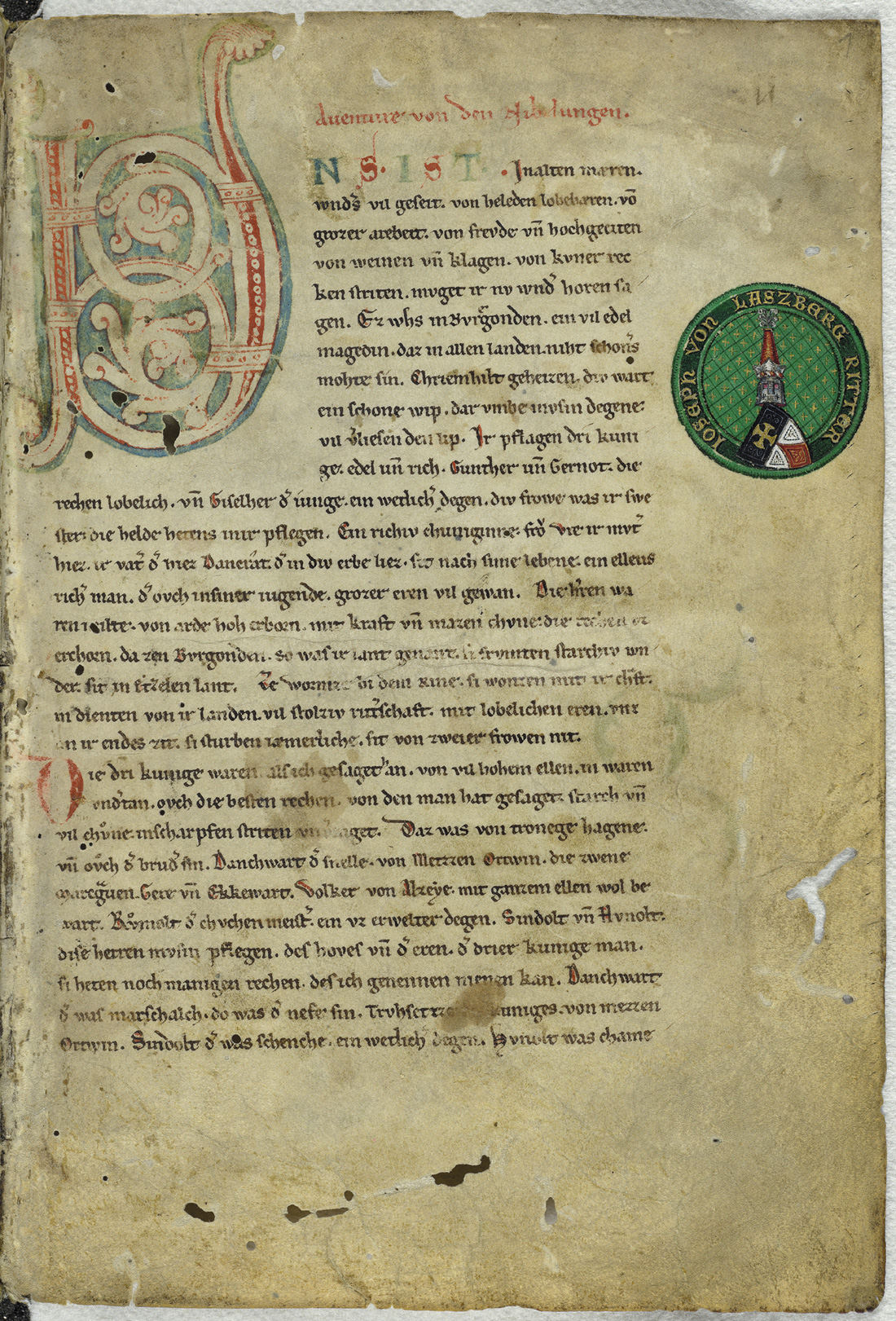
The text is the opening strophe of the Nibelungenlied ().
Middle High German Uns ist in alten mæren wunders vil geseit von helden lobebæren, von grôzer arebeit, von freuden, hôchgezîten, von weinen und von klagen, von küener recken strîten muget ir nu wunder hœren sagen.
Modern German translation In alten Erzählungen wird uns viel Wunderbares berichtet von ruhmreichen Helden, von hartem Streit, von glücklichen Tagen und Festen, von Schmerz und Klage: vom Kampf tapferer Recken: Davon könnt auch Ihr nun Wunderbares berichten hören.
English translation In ancient tales many marvels are told us of renowned heroes, of great hardship of joys, festivities, of weeping and lamenting of bold warriors' battles — now you may hear such marvels told!
Commentary: All the MHG words are recognizable from Modern German, though mære ("tale") and recke ("warrior") are archaic and lobebære ("praiseworthy") has given way to lobenswert. Words which have changed in meaning include arebeit, which means "strife" or "hardship" in MHG, but now means "work", and hôchgezît ("festivity") which now, as Hochzeit, has the narrower meaning of "wedding".
''Erec''
The text is from the opening of Hartmann von Aue's Erec (). The manuscript (the Ambraser Heldenbuch) dates from 1516, over three centuries after the composition of the poem.
| Original manuscript | Edited text | English translation |
|---|---|---|
| 5 | nu riten ſÿ vnlange friſt |
Literature
Main article: Middle High German literature
The following are some of the main authors and works of MHG literature:
- Lyric poetry
- Minnesang
- Codex Manesse
- Reinmar von Hagenau
- Walther von der Vogelweide
- Heinrich Frauenlob
- Oswald von Wolkenstein
- Minnesang
- Epic
- Nibelungenlied
- Kudrun
- Chivalric romance
- Hartmann von Aue's Erec and Iwein
- Wolfram von Eschenbach's Parzival
- Gottfried von Strassburg's Tristan
- Ulrich von Türheim's Rennewart and Willehalm
- Rudolf von Ems's works
- Konrad von Würzburg's works
- Eilhart von Oberge's Tristrant
- Spielmannsdichtung
- King Rother
- Herzog Ernst
- Chronicles
- Annolied
- Jans der Enikel's Weltchronik and Fürstenbuch
- Kaiserchronik
- Law
- Sachsenspiegel
References
Bibliography
This article was imported from Wikipedia and is available under the Creative Commons Attribution-ShareAlike 4.0 License. Content has been adapted to SurfDoc format. Original contributors can be found on the article history page.
Ask Mako anything about Middle High German — get instant answers, deeper analysis, and related topics.
Research with MakoFree with your Surf account
Create a free account to save articles, ask Mako questions, and organize your research.
Sign up freeThis content may have been generated or modified by AI. CloudSurf Software LLC is not responsible for the accuracy, completeness, or reliability of AI-generated content. Always verify important information from primary sources.
Report