From Surf Wiki (app.surf) — the open knowledge base
Mi'ilya

| Field | Value | |||
|---|---|---|---|---|
| name | Mi'ilya | |||
| native_name | {{Hlist | |||
| rtl | yes}} | |||
| {{Lang | ar | معليا | rtl | yes}} |
| settlement_type | Local council (from 1957) | |||
| translit_lang1 | Hebrew | |||
| translit_lang1_type1 | ISO 259 | |||
| translit_lang1_info1 | Miˁilyaˀ | |||
| translit_lang1_type3 | Also spelled | |||
| translit_lang1_info3 | Malia (unofficial) | |||
| image_skyline | Mi'ilya overview 2.JPG | |||
| image_blank_emblem | Mi'ilya COA.png | |||
| pushpin_map | Israel northwest#Israel | |||
| coordinates | ||||
| subdivision_type | Country | |||
| subdivision_name | ||||
| subdivision_type2 | District | |||
| subdivision_name2 | Northern | |||
| grid_position | 174/269 PAL | |||
| established_title | Founded | |||
| established_date | Prior to 1160 | |||
| unit_pref | dunam | |||
| area_total_dunam | ||||
| population_footnotes | ||||
| population_total | ||||
| population_as_of | ||||
| population_density_km2 | auto | |||
| demographics_type1 | Ethnicity | |||
| demographics1_footnotes | ||||
| demographics1_title1 | Arabs | |||
| demographics1_info1 | 97.5% | |||
| demographics1_title2 | Jews and others | |||
| demographics1_info2 | 2.5% | |||
| blank_name_sec1 | Name meaning | |||
| blank_info_sec1 | "The High place" |
| {{Script/Hebrew|מִעִלְיָא}} | معليا
Mi'ilya (; ), also called Mi'elya, is an Arab local council in the western Galilee in the Northern District of Israel. Its name during the Kingdom of Jerusalem era in Galilee was Castellum Regis. The town is located immediately to the northwest of Ma'alot-Tarshiha.
History
Archaeological excavations in Mi'ilya gives indication of inhabitation from the Late Bronze Age and Iron Age, as well as Hellenistic, Roman, Byzantine, Crusader, Mamluk and Ottoman periods. Remains include a mosaic carpet with a Greek inscription, dating from the fifth or early sixth century CE.
Crusader period
In the Crusader period, Mi'ilya was first mentioned in 1160, when it and several surrounding villages was transferred to a Crusader named Iohanni de Caypha (Johannes of Haifa).
In 1179 Viscountess Petronella of Acre sold the houses, vineyards and gardens of Mi'ilya to Count Jocelyn III, uncle of Baldwin IV, and in 1183, Baldwin IV transferred a house that he had bought in Mi'ilya from the scribe, John of Bogalet, in addition to other possessions in the vicinity of Mi'ilya to the same uncle, Jocelyn III.
However, in 1187 Mi'ilya (including its castle) fell to Saladin. In 1188 it was granted by Conrad of Montferrat to the Pisans who were defending Acre, but it is unclear if they ever took control of it.
In 1220 Jocelyn III's daughter Beatrix de Courtenay and her husband Otto von Botenlauben, Count of Henneberg, sold Mi'ilya to the Teutonic Knights on 31 May, for the sum of 7000 marks of silver. This included Mi'ilya with its dependencies, and a third of the fief of St. George. In 1228, Jocelyn III's grandson James of Mandale sold his part to the Teutonic Knights.
Between 1220 and 1243, the Teutonic Knights bought a number of properties from private owners around the castle.
Another document from the year 1257 mentions a house and other property in Mi‘ilya that belonged to the Bishop of Akko.
By 1268–1271 Mi'ilya was conquered by Baibars.
Ottoman period
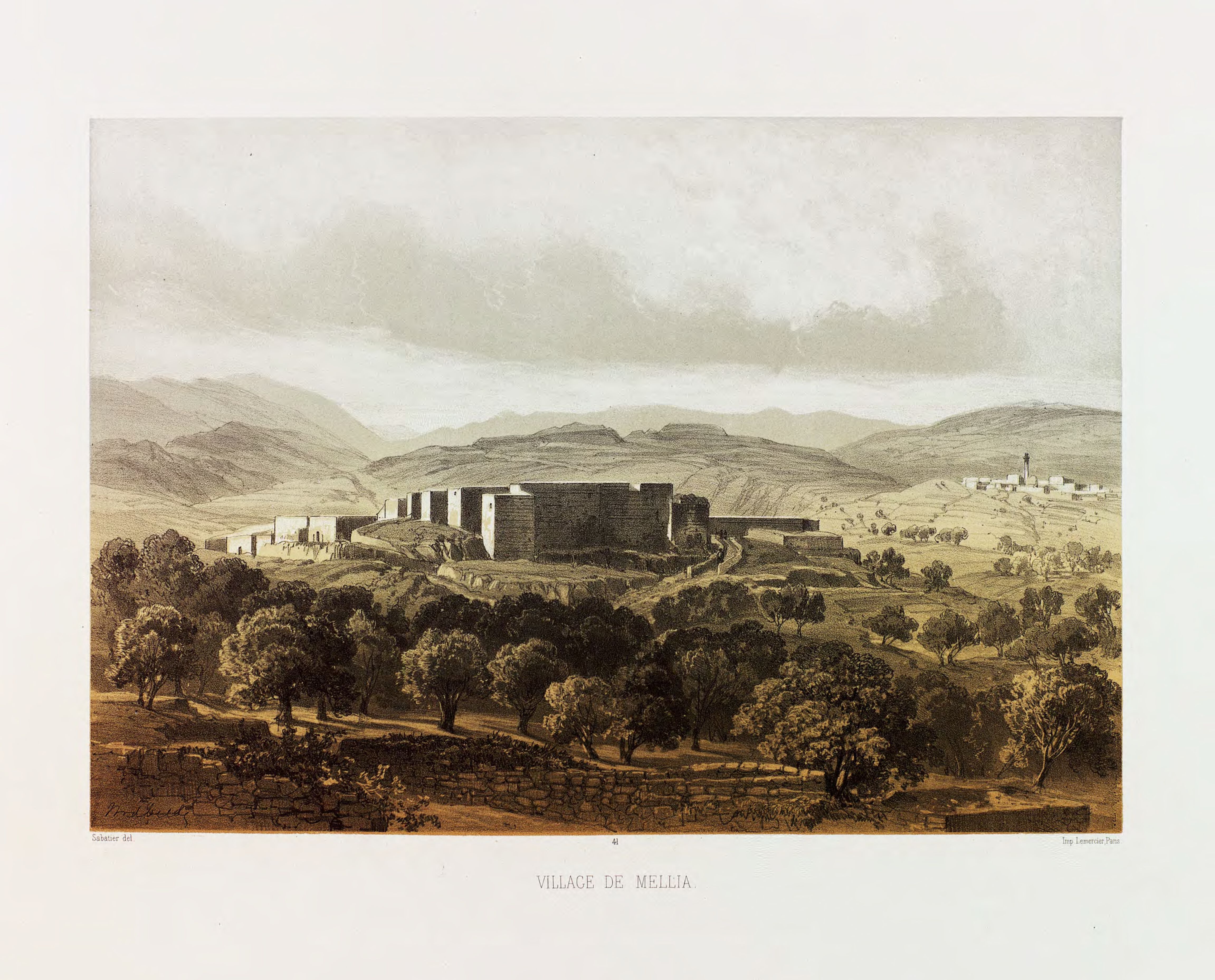
In 1596, Mi'ilya appeared in Ottoman tax registers as being in the Nahiya of Akka of the Liwa Safad, with a population of 15 Muslim households and 2 Christian households. The villagers paid a fixed tax-rate of 25% on various agricultural products, including wheat, barley, olives, and goats or beehives, a total of 2,151 akçe.
In 1838, Ma'lia was noted as a village in the El Jebel district, located west of Safad.
In the 1881 PEF's Survey of Western Palestine Mi'ilya was described as being a large and well-built village of stone, containing 450 Christians, surrounded by olives and arable land.
In 1890, Missionary Père Angelil requested the help of the nuns from the Lebanese village of Ain Ebel to teach the people of neighboring Mi'ilya for eight days. Following this, two nuns from Ain Ebel stayed behind to oversee the operation of the newly established school.
A population list from about 1887 showed Ma'lia to have about 775 inhabitants, all Christians.
British Mandate period
In the 1922 census of Palestine conducted by the British Mandatory authorities, Mi'ilya had a population of 442 inhabitants; 429 Christians and 13 Muslims. Of the Christians, 3 were Orthodox, 2 Catholics and 424 Greek Catholic (Melchite). The population had increased in the 1931 census to 579; 553 Christians, 25 Muslims and 1 Druze, in a total of 138 houses.
In the 1945 statistics, the population had increased to 900; 790 Christians and 110 Muslims, while the total land area was 29,084 dunams, according to an official land and population survey. Of this, 1,509 dunams were allocated for plantations and irrigable land, 2,883 for cereals, while 123 dunams were classified as built-up areas.
State of Israel
In the early part of 1948 the village suffered from food shortages and harassment from neighbouring Jewish areas. It was captured by the Israel Defense Forces during Operation Hiram at the end of October. After a short fight, most of population fled into the countryside. The following day the local IDF commander allowed them to return to their homes. This was one of the few occasions when villagers were allowed back into their villages after they had left. In January 1949 some villagers from Mi'ilya were expelled to Jenin; they complained of being robbed by Israeli soldiers whilst being deported. The Ministry for Minority Affairs reported that a further 25 villagers were expelled in March being suspected of passing information to the enemy. Mi'ilya was recognized as a local council in 1957. The Arab population remained under martial law until 1966.
Demographics
In 2022, 99.8% of the population was Christian, 0.1% was Druze and 0.1% was Muslim.{{Cite web |title=מעיליא
Transportation
Mi'ilya is located on Highway 89 which connects Nahariya with Elifelet via Safed.
Landmarks
King's castle

King's Castle, was first noted in Crusader sources in 1160, when it was probably built during King Baldwin III's reign, along with one of the biggest wineries in the Crusader states.
By 1179 the castle had apparently been rebuilt, as it was then called Castellum Novo.
By 1187, the castle fell to Saladin, but was soon back in Crusader control. In the 1220, ownership passed to the Teutonic Knights. However, the importance of the castle of Mi'ilya was by this time superseded by the Montfort Castle.
The Arab geographer, Al-Dimashqi, noted the "fine castle", and that close to it was a very pleasant valley, where musk-pears and large citrons were grown.
Victor Guérin found in 1875 that “on the highest part of the hill we remark the remains of an ancient fortress, flanked by four square towers; considerable portions remain, showing that it was built of regular blocks, some levelled plane and some embossed; the latter were reserved for the angles. The ruins and interior of this fortress are now inhabited by about twenty families, which have built their little habitations in the midst of the debris.”
Church of St Mary Magdalen

Giovanni Mariti passed by in 1761, and noted "an ancient church, in which the Catholic Greeks perform divine service."
Victor Guérin visited in 1875, and noted that "The Greeks had just rebuilt their church on the foundations of another much more ancient, which was decorated with monolithic columns with capitals imitating Corinthian columns.“
References
Bibliography
- {{Cite book
- {{Cite book
- {{Cite book
- {{Cite book
- {{Cite book
- {{Cite book
- {{Cite book
- {{Cite book |url=https://archive.org/details/CensusOfPalestine1931.PopulationOfVillagesTownsAndAdministrativeAreas |editor-last=Mills, E. |location=Jerusalem}}
- {{Cite book |url-access=registration }}
- {{Cite book
- {{Cite journal
- {{Cite book
- {{Cite book
- {{Cite book
- {{Cite thesis
- {{Cite book
- {{Cite book
- {{Cite journal
- {{Cite book |editor-last=Strehlke | editor-first = E.| editor-link = Ernst Strehlke
References
- Ellenblum, 2003, p. [https://books.google.com/books?id=riHMZiH_Te4C&pg=PA41 41]
- Palmer, 1881, p. [https://archive.org/stream/surveyofwesternp00conduoft#page/52/mode/1up 52]
- (23 December 2018). "Celebrating Christmas in Israel's ancient Greek Catholic villages". Ynet.
- Porat, 2009, [http://www.hadashot-esi.org.il/report_detail_eng.aspx?id=1056&mag_id=115 Mi‘ilya, the Church Square Preliminary Report]
- (2023-03-06). "XXXI. Miʿilya". De Gruyter.
- Strehlke, 1869, pp. [https://archive.org/stream/tabulaeordinist00stregoog#page/n18/mode/1up 2]-3, No. 2; Cited in Röhricht, 1893, RRH, p. [https://archive.org/stream/regestaregnihie00rhgoog#page/n95/mode/1up 89], No. 341; Cited in Pringle, 1993, p. [https://books.google.com/books?id=BgQ6AAAAIAAJ&pg=PA30 30] and in Ellenblum, 2003, p. [https://books.google.com/books?id=riHMZiH_Te4C&pg=PA41 41]
- Strehlke, 1869, pp. [https://archive.org/stream/tabulaeordinist00stregoog#page/n27/mode/1up 11]-12, No. 11; cited in Röhricht, 1893, RRH, p. [https://archive.org/stream/regestaregnihie00rhgoog#page/n162/mode/1up 156], No. 587; cited in Pringle, 1997, p. [https://books.google.com/books?id=-_NbE5obqRMC&pg=PA71 71]
- Strehlke, 1869, p. [https://archive.org/stream/tabulaeordinist00stregoog#page/n32/mode/1up 16], No. 17; cited in Röhricht, 1893, RRH, pp. [https://archive.org/stream/regestaregnihie00rhgoog#page/n171/mode/1up 165]-6, No. 625; Cited in Pringle, 1998, p. [https://books.google.com/books?id=2Y0tA0xLzwEC&pg=PA30 30]
- [[Abu'l-Fida]], in [[Recueil des historiens des croisades#Historiens orientaux .281872.E2.80.931906.29. R.H.C. Or. I.]], p. [https://archive.org/stream/recueildeshistor01acad#page/56/mode/1up 56], [[Ali ibn al-Athir]], 1231, [[The Complete History
- Röhricht, 1893, RRH, p. [https://archive.org/stream/regestaregnihie00rhgoog#page/n186/mode/1up 180], No. 674, cited in Pringle, 1998, p. [https://books.google.com/books?id=2Y0tA0xLzwEC&pg=PA30 30]
- Strehlke, 1869, pp. [https://archive.org/stream/tabulaeordinist00stregoog#page/n59/mode/1up 43]-44, No. 53; pp. [https://archive.org/stream/tabulaeordinist00stregoog#page/n63/mode/1up 47]-49, Nos. 58-59; Cited in Röhricht, 1893, RRH, p. [https://archive.org/stream/regestaregnihie00rhgoog#page/n254/mode/1up 248], No. 934; Cited in Pringle, 1998, p. [https://books.google.com/books?id=2Y0tA0xLzwEC&pg=PA30 30]
- Conder and Kitchener, 1881, SWP I, p. [https://archive.org/stream/surveyofwesternp01conduoft#page/190/mode/1up 190]
- Strehlke, 1869, pp. [https://archive.org/stream/tabulaeordinist00stregoog#page/n67/mode/1up 51]-53, No. 63; pp. [https://archive.org/stream/tabulaeordinist00stregoog#page/n69/mode/1up 53]-54, No. 65; Cited in Röhricht, 1893, RRH, p. [https://archive.org/stream/regestaregnihie00rhgoog#page/n269/mode/1up 263], No. 1002; p. [https://archive.org/stream/regestaregnihie00rhgoog#page/n271/mode/1up 265], No. 1011; Cited in Pringle, 1998, p. [https://books.google.com/books?id=2Y0tA0xLzwEC&pg=PA30 30]
- Strehlke, 1869, pp. [https://archive.org/stream/tabulaeordinist00stregoog#page/n136/mode/1up 120]-128, No.128; Cited in Röhricht, 1893, RRH, pp. [https://archive.org/stream/regestaregnihie00rhgoog#page/n140/mode/1up 134]-135, No. 510; Cited in Pringle, 1998, p. [https://books.google.com/books?id=2Y0tA0xLzwEC&pg=PA31 31] and Ellenblum, 2003, pp. [https://books.google.com/books?id=riHMZiH_Te4C&pg=PA42 42]-44
- Strehlke, 1869, pp. [https://archive.org/stream/tabulaeordinist00stregoog#page/n107/mode/1up 91]-94, No. 112; Cited in Röhricht, 1893, RRH, p. [https://archive.org/stream/regestaregnihie00rhgoog#page/n337/mode/1up 331], No. 1260; cited in Ellenblum, 2003, p. [https://books.google.com/books?id=riHMZiH_Te4C&pg=PA149 149] and Khamisy, 2013, [http://www.hadashot-esi.org.il/report_detail_eng.aspx?id=4362&mag_id=120 Mi‘ilya]
- Pringle, 1997, p. [https://books.google.com/books?id=-_NbE5obqRMC&pg=PA71 71]
- Hütteroth and Abdulfattah, 1977, p. 194
- Note that Rhode, 1979, p. [http://www.academia.edu/2026845/The_Administration_and_Population_of_the_Sancak_of_Safed_in_the_Sixteenth_Century 6] writes that the register that Hütteroth and Abdulfattah studied from the Safad-district was not from 1595/6, but from 1548/9
- Robinson and Smith, 1841, vol. 3, 2nd appendix, p. [https://archive.org/stream/biblicalresearch03robiuoft#page/133/mode/1up 133]
- Conder and Kitchener, 1881, SWP I, [https://archive.org/stream/surveyofwesternp01conduoft#page/149/mode/1up p.149]
- ''Relations d'Orient: Liban, Syrie, Egypte, Arménie,'' "Travaux et Missions Dans Le Belad-Bechara et le District de Saphad: Extrait de Lettres du P. Angelil au P. Supérieur de la Mission," Imprimerie Polleunis et Ceuterick, Bruxelles, Janvier 1891, page 37-38
- Schumacher, 1888, p. [https://archive.org/stream/quarterlystateme19pale#page/n216/mode/1up 191]
- Barron, 1923, Table XI, Sub-district of Acre, p. [https://archive.org/stream/PalestineCensus1922/Palestine%20Census%20%281922%29#page/n38/mode/1up 36]
- Barron, 1923, Table XVI, p. [https://archive.org/stream/PalestineCensus1922/Palestine%20Census%20%281922%29#page/n52/mode/1up 50]
- Mills, 1932, p. [https://archive.org/details/CensusOfPalestine1931.PopulationOfVillagesTownsAndAdministrativeAreas 102]
- Department of Statistics, 1945, p. [http://users.cecs.anu.edu.au/~bdm/yabber/census/VSpages/VS1945_p04.jpg 4]
- Government of Palestine, Department of Statistics. ''Village Statistics, April, 1945.'' Quoted in Hadawi, 1970, p. [http://www.palestineremembered.com/download/VillageStatistics/Table%20I/Acre/Page-041.jpg 41]
- Government of Palestine, Department of Statistics. ''Village Statistics, April, 1945.'' Quoted in Hadawi, 1970, p. [http://www.palestineremembered.com/download/VillageStatistics/Table%20II/Acre/Page-081.jpg 81]
- Government of Palestine, Department of Statistics. ''Village Statistics, April, 1945.'' Quoted in Hadawi, 1970, p. [http://www.palestineremembered.com/download/VillageStatistics/Table%20III/Acre/Page-131.jpg 131]
- [[Benny Morris. Morris]], 1987, p. 228
- Morris, 1987, p. 352
- Röhricht, 1893, RRH, p. [https://archive.org/stream/regestaregnihie00rhgoog#page/n95/mode/1up 89], no. 341; cited in Pringle, 1993, p. [https://books.google.com/books?id=BgQ6AAAAIAAJ&pg=PA30 30] and in Pringle, 1997, p. [https://books.google.com/books?id=-_NbE5obqRMC&pg=PA71 71]
- (12 August 2019). "Israeli Village Excavates Itself, Finds Biggest Winery in the Crusader World".
- In 1182, [[Baldwin IV]] granted the castle to his uncle, [[Jocelyn III]]. At this time it was called "The new castle in the mountains of Acre".Strehlke, 1869, pp. [https://archive.org/stream/tabulaeordinist00stregoog#page/n29/mode/1up 13]-15, No. 14; cited in Röhricht, 1893, RRH, pp. [https://archive.org/stream/regestaregnihie00rhgoog#page/n168/mode/1up 162]-163, No. 614, cited in Pringle, 1998, p. [https://books.google.com/books?id=2Y0tA0xLzwEC&pg=PA30 30]
- Le Strange, 1890, [https://archive.org/stream/palestineundermo00lestuoft#page/495/mode/1up p.495]
- Guérin, 1880, pp. [https://archive.org/stream/descriptiongogr00gugoog#page/n76/mode/1up 60]- 61, as translated in Conder and Kitchener, 1881, SWP I, pp. [https://archive.org/stream/surveyofwesternp01conduoft#page/190/mode/1up 190]-191
- Mariti, 1792, p. [https://archive.org/stream/travelsthroughc00marigoog#page/n369/mode/1up 339]; 1769 edition noted in Pringle, 1998, p. [https://books.google.com/books?id=2Y0tA0xLzwEC&pg=PA31 31]
- Guérin, 1880, pp. [https://archive.org/stream/descriptiongogr00gugoog#page/n76/mode/1up 60]- 61, as translated in Pringle, 1998, p. [https://books.google.com/books?id=2Y0tA0xLzwEC&pg=PA31 31]
This article was imported from Wikipedia and is available under the Creative Commons Attribution-ShareAlike 4.0 License. Content has been adapted to SurfDoc format. Original contributors can be found on the article history page.
Ask Mako anything about Mi'ilya — get instant answers, deeper analysis, and related topics.
Research with MakoFree with your Surf account
Create a free account to save articles, ask Mako questions, and organize your research.
Sign up freeThis content may have been generated or modified by AI. CloudSurf Software LLC is not responsible for the accuracy, completeness, or reliability of AI-generated content. Always verify important information from primary sources.
Report