From Surf Wiki (app.surf) — the open knowledge base
Mezuzah
Piece of parchment in a decorative case
.JPG)
Piece of parchment in a decorative case
| Field | Value | |
|---|---|---|
| image | [[File:Mezuzah Museum of the History of Polish Jews in Warsaw.JPG | 280px]] |
| caption | Mezuzah at the entrance to | |
| POLIN Museum of the History of Polish Jews, which is inside a red decorative case | ||
| verse | and | |
| talmud | Shabbat 32a, Yoma 11a, Menachot 33a, | |
| mishnah | Menachot 3:7 | |
| rambam | Tefillin, Mezuzah, veSefer Torah ch. 5–6 | |
| sa | Yoreh De'ah 285–291 |
POLIN Museum of the History of Polish Jews, which is inside a red decorative case

A mezuzah ( 'doorpost'; plural: mezuzot) is a piece of parchment inscribed with specific Hebrew verses from the Torah, which Jews affix in a small case to the doorposts of their homes. These verses are the Biblical passages in which the use of a mezuzah is commanded ( and ); they also form part of the Shema prayer.
According to traditional Jewish law, a mezuzah must be placed on every post-and-lintel entrance to a residence, courtyard, or city. Since the time of Meir of Rothenburg (), religious Jews have increasingly also placed mezuzot on the entrances to non-residential buildings such as synagogues and offices, and on each internal doorway of the home or building, with the exception of bathrooms (where the name of God is forbidden) and small closets.
The klaf is prepared by a qualified scribe ("sofer stam) who has undergone training, both in studying the relevant religious laws, and in the more practical parts—i.e., carving the quill and practising writing. The verses are written in indelible black ink with a special quill pen made either from a feather or, now quite rare, a reed. The klaf is then rolled up and placed inside the case.
Etymology
In the Bible, the word mezuzah only refers to the two 'doorposts' or 'doorjambs' of a door, the upright posts on either side of it which support the lintel, and appears in various contexts unrelated to any religious commandment or parchment. The word later acquired the modern meaning of piece of parchment in post-Biblical Hebrew due to the Deuteronomy commandment above requiring to write verses on doorposts.
.jpg)
The word's origin is disputed:
- one accepted understanding derives mezuzah from the root (ז-ו-ז) meaning 'motion' or 'shift' (), describing a doorpost as the device enabling the door to move or shift. The root is unused in the Bible but is common in post-Biblical Hebrew and Aramaic, and is considered to have existed in the language then.
- another accepted understanding derives mezuzah from the Akkadian word mazzāzu 'stand' (like the socle or plinth of a column or stele), from the Akkadian verb izuzzu 'to stand', describing a doorpost as the socle or stand of the entrance, as opposed to the moving part, the door which revolves – a description similar to its corresponding Greek translation σταθμός in the Septuagint, which in addition to 'doorpost' generally means 'something fixed, something standing' from ἵστημι 'to stand'. However, there is no example of Akkadian mazzazu specifically meaning doorpost and some researchers doubt that Hebrew mezuzah borrowed this word.
Purpose
In the biblical verses where the mezuzah command is found, the purpose is educational, to constantly remind a person of God's commandments:
In later generations, though, the mezuzah began to be interpreted as an apotropaic device, protecting the house from forces of evil. A culture-comparative analysis suggests that the objects placed on domestic thresholds often bear the function of an amulet repelling the broadly understood evil. Some early Rabbinic sources (including JT Megillah 4:12, BT Bava Metziya 102a, and BT Pesahim 113b) explicitly witness the belief in the anti-demonic function of mezuzot. While some Jewish sources indicate that mezuzah is construed as a device protecting against divine anger, others vehemently reject such an interpretation.
The belief in the protective power of mezuzah is prevalent in modern times as well. In the 1970s, after a series of terrorist attacks in Ma'alot, the representatives of Chabad started the campaign for the systematic checking of mezuzahs. The general assumption underlying the action was that adhering to the mitzvot would guarantee personal safety.
According to various pieces of sociological research, approximately three-quarters of adults in Israel believe the mezuzah guards their houses.
Design
The mezuzah must be written on parchment (klaf) by a specially trained scribe (sofer).
Additional inscriptions
It is customary to write two inscriptions on the back of the parchment:
- the Hebrew word (Shaddai)
- the phrase ""

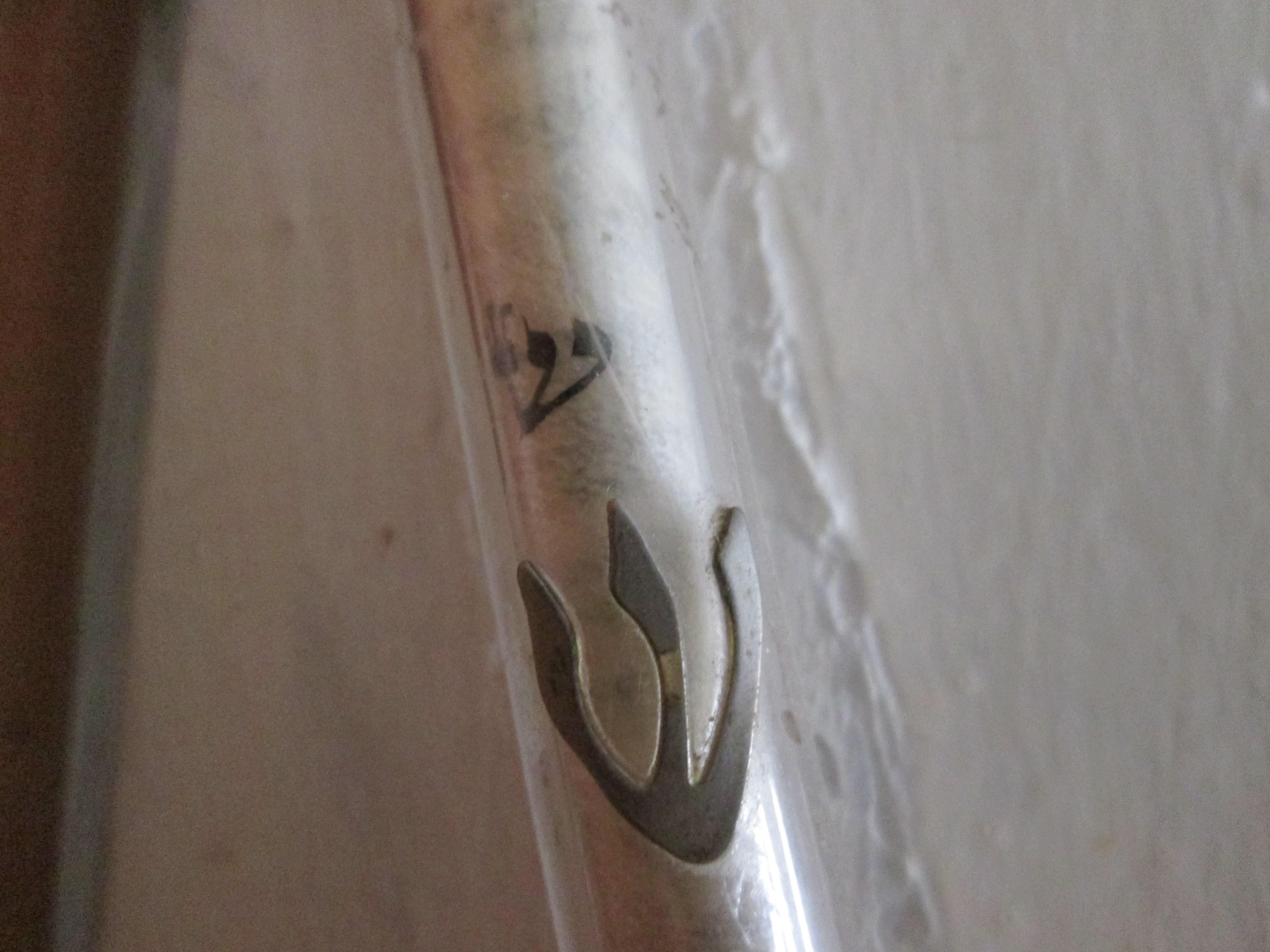
Shaddai, ["Almighty"] one of the biblical names of God, also serves here as an acronym for Shomer Daltot Yisrael, "Guardian of Israel's doors". Many mezuzah cases are also marked with the Hebrew letter (Shin), for Shaddai.
"" is a Caesar cipher—a one-letter shift—of the third, fourth, and fifth words of the Shema, "Adonai, Eloheinu, Adonai", "The Lord, our God, the Lord"; it is written on the back of the case, opposite the corresponding words on the front. This inscription dates from the 11th century and is found among the Hasidei Ashkenaz (medieval German Jewish mystics).
The Sephardic custom (minhag) leaves out the phrase "", and only the Hebrew word (Shaddai) is written on the back of the mezuzah. This follows the Shulchan Aruch and the writings of the Rambam. The Ashkenazi custom of writing both phrases, however, was supported in the writings of the Remo. (Yoreh De'ah 288:15)
In this regard it is worthwhile to refer to the often cited passage from Rambam's Mishneh Torah which states:
It is a common custom to write [God's name,] Shaddai, on the outside of a mezuzah opposite the empty space left between the two passages. There is no difficulty in this, since [the addition is made] outside. Those, however, who write the names of angels, other sacred names, verses, or forms, on the inside [of a mezuzah] are among those who do not have a portion in the world to come. Not only do these fools nullify the mitzvah, but furthermore, they make from a great mitzvah [which reflects] the unity of the name of the Holy One, blessed be He, the love of Him, and the service of Him, a talisman for their own benefit. They, in their foolish conception, think that this will help them regarding the vanities of the world.
Mezuzah cases
While the most important part of the mezuzah is the klaf, or the parchment, and not the case, designing and producing mezuzah cases has been elevated to an art form over the ages. Mezuzah cases are produced from a wide variety of materials, from silver and precious metals, to wood, stone, ceramics, pewter, and even polymer clay. Some dealers of mezuzah cases will provide or offer for sale a copy of the text that has been photocopied onto paper; this is not a kosher (valid) mezuzah, which must be handwritten onto a piece of parchment by a qualified scribe. Other Judaica sellers work directly with professional scribes to offer kosher scrolls together with the purchase of an artistic mezuzah case.
Practices
Affixing the mezuzah
Position and integrity
According to halakha, the mezuzah should be placed on the right side of the door or doorpost, in the upper third of the doorpost (i.e., approximately shoulder height), within approximately 3 in of the doorway opening. Care should be taken to not tear or damage the parchment or the wording on it, as this will invalidate the mezuzah.
Angle

Where the doorway is wide enough, many Ashkenazi Jews tilt the mezuzah so that the top slants toward the room into which the door opens. This is done to accommodate the variant opinions of Rashi (1040–1105) and of his grandson, Rabbeinu Tam, as to whether it should be placed vertically (Rashi) or horizontally (Rabbeinu Tam), and also to imply that God and the Torah (which the mezuzah symbolizes) are entering the room. The compromise solution was suggested by Rabbi Jacob ben Asher ().
Most Sephardi Jews, Mizrahi Jews and other non-Ashkenazi Jews affix the mezuzah vertically, though Spanish and Portuguese Jews living in countries where the majority of Jews are Ashkenazim usually place it slanting.
Time
Generally, halakha requires Jews living in the diaspora (i.e., outside of the Land of Israel) to affix a mezuzah within 30 days of moving into a rented house or apartment. For a purchased home or apartment in the diaspora, or a residence in Israel (owned or rented), the mezuzah is affixed immediately upon moving in. The reason for this difference is that there is an assumption that when a Jew lives in Israel, Israel shall remain their permanent residence, whereas a home in the diaspora is temporary.
Blessing
The procedure is to hold the mezuzah against the spot upon which it will be affixed, then recite a blessing:
: :Barukh atah Adonai Eloheinu melekh ha‘olam, asher qideshanu bemitzvotav vetzivanu liqboa‘ mezuzah. :Blessed are You, Lord our God, King of the Universe, Who sanctified us with His mitzvot, and commanded us to affix a mezuzah.
Any Jew can recite the blessing, provided they are old enough to understand the significance of the mitzvah. After the blessing, the mezuzah is attached.
When affixing several mezuzot, it is sufficient to recite the blessing once, before affixing the first one.
Touching the mezuzah
Whenever passing through the doorway, many people touch a finger to the mezuzah as a way of showing respect to God. Many people also kiss their finger after touching it to the mezuzah.
Checking the parchment
Many observant Jews from all Jewish denominations have a qualified scribe check the mezuzot parchments for defects (such as small tears or faded lettering) at least twice every seven years. This job can be done by a sofer (scribe) or by anyone with similar training. A sofer also can make new mezuzot parchments which are in accordance with Jewish law.
Karaite and Samaritan mezuzah
This article deals mainly with the mezuzah as it is used in Rabbinic Judaism, but Karaite Judaism and Samaritanism have their own traditions.

In Karaite Judaism the Deuteronomic verse "And you shall write them on the doorposts of your houses and your gates" () is interpreted to be a metaphor and not as referring to the Rabbanite mezuzah. Thus Karaites do not traditionally use mezuzot, but put up a small plaque in the shape of the two Tablets of the Law with the Ten Commandments. In Israel, where they might try not to make other Jews feel uncomfortable, many Karaites make an exception and place a mezuzah on their doorpost as well. The Karaite version of the mezuzah is fixed to the doorways of public buildings and sometimes to private buildings, too.

The Samaritans interpret the deuteronomic commandment to mean displaying any select text from the Samaritan version of the five Books of Moses. This can contain a blessing or a particularly holy or uplifting message. In the past they placed a stone plaque inscribed with the Ten Commandments above the house door, some examples dating back to the Byzantine (4th–7th century) and Early Muslim (7th–11th century) periods being now shown in the Israel Museum in Jerusalem.
Nowadays a Samaritan mezuzah is usually made of either marble, a wooden plate, or a sheet of parchment or high quality paper, on which they inscribe select verses from the Samaritan Torah. This they place either above the house door, or inside the house, in the entrance hall or at a prominent place on a large wall. These mezuzot are found in every Samaritan household as well as in the synagogue. Today some Samaritans would also use a Jewish-style mezuzah case and place inside it a small written Samaritan scroll, i.e. a text from the Samaritan Torah, written in the Samaritan alphabet. The more such mezuzot there are in the house, the better it is considered to be.
Legal battles in the U.S.
The Jewish practice of affixing a mezuzah to the entranceway of a residential unit was rarely challenged in the United States or Canada. However, in Chicago in 2001, a condominium association at Shoreline Towers banned "mats, boots, shoes, carts or objects of any sort… outside unit entrance doors", which by board vote in 2004 was interpreted to be absolute. Shoreline Towers management removed the hallway mezuzot of condominium tenants. Complaints were subsequently filed with the Chicago Commission on Human Relations, Illinois Attorney General, and U.S. Department of Housing and Urban Development, alleging housing discrimination on the basis of religion. Shoreline Towers was not the sole condominium association in Chicago with such a restriction, although one of them agreed to modify its rule.
On reading a news report of the mezuzah dispute, Chicago alderman Burton Natarus drafted an amendment to the city's municipal code which made it illegal for a renter or owner of an apartment, house, or condo to be prohibited from "placing or affixing a religious sign, symbol or relic on the door, door post or entrance." Although there was opposition, it became law in Chicago that December. The first such legislation in North America, it included a maximum $500 fine for its violation.
Notwithstanding this legislation, in 2006, a federal court judge determined that the rule did not violate the Federal Fair Housing Act; the district court upheld the opinion on appeal in 2008; in 2009, the U.S. Court of Appeals for the 7th Circuit in Chicago reversed the 2008 decision, and the case proceeded. Meanwhile, records of the Chicago Jewish Star were unsuccessfully subpoenaed, and Illinois' anti-SLAPP legislation was applied. In 2011, a confidential settlement to the Shoreline Towers disputes was achieved.
In January 2006, a more narrowly focused amendment to the state's Condominium Property Act was initiated by Illinois Senator Ira Silverstein, the first such state law, which specifically prohibited Condominium Boards from creating "a rule or regulation that shall prohibit any reasonable accommodation for religious practices, including the attachment of religiously-mandated objects to the front door area of a condominium unit." That April, the bill was signed by Governor Rod Blagojevich, and went into effect January 1, 2007.
In 2006, a woman in a condo building in Fort Lauderdale, Florida, was instructed to remove the mezuzah from her hallway unit and threatened with a fine. After a lengthy legal battle, the condo association was found guilty of discrimination. In 2008, House Bill 995, an amendment to the Florida Condominium Act, modeled on the Illinois state legislation, became law.
In Texas in 2007, a couple living in Houston was instructed to "remove the item attached to your door frame" to avoid violating association rules. A legal battle ensued, during which a U.S. District Court judge ruled in 2008 on behalf of the condo association. Subsequently, the couple turned to Texas House of Representatives member Garnet F. Coleman. His bill to protect such religious displays, as introduced in 2009, was not adopted, but in June 2011 a slightly revised version (HB1278) was signed into law by Texas Governor Rick Perry.
A bill designed to prevent mezuzah bans nationwide was proposed in 2008 (H.R. 6932) by U.S. Congressman Jerrold Nadler. It never became law.
References
Bibliography
References
- Zaklikowski, Dovid. "The Mezuzah Scroll and Case".
- ''[[Shulchan Aruch]]'', Yoreh Deah 286ff.
- ''Shu"T Maharam'' #108
- "Strong's Hebrew: 4201. מְזוּזָה (mezuzah) – a doorpost, gatepost".
- like the story of Samson tearing down Gaza's city gate and its two ''doorposts'' (''mezuzot''): [https://biblehub.com/interlinear/judges/16-3.htm Judges 16:3].
- "''You shall write them on the doorposts of your house''", [https://biblehub.com/deuteronomy/6-9.htm Deuteronomy 6:9].
- for example, according to [https://www.blueletterbible.org/lexicon/h4201/kjv/wlc/0-1/ Strong's Lexicon H4201 - mᵊzûzâ].
- (1860). "Gesenius's Hebrew and Chaldee lexicon to the Old Testament scriptures, tr., with additions and corrections from the author's other works".
- for example, according to the [[Even-Shoshan Dictionary. Even-Shoshan dictionary]], entry ''mezuzah''. Or [[Hebrew and Aramaic Lexicon of the Old Testament. HALOT]].
- "mazzāzu".
- (2000). "A Concise Dictionary of Akkadian, 2nd (corrected) printing". Harrassowitz Verlag.
- "izuzzu".
- Greek σταθμός [https://studybible.info/interlinear/exo%2012:7 translates Hebrew ''mezuzah'' in LXX].
- "σταθμός – Greek Word Study Tool".
- Tawil, Hayim. (2009). "An Akkadian Lexical Companion for Biblical Hebrew: Etymological-semantic and Idiomatic Equivalents with Supplement on Biblical Aramaic". KTAV Publishing House.
- {{Bibleverse. Deuteronomy. 6:6-9. ESV; similarly in {{Bibleverse-nb. Deuteronomy. 11:18-20. ESV
- Franz Landsberger, [https://www.jstor.org/stable/23506541 THE ORIGIN OF THE DECORATED MEZUZAH], ''Hebrew Union College Annual'', Vol. 31 (1960), pp. 149-166
- Frankfurter, David. (January 2008). "The Interpenetration of Ritual Spaces in Late Antique Religions: An Overview". Archiv für Religionsgeschichte.
- Jansson, Eva-Maria. (1999). "The Message of a Mitsvah: The Mezuzah in Rabbinic Literature".
- Wojciech Kosior. (January 2014). ""It Will Not Let the Destroying [One] Enter." - The Mezuzah as an Apotropaic Device According to Biblical and Rabbinic Sources". The Polish Journal of the Arts and Culture.
- Martin L. Gordon. (1977). "Mezuzah: Protective Amulet or Religious Symbol". Tradition: A Journal of Orthodox Thought.
- Aviezer, Hillel. (1997). "Ha-Mezuzah – beyn Mitzvah le-Qamiya'". Ma'aliyot.
- Alexander Poltorak. "Mezuzah and Astrology".
- (2010). "Tefillin, Mezuzah and Sefer Torah - Chapter Five".
- "How to Hang a Mezuzah".
- "Mezuzah Cases & Kosher Scrolls". JudaicaWebstore.com.
- ''Beit Yosef'' YD 289; and see ''Nekudot Hakesef'' ad loc
- Janowski, Malkie. "Mezuzah Questions & Answers - Why Is the Mezuzah Slanted?".
- (March 11, 1995). "Ask the Rabbi - Mezuzah – Which Way is UP??".
- Rabbi Reuvain Mendlowitz. "Mezuzah Blessing FAQ".
- [[Babylonian Talmud]], Yoma 11a
- [[Shulchan Aruch]] (291:1)
- (July 18, 2021). "Tefillin (phylacteries)".
- (December 10, 1999). "Israels 30,000 Karaites follow Bible, not Talmud". J.
- (December 20, 2012). "The Mezuzah throughout the Ages". Pe'er HasTam.
- "Mezuza (Doorpost)".
- (26 November 2018). "Tefillin and Mezuzot in Samaritan and Jewish Tradition".
- "Samaritan mezuzah bearing excerpts from the Ten Commandments".
- Dr. Suzan Hazan. (September 2014). "The aesthetic of the text: the meaning, beauty, and the inspiration of the written word.".
- Rachel Feldman. "Diving Deep into Mezuzah Customs and Lore". Judica Web Store.
- In 1993, 98 percent of Israelis placed a mezuzah on at least the front door to their dwelling, making it the "commandment most widely observed" (''[[Jerusalem Post]]'', December 20, 1993); a 1999 survey in Florida found that in Palm Beach County 89 percent of Jewish residents affix a mezuzah on a doorpost and 87 percent attend a seder ([[Jewish Telegraphic Agency]], December 15, 1999).
- Toronto: League for Human Rights of B’nai Brith Canada, ''2000 Annual Audit of Antisemitic Incidents'' (Ontario Report); Connecticut: Doft v. Washington Mews Condominium Association (2003).
- "Condo revises mezuzah rule", ''Chicago Jewish Star'', September 16, 2005, p. 1.
- Douglas Wertheimer, "Not On Our Doorposts: Chicago condo bans mezuzahs", ''Chicago Jewish Star'', July 15, 2005, p. 2.
- "More mezuzah bans", ''Chicago Jewish Star'', August 5, 2005, p. 2.
- (August 19, 2005). "Ordinance to stop ban on mezuzahs; one condo concedes". Chicago Jewish Star.
- Howard Dakoff, "Why I Opposed the Mezuzah Ban", ''Chicago Jewish Star'', November 4, 2005, p. 4.
- [Municipal Code of Chicago, Unfair Housing Practices (5-8-030/h)]; Mark Fitzgerald, "Mezuzah muckraking gains legal huzzahs", ''[[Editor & Publisher]]'', October 2005, p. 13; "Chicago Law Inspired by 'Jewish Star' Articles May Go State-wide", ''Editor & Publisher'', January 26, 2006.
- Editorial, "Give peacemaking a chance", ''[[Chicago Sun-Times]]'', September 2, 2005.
- Washburn, Gary. (December 14, 2005). "Ethics class eyed for city workers". [[Chicago Tribune]].
- Ruth Eglash, "The case of the confiscated mezuzah", ''Jerusalem Post'', June 8, 2006; Editorial, "Judge: Jews Not Welcome", ''Chicago Jewish Star'', September 8, 2006, p. 4.
- Josh Gerstein, "Court: No Federal Right to Mezuzot at Condominiums", ''[[New York Sun]]'', July 11–13, 2008, p.4; Dan Slater, "Mezuzah Suit Sparks Ruckus, Impassioned 7th Cir. Dissent", ''[[Wall Street Journal]]'' Law Blog (July 11, 2008); "Judges rule on Jewish lawsuits. The Hallway mezuzah: Unjustified accommodation or intentional discrimination?" ''Chicago Jewish Star'', July 18, 2008, p. 1.
- "Supreme Court contender [ [[Diane P. Wood]] ] mulls mezuzah bias case against condo board", ''Chicago Sun-Times'', May 13, 2009; "Possible Court Pick is Used to Dueling on Bench", ''[[Washington Post]]'', May 16, 2009; [[Courthouse News Service]], November 17, 2009; Kenneth E. Kraus, "Court takes a new view of FHA, mezuzah case", ''Chicago Jewish Star'', November 20, 2009, p. 4; J. Schwartz, "Fight Over Jewish Symbol Heads to Trial", ''[[New York Times]]'', November 21, 2009; [https://caselaw.findlaw.com/us-7th-circuit/1498717.html Lynne Bloch, Helen Bloch and Nathan Bloch v. Edward Frischholz and Shoreline Towers Condominium Association, No. 06-3376], 7th Cir. U.S. Court of Appeals, argued May 13, 2009, decided Nov. 13, 2009.
- "''Jewish Star'' objects to subpoena", ''Chicago Jewish Star'', July 27, 2007, p. 1.
- Debbie L. Berman and Wade A. Thomson, "Illinois' Anti-SLAPP Statute: A Potentially Powerful New Weapon for Media Defendants", ''Communications Lawyer'', vol. 26, March 2009; "Fall-out from mezuzah case impacted by new law", ''Chicago Jewish Star'', April 4, 2008, p. 1; "$36k award in SLAPP-mezuzah case", ''Chicago Jewish Star'', August 7, 2009, p. 1.
- "Families settle mezuzah dispute with Chicago condo", Jewish Telegraphic Agency, July 13, 2011.
- (12 April 2006). "Bill Status of SB2165 94th General Assembly".
- (12 April 2006). "Gov. Blagojevich signs legislation preventing condo boards from interfering with religious practices".
- Joe Kollin, "Lauderdale condo bans religious symbol on doorposts", ''[[South Florida Sun-Sentinel]]'', February 3, 2007; "Florida condo bans mezuzahs", ''Chicago Jewish Star'', February 9, 2007; "Florida mezuzah ban ends", ''Chicago Jewish Star'', April 20, 2007; Steve Lipman, "Mezuzah Standoff in Ft. Lauderdale", ''[[The Jewish Week]]'', February 16, 2007, p. 25; D. Morris, "Richter Wins Fight to Keep Mezuzah", ''[[Florida Jewish News]]'', April 13, 2007; "Florida gets a mezuzah bill", ''Chicago Jewish Star'', May 23, 2008, p. 3; [Florida House of Representatives, CS/HB 995].
- "Illinois, then Florida – Is Texas next?", ''Chicago Jewish Star'', April 3, 2009, p. 1; ''[[Jewish Herald-Voice]]'', April 9, 2009; ''Jewish Herald-Voice'', April 30, 2009.
- "Texas gets a mezuzah law", ''Chicago Jewish Star'', May 27, 2011, p. 1; Kate Shellnutt, "New Texas law defends residents' religious displays", ''[[Houston Chronicle]]'', June 20, 2011; "Perry signs mezuzah bill", ''Chicago Jewish Star'', June 24, 2011, p. 1; [http://tx.opengovernment.org/sessions/82/bills/hb-1278 Texas House of Representatives, HB 1278] {{webarchive. link. (2012-07-15 .)
- (September 19–21, 2008). (April 2025)
- (September 26, 2008). "Congress to Trump Court on Mezuzah Issue". Chicago Jewish Star.
- (April 3, 2009). (April 2025)
- "H.R. 6932: Freedom of Religious Expression in the Home Act of 2008".
This article was imported from Wikipedia and is available under the Creative Commons Attribution-ShareAlike 4.0 License. Content has been adapted to SurfDoc format. Original contributors can be found on the article history page.
Ask Mako anything about Mezuzah — get instant answers, deeper analysis, and related topics.
Research with MakoFree with your Surf account
Create a free account to save articles, ask Mako questions, and organize your research.
Sign up freeThis content may have been generated or modified by AI. CloudSurf Software LLC is not responsible for the accuracy, completeness, or reliability of AI-generated content. Always verify important information from primary sources.
Report