From Surf Wiki (app.surf) — the open knowledge base
Mexico City International Airport
International airport serving Mexico City

International airport serving Mexico City
| Field | Value | |
|---|---|---|
| name | Mexico City International Airport | |
| nativename | Aeropuerto Internacional Benito Juárez | |
| image | MEX airport logo.png | |
| image-width | 200px | |
| image2 | Aerial View of Mexico City Airport on 3.21.11 (cropped).jpg | |
| IATA | MEX | |
| ICAO | MMMX | |
| LID | ME1 | |
| type | Public | |
| owner-oper | Grupo Aeroportuario de la Ciudad de México | |
| city-served | Greater Mexico City | |
| location | Venustiano Carranza, Mexico City, Mexico | |
| opened | ||
| hub | {{Unbulleted list | |
| focus_city | Magnicharters | |
| coordinates | ||
| pushpin_map | Mexico Mexico City#Mexico Federal District #Mexico | |
| pushpin_label | MEX | |
| pushpin_map_caption | Location within Mexico City | |
| metric-rwy | y | |
| r1-number | 05R/23L | |
| r1-length-m | 3,900 | |
| r1-surface | Asphalt | |
| r2-number | 05L/23R | |
| r2-length-m | 3,952 | |
| r2-surface | Asphalt | |
| website | ||
| stat-year | 2025 | |
| stat1-header | Total passengers | |
| stat1-data | 44,605,800 | |
| stat2-header | Ranking in Mexico | |
| stat2-data | 1st | |
| stat3-header | Cargo tonnage | |
| stat3-data | 252,555.6 | |
| footnotes | Source: DAFIF | |
| Statistics: Airport website | ||
| stat4-header | Employees | |
| stat4-data | 1,265 | |
| elevation-m | 2230 | |
| metric-elev | y | |
| timezone | CST | |
| utc | UTC−06:00 |
| image-width = 200px | owner-oper = Grupo Aeroportuario de la Ciudad de México | city-served = Greater Mexico City |Aeroméxico |Aeroméxico Connect |Volaris |Viva | metric-rwy = y | r1-number = 05R/23L | r1-length-m = 3,900 | r1-surface = Asphalt | r2-number = 05L/23R | r2-length-m = 3,952 | r2-surface = Asphalt | stat-year = 2025 | stat1-header = Total passengers | stat1-data = 44,605,800 | stat2-header = Ranking in Mexico | stat2-data = 1st | stat3-header = Cargo tonnage | stat3-data = 252,555.6 Statistics: Airport website | stat4-header = Employees | stat4-data = 1,265 | elevation-m = 2230 | metric-elev = y
Mexico City International Airport (), officially Aeropuerto Internacional Benito Juárez (Benito Juárez International Airport) is the primary international airport serving Greater Mexico City. It is the busiest airport in Mexico, and as of 2025 ranks as the third-busiest in Latin America, the 15th-busiest in North America, and the 50th-busiest in the world by passenger traffic. The airport is served by more than 25 airlines with routes to over 100 destinations across Mexico, the Americas, Europe, the Middle East, and Asia.
As the primary hub for Mexico's flag carrier, Aeroméxico, the airport serves as a SkyTeam hub. It is also a hub for Volaris and Viva and a focus city for Magnicharters. The airport has two passenger terminals and two runways. It hosts agencies including the Mexican Airspace Navigation Services (SENEAM), the Mexican Federal Civil Aviation Agency (AFAC), as well as an Air Force base. The airport is owned by the Mexican Navy and operated by Grupo Aeroportuario de la Ciudad de México. It is named after 19th-century president Benito Juárez.
As part of Mexico City’s airport system—along with Toluca International Airport and Felipe Ángeles International Airport—the airport operates at full capacity. It is one of the busiest two-runway airports in the world, with 850 aircraft movements per day. With an average daily passenger count of 122,000, the airport handled 44,605,576 passengers in 2025, marking a 1.7% decrease from the previous year.
History
Origins
The site known as Llanos de Balbuena has been used for aviation since 1910. That year, Alberto Braniff made the first powered flight over Mexican soil, flying a French Voisin aircraft with a 50-horsepower engine. On November 30, 1911, President Francisco I. Madero became the world’s first head of state to fly in an airplane, piloted by Geo M. Dyott of Moisant International.
In 1915, the site opened as Balbuena Military Airport, equipped with five runways. A small civilian airport opened in 1928, with regular commercial service starting in 1929 and was officially inaugurated on May 15, 1931. On July 8, 1943, it was granted international status and launched its first international route to Los Angeles, operated by Mexicana de Aviación.
From 1949 to 1951, the airport expanded with a new runway (05R-23L), an apron, a control tower, and administration offices. President Miguel Alemán inaugurated a renovated passenger terminal on November 19, 1952. By 1956, the airport operated with four runways: 05L-23R (2720 m), 05R-23L (3000 m), featuring electric lights for night-time service; 13-31 (2300 m), built to replace Runway 14-32, which was too close to adjacent residential areas; and Runway 5 Auxiliary (759 m).
On December 2, 1963, the airport's name was changed from "Aeropuerto Central" (Central Airport) to "Aeropuerto Internacional de la Ciudad de México" (Mexico City International Airport).{{cite web |access-date=2016-01-26 |archive-date=February 22, 2016 |archive-url=https://web.archive.org/web/20160222114657/http://www.colegiodepilotos.org/nosotros/la-aviaci%C3%B3n-en-m%C3%A9xico/ |url-status=dead |access-date=2016-02-03
Expansion and decentralization

The airport’s location in a densely populated area restricts infrastructure expansion. The proximity of the two parallel runways prevents fully independent simultaneous operations, limiting the airport’s capacity.
The terminal was expanded in 1980, doubling its capacity. In 1990, the terminal was reconfigured to separate domestic and international operations. On April 11, 1994, a new international section opened through a joint venture between Aeropuertos y Servicios Auxiliares (ASA) and Hakim Grupo Industrial.
In the 1990s, Mexicana began decentralizing operations to reduce congestion, shifting many flights to Guadalajara, Monterrey, and Mérida. In 1994, all general aviation operations were moved to Toluca International Airport, which became the new hub for private and non-commercial flights. Since then, general aviation has been prohibited, with only military, government, commercial, and authorized flights permitted. In 2001, a satellite concourse with eight gates was added east of the main terminal.
Congestion challenges

The congestion challenges at Mexico City Airport became a prominent issue in Mexican politics in the early 2000s. Large infrastructure projects, particularly in transportation, have historically played a crucial role in presidential legacies due to centralized decision-making, their symbolic significance for progress, and leaders' aspirations to leave a lasting impact.
In 2002, President Vicente Fox's administration proposed a new airport on a 5000 ha site in Atenco and Texcoco. However, the Atenco project faced significant local opposition, particularly from the Community Front in Defense of Land (), representing locals facing displacement. Violent clashes forced the cancellation of the project later that year.

Following the cancellation of the Atenco project, the federal government announced an extension to the existing terminal in 2003, increasing its annual capacity from 20 to 32 million passengers. The project added 48000 m2 of new construction and renovated 42000 m2, including new check-in areas, commercial zones, a departures concourse, and a long-distance bus terminal with direct access to nearby neighborhoods.
Throughout the 2000s and 2010s, political initiatives aimed at establishing nearby airports such as Puebla, Toluca, Cuernavaca, and Querétaro as supplementary options for serving the Mexico City Area were introduced. This initiative, known as the Metropolitan Airport System, aimed to reduce pressure on Mexico City International Airport.
Until 2007, a single terminal served all flights at Mexico City's airport. The airport was among a few globally to employ mobile lounges as a boarding system, a technology also used by airports such as Washington-Dulles, Montreal, New York-JFK, Paris-Charles de Gaulle, and Jeddah. This system involved elevated bus-like vehicles to transport passengers from gates to remote aircraft parking positions. Terminal 2 was inaugurated on November 15, 2007, and fully opened in March 2008. It increased the number of gates by 40% and overall capacity by 15%. Most SkyTeam members—except Air France and KLM—moved operations to the new terminal.[[File:20150719 Boeing 747 PH-BFD KLM MEX IMG 7995 by sebaso.jpg|thumb|Image showing the physical constraints of the airport]]
Replacement controversy
Main article: Mexico City Texcoco Airport
In 2014, aviation authorities declared Mexico City’s airspace saturated, capping operations at 61 per hour between 07:00 and 23:59. That year, President Peña Nieto’s administration launched the Texcoco Airport project. Positioned as Mexico's largest public infrastructure project in a century, it aimed to replace the aging Mexico City International Airport by 2023, featuring a state-of-the-art terminal of 560000 m2 and six runways. However, López Obrador, then a presidential candidate, campaigned against the project, sparking political controversy.
Upon assuming the presidency, López Obrador's administration held a controversial public referendum on whether to cancel Texcoco. Despite criticism over its legality and transparency, the project was cancelled, and construction began on Felipe Ángeles International Airport at Santa Lucía, which opened in 2022. Intended as a secondary airport for Mexico City, it has struggled to attract airlines and passengers.
On July 23, 2020, Terminal 2’s Pier L extension opened, adding seven gates to reduce remote stand operations and bus transfers to aircraft. However, in 2022, a new saturation declaration reaffirmed the 61-operations-per-hour cap, effective 05:00–23:59 at Terminal 1 and 06:00–23:00 at Terminal 2, maintaining the 61 operations/hour limit.{{cite web |access-date=2023-01-16
Facilities

The airport is located in the neighborhood of Peñón de los Baños within Venustiano Carranza, one of Mexico City’s sixteen boroughs, 5 km east of Downtown. It is surrounded by built-up areas: Gustavo A. Madero to the north, and Venustiano Carranza to the west, south, and east.
The airport spans 747 ha and has two parallel runways separated by less than 300 m, which restricts simultaneous operations. At 2230 m elevation, the airport is classified as hot and high, where reduced air density reduces aircraft performance. Runway 05L/23R is 3900 m long, and runway 05R/23L is 3950 m long. The runways, aligned southwest–northeast, contribute to aircraft noise pollution in central neighborhoods, especially during landings with northeast winds.
Terminal 1, cargo facilities, maintenance hangars, and administration buildings are located on the north side of the airfield. On its northern edge, Aeropuertos y Servicios Auxiliares (ASA), a government-owned corporation, is headquartered. On the south side of the airfield are Terminal 2, maintenance hangars, police facilities, Mexican Airspace Navigation Services buildings, and a military complex. The airport includes 95 aircraft stands for commercial operations, 63 of which are connected to the terminals via jet bridges (33 in Terminal 1 and 30 in Terminal 2), and 32 are remote.
Air Force Base No. 19 () (B.A.M. 19) is located on airport grounds, adjacent to Terminal 2. It serves as the home for the High Command Special Air Transport Unit (UETAAM), which operates a fleet that includes the Boeing 737, IAI 201, JetStar, King Air, SA 330J, and UH-60 Black Hawk. It also hosts the Coordination Office of the Presidential Air Transport Unit. B.A.M. 19 includes an apron and several hangars, one of which is known as the Presidential Hangar, used for state visits and presidential transport. It also includes administrative buildings and facilities to accommodate Air Force personnel.

Mexico City Area Control Center (ACC) is one of four Area Control Centers in Mexico, along with Mazatlán ACC, Monterrey ACC, and Mérida ACC. It operates under the Mexican Airspace Navigation Services (). Mexico ACC provides air traffic control services to aircraft within the Mexico Flight Information Region (FIR), covering central Mexico. It borders Monterrey ACC to the north, Mérida ACC to the east, Mazatlán ACC to the west, and Mazatlán Oceanic (MMFO) to the south.
Terminals

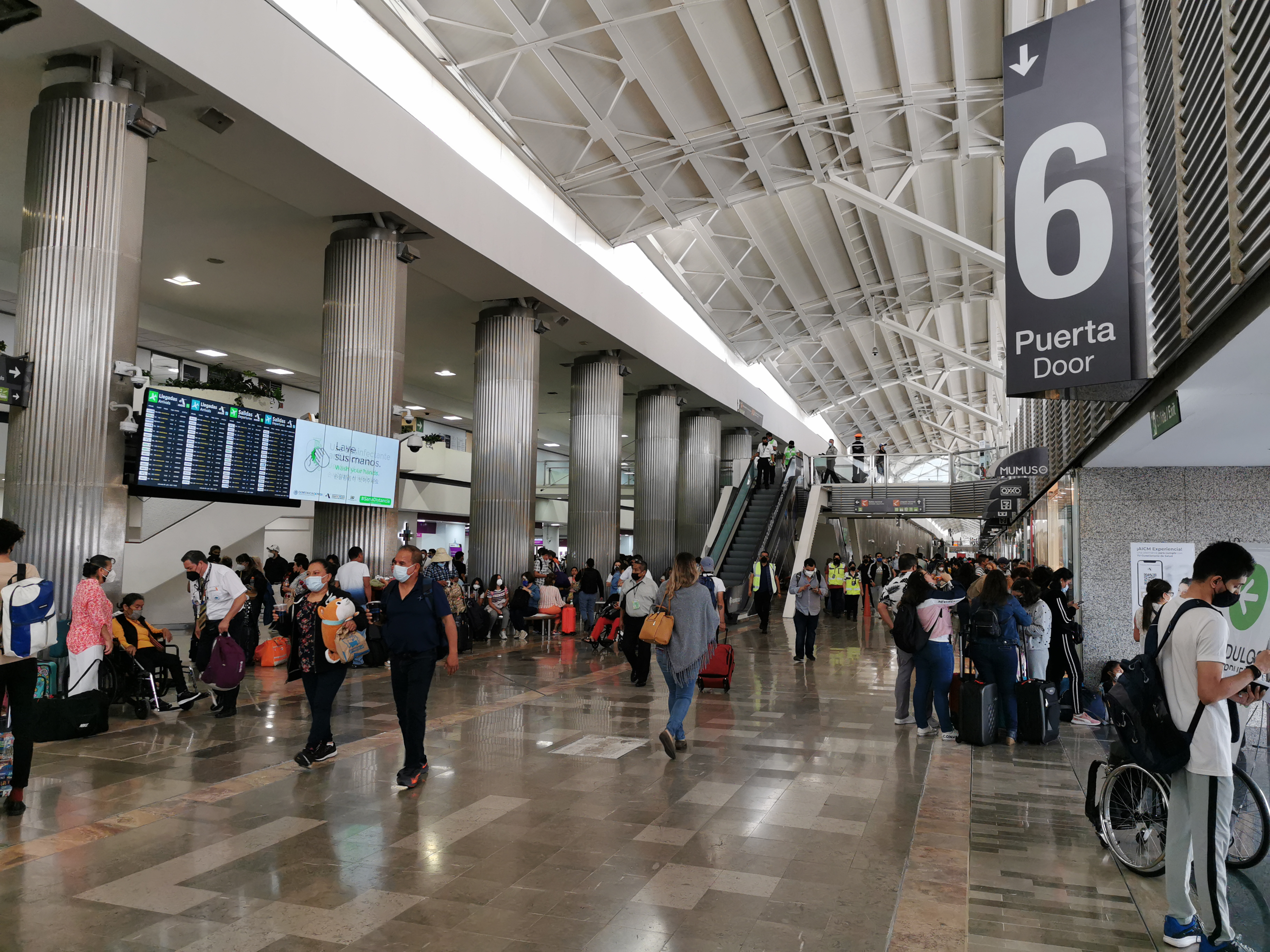
Terminal 1
Terminal 1, operational since 1958, has undergone several expansions, with major upgrades in 1970, 1989, 1998, 2000, and 2004, resulting in a total surface area of 542000 m2. The terminal is an 800 m long, two-story building, with international services located in the eastern section and domestic services in the west. The ground floor houses all arrival facilities, including 22 baggage claim carousels; domestic check-in areas for Volaris, Viva, and Magnicharters (A1, A2, B, C, D, D1), and a commercial corridor hosting snack kiosks, banks, souvenir shops and car rental services. The top floor contains international check-in areas (F1, F2, F3), food courts, restaurants, security checkpoints, and a 900 m long departures concourse (gates 1-28) connected via a walkway to a satellite building (gates 29-36).
Terminal 1 offers 33 contact gates with jet bridges and 20 remote stands. Gates 1-18 primarily serve domestic flights, while gates 19-36 cater to international routes. Passengers using remote gates are transported by bus. The terminal also houses administrative offices, two long-distance bus terminals, and parking for 5,500 vehicles.
Terminal 1 features various VIP lounges, including the Admirals Club by American Airlines, Elite Lounge by MasterCard, Salón Centurión by American Express, Salón Beyond by Citibanamex, Sala Avianca, The Grand Lounge Elite (Air France-KLM-ANA-Visa), Iberia VIP Lounge (Iberia-British Airways), Televisa VIP Lounge, Terraza Elite, The Lounge by Global Network, United Club by United Airlines, and VIPort Lounge.
Hotel services within Terminal 1 include the Camino Real with 600 rooms, the Hilton with 110 rooms, and the Courtyard Mexico City Airport with 288 rooms. Nearby hotels accessible from the terminal include izZzleep Hotel, Fiesta Inn Aeropuerto México, Holiday Inn México Dalí Aeropuerto, City Express Aeropuerto Ciudad de México, Hotel Grand Prix, Hotel Riazor, and We Hotel Aeropuerto.
Terminal 1 is served by domestic carriers such as Volaris, Viva, and Magnicharters; North American airlines including Air Canada, United Airlines, and American Airlines; European carriers such as Lufthansa, Turkish Airlines, Air France, KLM, Iberia, and British Airways; Asian airlines including All Nippon Airways, China Southern Airlines, Emirates, and Hainan Airlines; and Latin American carriers including Avianca, Avianca Costa Rica, Avianca El Salvador, LATAM Brasil, LATAM Chile, LATAM Perú, Volaris Costa Rica, and Volaris El Salvador.
Terminal 2

_Feb_2021.jpg)
Terminal 2 began operations on November 15, 2007, with inaugural flights by Delta Air Lines, followed by Aeroméxico, Copa Airlines and LATAM. It was officially inaugurated by President Felipe Calderón on March 26, 2008. Despite the initial plan for all SkyTeam member airlines to use the terminal, Air France and KLM opted to remain at Terminal 1. Terminal 2 currently serves as the main hub for Aeromexico. Due to capacity constraints at Terminal 2, some of Aeromexico's domestic services temporarily operated from Terminal 1 between 2021 and 2023.
The terminal spans 288000 m2. Arrivals are handled on the lower level, featuring 15 baggage claim carousels, customs and immigration facilities, and an arrivals hall with a long-distance bus terminal. The upper level contains three check-in areas (L1-L3), two security checkpoints, and a main concourse connected to three piers. A mezzanine level houses VIP lounges and administrative offices.
The three piers contain food courts, duty-free shops, and 30 gates (numbered 52-81), all equipped with jet bridges. The northern pier contains gates 52-62, and the southern pier has gates 63-75. In 2020, the terminal was expanded with the inauguration of Pier L, located at the southern end, adjacent to the airport's boundary with Boulevard Fuerza Aérea Mexicana. Gates 75-81, used by Aeromexico Connect services with narrow-body aircraft, are situated in this pier. Due to the building’s narrow layout, it lacks commercial amenities. Ten remote stands are also accessible via bus.
Terminal 2 includes several VIP lounges, such as the HSBC Premier Lounge, by HSBC, Salón Beyond by Citibanamex, Salón Centurión by American Express, Salón Premier Nacional and Salón Premier Internacional by Aeroméxico, Terraza Premier by Heineken and Aeroméxico, and VIPort Lounge. Hotel services include the 287-room NH Hotel, and izZzleep Hotel Terminal 2. Parking facilities accommodate 3,000 vehicles.
Terminal 2 is served by Aeroméxico, Aeroméxico Connect, Copa Airlines, and Delta Air Lines.
Inter-terminal transportation
The two terminals are 3 km apart. Passengers have two landside transport options: a bus shuttle service, branded as "inter-terminal transportation", connects Terminal 1 (Entrance 6) and Terminal 2 (Entrance 4). The Aerotrén people mover, available only to passengers with a boarding pass and airline crew, operates at a speed of 45 km/h and has a daily capacity of 7,800 passengers.
Terminal 3 (proposed)
The intended construction of Terminal 3 was cancelled during the global COVID-19 pandemic in 2020. Furthermore, the opening of the Felipe Ángeles Airport in Mexico State in 2022 may pose challenges for the Mexico City Airport in achieving pre-pandemic levels.
Airlines and destinations
Passenger
The airport serves 44 domestic and 62 international destinations across the Americas, Europe, and Asia. Aeromexico serves the largest number of cities from any Latin American hub (93 total: 44 domestic and 49 international). It also operates the highest number of departures and destinations from the airport followed by Volaris. The leading foreign airlines at the airport include United Airlines, American Airlines, Delta Air Lines and Avianca Holdings. In addition to scheduled service, the airport is also used by other carriers for charter flights, including Sunwing Airlines.
General sources:
|Aeroméxico|Acapulco, Aguascalientes, Amsterdam, Austin, Barcelona (resumes March 28, 2026), Bogotá, Boston, Buenos Aires–Ezeiza, Cali, Cancún, Cartagena, Chetumal, Chicago–O'Hare, Chihuahua, Ciudad del Carmen, Ciudad Juárez, Cozumel, Culiacán, Dallas/Fort Worth, Denver, Guadalajara, Guatemala City, Havana, Hermosillo, Houston–Intercontinental, Huatulco, La Paz, Las Vegas, León/El Bajío, Lima, London–Heathrow, Los Angeles, Madrid, Manzanillo, Mazatlán, Medellín–JMC, Mérida, Mexicali, Miami, Monterrey, Montréal–Trudeau, New York–JFK, Newark, Oaxaca, Orlando, Panama City–Tocumen, Paris–Charles de Gaulle, Philadelphia, Phoenix–Sky Harbor, Puerto Escondido, Puerto Vallarta, Punta Cana, Querétaro, Quito (resumes March 23, 2026), Reynosa, Rome–Fiumicino, Salt Lake City, San Antonio, San Francisco, San José (CR), San José del Cabo, San Luis Potosí, San Salvador, Santiago de Chile, Santo Domingo–Las Américas, São Paulo–Guarulhos, Seattle/Tacoma, Seoul–Incheon, Tampa, Tampico, Tapachula, Tijuana, Tokyo–Narita, Toronto–Pearson, Torreón/Gómez Palacio, Tulum, Tuxtla Gutiérrez, Vancouver, Veracruz, Villahermosa, Washington–Dulles |Aeroméxico Connect|Acapulco, Aguascalientes, Austin, Campeche, Chetumal, Chihuahua, Ciudad del Carmen, Ciudad Juárez, Ciudad Obregón, Cozumel, Culiacán, Durango, Guatemala City, Hermosillo, Houston–Intercontinental, Huatulco, Ixtapa/Zihuatanejo, La Paz, León/El Bajío, Los Mochis, Managua, Manzanillo, Matamoros, Mazatlán, Mérida, Minatitlán/Coatzacoalcos, Morelia, Nuevo Laredo, Oaxaca, Puerto Vallarta, Querétaro, Raleigh/Durham, Reynosa, San Antonio, San José (CR), San José del Cabo, San Luis Potosí, San Pedro Sula, Santo Domingo–Las Américas, Tampico, Tapachula, Tegucigalpa/Comayagua (resumes March 19, 2026), Tepic, Torreón/Gómez Palacio, Tuxtla Gutiérrez, Veracruz, Villahermosa, Zacatecas |Air Canada|Montréal–Trudeau, Toronto–Pearson, Vancouver |Air France|Paris–Charles de Gaulle |All Nippon Airways|Tokyo–Narita |American Airlines|Charlotte, Chicago–O'Hare, Dallas/Fort Worth,Los Angeles, Miami, New York–JFK, Phoenix–Sky Harbor |Avianca|Bogotá, Medellín–JMC |Avianca Costa Rica|San José (CR) |Avianca El Salvador|San Salvador |British Airways|London–Heathrow |China Southern Airlines|Shenzhen |Copa Airlines|Panama City–Tocumen
|Delta Air Lines|Atlanta, Detroit, Minneapolis/St. Paul, New York–JFK, Salt Lake City Seasonal: Los Angeles |Emirates|Barcelona, Dubai–International |Flair Airlines|Toronto–Pearson, |Hainan Airlines|Beijing–Capital |Iberia|Madrid |KLM|Amsterdam
|LATAM Brasil|São Paulo–Guarulhos |LATAM Chile|Santiago de Chile |LATAM Perú|Lima |Lufthansa|Frankfurt, Munich |Magnicharters|Cancún, Havana, Huatulco, Mérida |Turkish Airlines|Istanbul |United Airlines|Chicago–O'Hare, Houston–Intercontinental, Newark, San Francisco, Washington–Dulles Seasonal: Denver |Viva|Cancún, Chetumal, Chicago–O'Hare, Chihuahua, Ciudad Juárez, Dallas/Fort Worth, Guadalajara, Hermosillo, Houston–Intercontinental, Huatulco, Las Vegas, Los Angeles, Mazatlán, Mérida, Monterrey, New York–JFK, Oaxaca, Puerto Escondido, Puerto Vallarta, Reynosa, San Antonio, San José del Cabo, Tijuana, Torreón/Gómez Palacio, Tuxtla Gutiérrez, Veracruz, Villahermosa |Volaris|Acapulco, Cancún, Chetumal, Chicago–O'Hare, Chihuahua, Ciudad Juárez, Cozumel, Culiacán, Dallas/Fort Worth, Denver, Guadalajara, Guatemala City, Hermosillo, Houston–Intercontinental, Huatulco, Ixtapa/Zihuatanejo, La Paz, Las Vegas, Lima, Los Angeles, Los Mochis, Mazatlán, Mérida, Mexicali, Miami, Monterrey, Oakland, Oaxaca, Orlando, Puerto Escondido, Puerto Vallarta, Sacramento, San Antonio, San José del Cabo, Tapachula, Tijuana, Tuxtla Gutiérrez, Villahermosa |Volaris Costa Rica|Guatemala City, San José (CR) |Volaris El Salvador|San Salvador |WestJet|Calgary Notes: : Aeromexico’s flight to Seoul–Incheon operates via Monterrey, but the flight from Seoul–Incheon to Mexico City is non-stop.
: China Southern’s flights to Shenzhen make a stop in Tijuana. However, the airline does not have traffic rights to transport passengers solely between Mexico City and Tijuana. The flight from Shenzhen to Mexico City is non-stop.
: Emirates’ flights to and from Dubai make a stop in Barcelona.
: Hainan Airlines’ flights to and from Beijing–Capital make a stop in Tijuana. However, the airline does not have traffic rights to transport passengers solely between Mexico City and Tijuana.
: Turkish Airlines’ flights to Istanbul make a stop in Cancún. However, the airline does not have traffic rights to transport passengers solely between Mexico City and Cancún. The flight from Istanbul to Mexico City is non-stop.
Cargo
As of January 2022, 20 cargo airlines operated direct flights from Mexico City Airport to destinations across Europe, the Americas, the Middle East, Africa, and East Asia. However, in July 2023, a government decree relocated all cargo operations to Felipe Ángeles International Airport.
Destination maps
| {{Location map+ | Afro-Eurasia | width=930 | float=center | red | Red}} = Year-round destination |
|---|---|---|---|---|---|
| = Future destination | |||||
| = Seasonal destination | places= |
Statistics

In 2025, Mexico City International Airport handled 44,605,800 passengers, making it the busiest airport in Mexico and the third-busiest in Latin America. It held the top spot in the region from 2016 to 2023 but its market share dropped since the opening of Mexico City-AIFA International Airport. It remains the busiest airport in North America outside the United States. On a typical day, over 120,000 passengers travel through the airport.
The broader Mexico City Airport System, which includes Mexico City-AIFA International Airport and Toluca International Airport, handled 53,591,517 passengers in 2025, making it the second-busiest metropolitan airport system in Latin America and 34th globally.
For international traffic, the airport served 17,482,146 passengers, ranking second in Mexico and third in Latin America.
With 313,467 aircraft movements in 2025, it retained its position as the busiest airport in Mexico and among the most active in Latin America. Despite having only two runways, it remains one of the busiest dual-runway airports globally.
In cargo operations, the airport processed 252,555.6 tons in 2025, ranking second in the country after Mexico City-AIFA International Airport. The airport directly supports 35,000 jobs and indirectly influences another 15,000 in the surrounding area.
| Year | Domestic | % change | International | % change | Total | % change |
|---|---|---|---|---|---|---|
| 2025 | 27,123,430 | 4.0 | 17,482,146 | 2.1 | 44,605,576 | 1.7 |
| 2024 | 28,243,160 | 12.0 | 17,116,325 | 4.8 | 45,359,485 | 6.3 |
| 2023 | 32,082,959 | 1.2 | 16,332,734 | 12.1 | 48,415,693 | 4.7 |
| 2022 | 31,694,588 | 22.4 | 14,563,933 | 43.2 | 46,258,521 | 28.3 |
| 2021 | 25,883,725 | 59.9 | 10,172,889 | 75.5 | 36,056,614 | 64.0 |
| 2020 | 16,186,836 | 50.4 | 5,794,875 | 67.2 | 21,981,711 | 56.3 |
| 2019 | 32,660,267 | 7.1 | 17,647,782 | 2.6 | 50,308,049 | 5.5 |
| 2018 | 30,495,723 | 5.2 | 17,204,824 | 9.2 | 47,700,547 | 6.6 |
| 2017 | 28,979,063 | 4.8 | 15,753,355 | 12.1 | 44,732,418 | 7.2 |
| 2016 | 27,654,171 | 7.7 | 14,056,083 | 10.2 | 41,710,254 | 8.5 |
| 2015 | 25,674,622 | 12.8 | 12,758,456 | 10.9 | 38,433,078 | 12.2 |
| 2014 | 22,753,467 | 8.9 | 11,502,272 | 8.2 | 34,255,739 | 8.6 |
| 2013 | 20,900,194 | 6.2 | 10,634,444 | 8.4 | 31,534,638 | 6.9 |
| 2012 | 19,678,117 | 12.7 | 9,813,436 | 10.2 | 29,491,553 | 11.84 |
| 2011 | 17,461,438 | 12.03 | 8,907,423 | 4.26 | 26,368,861 | 9.28 |
| 2010 | 15,587,068 | 3.44 | 8,543,467 | 5.47 | 24,130,535 | 0.46 |
| 2009 | 16,142,330 | 3.8 | 8,100,726 | 14.1 | 24,243,056 | 7.5 |
| 2008 | 16,777,773 | 1.1 | 9,432,444 | 1.5 | 26,210,217 | 1.3 |
| 2007 | 16,592,422 | 4.7 | 9,289,240 | 4.6 | 25,881,662 | 4.7 |
| 2006 | 15,848,060 | 2.1 | 8,879,236 | 3.3 | 24,727,296 | 2.5 |
| 2005 | 15,523,755 | - | 8,591,797 | - | 24,115,552 | - |
| Year | Domestic | % change | International | % change | Total | % change |
|---|---|---|---|---|---|---|
| 2025 | 197,986 | 9.6 | 115,481 | 6.8 | 313,467 | 2.8 |
| 2024 | 214,333 | 14.8 | 108,094 | 3.3 | 322,427 | 11.2 |
| 2023 | 251,434 | 7.7 | 111,837 | 2.7 | 363,271 | 6.2 |
| 2022 | 272,505 | 14.7 | 114,945 | 27.3 | 387,450 | 18.2 |
| 2021 | 237,570 | 33.2 | 90,319 | 47.7 | 327,889 | 36.9 |
| 2020 | 178,247 | 45.0 | 61,120 | 55.1 | 239,367 | 48.0 |
| 2019 | 323,858 | 1.9 | 136,129 | 3.4 | 459,987 | 0.3 |
| 2018 | 317,722 | 0.7 | 140,866 | 4.9 | 458,588 | 2.0 |
| 2017 | 315,409 | 3.6 | 134,255 | 11.1 | 449,664 | 0.3 |
| 2016 | 327,273 | 4.2 | 120,874 | 7.3 | 448,150 | 5.0 |
| 2015 | 314,098 | 3.5 | 112,663 | 9.5 | 426,761 | 5.0 |
| 2014 | 307,017 | 4.3 | 102,937 | 4.7 | 409,954 | 4.4 |
| 2013 | 294,279 | 3.3 | 98,287 | 5.9 | 392,566 | 3.9 |
| 2012 | 284,971 | 7.1 | 92,772 | 10.4 | 377,743 | 7.9 |
| 2011 | 265,986 | 2.51 | 84,046 | 4.50 | 350,032 | 2.98 |
| 2010 | 259,470 | 3.3 | 80,428 | 0.5 | 339,898 | 2.4 |
| 2009 | 268,252 | 3.3 | 80,054 | 10.3 | 348,306 | 5.0 |
| 2008 | 277,294 | 3.3 | 89,267 | 2.3 | 366,561 | 3.1 |
| 2007 | 286,821 | 6.3 | 91,340 | 6.4 | 378,161 | 6.3 |
| 2006 | 269,719 | 6.8 | 85,874 | 7.1 | 355,593 | 6.9 |
| 2005 | 252,472 | - | 80,151 | - | 332,623 | - |
| Year | Domestic | % change | International | % change | Total | % change |
|---|---|---|---|---|---|---|
| 2025 | 59,077.3 | 5.7 | 193,478.3 | 5.1 | 252,555.6 | 5.1 |
| 2024 | 55,905.2 | 23.3 | 184,129.4 | 50.9 | 240,034.6 | 46.4 |
| 2023 | 72,921.4 | 16.3 | 374,965.8 | 22.5 | 447,887.2 | 21.5 |
| 2022 | 87,101.2 | 8.7 | 483,707.8 | 2.4 | 570,809.0 | 0.5 |
| 2021 | 95,377.9 | 19.9 | 472,401.2 | 21.0 | 567,779.1 | 18.4 |
| 2020 | 79,536.3 | 24.1 | 390,178.0 | 13.5 | 469,714.3 | 15.5 |
| 2019 | 104,832.5 | 3.0 | 451,309.8 | 6.0 | 556,142.3 | 4.4 |
| 2018 | 101,774.72 | 2.49 | 479,900.56 | 9.58 | 581,675.28 | 8.27 |
| 2017 | 99,303.94 | 8.15 | 437,958.75 | 11.83 | 537,262.69 | 11.13 |
| 2016 | 91,820.00 | 11.84 | 391,613.40 | 7.35 | 483,433.40 | 8.17 |
| 2015 | 82,100.42 | 21.92 | 364,814.69 | 10.14 | 446,915.11 | 12.13 |
| 2014 | 67,341.85 | 5.75 | 331,214.62 | 5.85 | 398,556.47 | 5.83 |
| 2013 | 63,678.54 | 19.05 | 312,911.31 | 1.71 | 376,589.85 | 5.15 |
| 2012 | 78,666.10 | 4.01 | 318,351.98 | 3.38 | 397,018.08 | 3.51 |
| 2011 | 81,953.37 | 3.41 | 329,502.22 | 6.90 | 411,455.59 | 4.68 |
| 2010 | 84,846.88 | 1.01 | 308,228.992 | 29.98 | 393,075.87 | 22.40 |
| 2009 | 83,999.43 | 13.47 | 237,134.01 | 15.01 | 321,133.44 | 14.61 |
| 2008 | 97,070.08 | - | 279,025.63 | - | 376,095.71 | - |
Busiest routes
| Rank | Airport | Passengers | YoY % change | Ranking | Airline(s) |
|---|---|---|---|---|---|
| 1 | Quintana Roo, Cancún | 1,665,578 | 21.66% | Aeroméxico, Magnicharters, Viva, Volaris | |
| 2 | Nuevo León, Monterrey | 1,578,366 | 9.36% | Aeroméxico, Viva, Volaris | |
| 3 | Jalisco, Guadalajara | 1,414,248 | 6.70% | Aeroméxico, Viva, Volaris | |
| 4 | Baja California, Tijuana | 1,099,156 | 9.00% | Aeroméxico, Viva, Volaris | |
| 5 | Yucatán, Mérida | 843,225 | 11.44% | Aeroméxico, Aeroméxico Connect, Magnicharters, Viva, Volaris | |
| 6 | Jalisco, Puerto Vallarta | 514,591 | 9.48% | Aeroméxico, Aeroméxico Connect, Viva, Volaris | |
| 7 | Sonora, Hermosillo | 441,719 | 10.11% | 1 | Aeroméxico, Aeroméxico Connect, Viva, Volaris |
| 8 | Tabasco, Villahermosa | 437,941 | 1.62% | 3 | Aeroméxico, Aeroméxico Connect, Viva, Volaris |
| 9 | Baja California Sur, San José del Cabo | 413,573 | 23.77% | 2 | Aeroméxico, Aeroméxico Connect, Viva, Volaris |
| 10 | Chihuahua, Chihuahua | 390,318 | 1.24% | 2 | Aeroméxico, Aeroméxico Connect, Viva, Volaris |
| 11 | Chiapas, Tuxtla Gutiérrez | 388,054 | 13.12% | 1 | Aeroméxico, Aeroméxico Connect, Viva, Volaris |
| 12 | Chihuahua, Ciudad Juárez | 377,685 | 18.37% | 3 | Aeroméxico, Aeroméxico Connect, Viva, Volaris |
| 13 | Oaxaca, Oaxaca | 335,090 | 6.65% | Aeroméxico, Aeroméxico Connect, Viva, Volaris | |
| 14 | Sinaloa, Mazatlán | 308,599 | 10.10% | 3 | Aeroméxico, Aeroméxico Connect, Viva, Volaris |
| 15 | Veracruz, Veracruz | 285,909 | 3.98% | 3 | Aeroméxico, Aeroméxico Connect, Viva |
| 16 | Oaxaca, Huatulco | 260,362 | 21.78% | 2 | Aeroméxico, Aeroméxico Connect, Magnicharters, Viva, Volaris |
| 17 | Oaxaca, Puerto Escondido | 259,398 | 21.98% | 2 | Aeroméxico, Viva, Volaris |
| 28 | Coahuila, Torreón | 257,315 | 0.19% | 2 | Aeroméxico, Aeroméxico Connect, Viva |
| 19 | Sinaloa, Culiacán | 219,021 | 16.74% | Aeroméxico, Aeroméxico Connect, Volaris | |
| 20 | Baja California, Mexicali | 202,729 | 35.62% | 4 | Aeroméxico, Volaris |
| Rank | Airport | Passengers | YoY % change | Ranking | Airline(s) |
|---|---|---|---|---|---|
| 1 | Spain, Madrid | 577,191 | 11.59% | Aeroméxico, Iberia | |
| 2 | United States, Los Angeles | 470,894 | 5.50% | Aeroméxico, American Airlines, Delta Air Lines, Viva, Volaris | |
| 3 | Colombia, Bogotá | 442,118 | 3.62% | 1 | Aeroméxico, Avianca, Volaris |
| 4 | United States, Houston–Intercontinental | 423,418 | 3.88% | 1 | Aeroméxico, Aeroméxico Connect, United Airlines, Viva, Volaris |
| 5 | United States, Miami | 402,019 | 4.88% | Aeroméxico, American Airlines, Volaris | |
| 6 | United States, New York–JFK | 399,756 | 9.46% | Aeroméxico, American Airlines, Delta Air Lines, Viva | |
| 7 | United States, Chicago–O'Hare | 384,979 | 12.48% | Aeroméxico, American Airlines, United Airlines, Viva, Volaris | |
| 8 | United States, Dallas/Fort Worth | 301,215 | 7.55% | Aeroméxico Connect, American Airlines, Viva, Volaris | |
| 9 | France, Paris–Charles de Gaulle | 292,871 | 10.24% | Aeroméxico, Air France | |
| 10 | Panama, Panama City–Tocumen | 262,658 | 5.65% | Aeroméxico, Copa Airlines | |
| 11 | United States, Atlanta | 256,915 | 5.87% | Delta Air Lines | |
| 12 | United States, San Francisco | 244,586 | 3.18% | Aeroméxico, United Airlines | |
| 13 | Costa Rica, San José (CR) | 203,395 | 3.24% | 2 | Aeroméxico, Aeroméxico Connect, Avianca Costa Rica, Volaris Costa Rica |
| 14 | United States, Las Vegas | 201,574 | 4.08% | 3 | Aeroméxico, Viva, Volaris |
| 15 | Guatemala, Guatemala City | 199,856 | 3.02% | 1 | Aeroméxico, Aeroméxico Connect, Volaris Costa Rica |
| 16 | United States, Orlando | 199,505 | 0.10% | 2 | Aeroméxico, Volaris |
| 17 | The Netherlands, Amsterdam | 172,148 | 6.16% | 2 | Aeroméxico, KLM |
| 18 | Peru, Lima | 168,866 | 4.77% | 2 | Aeroméxico, LATAM Perú, Volaris |
| 19 | United States, San Antonio | 164,547 | 9.61% | 2 | Aeroméxico, Aeroméxico Connect, Viva, Volaris |
| 20 | Canada, Toronto-Pearson | 163,185 | 22.33% | 7 | Aeroméxico, Air Canada |
Ground transportation

Metrobús
Metrobús Line 4 provides direct express service between both terminals and San Lázaro Metro Station. San Lázaro Metro Station is served by Metro Lines 1 and B, and located adjacent to the TAPO (Terminal de Autobuses de Pasajeros de Oriente), the largest long-distance bus terminal in Mexico City. TAPO offers bus services to central, eastern, and southern Mexico.
Metrobús stops are located at Entrance 7 of Terminal 1 and Entrance 2 of Terminal 2. Passengers can access the service by obtaining a Metrobús Card from vending machines at these bus stops. The fare to San Lázaro is 30 Mexican Pesos, with the card itself costing 21 pesos as of 2024. Service operates daily from 05:00 to 00:00.
| Service | Destinations [departing from the airport] | Operator | |||
|---|---|---|---|---|---|
| [[File:Mexico City Metrobús Line 4 icon.svg | 20px | link=Mexico City Metrobús Line 4]] | San Lázaro Metro Station/(TAPO bus terminal) | [[File:Movilidad Integrada (logo) Metrobús de la CDMX.svg | 30px]] Metrobús |
Metro Station
Terminal 1 is connected to the Terminal Aérea metro station, which is part of Mexico City Metro Line 5 running from Pantitlán to Politécnico. It is linked to Terminal 1 through an open-air walkway starting at Entrance 1. Terminal Aérea is also served by Trolleybus line 4 northbound, which follows a route similar to Metro Line 2 before diverging toward El Rosario metro station.
Terminal 2 lacks a nearby metro station. However, it is within 800 m of Pantitlán metro station, served by Metro Lines 1, 5, 9, A, and multiple local bus routes.
Long-distance Buses
In Terminal 1, the long-distance bus terminal, also known as Terminal de Autobuses or Autobuses Foráneos, serves various bus companies. Access is from the international departures section on the top floor, near the food court, through an elevated walkway spanning the entrance road. Ticketing counters are available, and platforms can be reached via escalators to the ground floor.
Terminal 1 also features a private terminal for the ADO bus company, named ADO Llegadas Nacionales. Situated next to the Hotel Camino Real, it can be accessed through a secondary elevated walkway spanning the entrance road. This walkway begins at the domestic section on the top floor, in front of Hall B, above Entrance 4.
In Terminal 2, the long-distance bus terminal, labeled "Transportación Terrestre," or "Autobuses Foráneos" is located on the ground floor next to arrivals Hall Q.
| Terminal 1 Terminal de Autobuses Foráneos | Bus Company | Type of Service | Destinations | 'Terminal 1 ADO Llegadas Nacionales''''' | Terminal 2 *Autobuses Foráneos* |
|---|---|---|---|---|---|
| ADO | Long distance coach | Puebla CAPU, Puebla Paseo Destino | |||
| ADO conecta | Shuttle service | Mexico City-AIFA | |||
| Caminante | Long distance coach | Toluca Tollocan | |||
| Estrella Blanca | Pachuca | ||||
| Estrella Roja | Puebla CAPU, Puebla Paseo Destino | ||||
| Primera Plus | Querétaro Central, Querétaro 5 de Febrero, Celaya, San Juan del Río | ||||
| Pullman de Morelos | Cuernavaca Casino | ||||
| ADO | Long distance couch | Córdoba, Orizaba, Veracruz | |||
| ADO Aeropuerto | Shuttle service | Xalapa | |||
| ADO GL | First class long-distance coach | Oaxaca | |||
| Diamante | Long distance coach | Acapulco Costera | |||
| ADO | Long distance coach | Puebla CAPU, Puebla Paseo Destino | |||
| Caminante | Toluca Tollocan | ||||
| Estrella Roja | Puebla CAPU, Puebla Paseo Destino | ||||
| Primera Plus | Querétaro Central, Querétaro 5 de Febrero, Celaya, San Juan del Río |
Bus service to Felipe Angeles Airport
Transportation options to Mexico City’s secondary airport, Felipe Ángeles International Airport, are limited. Shuttle services from Terminal 1 are provided by ADO and Aeropuertos y Servicios Auxiliares.
Authorized taxis
Taxis operate in Terminals 1 and 2 and there are two models of service: ordinary service in a sedan-type vehicle for four passengers, and executive service in eight-passenger vans. There are five taxi groups in operation, and these are the only taxis authorized by the Mexican Department of Transportation (SCT).
Accidents and incidents
- On September 26, 1949, a Mexicana de Aviacion DC-3 crashed into the Popocatepetl volcano while approaching the airport with clouds and turbulence en route from Tapachula; all 23 people on board, including actress Blanca Estela Pavon and senator Gabriel Ramos Millan, died.
- On April 10, 1968, an Aerovías Rojas Douglas R4D-3 crashed on approach, killing all eighteen people on board. The aircraft was operating a domestic scheduled passenger flight, which was the airline's inaugural flight from Aguascalientes International Airport to Mexico City.
- On October 31, 1979, Western Airlines Flight 2605 crash-landed. The crew of the DC-10 landed on a closed runway and hit construction vehicles on the runway. There were 73 fatalities (including one on the ground) and 16 survivors.
- On December 12, 1981, a bomb exploded inside the passenger cabin of a parked Aeronica Boeing 727-100, tearing a hole into the fuselage. The captain, two flight attendants, and a groundworker were injured. They had been on board the aircraft for pre-departure checks for a scheduled passenger flight to San Salvador and onwards to Managua's Augusto C. Sandino International Airport.
- An Aero California DC-9-15 overran a runway on July 21, 2004, during an intense storm at the airport. The torrential downpour was so intense that visibility was barely 50 meters. The control tower had to ask that several vehicles go out to comb the airfield to find out where the aircraft was. There were no victims, but the aircraft was scrapped. A woman died later due to a heart attack.
- On November 4, 2008, a Mexican Interior Ministry LearJet 45 crashed on approach around 18:45 local time. On board was Mexican Secretary of the Interior Juan Camilo Mouriño, who was a top aide to President Felipe Calderón. Mouriño was in charge of the fight against the drug trade in Mexico. Also on board was José Luis Santiago Vasconcelos, former assistant attorney general and current head of the federal technical secretariat for implementing the recent constitutional reforms on criminal justice and public security. All eight on board died, along with eight others on the ground. 40 others on the ground were injured. The crash was attributed to pilot error.
- On September 9, 2009, hijacked Aeroméxico Flight 576 landed at Mexico City International Airport from Cancún International Airport.
- On September 13, 2009, a Lufthansa Cargo McDonnell-Douglas MD-11 was damaged in a heavy landing. Post-landing inspection revealed that there were wrinkles in the fuselage skin and the nose gear was bent. According to a Lufthansa spokesman, the aircraft would be repaired and returned to full service.
References
References
- "Airport information for MMMX".
- {{GCM. MEX
- (December 2025). "AICM in Numbers, December 2025".
- (2024-09-23). "José Ramón Rivera, director del AICM: "El desorden que había con las aerolíneas está resuelto"".
- Tomás Serebrisky. "Airport Economics in Latin America and the Caribbean". The World Bank.
- (April 2023). "2022 Airport Traffic Report". Port Authority of New York and New Jersey.
- (October 5, 2006). "Decretará Fox que el AICM se denomine Benito Juárez".
- (June 11, 2020). "IATA respalda cancelación de la Terminal 3 y suspensión de adquisición del Aeropuerto de Toluca". El Universal (México).
- "Mexican-americans in aviation online exhibition".
- "Conquistador of the Sky: A History of Aviation in Latin America".
- "Mexico's 100 years of flying taking off to new heights!".
- "A brief Mexican History aviation".
- (February 15, 2006). "Mexicana De Aviacion celebrates 70th anniversary".
- "One more year of Mexico City International Airport (In Spanish)".
- ""Breve Historia del Aeropuerto Internacional de la Ciudad de México", Mexico City International Airport".
- (1993). "Obras".
- "A New Airport for Mexico City?". MexDFmagazine.
- Historic photo at [http://www.flyapm.com/foro/viewtopic.php?f=2&t=139 FlyAPM site]
- (July 5, 2007). "Mexico City airport unable to keep up; Facility relies on 2 runways that modern jets can't use at the same time".
- (2011-09-20). "Hakim Grupo Industrial El caballo de".
- Sherman, Paul. (1993-10-10). "TRAVEL ADVISORY; Mexico City Adds Terminal To Airport". The New York Times.
- (January 13, 1994). "DECRETO que establece el cierre del Aeropuerto Internacional de la Ciudad de México Benito Juárez (in Spanish)".
- (January 3, 2000). "Iniciaría en febrero la ampliación del AICM (in Spanish)". El Universal.
- (August 3, 2002). "Mexico drops planned airport after protests from peasants". The New York Times.
- "Mexico City ponders a second airport, again".
- (December 5, 2011). "Airports in Mexico – 13 Years After Privatization".
- (June 22, 2023). "These Bizarre Bus-Like Mobile Lounges Tried To Revolutionize Airports, Now They're Relics Of The Past".
- (July 12, 2017). "Truck Trend Legends: The Mobile Lounge".
- "Mexico City inaugurates new airport terminal". USA Today.
- (2014-09-29). "DECLARATORIA de saturación en el campo aéreo del Aeropuerto Internacional de la Ciudad de México". Diario Oficial de la Federación.
- "New Mexico City International Airport". CAPA Centre for Aviation.
- (September 4, 2014). "UPDATE 1-Mexico eyes foreign builder, local partners for $9 bln airport". [[Reuters]].
- Uphoff, Rainer. (September 4, 2014). "Mexico to open new mega airport in 2018". [[Flightglobal]].
- [https://www.csmonitor.com/World/Americas/2014/0903/Ready-for-landing-Mexico-City-airport-expansion-could-make-it-one-of-largest-in-world "Ready for landing: Mexico City airport expansion could make it one of largest in world", ''Christian Science Monitor'', 2014-09-03]
- Luhnow, David. (September 2, 2014). "Mexico Plans New $9.2 Billion Airport". [[The Wall Street Journal]].
- Alissa Walker. (September 3, 2014). "Mexico City's New Mega-Airport Will Collect Its Own Energy and Water".
- "Close".
- (12 December 2018). "IATA: Cancellation of Mexico airport construction to cost over $5 billion".
- (January 10, 2024). "Mexico's airline industry continues to lose interest: specialists".
- (April 22, 2025). "Access to AIFA Struggles After Costly Transport Service Ends".
- (June 6, 2024). "Mexico expands new airport after forced move of cargo flights".
- (January 14, 2025). ["AICM Gets MX$8 Billion Renovation for 2026 World Cup"](https://mexicobusiness.news/aerospace/news/aicm-gets-mx8-billion-renovation-2026-world-cup#:~:text=Mexico%20City's%20International%20Airport%20(AICM,the%20airport's%20infrastructure%20and%20security.).
- (January 13, 2025). "Anuncian remodelación del AICM rumbo al Mundial 2026 con inversión de 8 mmdp".
- "Unplanned airport planning in Mexico City".
- "The Boeing 727 JATO Option".
- "Disgruntled neighbours by noise pollution in Mexico City".
- "ASA's address".
- Retrieved on December 20, 2011. "Av.602 No.161 Col.Zona Federal Aeropuerto Internacional Ciudad de México Delegación Venustiano Carranza, C.P.15620, México D.F."
- (22 July 2020). "Estrenan Base Aérea Militar con regreso del Avión Presidencial".
- "Bases Aéreas. Secretaría de la Defensa Nacional.".
- "Air Traffic Control Services".
- (September 13, 2013). "Interactive Map".
- (August 3, 2023). "AICM cancels Aeromexico's operations at T1".
- "Entra en operaciones el Dedo "L" de la T2 del AICM".
- "Terminals Mexico City Benito Juarez Airport".
- "Automated People Mover".
- "Aeromexico, The Airline Serving The Largest Number Of Cities From A Hub In Latin America".
- (2026-01-05). "Flights from Mexico City (MEX)".
- "Direct (non-stop) flights from Mexico City (MEX) - FlightsFrom.com".
- (2022-06-25). "Airlines flying to Mexico City Airport (MEX)".
- directflights.com. "Direct flights from Mexico City - 103 destinations - MEX, Mexico".
- (2013-08-16). "Flight information – Aeropuerto Internacional de la Ciudad de México".
- "Live Flight Tracker - Real-Time Flight Tracker Map".
- "Mexico City destinations – 103 routes (2026)".
- "Aeromexico Flights from Mexico City".
- Medrano, Fernando. (10 July 2025). "Confirman ampliación del Aeropuerto Internacional de Aguascalientes". NW.noticias.
- Medrano, Fernando. "Se ampliará oferta de vuelos Ags – CDMX".
- (5 May 2025). "Aeroméxico conecta Europa con siete destinos clave en México". El Economista.
- (November 2025). "Aeromexico announces new routes to Barcelona and Paris for 2026".
- Rainer Nieves Dolande. (8 May 2023). "Delta Air Lines programa vuelos entre Boston y Ciudad de México". Avacionline.
- (13 February 2025). "Aeroméxico announces 7 new routes, continuing its post-bankruptcy comeback". Mexico News Daily.
- (18 October 2017). "Gobierno de Chihuahua celebra que Aeroméxico se sume a política de crecimiento económico". Noticias Chihuahua.
- (1 September 2010). "Abre Aeroméxico rutas a Mexicali desde México, Monterrey y Guadalajara". Zócalo.
- "Aeromexico NW24 US Network Additions".
- (October 22, 2024). "Aeromexico adds new nonstop flight to Phoenix Sky Harbor". abc15 Arizona.
- (October 2025). "Aeroméxico resumes suspended international route in March 2026".
- (July 2023). "Aeroméxico makes adjustments to its international itineraries for the winter".
- (Aug 2025). "Aeromexico Adds Mexico City – Tulum Service in NW25".
- Clabaugh, Jeff. (2 July 2024). "Aeromexico launches nonstops from Dulles to Mexico City". WTOP.com.
- (Jan 2026). "AeroMexico Resume Direct Flights between Mexico City and Tegucigalpa".
- "Montreal, QC, Canada YMQ".
- "Toronto, ON, Canada YTO".
- "Vancouver, BC, Canada YVR".
- (17 May 2021). "AIR FRANCE. Nueva frecuencia en la ruta con Ciudad de México". LADEVi.
- (17 February 2022). "El único vuelo entre México y Japón que sobrevive a la pandemia se queda en AICM Expansión". Lado.mx.
- (July 2025). "American Airlines will increase flight frequencies to Mexico".
- Salerno, Michael. (22 October 2024). "Aeromexico returns to Phoenix Sky Harbor after a decade. Here's where they'll take you". Arizona Republic.
- Martínez, Juan. (23 September 2025). "Avianca aumenta frecuencia entre San Salvador y Ciudad de México". El Salvador.com.
- (31 July 2024). "British Airways reduce sus frecuencias con Ciudad de México". Expreso.
- (27 September 2022). "Copa Airlines inaugura nuevo vuelo a ciudad de México". Oye Lo Bueno.
- (29 April 2025). "Delta 2H25 Mexico City Service Changes".
- "Dubai, United Arab Emirates DXB".
- (July 2025). "Flair Airlines to launch cheap Vancouver flights to Mexico City".
- Torres, Alejandro. (13 July 2024). "Hainan Airlines reinicia operaciones en Ciudad de México con dos frecuencias". Infoaviacion.com.mx.
- Torres, Michelle. (19 March 2024). "Va iberia por consolidar sus tres vuelos diarios a México".
- (2 November 2022). "KLM en México, 70 años de conectar grandes ciudades". Concierge.
- (27 October 2022). "KLM celebra 70 años de presencia en México".
- (29 May 2025). "LATAM traslada en junio sus operaciones a la Terminal 1 del Aeropuerto de la Ciudad de México". Aviacion al Dia.
- Rainer Nieves Dolande. (14 December 2022). "Lufthansa retomará sus vuelos entre Múnich y Ciudad de México".
- (24 August 2025). "Turkish Airlines' Strategic Expansion in the Region".
- Miriam Paredes. (28 August 2024). "Turkish Airlines quiere expandir alas en México en esta fecha". Dinero en Imagen.
- (April 2025). "United Plans More International Routes". AirlineGeeks.com.
- (4 July 2018). "Volaris incrementa de 3 a 6 frecuencias semanales en la ruta Mexico Chetumal".
- (11 December 2012). "Volaris inició operaciones en Denver, Colorado".
- "Calgary, AB, Canada YYC".
- (2023-02-03). "El Gobierno cierra por decreto el aeropuerto de la Ciudad de México a los vuelos de carga". El País.
- (2023-02-02). "Decreto que establece el cierre del Aeropuerto Internacional de la Ciudad de México Benito Juárez, para las operaciones del servicio al público de transporte aéreo que se indica".
- (July 19, 2023). "ACI World confirms top 20 busiest airports worldwide".
- "Benito Juárez International airport - Economic and social impacts".
- (January 2025). "Estadística operacional por origen-destino / Traffic Statistics by City Pairs". Agencia Federal de Aviación Civil.
- (September 11, 2013). "Metrobus". Mexico City International Airport.
- "Buses at AICM".
- (August 24, 2017). "Blanca Estela Pavón y el campesino que informó su muerte a orillas del Popo".
- "XA-GEV Accident description".
- "WA2605 Accident description".
- "Flight WA2605 crash photo".
- "Commercial airline bombing history".
- "XA-BCS Accident description (in Spanish)".
- "Plane crash kills Mexico's deputy leader".
- "Bolivian man acted alone in Mexico hijacking.".
- "Accident: Lufthansa Cargo MD11 at Mexico City on Sep 13th 2009, hard landing".
- (October 16, 2009). "Lufthansa Cargo wird D-ALCO in Stand setzen".
This article was imported from Wikipedia and is available under the Creative Commons Attribution-ShareAlike 4.0 License. Content has been adapted to SurfDoc format. Original contributors can be found on the article history page.
Ask Mako anything about Mexico City International Airport — get instant answers, deeper analysis, and related topics.
Research with MakoFree with your Surf account
Create a free account to save articles, ask Mako questions, and organize your research.
Sign up freeThis content may have been generated or modified by AI. CloudSurf Software LLC is not responsible for the accuracy, completeness, or reliability of AI-generated content. Always verify important information from primary sources.
Report