From Surf Wiki (app.surf) — the open knowledge base
Metropolitan Atlanta Rapid Transit Authority
Public transit operator in Metro Atlanta, Georgia
Public transit operator in Metro Atlanta, Georgia
| Field | Value | ||
|---|---|---|---|
| name | Metropolitan Atlanta | ||
| Rapid Transit Authority | |||
| image | Metropolitan Atlanta Rapid Transit Authority (logo).svgclass=skin-invert | ||
| image2 | Marta atlanta skyline.jpg | ||
| image3 | MARTA Rail Map.svgclass=skin-invert | ||
| caption2 | MARTA Rail System | ||
| caption3 | System map | ||
| locale | Atlanta, Georgia | ||
| transit_type | {{Plainlist | ||
| lines | {{ubl | class=nowrap | |
| stations | 38 (rail) | ||
| 12 (streetcar) | |||
| annual_ridership | {{Unbulleted list | ||
| daily_ridership | {{Unbulleted list | ||
| headquarters | Atlanta, Georgia | ||
| website | |||
| began_operation | (buses) | ||
| (rail) | |||
| system_length | 48 mi | ||
| track_gauge | |||
| top_speed | 70 mph | ||
| el | (rapid transit) | ||
| (streetcar) | |||
| line_number | Red Line | ||
| Gold Line | |||
| Blue Line | |||
| Green Line | |||
| Streetcar Line | |||
Rapid Transit Authority
- Bus
- Bus rapid transit
- Paratransit
- Rapid transit (heavy rail)
- Streetcar |Bus: 113 |Bus rapid transit: 1 |Rail rapid transit: 4 |Streetcar: 1 12 (streetcar) | (total, ) | (bus, ) | (rail, ) | (streetcar, ) | (total, ) | (bus, ) | (rail, ) | (streetcar, ) (rail) (streetcar) Gold Line Blue Line Green Line Streetcar Line
The Metropolitan Atlanta Rapid Transit Authority (MARTA ) is the principal public transport operator in the Atlanta metropolitan area. Formed in 1971 as strictly a bus system, MARTA operates a network of bus routes linked to a rapid transit system consisting of 48 mi of rail track with 38 subway stations. MARTA's rapid transit system is the eighth-largest rapid transit system in the United States by ridership.
MARTA operates almost exclusively in Fulton, Clayton, and DeKalb counties, although they maintain bus service to two destinations in neighboring Cobb County (Six Flags Over Georgia and the Cumberland Transfer Center next to the Cumberland Mall which offers a connection to many CobbLinc bus services), while Doraville station serves portions of Gwinnett County via Ride Gwinnett buses. MARTA also operates MARTA Mobility, a separate paratransit service for disabled customers.
In , the entire system (bus and subway lines) had rides, or about per weekday in .
After 2000, expansion of the MARTA system stalled, after the completion of three new rail stations north of the Interstate 285. In 2016, Atlanta voters approved a historic sales tax increase to raise $2.7 billion over 40 years, in order to significantly expand the MARTA system (dubbed the More MARTA program), including 29 miles of light rail transit, 13 miles of bus rapid transit, arterial rapid transit, transit centers and multiple infill MARTA stations. Since its inception, the More MARTA program has been criticized for slow progress, delays, and reversals on executing its list of expansion projects.
History
Main article: History of Metropolitan Atlanta Rapid Transit Authority
Beginnings
MARTA was proposed as a rapid transit agency for DeKalb, Fulton, Clayton, Gwinnett, and Cobb counties. These were the five original counties in the Atlanta metropolitan area, and to this day are the five largest counties in the region and state. MARTA was formed by an act of the Georgia General Assembly in 1965. In the same year, four of the five metropolitan area counties (Clayton, DeKalb, Fulton, and Gwinnett) and the City of Atlanta passed a referendum authorizing participation in the system, but the referendum failed in Cobb.
Although a 1968 referendum to fund MARTA failed, in 1971, voters in Fulton and DeKalb counties successfully passed a 1% sales tax increase to pay for MARTA operations, while Clayton and Gwinnett counties overwhelmingly rejected the tax in the referendum. Gwinnett County remains outside of the MARTA system. In November 2014, however, Clayton County voters passed a 1% sales tax to join the MARTA system, reversing its 1971 decision.
Also in 1971, the agency agreed to purchase the existing, bus-only Atlanta Transit Company; the sale of the company closed on February 17, 1972, giving the agency control over all public transit in the immediate Atlanta area.
Heavy rail system
Construction began on MARTA's heavy rail system in 1975, with the first rail service commencing on June 30, 1979.
Georgia State University was contracted to undergo archaeological excavations of rail construction areas in the late 1970s with the MARTA Archeology Project. Artifacts from the excavations are still housed at GSU.
In December 2000, MARTA opened the final three MARTA rail stations to be built, Dunwoody, Sandy Springs and North Springs - all north of the Interstate 285 Perimeter. The tracks to those stations were run on the surface of the median strip of Georgia 400, which was constructed just east of the Buckhead area as a tollway during the early 1990s. This is one of just two places at which the MARTA rail system extends outside of Interstate 285. The other is at the Indian Creek Station in eastern DeKalb County.
Since 2000, there have been no active railway expansion projects in the MARTA system due to lack of additional sales-tax funding, the need to spend its limited capital budget on refurbishing its older rolling stock, replacing the fare-collection system, repairing the tracks and their electrical systems, and other long-term maintenance, repair, and operations requirements.
Memorial Drive BRT
On September 27, 2010, MARTA opened a bus rapid transit line along Memorial Drive from Kensington Station to the Goldsmith Road MARTA park and ride lot in Stone Mountain and Ponce De Leon Avenue. The bus had two routes: The Q Express runs between MARTA's Kensington Station and a free 150-car Park-and-Ride lot at Goldsmith Road & Memorial Drive; The Express only stops twice along the way at North Hairston Road and again at Georgia Perimeter College.
The Q Limited also ran north along Memorial Drive from Kensington Station but branched off at North Hairston Road on the way to East Ponce de Leon Avenue. The Q Limited had four stops along the way in addition the same stops for the Express The implementation of revenue-collecting service had initially been planned for early 2009. Due to low ridership, BRT service was discontinued.
Expansion to Clayton County
Main article: Clayton County commuter rail
On July 5, 2014, the Clayton County Board of Commissioners, by a margin of 3-1 (Jeff Turner, Shana Rooks, and Sonna Gregory voting in favor,) approved a contract with MARTA to extend service to the county, financed by a 1 percent sales tax. Fulton and DeKalb county leaders approved the expansion. On November 4, 2014, Clayton County residents approved the 1% sales tax to join MARTA. Bus service was implemented on March 21, 2015. The contract also includes provisions for future rail transit to the county by 2025.
In 2018, commuter rail was selected as the locally preferred alternative of transit mode along the Clayton county corridor, with plans to construct a line from East Point station to Jonesboro and Lovejoy. Those plans fell apart after the Norfolk Southern Railway said it would not allow MARTA to use its track.
Expansion to Gwinnett County
In September 2018, MARTA's board of directors and the Gwinnett County Board of Commissioners gave conditional approval to an agreement that would see MARTA assume, and significantly expand, operations of Gwinnett's bus system (in operation since 2001) and clear the way for the long-sought-after extension of MARTA's rail system into the county from its current terminus at Doraville. The population of Gwinnett County has significantly increased, and become more racially and ethnically diverse, since 1990, the last time the county rejected joining MARTA. Whereas white business elites were the initial demographic to support the MARTA in 1965, most black voters had voted to fund transit. Large communities of rural white Georgians opposed MARTA.
The original plan in 2018 includes a detailed multi-year plan to expand heavy rail rapid transit in Gwinnett County. Some aspects of the Connect Gwinnett plan will include a train that runs every ten minutes, and also get more buses to take people to the MARTA station. This was possible because Georgia Legislature permitted counties to raise taxes to fund transit, which before was not allowed. The contract with MARTA would go into effect only if a public vote, that was scheduled for March 19, 2019, succeeded. The agreement called for a new one-cent sales tax that would be collected in Gwinnett County until 2057. On March 19, 2019, the third transit referendum failed, with 54.32% of the vote being "No" to expand. A fourth transit referendum was added to the ballot during the 2020 presidential election, which failed by a margin of slightly more than 1,000 voters as 50.13% of voters chose to vote against the referendum.
More MARTA program
In November 2016, 71% of Atlanta voters approved a half-penny sales tax increase to fund "More MARTA" projects, projected to raise $2.7 billion over 40 years, in order to significantly expand MARTA by constructing additional bus rapid transit and light rail lines, and multiple and infill stations. In October 2018, MARTA's board approved and allocated funding towards a comprehensive list of "More MARTA" projects, including 29 miles of light rail transit (LRT), 13 miles of bus rapid transit (BRT), arterial rapid transit (ART), transit centers and 15 MARTA stations:
- Beltline Northeast LRT
- Beltline Northwest LRT
- Beltline Southwest LRT
- Beltline Southeast LRT
- Campbellton Rd LRT
- Clifton Corridor LRT
- Atlanta Streetcar Downtown East Extension
- Atlanta Streetcar Downtown West Extension
- Capitol Ave BRT
- North Ave-Hollowell Parkway BRT
- Northside Drive BRT
- Peachtree Road BRT
- Cleveland Ave ART
- Metropolitan Parkway ART
- Greenbriar Transit Center
- Moores Mill Transit Center
In March 2023, MARTA significantly scaled back its list of projects prioritized for delivery by 2028, to six transit lines and the renovation and construction of 3 transit stations. Among those prioritized projects included the Summerhill, Campbellton, and Clifton Corridor BRTs, the Atlanta Streetcar Downtown East Extension to Ponce City Market, reconstruction of Five Points station, and a platform extension at Bankhead station. Other projects, including Beltline LRT at other corridors, transit centers, and the Streetcar Downtown West Extension, were deprioritized. In response to the announcement, the Atlanta City Council unanimously approved an independent audit of More MARTA's program revenues and expenditures. MARTA has been criticized for slow progress on its More MARTA expansion, rising costs, and ongoing delays.
In June 2023, MARTA selected a designer extend the Atlanta Streetcar to the Beltline. Construction of the $230 million was set to begin in 2025. In March 2025, Atlanta mayor Andre Dickens withdrew his support from the Streetcar East Extension, and reprioritized a streetcar extension into the Southside corridor instead. Various lobbying groups, including Better Atlanta Transit had lobbied against this extension, while advocates of Beltline transit, including Beltline Rail Now criticized the late-breaking decision.
In March 2024, Mayor Andre Dickens announced that four new infill stations would be constructed across the network, including at Murphy Crossing – intersecting with the Beltline – as well as at Krog Street, Joseph E. Boone, and Armour Yards.
In June 2024, MARTA began construction on the Summerhill BRT, MARTA's first new transit line in 2 decades and Atlanta's first BRT line. The $91 million project was projected to be complete in spring 2025. The 5-mile (8-kilometer) line will run from downtown Atlanta, through Summerhill, and end at the Atlanta Beltline. The line, named the "MARTA Rapid A Line", will utilize new 60 ft articulated electric buses. In April 2025, completion of construction was delayed to 2026, due to construction issues.
In July 2024, MARTA paused a $230 million renovation project of Five Points station, due to opposition from the Atlanta City Council and mayor, due to the project's impact to pedestrians and bus service. In April 2025, MARTA announced plans to resume the renovation project in preparation for the 2026 World Cup.
In August 2024, a city audit found that $70 million of the More MARTA capital fund intended for capital projects, had been siphoned to cover MARTA operational expenses. The audit also found that the sales tax had raised $493 million in More MARTA funding from fiscal years 2017 to 2023, while $69 million had been spent during that time period. In March 2025, MARTA disputed the audit findings, citing that another audit that found MARTA owed only $865,000 to the More MARTA capital fund.
System
MARTA is composed of a heavy rail rapid transit system, a light rail system, and a bus system, all of which operate primarily within the boundaries of Fulton, Clayton and DeKalb counties. In addition to Atlanta itself, the transit agency serves various suburbs within its service area, including Alpharetta, Avondale Estates, Brookhaven, Chamblee, Clarkston, College Park, Decatur, Doraville, Dunwoody, East Point, Ellenwood, Fairburn, Forest Park, Hapeville, Jonesboro, Lake City, Lovejoy, Lithonia, Morrow, Palmetto, Riverdale, Roswell, Sandy Springs, Stone Mountain, and Union City. MARTA also serves the airport via a station located next to the main terminal. Although Cobb County is not part of the MARTA system, the agency operates one limited bus route to the Cumberland Boulevard Transfer Center and another to Six Flags Over Georgia.
MARTA allows bicycles on its trains, and buses have room for two bicycles on racks mounted on the front of the bus. At the airport, bicycles can be locked up in all of the parking decks, so long as they are not obstructing either pedestrian or vehicular traffic.
In 2007, MARTA had 4,729 full and part-time employees, of whom 1,719 were bus drivers or train operators. Rail and bus operators, station agents, rail maintenance workers, and many other employees of MARTA are represented in negotiations by the Amalgamated Transit Union's Local 732.
Subway/Metro
Main article: MARTA rail
MARTA's rapid transit system has 47.6 mi of route and 38 rail stations located on four lines: the Red Line (prior to October 2009, known as the North-South Line), Gold Line (former Northeast-South Line), Blue Line (former East-West Line), and Green Line (former Proctor Creek Line). The tracks for this system are a combination of elevated, ground-level, and subway tracks.
The deepest Subway station in the MARTA system is the Peachtree Center station, which is located in a hard-rock tunnel, 120 ft beneath the city, where the highest hills in Atlanta are 1100 ft above sea level. No tunnel lining was installed in this station, or the adjacent tunnels. The architects and civil engineers decided to leave these with their rugged gneiss rock walls. The highest station in the MARTA system is the King Memorial station. It rises 90 feet over a former CSX rail yard.
MARTA switched to a color-based identification system in October 2009. Formerly, the lines were named based upon their terminal stations, namely: Airport, Doraville, North Springs, H. E. Holmes, Bankhead, King Memorial, Candler Park, Indian Creek; or by their compass direction. During the transition between the two naming systems, all stations on the Red and Gold lines used their original orange signs, and all stations on the Blue and Green lines used their original blue signs.
All rapid transit lines have an ultimate nexus at the Five Points station, located in downtown Atlanta. MARTA trains are operated using the Automatic Train Control system, with one human operator per train to make announcements, operate doors, and to operate the trains manually in case of a control system malfunction or an emergency. Many of the suburban stations have free daily and paid long-term parking in park and ride lots. These stations also have designated Park and Ride passenger drop-off areas close to the stations' entrances.
Streetcar
Main article: Atlanta Streetcar
The Atlanta Streetcar is a modern streetcar route that is powered by an overhead line and operates in mixed vehicle traffic. The system was constructed by the City of Atlanta and was integrated into MARTA operations on July 1, 2018. The streetcar operates on a 2.7 mile pinched loop system in Downtown Atlanta.
Rolling stock
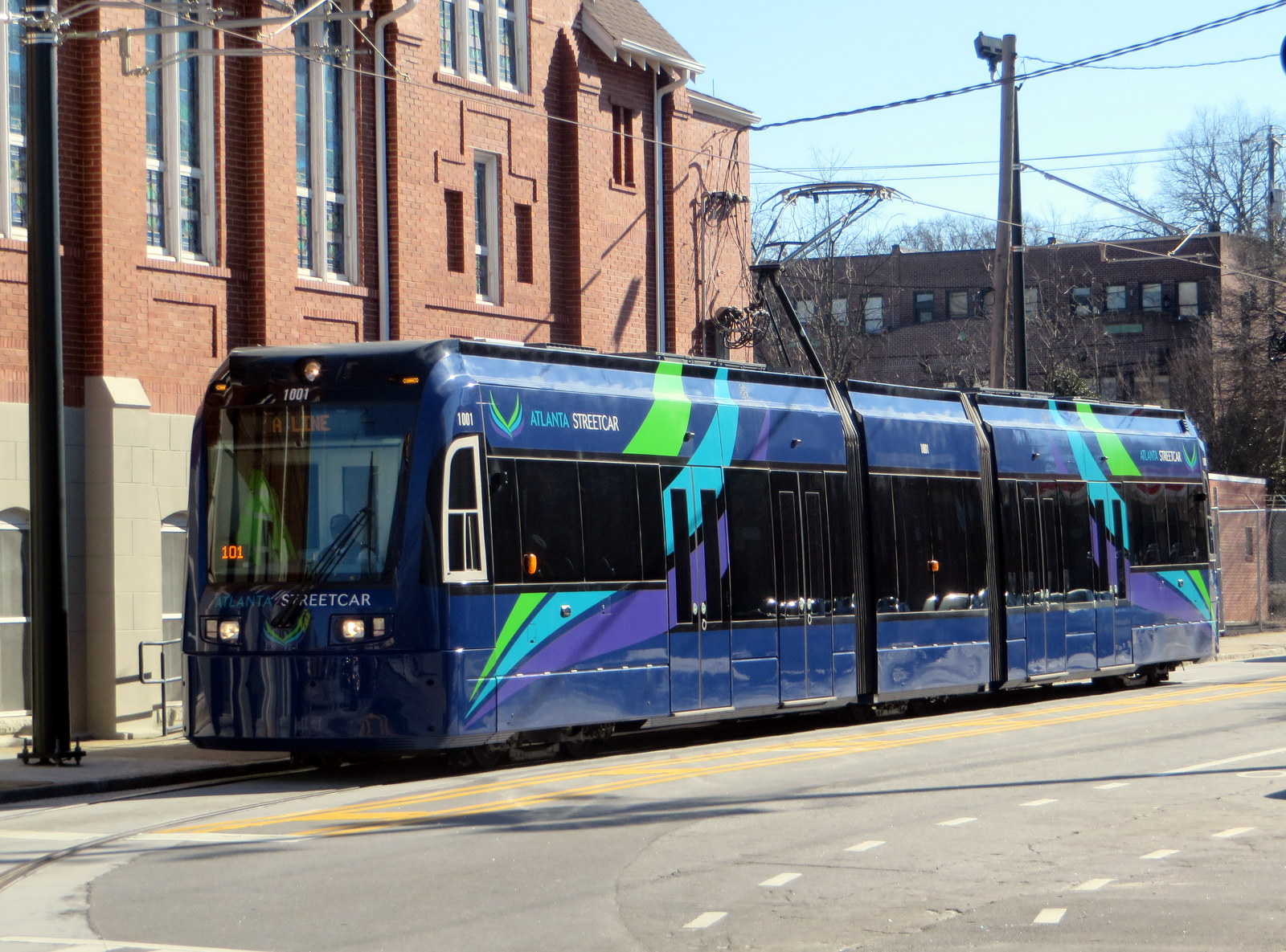
The Atlanta Streetcar system uses Siemens S70 light rail vehicles (LRVs). A total of four S70 cars were purchased and were built at two different facilities; the cars themselves were built in Sacramento, California while most other major components, like the propulsion system, were assembled at a plant about 30 mi north of Atlanta, in Alpharetta. They were delivered in the first months of 2014 and are numbered 1001–1004.
Bus
Main article: List of MARTA bus routes
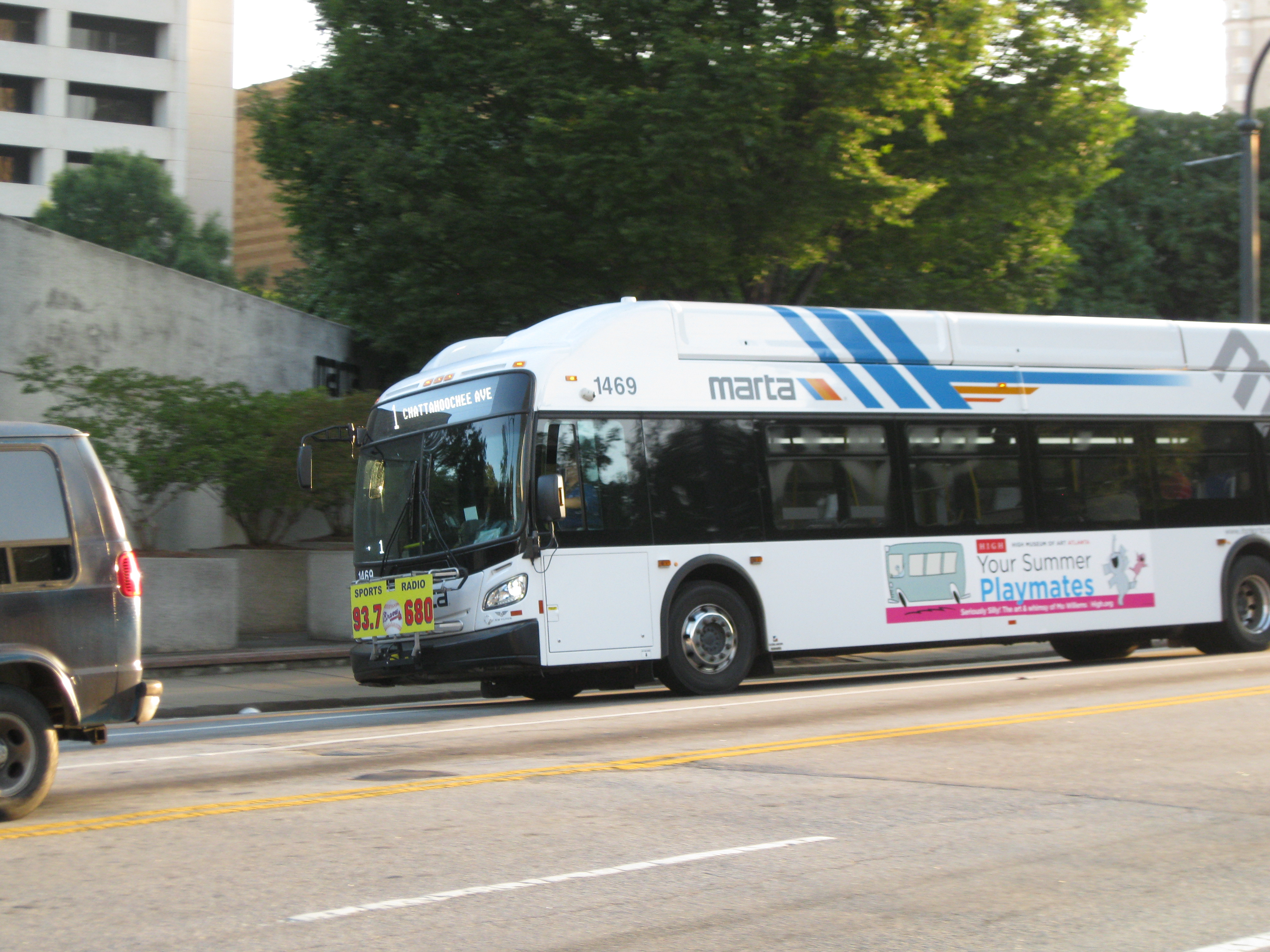
MARTA's bus system serves a wider area than the rail system, serving areas in Fulton, Clayton and DeKalb counties such as the cities of Roswell and Alpharetta in North Fulton, along with South DeKalb. MARTA bus service for Clayton County became effective March 21, 2015. As of 2010, MARTA has 554 diesel and compressed natural gas buses that covers over 110 bus routes that operated 25.9 million annual vehicle miles (41.7 million kilometers). MARTA has one bus route providing limited service in Cobb County (Route 12 has been extended to Cobb County's Cumberland Boulevard Transfer Center). As of June 2016, MARTA purchased 18 New Flyer Industries Xcelsior XN60, which are primarily used on route 39 Buford Highway, the busiest bus route in the system.{{cite press release |access-date=February 24, 2008 |url-status=dead |archive-url=https://web.archive.org/web/20070927025854/http://www.itsmarta.com/newsroom/press_releases/rel.asp?id=179 |archive-date=September 27, 2007 }} All of the MARTA bus lines, except for routes 142, 197 and 198, feed into or intersect MARTA rail lines as well. MARTA shuttle service is available to Six Flags Over Georgia during the park's summer season.
In addition to the free parking adjacent to many rail stations, MARTA also operates five park and ride lots serviced only by bus routes (Windward Parkway, Mansell Road, Stone Mountain, Barge Road, and South Fulton).
Route list
| Route Name | Terminal 1 | Terminal 2 | via | Length | Notes |
|---|---|---|---|---|---|
| 1 Marietta Boulevard / Joseph E. Lowery Boulevard | West End | ||||
| West End station | Bolton | ||||
| Marietta Boulevard & Moores Mill Road at Moores Mill Shopping Center | Marietta Boulevard, Joseph E. Lowery Boulevard | 6.9 mi | |||
| 2 Ponce de Leon Avenue / Druid Hills | Midtown | ||||
| North Avenue station | Oakhurst | ||||
| East Lake station | Ponce de Leon Avenue, East Lake Road | 4.9 mi | |||
| 3 Martin Luther King Jr. Drive / Auburn Ave | Old Fourth Ward | ||||
| John Wesley Dobbs Avenue & Howell Street | Harland Terrace | ||||
| Hamilton E. Holmes station | Auburn Avenue (EB), Edgewood Avenue (WB), Martin Luther King Jr. Drive | 7 mi | |||
| 4 Moreland Avenue | Inman Park/Reynoldstown | ||||
| Inman Park/Reynoldstown station | Norwood Manor | ||||
| Constitution Road & Jonesboro Road | Moreland Avenue | 7.2 mi | |||
| Rebel Valley Forest | |||||
| Redford Drive & Rebel Forest Drive | 7.3 mi | ||||
| 5 Piedmont Road / Sandy Springs | Lindbergh/Morosgo | ||||
| Lindbergh Center station | Dunwoody | ||||
| Dunwoody station/Perimeter Mall | Piedmont Road, Roswell Road | 9.8 mi | |||
| 6 Clifton Road / Emory | Inman Park/Reynoldstown | ||||
| Inman Park/Reynoldstown station | Clifton Road, Briarcliff Road | 8.3 mi | |||
| Lavista Road branch | |||||
| 8.8 mi Woodland Avenue branch | |||||
| 8 North Druid Hills Road | Brookhaven | ||||
| Brookhaven/Oglethorpe station | Kensington | ||||
| Kensington station | North Druid Hills Road | 11.3 mi | |||
| 9 Boulevard / Tilson Road | Oakland | ||||
| King Memorial station | Panthersville | ||||
| Gallery at South DeKalb | Boulevard, Custer Avenue, Tilson Road | 10.9 mi | |||
| 12 Howell Mill Road / Cumberland | Midtown | ||||
| Midtown station | Cumberland | ||||
| Cumberland Transfer Center | 10th Street, Howell Mill Road | 11.1 mi | |||
| 14 14th Street / Blandtown | Bolton | ||||
| Marietta Boulevard & Moores Mill Road at Moores Mill Shopping Center | 14th Street, Chattahoochee Avenue, Marietta Boulevard | 5.7 mi | |||
| 15 Candler Road | Decatur | ||||
| Decatur station | Woodcrest | ||||
| Panthersville Road & Bouldercrest Road | Candler Road, Panthersville Road, River Road, Bouldercrest Road | 11.6 mi | |||
| Stonecrest | |||||
| Linecrest Road & 3800 | 11.6 mi | ||||
| 19 Clairmont Road / Howard Avenue | Chamblee | ||||
| Chamblee station | Oakhurst | ||||
| East Lake station | Clairmont Road, Howard Avenue | 10.9 mi | |||
| 21 Memorial Drive | Downtown | ||||
| Georgia State station | Kensington | ||||
| Kensington station | Memorial Drive | 10 mi | |||
| 24 McAfee / Hosea Williams | Edgewood/Candler Park | ||||
| Edgewood/Candler Park station | Stone Mountain | ||||
| Indian Creek station | Hosea L. Williams Drive, McAfee Road, Indian Creek Drive | 14.6 mi | |||
| 25 Peachtree Boulevard | Brookhaven | ||||
| Brookhaven/Oglethorpe station | Doraville | ||||
| Doraville station | Peachtree (Industrial) Boulevard | 6.6 mi | |||
| 26 Marietta Street / Perry Boulevard | Downtown | ||||
| Five Points station | Riverside | ||||
| Bolton Road & Parrott Avenue | Marietta Street, Perry Boulevard | 10.5 mi Perry Boulevard branch | |||
| 11.1 mi McCallie Boulevard branch | |||||
| 27 Cheshire Bridge Road | Midtown | ||||
| Arts Center station | Lenox | ||||
| Lenox station | Piedmont Avenue, Cheshire Bridge Road (Lenox Road) | 5.7 mi | |||
| 30 LaVista Road | Lindbergh/Morosgo | ||||
| Lindbergh Center station | Northlake | ||||
| Ranchwood Drive & Weems Road at Northlake Mall | Lavista Road | 9.6 mi | |||
| 32 Bouldercrest | Inman Park/Reynoldstown | ||||
| Inman Park/Reynoldstown station | Ellenwood | ||||
| SouthPark Industrial Park (S. Park Boulevard & 3060) | Moreland Avenue, Bouldercrest Road | 12.7 mi | |||
| 34 Gresham Road | Oakhurst | ||||
| East Lake station | Decatur | ||||
| Perimeter College at Georgia State University | 2nd Avenue, Gresham Road, Clifton Springs Road | 7.6 mi | |||
| 8 mi Vee Kirk branch | |||||
| 9.2 mi Vicki Lane branch | |||||
| 36 N Decatur Road / Virginia Highland | Midtown | ||||
| Midtown station | Decatur | ||||
| Decatur station | Virginia Avenue, Highland Avenue, (North) Decatur Road | 9.1 mi | |||
| 37 Defoors Ferry Road | Midtown | ||||
| Arts Center station | Bolton | ||||
| Marietta Boulevard & Moores Mill Road at Moores Mill Shopping Center | 17th Street, Defoor Avenue (Defoors Ferry Road) | 6.2 mi | |||
| 39 Buford Highway | Lindbergh/Morosgo | ||||
| Lindbergh Center station | Doraville | ||||
| Doraville station | Buford Highway | 8.4 mi | |||
| 40 Peachtree Street / Downtown | Midtown | ||||
| Arts Center station | West End | ||||
| West End station | Peachtree Street | 5.2 mi | |||
| 42 Pryor Road | Downtown | ||||
| Five Points station | Sylvan Hills | ||||
| Lakewood/Fort McPherson station | Pryor Street (SB), Central Avenue (NB), Pryor Road, Arthur B. Langford Jr. Parkway | 8.5 mi | |||
| 8.9 mi Cooper Street branch | |||||
| 9 mi Amal Drive branch | |||||
| 47 I-85 Access Road | Brookhaven | ||||
| Brookhaven/Oglethorpe station | Chamblee | ||||
| Chamblee station | Briarwood Road, I-85 Access Road | 9.7 mi | |||
| 49 McDonough Boulevard | Downtown | ||||
| Five Points station | Constitution | ||||
| Metro Regional Youth Detention Center | McDonough Boulevard, Moreland Avenue | 7.9 mi McDonough Boulevard branch | |||
| 8.1 mi Englewood Avenue branch | |||||
| 50 Donald Lee Hollowell Parkway | Midtown | ||||
| North Avenue station | Bankhead | ||||
| UPS Distribution Center | North Avenue, Donald Lee Hollowell Parkway | 7.8 mi | |||
| 8.2 mi English Avenue branch | |||||
| 51 Joseph E. Boone Boulevard | Harland Terrace | ||||
| Hamilton E. Holmes station | Joseph E. Boone Boulevard, Hamilton E. Holmes Drive | 6.6 mi Luckie Street branch | |||
| 6.6 mi Centennial Olympic Park Drive branch | |||||
| 55 Jonesboro Road | Downtown | ||||
| Five Points station | Forest Park | ||||
| Forest Parkway & Bartlett Drive at Forest Square Shopping Center | Hank Aaron Drive, Jonesboro Road | 13.1 mi | |||
| 58 Hollywood Road / Lucile Avenue | West End | ||||
| West End station | Riverside | ||||
| James Jackson Parkway & Bolton Road | Lucile Avenue, West Lake Avenue, Hollywood Road | 9.1 mi | |||
| 9.6 mi Argyle Drive branch | |||||
| 60 Hightower Road | Harland Terrace | ||||
| Hamilton E. Holmes station | Bolton | ||||
| Marietta Boulevard & Moores Mill Road at Moores Mill Shopping Center | Hamilton E. Holmes Drive (Hightower Road), Hollywood Road, Bolton Road | 6.7 mi | |||
| 66 Lynhurst Drive / Princeton Lakes | Princeton Lakes | ||||
| North Commerce Drive & Marketplace Boulevard | Lynhurst Drive | 13.3 mi | |||
| 68 Benjamin E Mays Drive | Vine City | ||||
| Ashby station | Harland Terrace | ||||
| Hamilton E. Holmes station | Beecher Road, Benjamin E Mays Drive | 11.9 mi | |||
| 71 Cascade Road | West End | ||||
| West End station | Ashley Courts | ||||
| Kimberly Road & Fairly Way | Ralph David Abernathy Boulevard, Cascade Road | 7.2 mi | |||
| South Fulton | |||||
| Boat Rock Road & Reynolds Road | 11.7 mi | ||||
| 73 Fulton Industrial | Harland Terrace | ||||
| Hamilton E. Holmes station | West Atlanta | ||||
| West Park Place & Westpark Drive | Martin Luther King Jr. Drive, Fulton Industrial Boulevard | 9.2 mi | |||
| West Atlanta | |||||
| LaGrange Boulevard & Boat Rock Road | 10.2 mi | ||||
| 74 Flat Shoals Road | Inman Park/Reynoldstown | ||||
| Inman Park/Reynoldstown station | Panthersville | ||||
| Rainbow Way & Candler Road | Moreland Avenue, Flat Shoals Road | 8.2 mi Bull Run Drive branch | |||
| 8.5 mi Whites Mill Road branch | |||||
| 75 Lawrenceville Highway | Avondale Estates | ||||
| Avondale Station | Tucker | ||||
| Tuckerstone Parkway & Mountain Industrial Boulevard | Dekalb Industrial Way, Lawrenceville Highway | 10.8 mi | |||
| 78 Cleveland Avenue | East Point | ||||
| East Point station | Browns Mill Park/Rosedale Heights | ||||
| Cleveland Avenue & Jonesboro Road | Cleveland Avenue | 5.7 mi | |||
| 79 Sylvan Hills | Oakland City | ||||
| Oakland City station | East Point | ||||
| East Point station | Sylvan Road, Springdale Road, Cleveland Avenue | 7.8 mi | |||
| 81 Venetian Hills / Delowe Drive | West End | ||||
| West End station | Delowe Drive, Headland Drive | 13.6 mi | |||
| 82 Camp Creek / South Fulton Parkway | College Park | ||||
| College Park station | Union City | ||||
| Derrick Industrial Parkway & Derrick Industrial Drive (Walmart Distribution Center) | Camp Creek Parkway, Welcome All Road, South Fulton Parkway | 15.4 mi | |||
| 83 Campbellton Road | Oakland City | ||||
| Oakland City station | Ben Hill Acres | ||||
| Barge Road Park & Ride | Campbellton Road, Greenbriar Parkway | 6.3 mi | |||
| 84 Washington Road / Camp Creek Marketplace | East Point | ||||
| East Point station | Princeton Lakes | ||||
| Camp Creek Marketplace (Centre Parkway & 1800) | Washington Road, North Commerce Drive | 8.7 mi | |||
| 85 Roswell | Sandy Springs | ||||
| North Springs station | Alpharetta | ||||
| Mansell Park & Ride | Turner McDonald Parkway, Atlanta Street (Alpharetta Street), Mansell Road | 10.3 mi | |||
| 86 Fairington Road | Kensington | ||||
| Kensington station | Stonecrest | ||||
| Hillandale Drive & Hillandale Park Drive | Snapfinger Road (Snapfinger Woods Drive), Fairington Road | 12 mi | |||
| Stonecrest | |||||
| The Mall at Stonecrest | 16.2 mi | ||||
| 87 Roswell Road / Sandy Springs | Dunwoody | ||||
| Dunwoody station/Perimeter Mall | Sandy Springs | ||||
| East Point station | Hammond Drive, Roswell Drive, Turner McDonald Parkway | 12.5 mi | |||
| 89 Old National Highway | College Park | ||||
| College Park station | Union City | ||||
| Lancaster Lane & Shannon Parkway (Atlanta Metro Studios) | Old National Highway, Jonesboro Road | 13 mi | |||
| Riverdale | |||||
| Riverdale Park & Ride | 13.5 mi | ||||
| 93 Headland Drive / Main Street | Brentwood/Greenbriar | ||||
| Camp Creek Parkway & 3540 (Royal Oaks Apartments) | Main Street, Headland Drive | 9.2 mi | |||
| 94 Northside Drive | West End | ||||
| West End station | Midtown | ||||
| Arts Center station | Northside Drive, 17th Street | 6.4 mi | |||
| 95 Metropolitan Parkway | Hapeville | ||||
| King Arnold Street & Claire Drive | Metropolitan Parkway | 7.1 mi | |||
| 102 North Avenue / Little Five Points | Midtown | ||||
| North Avenue station | Edgewood/Candler Park | ||||
| Edgewood/Candler Park station | North Avenue, Ponce de Leon Avenue, Moreland Avenue | 4.3 mi | |||
| 103 Peeler Road | Chamblee | ||||
| Chamblee station | Peachtree Corners | ||||
| Winters Chapel Road & 4830 (DeKalb County Water Works & Scott Candler Filter Plant) | Shallowford Road, Peeler Road | 7.2 mi | |||
| 104 Winters Chapel Road | Doraville | ||||
| Doraville station | North Doraville | ||||
| Winters Chapel Road & Clarke Drive (Consulate of El Salvador & Consulate of Honduras) | New Peachtree Road, Winters Chapel Road, Peachtree Industrial Boulevard | 4.4 mi | |||
| 107 Glenwood | Downtown | ||||
| Georgia State station | Stone Mountain | ||||
| Indian Creek station | Memorial Drive, Glenwood Avenue (Glenwood Road) | 13.5 mi | |||
| 110 Peachtree Road / Buckhead | Midtown | ||||
| Arts Center station | Brookhaven | ||||
| Brookhaven/Oglethorpe station | Peachtree Street (Peachtree Road) | 7.2 mi | |||
| 111 Snapfinger Woods | Stone Mountain | ||||
| Indian Creek station | Stonecrest | ||||
| Hillandale Drive & Hillandale Park Drive | Redan Road, South Hairston Road, Snapfinger Woods Drive, Hillandale Drive | 13.3 mi | |||
| Stonecrest | |||||
| The Mall at Stonecrest | Redan Road, South Hairston Road, Snapfinger Woods Drive, Hillandale Drive, Covington Highway | 18.5 mi | |||
| 114 Columbia Drive | Avondale Estates | ||||
| Avondale Station | Decatur | ||||
| Perimeter College at Georgia State University | Columbia Drive | 8.4 mi | |||
| 115 Covington Highway | Kensington | ||||
| Kensington station | Stonecrest | ||||
| Covington Highway & Chupp Road | Covington Highway | 10 mi | |||
| Stonecrest | |||||
| The Mall at Stonecrest | 13.4 mi | ||||
| 116 Redan Road | Stone Mountain | ||||
| Indian Creek station | Redan Road, Stone Mountain Lithonia Road | 12 mi | |||
| 117 Rockbridge Road / Panola Road | Avondale Estates | ||||
| Avondale Station | Stonecrest | ||||
| XPRESS Panola Park & Ride | North Decatur Road (Rockbridge Road), Panola Road | 15 mi | |||
| 119 Hairston Road / Stone Mountain Village | Kensington | ||||
| Kensington station | Stone Mountain | ||||
| Goldsmith Park & Ride | Redan Road, Hairston Road | 10.8 mi | |||
| 120 East Ponce de Leon Avenue | Avondale Estates | ||||
| Avondale Station | Ponce de Leon Avenue | 8.8 mi | |||
| 121 Memorial Drive / North Hairston Road | Kensington | ||||
| Kensington station | Tucker | ||||
| North Royal Atlanta Drive & Commerce Place | Memorial Drive, North Hairston Road (Mountain Industrial Boulevard) | 10.1 mi | |||
| Tucker | |||||
| Granite Drive & Patillo Field | Memorial Drive, North Hairston Road, Idlewood Road | 10.4 mi | |||
| 123 Church Street | Decatur | ||||
| Decatur station | North Decatur | ||||
| North DeKalb Mall | Church Street | 4.8 mi | |||
| 124 Pleasantdale Road | Doraville | ||||
| Doraville station | Tucker | ||||
| Lawrenceville Highway & Hugh Howell Road | Buford Highway, Oakcliff Road, Pleasantdale Road (Chamblee Tucker Road) | 8.3 mi | |||
| 9.2 mi Dawson Boulevard branch | |||||
| 125 Clarkston | Kensington | ||||
| Kensington station | Northlake | ||||
| Briarcliff Road & Randolph Road at Northlake Mall | Indian Creek Drive (Montreal Road) | 7.8 mi | |||
| Indian Creek Drive, Northlake Parkway | 8.7 mi | ||||
| 126 Embry Hills | Chamblee | ||||
| Chamblee station | Northlake | ||||
| Ranchwood Drive & Weems Road at Northlake Mall | Chamblee Tucker Road, Henderson Mill Road | 8.1 mi | |||
| 10.9 mi | |||||
| 132 Tilly Mill Road | Chamblee | ||||
| Chamblee station | Dunwoody | ||||
| Mount Vernon Road & Jett Ferry Road | North Peachtree Road, Tilly Mill Road | 6 mi | |||
| 133 Shallowford Road | Doraville | ||||
| Doraville station | Northlake | ||||
| Ranchwood Drive & Weems Road at Northlake Mall | Shallowford Road, Briarcliff Road | 5.9 mi | |||
| 140 North Point Parkway | Sandy Springs | ||||
| North Springs station | Alpharetta | ||||
| Windward Park & Ride | Turner McDonald Parkway, North Point Parkway | 13.3 mi | |||
| 141 Haynes Bridge Road / Milton | Turner McDonald Parkway, Haynes Bridge Road, North Main Street, Windward Parkway | 15.4 mi | |||
| Turner McDonald Parkway, Haynes Bridge Road, North Main Street, Deerfield Parkway | 17.5 mi | ||||
| 142 East Holcomb Bridge Road | Alpharetta | ||||
| Mansell Park & Ride | Norcross | ||||
| Spalding Drive & 7708 (Spalding Corners) | Turner McDonald Parkway, Holcomb Bridge Road | 7.1 mi | |||
| 143 Windward Park & Ride | Sandy Springs | ||||
| North Springs station | Alpharetta | ||||
| Windward Park & Ride | Turner McDonald Parkway, Morris Road (McGinnis Ferry Road) | 16.8 mi | |||
| 148 Mount Vernon Highway | Sandy Springs | ||||
| Sandy Springs station | West Sandy Springs | ||||
| Riveredge Parkway & 1600 | Mount Vernon Highway, Powers Ferry Road | 7.2 mi | |||
| 150 Dunwoody Village | Dunwoody | ||||
| Dunwoody station/Perimeter Mall | Dunwoody Village | ||||
| Chamblee Dunwoody Road & Dunwoody Village Parkway | Perimeter Center, Ashford Dunwoody Road | 4.4 mi | *Off peak | ||
| Dunwoody | |||||
| Mount Vernon Road & Jett Ferry Road | 7.2 mi | *Weekday peak only via Dunwoody Village | |||
| 153 James Jackson Parkway | Harland Terrace | ||||
| Hamilton E. Holmes station | Riverside | ||||
| James Jackson Parkway & James Jackson Court | Hamilton E. Holmes Drive (James Jackson Parkway), Northwest Drive (NB) | 5.1 mi | |||
| 155 Pittsburgh | West End | ||||
| West End station | Swallow Circle-Baywood | ||||
| Swallow Circle & Finch Drive | McDaniel Street, Lakewood Avenue, Harper Road | 6.5 mi | |||
| Polar Rock | |||||
| Polar Rock Terrace & Polar Rock Road | McDaniel Street, Lakewood Avenue | 7.5 mi | |||
| 162 Myrtle Drive / Alison Court | Oakland City | ||||
| Oakland City station | Campbellton Road | ||||
| Myrtle Drive & 1881 (Campbellton Plaza & Baptist Towers) | Campbellton Road, Stanton Road | 3.6 mi | |||
| 165 Fairburn Road | Harland Terrace | ||||
| Hamilton E. Holmes station | Ben Hill Acres | ||||
| Barge Road Park & Ride | Martin Luther King Jr. Drive, Fairburn Road | 7.7 mi | |||
| 172 Sylvan Road / Virginia Avenue | Oakland City | ||||
| Oakland City station | College Park | ||||
| College Park station | Sylvan Road, Virginia Avenue | 9.3 mi | |||
| 178 Empire Boulevard / Southside Industrial Park | Sylvan Hills | ||||
| Lakewood/Fort McPherson station | Glenrose Heights | ||||
| Hamilton Boulevard & 3400 (Hamilton Bus Facility) | Arthur B. Langford Parkway, Macon Drive, Browns Mill Road (SB), Empire Boulevard (NB) | 8.1 mi | |||
| 180 Roosevelt Highway | College Park | ||||
| College Park station | Palmetto | ||||
| Main Street & Toombs Street | Roosevelt Highway | 17.4 mi | |||
| 181 Washington Road / Fairburn | East Point | ||||
| East Point station | Fairburn | ||||
| Smith Street & Broad Street | Washington Road, Buffington Road | 16.1 mi Shannon Parkway branch | |||
| 16.2 mi Oakley Road branch | |||||
| 183 Greenbriar | Sylvan Hills | ||||
| Lakewood/Fort McPherson station | Arlington Estates/Elmco Estates | ||||
| County Line Road & Campbellton Road | Arthur B. Langford Parkway, Greenbriar Parkway, Campbellton Road | 8 mi (detour) | |||
| 185 Alpharetta | Sandy Springs | ||||
| North Springs station | Alpharetta | ||||
| Old Milton Parkway & Park Bridge Parkway (Georgia State University Alpharetta) | Turner McDonald Parkway, Alpharetta Highway, Old Milton Parkway | 15.5 mi | |||
| 186 Rainbow Drive / South DeKalb | Downtown | ||||
| Five Points station | Decatur | ||||
| New Snapfinger Woods Drive & 4325 (Georgia Piedmont Technical College South DeKalb) | Ralph David Abernathy Freeway, Rainbow Drive | 14.2 mi | |||
| 14.8 mi East Side Drive branch | |||||
| 188 Oakley Industrial | College Park | ||||
| College Park station | Fairburn | ||||
| Fairburn Park & Ride | Interstate 85, Oakley Industrial Boulevard | 19.8 mi | |||
| 189 Flat Shoals Road / Scofield Road | South Fulton | ||||
| Union City Park & Ride | Old National Highway, Scofield Road, Flat Shoals Road | 10.5 mi Hillandale Drive branch | |||
| 11.7 mi Kimberly Mill Road branch | |||||
| 191 Riverdale / ATL International Terminal [[File:Airplane silhouette white.svg | 15px]] | Sylvan Hills | |||
| Lakewood/Fort McPherson station | Jonesboro | ||||
| Harold R. Banke Justice Center | Interstate 75, Highway 85, Highway 138 | 24.4 mi | |||
| Interstate 75, Highway 85, Flint River Road | 25.8 mi | ||||
| 192 Old Dixie / Tara Boulevard | East Point | ||||
| East Point station | Perry J. Hudson Parkway, Old Dixie Highway/Road (Tara Boulevard) | 15 mi | |||
| 193 Morrow / Jonesboro | Forest Parkway, Jonesboro Road | 18.1 mi | |||
| Forest Parkway, Battle Creek Road, Tara Boulevard | 19.7 mi | ||||
| 194 Conley Road / Mount Zion | Sylvan Hills | ||||
| Lakewood/Fort McPherson station | Morrow | ||||
| Southlake Mall | Interstate 75, Conley Road, Mount Zion Boulevard/Road | 19.4 mi | |||
| 195 Forest Parkway | College Park | ||||
| College Park station | Ellenwood | ||||
| Anvil Block Road & Lunsford Drive | Forest Parkway | 16.3 mi | |||
| 196 Upper Riverdale | Riverdale | ||||
| Lamar Hucheson Parkway & Valley Hill Road | Riverdale Road, Highway 85 | 10.3 mi | |||
| Morrow | |||||
| Southlake Mall | Riverdale Road, Highway 85, Upper Riverdale Road, Mount Zion Road | 14.6 mi | |||
| 197 Battle Creek Road | Riverdale | ||||
| Church Street & Town Center Drive (Riverdale Town Center) | Stockbridge | ||||
| Davidson Parkway & Davidson Circle | Valley Hill Road (Battle Creek Road), Mount Zion Road/Parkway | 12.6 mi | |||
| 198 Southlake Parkway | Morrow | ||||
| Southlake Mall | Highway 138, Southlake Parkway | 8.1 mi | |||
| 221 Memorial Drive Limited | Kensington | ||||
| Kensington station | Stone Mountain | ||||
| Juliette Road & 1551 | Memorial Drive | 7.6 mi | |||
| 295 Metropolitan Campus Express | Oakland City | ||||
| Oakland City station | Sylvan Hills | ||||
| Atlanta Metro State College | Dill Avenue, Metropolitan Parkway, Caspian Street | 2.5 mi | |||
| 800 Lovejoy | Jonesboro | ||||
| Harold R. Banke Justice Center | Tara Boulevard, McDonough Road, Lovejoy Road | 16.1 mi | |||
| 809 Monroe Drive / Boulevard | Lindbergh/Morosgo | ||||
| Lindbergh Center station | Oakland | ||||
| King Memorial station | Monroe Drive (Boulevard) | 5.9 mi | |||
| 8.1 mi Armour Drive branch | Select trips | ||||
| 813 Atlanta University Center | Downtown | ||||
| Georgia State station | Penelope Neighbors | ||||
| West Lake station | Peters Street, Atlanta Student Movement Boulevard (Fair Street), Westview Drive | 5 mi | |||
| 816 North Highland Avenue | Downtown | ||||
| Five Points station | Druid Hills | ||||
| Michael Street & Houston Mill Road (Emory University) | Ralph McGill Boulevard, North Highland Avenue | 7.7 mi | |||
| 823 Belvedere | Decatur | ||||
| Decatur station | Belvedere Park | ||||
| Belvedere Lane & Rupert Road | McDonough Street, Memorial Drive | 4.6 mi | |||
| 825 Johnson Ferry Road | Sandy Springs | ||||
| Medical Center station | Chamblee | ||||
| Chamblee station | Johnson Ferry Road | 4 mi | |||
| 832 Grant Park | West End | ||||
| West End station | Custer/McDonough/Grice | ||||
| Woodland Avenue & Custer Avenue | Ralph David Abernathy Boulevard (Georgia Avenue), United Avenue | 6.5 mi | |||
| 850 Carroll Heights / Fairburn Heights | Harland Terrace | ||||
| Hamilton E. Holmes station | Northwest Atlanta | ||||
| Atlanta Industrial Parkway & 3755 (Atlanta Industrial Park) | Collier Drive, Fairburn Road, Atlanta Industrial Parkway | 5.7 mi | |||
| Collier Drive, Bolton Road, Atlanta Industrial Parkway | 7.1 mi | ||||
| 853 Center Hill | Penelope Neighbors | ||||
| West Lake station | Collier Heights | ||||
| Skipper Drive & Skipper Place | North Avenue (Baker Road), Donald Lee Hollowell Parkway | 8 mi | |||
| 856 Baker Hills / Wilson Hills Meadows | Harland Terrace | ||||
| Hamilton E. Holmes station | Wilson Hills Meadows | ||||
| Alex Drive & Alex Way | Burton Road, Collier Drive | 5.6 mi | |||
| 865 Boulder Park Drive | Ridgecrest Forest | ||||
| Dollar Mill Road & Boulder Park Drive | Burton Road, Delmar Lane, Boulder Park Drive | 5.4 mi | |||
| 867 Peyton Forest / Dixie Hills | Penelope Neighbors | ||||
| West Lake station | Harland Terrace | ||||
| Hamilton E. Holmes station | Martin Luther King Jr. Drive | 6.9 mi | |||
| 899 Old Fourth Ward | Downtown | ||||
| Georgia State station | Midtown | ||||
| North Avenue station | Jackson Street, North Avenue | 4 mi |
Paratransit
In compliance with the Americans with Disabilities Act (ADA), MARTA provides the Mobility paratransit service for those persons defined as disabled by the ADA. MARTA uses 211 special lift-equipped vehicles for this service, and can either deliver passengers to their final destination (curb-to-curb service) or can deliver the passenger to the closest accessible bus stop or rail station (feeder service). Mobility is limited to existing rail and bus routes and cannot extend more than a 0.75 mi radius from any existing route. Mobility service is only provided during the hours of the fixed route servicing the area. An application for acceptance into the Mobility service is required; reservations are required for each trip. In fiscal year 2006, MARTA provided 289,258 Mobility trips.
The average cost to MARTA for providing a one-way trip for an individual Mobility passenger is US$31.88. This is much greater than the US$4.00 fare the Mobility rider is required to pay. The Americans with Disabilities Act forbids MARTA from charging a Mobility fare more than twice the normal fixed route fare.
A 2001 federal civil lawsuit, Martin v. Metropolitan Atlanta Rapid Transit Authority, was brought by several disabled riders who alleged MARTA was violating the ADA by failing to provide: bus schedule and route information in an accessible format, buses with working wheelchair lifts, stop announcements on rail and bus routes, and adequate staff to schedule and provide on-time Mobility service. The district court ruled in 2002 that MARTA had violated the ADA and granted the plaintiffs an injunction requiring MARTA to improve service to the disabled.
Microtransit
MARTA has a microtransit system called MARTA Reach that provides on-demand shuttle service from different underserved areas to train stations and bus stops using mobile app. It will be implemented on March 2026.
Fare structure and operation

Currently, the one-way full fare for MARTA costs US$2.50. New Breeze cards are $2. Breeze Tickets carry an extra fee of $1. Passengers over 65, passengers with disabilities and Medicare recipients are eligible to receive a discounted fare of $1. A one-way paratransit fare is $4. Ten full fare one-way trips can be purchased for $25, and twenty full fare trips can be purchased at a discount for $42.50. MARTA also offers unlimited travel through multiple transit pass options: 24-Hour pass $9, 2-day pass $14, 3-day pass $16, 4-day pass $19, 7-day pass $23.75, and a 30-day pass for $95. Additional discounted pass programs allow for university students and staff to purchase calendar monthly passes. Additional discounts are available to corporate partners who sell monthly MARTA passes to employees and also to groups and conventions visiting Atlanta. Some employers (at their own expense) also provide reduced cost or free MARTA passes to employees to encourage the use of public transportation. Children up to 46 in can ride for free with fare-paying rider; limit is 2.
Free shuttles also operate within the MARTA area, but are not part of MARTA. The Buckhead Uptown Connection (The BUC) goes around Buckhead, Atlanta's uptown section and its third major business district behind downtown and midtown. This includes Lenox Square mall and the many high-rises and skyscrapers built along Peachtree Road. The Atlantic Station Shuttle offers service between the Arts Center MARTA Station and the Atlantic Station neighborhood of Midtown. Georgia Tech operates "Stinger" buses between central campus, Technology Square, and the Midtown MARTA Station. Emory University operates "The Cliff" shuttle buses in and around its campus. The Clifton Corridor Transportation Management Association (CCTMA) operates a shuttle connecting Emory with downtown Decatur and the Decatur MARTA station.
Due to the COVID-19 outbreak, in March 2020 MARTA introduced free fares to bus rides, which ended early September 2020. The free fare modification did not apply to rail fares.
Breeze Card
Main article: Breeze Card
MARTA finished implementing the "Breeze" smart card electronic fare collection system in September 2006, replacing the previous token-based fare collection system. The new Breeze Card allows riders to load money on the card for use over time, and to add unlimited day passes that are not fixed to a calendar period. The Breeze Card is for every passenger riding MARTA. The new Breeze fare gates are designed to help prevent fare evasion; with the older fare collection system fare evasion was much easier and was estimated to cost MARTA $10 million per year. Other connecting transit systems such as GRTA Xpress, Ride Gwinnett, and CobbLinc also use the Breeze system.
MARTA stopped selling tokens after the Breeze conversion. Cards (without fare) were sent by mail for free to those who requested them when the system was first implemented.
To protect against hacking problems experienced by the then-current Breeze Card, MARTA rolled out a new Breeze Card in January 2016. The new card costs $2.
In October 2025, MARTA announced a "Better Breeze" system with a new chipped orange card and updated faregates. The faregates were designed to support more contactless payment methods, like mobile wallet and debit/credit cards equipped with near-field communication (NFC). A new app was made with support for digital cards. New touchscreen ticket vending machines were also added and are available at various retail locations. Implementation was done on Spring 2026.
Hours of operation
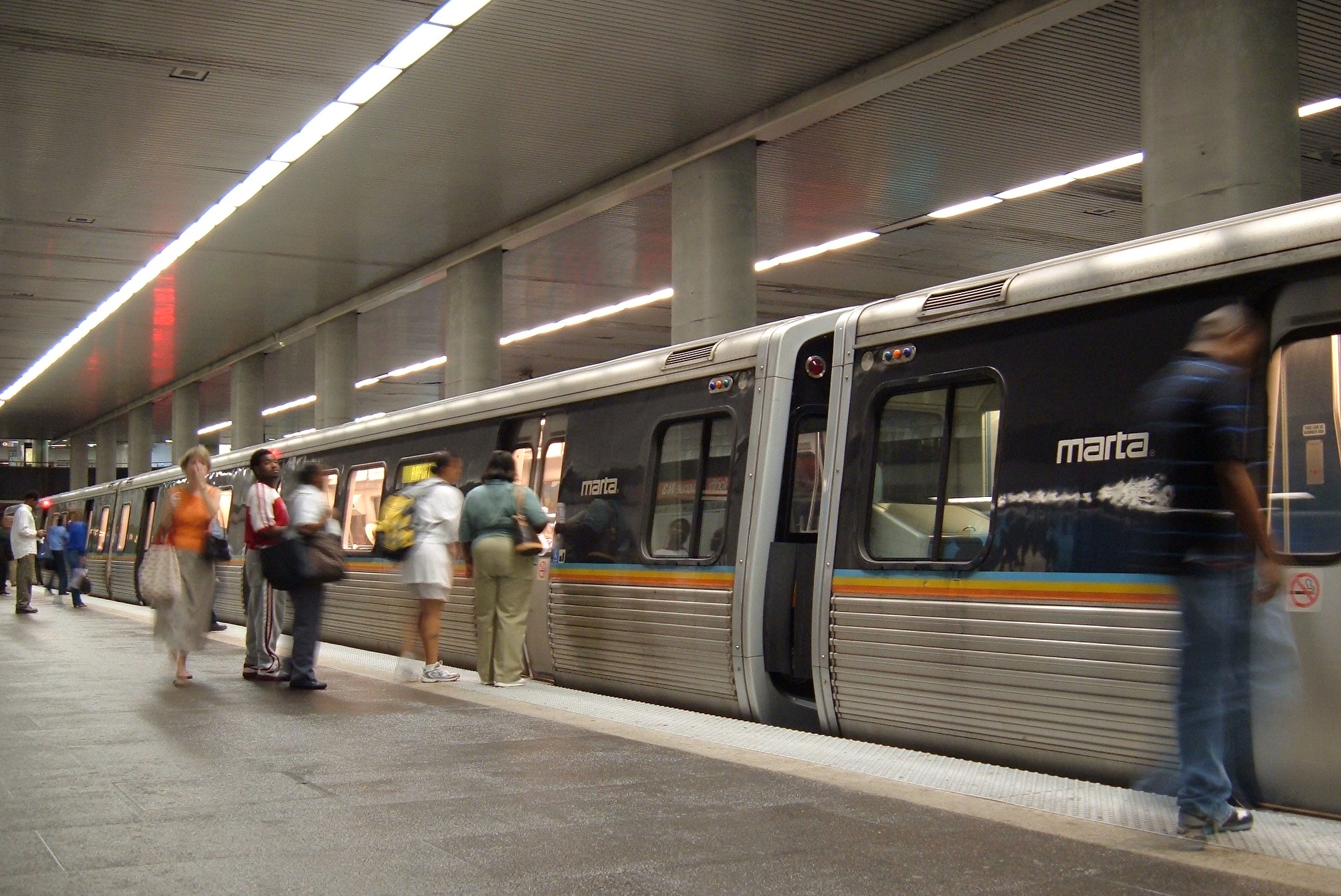

MARTA operates every day. Rail service is provided from approximately 4:45 am to 1:00 am, Monday to Friday, and 6:00 am to 1:00 am on Saturday, Sunday & most holidays. During certain events (New Year's Eve) trains run until 2:00 a.m. (Trains also run all night during winter storms, though not in passenger service, to prevent ice from forming on non-underground lines.) On weekdays, trains run every 20 minutes on all rail lines from the beginning of service until 6:00 am. From 6:00 am-9:00 am and 3:00 pm-7:00 pm, trains run every 10 minutes on all rail lines. From 9:00 am-3:00 pm and 7:00 pm-8:30 pm, trains run every 12 minutes on all rail lines. From 8:30 pm until the end of service, trains run every 20 minutes on all rail lines. MARTA's Red Line rail service only operates between North Springs and Lindbergh Center stations after 8:30 pm. MARTA's Green Line rail service only operates between Bankhead and Vine City stations after 8:30 pm; Monday-Friday (with the exception of public holidays and track work performed by the authority). On weekends and public holidays, trains run every 20 minutes on all rail lines. Bus routes have varying frequencies dependent upon passenger demand.
Fare reciprocity
Through formal fare reciprocity agreements, MARTA riders are able to transfer for free to the three other metro-Atlanta transit systems: Ride Gwinnett, CobbLinc and GRTA Xpress. Some of these agreements require that neither system have significantly more transfers than the other. MARTA has stated that this is the case, that inbound (to MARTA from another system) and outbound (from MARTA to another system) transfers are approximately equal (for second quarter 2006, 8888 daily passengers transferred inbound and 8843 transferred outbound). Analysis of morning transfers (5 to 9 am) to MARTA shows that Cobb County had 718 inbound transfers but only 528 outbound, Gwinnett County had 239 inbound and 269 outbound, and GRTA Xpress had 1,175 inbound but 615 outbound. Some have suggested that more people from the other systems may benefit from free transfers than those living in the MARTA service area. It has also been noted that workers traveling in the morning to Atlanta from another system will more than likely make the return trip home, resulting in an equal number of transfers.
Funding
Sales tax
In addition to fare collections, the MARTA budget is funded by a 1% sales tax in Fulton, Clayton and DeKalb counties along with limited federal money. In 2017, the City of Atlanta raised their sales tax for MARTA to 1.5% to improve and expand MARTA. For fiscal year 2007, MARTA had a farebox recovery ratio of 31.8%. By law, funds from the 1% sales tax must be split evenly between MARTA's operational and Capital expenditure budgets. This restriction does not apply to other sources of revenue, including passenger revenue. The split was written into MARTA legislation at MARTA's formation with the rationale that MARTA should continue expanding and investing in the system. Nonetheless, MARTA has no active heavy rail construction projects. Capital funds continue to decrease every year, creating a shortfall. The operations funds limit the amount of service MARTA provides. The sales tax law was amended by the state legislature in 2002 to allow a temporary three-year 45% capital/55% operations split. This additional 5% for operations expired in 2005. A 2005 bill to renew the split was tabled by the legislature's MARTA Oversight Committee, forcing MARTA to pass a new budget with cuts in service. The temporary 45%/55% capital/operations split was renewed again in the 2006 state legislative session. The capital funds surplus has resulted in projects, such as a new US$100 million Breeze Card fare collection system and US$1.1 million automatic toilets in the MARTA Five Points station, occurring at the same time that MARTA is struggling to pay for bus and rail operations. In 2015, the Georgia General Assembly approved a new bill that no longer requires MARTA to split the 1% Sales Tax. Due to low Sales Tax Revenue and no source of funding from the State of Georgia, MARTA was forced to eliminate 43 bus routes, eliminate shuttles, (Excluding the Six Flags Over Georgia and Braves Shuttle) and reduce Rail Service frequencies and hours. MARTA also closed the majority of its station restrooms. There are 13 station restrooms open to the public, most of which are located at the terminus of each line, and which include College Park, Arts Center, Peachtree Center, West End, Avondale, Kensington and Lindbergh Center. There are two Ridestores available, located at the Airport and Five Points Rail Stations. Despite the massive cuts, MARTA predicted the system would still come up 69.34 million dollars short for FY 2011, which was pulled from their Reserved Account. A $9 million addition was posted for 2013. This money was reinvested into the system by adding frequency to trains and bus routes.
The current 1% sales tax was set to be reduced to 0.5% in 2032. In early 2007 MARTA made a request to the City of Atlanta, DeKalb County, and Fulton County to seek a 15-year extension of the 1% sales tax from 2032 to 2047, with a 0.5% sales tax from 2047 to 2057. This is the fourth time in its history that MARTA sought the extension, the most recent in 1990. MARTA said the commitment to the tax is needed for the agency to secure long-term financing in the form of bonds to pay for any future expansions to the system. The resolution called for four new routes: bus rapid transit from H.E. Holmes station to Fulton Industrial Boulevard, bus rapid transit from Garnett station to Stonecrest Mall, transit for the Beltline, and a direct transit link from Lindbergh Center to Emory University (formerly called the "C-Loop"). To approve the tax extension, two of the three government agencies needed to agree to the extension. In March 2007 the City of Atlanta voted 12–1 to approve the extension. In April 2007 the DeKalb County Commission also approved the sales tax extension. Some Fulton county officials opposed the sales tax extension on the basis that the proposed service expansions did not include previously proposed expansion of the North Rail line to Roswell and Alpharetta in North Fulton County.
State funding controversy
MARTA was formed through the Metropolitan Atlanta Rapid Transit Authority Act of 1965, an act of the Georgia General Assembly. In addition to allowing the formation of the agency, and the collection of revenue from taxes, the legislation previously placed restrictions on how the agency managed its funds. In particular, the legislation established that any funds raised from the sale of bonds and capital goods would be spent on capital expenditures, and that any extra proceeds be put aside for paying off bond debt. While the enabling legislation put restrictions on how MARTA could manage its money, MARTA has never received any operational funding from the State of Georgia, making it the largest public transportation agency in the United States and the second-largest transit agency in Anglo-America (after the Toronto Transit Commission) not to receive state or provincial funding for operational expenses. The funding restrictions on MARTA were removed in 2015, with the passage of House Bill 213 by the General Assembly.
In early April 2009, MARTA experienced a budget crisis when the Georgia General Assembly failed to pass a bill that would allow MARTA to access its own capital reserve account, in order to compensate for a severe drop in sales-tax revenue during the late-2000s recession. MARTA stated that this could force the agency to discontinue operations one day out of the week, possibly a weekday. The agency's budget crisis forced MARTA to lay off 700 employees. Service cuts and other budget-stabilizing measures began in fiscal year 2011, with the first affected service mark-up in September 2010. Governor Sonny Perdue refused to call a special session as requested, and did not issue an executive order as he stated it would not be legal to do so.
Governance
MARTA is a joint powers authority that is governed by a board of directors, consisting of representatives appointed from the city of Atlanta (3 members), and the remainder of the counties of Fulton (3 members), Clayton (2 members) and DeKalb (4 members). Additionally, there is 1 representative from the Georgia Department of Transportation, and 1 representative from Georgia Regional Transportation Authority who also serve as non-voting members.
Positions on the MARTA board are directly appointed by the organizations they represent. Although the state of Georgia does not contribute to MARTA's operational funding, it still has voting members on the MARTA board. A similar situation existed for both Clayton and Gwinnett counties during most of MARTA's history; as a consequence of passing the authorization referendum but not the funding referendum. Gwinnett County have representation on the MARTA Board of Directors without paying into the system. This situation became controversial in 2004 when Gwinnett's representative Mychal Walker was found to have accepted US$20,000 from a lobbyist trying to secure a US$100 million contract with MARTA. Despite the controversy, as well as a MARTA board ruling that Walker violated the MARTA ethics policy, the Gwinnett County Commission initially failed to remove Mr. Walker from his position on the MARTA Board. Eventually, the state legislature was called upon to change the law governing MARTA's Board to allow for the removal of a member whose appointing county did not act on a request for removal. Before the new law could be used, Mr. Walker was arrested on an unrelated child support violation, which resulted in his firing by the Gwinnett County Commission.
The highest position at MARTA is the general manager and chief executive officer. Below is a list of people that have held the position:
- MARTA's General Manager was Richard McCrillis from 2006 to 2007. In October 2007, McCrillis retired after 22 years of service at MARTA.
- In October 2007, Dr. Beverly A. Scott was named the new general manager. Prior to joining MARTA, Dr. Scott served as GM/CEO of the Sacramento Regional Transit District. She has over 30 years of experience in the transportation industry. After 5 years at MARTA, she decided not to renew her contract with MARTA's board of directors. Scott's last day was December 9, 2012.
- Keith Parker was MARTA's General Manager/CEO from December 9, 2012 – October 11, 2017.
- Jeffrey A. Parker served as MARTA's General Manager/CEO position starting in 2017 until his death in 2022.
- Collie Greenwood assumed responsibilities as interim MARTA CEO on January 15, 2022. Prior to his role as interim CEO, Greenwood was MARTA's deputy general manager for operations. Greenwood was removed from his position as MARTA CEO by the Board of Directors on July 17, 2025, citing immigration status issues.
The Georgia General Assembly has a standing committee that is charged with financial oversight of the agency. During the 2009 legislative session, Representative Jill Chambers, the MARTOC chairperson at the time, introduced a bill that would place MARTA under GRTA, and permanently remove the requirement that MARTA split its expenditures 50/50 between capital and operations. This would allow MARTA to avoid service cuts at times when sales tax revenue is low due to recession, without having to ask the state legislature for temporary exemptions (typically a 55/45 split) as it has received before. The bill was not passed, but the funding restrictions were removed in 2015.
Performance and safety
During the 2005 fiscal year, MARTA had a customer satisfaction rate of 79%. On-time performance for rail service was 91.64%. The mean distance between rail service interruptions was 9493 mi and the mean distance between bus failures was 3301 mi.

MARTA has had two fatal accidents that resulted in a formal investigation by the National Transportation Safety Board. On February 25, 2000, a train near Avondale station struck two automatic train control technicians who were inspecting a relay box; one was fatally injured and the other technician suffered serious injuries. The workers had failed to apply for a safe clearance restriction for the track work. In addition, the rail system center controller, who was aware of the workers, failed to notify train drivers of the technicians' presence. A second accident occurred on April 10, 2000, when a train struck a bucket lift containing two contract workers at Lenox station; the workers were fatally injured. Although the MARTA employee who was accompanying the workers notified the rail control center of the work over the track, the control center employee failed to block off the section of the track in the automated rail control system and also failed to notify the unscheduled southbound train of the workers' presence. In 2001 MARTA settled with the families of the two killed workers for US$10.5 million.
In addition to these accidents, MARTA trains have derailed five times in recent years. The most recent incident occurred in January 2019 when an out of service train derailed between Airport station and College Park station. The operator was not injured.https://www.bizjournals.com/atlanta/news/2019/01/16/marta-train-near-atlanta-airport-derails-service.htmlhttps://www.ajc.com/news/traffic/update-stuck-train-continues-disrupt-marta-service-atlanta-airport/3HCMEzTsDvS1dJ5SxPIIEK/ A previous derailment occurred on December 4, 2006 Medical Center station when a train carrying passengers was moved over a rail switch. No injuries were reported. In July 1996 during Atlanta's hosting of the Olympics, a paired car on a train that had developed mechanical problems was uncoupled from other cars at Indian Creek station (the last station on the east line). The train began rolling, crashing through the bumper at the end of the rail line and running off of the track. The train operator, the only person on board, received minor injuries. In June 1996 a minor derailment occurred at the junction between the North and Northeast lines; MARTA estimated 150 people were aboard. The derailment occurred when a rail supervisor told the train driver to reverse the train after realizing the train had gone the wrong way at a track split; a MARTA investigation of the incident showed the derailment caused $125,000 of damage to the train and track and caused injury to 16 passengers. And in August 1994 a minor derailment occurred at a switch between Candler Park and Inman Park. Approximately 20 passengers were on board and no one was injured.
On December 31, 2007, MARTA had three separate escalator accidents that injured at least 11 people. The incidents occurred as large crowds were going to the Chick-fil-A Bowl. Two escalators failed at Five Points station, and one escalator failed at Dome/GWCC/Philips Arena/CNN Center station. MARTA initially blamed the incidents on rowdy patrons jumping on the escalator. A subsequent formal investigation showed that the braking systems and a weak motor were to blame for the incidents.
In September 2008, a Fulton County jury awarded a woman $525,000 for injuries received in an accident at the Peachtree Center station. MARTA has been criticized for its escalator maintenance policies after recent injuries due to escalators overloading, but has discussed plans to improve its policies and regulate passenger loads with posted station agents.
Criticism and concern
Criticism of MARTA has originated from many different groups. Opponents of MARTA are critical of MARTA's perceived inefficiency and alleged wasteful spending. Supporters of MARTA are critical of the almost complete lack of state and regional support of MARTA. In recent years, additional concerns have been raised regarding the reliability of service, as well as the governing structure of MARTA.
Lack of regional financial support
Since the formation of MARTA, the Georgia state government has never contributed to MARTA operational funding. Currently, MARTA is the largest mass transportation system in the United States not to receive state funding. Revenue from the Georgia motor fuel tax is currently restricted to roads and bridges and cannot be used for public transportation, further complicating potential sources of state funding for MARTA. In addition, the other largest two suburban counties (Gwinnett and Cobb counties) have refused to join or fund MARTA. Both Gwinnett and Clayton counties initially agreed to join MARTA but refused MARTA rail and bus service when voters in their respective counties voted against paying to help fund the system. Clayton County finally joined MARTA in November 2014. Gwinnett, along with Cobb County, created independent bus transit: Cobb Community Transit on July 10, 1989, Gwinnett County Transit on November 5, 2001. A separate regional bus transit service, Xpress, is operated by the Georgia Regional Transportation Authority in partnership with 11 metro Atlanta counties including Fulton and DeKalb, and began service on June 6, 2004.
The MARTA Board members are criticized for not being regular users of MARTA and thus are not actually aware of the concerns of MARTA commuters. Former CEO, Keith Parker, was known for commuting daily from Dunwoody to the headquarters using the Red Line.
Due to no funding from the state of Georgia and its limited funding from Fulton, Clayton and DeKalb counties, MARTA has struggled for many years to provide adequate service to the metropolitan area. As a result, MARTA has gained a notorious reputation throughout the metro Atlanta area for being ineffective and inconvenient. Many people who own cars avoid using the system altogether while residents in suburban areas usually drive their car to a MARTA rail station (instead of using bus service) if their job is near an adjacent one. MARTA's financial structure (being tied to a 1% sales tax) has forced the agency to cut services during times of economic depression, further resulting in complaints about the inconvenience and inadequacy of MARTA services.
Although surrounding counties do not pay for MARTA, many of their residents use MARTA by driving directly to a MARTA station or by using a county or regional bus system that connects to MARTA. A license plate study from 1988 to 1997 showed that 44% of the cars parked in MARTA park-and-ride lots were from outside of Fulton and DeKalb counties. Current fare reciprocity agreements also allow non-paying counties to provide bus service for their residents that provide free connections to MARTA (see Fare reciprocity). According to a 2000 MARTA ridership study, 12% of MARTA riders live outside of MARTA's service area.
Effects of race on expansion and funding
It is often argued that racial politics also play a role in the operation and future service planning for MARTA. Opponents of Georgia's transportation policies have alleged a race-based two-tiered system, where billions are spent by the state on highway expansion to aid the automobile commutes of mostly white residents of the suburbs and rural areas (like GRIP), while service cuts at MARTA have hurt mostly black riders in low-income areas where residents cannot afford automobile ownership. Proponents contest that a portion of state funding for highways comes from the gasoline tax, a user fee analogous to the fare MARTA riders pay. Supporters of MARTA have alleged that the lack of participation by other metro Atlanta counties is rooted in racism and classism. In 1987, David Chesnut, then chairman of MARTA, stated, "The development of a regional transit system in the Atlanta area is being held hostage to race, and I think it's high time we admitted it and talked about it." As part of its Title VI plan, MARTA data revealed that in 2015, 75% of MARTA riders were black. The percentage of white riders is particularly low outside rush hours.
Criminal activity
Despite a strong safety record, throughout MARTA's history there have been continued concerns regarding criminal activity on MARTA trains and in and around MARTA train stations. In the aftermath of a 1985 aggravated assault against the daughter of a Georgia State University professor, complaints were made that MARTA was underreporting its annual crime statistics. A 1986 review of the previous year's records by MARTA's audit office and the state legislature's MARTA Oversight Committee (MARTOC) showed no deliberate underreporting of crime, but rather over-reporting of crime because MARTA included crimes not related to the rail line and did not adhere to the Uniform Crime Reporting system (reporting multiple crimes by the same person instead of only the most serious crime).
According to Federal Transit Administration records, MARTA's crime statistics are in line with those of similar-sized systems, such as Bay Area Rapid Transit in the San Francisco Bay area. Nonetheless, high-profile crimes on or near MARTA have created the impression with some that MARTA is unsafe and lacks a strong police presence, even though it has its own police department. From 2005 to 2009, two homicides and one rape were reported on MARTA property. The most common crime reported was larceny. The most common area for crime was MARTA's rail service, followed by MARTA's parking lots. For fiscal year 2009, MARTA had a crime rate of 3.09 per 1 million riders, with 483 crimes reported during the entire year.
Suburban counties have opposed expanding MARTA on the basis that it would lead to increased crime, as well as the cost of expansion and the lack of perceived necessity to areas currently outside MARTA transit. It is alleged that because MARTA's service area includes some of Atlanta's most economically depressed and high-crime neighborhoods, expansion of MARTA would supposedly allow crime to spread to suburban areas. Then-MARTA-CEO, Dr. Scott, acknowledged that assumption and cites a study that did not find transit systems to nucleate crime. Other counterarguments often cite the case of the Washington Metro, which provides services in economically depressed areas with limited problems in suburban Washington D.C. stops.
Reliability of service

As is typical of rail transit in the United States, MARTA's rail lines have two parallel tracks. Any train failure or track work results in shared use of the other track by trains going opposite directions, a situation known as single-tracking. There are no plans at this time to expand the number of tracks. MARTA is currently nearing the end of a complete replacement of tracks on all rail lines. Over the past few years, this replacement work has caused the agency to implement single-tracking on the weekends, which in turn has caused weekend patrons to experience less-frequent service.
In the summer of 2006, as a result of unusually high summertime temperatures, many MARTA rail cars became overheated, damaging on-board propulsion equipment. As a result, many trains broke down and had to be taken out of service for repair. This was further compounded by the fact that at any given time up to 50 older rail cars were out of service as part of MARTA's rail car rehabilitation project. To compensate for the reduced number of operating rail cars, MARTA shortened trains from six to four cars in length. This sometimes resulted in almost half of the trains being shortened, creating crowded conditions for passengers.
A 2024 analysis found that MARTA's rail lines had experienced a significant surge in weekend service cuts and delays due to single tracking, resulting in 5,500 canceled trains in 2023. This was especially problematic on the Gold and Red Lines, which were single-tracked 80% of weekends, while the Blue and Green Lines were single-tracked 50% of weekends.
Misuse of funds by employees for personal expenses
In 2006 internal and external audits of MARTA corporate spending revealed personal charges on a pair of MARTA credit cards used by former General Manager and CEO Nathaniel Ford and two of his secretaries. Ford's charges included $454 at a golf pro shop, $335 in clothing from Men's Wearhouse and a $58 visit to the dentist. In response to the 2006 audit, Ford sent MARTA a check for $1,000 as reimbursement for the charges. An additional credit card with charges involving two of his secretaries, Iris Anthony and Stephannie Smart, was also uncovered. Smart used the cards to pay approximately $6,000 in private expenses, and subsequently agreed to repay this amount to MARTA.
Proposed expansions
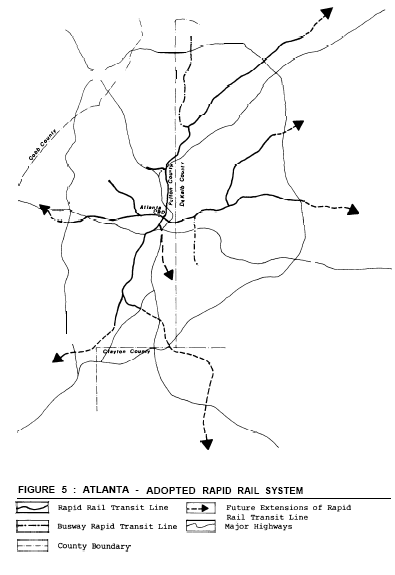
MARTA was built with at least three stubs for rail lines that were never built. The Northwest Line towards Cobb County has a stub tunnel east of Atlantic Station, but that redevelopment has not been built with a MARTA station in mind, and Cobb County would instead most likely get a light rail or commuter rail system (neither of which have been studied) or a bus rapid transit service (see Northwest Corridor HOV/BRT). The Northwest line was reduced to two planned stations but was later dropped entirely.
The South Line's branch to Hapeville was considered for extension into Clayton County as far away as Forest Park, but this idea was also cut off when the voters of that county initially refused to approve tax funding for the line. Another idea for a rail spur line was for an above-ground line from near the International Airport for a spur line to the town of Hapeville, but no work has been initiated. The idea to revive expansion plans in the form of heavy rail and bus was approved to go once again before voters in November 2014 by the Clayton county commissioners in July 2014 with a 1% sales tax providing the funding for said expansion. This time, the referendum was approved and Clayton County voted to join MARTA, the system's first ever expansion outside of Fulton, Dekalb and the city of Atlanta.
Yet another proposed spur line would have branched off the Blue Line in DeKalb County, Called the Tucker-North Dekalb Line it would have run northeast to the area of North Druid Hills, Emory University, and the town of Tucker. Now under consideration is an idea for light rail line (rather than heavy rail) from Avondale Station to Lindbergh Center, via Emory/CDC.
The Northeast Line of the rail system, which has ended in Doraville for two decades, was considered for extension into Gwinnett County as far as northeast as Norcross, Georgia, but this idea was cut off when the voters of that county declined to approve sales-tax funding for it.
The Proctor Creek branch was also projected to go one more station northwestward to the West Highlands neighborhood, but no work has been done on that one either.
Expansion westward to Fulton Industrial Boulevard through the use of either heavy rail extension or bus rapid transit has been proposed as an extension of the West Line since the system was originally planned.
Clifton Corridor
Main article: Clifton Corridor
Rapid transit alternatives are as of October 2011, under consideration for the Clifton Corridor, from Lindbergh Center, following the CSX rail corridor to Emory University and the Centers for Disease Control, with possible continuation along the northern edge of Decatur on to Avondale MARTA station. Bus, light rail and heavy rail rapid-transit options had been considered, with light rail being selected as the preferred option.
Mall at Stonecrest Expansion
Eastward expansion focuses on bus rapid transit from downtown Atlanta along I-20 and extension of heavy rail transit from Indian Creek station, south along I-285 to I-20, then east along the I-20 corridor to the Mall at Stonecrest. The current Green Line would also be extended east from its current terminus at Edgewood/Candler Park station to Mall at Stonecrest. This proposed extension has not been studied further since 2018.
Connect 400
The Georgia 400 Transit Initiative (also known as "Connect 400") is a MARTA project to study options for expanding high-capacity transit along the Georgia State Route 400 corridor into the northern reaches of Fulton county. The initiative, kicked off in December 2011, envisages an 11.9-mile extension of rapid transit service, starting in the south at North Springs Transit Station, the current terminus of the existing MARTA Red Line. From there, such an extension would continue northward through the cities of Sandy Springs, Roswell, and Alpharetta, terminating in the vicinity of Windward Parkway.
As of the fifth public meeting on the subject on September 26, 2013, the study had narrowed the field of transit technology alternatives to three, all using existing right-of-way along SR 400: heavy-rail transit (HRT, extending the Red Line northward), light-rail transit (LRT), or bus rapid transit (BRT). Early designs for all three options include stations near Northridge Road, Holcomb Bridge Road, Mansell Road, North Point Mall, and Windward Parkway; initial sketches of the LRT and BRT options also include a station near Old Milton Parkway.
As of June 2015, the project is moving into the Environmental Impact study stage of the planning process. According to MARTA Representatives at the April 2015 meetings, the expansion could open in 2025 at the earliest assuming a best-case scenario. Federal funding is still not approved; the Environmental Impact study must be complete. By the April 2015 meeting, the LRT option has been discarded. The HRT option has been approved as the Locally Preferred Alternative, though two BRT options exist - one that would run in a dedicated bus guideway and the other to integrate with Georgia DOT's planned work for the corridor. The GDOT integrated option would include sharing normal traffic lanes at least in some parts of the route. The plans for stations at Mansell Rd. and Haynes Bridge Rd. have been merged into one station at North Point Mall.
As of June 2018, the project's adopted alternative is bus rapid transit (BRT) style bus service utilizing express lanes along new toll lanes. Heavy rail expansion will not be considered according to the signed House Bill (HB) 930.
Atlanta Beltline
Main article: Streetcars in Atlanta#Beltline routes

Additionally, several traffic corridors are currently being studied by MARTA for possible system expansion. The Atlanta Beltline is a proposal for the use of light rail and possibly bus or streetcar service on existing railroad rights-of-way around Atlanta's central business districts. The conversion of existing rail right-of-way to the proposed Beltline also calls for the creation of three additional MARTA rapid transit stations where existing lines intersect the Beltline at Simpson Road, Hulsey Yard, and Murphy Crossing.
Proposed new infill stations
Adding another station to the existing line near Armour Yard (MARTA's main railyard, opened 2005) has also been discussed, as the Red and Gold MARTA lines, the northeast Beltline light rail, proposed commuter rail lines to points northeast such as Athens (the "Brain Train") and Gainesville, would all pass through Armour Yard. Other stations that have been proposed are; Mechanicsville, Boone, Murphy Crossing, and Krog.
The proposed Atlanta Multimodal Passenger Terminal (MMPT) would be built next to Five Points station, connecting MARTA to surface passenger rail, including commuter rail, future intercity rail, Amtrak, and possible high-speed rail in the Southeast Corridor.
Additional expansion plans for MARTA and other metro Atlanta transportation agencies are detailed in Mobility 2030 a timeline by the Atlanta Regional Commission for improving transit through the year 2030.
Major incidents
On April 10, 2000, two MARTA contract workers repairing the ceiling of MARTA's Lenox Station were killed when an unscheduled MARTA train struck the bucket of the self-propelled lift they were in. As a result, the Georgia Department of Transportation (GDOT) audited MARTA operations and enforced changes to rule compliance by MARTA employees.
On October 15, 2011, 19-year-old Joetavius Stafford was killed by a MARTA police officer at the Vine City rail station. MARTA claims that Stafford was armed while his brother said he was unarmed. After a full investigation, there was evidence that Stafford was armed and the MPO was cleared.
In June 2018, a MARTA contractor died after being struck by a train while working on the tracks between Buckhead and North Springs stations.
On January 14, 2022, MARTA CEO Jeffrey Parker committed suicide by stepping in front of a moving train at the East Lake station.
References
References
- "Assessing Electoral Defeat: New Directions and Values for MARTA". Urban Mass Transportation Administration.
- Bullard, R. D.. (2000). "Sprawl City: Race, Politics, and Planning in Atlanta". Island Press.
- "History of MARTA - 1970-1979". Metropolitan Atlanta Rapid Transit Authority.
- Ferreira, Robert. "MARTA Provisions for Future Extensions". world.nysubway.org.
- "Phoenix Project home page".
- "Metropolitan Atlanta Rapid Transit Authority".
- "Memorial Drive Arterial Bus Rapid Transit". Metropolitan Atlanta Rapid Transit Authority.
- John Ruch. (July 5, 2014). "Clayton approves MARTA contract for November ballot". Creative Loafing Atlanta.
- (July 13, 2018). "Commuter rail is MARTA's choice for Clayton County".
- "Archived copy".
- Wickert, David. "Former official: MARTA short of cash for Atlanta, Clayton County expansions". The Atlanta Journal-Constitution.
- (February 8, 2017). "How Racial Discrimination Shaped Atlanta's Transportation Mess".
- "Connect Gwinnett: Transit Plan {{!}} Gwinnett County".
- Estep, Tyler. (September 6, 2018). "MARTA board approves historic Gwinnett contract". The Atlanta Journal-Constitution (ajc.com).
- Yeomans. (March 19, 2019). "Gwinnett back at square one after MARTA rejected in key vote".
- Yeomans, Curt. (November 7, 2020). "Gwinnett has — once again — rejected a transit tax in narrow defeat of referendum".
- "MARTA".
- "MARTA".
- "MARTA tax increase begins in Atlanta, others follow in Fulton April 1". The Atlanta Journal-Constitution.
- Kass, Arielle. "Fulton, Atlanta transportation taxes appear to win; MARTA approved". The Atlanta Journal-Constitution.
- Wickert, David. "MARTA unveils revised Atlanta expansion plan". The Atlanta Journal-Constitution.
- "22-Mile Loop of Pedestrian-friendly Transit on the Atlanta Beltline".
- (October 5, 2018). "After Beltline transit win, More MARTA project list is officially approved".
- Wickert, David. "Council demands audit of MARTA's Atlanta expansion program". The Atlanta Journal-Constitution.
- Wickert, David. "MARTA's Atlanta expansion: Moving forward under scrutiny". The Atlanta Journal-Constitution.
- Green, Josh. (June 22, 2023). "MARTA picks designer for streetcar extension into Atlanta BeltLine {{!}} Urbanize Atlanta".
- Quinn, Patrick. (March 9, 2024). "BeltLine transit battle: Inside the design draft of MARTA's Streetcar east extension line".
- Green, Josh. (March 13, 2025). "Atlanta mayor yanks support for eastside Beltline streetcar {{!}} Urbanize Atlanta".
- Kelley, Collin. (March 13, 2025). "UPDATE: Dickens rejects new MARTA audit findings, 'reprioritizes' streetcar extension to Beltline".
- Green, Josh. (March 13, 2025). "Atlanta mayor yanks support for eastside Beltline streetcar {{!}} Urbanize Atlanta".
- (March 25, 2024). "4 new MARTA rail stations coming to Atlanta, mayor announces". Atlanta News First.
- (April 11, 2024). "Locations revealed for new 4 Atlanta MARTA stations". Atlanta News First.
- Green, Josh. (June 17, 2024). "Photos: Atlanta's first rapid bus line, fresh bike lanes make progress {{!}} Urbanize Atlanta".
- Gregory, Sara. "MARTA BRT project delayed by long-forgotten parking garage, trolley lines". The Atlanta Journal-Constitution.
- Kelley, Collin. (July 3, 2024). "MARTA hits pause on Five Points Station renovation plans".
- Kelley, Collin. (April 3, 2025). "MARTA to resume work on Five Points Station renovation project".
- Green, Josh. (August 19, 2024). "City releases findings of More MARTA audit, says program owed $70M {{!}} Urbanize Atlanta".
- Torpy, Bill. "OPINION: How 'More MARTA' became 'Hardly Any MARTA'". The Atlanta Journal-Constitution.
- Kelley, Collin. (March 12, 2025). "Report: New MARTA audit disputes financial claims made by the city".
- "Bikes on MARTA".
- Information collected from Parking Division at (404)209-2945, Parking Operations at (404)530-67254, and Airport Police at (404)530-6800.
- (June 30, 2007). "Comprehensive Annual Financial Report". Metropolitan Atlanta Rapid Transit Authority.
- "MARTA - Getting There - Rail Schedules and Map". Metropolitan Atlanta Rapid Transit Authority.
- (July 1, 2018). "MARTA officially assumes operations of Atlanta Streetcar".
- (July 2, 2018). "MARTA officially takes over Atlanta Streetcar operations".
- (July 2013). "Fact Sheet". Atlanta Streetcar.
- (February 2015). "Atlanta meets New Year deadline: Streetcars return to the streets of Georgia after a 65-year break". LRTA Publishing.
- "Siemens to build Atlanta streetcars".
- "Siemens is supplying Atlanta with the American type S70 LRT vehicles". Siemens.
- (April 2014). "Worldwide Review (regular news section)". LRTA Publishing.
- (June 30, 2006). "Comprehensive Annual Financial Report". Metropolitan Atlanta Rapid Transit Authority.
- "Route 12 - Howell Mill". Metropolitan Atlanta Rapid Transit Authority.
- "Parking Information". Metropolitan Atlanta Rapid Transit Authority.
- (June 30, 2006). "Fiscal Year 2006 Annual Report". Metropolitan Atlanta Rapid Transit Authority.
- "Georgia Governor's Council on Developmental Disabilities Five Year Strategic Plan". Georgia Governor's Council on Developmental Disabilities.
- (October 1, 2005). "Part 37—Transportation Services for Individuals with Disabilities". Federal Transit Administration.
- [http://www.gand.uscourts.gov/documents/1001cv3255TWTinj.pdf Martin v Metropolitan Atlanta Rapid Transit Administration] {{webarchive. link. (April 4, 2015 , No. 1:01-CV-3255-TWT (United States District Court for the Northern District of Georgia Atlanta Division). Retrieved on February 24, 2008.)
- "MARTA".
- Donsky, Paul. (February 22, 2006). "MARTA Plugs Gap in New Station Gates". The Atlanta Journal-Constitution.
- "Frequently Asked Questions". Metropolitan Atlanta Rapid Transit Authority.
- (August 19, 2015). "MARTA Breeze Cards Will Double In Price Starting January". WABE.
- (2025-10-27). "MARTA begins replacing faregates, cards, and apps with upgraded "Better Breeze" system: Here's what to know - CBS Atlanta".
- (2025-10-27). "MARTA begins replacing faregates, cards, and apps with upgraded "Better Breeze" system: Here's what to know - CBS Atlanta".
- "Hours of Operation". Metropolitan Atlanta Rapid Transit Authority.
- (March 20, 2006). "Minutes of the Board of Directors Customer Development Committee". Metropolitan Atlanta Rapid Transit Authority.
- (August 15, 2006). "FY06 MARTOC Report". Metropolitan Atlanta Rapid Transit Authority.
- "History of MARTA - 2000-Present". Metropolitan Atlanta Rapid Transit Authority.
- Donsky, Paul. (July 19, 2006). "MARTA flushes in new era with 12 self-cleaning toilets". The Atlanta Journal-Constitution.
- Donsky, Paul. (March 29, 2007). "Atlanta votes to extend sales tax for MARTA". The Atlanta Journal-Constitution.
- Donsky, Paul. (March 28, 2007). "MARTA resists sales tax referendum". The Atlanta Journal-Constitution.
- Pendered, David. (March 26, 2007). "Atlanta council plans special meeting for vote on MARTA tax". The Atlanta Journal-Constitution.
- Donsky, Paul. (April 25, 2007). "MARTA wins tax extension: Next stop could be new bus, rail lines". The Atlanta Journal-Constitution.
- Donsky, Paul. (April 4, 2007). "Northside may balk on MARTA tax". The Atlanta Journal-Constitution.
- Wall, Michael. (April 19, 2006). "Waiting for a ride: The racial reality behind MARTA's downward spiral". Creative Loafing.
- "HB173". Georgia General Assembly.
- "Meet The Board". Metropolitan Atlanta Rapid Transit Authority.
- (October 20, 2007). "MARTA Monthly MARTA Thanks General Manager Richard McCrillis for 22 Years of Dedicated Service and Leadership". Metropolitan Atlanta Rapid Transit Authority.
- "Dr. Scott's Biography". Metropolitan Atlanta Rapid Transit Authority.
- (January 15, 2022). "Update: MARTA CEO Jeff Parker hit by train at East Lake station".
- "MARTA CEO Jeffrey Parker, 56, has died". The Atlanta Journal-Constitution.
- "MARTA CEO steps down amid issues with immigration status".
- "MARTOC". Georgia General Assembly.
- (June 30, 2005). "Fiscal Year 2005 Annual Report". Metropolitan Atlanta Rapid Transit Authority.
- (August 8, 2003). "Metropolitan Atlanta Rapid Transit Authority (MARTA) train 103 striking technicians fouling the track Near MARTA Avondale Station in Decatur, Georgia February 25, 2000". National Transportation Safety Board.
- (August 8, 2003). "Metropolitan Atlanta Rapid Transit Authority (MARTA) Unscheduled train 166 striking bucket of self-propelled lift containing two contract workers MARTA Lenox rail transit station in Atlanta, Georgia April 10, 2000, about 2:30 am". National Transportation Safety Board.
- Ippolito, Milo. (December 5, 2001). "MARTA pays $10.5 million in workers' deaths". The Atlanta Journal-Constitution.
- Donsky, Paul. (December 5, 2006). "Human error blamed in MARTA derailment". The Atlanta Journal-Constitution.
- Monroe, Doug. (July 25, 1996). "MARTA driver injured when two cars derail". The Atlanta Journal-Constitution.
- (July 26, 1996). "ATLANTA DAY 7;Atlanta Train Misses Station". The New York Times.
- Kim, Lillian Lee. (June 2, 1996). "MARTA officials say accident a 'fluke'". The Atlanta Journal-Constitution.
- Visser, Steve. (January 12, 2008). "MARTA safety standards are being reviewed". The Atlanta Journal-Constitution.
- "MARTA escalator failures were mechanical".
- (June 2016). "Cobb Community Transit (CCT) History". Cobb County Department of Transportation }}{{dead link.
- "About Xpress". Georgia Regional Transportation Authority.
- (April 30, 2002). "Task 1.2 Existing Transit Service Inventory". Manuel Padron & Associates, Inc. and URS, Inc..
- (2004). "Highway robbery: transportation racism & new routes to equity". [[South End Press]].
- (August 13, 1989). "Atlanta weighing transit expansion". The New York Times.
- Monroe, Doug. (August 1, 2012). "Where It All Went Wrong".
- Schmidt, William. (July 22, 1987). "Racial roadblock seen in Atlanta transit system". The New York Times.
- "Metropolitan Atlanta Rapid Transit Authority Title VI Program Update June 2016 - 2019".
- McCosh, John. (February 11, 2001). "MARTA calls on marketers for image aid; Can soft drinks fill empty seats?". The Atlanta Journal-Constitution.
- Harris, Karen. (May 30, 1986). "MARTA overreports crimes, legislative audit finds". The Atlanta Journal.
- Donsky, Paul. (February 9, 2007). "MARTA: HOW SAFE? Transit system officials defend security, cite low crime totals, despite a few high-profile incidents". The Atlanta Journal-Constitution.
- "MARTA Police: Crime Stats". Metropolitan Atlanta Rapid Transit Authority.
- Firestone, David. (April 8, 2002). "Overcoming a Taboo, Buses Will Now Serve Suburban Atlanta". The New York Times.
- "We're Building a Better Way". Metropolitan Atlanta Rapid Transit Authority.
- "MARTA Track Renovation Information". Metropolitan Atlanta Rapid Transit Authority.
- Donsky, Paul. (September 12, 2006). "MARTA riders crowd heat-diminished fleet". The Atlanta Journal-Constitution.
- Gregory, Sara. "MARTA to rethink weekend service cuts after Pride weekend delays". The Atlanta Journal-Constitution.
- Ip, Alex. (November 1, 2024). "Atlanta Takes No Pride in MARTA's Weekend "Special Schedules"".
- Mahoney, Ryan. (August 18, 2006). "Ex-MARTA CEO abused credit cards". Atlanta Business Chronicle.
- [http://world.nycsubway.org/us/atlanta/marta-provisions.html MARTA Provisions] {{Webarchive. link. (February 16, 2008. world.nycsubway.org. Retrieved on August 16, 2013.)
- "West Line Corridor Details". Metropolitan Atlanta Rapid Transit Authority.
- [http://www.itsmarta.com/Clifton-Corr.aspx MARTA Clifton Corridor] {{webarchive. link. (January 24, 2012)
- [http://atlanta.curbed.com/archives/2012/03/22/light-rail-transit-recommended-for-the-clifton-corridor.php Light Rail Transit Recommended for the Clifton Corridor - Annals of Transportation - Curbed Atlanta] {{Webarchive. link. (June 23, 2012. Atlanta.curbed.com (March 22, 2012). Retrieved on August 16, 2013.)
- "I-20 East Corridor Details". Metropolitan Atlanta Rapid Transit Authority.
- "Archived copy".
- MARTA, Connect 400. "September 26, 2013 Presentation". MARTA.
- MARTA, Connect 400. "Connect 400 Newsletter #3: September 2013". MARTA.
- "Archived copy".
- (April 9, 2015). ""Connect 400" Transit Initiative Moves Forward".
- "Beltline Corridor Details". Metropolitan Atlanta Rapid Transit Authority.
- (August 8, 2003). "RAILROAD ACCIDENT BRIEF: METROPOLITAN ATLANTA RAPID TRANSIT AUTHORITY (MARTA) UNSCHEDULED TRAIN 166 STRIKING BUCKET OF SELF-PROPELLED LIFT CONTAINING TWO CONTRACT WORKERS AT MARTA LENOX RAIL TRANSIT STATION IN ATLANTA, GEORGIA, APRIL 10, 2000".
- Steve Visser (October 17, 2011). "[http://www.ajc.com/news/atlanta/marta-dead-teen-was-1204009.html MARTA: Dead teen was armed] {{Webarchive. link. (October 20, 2011 " ''[[The Atlanta Journal-Constitution]]''. Accessed October 26, 2011.)
- Steve Visser (October 20, 2011). "[http://www.ajc.com/news/atlanta/forensic-evidence-little-help-1206704.html Forensic evidence little help in investigation of MARTA shooting] {{Webarchive. link. (October 23, 2011 " ''[[The Atlanta Journal-Constitution]]''. Accessed October 26, 2011.)
- Adrianne Haney (June 13, 2018). "[https://www.11alive.com/article/news/local/marta-contractor-struck-by-train-sunday-night-has-died/561116569 MARTA contractor struck by train Sunday night has died] {{Webarchive. link. (February 15, 2023 " 11-Alive. Accessed March 12, 2020.)
- Adams, Abigail. (January 15, 2022). "MARTA CEO Jeffrey Parker Dies by Suicide: 'He Will Be Greatly Missed'". People.
This article was imported from Wikipedia and is available under the Creative Commons Attribution-ShareAlike 4.0 License. Content has been adapted to SurfDoc format. Original contributors can be found on the article history page.
Ask Mako anything about Metropolitan Atlanta Rapid Transit Authority — get instant answers, deeper analysis, and related topics.
Research with MakoFree with your Surf account
Create a free account to save articles, ask Mako questions, and organize your research.
Sign up freeThis content may have been generated or modified by AI. CloudSurf Software LLC is not responsible for the accuracy, completeness, or reliability of AI-generated content. Always verify important information from primary sources.
Report