From Surf Wiki (app.surf) — the open knowledge base
Metal amides
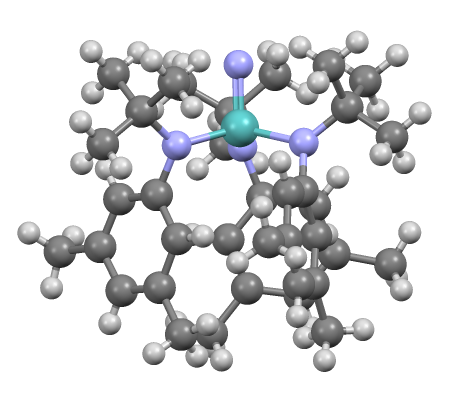
Metal amides (systematic name metal azanides) are a class of coordination compounds composed of a metal center with amide ligands of the form NR2−. Amido complexes of the parent amido ligand NH2− are rare compared to complexes with diorganylamido ligand, such as dimethylamido. Amide ligands have two electron pairs available for bonding.
File:Tris(dimethylamino)aluminium dimer.png|Tris(dimethylamino)aluminium dimer File:Ti(NMe2)4.png|Tetrakis(dimethylamino)titanium File:Ta(NMe2)5.png|Pentakis(dimethylamido)tantalum
Geometry and structure
In principle, the M-NX2 group could be pyramidal or planar. The pyramidal geometry is not observed.
In many complexes, the amido is a bridging ligand. Some examples have both bridging and terminal amido ligands. Bulky amide ligands have a lesser tendency to bridge. Amide ligands may participate in metal-ligand π-bonding giving a complex with the metal center being co-planar with the nitrogen and substituents. Metal bis(trimethylsilyl)amides form a significant subcategory of metal amide compounds. These compounds tend to be discrete and soluble in organic solvents.
Alkali metal amides
Main article: lithium amide, sodium amide, potassium amide
Lithium amides are the most important amides. They are prepared from n-butyllithium and the appropriate amine : The lithium amides are more common and more soluble than the other alkali metal analogs. Potassium amides are prepared by transmetallation of lithium amides with potassium t-butoxide (see also Schlosser base) or by reaction of the amine with potassium, potassium hydride, n-butylpotassium, or benzylpotassium.
The alkali metal amides, MNH2 (M = Li, Na, K) are commercially available. Sodium amide (also known as sodamide) is synthesized from sodium metal and ammonia with ferric nitrate catalyst. The sodium compound is white, but the presence of metallic iron turns the commercial material gray.
:2 Na + 2 NH3 → 2 NaNH2 + H2
Lithium diisopropylamide is a popular non-nucleophilic base used in organic synthesis. Unlike many other bases, the steric bulk prevents this base from acting as a nucleophile. It is commercially available, usually as a solution in hexane. It may be readily prepared from n-butyllithium and diisopropylamine.
Main group amido complexes
Amido derivatives of main group elements are well developed.
Transition metal complexes
Early transition metal amides may be prepared by treating anhydrous metal chloride with alkali amide reagents. In some cases, two equivalents of a secondary amine can be used, one equivalent serving as a base: :MCln + n LiNR2 → M(NR2)n + n LiCl :MCln + 2n HNR2 → M(NR2)n + n HNR2·HCl
Transition metal amide complexes have been prepared by these methods:
- treating a halide complex with an alkali amide
- deprotonation of a coordinated amine
- oxidative addition of an amine
Amido-ammine complexes
Highly cationic metal ammine complexes such as [Pt(NH3)6]4+ spontaneously convert to the amido derivative: :[Pt(NH3)6]4+ ↔ [Pt(NH3)5(NH2)]3+ + H+
Transition metal amides are intermediates in the base-induced substitution of transition metal ammine complexes. Thus, the Sn1CB mechanism for the displacement of chloride from chloropentamminecobalt chloride by hydroxide proceeds via an amido intermediate: :[Co(NH3)5Cl]2+ + OH− → [Co(NH3)4(NH2)]2+ + H2O + Cl− :[Co(NH3)4NH2]2+ + H2O → [Co(NH3)5OH]2+
References
References
- (1983). "Dimethylaminoalane, H3−nAl[N(CH3)2]n, n = 1, 2, 3 Kristallstrukturen und Molekülspektren". Zeitschrift für anorganische und allgemeine Chemie.
- [[Michael Lappert]], Andrey Protchenko, Philip Power, Alexandra Seeber. (2009). "Metal Amide Chemistry". John Wiley & Sons.
- Bergstrom, F. W.. (1955). "Sodium Amide".
- (1946). "Inorganic Syntheses". [[Inorg. Synth.]].
- (1990). "Structural and spectroscopic characterization of the compounds [Al(NMe2)3]2, [Ga(NMe2)3]2, [(Me2N)2Al{μ-N(H)1-Ad}]2 (1-Ad = 1-adamantanyl) and [{Me(μ-NPh2)Al}2NPh(μ-C6H4)]". Polyhedron.
- John F. Hartwig. (2009). "Organotransition Metal Chemistry: From Bonding to Catalysis". University Science Books.
- (2008). "Shining Light on Dinitrogen Cleavage: Structural Features, Redox Chemistry, and Photochemistry of the Key Intermediate Bridging Dinitrogen Complex". Journal of the American Chemical Society.
- G. L. Miessler and D. A. Tarr "Inorganic Chemistry" 3rd Ed, Pearson/Prentice Hall publisher, {{ISBN. 0-13-035471-6.
This article was imported from Wikipedia and is available under the Creative Commons Attribution-ShareAlike 4.0 License. Content has been adapted to SurfDoc format. Original contributors can be found on the article history page.
Ask Mako anything about Metal amides — get instant answers, deeper analysis, and related topics.
Research with MakoFree with your Surf account
Create a free account to save articles, ask Mako questions, and organize your research.
Sign up freeThis content may have been generated or modified by AI. CloudSurf Software LLC is not responsible for the accuracy, completeness, or reliability of AI-generated content. Always verify important information from primary sources.
Report