From Surf Wiki (app.surf) — the open knowledge base
Meskheti

| Field | Value |
|---|---|
| name | Meskheti/Samtskhe |
| native_name | მესხეთი/სამცხე |
| settlement_type | Historical Region |
| image_map | Part of Historical Samtskhe in modern international borders of Georgia.svg |
| map_caption | Map highlighting the historical region of Meskheti in Georgia |
| imagesize | 300 |
| subdivision_type | Country |
| subdivision_name | Georgia |
| subdivision_type1 | Mkhare |
| subdivision_name1 | Samtskhe-Javakheti |
| seat | Akhaltsikhe |
| seat_type | Capital |
| population_density_km2 | auto |
| parts_type | Districts |
| parts_style | para |
| footnotes | Meskheti is not an official subdivision of the Georgia; it constitutes a historical region only. |
Meskheti (მესხეთი , ) or Samtskhe (სამცხე ), also known as Moschia in ancient sources, is a mountainous area in southwestern Georgia.
History
.svg)
The ancient tribe of Meskhetians is the first known inhabitants of the modern Samtskhe-Javakheti region.
Between the 2nd millennium BC and the 4th century BC, Meskheti was part of the kingdom of Diauehi. It was subsequently, until the 6th century, part of the Kingdom of Iberia.
During the 10th-15th centuries, this region was a part of the united Georgian Kingdom. In the 16th century it was the independent Principality of Samtskhe until it was occupied and annexed by the Ottoman Empire.
In 1829-1917 the region was a part of Tiflis Governorate, and then briefly (1918–1921) part of the Democratic Republic of Georgia. Between 1921-1990 it was a part of the Soviet Union, as the Georgian SSR.
Meskheti is now part of the Samtskhe-Javakheti region, together with Javakheti and Tori.
Demographics
Ethnic groups
Georgians
Meskhetians or Meskhs (Meskhi) are an ethnographic subgroup of Georgians who speak the Meskhetian dialect of the Georgian language, which among Georgia's regional dialects is relatively close to official Georgian. Meskhetians are the indigenous population of Meskheti, a historical region in southern Georgia. Today they are mainly followers of Georgian Orthodox Church, while part of them are Catholics.
Meskhetian Turks
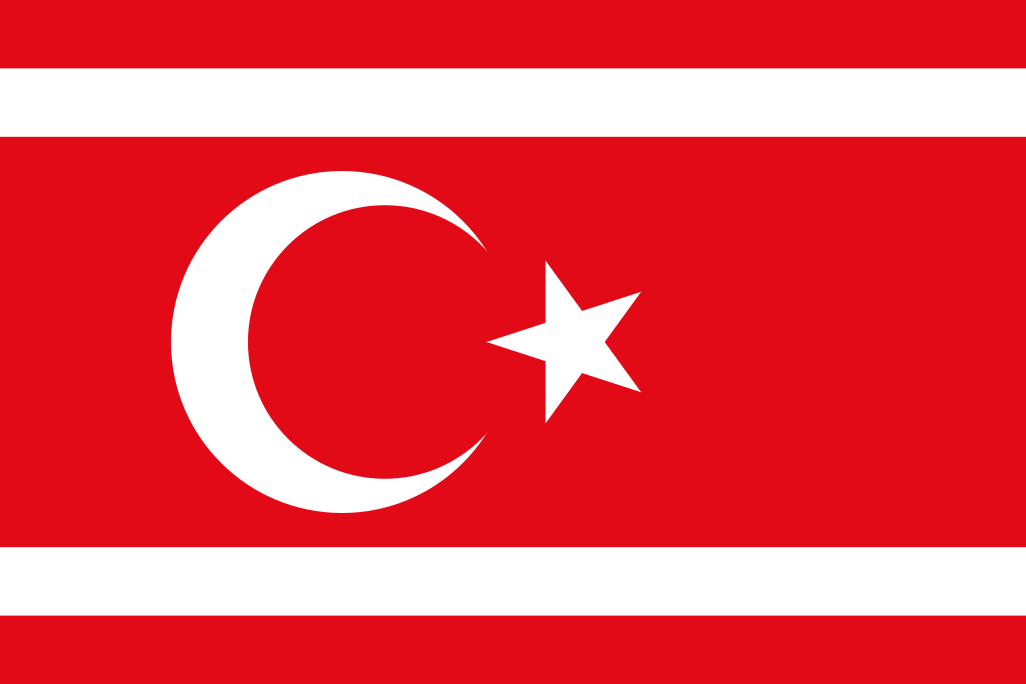
Meskhetian Turks are the former inhabitants of the Meskheti region of Georgia along the border with Turkey. They were deported to Central Asia during November 15–25, 1944 by Joseph Stalin and settled within Kazakhstan, Kyrgyzstan, and Uzbekistan. Of the 120,000 forcibly deported in cattle-trucks a total of 10,000 perished. Today they are dispersed over a number of other countries of the former Soviet Union. There are 500,000 to 700,000 Meskhetian Turks in exile in Azerbaijan and Central Asia. Most Meskhetian Turks are Sunni Muslims.
References
Literature
- (Georgian) * თაყაიშვილი ე.,* არქეოლოგიური ექსპედიცია კოლა-ოლთისში და ჩანგლში, ტფ., 1907;
- (Georgian) ლომსაძე. შ., სამცხე ჯავახეთი (XVIII ს. შუაწლებიდან XIX საუკუნის შუა წლებამდე), თბ., 1975;
- (Georgian) მუსხელიშვილი დ., ქსე, ტ. 6, გვ. 601-602, თბ., 1983
- (Georgian) ნოზაძე ვ. საქართველოს აღდგენისათვის ბრძოლა მესხეთის გამო, თბილისი, 1989;
References
- Melikishvili, Giorgi, ''Georgian Soviet Encyclopedia'', Vol. 7, Tbilisi, 1984, p. 146.
- "''East of Center » Archive » Meskhetian Turks Bouncing From Exile to Exile''".
- "''ECMI - European Centre for Minority Issues: Publications''".
- Brennan, Dan. (5 April 2003). "Guram Mamulia". The Guardian.
- Krauthamer, Ky. "Meskhetian Bouncing From Exile to Exile". East of Center.
- Trier, Tom. (2008). "The Meskhetian Turks at a Crossroads". European Center for Minority Issues.
This article was imported from Wikipedia and is available under the Creative Commons Attribution-ShareAlike 4.0 License. Content has been adapted to SurfDoc format. Original contributors can be found on the article history page.
Ask Mako anything about Meskheti — get instant answers, deeper analysis, and related topics.
Research with MakoFree with your Surf account
Create a free account to save articles, ask Mako questions, and organize your research.
Sign up freeThis content may have been generated or modified by AI. CloudSurf Software LLC is not responsible for the accuracy, completeness, or reliability of AI-generated content. Always verify important information from primary sources.
Report