From Surf Wiki (app.surf) — the open knowledge base
Merycoidodon
Extinct genus of mammals

Extinct genus of mammals
- †M. (?M.) presidioensis
- †M. (M.) culbertsoni †Otarohyus
- †M. (O.) bullatus
- †M. (O.) major unassigned
- †M. dunagani
- †Genetochoerus Schultz and Falkenbach, 1968
- †Oreodon Leidy, 1851
- †Otionohyus Schultz and Falkenbach, 1968
- †Paramerycoidodon Schultz and Falkenbach, 1968
- †Prodesmatochoerus Schultz and Falkenbach, 1954
- †Subdesmatochoerus Schultz and Falkenbach, 1954
Merycoidodon ("ruminating teeth") is an extinct genus of herbivorous artiodactyl of the family Merycoidodontidae, more popularly known by the name Oreodon ("hillock teeth"). It was endemic to North America during the Middle Eocene to Middle Miocene (46—16 mya) existing for approximately .
Taxonomy
Most researchers in paleobiology and paleontology now use the antecedent genus Merycoidodon to refer to this Oligocene epoch oreodont, even though it was once widely known by the younger synonym of Oreodon. Taxonomically speaking, Merycoidodon belongs to the family Merycoidodontidae (once known as "Oreodontidae"), a group of artiodactyls related to camels that were endemic to North America. Its ancestors date back to the Eocene and its last descendants are known from the end of the Miocene, so that oreodonts, broadly speaking, lived throughout most of the Paleogene.
Morphology
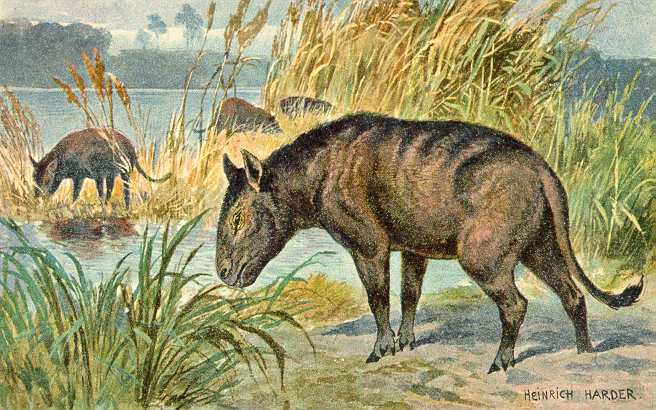

Merycoidodon would have somewhat resembled a pig in appearance, but had a longer body, at about 1.4 m, and short limbs. The fore limbs had five toes (although the first one was vestigial), while the hind limbs had four. Given the shape of the limbs, it is unlikely that the animals would have been able to run fast. Unlike modern ruminants, they had a full set of teeth, although the molars were adapted for grinding up tough vegetation. Notably, they had strong, and very striking, canines.
The skulls of Merycoidodon have a pit in front of the eyes. Similar pits are found in the skulls of modern deer, where they contain a scent gland used for marking territory. Although Merycoidodon was not directly related to deer, it seems likely that it possessed a similar gland, which may imply that it, too, was territorial. Oreodonts lived in large herds and moved about from place to place. They seem to have had a predilection for well-watered regions, where food was plentiful and succulent. The number of fossils found implies that, at one time, oreodonts were as plentiful in South Dakota as zebras are today on the serengeti plains, and as common in Denver, Colorado as cattle on the Colorado farm range.
Fossil distribution
Fossils have been uncovered from as far north as Alberta, Canada to Florida, Texas, Colorado and Oregon in the United States.
Gallery
File:Merycoidodon gracilis.jpg|Merycoidodon gracilis from South Dakota File:Artiodactyla - Merycoidodon gracilis.JPG|Merycoidodon gracilis from South Dakota. Skull File:Mandíbula y dientes de un oreodon (Merycoidodon culbertsoni), Dakota del Sur, Estados Unidos, 2021-01-15, DD 162-186 FS.jpg|3 cm-long teeth on a jaw fragment from Merycoidodon culbertsoni. Oligocene, Brule Formation, South Dakota, USA File:Artiodactyla - Merycoidodon.JPG|Skeleton at the Canadian Museum of Nature
References
- Benes, Josef. Prehistoric Animals and Plants. Pg. 219. Prague: Artua, 1979.
References
- Stevens, M.S.. (1996). "The terrestrial Eocene-Oligocene transition in North America". Cambridge University Press.
- [https://paleobiodb.org/classic/checkTaxonInfo?taxon_no=42502 ''Merycoidodon'' at fossilworks]
- (1999). "The Marshall Illustrated Encyclopedia of Dinosaurs and Prehistoric Animals". Marshall Editions.
This article was imported from Wikipedia and is available under the Creative Commons Attribution-ShareAlike 4.0 License. Content has been adapted to SurfDoc format. Original contributors can be found on the article history page.
Ask Mako anything about Merycoidodon — get instant answers, deeper analysis, and related topics.
Research with MakoFree with your Surf account
Create a free account to save articles, ask Mako questions, and organize your research.
Sign up freeThis content may have been generated or modified by AI. CloudSurf Software LLC is not responsible for the accuracy, completeness, or reliability of AI-generated content. Always verify important information from primary sources.
Report