From Surf Wiki (app.surf) — the open knowledge base
Mercedes-Benz in motorsport
none

none
Throughout its long history, Mercedes-Benz has been involved in a range of successful motorsport activities, including sportscar racing, touring car racing, Grand Prix racing, and rallying. It is currently active in GT racing, and Formula One. Mercedes is also one of only three constructors to complete the Triple Crown of Motorsport (wins at the Indianapolis 500, 24 Hours of Le Mans, and Monaco Grand Prix), a feat that Mercedes achieved as both a chassis manufacturer and an engine manufacturer by winning the 1952 24 Hours of Le Mans.
Early history
The two companies which were merged to form the Mercedes-Benz brand in 1926 had both already enjoyed success in the new sport of motor racing throughout their separate histories. A single Benz competed in the world's first motor race, the 1894 Paris–Rouen, where Émile Roger finished 14th in 10 hours 1 minute. In spring 1888, Roger was granted the sole agency rights for Benz vehicles and engines in France. Roger was not only a high-performing sales partner for Carl Benz, selling vehicles from Germany with great success; this step also marked the beginning of foreign sales for Benz. The Mercedes Simplex of 1902, built by DMG, was Mercedes' first purpose-built race car—much lower than their usual designs—which were similar to horse carriages; that model dominated racing for years. In 1914, just before the beginning of the First World War, the DMG Mercedes 35 hp won the French Grand Prix, finishing 1–2–3.
Karl Benz's company, Benz & Cie. built the "bird beaked", Blitzen Benz that set land speed records several times, reaching 228.1 km/h in 1911. That record gained that model the reputation of being faster than any other automobile—as well as any train or plane. They constructed many aerodynamically designed race cars. Mercedes-Benz won the Elgin Trophy three consecutive years with driver Ralph DePalma (1912, 1913, 1914).
Grand Prix motor racing
The Silver Arrows (1923–1931, 1934–1939)

Benz was involved in Grand Prix motor racing from 1923, when the Benz Tropfenwagen (described as having a teardrop shape) was introduced to motorsport at the European Grand Prix at Monza. These, the brainchild of Benz chief engineer Hans Nibel (1880–1934), were inspired by the Rumpler Tropfenwagen and were intended to increase public acceptance of mid-engined cars. They resembled the later Auto Unions (also built in part by Rumpler engineers), and used the virtually unchanged Rumpler chassis. They were fitted with a 1991 cc DOHC inline six producing 80 hp and demonstrated "impeccable roadholding" at 90 mph and above.
Despite a promising start, with a fourth and a fifth (and one retirement) in their debut, they did no better in three years of Grands Prix and hillclimbing, and the expected public acceptance did not materialize. Financial difficulties led to a merger with Daimler.
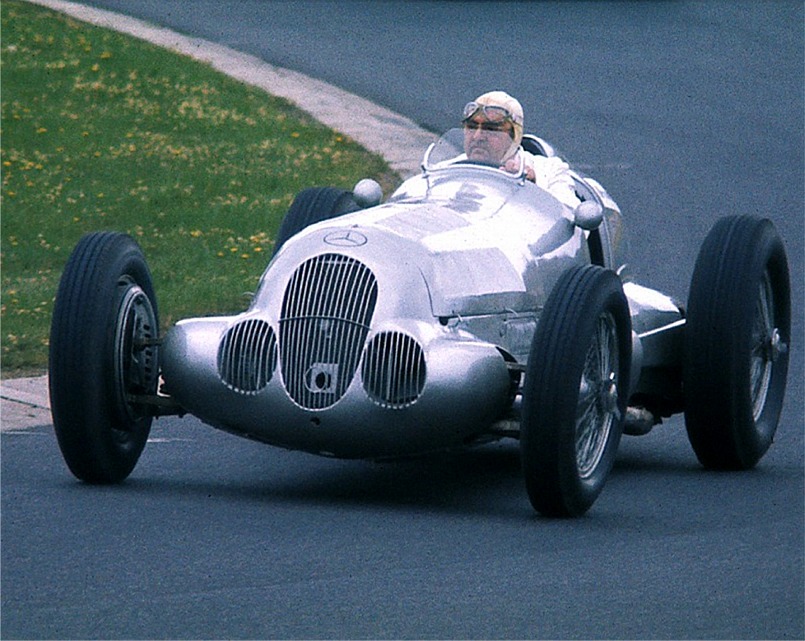
In the 1930s, the new joint company, Daimler-Benz, with their mighty Mercedes-Benz Silver Arrows, dominated Grand Prix racing in Europe together with its rival, Auto Union. In fact the colour of the cars, which was later to become legendary, was unintentional—they had initially been painted white as was traditional for German cars, but the paint was stripped away to reduce weight. The cars set speed records up to 435 km/h. The team was guided by the great Rennleiter (racing team manager) Alfred Neubauer (1891–1980) until the company ceased racing at the start of WWII.
Formula One
In early 1951, Mercedes took three pre-war W154s to Argentina to take part in two Formula Libre races of the Buenos Aires Grand Prix. Drivers were pre-war veteran Hermann Lang, Karl Kling, and local hero Juan Manuel Fangio who would win his first World Championship in 1951 and rejoin Mercedes in 1954. The old Mercedes did well, finishing second and third in each heat, but were beaten by a modern Ferrari 166 FL. Daimler decided that there was no point in competing with the old cars. Instead, they would run the new 300 SL in sportscars races in 1952, and then develop a Formula One car for the new rules that would come into effect in 1954.
Main article: Mercedes-Benz in Formula One
Original factory team (1954–1955)

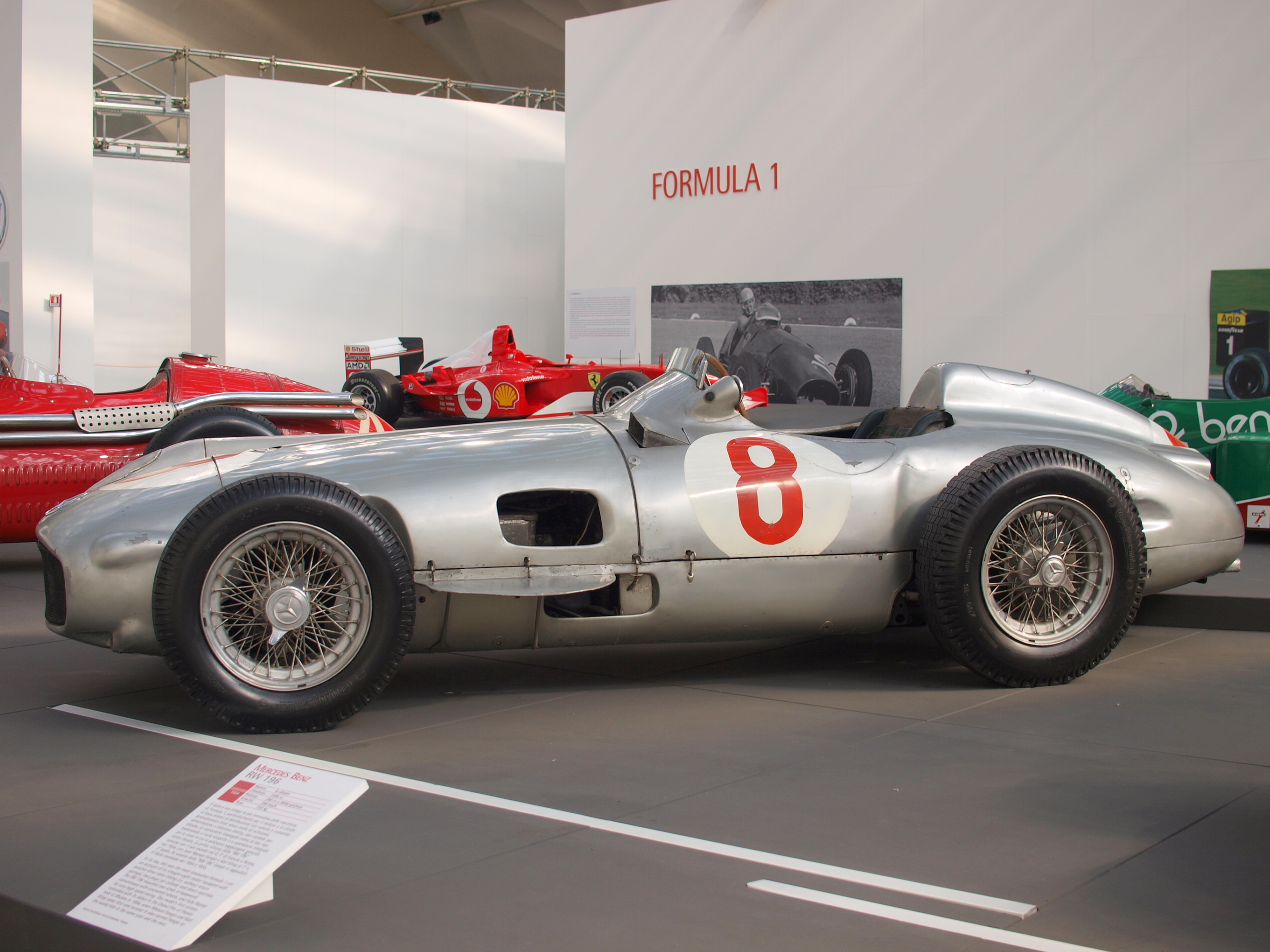
In 1954 Mercedes-Benz returned to what was now known as **Formula One racing ** (a World championship having been established in 1950), using the technologically advanced Mercedes-Benz W196 which was run in both open-wheeled and streamlined forms. Juan Manuel Fangio, a previous champion (1951) transferred mid-season from Maserati to Mercedes-Benz for their debut at the French Grand Prix on 4 July 1954. The team had immediate success and recorded a 1–2 victory with Fangio and Karl Kling, as well as the fastest lap (Hans Herrmann. Fangio went on to win three more races in 1954, winning the Championship.
The success continued into the 1955 season, where the same car was used again. The team's main drivers, Fangio and the young Stirling Moss, won 6 of the 9 rounds between them, and finished first and second in that year's championship.
Having proven that they could win both in F1 and sportscars, the company decided to discontinue racing at the end of the 1955 championships seasons to focus on road car development. The withdrawal is commonly attributed to the 1955 Le Mans disaster.
Engine supplier
Main article: Mercedes AMG High Performance Powertrains
Mercedes made its return to Formula One in 1994 as an engine supplier to Sauber, with whom they had already enjoyed success in sportscar racing, after 1993 funding their engine partner Ilmor, Mercedes and Sauber announced that the teams' engines will be rebadged "Mercedes-Benz" for the 1994 season thus signaling Mercedes partial return to factory-sponsored motorsport the first time since 1955. In the one year that Sauber ran Mercedes badged engines they only managed to score twelve points.
McLaren (1995–2014, 2021–)
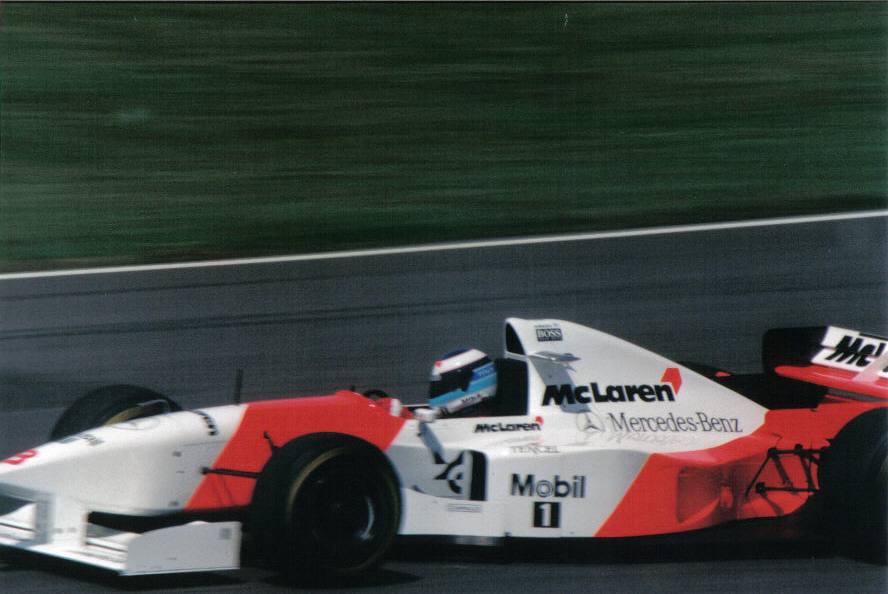
saw the normally aspirated Mercedes-Benz-Ilmor F1-V10 move to the Woking based McLaren team, replacing Peugeot who moved to supplying their engines to the Jordan team. In a season dominated by the Renault powered Benetton B195s and Williams FW17s, the McLaren-Mercedes partnership produced thirty points with 2 podium finishes from Mika Häkkinen. produced similar results to '95 with the team finishing behind the trio of Williams, Benetton and Ferrari, but the team still scored three times as many podium positions in comparison to the previous year. Outside Formula One, Mercedes-Benz had increased its shareholding in the Ilmor company in 1996 and took full control nine years later. They have continued to design and build engines for McLaren.
In the opening race of the 1997 Formula One season, David Coulthard produced victory for McLaren and ushered in a new era of success for the British based squad. Coincidentally this was the first race in which McLaren had competed with a silver livery due to West replacing Marlboro, who moved to Ferrari, as title sponsor. The colour drew inevitable comparisons to the Silver Arrows of a previous era, and the nickname was applied to the McLarens. This was a significant result in F1 racing, McLaren's first victory for three seasons and the first win for Mercedes-Benz since Juan Manuel Fangio's success at the 1955 Italian Grand Prix. McLaren and Mercedes-Benz still, however, finished fourth in the Constructors' Championship behind the same three teams as the previous two seasons, but they had collected more than twice as many points in '97 as they had in '95.
With an Adrian Newey designed MP4/13 for , McLaren went on to win both the Drivers' Championship with Häkkinen and the Constructors' title, their first in seven years, by twenty-three points to their nearest rivals Ferrari. Häkkinen went on to win the title for the second time in succession the following season, however, the team failed to retain their Constructors' title, losing it to Ferrari by four points.
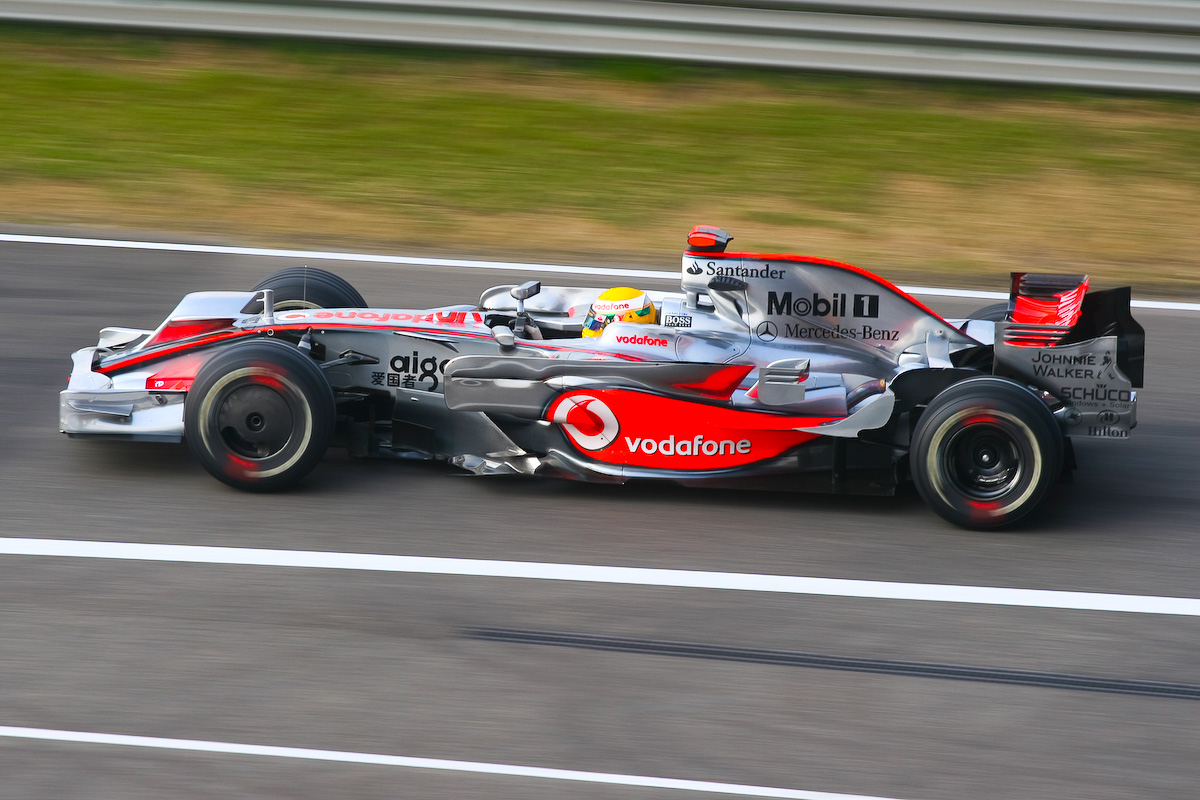
and saw McLaren and their drivers play second fiddle to the dominant partnership of Michael Schumacher and Ferrari, as the Italian-German partnership won nineteen of a possible thirty-four races. Häkkinen retired from Formula One before the season, although he would later represent Mercedes in the Deutsche Tourenwagen Masters series. Fellow Finn Kimi Räikkönen replaced him. McLaren dropped down the order in terms of Constructors' Championship position, losing its second-place position to the BMW-Williams team, with the season still being dominated overall by Schumacher and Ferrari. For the following four years McLaren proved to be one of the fastest cars in the field but lacked in reliability, most notably in and ; the 2006 season marked the first since 1996 in which McLaren had failed to win a race. In McLaren's drivers finished second and third in the Drivers' Championship, only 1 point behind Champion Kimi Räikkönen. The team was also disqualified from the championship. In Lewis Hamilton won the Drivers' Championship by 1 point from Ferrari's Felipe Massa. Jenson Button won McLaren-Mercedes’ last race in the V8 era at the 2012 Brazilian Grand Prix.
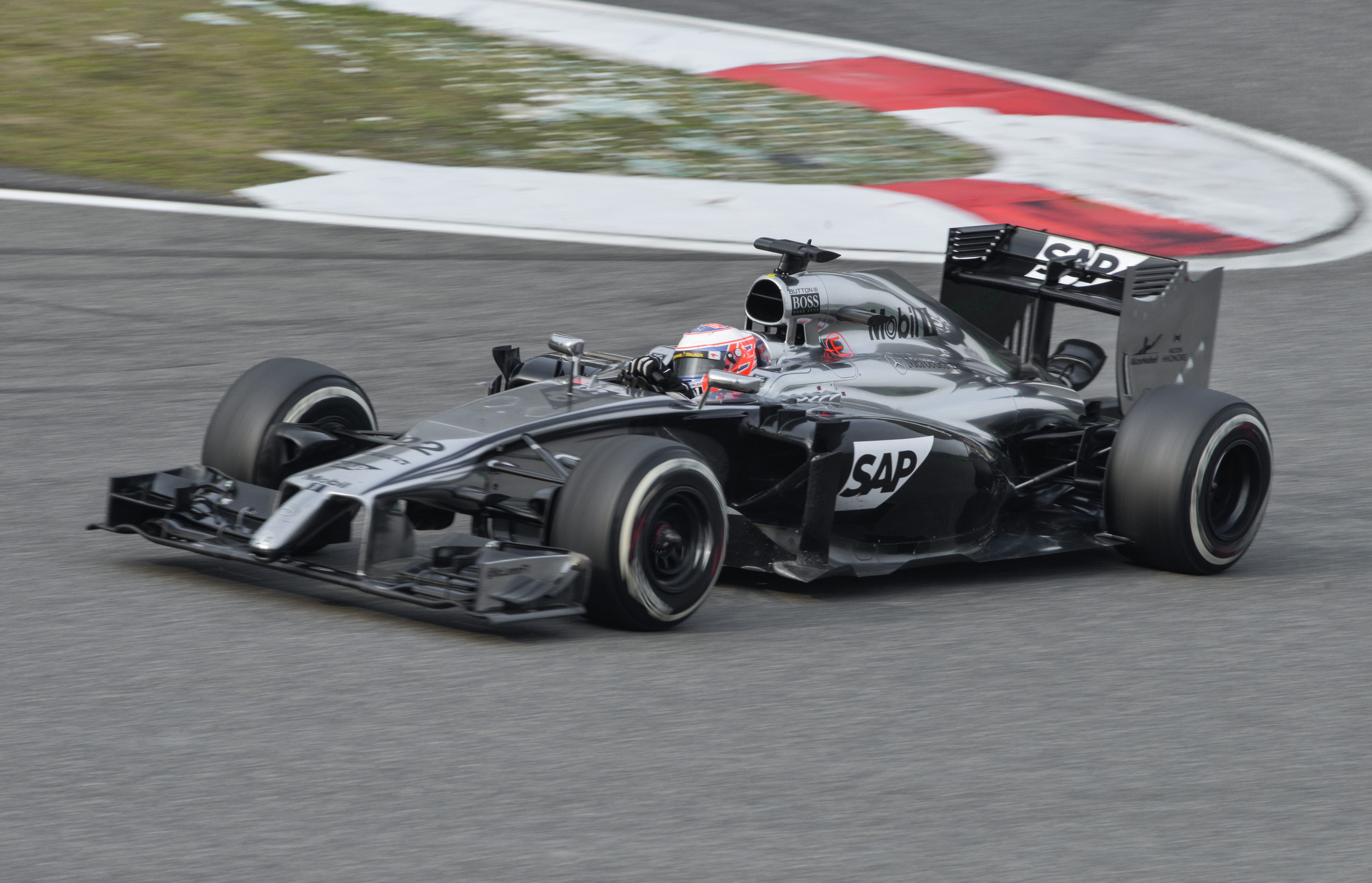
For the 2014 Season, McLaren-Mercedes used the Mercedes PU106A Hybrid, a 1.6-litre V6 turbocharged engine. In their final season as McLaren-Mercedes the team finished 5th in the World Constructors' Championship standings with 181 points. At the end of the season, Mercedes-Benz officially ended its 20-year partnership with McLaren.
On September 28, 2019, Mercedes-Benz and McLaren agreed to a four-year deal for Mercedes-Benz to be an engine supplier for McLaren in the beginning of the year 2021. McLaren's first season back with Mercedes power saw them achieve a 1-2 result at the 2021 Italian Grand Prix with Daniel Ricciardo and Lando Norris finishing 1st and 2nd, respectively, and 3 further podiums (all from Norris) to finish 4th in the Constructors' Championship, by losing 3rd place to Ferrari. In 2023, the existing partnership between McLaren and Mercedes was extended to 2030. McLaren went on to win Constructors' championships in and . Lando Norris clinched the drivers' title in by 2 points from Red Bull's Max Verstappen.
Williams (2014–present)
In early 2013, it was announced that Mercedes-Benz would be the engine supplier to Williams for the 2014 season. The team finished the season placing third in the World Constructors' Championship standings with 257 points, with both Felipe Massa and Valtteri Bottas scoring 4 podiums during the season. For the next two seasons, the team finished 5th in and . For the season, Williams-Mercedes faced a disappointing season only finishing 10th in the World Constructors' Championship standings. On 13 September 2019, Williams and Mercedes-Benz agreed to extend their partnership until 2025.
Safety cars

In 2003, the partnership between Mercedes and McLaren was extended into the production of a Mercedes-McLaren roadcar, the SLR. Mercedes also supplies the cars to the FIA for use as safety cars and other race official roles, such as the medical car, at Formula One races. Currently, in Formula One, Mercedes and Aston Martin both supply the Safety Car and alternate per race. At the moment the Mercedes safety car is a red design.
New factory team (2010–present)
.jpg)
On November 16, 2009, it was announced that Mercedes would buy Brawn. They purchased 75% which gave them the controlling stake in the 2009 championship-winning team Brawn GP. The team, renamed and branded Mercedes GP, debuted at the 2010 Bahrain Grand Prix, with an all-German driver line-up of Nico Rosberg and Michael Schumacher and was their full return to factory sponsored motorsport in F1. Over the next few years, with Lewis Hamilton in the team, Mercedes would go on to win eight consecutive Formula One World Constructors' Championships from to the third highest total in Formula One history. Mercedes also won seven Drivers' Championships until Hamilton lost the title to Max Verstappen in 2021.
Sportscar racing

It was in 1952 that Mercedes-Benz returned to racing after the war, again with Alfred Neubauer as team manager. The gull-winged Mercedes-Benz W194, won several races in 1952 including the 24 Hours of Le Mans, the Carrera Panamericana, and did well in other important races such as the Mille Miglia.
Mercedes-Benz was also dominant in sports car racing during the 1950s. The Mercedes-Benz 300 SLR was derived from the W196 Formula One car for use in the 1955 World Sportscar Championship season. At Le Mans that year, a disaster occurred in which a Mercedes-Benz 300 SLR collided with another car, killing more than eighty spectators. The team went on to win the two remaining races of the season, and won the Manufacturer's championship, but it had already been planned at the beginning of that year that the company would retire its teams at the end of the 1955 season. In fact in the aftermath of the Le Mans disaster, it would be several decades until Mercedes-Benz returned to front line motorsport.
In the late 1960s and early 1970s, Mercedes returned to competition through the tuning company AMG (later to become a Mercedes-Benz subsidiary), which entered the big Mercedes-Benz 300SEL 6.3 V8 sedan in the Spa 24 Hours and the European Touring Car Championship.
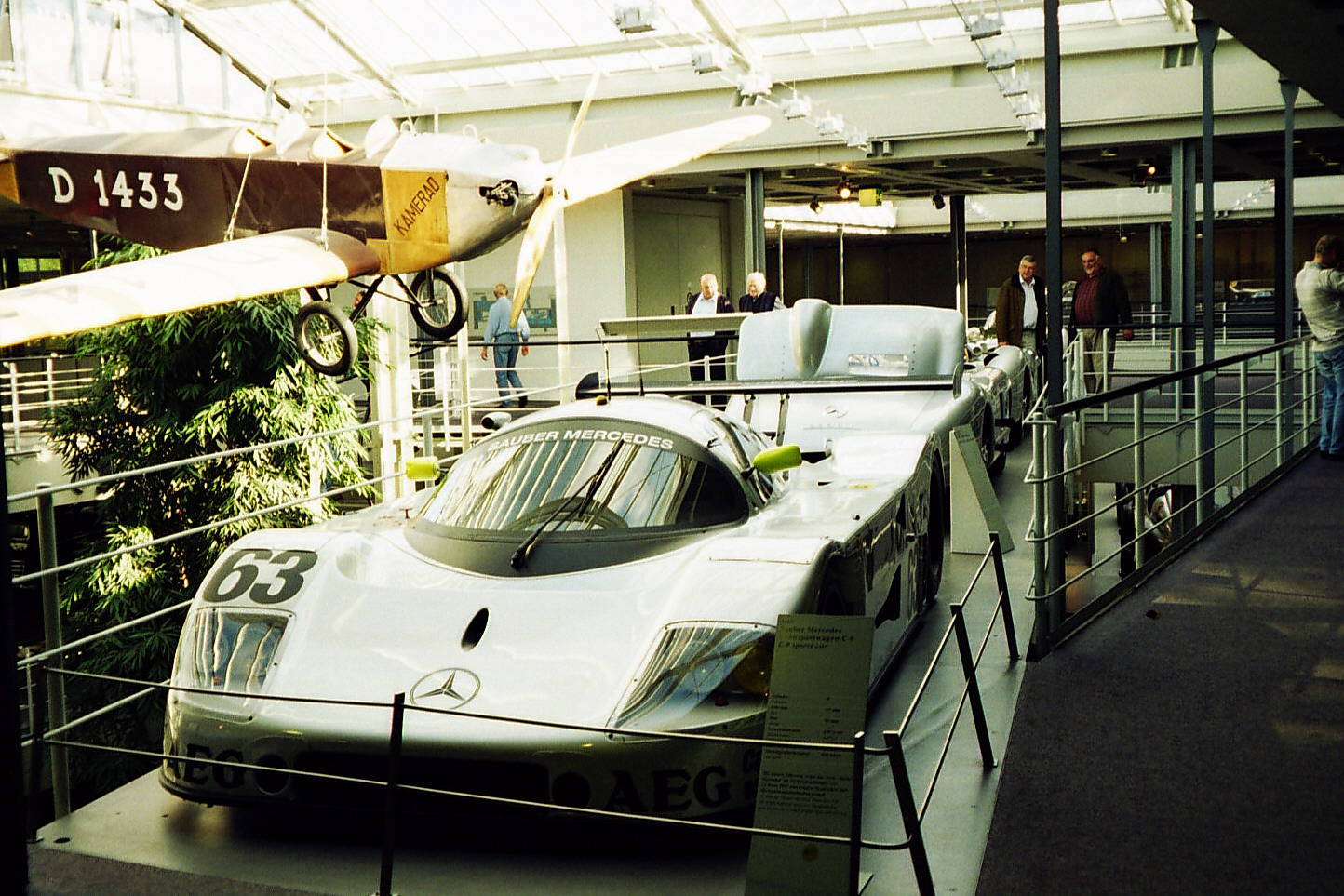
In 1985 Mercedes-Benz returned to the World Sportscar Championship as an engine supplier for the privateer Sauber team. The first car produced by this relationship, the Sauber C8 was not particularly successful. However the successor, the C9 won several races, including 24 Hours of Le Mans in 1989.
After the Sauber team parted company with their sponsor Kouros at the end of 1987, Mercedes-Benz increased their involvement with Sauber for the 1988 season to become a factory entrant under the Sauber-Mercedes name. Still using the C9 the team won 5 races but came 2nd to the TWR Jaguar team in the championship. However, 1989 was to be a different story with Sauber-Mercedes winning all but one championship race to become world champions (including coming 1st and 2nd at the 24 Hours of Le Mans - all achieved with the C9. For the 1990 World Sportscar Championship season the C9 was replaced by the all-new C11, while the team was renamed Mercedes-Benz (though the outfit was still run by Sauber). The team dominated the season, again winning all but one race to become world champions. Mercedes-Benz eventually withdrew from sportscar racing after a dismal 1991 season with the C291.
Mercedes-Benz returned to sportscar racing in 1997, with the CLK GTR which was entered in the new FIA GT Championship world championship series. In its first year, the CLK GTR won the teams' and the drivers' championships. It would again dominate the FIA GT in 1998, and would go on to win its second championship in a row. The CLK GTR would be the last car to win the FIA GT Championship. The successor to this car, the CLR was a spectacular failure. It was entered in the 1999 Le Mans race, but a series of accidents involving the car become airborne brought about the cancellation of the CLR project and Mercedes-Benz (as a factory team) has not participated in sports prototype racing since.

In 2001, Mercedes-Benz and AMG returned to tarmac rallying, with a specially modified version of the W208 CLK55 AMG. Mercedes-Benz and AMG created a one off works Tarmac Rally Car to compete with full factory support in the 2001 Targa Tasmania tarmac rally in Australia. Mick Doohan, 5 time motorcycle world champion, was chosen as the works driver.
In 2011, Mercedes-Benz announced that a GT3 version of the Mercedes-Benz SLS AMG would be made available for private racing teams. Beginning that year, the SLS AMG GT3 has taken numerous endurance racing wins at the 24 Hours of Dubai, 24 Hours of Nürburgring and 24 Hours of Spa and has won many other races in national and global GT3 championships. In 2015, the new Mercedes-AMG GT3 was launched to replace the SLS AMG GT3. This was then followed up by an "Evo" version of the AMG GT3 in 2020, which has also seen tons of success. In late 2024, it was announced that Mercedes-AMG would return to Le Mans after 25 years as Iron Lynx is set to run two AMG GT3's in the 2025 FIA World Endurance Championship.
Touring cars

Mercedes-Benz had intended to enter rallying with the Mercedes-Benz W201 in the early 1980s. Yet, as all wheel drive and turbochargers were introduced by the competition (Audi Quattro) at that time, this was cancelled. Instead the W201 ended up being used in the DTM touring car series from 1988, with the car again being prepared by AMG, who became an official partner and continue to enter the new DTM. However, Mercedes-Benz ceased its factory involvement in DTM at the end of the 2018 season in order to join the Formula E series for Season 6 (2019–20).
In 2013, Mercedes-Benz entered the V8 Supercars Championship with the Erebus Motorsport team, fielding three Mercedes-Benz E63s V8s in 2013 and two in the 2014 and 2015 championships. For the 2016 season, Erebus ceased development of its E63 AMGs to instead field a pair of Holden VF Commodores, bringing an end to Mercedes-Benz' involvement in the Supercars Championship for the foreseeable future.
Formula E
Main article: Mercedes EQ Formula E Team
.jpg)
On July 24, 2017, Mercedes announced that they would enter the FIA Formula E Championship for the 2019–20 season with a works effort, leaving the DTM series in favour of the new venture. The team was known as the Mercedes EQ Formula E team and made use of the same powertrain development facility as the Formula One team, Mercedes AMG High Performance Powertrains in Brixworth, UK. One of the teams that ran Mercedes cars in the DTM entered the 2018–19 season as HWA Racelab, which became the full works team in 2019–20. They won both the 2020–21 and 2021–22 Formula E World Drivers' and Teams' Championships, with Stoffel Vandoorne and Nyck de Vries, before selling the team to McLaren.
Other sports
Speed records
On August 13–21, 1983 at the Nardo High Speed Track in southern Italy, the new compact-size W201 190 class, sporting a 16-valve engine, built by Cosworth, broke three FIA world records after running almost non-stop (only a 20-sec pit stop every 2½ hours) in a total of 201 hours, 39 minutes, and 43 seconds—completing 50000 km at an average speed of 247.9397 km/h. It went on to become the 190E 2.3-16 touring model.
IndyCar

In 1994, Al Unser Jr. won the Indianapolis 500 with a Penske-Mercedes IndyCar. The engines were developed and built by Ilmor, but were badged as Mercedes-Benz. Ilmor which, realizing that a loophole in the rules for production-based engines would include any pushrod engine, built a very unusual purpose-built pushrod engine with a significant power advantage. This was done knowing that the "forgotten" loophole would be closed immediately after they took advantage of it, and so the engine would in fact be usable only for this single race.
Starting from 1995, Daimler AG entered the CART IndyCar World Series full-time via the Mercedes-Benz brand by rebranding the Ilmor engines. They achieved six wins in their first full season, also reaching second in the Drivers' Championship powering Al Unser Jr. After a dry spell in 1996, Mercedes-Benz came back in 1997 with nine wins and won the Manufacturers' Championship. However, a lack of competitive results in the following seasons and the CART/IRL split meant Mercedes gradually lost interest and the German manufacturer shut down its CART Champ Car operations at the end of the 2000 season as DaimlerChrysler re-allocate their resources for NASCAR Winston Cup Series from 2001 onwards via the Dodge brand (Mercedes-Benz and Dodge were sister brands at the time as well as R5P7 engines were also helped development by Mercedes-Benz). In total, Mercedes achieved 18 wins and one driver runner-up finish in the CART championship (Al Unser Jr. in 1995).
Formula Three

In the five years since Mercedes-Benz began its involvement in Formula Three, it has developed into the formula's most dominant engine supplier. Its engines, which are built and serviced by H.W.A GmbH, have so far contributed to a total of four drivers' and four teams' championship titles in the Formula Three Euroseries and British Formula Three Championship.
The H.W.A Mercedes-AMG M271 was based on a 1.8 litre 4-cylinder from the C-Klasse, bored out to the regulation 2.0 litre capacity. Formula Three engine regulations demand a naturally aspirated, 4-stroke, 4-cylinder, production-based specification, with a capacity of not more than 2,000 cc. The M271 made its competitive debut in the 2002 German Formula 3 Championship in two of Mücke Motorsport's three Dallara F302 chassis, driven by Markus Winkelhock and Marcel Lasse. Winkelhock achieved Mercedes' first F3 win at the Nürburgring in August 2002.
In 2003, Mercedes expanded its Formula Three program by supplying three teams in the inaugural year of the F3 Euroseries. Its engine powered the seven cars of Mücke Motorsport, Team Kolles, and ASM Formule 3. Speiss-Opel was dominant, thanks in part to Ryan Briscoe and Prema Powerteam, but Mercedes was winning by the eighth round. Its most notable win was provided by Christian Klien at Zandvoort in the non-championship Marlboro Masters.
Between 2004 and 2006, Mercedes-powered cars dominated the drivers' and teams' championships in the Euroseries, due in part to its close relationship with ASM Formule 3, which is one of France's most successful F3 teams. During that period, it brought drivers' titles for Jamie Green, Lewis Hamilton, and Paul di Resta. 2006 also saw Mercedes' first participation in the British F3 Championship, when it partnered with Räikkönen Robertson Racing, co-owned by Kimi Räikkönen, and two other teams. Double R Racing's lead driver, Mike Conway, dominated the championship. In the 2007 British F3 season, Mercedes powered the majority of the Championship field.
Rally
In 1977, four W123 280E's entered by dealerships participated in the 1977 London–Sydney Marathon, taking a 1-2 finish and also 6th and 8th places. Based on this, Mercedes-Benz considered an entry in the rally. However, in order to keep winning against lighter Fiat and Ford cars with a better power-to-weight ratio, a more powerful vehicle would be required, thus the C107 450 SLC 5.0 was developed.
In 1978, led by engineer Erich Waxenberger who had created the legendary 300 SEL 6.3, Mercedes-Benz participated in the 28,600 kilometer Vuelta a La América del Sud in South America with four 280Es and four 450 SLC 5.0's. All but one of the 450 SLCs (driven by Rubén Daray) finished, and Mercedes scored a 1-2-3-4-5 finish, plus 9th and 10th places. The same year, a Kenyan Mercedes-Benz dealer, D.T. Dobie of Nairobi entered the Safari Rally with four entrants, all driving 280Es. Only Sobiesław Zasada finished (in 6th place), Joginder Singh, Andrew Cowan and Tony Fowkes were forced to retire. In 1979, Dobie entered the Safari Rally with both 280Es and also 450 SLC 5.0's. Hannu Mikkola in a 450 SLC 5.0 came 2nd, losing to Shekhar Mehta by 48 minutes, whilst Cowan came 4th in a 280E, Björn Waldegård came 6th in a 450SLC 5.0 and Singh in a 280E came 11th; Vic Preston Jr (450 SLC 5.0) and Zasada (280E) were forced to retire. However, in the Rallye Côte d'Ivoire in November, Mikkola, Waldegård, Cowan and Preston scored a 1-2-3-4 victory on 450 SLC 5.0's.
However, the heavier and bigger Benzes were unable to replicate the success in the shorter European rallies. In the Acropolis Rally, they shredded their tires, and its only European points finishes came from the narrow roads of Portugal, with Waldegård and Ingvar Carlsson coming in 4th and 5th behind the more nimble Fiat 131 Abarths. While in Argentina, Mikkola came in 2nd behind Walter Röhrl; in Safari Rally, that played to the SLC's strengths, due to rear suspension failures, Preston only managed to come in 3rd place, with Cowan in 6th and Waldegård in 10th; in New Zealand, Mikkola came 3rd and Waldegård 5th; and in the Ivory Coast, Waldegård and Jorge Recalde scored a 1-2. Overall, Mercedes-Benz finished the season in 4th place, behind Fiat, Datsun and Ford. With Daimler management deciding that anything less than total victory was bad publicity and not worth the risk or expenditure, the works team was disbanded by the end of 1980.
For 1981, Waxenberger had managed to lure over the 1980 World Champion Walter Röhrl to drive a new 500SL-based rally car, who however, expressed disappointment while testing the car, believing it would not be competitive against the increasingly more specialized Audis and Lancias, thus it never raced.
Mercedes then set off to build a new rally car based on the new W201, so they turned to British engineering firm Cosworth for assistance. Cosworth built the 16-valve version of the M102 engine, however, with the success of four-wheel drive turbocharged Audi Quattro, the W201 would have never stood a chance, leading to the rally entrance being scrapped. However, Mercedes then decided to race the W201 instead in DTM, and was successful there.
Factory drivers
Current
- AUT Lucas Auer
- GBR Adam Christodoulou
- SWI Philip Ellis
- GER Maro Engel
- GER Maximilian Götz
- FRA Jules Gounon
- CAN Mikaël Grenier
- ITA Andrea Kimi Antonelli
- GER Thomas Jäger
- ESP Daniel Juncadella
- AUS Jordan Love
- IND Arjun Maini
- CAN Daniel Morad
- GER Jusuf Owega
- GBR George Russell
- GER Fabian Schiller
- GER Bernd Schneider
- GER David Schumacher
- GER Luca Stolz}}
Racing vehicles
| Year | Vehicle | Image | Category | |
|---|---|---|---|---|
| 1928 | Mercedes-Benz SSK | [[File:Paris - Retromobile 2012 - Mercedes-Benz SSK - 1928 - 017.jpg | frameless]] | Sports Car |
| 1934 | Mercedes-Benz W25 | [[File:1934Mercedes-BenzW25-side Goodwood, 2009.JPG | frameless]] | Grand Prix |
| 1937 | Mercedes-Benz Stromlinienwagen | [[File:Mercedes-Benz W25 Avus streamliner front-left Mercedes-Benz Museum.jpg | frameless]] | Grand Prix |
| Mercedes-Benz W125 | [[File:Mercedes-Benz W 125 Donington.jpg | frameless]] | Grand Prix | |
| Mercedes-Benz W125 Rekordwagen | [[File:Mercedes-Benz W125 Rekordwagen front-left2 Mercedes-Benz Museum.jpg | frameless]] | Land Speed Record | |
| 1938 | Mercedes-Benz W154 | [[File:Mercedes-Benz W154, Techno-Classica 2018, Essen (IMG 9893).jpg | frameless]] | Grand Prix |
| 1939 | Mercedes-Benz T80 | [[File:MHV MB T80 World Record Car 1939.jpg | frameless]] | Land Speed Record |
| Mercedes-Benz W165 | [[File:Mercedes-Benz W 165, Bj. 1939 - 1984-05-12 auf dem Nürburgring.jpg | frameless]] | Voiturette | |
| 1952 | Mercedes-Benz W194 | [[File:300slretro2012av.jpg | frameless]] | Endurance racing |
| 1954 | Mercedes-Benz W196 | [[File:KlingK-MB-W196-1976.jpg | frameless]] | Formula One |
| 1955 | Mercedes-Benz 300 SLR | [[File:Mercedes-Benz 300 SLR 1955.jpg | frameless]] | Sports Car |
| 1979 | Mercedes-Benz 450 | [[File:1979 Mercedes-Benz 450 SLC 'Rallyewagen'.jpg | frameless]] | Group 4 |
| 1980 | Mercedes-Benz 500 | Group 4 | ||
| 1991 | Mercedes-Benz C11 | [[File:Mercedes-Benz C11 front-left Mercedes-Benz Museum.jpg | frameless]] | Group C2 |
| Mercedes-Benz C291 | [[File:1991 Mercedes-Benz C291 Automuseum Dr. Carl Benz, 2014 (02).JPG | frameless]] | Group C1 | |
| Mercedes-Benz C292 | [[File:Mercedes Benz C292 (25745989317).jpg | frameless]] | Group C1 | |
| 1992 | Mercedes-Benz Actros 1935 AK | Group T5 | ||
| Mercedes-Benz Actros 1936 AK | Group T5 | |||
| Unimog U1550 L37 | Group T5 | |||
| 1993 | Mercedes-Benz 190E | [[File:Mercedes-Benz W201 Roland Asch DTM 1993.jpg | frameless]] | Class 1 |
| Mercedes-Benz 190E 2.3-16/Evolution/Evolution II | [[File:Stig Amthor - DTM Junior Team - AMG-Mercedes 190E (45829712105).jpg | frameless]] | Group A | |
| Mercedes-Benz Actros 2635 AK | Group T5 | |||
| Mercedes-Benz Actros 2636 AK | Group T5 | |||
| 1994 | Mercedes-Benz C-Class | [[File:D2 Mannesmann DTM Mercedes W202 Goodwood 2010.jpg | frameless]] | Class 1 |
| 1997 | Mercedes-Benz Actros 1844 AK | Group T5 | ||
| Mercedes-Benz CLK GTR | [[File:Mercedes-Benz CLK GTR at Goodwood 2014 001.jpg | frameless]] | Group GT1 | |
| 1998 | Mercedes-Benz CLK LM | [[File:Mercedes-Benz CLK LM - Flickr - andrewbasterfield.jpg | frameless]] | Group GT1 |
| 1999 | Mercedes-Benz CLR | [[File:Mercedes-Benz CLR - Christophe Bouchut, Nick Heidfeld & Peter Dumbreck (who would later flip the car) exits Dunlop Chicane at the 1999 Le Mans (51913539313).jpg | frameless]] | LMGTP |
| 2004 | Unimog U400 | Group T5 | ||
| Unimog U500 | Group T5 | |||
| 2007 | Mercedes-Benz Axor 1833 AK 4x4 | Group T5 | ||
| 2010 | Mercedes MGP W01 | [[File:Schumacher Mercedes Jerez (cropped).jpg | frameless]] | Formula One |
| 2011 | Mercedes MGP W02 | [[File:Michael Schumacher (6182900110).jpg | frameless]] | Formula One |
| Mercedes-Benz SLS AMG GT3 | [[File:Mercedes-Benz SLS AMG-GT3 2011 Motorsport Japan.jpg | frameless]] | Group GT3 | |
| 2012 | Mercedes F1 W03 | [[File:Michael Schumacher 2012 Malaysia FP2.jpg | frameless]] | Formula One |
| 2013 | Mercedes F1 W04 | [[File:Lewis Hamilton 2013 Malaysia FP2 1.jpg | frameless]] | Formula One |
| Mercedes-Benz E63 AMG | [[File:20130517-IMG 2078 (8748732697).jpg | frameless]] | New Generation V8 Supercar | |
| 2014 | Mercedes F1 W05 Hybrid | [[File:Mercedes F1 W05 Hybrid (Lewis Hamilton).jpg | frameless]] | Formula One |
| Mercedes-Benz A-Class | [[File:2016 British Touring Car Championship, Brands Hatch GP (30362401835).jpg | frameless]] | NGTC | |
| 2015 | Mercedes F1 W06 Hybrid | [[File:Lewis Hamilton 2015 Malaysia FP2 1.jpg | frameless]] | Formula One |
| 2016 | Mercedes F1 W07 Hybrid | [[File:Nico Rosberg 2016 Malaysia FP2.jpg | frameless]] | Formula One |
| Mercedes-AMG GT3 | [[File:No.4 GOODSMILE HATSUNEMIKU AMG in 2022 SUPER GT (7).jpg | frameless]] | Group GT3 | |
| 2017 | Mercedes AMG F1 W08 EQ Power+ | [[File:Lewis Hamilton 2017 Malaysia FP2.jpg | frameless]] | Formula One |
| Mercedes-AMG GT4 | [[File:Mercedes-AMG GT4.jpg | frameless]] | SRO GT4 | |
| 2018 | Mercedes AMG F1 W09 EQ Power+ | [[File:FIA F1 Austria 2018 Nr. 44 Hamilton.jpg | frameless]] | Formula One |
| 2019 | Mercedes AMG F1 W10 EQ Power+ | [[File:FIA F1 Austria 2019 Nr. 77 Bottas 1.jpg | frameless]] | Formula One |
| Mercedes-Benz EQ Silver Arrow 01 | [[File:2019 Mercedes EQ Silver Arrow 01.jpg | frameless]] | Formula E | |
| 2020 | Mercedes-AMG F1 W11 EQ Performance | [[File:Lewis Hamilton 2020 Tuscan Grand Prix - race day (cropped).jpg | frameless]] | Formula One |
| Mercedes-EQ Silver Arrow 02 | [[File:Stoffel Vandoorne Mercedes-EQ Formula E Team FIA Formula E World Championship 2021 Valencia Testing.jpg | frameless]] | Formula E | |
| 2021 | Mercedes W12 | [[File:FIA F1 Austria 2021 Nr. 44 Hamilton (side).jpg | frameless]] | Formula One |
| 2022 | Mercedes W13 | [[File:2022 British Grand Prix (52382658334).jpg | frameless]] | Formula One |
| 2023 | Mercedes W14 | [[File:FIA F1 Austria 2023 Nr. 44 (2).jpg | frameless]] | Formula One |
| Mercedes-AMG GT2 | [[File:2024 Mercedes AMG GT2 Pro.jpg | frameless]] | SRO GT2 | |
| 2024 | Mercedes W15 | [[File:2024-08-24 Motorsport, Formel 1, Großer Preis der Niederlande 2024 STP 3434 by Stepro.jpg | frameless]] | Formula One |
| 2025 | Mercedes W16 | [[File:2025 Japan GP - Mercedes - Kimi Antonelli - FP2.jpg | frameless]] | Formula One |
References
Notes
Bibliography
References
- The Story Of The Grand Prix [http://www.ddavid.com/formula1/story.htm Article] {{Webarchive. link. (2009-08-30)
- "The Blitzen-Benz". autospeed.com.
- "Elgin National Road Races History". kalracing.com.
- Lyons, Pete. "10 Best Ahead-of-Their-Time Machines", in ''Car and Driver'', 1/88, p. 74.
- Wise, David Burgess. "Rumpler: One Aeroplane which Never Flew", in Northey, Tom, ed. ''World of Automobiles'' (London: Orbis, 1974), Vol. 17, p. 1964.
- Wise, p. 1964.
- Wise, p. 1965.
- Wise, p. 1965; Lyons, p. 74.
- Lyons, p. 74.
- (2002). "Mercedes-Benz Silver Arrows". MotorBooks International.
- "McLaren Mercedes first to launch 2014 car – the MP4-29". www.us.motorsport.com.
- "McLaren to use Mercedes power from 2021". www.formula1.com.
- (November 24, 2023). "McLaren Formula 1 Team and Mercedes-Benz renew power unit agreement until 2030". McLaren.
- "Williams extend Mercedes power unit to 2025". www.formula1.com.
- (2009-11-16). "Mercedes takes over Brawn". Autosport.com.
- "Stats: Quantifying Mercedes Greatness after their fifth constructors title". www.formula1.com.
- Young, Eoin: "The Amazing Summer of '55", page 158. Haynes Publishing, 2005
- "Michael Doohan debuts in Targa Tasmania".
- (25 July 2017). "Mercedes to quit DTM, join Formula E". Speedcafe.
- (8 January 2013). "Erebus Motorsport completes SBR take over". Speedcafe.
- (6 January 2014). "Erebus owner confirms Will Davison for 2014". Speedcafe.
- (14 January 2016). "Betty Klimenko explains why Erebus Motorsport is ditching Mercedes for Holden in 2016". Fox Sports.
- (24 July 2017). "Mercedes-Benz to enter Formula E in Season 6".
- "Mercedes Reveals First Details Of Formula E Plans".
- "Mercedes-Benz's Normcore 190E Set a Record That Will Never Be Broken".
- (2014). "Beast". Octane Press.
- [http://www.autosport-atlas.com/article.asp?id=17990 Mercedes develops new engine] Retrieved on January 27, 2007.
- FIA Formula 3 Technical Regulations – ''Articles 5.1-5.6'' p. 8–9
- [http://www.speedsportmag.de/racing/statentry.php?sprache=en&back=formula3germany&sid=70 2002 German F3 entry list] Retrieved on January 27, 2007.
- [http://www.autosport-atlas.com/article.asp?id=20124 Winkelhock wins for Mercedes] Retrieved on January 27, 2007.
- [http://www.autosport-atlas.com/article.asp?id=21898 Mercedes increases its attack] Retrieved on January 27, 2007.
- [http://www.speedsportmag.de/racing/statresults.php?sprache=en&back=formula3euroseries&sid=117 2003 Euroseries results] Retrieved on January 27, 2007.
- [http://www.autosport-atlas.com/article.asp?id=24170 Masters: Klien cleans up] Retrieved on January 27, 2007.
- [http://www.speedsportmag.de/racing/csp_formula3euroseries.php?sprache=en Euroseries champions] Retrieved on January 27, 2007.
- [http://www.formula3.cc/content/view/5118/2/ Mercedes confirms British F3 supply] Retrieved on January 27, 2007.
- [http://forix.autosport.com/cp.php?l=0&d=46&r=462006&c=30 2006 British F3 Championship standings] Retrieved on January 27, 2007.
- Buckley, Martin. "Mercedes-Benz 450SLC 5.0: the world's least likely rally car?".
- Shacki. "Final results Vuelta a la America del Sud 1978".
- Shacki. "Final results Safari Rally 1978".
- Shacki. "Final results Safari Rally 1979".
- Shacki. "Final results Rallye Bandama Côte d'Ivoire 1979".
- Shacki. "Final results Rallye de Portugal - Vinho do Porto 1980".
- Braithwaite-Smith, Gavin. (2023-01-16). "When Mercedes went rallying with a V8-engined, automatic coupé {{!}} Hagerty UK". Hagerty UK.
- MacKenzie, Angus. (2023-08-28). "Mercedes-Benz's Normcore 190E Set a Record That Will Never Be Broken".
- "Mercedes-AMG gibt Fahrerkader für 2023 bekannt: Drei Neuzugänge, drei Abgänge".
- "The Team".
This article was imported from Wikipedia and is available under the Creative Commons Attribution-ShareAlike 4.0 License. Content has been adapted to SurfDoc format. Original contributors can be found on the article history page.
Ask Mako anything about Mercedes-Benz in motorsport — get instant answers, deeper analysis, and related topics.
Research with MakoFree with your Surf account
Create a free account to save articles, ask Mako questions, and organize your research.
Sign up freeThis content may have been generated or modified by AI. CloudSurf Software LLC is not responsible for the accuracy, completeness, or reliability of AI-generated content. Always verify important information from primary sources.
Report