From Surf Wiki (app.surf) — the open knowledge base
Menshutkin reaction
Chemical reaction

Chemical reaction
In organic chemistry, the Menshutkin reaction converts a tertiary amine into a quaternary ammonium salt by reaction with an alkyl halide. Similar reactions occur when tertiary phosphines are treated with alkyl halides.
The reaction is the method of choice for the preparation of quaternary ammonium salts. Some phase transfer catalysts (PTC) can be prepared according to the Menshutkin reaction, for instance the synthesis of triethyl benzyl ammonium chloride (TEBA) from triethylamine and benzyl chloride:

Scope
Reactions are typically conducted in polar solvents such as alcohols. Even pyridines, which are considerably less nucleophilic than typical tertiary amines, react with dichloromethane at room temperature over a period of several days to weeks to give bis(pyridinium)methane salts.
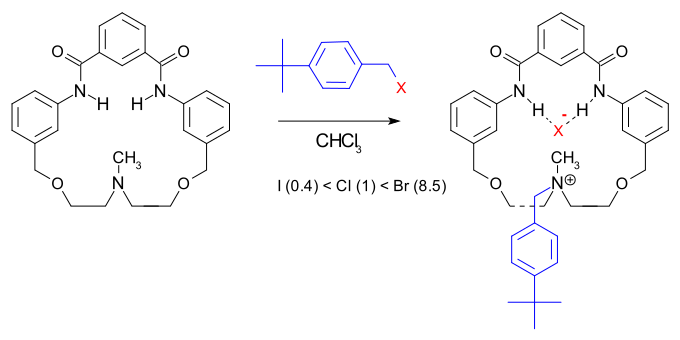
In addition to solvent and alkylating agent, other factors strongly influence the reaction. In one particular macrocycle system the reaction rate is not only accelerated (150000 fold compared to quinuclidine) but the halide order is also changed
History
The reaction is named after its discoverer, Nikolai Menshutkin, who described the procedure in 1890. Depending on the source, his name (and the reaction named after him) is spelled as Menšutkin, Menshutkin, or Menschutkin.
References
References
- W. R. Brasen. (1954). "o-Methylethylbenzyl Alcohol". Org. Synth..
- (16 January 1981). "N-alkylation of tertiary aliphatic amines by chloroform, dichloromethane and 1,2-dichloroethane". Journal of Chromatography A.
- ''Reaction of Dichlormethane with Pyridine Derivatives under Ambient Conditions'' Alexander B. Rudine, Michael G. Walter, and Carl C. Wamser [[J. Org. Chem.]] '''2010''', 75, 4292–95 {{doi. 10.1021/jo100276m
- ''Dramatic Acceleration of the Menschutkin Reaction and Distortion of Halide Leaving-Group Order'' Keith J. Stanger, Jung-Jae Lee, and Bradley D. Smith [[J. Org. Chem.]] '''2007''', 72, 9663–68 {{doi. 10.1021/jo702090p
- N. Menschutkin. Beiträgen zur Kenntnis der Affinitätskoeffizienten der Alkylhaloide und der organischen Amine ''Z. Physik. Chem.'' 5 ('''1890''') 589.
- N Menschutkin. Über die Affinitätskoeffizienten der Alkylhaloide und der Amine ''Z. Physik. Chem.'' 6 ('''1890''') 41.
- M B Smith, J March. ''March's Advanced Organic Chemistry'' (Wiley, 2001) ({{ISBN. 0-471-58589-0)
- ''Lexikon bedeutender Chemiker'' (VEB Bibliographisches Institut Leipzig, 1989) ({{ISBN. 3817110553
This article was imported from Wikipedia and is available under the Creative Commons Attribution-ShareAlike 4.0 License. Content has been adapted to SurfDoc format. Original contributors can be found on the article history page.
Ask Mako anything about Menshutkin reaction — get instant answers, deeper analysis, and related topics.
Research with MakoFree with your Surf account
Create a free account to save articles, ask Mako questions, and organize your research.
Sign up freeThis content may have been generated or modified by AI. CloudSurf Software LLC is not responsible for the accuracy, completeness, or reliability of AI-generated content. Always verify important information from primary sources.
Report