From Surf Wiki (app.surf) — the open knowledge base
Menelik I
Emperor of Ethiopia from 975 to 950 BC
_to_Axum.jpg)
Emperor of Ethiopia from 975 to 950 BC
| Field | Value |
|---|---|
| name | Menelik I |
| ምኒልክ | |
| image | ArkCovenant-Axum (Menelik I).jpg |
| caption | Detail from a larger painting in the church at Axum |
| succession | Emperor of Ethiopia (traditional) |
| reign | 982–957 B.C. (E.C.) |
| 975–950 B.C. (G.C.) (according to Tafari Makannon's King List) | |
| 954–930 B.C. (Alternate dates from E. A. Wallis Budge) | |
| predecessor | Makeda |
| successor | Hanyon or Tomai (depending on the king list) |
| birth_date | 1000 B.C. |
| dynasty | House of Solomon |
| father | King Solomon |
| mother | Queen of Sheba |
ምኒልክ 975–950 B.C. (G.C.) (according to Tafari Makannon's King List) 954–930 B.C. (Alternate dates from E. A. Wallis Budge) Menelik I (Ge'ez: ምኒልክ, Mənilək) was the legendary first Emperor of Ethiopia's Solomonic dynasty. According to Kebra Nagast, a 14th-century national epic, in the 10th century BC he is said to have inaugurated the Solomonic dynasty of Ethiopia, so named because Menelik I was the son of the biblical King Solomon of ancient Israel and of Makeda, the Queen of Sheba.
Life
According to the medieval Ethiopian book, the Kebra Nagast, written in Geʽez in 1321 CE, his name was Bäynä Ləḥkəm (from , ar, "son of the wise"The name "Menelik" is Amharic (a Semitic language spoken in Ethiopia) in origin, and has two meanings:http://www.newKerala.com/baby-name/4260/menelik
- "Son of the wise man"
- "What will he send?"). He was conceived when his father Solomon tricked his visiting mother, the Queen of Sheba, into sleeping with him. His mother raised him as Jewish in her homeland, and he only traveled to Jerusalem to meet his father for the first time when he was in his twenties. While his father begged Menelik to stay and rule over Israel, Menelik told him that he wanted to return home. Thus, Solomon sent many Israelites with him, to aid him in ruling according to biblical standards; which were aggrieved at being exiled forever. One recount is that King Solomon gave the Ark of the Covenant to his son, while another states that Menelik and his Israelite companions took the Ark with them; and Solomon attempted to regain the ark but was unable to, due to its supernatural properties aiding Menelik. Upon the death of his mother, or upon her abdication in his favor, Menelik was crowned King of Ethiopia.
According to one Ethiopian tradition, Menelik was born at Mai-Bela near the village of Addi-Shmagle, located north west of Asmara, in Eritrea.
Dynasty
According to legend, Menelik I founded the Solomonic dynasty that ruled Ethiopia with few interruptions for close to three thousand years. This dynasty ended after 225 generations, with the deposition of Emperor Haile Selassie in 1974. The Solomonic dynasty began (or was restored, based on the traditional narrative) in 1270, when Yekuno Amlak, who claimed descent from biblical Solomon and Sheba, overthrew the last ruler of the Zagwe dynasty, dismissing them as not of "the house of Israel" (i.e., of Solomon). and re-established the Solomonic Dynasty in 1270 AD. The term Madrā Ag'azi appears in the Gädlä Marqorewos (Conti Rossini 1904, 27 (text); 38, tr.) as the realm of King Mənəlik.
In popular culture
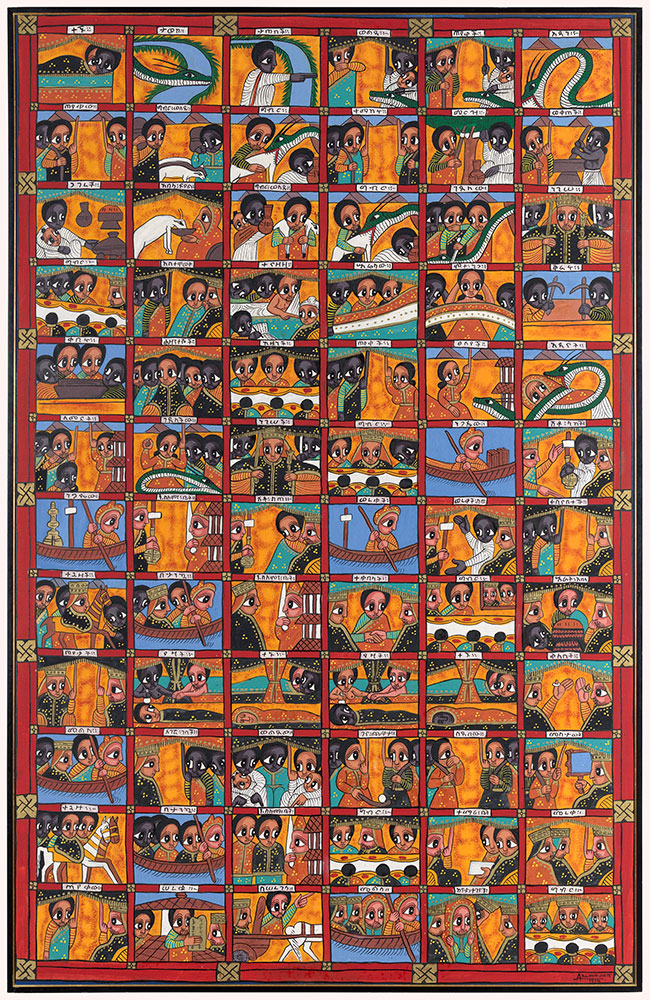
Much Ethiopian art depicts the narrative about Menelik I in a series of panels, 44 scenes, eleven for each of four lines. The story depicted on these panels is the oral version (beginning with a backstory on Sheba and including an Ethiopian maid who also becomes pregnant by Solomon), not the medieval text version.
A short film, Menelik I, was produced in 2004. Filmed in Ethiopia, it tells the story of the son of the Queen of Sheba through tableau images and music.
Tomb
A site known as the tomb of Menelik I is located two kilometres west of Axum. A German archaeological expedition discovered walls and a room at the site in 1906. Bones that were alleged to belong to Menelik I were collected and deposited in the Church of Our Lady Mary of Zion in Axum.
Ark of the Covenant
According to Ethiopian tradition, the Ark of the Covenant was brought to Ethiopia by first-born sons of Israelites who accompanied Menelik on his return from Jerusalem. The Ark is believed by some people to be held in a shrine in Axum that no one is allowed to enter, except for one monk who is assigned to guard it for life and is not allowed to leave the courtyard of the church. During the persecution of Gudit in the 10th century and the Ethiopian-Adal war in the 16th century, the Ark was moved south to Lake Ziway and later brought back to Axum.
Notes
References
References
- C. F. Rey, ''In the Country of the Blue Nile'' (1927), Camelot Press, London, pg. 263
- C. F. Rey, ''In the Country of the Blue Nile'' (1927), Camelot Press, London, pg. 266
- Budge, E. A. Wallis. (1928). "A History of Ethiopia: Nubia and Abyssinia (Volume 1)". Methuen & Co..
- Marrassini, Paolo. 2007. "Kəbrä Nägäśt." In Encyclopaedia Aethiopica: He-N: Vol. 3, edited by Siegbert Uhlig, 364-368. Wiesbaden: Harrassowitz.
- [[Fiaccadori, Gianfranco]]. 2007. "Mənilək I." In Encyclopaedia Aethiopica: He-N: Vol. 3, edited by Siegbert Uhlig, 921-922. Wiesbaden: Harrassowitz.
- Bezold, Carl. 1905. Kibra negest, die Kerrlichkeit der Könige: Nach den Handschriften in Berlin, London, Oxford und Paris. München: K.B. Akademie der Wissenschaften.
- Anonymous. 1932. The Queen of Sheba and Her Only son Menyelek ... A Complete Translation of the Kebra Nagast. Translated by E. A. Wallis Budge. 2nd ed. London: Oxford University Press.
- Hubbard, David Allan. 1957. "The Literary Sources of the Kebra Nagast."PhD diss, University of St. Andrews.
- Budge, E. A. Wallis. (1928). "A History of Ethiopia: Nubia and Abyssinia (Volume 1)". Methuen & Co..
- (1986). "Fear God, Honor the King: The Use of Biblical Allusions in Ethiopian Historical Literature, Part I". Northeast African Studies.
- "Zagwe dynasty | Ethiopian history".
- CHRONICLE OF KING GÄLAWDEWOS, (1540-1559), p. 191, TRANSLATED BY SOLOMON GEBREYES, LOVANII IN AEDIBUS PEETERS, 2019
- "The Story of the Queen of Sheba".
- Biasio, Elisabeth. (2009). "Contemporary Ethiopian Painting in Traditional Style: From Church-Based to Tourist Art". African Arts.
- "Menelik l}}, {{YouTube".
- Selassie, Sergew Hable. (1972). "Ancient and Medieval Ethiopian History to 1270".
This article was imported from Wikipedia and is available under the Creative Commons Attribution-ShareAlike 4.0 License. Content has been adapted to SurfDoc format. Original contributors can be found on the article history page.
Ask Mako anything about Menelik I — get instant answers, deeper analysis, and related topics.
Research with MakoFree with your Surf account
Create a free account to save articles, ask Mako questions, and organize your research.
Sign up freeThis content may have been generated or modified by AI. CloudSurf Software LLC is not responsible for the accuracy, completeness, or reliability of AI-generated content. Always verify important information from primary sources.
Report