From Surf Wiki (app.surf) — the open knowledge base
Men's 100 metres world record progression
List of world records for men's 100m sprint
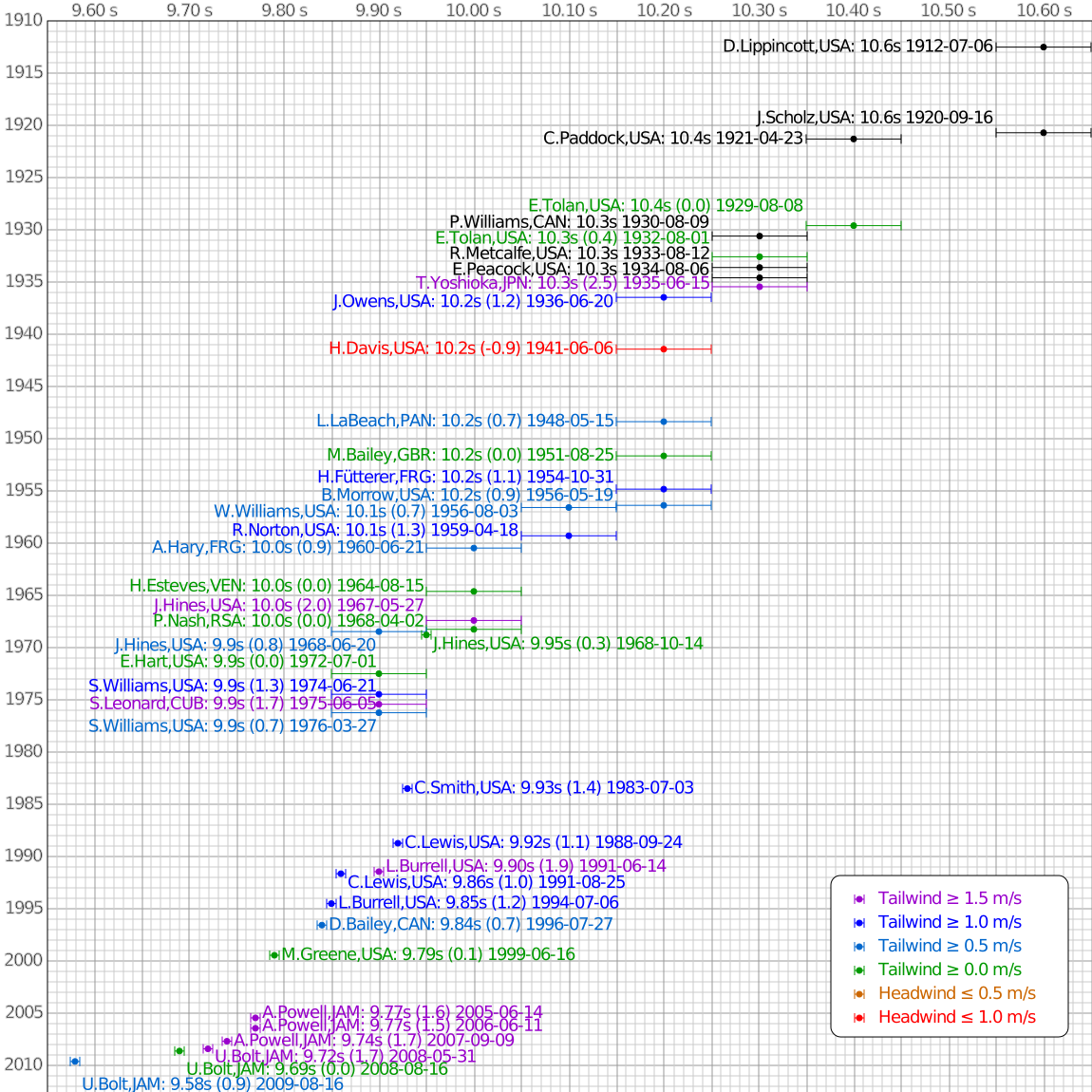
List of world records for men's 100m sprint
The first record in the 100 metres for men (athletics) was recognised by the International Amateur Athletics Federation, now known as World Athletics, in 1912.
, the IAAF had ratified 67 records in the event, not including rescinded records.
Unofficial progression before the IAAF
| Time | Athlete | Nationality | Location of races | Date |
|---|---|---|---|---|
| 10.8 | Luther Cary | United States | Paris, France | July 4, 1891 |
| Cecil Lee | Brussels, Belgium | September 25, 1892 | ||
| Étienne De Ré | Brussels, Belgium | August 4, 1893 | ||
| L. Atcherley | Frankfurt/Main, Germany | April 13, 1895 | ||
| Harry Beaton | Rotterdam, Netherlands | August 28, 1895 | ||
| Harald Anderson-Arbin | Helsingborg, Sweden | August 9, 1896 | ||
| Isaac Westergren | Gävle, Sweden | September 11, 1898 | ||
| Gävle, Sweden | September 10, 1899 | |||
| Frank Jarvis | United States | Paris, France | July 14, 1900 | |
| Walter Tewksbury | United States | Paris, France | July 14, 1900 | |
| Carl Ljung | Stockholm, Sweden | September 23, 1900 | ||
| Walter Tewksbury | United States | Philadelphia, United States | October 6, 1900 | |
| André Passat | Bordeaux, France | June 14, 1903 | ||
| Louis Kuhn | Bordeaux, France | June 14, 1903 | ||
| Harald Grønfeldt | Aarhus, Denmark | July 5, 1903 | ||
| Eric Frick | Jönköping, Sweden | August 9, 1903 | ||
| 10.6 | Knut Lindberg | Gothenburg, Sweden | August 26, 1906 | |
| 10.5 | Emil Ketterer | German Empire | Karlsruhe, Germany | July 9, 1911 |
| Richard Rau | German Empire | Braunschweig, Germany | August 13, 1911 | |
| Richard Rau | German Empire | Munich, Germany | May 12, 1912 | |
| Erwin Kern | German Empire | Munich, Germany | May 26, 1912 |
IAAF record progression
| Ratified but later rescinded |
|---|
"Wind" in these tables refers to wind assistance, the velocity of the wind parallel to the runner - positive values are from the starting line towards the finish line, negative are from the finish line towards the starting line, 0 is no wind in either direction, and all values are measured in metres per second. Any wind perpendicular to the runners (from left to right, right to left, or up to down or down to up, although the conditions of the track generally preclude those wind directions) is ignored and not listed.
"Auto" refers to automatic timing, and for the purposes of these lists, indicates auto times which were either also taken for hand-timed records, or were rounded to the tenth or hundredth of a second (depending on the rounding rules then in effect) for the official record time.
Records 1912–1976
| Time | Wind | Auto | Athlete | Nationality | Location of race | Date | Ref | ||||||
|---|---|---|---|---|---|---|---|---|---|---|---|---|---|
| 10.6 | Donald Lippincott | United States | Stockholm, Sweden | July 6, 1912 | |||||||||
| Jackson Scholz | September 16, 1920 | ||||||||||||
| 10.4 | Charley Paddock | Redlands, USA | April 23, 1921 | ||||||||||
| 0.0 | Eddie Tolan | Stockholm, Sweden | August 8, 1929 | ||||||||||
| Copenhagen, Denmark | August 25, 1929 | ||||||||||||
| 10.3 | Percy Williams | Canada | Toronto, Canada | August 9, 1930 | |||||||||
| 0.4 | 10.38 | Eddie Tolan | United States | Los Angeles, USA | August 1, 1932 | ||||||||
| Ralph Metcalfe | Budapest, Hungary | August 12, 1933 | |||||||||||
| Eulace Peacock | Oslo, Norway | August 6, 1934 | |||||||||||
| Chris Berger | Amsterdam, Netherlands | August 26, 1934 | |||||||||||
| Ralph Metcalfe | United States | Osaka, Japan | September 15, 1934 | ||||||||||
| 2.0 | Dairen, Japan | September 23, 1934 | |||||||||||
| 2.5 | Takayoshi Yoshioka | Empire of Japan | Tokyo, Japan | June 15, 1935 | |||||||||
| 10.2 | 1.2 | Jesse Owens | United States | Chicago, USA | June 20, 1936 | ||||||||
| 10.3 | 0.5 | Lennart Strandberg | Malmö, Sweden | September 26, 1936 | url=http://iaaf-ebooks.s3.amazonaws.com/2015/Progression-of-IAAF-World-Records-2015/projet/IAAF-WRPB-2015.pdf | title=IAAF World Records Progression | edition=2015 | author1=Hymans, Richard | author2=Matrahazi, Imre | publisher=International Association of Athletics Federations | access-date=October 20, 2015}} | ||
| 10.2 | −0.9 | Harold Davis | United States | Compton, USA | June 6, 1941 | ||||||||
| 0.7 | Lloyd LaBeach | Fresno, USA | May 15, 1948 | ||||||||||
| 10.35 | Barney Ewell | United States | Evanston, United States | July 9, 1948 | |||||||||
| 0.0 | McDonald Bailey | Belgrade, Yugoslavia | August 25, 1951 | ||||||||||
| 1.1 | Heinz Fütterer | Yokohama, Japan | October 31, 1954 | ||||||||||
| 0.9 | Bobby Morrow | United States | Houston, USA | May 19, 1956 | |||||||||
| −1.0 | Ira Murchison | Compton, USA | June 1, 1956 | ||||||||||
| 0.0 | Bobby Morrow | Bakersfield, USA | June 22, 1956 | ||||||||||
| −1.3 | Ira Murchison | Los Angeles, USA | June 29, 1956 | ||||||||||
| −0.4 | Bobby Morrow | ||||||||||||
| 10.1 | 0.7 | Willie Williams | Berlin, Germany | August 3, 1956 | |||||||||
| 1.0 | Ira Murchison | August 4, 1956 | |||||||||||
| 1.5 | Leamon King | Ontario, USA | October 20, 1956 | ||||||||||
| 0.9 | Santa Ana, USA | October 27, 1956 | |||||||||||
| 1.3 | Ray Norton | San Jose, USA | April 18, 1959 | ||||||||||
| 10.0 | 0.9 | 10.25 | Armin Hary | Zürich, Switzerland | June 21, 1960 | ||||||||
| 1.8 | Harry Jerome | Canada | Saskatoon, Canada | July 15, 1960 | |||||||||
| 0.0 | Horacio Esteves | Venezuela | Caracas, Venezuela | August 15, 1964 | |||||||||
| 1.3 | 10.06 | Bob Hayes | Tokyo, Japan | October 15, 1964 | |||||||||
| 2.0 | 10.17 | Jim Hines | Modesto, USA | May 27, 1967 | |||||||||
| 1.8 | Enrique Figuerola | Budapest, Hungary | June 17, 1967 | ||||||||||
| 0.0 | Paul Nash | RSA | Krugersdorp, South Africa | April 2, 1968 | |||||||||
| 1.1 | Oliver Ford | Albuquerque, USA | May 31, 1968 | ||||||||||
| 2.0 | 10.20 | Charles Greene | Sacramento, USA | June 20, 1968 | |||||||||
| 2.0 | 10.28 | Roger Bambuck | |||||||||||
| 9.9 | 0.8 | 10.03 | Jim Hines | ||||||||||
| 0.8 | 10.14 | Ronnie Ray Smith | |||||||||||
| 0.9 | 10.10 | Charles Greene | |||||||||||
| 0.3 | 9.95 | Jim Hines | Mexico City, Mexico | October 14, 1968 | |||||||||
| 0.0 | Eddie Hart | Eugene, USA | July 1, 1972 | ||||||||||
| 0.0 | Rey Robinson | ||||||||||||
| 1.3 | Steve Williams | Los Angeles, USA | June 21, 1974 | ||||||||||
| 1.7 | Silvio Leonard | Ostrava, Czechoslovakia | June 5, 1975 | ||||||||||
| 0.0 | Steve Williams | Siena, Italy | July 16, 1975 | ||||||||||
| −0.2 | Berlin, Germany | August 22, 1975 | |||||||||||
| 0.7 | Gainesville, USA | March 27, 1976 | |||||||||||
| 0.7 | Harvey Glance | Columbia, USA | April 3, 1976 | ||||||||||
| Baton Rouge, USA | May 1, 1976 | ||||||||||||
| 1.7 | Don Quarrie | Modesto, USA | May 22, 1976 |
The first manual time of 9.9 seconds was recorded for Bob Hayes in the final of the 100 metres at the 1964 Olympics. Hayes' official time of 10.0 seconds was determined by rounding down the electronic time of 10.06 to the nearest tenth of a second, giving the appearance of a manual time. This method was unique to the Olympics of 1964 and 1968, and the officials at the track recorded Hayes' time as 9.9 seconds.
Records since 1977
Since 1975, the IAAF has accepted separate automatically electronically timed records for events up to 400 metres. Starting on January 1, 1977, the IAAF has required fully automatic timing to the hundredth of a second for these events.
Jim Hines' October 1968 Olympic gold medal run was the fastest recorded fully electronic 100 metre race up to that date, at 9.95 seconds. Track and Field News has compiled an unofficial list of automatically timed records starting with the 1964 Olympics and Bob Hayes' gold medal performance there. Those marks are included in the progression.
The event is linked on some of the dates.
| Time | Wind | Auto | Athlete | Nationality | Location of race | Date | World Championships record]] | Duration of record | |||||||||||
|---|---|---|---|---|---|---|---|---|---|---|---|---|---|---|---|---|---|---|---|
| 10.06 | 1.3 | Bob Hayes | Tokyo, Japan | October 15, 1964 | title=Stat Corner: 100 WR Progression | journal=Track & Field News | volume=61 | issue=7 | page=55 | date=July 2008}} | 1964 | 10 | 15 | 1968 | 6 | 20}}" | |||
| 10.03 | 0.8 | Jim Hines | Sacramento, USA | June 20, 1968 | 1968 | 6 | 20 | 1968 | 10 | 13}}" | |||||||||
| 10.02 | 2.0 | Charles Greene | Mexico City, Mexico | October 13, 1968 | 1968 | 10 | 13 | 1968 | 10 | 14}}" | |||||||||
| 9.95 | 0.3 | Jim Hines | Mexico City, Mexico | October 14, 1968 | , | 1968 | 10 | 14 | 1983 | 7 | 3}}" | ||||||||
| 9.93 | 1.4 | Calvin Smith | Colorado Springs, USA | July 3, 1983 | 1983 | 7 | 3 | 1987 | 8 | 30}}" | |||||||||
| 9.83 | 1.0 | Ben Johnson | Rome, Italy | August 30, 1987 | Ben Johnson]]'s time of 9.79 on September 24, 1988 was disallowed and never ratified as a record as he tested positive for stanozolol after the race. Johnson subsequently admitted to steroid use between 1981 and 1988, and his world record of 9.83 set on August 30, 1987 was rescinded by the IAAF Council in September 1989.(Track and Field News, November 1989, vol. 42, #11, p. 37) | 1987 | 8 | 30 | 1987 | 8 | 30}}" | ||||||||
| 9.93 | 1.0 | Carl Lewis | Rome, Italy | August 30, 1987 | Carl Lewis's times of 9.93 were deemed by the IAAF to have equalled the world record after Ben Johnson's 9.83 time was rescinded, but were never ratified as world records, and his time of 9.92 to win the gold medal at the Seoul Olympics after Johnson was disqualified was recognized as the world record from January 1, 1990. | 1987 | 8 | 30 | 1988 | 8 | 17}}" | ||||||||
| 1.1 | Zürich, Switzerland | August 17, 1988 | 1988 | 8 | 17 | 1988 | 9 | 24}}" | |||||||||||
| 9.79 | 1.1 | Ben Johnson | Seoul, South Korea | September 24, 1988 | Ben Johnson]]'s time of 9.79 on September 24, 1988 was disallowed and never ratified as a record as he tested positive for stanozolol after the race. Johnson subsequently admitted to steroid use between 1981 and 1988, and his world record of 9.83 set on August 30, 1987 was rescinded by the IAAF Council in September 1989.(Track and Field News, November 1989, vol. 42, #11, p. 37) | 1988 | 9 | 24 | 1988 | 9 | 24}}" | ||||||||
| 9.92 | 1.1 | Carl Lewis | Seoul, South Korea | September 24, 1988 | 1988 | 9 | 24 | 1991 | 6 | 14}}" | |||||||||
| 9.90 | 1.9 | Leroy Burrell | New York, USA | June 14, 1991 | 1991 | 6 | 14 | 1991 | 8 | 25}}" | |||||||||
| 9.86 | 1.2 | Carl Lewis | Tokyo, Japan | August 25, 1991 | 1991 | 8 | 25 | 1994 | 7 | 6}}" | |||||||||
| 9.85 | 1.2 | 9.848 | Leroy Burrell | Lausanne, Switzerland | July 6, 1994 | 1994 | 7 | 6 | 1996 | 7 | 27}}" | ||||||||
| 9.84 | 0.7 | 9.835 | Donovan Bailey | Atlanta, USA | July 27, 1996 | 1996 | 7 | 27 | 1999 | 6 | 16}}" | ||||||||
| 9.79 | 0.1 | Maurice Greene | Athens, Greece | June 16, 1999 | 1999 | 6 | 16 | 2002 | 9 | 14}}" | |||||||||
| 9.78 | 2.0 | Tim Montgomery | Paris, France | September 14, 2002 | Tim Montgomery's time of 9.78 on September 14, 2002 was rescinded after a 2005 ruling on his involvement with BALCO scandal ordered his results from 2001-2005 struck from the records and ordered him to forfeit medals and prizes from that time. By that time, however, it had been surpassed by Asafa Powell.http://www.iaaf.org/news/kind=101/newsid=32920.html | 2002 | 9 | 14 | 2006 | 5 | 12}}" | ||||||||
| 9.77 | 1.6 | 9.768 | Asafa Powell | Athens, Greece | June 14, 2005 | 2005 | 6 | 14 | 2006 | 5 | 12}}" | ||||||||
| 1.7 | 9.766 | Justin Gatlin | Doha, Qatar | May 12, 2006 | url=https://www.nytimes.com/2006/05/18/sports/othersports/18track.html | title=Gatlin Must Share 100-Meter Record | newspaper=New York Times | author=Frank Litsky | date=May 18, 2006 | access-date=2008-09-03}}Justin Gatlin was briefly credited with a new world record time of 9.76, but five days later the IAAF announced that the official timers, Tissot Timing, had discovered Gatlin's time of 9.766 had erroneously been rounded down to the nearest hundredth instead of rounded up. This time instead made Gatlin co-world record holder with Asafa Powell,http://www.iaaf.org/history/GP/season=2006/news/kind=101/newsid=34686.html but this was rescinded in 2007 after Gatlin failed a doping test.https://web.archive.org/web/20110726002443/http://www.usantidoping.org/files/active/resources/press_releases/PRESS%20RELEASE%20-%20Gatlin%20-%20January%201,%202008.pdf | 2006 | 5 | 12 | 2006 | 6 | 11}}" | |||
| 1.5 | 9.763 | Asafa Powell | Gateshead, United Kingdom | June 11, 2006 | 2006 | 6 | 11 | 2006 | 8 | 18}}" | |||||||||
| 1.0 | 9.762 | Zürich, Switzerland | August 18, 2006 | 2006 | 8 | 18 | 2007 | 9 | 9}}" | ||||||||||
| 9.74 | 1.7 | 9.735 | Rieti, Italy | September 9, 2007 | title = IAAF World Championships: IAAF Statistics Handbook. Daegu 2011. | url = http://www.iaaf.org/mm/Document/06/10/33/61033_PDF_English.pdf | publisher = IAAF Media & Public Relations Department | ||||||||||||
| 9.72 | 1.7 | 9.715 | Usain Bolt | New York, USA | May 31, 2008 | 2008 | 5 | 31 | 2008 | 8 | 16}}" | ||||||||
| 9.69 | 0.0 | 9.683 | Beijing, China | August 16, 2008 | 2008 | 8 | 16 | 2009 | 8 | 16}}" | |||||||||
| 9.58 | 0.9 | 9.572 | Berlin, Germany | August 16, 2009 | CR | 2009 | 8 | 16}}" |
Low-altitude record progression 1968–1987
The IAAF considers marks set at high altitude as acceptable for record consideration. However, high altitude can significantly assist sprint performances. One estimate suggests times in the 200 m sprint can be assisted by between 0.09s and 0.14s with the maximum allowable tailing wind of 2.0 m/s, and gain 0.3s at altitudes over 2000m. For this reason, unofficial low-altitude record lists have been compiled.
After the IAAF started to recognise only electronic times in 1977, the then-current record and subsequent record were both set at altitude. It was not until 1987 that the world record was equalled or surpassed by a low-altitude performance. The following progression of low-altitude records therefore starts with Hines's low-altitude "record" when the IAAF started to recognise only electronic timing in 1977, and continues to Lewis's low-altitude performance that equalled the high-altitude world record in 1987. (Ben Johnson's 9.95 run in 1986 and 9.83 run in 1987 are omitted.)
| Time | Athlete | Nationality | Location of race | Date |
|---|---|---|---|---|
| 10.03 | Jim Hines | Sacramento, USA | June 20, 1968 | |
| 10.03 | Silvio Leonard | Havana, Cuba | September 13, 1977 | |
| 10.02 | James Sanford | Westwood, USA | May 11, 1980 | |
| 10.00 | Carl Lewis | Dallas, USA | May 16, 1981 | |
| 10.00 | Modesto, USA | May 15, 1982 | ||
| 9.97 | Modesto, USA | May 14, 1983 | ||
| 9.97 | Calvin Smith | Zürich, Switzerland | August 24, 1983 | |
| 9.96 | Mel Lattany | Athens, USA | May 5, 1984 | |
| 9.93 | Carl Lewis | Rome, Italy | August 30, 1987 |
Notes
References
de:100-Meter-Lauf#Weltrekordentwicklung
References
- "IAAF World Records Progression". [[International Association of Athletics Federations]].
- [https://web.archive.org/web/20131113125002/http://www.trackandfieldnews.com/discussion/viewtopic.php?f=5&t=52318 revisionist history: men's 100 WR]. Track and Field News. November 1, 2013
- (July 2008). "Stat Corner: 100 WR Progression". Track & Field News.
- ''Track and Field News'', November 1989, vol. 42, #11, p. 37
- "10m Splits for Various 100m Final Events".
- (14 September 2002). "100m World Record falls to Montgomery - 9.78!". IAAF.
- (2009-08-16). "12th IAAF World Championships in Athletics - Berlin 2009 - Bolt again! 9.58 World record in Berlin!". Berlin.iaaf.org.
- (2009-09-30). "World records set at Berlin World Championships have been ratified". iaaf.org.
- "Effect of wind speed and altitude on sprint times". www.brianmac.co.uk.
- "IngentaConnect Modeling wind and altitude effects in the 200 m sprint". www.ingentaconnect.com.
This article was imported from Wikipedia and is available under the Creative Commons Attribution-ShareAlike 4.0 License. Content has been adapted to SurfDoc format. Original contributors can be found on the article history page.
Ask Mako anything about Men's 100 metres world record progression — get instant answers, deeper analysis, and related topics.
Research with MakoFree with your Surf account
Create a free account to save articles, ask Mako questions, and organize your research.
Sign up freeThis content may have been generated or modified by AI. CloudSurf Software LLC is not responsible for the accuracy, completeness, or reliability of AI-generated content. Always verify important information from primary sources.
Report