From Surf Wiki (app.surf) — the open knowledge base
Memorial Stadium (University of Minnesota)
Stadium of University of Minnesota
Stadium of University of Minnesota
| Field | Value |
|---|---|
| name | Memorial Stadium |
| nickname | "The Brick House" |
| image | Memorial Stadium, Minneapolis, 1926.jpg |
| image_size | 220 |
| caption | Stadium in 1926 |
| address | University Ave SE |
| location | University of Minnesota |
| Minneapolis, Minnesota, U.S. | |
| mapframe | yes |
| mapframe-zoom | 15 |
| pushpin_map | USA#Minnesota |
| pushpin_relief | 1 |
| pushpin_map_caption | Location in the United States##Location in Minnesota |
| pushpin_label | Minneapolis |
| coordinates | |
| broke_ground | March 6, 1924 |
| opened | October 4, 1924 |
| closed | November 21, 1981 |
| demolished | |
| owner | University of Minnesota |
| operator | University of Minnesota |
| surface | Natural grass (1977–1981) |
| Tartan Turf (1970–1976) | |
| Natural grass (1924–1969) | |
| tenants | Minnesota Golden Gophers (NCAA) (1924–1981) |
| seating_capacity | 56,652 (1970–81) |
| 52,809 (1924–69) |
Minneapolis, Minnesota, U.S. | mapframe-zoom = 15 Tartan Turf (1970–1976) Natural grass (1924–1969) 52,809 (1924–69)
Memorial Stadium, also known as the "Brick House", was an outdoor athletic stadium in the north central United States, located on the campus of the University of Minnesota in Minneapolis. It was the home of the Minnesota Golden Gophers football team for 58 seasons, from 1924 through 1981. Prior to 1924, the Gophers played at Northrop Field.
Starting in 1982, the Gophers played their home games in the new Hubert H. Humphrey Metrodome, and Memorial Stadium was demolished a decade later. After 27 seasons indoors, the Gophers returned to campus in 2009 at the new Huntington Bank Stadium, a block from the site of Memorial Stadium.
History
Opened on October 14, 1924, the stadium was dedicated to the 3,527 students, graduates, and workers who served in World War I, which had ended six years earlier. It sat on approximately 11 acre.
While Memorial Stadium was its home, the football team won six national championships, including three consecutive (1934–1936). The championship years were 1934, 1935, 1936, 1940, 1941, and 1960. The official capacity of the stadium during the 1970s was listed as 56,652. From the 1940s onward, temporary bleachers were occasionally brought in to boost capacity to approximately 66,000, though many of the seats were far away from the field. The stadium's attendance record was 66,284, set in 1961 against Purdue on November 18.
Memorial Stadium also served as the university's track and field venue, and was an occasional back-up venue for professional football and soccer. In 1969, the NFL's Minnesota Vikings played a regular season game on October 5 against the Green Bay Packers at Memorial Stadium. It was due to a conflict with a Minnesota Twins playoff game at Metropolitan Stadium, game three of the 1969 American League Championship Series the following day. The Vikings also played a pre-season game at Memorial in 1971, its second season with artificial turf. The artificial Tartan Turf was removed after seven seasons and returned to natural grass in 1977.
The Minnesota Kicks soccer team of the NASL played once at Memorial Stadium, a 1981 playoff game on September 6 against the Fort Lauderdale Strikers and lost 3–0. The game was moved due to a schedule conflict with the Twins at Met Stadium. It was the last game in Kicks' history.
Ancel Keys founded the Laboratory of Physiological Hygiene underneath Memorial Stadium, on the ground floor accessed at Gate 27. Here thirty-six conscientious objectors were confined during the yearlong Minnesota Starvation Experiment.
Memorial Stadium served as the anchor for Stadium Village, a small commercial area at the southeast portion of the Twin Cities campus.
Move to Metrodome 1982
Pressured by downtown Minneapolis business interests and athletic boosters, the school elected to move out of the stadium to the new Metrodome, about 2 mi away, during the spring of 1982. Athletic director Paul Giel cited the advantages of recruiting by playing in a new NFL venue. Also, the attendance was expected to go up in the late fall with protection from harsh weather.
Memorial Stadium had been neglected by that time, and was badly in need of renovation. New head coach Lou Holtz gave an impassioned speech when the time came in 1984 to decide whether to remain at the Metrodome, and declared that "Athletes want to play at the Dome."
University Aquatic center
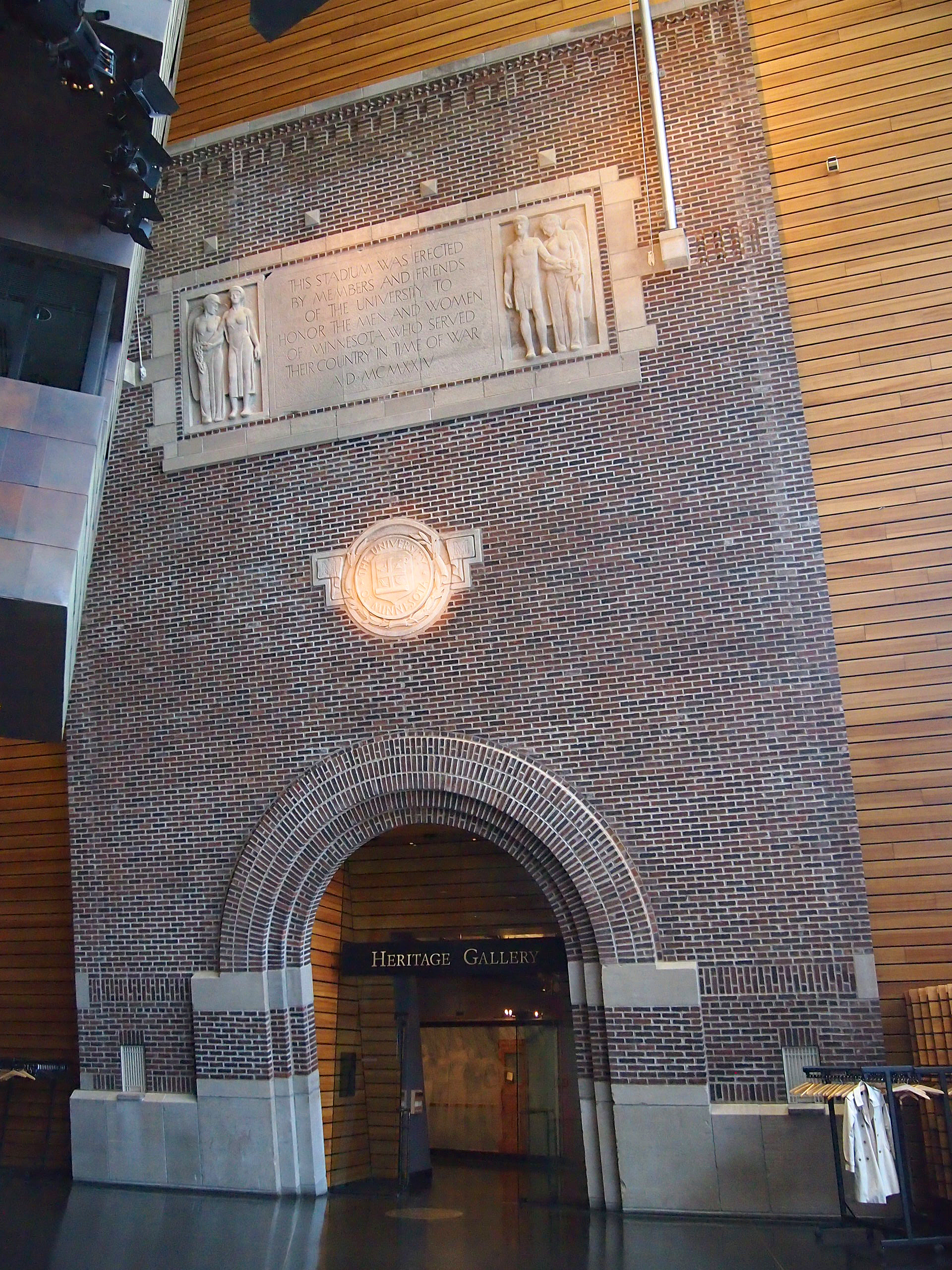
Following the move, the University of Minnesota proposed a new natatorium that would extend into the field at the open end of the horseshoe and ensure that there could be no return to Memorial Stadium. After legal challenges to halt construction of the natatorium failed, the Aquatic Center opened in 1990 and the stadium was torn down two years later. The original brick entrance arch was preserved, and when the McNamara Alumni Center was built on the same site it was installed in the interior atrium over the entrance to a small museum.
Aftermath
The move to the Metrodome proved to be a dismal failure in the long run, as Gophers home games lost the charm of being on a college campus.{{cite book | author-link = Bob Wood (author) | url-access = registration
On May 20, 2006, the state legislature passed a bill providing funding for a new on-campus stadium. It opened in the fall of 2009 as TCF Bank Stadium. The original Memorial Stadium site could not be used, due to the construction of the aquatic and alumni centers. The new stadium is located about a block from where the old stadium once stood and was designed so that the alumni center on the old site is visible through the open end of the horseshoe.

Attendance

| Minnesota Golden Gophers | color=white}};" | Year | Minnesota Golden Gophers | color=white}};" | Total | Minnesota Golden Gophers | color=white}};" | Games | Minnesota Golden Gophers | color=white}};" | Season highest | Minnesota Golden Gophers | color=white}};" | Average |
|---|---|---|---|---|---|---|---|---|---|---|---|---|---|---|
| 1924 | 139,772 | 6 | Illinois (35,341) | 23,297 | ||||||||||
| 1925 | 193,707 | 7 | Notre Dame (49,009) | 27,672 | ||||||||||
| 1926 | 156,032 | 5 | Michigan (58,362) | 31,206 | ||||||||||
| 1927 | 166,848 | 5 | Wisconsin (48,443) | 23,126 | ||||||||||
| 1928 | 146,185 | 5 | Chicago (53,016) | 29,237 | ||||||||||
| 1929 | 204,083 | 6 | Michigan (58,160) | 34,014 | ||||||||||
| 1930 | 167,728 | 6 | Northwestern (50,225) | 27,955 | ||||||||||
| 1931 | 115,631 | 5 | Wisconsin (48,443) | 23,126 | ||||||||||
| 1932 | 113,956 | 5 | Northwestern (52,426) | 43,557 | ||||||||||
| 1933 | 164,301 | 6 | Iowa (41,177) | 27,384 | ||||||||||
| 1934 | 192,922 | 5 | Michigan (59,362) | 38,584 | ||||||||||
| 1935 | 217,785 | 5 | Northwestern (52,426) | 43,557 | ||||||||||
| 1936 | 247,653 | 5 | Iowa (61,172) | 49,531 | ||||||||||
| 1937 | 254,188 | 5 | Notre Dame (63,237) | 50,838 | ||||||||||
| 1938 | 237,000 | 5 | Michigan (54,212) | 47,400 | ||||||||||
| 1939 | 229,954 | 5 | Northwestern (52,372) | 45,991 | ||||||||||
| 1940 | 234,990 | 5 | Michigan (61,976) | 46,998 | ||||||||||
| 1941 | 239,227 | 5 | Northwestern (61,784) | 47,845 | ||||||||||
| 1942 | 231,307 | 6 | Michigan (52,351) | 38,551 | ||||||||||
| 1943 | 182,779 | 7 | Purdue (38,709) | 26,111 | ||||||||||
| 1944 | 179,979 | 6 | Northwestern (39,997) | 29,997 | ||||||||||
| 1945 | 246,931 | 6 | Ohio State (55,789) | 41,155 | ||||||||||
| 1946 | 328,003 | 6 | Michigan (59,037) | 54,667 | ||||||||||
| 1947 | 289,612 | 5 | Purdue (61,087) | 57,922 | ||||||||||
| 1948 | 308,556 | 5 | Purdue (65,549) | 61,711 | ||||||||||
| 1949 | 305,200 | 5 | Wisconsin (63,139) | 61,040 | ||||||||||
| 1950 | 267,015 | 5 | Iowa (60,312) | 53,403 | ||||||||||
| 1951 | 224,759 | 5 | Nebraska (54,573) | 45,152 | ||||||||||
| 1952 | 270,292 | 5 | Iowa (60,376) | 54,058 | ||||||||||
| 1953 | 293,313 | 5 | Michigan (62,795) | 58,663 | ||||||||||
| 1954 | 347,555 | 6 | Iowa (65,464) | 57,926 | ||||||||||
| 1955 | 305,581 | 5 | USC (64,074) | 61,116 | ||||||||||
| 1956 | 372,654 | 6 | Iowa (64,235) | 62,109 | ||||||||||
| 1957 | 314,769 | 5 | Purdue (64,629) | 62,954 | ||||||||||
| 1958 | 282,230 | 5 | Iowa (63,726) | 56,446 | ||||||||||
| 1959 | 256,039 | 5 | Michigan (56,082) | 51,208 | ||||||||||
| 1960 | 342,199 | 6 | Iowa (65,292) | 57,033 | ||||||||||
| 1961 | 361,929 | 6 | Purdue (66,284) | 60,322 | ||||||||||
| 1962 | 368,200 | 6 | Iowa (65,061) | 61,367 | ||||||||||
| 1963 | 286,797 | 5 | Michigan (61,817) | 57,759 | ||||||||||
| 1964 | 268,908 | 5 | Iowa (62,514) | 53,782 | ||||||||||
| 1965 | 302,747 | 6 | Michigan (58,519) | 50,458 | ||||||||||
| 1966 | 248,248 | 5 | Iowa (62,631) | 49,600 | ||||||||||
| 1967 | 237,798 | 6 | Michigan State (56,334) | 39,633 | ||||||||||
| 1968 | 312,806 | 6 | USC (60,820) | 52,134 | ||||||||||
| 1969 | 272,449 | 6 | Ohio State (52,972) | 45,417 | ||||||||||
| 1970 | 225,468 | 5 | Nebraska (52,539) | 45,093 | ||||||||||
| 1971 | 207,662 | 6 | Michigan (44,412) | 34,610 | ||||||||||
| 1972 | 222,079 | 6 | Iowa (44,196) | 37,013 | ||||||||||
| 1973 | 252,917 | 6 | Nebraska (56,782) | 42,153 | ||||||||||
| 1974 | 226,127 | 6 | Ohio State (45,411) | 37,688 | ||||||||||
| 1975 | 220,081 | 7 | Wisconsin (37,578) | 31,440 | ||||||||||
| 1976 | 262,878 | 6 | Iowa (53,222) | 43,813 | ||||||||||
| 1977 | 247,118 | 7 | Michigan (44,165) | 35,303 | ||||||||||
| 1978 | 231,411 | 6 | Ohio State (52,209) | 38,569 | ||||||||||
| 1979 | 241,952 | 6 | Purdue (47,281) | 40,325 | ||||||||||
| 1980 | 265,105 | 6 | Iowa (58,158) | 44,184 | ||||||||||
| 1981 | 301,248 | 7 | Michigan (52,875) | 43,035 |
References
- {{cite book | author-link = Bob Wood (author) | url-access = registration
- University of Minnesota 2006 Football Media Guide - Records
References
- link. (2009-10-05 The official athletic site of the University of Minnesota)
- (February 18, 1977). "Tartan Turf to be replaced". Eugene Register-Guard.
- (2005). "They starved so that others be better fed: remembering Ancel Keys and the Minnesota experiment". J Nutr.
- Tucker, Todd. (2008). "The Great Starvation Experiment: Ancel Keys and the Men Who Starved for Science". U of Minnesota Press.
- "Archived copy".
This article was imported from Wikipedia and is available under the Creative Commons Attribution-ShareAlike 4.0 License. Content has been adapted to SurfDoc format. Original contributors can be found on the article history page.
Ask Mako anything about Memorial Stadium (University of Minnesota) — get instant answers, deeper analysis, and related topics.
Research with MakoFree with your Surf account
Create a free account to save articles, ask Mako questions, and organize your research.
Sign up freeThis content may have been generated or modified by AI. CloudSurf Software LLC is not responsible for the accuracy, completeness, or reliability of AI-generated content. Always verify important information from primary sources.
Report