From Surf Wiki (app.surf) — the open knowledge base
Memorial Day
Federal holiday in the United States

Federal holiday in the United States
| Field | Value |
|---|---|
| holiday_name | Memorial Day |
| type | Federal |
| image | Graves at Arlington on Memorial Day.JPG |
| caption | Arlington National Cemetery graves decorated with flags during Memorial Day weekend |
| observedby | United States |
| scheduling | nth weekday of the month |
| duration | 1 day |
| frequency | Annual |
| week_ordinal | last |
| weekday | Monday |
| month | May |
| date2024 | May 27 |
| date2025 | May 26 |
| date2026 | May 25 |
| observances | Decoration of military graves with American flags |
| significance | |
| firsttime | May 30, 1868 |
Memorial Day is a federal holiday in the United States for mourning the U.S. military personnel who died while serving in the United States Armed Forces. It is observed on the last Monday of May. It is also considered to be the unofficial beginning of summer.
Memorial Day is a time for visiting cemeteries and memorials to mourn the military personnel who died in the line of duty. Volunteers will place American flags on the graves of those military personnel in national cemeteries.
The first national observance of what would become Memorial Day occurred on May 30, 1868. Then known as Decoration Day, the holiday was proclaimed by Commander-in-Chief John A. Logan of the Grand Army of the Republic – a fraternal organization of veterans – to honor Union soldiers who had died in the American Civil War. This national observance followed the example of many local observances which were begun between the end of the Civil War and Logan's declaration. Many cities and people have claimed to be the first to observe it, however, the National Cemetery Administration, a division of the Department of Veterans Affairs, credits Mary Ann Williams of the Ladies Memorial Association of Columbus, Georgia with originating the idea of an annual date to decorate the graves of Civil War veterans with flowers.
Official recognition as a holiday spread among the states, beginning with New York in 1873. By 1890, every union state had adopted it. The world wars turned it into a day of remembrance for all members of the U.S. military who fought and died in service. In 1968, Congress changed its observance to the last Monday in May, and in 1971 standardized its name as "Memorial Day.” Two other days celebrate those who have served or are serving in the U.S. military: Armed Forces Day, which is earlier in May, a ceremonial U.S. day of commemoration for honoring those currently serving in the armed forces, and Veterans Day on November 11, a legal holiday which honors all those who have served in the United States Armed Forces.
Origins
A variety of cities and people have claimed origination of Memorial Day. In some such cases, the claims relate to documented events, occurring before or after the Civil War. Others may stem from general traditions of decorating soldiers' graves with flowers, rather than specific events leading to the national proclamation. Soldiers' graves were decorated in the U.S. before and during the American Civil War. Other claims may be less respectable, appearing to some researchers as taking credit without evidence, while erasing better-evidenced events or connections.
Precedents in the South
Warrenton, Virginia
.jpg)
On June 3, 1861, Warrenton, Virginia, was the location of the first Civil War soldier's grave to be decorated, according to an article in the Richmond Times-Dispatch in 1906. This decoration was for the funeral of the first soldier killed during the Civil War, John Quincy Marr, who died on June 1, 1861, during a skirmish at the Battle of Fairfax Courthouse in Virginia.
Jackson, Mississippi
On April 26, 1865, in Jackson, Mississippi, Sue Landon Vaughan decorated the graves of Confederate and Union soldiers according to her account. The first reference to this event however did not appear until many years later. Mention of the observance is inscribed on the southeast panel of the Confederate Monument in Jackson, erected in 1891. Vaughan's account is contradicted by contemporary sources.
Charleston, South Carolina
On May 1, 1865, in Charleston, South Carolina, the recently freed Black population held a parade of 10,000 people to honor 257 dead Union soldiers. The soldiers had been buried in a mass grave at the Washington Race Course, having died at the Confederate prison camp located there. After the city fell, the freed Black population unearthed and properly buried the soldiers, placing flowers at their graves. The event was reported contemporaneously in the Charleston Daily Courier and the New-York Tribune. Historian David Blight has called this commemoration the first Memorial Day. However, no direct link has been established between this event and General John Logan's 1868 proclamation for a national holiday.
Columbus, Georgia
at least one day in the year, by embellishing their humble graves with flowers, therefore we beg the assistance of the press and the ladies throughout the South to help us in the effort to set apart a certain day to be observed, from the Potomac to the Rio Grande and be handed down through time as a religious custom of the country, to wreathe the graves of our martyred dead with flowers. . . Let the soldiers’ graves, for that day at least, be the Southern Mecca, to whose shrine her sorrowing women, like pilgrims, may annually bring their grateful hearts and floral offerings. . .
The National Cemetery Administration, a division of the Department of Veterans Affairs, and scholars attribute the beginning of a Memorial Day practice in the South to a group of women of Columbus, Georgia. The women were the Ladies Memorial Association of Columbus. They were represented by Mary Ann Williams (Mrs. Charles J. Williams) who as association secretary wrote an open letter to the press on March 11, 1866 asking for assistance in establishing an annual holiday to decorate the graves of soldiers throughout the South. The letter was reprinted in several southern states and the plans were noted in newspapers in the North. The date of April 26 was chosen, which corresponded with the end date of the war with the surrender agreement between Generals Johnston and Sherman in 1865.
The holiday was observed in Atlanta, Augusta, Macon, Columbus and elsewhere in Georgia as well as Montgomery, Alabama; Memphis, Tennessee; Louisville, Kentucky; New Orleans, Louisiana; Jackson, Mississippi, and across the South. In some cities, mostly in Virginia, other dates in May and June were observed. General John Logan commented on the observances in a speech to veterans on July 4, 1866, in Salem, Illinois. After General Logan's General Order No. 11 to the Grand Army of the Republic to observe May 30, 1868, the earlier version of the holiday began to be referred to as Confederate Memorial Day.
Columbus, Mississippi
Following Mary William's call for assistance, four women of Columbus, Mississippi a day early on April 25, 1866, gathered together at Friendship Cemetery to decorate the graves of the Confederate soldiers. They also felt moved to honor the Union soldiers buried there, and to note the grief of their families, by decorating their graves as well. The story of their gesture of humanity and reconciliation is held by some writers as the inspiration of the original Memorial Day.
Other Southern precedents
According to the United States Library of Congress, "Southern women decorated the graves of soldiers even before the Civil War’s end. Records show that by 1865, Mississippi, Virginia, and South Carolina all had precedents for Memorial Day." The earliest Southern Memorial Day celebrations were simple, somber occasions for veterans and their families to honor the dead and tend to local cemeteries. In following years, the Ladies' Memorial Association and other groups increasingly focused rituals on preserving Confederate culture and the Lost Cause of the Confederacy narrative.
Precedents in the North
.jpg)
Gettysburg, Pennsylvania
The 1863 cemetery dedication at Gettysburg, Pennsylvania, included a ceremony of commemoration at the graves of dead soldiers. Some have therefore claimed that President Abraham Lincoln was the founder of Memorial Day. However, Chicago journalist Lloyd Lewis tried to make the case that it was Lincoln's funeral that spurred the soldiers' grave decorating that followed.
Boalsburg, Pennsylvania
On July 4, 1864, ladies decorated soldiers' graves according to local historians in Boalsburg, Pennsylvania. Boalsburg promotes itself as the birthplace of Memorial Day. However, no published reference to this event has been found earlier than the printing of the History of the 148th Pennsylvania Volunteers in 1904. In a footnote to a story about her brother, Mrs. Sophie (Keller) Hall described how she and Emma Hunter decorated the grave of Emma's father, Reuben Hunter, and then the graves of all soldiers in the cemetery. The original story did not account for Reuben Hunter's death occurring two months later on September 19, 1864. It also did not mention Mrs. Elizabeth Myers as one of the original participants. A bronze statue of all three women gazing upon Reuben Hunter's grave now stands near the entrance to the Boalsburg Cemetery. Although July 4, 1864, was a Monday, the town now claims that the original decoration was on one of the Sundays in October 1864.
National Decoration Day
On May 5, 1868, General John A. Logan issued a proclamation calling for "Decoration Day" to be observed annually and nationwide; he was commander-in-chief of the Grand Army of the Republic (GAR), an organization of and for Union Civil War veterans founded in Decatur, Illinois. With his proclamation, Logan adopted the Memorial Day practice that had begun in the Southern states two years earlier. The northern states quickly adopted the holiday. In 1868, memorial events were held in 183 cemeteries in 27 states, and 336 in 1869. One author claims that the date was chosen because it was not the anniversary of any particular battle. Logan's wife noted that the date was chosen because it was the optimal date for flowers to be in bloom in the North.
State holiday

In 1873, New York made Decoration Day an official state holiday and by 1890, every northern state had followed suit. There was no standard program for the ceremonies, but they were typically sponsored by the Women's Relief Corps, the women's auxiliary of the Grand Army of the Republic (GAR), which had 100,000 members. By 1870, the remains of nearly 300,000 Union dead had been reinterred in 73 national cemeteries, located near major battlefields and thus mainly in the South. The most famous are Gettysburg National Cemetery in Pennsylvania and Arlington National Cemetery, near Washington, D.C.
Waterloo proclamation
On May 26, 1966, President Lyndon B. Johnson designated an "official" birthplace of the holiday by signing the presidential proclamation naming Waterloo, New York, as the holder of the title. This action followed House Concurrent Resolution 587, in which the 89th Congress had officially recognized that the patriotic tradition of observing Memorial Day had begun one hundred years prior in Waterloo, New York. The legitimacy of this claim has been called into question by several scholars.
Early national history
In April 1865, following Lincoln's assassination, commemorations were extensive. The more than 600,000 soldiers of both sides who fought and died in the Civil War meant that burial and memorialization took on new cultural significance. Under the leadership of women during the war, an increasingly formal practice of decorating graves had taken shape. In 1865, the federal government also began creating the United States National Cemetery System for the Union war dead.

By the 1880s, ceremonies were becoming more consistent across geography as the GAR provided handbooks that presented specific procedures, poems, and Bible verses for local post commanders to utilize in planning the local event. Historian Stuart McConnell reports:
on the day itself, the post assembled and marched to the local cemetery to decorate the graves of the fallen, an enterprise meticulously organized months in advance to assure that none were missed. Finally came a simple and subdued graveyard service involving prayers, short patriotic speeches, and music ... and at the end perhaps a rifle salute.
Confederate Memorial Day
Main article: Confederate Memorial Day

In 1868, some Southern public figures began adding the label "Confederate" to their commemorations and claimed that Northerners had appropriated the holiday. The first official celebration of Confederate Memorial Day as a public holiday occurred in 1874, following a proclamation by the Georgia legislature. By 1916, ten states celebrated it, on June 3, the birthday of CSA President Jefferson Davis. Other states chose late April dates, or May 10, commemorating Davis' capture.
The Ladies' Memorial Association played a key role in using Memorial Day rituals to preserve Confederate culture. Various dates ranging from April 25 to mid-June were adopted in different Southern states. Across the South, associations were founded, many by women, to establish and care for permanent cemeteries for the Confederate dead, organize commemorative ceremonies, and sponsor appropriate monuments as a permanent way of remembering the Confederate dead. The most important of these was the United Daughters of the Confederacy, which grew throughout the South. Changes in the ceremony's hymns and speeches reflect an evolution of the ritual into a symbol of cultural renewal and conservatism in the South. By 1913, David Blight argues, the theme of American nationalism shared equal time with the Confederate.
Renaming

By the 20th century, various Union memorial traditions, celebrated on different days, merged, and Memorial Day eventually extended to honor all Americans who fought and died while in the U.S. military service. Indiana from the 1860s to the 1920s saw numerous debates on how to expand the celebration. It was a favorite lobbying activity of the Grand Army of the Republic (GAR). An 1884 GAR handbook explained that Memorial Day was "the day of all days in the G.A.R. Calendar" in terms of mobilizing public support for pensions. It advised family members to "exercise great care" in keeping the veterans sober.
Memorial Day speeches became an occasion for veterans, politicians, and ministers to commemorate the Civil War and, at first, to rehash the "atrocities" of the enemy. They mixed religion and celebratory nationalism, allowing Americans to make sense of their history in terms of sacrifice for a better nation. People of all religious beliefs joined, including German and Irish soldiers – ethnic minorities who at the time faced discrimination – who had become true Americans in the "baptism of blood" on the battlefield.
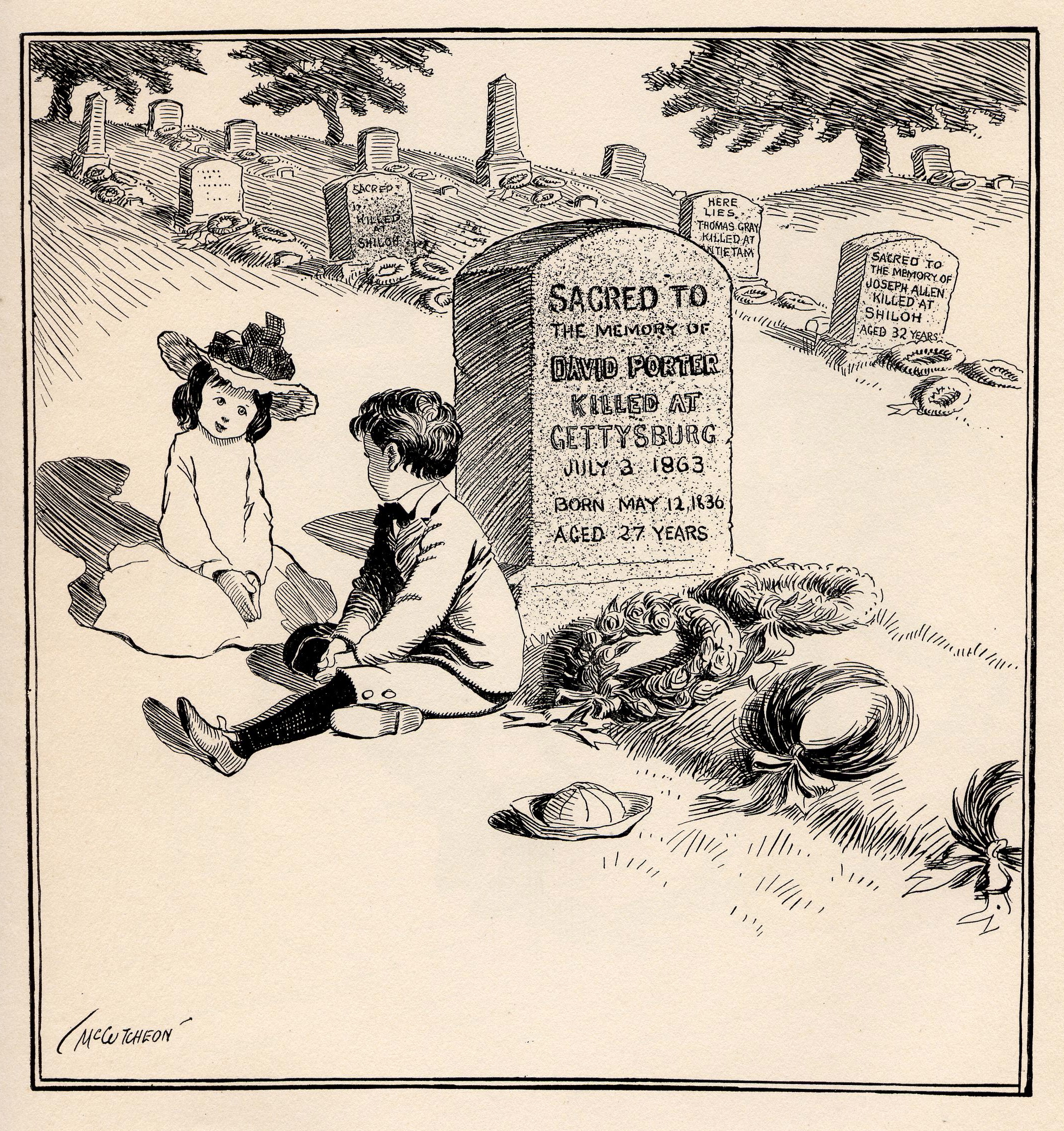
In the national capital in 1913 the four-day "Blue-Gray Reunion" featured parades, re-enactments, and speeches from a host of dignitaries, including President Woodrow Wilson, the first Southerner elected to the White House since the War. James Heflin of Alabama gave the main address. Heflin was a noted orator; his choice as Memorial Day speaker was criticized, as he was opposed for his support of segregation; however, his speech was moderate in tone and stressed national unity and good will, winning him praise from newspapers.
The name "Memorial Day", which was first used in 1882, gradually became more common than "Decoration Day" after World War II but was not declared the official name by federal law until 1967. On June 28, 1968, Congress passed the Uniform Monday Holiday Act, which moved four holidays, including Memorial Day, from their traditional dates to a specified Monday in order to create a three-day weekend. The change moved Memorial Day from its traditional May 30 date to the last Monday in May. The law took effect at the federal level in 1971.
In 1913, an Indiana veteran complained that younger people born since the war had a "tendency ... to forget the purpose of Memorial Day and make it a day for games, races, and revelry, instead of a day of memory and tears". In 1911, the scheduling of the Indianapolis Motor Speedway car race, later named the Indianapolis 500, was vehemently opposed by the increasingly elderly GAR. The state legislature in 1923 rejected holding the race on the holiday. However, the new American Legion and local officials wanted the race to continue, so Governor Warren McCray vetoed the bill and the race went on.
Civil religious holiday

Memorial Day endures as a holiday which most businesses observe because it marks the unofficial beginning of summer. (Labor Day is the unofficial end of summer.) The Veterans of Foreign Wars (VFW) and Sons of Union Veterans of the Civil War (SUVCW) advocated returning to the original date. The VFW stated in 2002:
Changing the date merely to create three-day weekends has undermined the very meaning of the day. No doubt, this has contributed a lot to the general public's nonchalant observance of Memorial Day.
In 2000, Congress passed the National Moment of Remembrance Act, asking people to stop and remember at 3:00 pm. On Memorial Day, the flag of the United States is raised briskly to the top of the staff and then solemnly lowered to the half-staff position, where it remains only until noon. It is then raised to full-staff for the remainder of the day. In commemoration ceremonies the Taps are played on the bugle. The National Memorial Day Concert takes place on the west lawn of the United States Capitol.
Scholars, following the lead of sociologist Robert Bellah, often make the argument that the United States has a secular "civil religion"—one with no association with any religious denomination or viewpoint—that has incorporated Memorial Day as a sacred event. With the Civil War, a new theme of death, sacrifice, and rebirth enters the civil religion. Memorial Day gave ritual expression to these themes, integrating the local community into a sense of nationalism. The American civil religion, in contrast to that of France, was never anticlerical or militantly secular; in contrast to Britain, it was not tied to a specific denomination, such as the Church of England. The Americans borrowed from different religious traditions so that the average American saw no conflict between the two, and deep levels of personal motivation were aligned with attaining national goals.
Parades
Since 1867, Brooklyn, New York, has held an annual Memorial Day parade which it claims to be the nation's oldest. Grafton, West Virginia, and Ironton, Ohio have also had an ongoing parade since 1868. However, the Memorial Day parade in Rochester, Wisconsin, predates both the Doylestown and the Grafton parades by one year (1867).
Poppies
Main article: Remembrance poppy
In 1915, following the Second Battle of Ypres, Lieutenant Colonel John McCrae, a physician with the Canadian Expeditionary Force, wrote the poem "In Flanders Fields". Its opening lines refer to the fields of poppies that grew among the soldiers' graves in Flanders. Inspired by the poem, YWCA worker Moina Michael attended a YWCA Overseas War Secretaries' conference three years later wearing a silk poppy pinned to her coat and distributed over two dozen more to others present. The National American Legion adopted the poppy as its official symbol of remembrance in 1920.
Observance dates (1971–2037)
| Year | Memorial Day | |
|---|---|---|
| 1971 | ||
| 1972 | ||
| 1973 | ||
| 1974 | ||
| 1975 | ||
In popular culture
Films
- In Memorial Day, a 2012 war film starring James Cromwell, Jonathan Bennett, and John Cromwell, a character recalls and relives memories of World War II.
Music
- American composer Charles Ives titled the second movement of his A Symphony: New England Holidays, "Decoration Day".
Poetry
Poems commemorating Memorial Day include:
- Francis M. Finch's "The Blue and the Gray" (1867)
- Henry Wadsworth Longfellow's "Decoration Day" (1882)
- Michael Anania's "Memorial Day" (1994)
References
Notes
Further reading
- Albanese, Catherine. "Requiem for Memorial Day: Dissent in the Redeemer Nation", American Quarterly, Vol. 26, No. 4 (Oct. 1974), pp. 386–398 in JSTOR
- Bellah, Robert N. "Civil Religion in America". Daedalus 1967 96(1): 1–21. online edition
- Blight, David W. "Decoration Day: The Origins of Memorial Day in North and South" in Alice Fahs and Joan Waugh, eds. The Memory of the Civil War in American Culture (2004), online edition pp. 94–129; the standard scholarly history
- Buck, Paul H. The Road to Reunion, 1865–1900 (1937)
- Cherry, Conrad. "Two American Sacred Ceremonies: Their Implications for the Study of Religion in America", American Quarterly, Vol. 21, No. 4 (Winter, 1969), pp. 739–754 in JSTOR
- Dennis, Matthew. Red, White, and Blue Letter Days: An American Calendar (2002)
- Jabbour, Alan, and Karen Singer Jabbour. Decoration Day in the Mountains: Traditions of Cemetery Decoration in the Southern Appalachians (University of North Carolina Press; 2010)
- Myers, Robert J. "Memorial Day". Chapter 24 in Celebrations: The Complete Book of American Holidays. (1972)
References
- "Memorial Day". United States Department of Veterans Affairs.
- {{UnitedStatesCode. 36. 116
- (May 27, 2023). "Memorial Day".
- Yan, Holly. (May 26, 2016). "Memorial Day 2016: What You Need to Know".
- "Today in History – May 30".
- "Memorial Day Order". National Cemetery Administration.
- (May 29, 2023). "Memorial Day History".
- Kickler, Sarah. (May 28, 2012). "Memorial Day vs. Veterans Day". Baltimore Sun.
- "Memorial Day History".
- Klein, Christopher. (May 25, 2016). "Where Did Memorial Day Originate?".
- "The Center for Civil War Research".
- L'Hommedieu Gardiner, Mary. (1842). "The Ladies Garland". J. Libby.
- In 1817, for example, a writer in the ''[[Analectic Magazine]]'' of Philadelphia urged the decoration of patriot's graves. E.J., "The Soldier's Grave", in ''The Analectic Magazine'' (1817), Vol. 10, 264.
- [https://www.snopes.com/fact-check/memorial-day/ "The Origins of Memorial Day"] {{Webarchive. link. (January 19, 2022 Snopes.com, May 25, 2018)
- (July 15, 1906). "Times-Dispatch". Perseus.tufts.edu.
- Poland Jr., Charles P. ''The Glories Of War: Small Battles And Early Heroes Of 1861.'' Bloomington, IN (2006), 42.
- Bellware, Daniel. (2014). "The Genesis of the Memorial Day holiday in America". Columbus State University.
- "Mississippi Confederate Monument – Jackson, MS".
- Roos, Dave. (May 24, 2019). "One of the Earliest Memorial Day Ceremonies Was Held by Freed African Americans".
- Blight, David W.. "Lecture: To Appomattox and Beyond: The End of the War and a Search for Meanings, Overview".
- [https://www.nytimes.com/2012/05/27/us/many-claim-to-be-memorial-day-birthplace.html David Blight, cited by Campbell Robertson, "Birthplace of Memorial Day? That Depends Where You're From", ''The New York Times'', May 28, 2012] {{Webarchive. link. (June 17, 2017 – Blight quote from 2nd web page: "He has called that the first Memorial Day, as it predated most of the other contenders, though he said he has no evidence that it led to General Logan's call for a national holiday.")
- (2000). "The Myth of the Lost Cause and Civil War History". Indiana University Press.
- Johnson, Kristina Dunn. (2009). "No Holier Spot of Ground: Confederate Monuments & Cemeteries of South Carolina". Arcadia Publishing.
- Kammen, Michael. (2011). "Mystic Chords of Memory: The Transformation of Tradition in American Culture". Knopf Doubleday Publishing Group.
- English, Tom. (May 22, 2015). "A 'complicated' journey: The story of Logan and Memorial Day".
- Logan, Mrs. John A.. (1913). "Mrs. Logan's Memoirs".
- (May 27, 2012). "Birthplace of Memorial Day? That Depends Where You're From". [[The New York Times]].
- Jones, Michael. (May 23, 2015). "Memorial Day's Roots Traced to Georgia". Northwest Herald.
- Brockell, Gillian. (May 27, 2019). "Memorial Day's Confederate Roots: Who Really Invented the Holiday?". [[The Washington Post]].
- Fallows, Deborah. (May 23, 2014). "A Real Story of Memorial Day".
- Adams, Will. (May 25, 2017). "Decoration Day & The Origins Of Memorial Day".
- "Confederate Decoration Day Historical Marker".
- "MSU Library, Ole Miss Anthropologist, Local Historian Search for Union Graves".
- "Today in History – May 30 – Memorial Day". United States Library of Congress.
- (2000). "America, history and life". Clio Press.
- Cox, Karen L.. (2003). "Dixie's Daughters: The United Daughters of the Confederacy and the Preservation of Confederate Culture". University Press of Florida.
- "Lincoln's Message to Today", Trenton (NJ) ''Evening Times'', May 30, 1913.
- Lloyd, Lewis. (1941). "Myths after Lincoln". Press of the Readers Club.
- "Sophie Keller Hall, in The Story of Our Regiment: A History of the 148th Pennsylvania Vols., ed. J.W. Muffly (Des Moines: The Kenyon Printing & Mfg. Co., 1904), quoted in editor's note, p. 45".
- (March 26, 1997). "Boalsburg, PA, birthplace of Memorial Day".
- Muffly, Joseph W.. (1994). "The Story of Our Regiment: A History of the 148th Pennsylvania Vols". Butternut and Blue.
- Flynn, Michael. (2010). "Boalsburg and the Origin of Memorial Day".
- Woodman, Wlliam. (1891). "Common School Education and Teachers World". Bemis Publishing Company.
- (2010). "Decoration Day in the Mountains: Traditions of Cemetery Decoration in the Southern Appalachians". Univ of North Carolina Press.
- (Spring–Summer 2018). "The Emergence and Evolution of Memorial Day". Journal of America's Military Past.
- Logan, Mrs. John A.. (1913). "General John Logan, Quoted By His Wife".
- [http://thesouthern.com/news/local/a-complicated-journey-the-story-of-logan-and-memorial-day/article_57e2de05-b9b1-5237-b933-0d43fb8492d7.html "A Complicated Journey: The Story of Logan and Memorial Day"] {{Webarchive. link. (September 7, 2017 Tom English, ''The Southern Illinoisan'', May 22, 2015)
- Halstead, Marilyn. "Did Logan Start Memorial Day? Logan Museum Director Invites Visitors to Decide".
- (May 25, 2018). "The forgotten history of Memorial Day".
- Blight, David W.. (2001). "Race and Reunion: The Civil War in American Memory". Harvard U.P..
- (1991). "The Folklore of American Holidays". Gale Research.
- (May 29, 2010). "Barack Obama, Weekly Address".
- (January 2011). "Interments in Department of Veterans Affairs (VA) National Cemeteries". National Cemetery Administration – Department of Veterans Affairs VA-NCA-IS-1.
- Johnson, Lyndon. "Presidential Proclamation 3727".
- (May 24, 2019). "The origin of Memorial Day: Is Waterloo's claim to fame the result of a simple newspaper typo?".
- (2009). "Wars within a War: Controversy and Conflict over the American Civil War". Univ of North Carolina Press.
- McConnell, Stuart. (1997). "Glorious Contentment: The Grand Army of the Republic, 1865–1900". Univ of North Carolina Press.
- [https://home.nps.gov/ande/learn/historyculture/flowersforjennie.htm National Park Service, "Flowers For Jennie"] Retrieved February 24, 2015
- Knight, Lucian Lamar. (1914). "Memorial Day: Its True History".
- "Confederate Memorial Day in Georgia". University of Georgia.
- Sacco, Nicholas W.. (2015). "The Grand Army of the Republic, the Indianapolis 500, and the Struggle for Memorial Day in Indiana, 1868–1923". Indiana Magazine of History.
- Samito, Christian G.. (2009). "Becoming American under Fire: Irish Americans, African Americans, and the Politics of Citizenship during the Civil War Era". Cornell University Press.
- Yeomans, G. Allan. (1972). "A Southern Segregationist Goes to Gettysburg".
- (2008). "The Good Fight That Didn't End: Henry P. Goddard's Accounts of Civil War and Peace". Univ of South Carolina Press.
- Axelrod, Alan. (2007). "Miracle at Belleau Wood: The Birth of the Modern U.S. Marine Corps". Globe Pequot.
- "Public Law 90-363".
- Mechant, David. (April 28, 2007). "Memorial Day History".
- Scott, Ryan. (May 24, 2015). "Memorial Day, 3 p.m.: Don't Forget". [[Forbes]].
- (2011). "Emily Post's Etiquette, 18". HarperCollins.
- (2009). "United States Code, 2006, Supplement 1, January 4, 2007, to January 8, 2008". Government Printing Office.
- (May 25, 2018). "The National Memorial Day Concert".
- (1998). "Encyclopedia of Religion and Society". Rowman Altamira.
- Cristi, Marcela. (2001). "From Civil to Political Religion: The Intersection of Culture, Religion and Politics". Wilfrid Laurier U.P..
- William M. Epstein. (2002). "American Policy Making: Welfare As Ritual". Rowman & Littlefield.
- (2009). "The Oxford Handbook of Religion and American Politics". Oxford Handbooks Online.
- Robert N. Bellah, "Civil Religion in America", ''Daedalus'' 1967 96(1): 1–21.
- Knapp, Aaron. "Rochester commemorates fallen soldiers in 150th Memorial Day parade". Journal Times.
- says, Lisa. (May 29, 2011). "Doylestown Hosts Oldest Memorial Day Parade In The Country".
- Spencer C. Tucker. (October 28, 2014). "World War I: The Definitive Encyclopedia and Document Collection [5 volumes]: The Definitive Encyclopedia and Document Collection". ABC-CLIO.
- (November 10, 2006). "Where did the idea to sell poppies come from?". BBC News.
- Jabbour, Alan. (May 27, 2010). "What is Decoration Day?".
- Brackner, Joey. "Decoration Day".
- Hooker, Elizabeth R.. (1933). "Religion in the Highlands: Native Churches and Missionary Enterprises in the Southern Appalachian Area". Home Mission Council.
- Meyer, Richard E.. "American Folklore: An Encyclopedia – Cemeteries".
- (2008). "A Charles Ives omnibus". Pendragon Press.
- Finch, Francis. (1867). "Blue and the Gray".
- Longfellow, Henry Wadsworth. "Memorial Day". The Atlantic.
- Anania, Michael. (1994). "Memorial Day".

This article was imported from Wikipedia and is available under the Creative Commons Attribution-ShareAlike 4.0 License. Content has been adapted to SurfDoc format. Original contributors can be found on the article history page.
Ask Mako anything about Memorial Day — get instant answers, deeper analysis, and related topics.
Research with MakoFree with your Surf account
Create a free account to save articles, ask Mako questions, and organize your research.
Sign up freeThis content may have been generated or modified by AI. CloudSurf Software LLC is not responsible for the accuracy, completeness, or reliability of AI-generated content. Always verify important information from primary sources.
Report