From Surf Wiki (app.surf) — the open knowledge base
Melon
Type of fruit

Type of fruit
melon in a broad sense
A melon is any of various plants of the family Cucurbitaceae with sweet, edible, and fleshy fruit. It can also specifically refer to Cucumis melo, commonly known as the "true melon" or simply "melon". The term "melon" can apply to both the plant and its fruit. Botanically, a melon is a kind of berry, specifically a "pepo". The word melon derives from Latin melopepo, which is the latinization of the Greek μηλοπέπων (mēlopepōn), meaning "melon", itself a compound of μῆλον (mēlon), "apple", treefruit (of any kind)" and πέπων (pepōn), amongst others "a kind of gourd or melon". Many different cultivars have been produced, particularly of the true melon, such as the cantaloupe and honeydew.
History
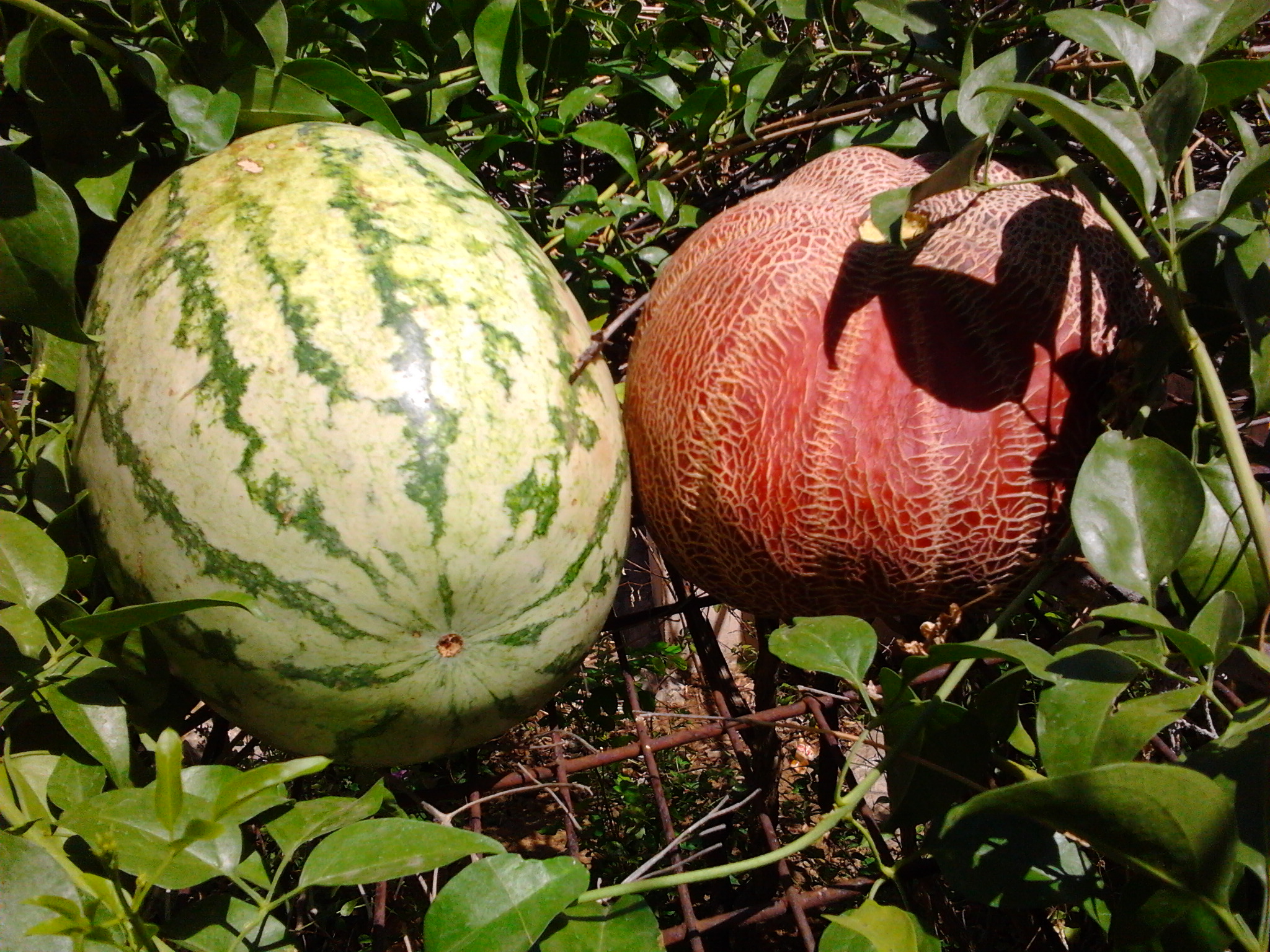
Melons were thought to have originated in Africa. However, recent studies suggest a Southwest Asian origin, especially Iran and India; from there, they gradually began to appear in Europe toward the end of the Western Roman Empire. Melons are known to have been grown by the ancient Egyptians. However, recent discoveries of melon seeds dated between 1350 and 1120 BCE in Nuragic sacred wells have shown that melons were first brought to Europe by the Nuragic civilization of Sardinia during the Bronze Age. Melons were among the earliest plants to be domesticated in the Old World and among the first crop species brought by westerners to the New World.{{cite journal | access-date=2014-10-20 |access-date = 2011-11-04 |url-status = dead |archive-url = https://web.archive.org/web/20120403223315/http://byf.unl.edu/Melon |archive-date = 2012-04-03 | archive-url=https://web.archive.org/web/20131102021047/http://www.abqjournal.com/food/2491846256food09-24-08.htm | access-date=October 20, 2014
Melons by genus


''Benincasa''
- Winter melonNot to be confused with Cucumis melo inodorus varieties, also collectively called winter melon. (B. hispida) is the only member of the genus Benincasa. The mature winter melon is a cooking vegetable that is widely used in Asia, especially in India. The immature melons are used as a culinary fruit (e.g., to make a distinctive fruit drink).
''Citrullus''
Main article: Citrullus
- Citron melon (C. amarus) closely resembles the watermelon, but has harder, whiter flesh. It is often cooked or preserved rather than being eaten raw. It is native to sub-Saharan Africa.
- Colocynth (C. colocynthis) is a wild melon, similar in appearance to the watermelon. The flesh is inedible, but the seeds are a valuable food source in Africa.{{cite web | archive-url=https://web.archive.org/web/20101006175830/http://blogs.worldwatch.org/nourishingtheplanet/seeds-seeds-seeds-egusi-the-miracle-melon/ | archive-date=October 6, 2010 | date=September 20, 2010 | access-date=2014-10-20 | archive-date=2015-05-07 | archive-url=https://web.archive.org/web/20150507194743/http://www.pressesagro.be/base/text/v12n4/393.pdf | url-status=live
- Watermelon (C. lanatus) originated in Africa, where evidence indicates that it has been cultivated for over 4,000 years. It is a popular summer fruit in all parts of the world.{{cite book
''Cucumis''


Melons in genus Cucumis are culinary fruits, and include the majority of culinary melons. All but a handful of culinary melon varieties belong to the species Cucumis melo L.
- Horned melon (C. metuliferus), a traditional food plant in Africa with distinctive spikes. Now grown in California, Chile, Australia and New Zealand as well.{{cite book | chapter-url=https://books.google.com/books?id=6jrlyOPfr24C&q=momordica%20charantia%20culinary&pg=PA385 | access-date=2014-10-20
- True melon (C. melo)
- C. melo cantalupensis, with skin that is rough and warty, not netted.
- The European cantaloupe, with lightly ribbed, pale green skin, was domesticated in the 18th century, in Cantalupo in Sabina, Italy, by the pope's gardener. It is also known as a 'rockmelon' in Australia and New Zealand. Varieties include the French Charentais and the Burpee Seeds hybrid Netted Gem, introduced in the 19th century.{{cite book | access-date=2014-10-20
- The Persian melon resemble a large cantaloupe with a darker green rind and a finer netting.{{cite book | access-date=2014-10-20
- C. melo inodorus, casabas, honeydew, and Asian melons
- Argos, a large, oblong, with orange wrinkled skin, orange flesh, strong aroma. A characteristic is its pointed ends. Growing in some areas of Greece, from which it gets its name.
- Banana melon, an heirloom variety with salmon-colored flesh and an elongated banana shape and yellow rind
- Canary melon, a large, bright-yellow melon with a pale green to white inner flesh.
- Casaba, bright yellow, with a smooth, furrowed skin. Less flavorful than other melons, but keeps longer.{{cite web | access-date=2014-10-20 | archive-date=2014-07-22 | archive-url=https://web.archive.org/web/20140722192652/http://www.wisegeek.com/what-is-a-casaba-melon.htm | url-status=live
- Crenshaw melon, a hybrid between a Casaba melon and a Persian melon that is described to have a very sweet flavor
- Gaya melon, originally from Japan, a honeydew cultivar that is ivory in color and has a mild, sweet flavor
- Hami melon, originally from Hami, Xinjiang, China. Flesh is sweet and crisp.{{cite news | access-date=2014-10-20 | archive-date=2013-11-01 | archive-url=https://web.archive.org/web/20131101162139/http://www1.chinaculture.org/library/2008-01/08/content_22024.htm | url-status=dead
- Honeydew, with a sweet, juicy, green-colored flesh. Grown as bailan melon in Lanzhou, China. There is a second variety which has yellow skin, white flesh and tastes like a moist pear.
- Honeymoon melon, a variety of honeydew with golden rind and bright green flesh and a sweet flavor
- Kajari melon, a sweet honeydew cultivar that is red-orange in color with green stripes reminiscent of a beach ball
- Kolkhoznitsa melon, with smooth, yellow skin and dense, white flesh.{{cite news | access-date=2014-10-20 | archive-date=2015-05-10 | archive-url=https://web.archive.org/web/20150510185404/http://www.themoscowtimes.com/sitemap/free/2007/9/article/likbez-melon-season/194219.html | url-status=live
- Japanese melons (including the Sprite melon).
- Korean melon, a yellow melon with white lines running across the fruit and white inside. Can be crisp and slightly sweet or juicy when left to ripen longer.
- Mirza melon, a large, cream-colored melon native to Central Asia with a sweet, savory flavor
- Oriental pickling melon
- Pixie melon, a sweet, palm-sized cantaloupe cultivar with a strange, cracked-looking netting
- Piel de Sapo () or Santa Claus melon, a melon with a blotchy green skin and white sweet-tasting flesh.
- Sugar melon, a smooth, white, round fruit.{{cite book
- Tiger melon, an orange, yellow and black striped melon from Turkey with a soft pulp.{{cite book
- C. melo reticulatus, true muskmelons, with netted (reticulated) skin.
- North American cantaloupe, distinct from the European cantaloupe, with the net-like skin pattern common to other C. melo reticulatus varieties.{{cite book | access-date=2014-10-20
- Galia (or Ogen), small and very juicy with either faint green or rosy pink flesh.
- Sharlyn melons, with taste between honeydew and cantaloupes, netted skin, greenish-orange rind, and white flesh.{{cite web | access-date=2014-10-20 | archive-date=2014-08-05 | archive-url=https://web.archive.org/web/20140805155746/http://www.foodreference.com/html/artmelon.html | url-status=live
- C. melo agrestis, Wilder melon cultivars, with smooth skin, and tart or bland taste. Often confused with cucumbers (Dosakai, Lemon Cucumber, Pie Melons).
- C. melo conomon, Conomon Melons, Pickling Melons, with smooth skin, and ranging from tart or bland taste (pickling melon) to mild sweetness in Korean Melon.Oriental Pickling melon, Korean Melon. Closely related to wilder melons (C Melo Var Agrestis).
- Modern crossbred varieties, e.g. Crenshaw (Casaba × Persian), Crane (Japanese × N.A. cantaloupe).
- C. melo cantalupensis, with skin that is rough and warty, not netted.
Gallery
File:Melon Sugar Baby Matisse-9953.jpg|Melon Sugar Baby Matisse File:Cucumis melo on white background.jpg|Cucumis melo File:Cantaloupe and canary melon.jpg|Canary melon and Cantaloupe File:Honeydew melon yellow flower.jpg|Honeydew melon yellow flower
Production
| Country | Production |
|---|---|
| (millions of tonnes) | |
| China | |
| Turkey | |
| India | |
| Iran | |
| Afghanistan | |
| United States | |
| Guatemala | |
| Brazil | |
| World | |
| Source: FAOSTAT of the United Nations |
In 2018, world production of melons was 27 million tonnes, led by China with 46% of the total (table). Turkey, Iran, and India each produced more than 1 million tonnes.
Notes
References
General references
- {{cite book | access-date=2014-10-20
- {{cite journal
References
- {{OEtymD. melon
- {{L&S. melopepo. ref
- {{LSJ. mhlope/pwn. μηλοπέπων. ref.
- {{LSJ. μῆλον. shortref.
- {{LSJ. pe/pwn. πέπων. shortref.
- (2009). "The new Oxford book of food plants". Oxford University Press.
- (2014-01-01). "Genetic diversity among melon accessions from Iran and their relationships with melon germplasm of diverse origins using microsatellite markers". Plant Systematics and Evolution.
- (2012-04-03). "Growing Melons".
- (16 May 2017). "Archaeobotanical analysis of a Bronze Age well from Sardinia: A wealth of knowledge". Plant Biosystems.
- (2012). "Domestication of Plants in the Old World: The Origin and Spread of Domesticated Plants in Southwest Asia, Europe, and the Mediterranean Basin". Oxford: University Press.
- Swamy, K. R. M.. (2018-08-29). "Origin, distribution and systematics of culinary cucumber (Cucumis melo subsp. agrestis var. conomon)". Journal of Horticultural Sciences.
- Lim, T. K.. (2012). "Edible Medicinal and Non-Medicinal Plants". Springer Netherlands.
- (2019). "Production of melons in 2018; Crops/Regions/World list/Production Quantity (pick lists)". [[UN Food and Agriculture Organization]], Corporate Statistical Database (FAOSTAT).
This article was imported from Wikipedia and is available under the Creative Commons Attribution-ShareAlike 4.0 License. Content has been adapted to SurfDoc format. Original contributors can be found on the article history page.
Ask Mako anything about Melon — get instant answers, deeper analysis, and related topics.
Research with MakoFree with your Surf account
Create a free account to save articles, ask Mako questions, and organize your research.
Sign up freeThis content may have been generated or modified by AI. CloudSurf Software LLC is not responsible for the accuracy, completeness, or reliability of AI-generated content. Always verify important information from primary sources.
Report