From Surf Wiki (app.surf) — the open knowledge base
Meldrum's acid

| NFPA-H = 2 | NFPA-F = 1 | NFPA-I = 1 | NFPA-S = | TLV-TWA = | TLV-STEL = | TLV-C =
Meldrum's acid or 2,2-dimethyl-1,3-dioxane-4,6-dione is an organic compound with formula . Its molecule has a heterocyclic core with four carbon and two oxygen atoms; the formula can also be written as .
It is a crystalline colorless solid that is sparingly soluble in water and which decomposes on heating to carbon dioxide, acetone, and a ketene. Its synthesis was first reported in 1908 by Andrew Norman Meldrum, for whom it is named. Meldrum incorrectly concluded that it was a carboxylic acid based on its acidity; the correct bislactone structure was not reported until 1948.
Properties
Acidity
The compound can easily lose a hydrogen ion from the methylene () in the ring (carbon 5); which creates a double bond between it and one of the adjacent carbons (number 4 or 6), and a negative charge in the corresponding oxygen. The resulting anion is stabilized by resonance between the two alternatives, so that the double bond is delocalized and each oxygen in the carbonyls has a formal charge of −1/2.
The ionization constant pKa is 4.97; which makes it behave as a monobasic acid even though it contains no carboxylic acid groups. In this and other properties, the compound resembles dimedone and barbituric acid. However, while dimedone exists in solution predominantly as the mono-enol tautomer, Meldrum's acid is almost entirely in the diketone form.
The unusually high acidity of this compound was long considered anomalous—it is 8 orders of magnitude more acidic than the closely related compound dimethyl malonate. In 2004, Ohwada and coworkers determined that the energy-minimizing conformation structure of the compound places the alpha proton's σ* orbital in the proper geometry to align with the π, so that the ground state poses unusually strong destabilization of the C-H bond.
Preparation
Original synthesis
The compound was first made by Meldrum by a condensation reaction of acetone with malonic acid in acetic anhydride and sulfuric acid.

Alternative syntheses
As an alternative to its original preparation, Meldrum's acid can be synthesized from malonic acid, isopropenyl acetate (an enol derivative of acetone), and catalytic sulfuric acid.
A third route is the reaction of carbon suboxide with acetone in the presence of oxalic acid.
Uses
Like malonic acid and its ester derivatives, and other 1,3-dicarbonyl compounds, Meldrum's acid can serve as a reactant for a variety of nucleophilic reactions.
Alkylation and acylation
The acidity of carbon 5 (between the two carbonyl groups) allows simple derivatization of Meldrum's acid at this position, through reactions such as alkylation and acylation. For example, deprotonation and reaction with a simple alkyl halide () attaches the alkyl group () at that position:

The analogous reaction with an acyl chloride () attaches the acyl () instead:

These two reactions allow Meldrum's acid to serve as a starting scaffold for the synthesis of many different structures with various functional groups. The alkylated products can be further manipulated to produce various amide and ester compounds. Heating the acyl product in the presence of an alcohol leads to ester exchange and decarboxylation in a process similar to the malonic ester synthesis. The reactive nature of the cyclic-diester allows good reactivity even for alcohols as hindered as t-butanol, and this reactivity of Meldrum's acid and its derivatives has been used to develop a range of reactions. Ketoesters formed from the reaction of alcohols with Meldrum's acid derivatives are useful in the Knorr pyrrole synthesis.
Synthesis of ketenes
At temperatures greater than 200 C Meldrum's acid undergoes a pericyclic reaction that releases acetone and carbon dioxide and produces a highly reactive ketene compound:

These ketenes can be isolated using flash vacuum pyrolysis (FVP). Ketenes are highly electrophilic and can undergo addition reactions with a range of other chemicals, particularly ketene cycloadditions, or dimerisation to diketene. With this approach it is possible to form new C–C bonds, rings, amides, esters, and acids:
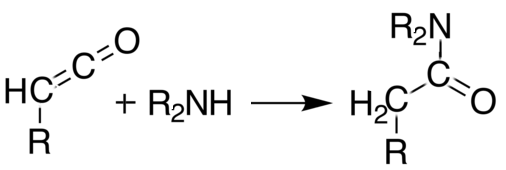


Alternately, the pyrolysis can be performed in solution, to obtain the same results without isolating the ketene, in a one-pot reaction. The ability to form such diverse products makes Meldrum's acid a very useful reagent for synthetic chemists.
History

The compound is named after Andrew Norman Meldrum who reported its synthesis in 1908. He misidentified its structure as a carboxylic acid based on its unusually high acidity, identifying it as the β-lactone of β-hydroxyisopropylmalonic acid;
References
References
- (24 December 2021). "SDS 2,2-Dimethyl-1,3-dioxane-4,6-dione". ThermoFisher Scientific.
- (2006). "Meldrum's Acid". Merck Research Laboratories.
- (1978). "Meldrum's acid". Chemical Society Reviews.
- (2004). "Rationale for the Acidity of Meldrum's Acid. Consistent Relation of C−H Acidities to the Properties of Localized Reactive Orbital". [[J. Org. Chem.]].
- (1978). "Meldrum's acid in organic synthesis. 2. A general and versatile synthesis of β-keto esters". [[J. Org. Chem.]].
- (2020). "Environmentally benign decarboxylative N -, O -, and S -acetylations and acylations". Green Chemistry.
- (13 February 2017). "Solvent-, and Catalyst-free Acylation of Anilines with Meldrum's Acids: A Neat Access to Anilides". ChemistrySelect.
- (3 April 2020). "Highly Stable Meldrum's Acid Derivatives for Irreversible Aqueous Covalent Modification of Amines". Organic Letters.
- (7 May 2021). "Dichloromeldrum's Acid (DiCMA): A Practical and Green Amine Dichloroacetylation Reagent". Organic Letters.
- (2001). "Synthetic Applications of the Pyrolysis of Meldrum's Acid Derivatives". Synthesis.
- (2009). "Meldrum's Acids and 5-Alkylidene Meldrum's Acids in Catalytic Carbon–Carbon Bond-Forming Processes". [[Acc. Chem. Res.]].
- (1978). "Meldrum's acid in organic synthesis. 1. A convenient one-pot synthesis of ethyl indolepropionates". Tetrahedron Letters.
- (2009). "One hundred years of Meldrum's acid: Advances in the synthesis of pyridine and pyrimidine derivatives". [[Mol. Divers.]].
- (2004). "Meldrum's Acid". Synlett.
- (1908). "A β-lactonic acid from acetone and malonic acid". Journal of the Chemical Society, Transactions.
- (1948). "The Structure of Meldrum's Supposed β-Lactonic Acid". Journal of the American Chemical Society.
This article was imported from Wikipedia and is available under the Creative Commons Attribution-ShareAlike 4.0 License. Content has been adapted to SurfDoc format. Original contributors can be found on the article history page.
Ask Mako anything about Meldrum's acid — get instant answers, deeper analysis, and related topics.
Research with MakoFree with your Surf account
Create a free account to save articles, ask Mako questions, and organize your research.
Sign up freeThis content may have been generated or modified by AI. CloudSurf Software LLC is not responsible for the accuracy, completeness, or reliability of AI-generated content. Always verify important information from primary sources.
Report