From Surf Wiki (app.surf) — the open knowledge base
Melbourne Town Hall
Town hall in Melbourne, Victoria, Australia
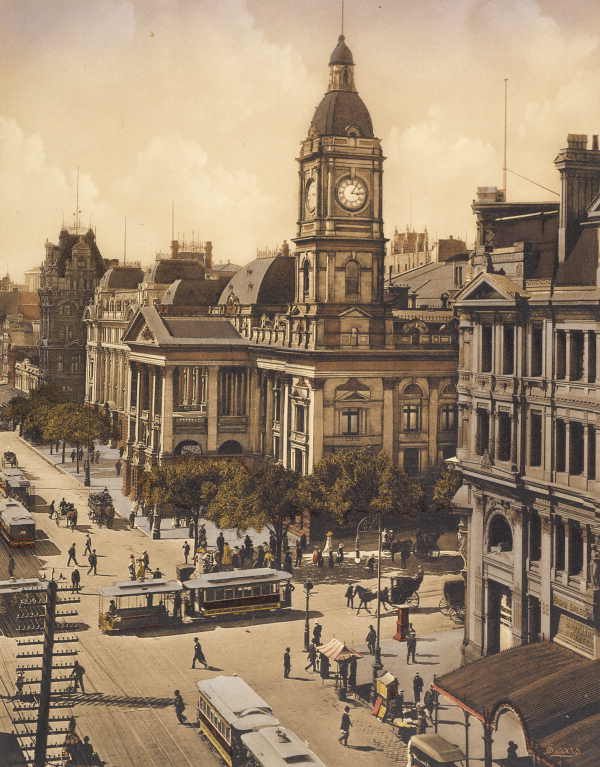
Town hall in Melbourne, Victoria, Australia
| Field | Value |
|---|---|
| name | Melbourne Town Hall |
| image | File:Melbourne Town Hall October 2023.jpg |
| caption | Melbourne Town Hall, October 2023 |
| location | 90-130 Swanston Street, Melbourne, Victoria |
| location_country | Australia |
| coordinates | |
| status | Completed |
| start_date | 1867 |
| completion_date | 1887 |
| owner | Council of the City of Melbourne |
| embedded | {{Infobox designation list |
| embed | yes |
| designation1 | VICHR |
| designation1_offname | Melbourne Town Hall and Administration Building |
| designation1_type | State Registered Place |
| designation1_date | 9 October 1974 |
| designation1_number | H0001 |
| designation1_free1name | Heritage Overlay number |
| designation1_free1value | HO746 |
| building_type | Town hall |
| architectural_style | Second Empire |
Melbourne Town Hall, often referred to as simply Town Hall, is the administrative seat of the local municipality of the City of Melbourne and the primary offices of the Lord Mayor and city councillors of Melbourne. Located on the northeast corner of Swanston and Collins streets in the central business district of Melbourne, Victoria, Australia, the building was completed in 1887 and heritage listed on the Victorian Heritage Register in 1974. The building is frequently used for art and cultural events such as concerts, festivals, theatrical plays and exhibitions.
History
Melbourne was officially incorporated as a town on 13 December 1842, with Henry Condell as its first Mayor. However, it was not until 1854 that its first Town Hall was completed. Begun in 1851, the work ground to a halt with the beginning of the Victorian gold rush. The foundation stone of a new, grander Town Hall was laid on 29 November 1867 by the visiting Prince Alfred, Duke of Edinburgh, after the demolition of the first. The current town hall officially opened on 11 August 1870 with a lavish ball, which was personally funded by the Lord Mayor Samuel Amess.
The foundation stone of the additional front portico was laid in 1887, and Sir Henry Weedon laid the foundation of the administrative annex building on 27 August 1908.
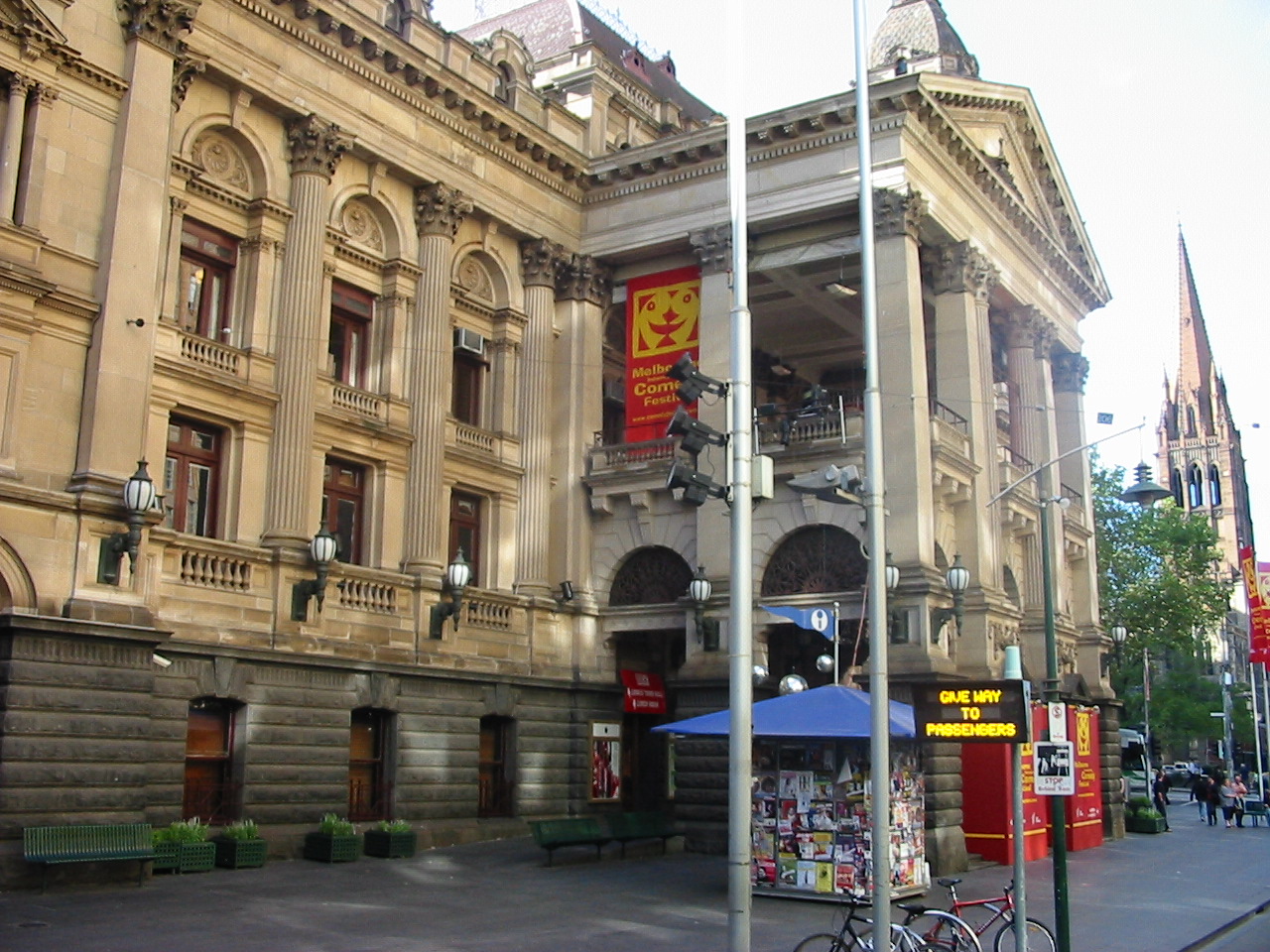
An early cinema event Soldiers of the Cross premiered at the Melbourne Town Hall on 13 September 1900 to an audience of about four thousand people.
In 1913, the city hired a hall keeper in his 30s named James "Jimmy" Dewar, a Scottish immigrant and Black Watch veteran from Dundee. He continued to work there loyally for 30 years. James lived with his wife and family in the Hall's penthouse, raising their children there, and retired in 1943. During their upbringing in the Town Hall, their only playing space was a small asphalt yard where the children went "pigeon-nesting" on the roof.
In his obituary in 1946, The Argus reported that James was a familiar face at the Hall in this era. In his duties, he greeted various visitors from locals to royals, including the French General Paul Pau, the Princes of Wales Edward VIII, and Prince Henry, the Duke of Gloucester. James was described as a "friend, guide, and philosopher" to many Lord Mayors of Melbourne. When opera singer Dame Nellie Melba performed at the Hall in 1928, she wanted to give an encore, but her piano had been packed up and there was no music. James lent her his piano from his upstairs penthouse so she could perform.
On 1 February 1925, a fire destroyed a large part of the town hall, including the main auditorium and pipe organ valued then at £15,000. It was rebuilt and enlarged, extending east over the site previously occupied by the Victoria Coffee Palace, an early temperance hotel frequented by Melbourne's power brokers. The rebuilt section lost some of Reed's original flourishes including the elaborate mansard roof.
In 1964, The Beatles attended a civic reception at the Melbourne Town Hall. "Outside 20,000 teenagers had gathered to obtain a glimpse of the pop idols. Again, frenzied and hysterical cheering and uncontrollable screaming erupted when the Beatles emerged."
Architecture

The Town Hall was designed by the famous local architect Joseph Reed and Barnes, in the Second Empire style. Reed's designs also included the State Library of Victoria, the Royal Exhibition Building, and Melbourne Trades Hall.
The building is topped by Prince Alfred's Tower, named after the Duke. The tower includes a 2.44 m diameter clock, which was started on 31 August 1874, after being presented to the council by the Mayor's son, Vallange Condell. It was built by Smith and Sons of London. The longest of its copper hands measures 1.19 m long, and weighs 8.85 kg.
The building and the portico, excluding the interiors, were first classified on the basis of its Venetian Renaissance facade architecture by the National Trust in 1964 and reclassified in 1971. The organ and the 1927 murals by Napier Waller commissioned for £1,700 (a 2021 value of A$138,340.00) are also classified as historically significant at the State level. They were painted directly in line onto the newly installed asbestos Celotex acoustic tiles in a redecoration of the Auditorium after a fire in 1925. Waller, who had been given a free hand in devising the artworks explained that the figures were not intended to be allegorical, but to create rhythm, and that line-work was used because a skin of paint would interfere with the panels' sound-absorbing quality. The actual painting on the series of 7 metre high by 4m wide wall sections from Waller's half-scale cartoons produced in his Darebin studio was undertaken by H. Oliver and Sons under the artist's supervision.
Organ
The Main Auditorium includes a magnificent concert organ, now comprising 147 ranks and 9,568 pipes. The organ can be played by a fixed console located directly beneath the front pipes or by a secondary mobile console which is placed in close view of the audience for recitals. This organ is of great significance as it is the largest and most comprehensive pipe organ in Australia (measuring by number of voices/stops, the Sydney Opera House organ has more pipes thanks to its entirely "straight" design; there is no borrowing or duplexing at all whereas the Melbourne Town Hall organ makes extensive use of borrowing in the pedal division). The organ is best suited for romantic and symphonic works but is capable of playing just about anything thanks to its vast tonal resources.
History of the organ


Specification
The stop list is as follows:
| I. Choir | II. Great | III. Swell | Pedal | IV. Solo | Bombarde |
|---|---|---|---|---|---|
| Contra Salicional | 16 | Double Open Diapason | 16 | Contra Violone | 32 |
| Horn Diapason | 8 | Tibia Profunda | 16 | Bourdon | 16 |
| Corno Flute | 8 | Contra Geigen | 16 | Violine | 16 |
| Flute Celeste | II | Open Diapason I | 8 | Diapason Phonon | 8 |
| Lieblich Gedeckt | 8 | Open Diapason II | 8 | Geigen Principal | 8 |
| Salicional | 8 | Diapason Phonon | 8 | Flauto Traverso | 8 |
| Voix Céleste | 8 | Tibia Plena | 8 | Cor de Nuit | 8 |
| Lieblich Flöte | 4 | Harmonic Flute | 8 | Bourdon | 8 |
| Gemshorn | 4 | Hohl Flöte | 8 | Gamba | 8 |
| Echo Viola | 4 | Rohr Flöte | 8 | Gamba Celeste | 8 |
| Harmonic Piccolo | 2 | Gamba Major | 8 | Aeoline | 8 |
| Dulciana Cornet | III | Octave Diapason | 4 | Vox Angelica | 8 |
| Tuba Sonora | 8 | Octave Phonon | 4 | Principal | 4 |
| Cor Anglais | 8 | Principal | 4 | Harmonic Flute | 4 |
| Closed Horn | 8 | Tibia Octave | 4 | Rohr Flute | 4 |
| Cremona | 8 | Wald Flöte | 4 | Octave Gamba | 4 |
| Octave Quint | 2 2/3 | Harmonic Quint | 2 2/3 | ||
| Stopped Quint | 2 2/3 | Piccolo | 2 | ||
| Super Octave | 2 | Salicetina | 2 | ||
| Fifteenth | 2 | Tierce | 1 3/5 | ||
| Tierce | 1 3/5 | Chorus Mixture | V | ||
| Grand Fourniture | VI-VII | Grave Mixture | III | ||
| Chorus Mixture | V | Sharp Mixture | III | ||
| Mixture | IV | Double Trumpet | 16 | ||
| Contra Trombone | 32 | Bassoon | 16 | ||
| Trombone | 16 | Cornopean | 8 | ||
| Fagotto | 16 | Trumpet Victoria | 8 | ||
| Trumpet Victoria | 8 | Orchestral Trumpet | 8 | ||
| Tromba | 8 | Horn | 8 | ||
| Harmonic Trumpet | 8 | Oboe | 8 | ||
| Clarion | 4 | Vox Humana | 8 | ||
| Clairon | 4 |
References
References
- "Melbourne Town Hall and Administration Building". [[Government of Victoria]].
- "Melbourne Town Hall {{!}} Melbourne, Victoria {{!}} Attractions".
- "Melbourne Town Hall".
- "Melbourne Town Hall {{!}} Venue Hire {{!}} Functions {{!}} VenueNow".
- (30 November 1867). "VISIT OF THE DUKE OF EDINURGH.". Hamilton Spectator & Grange District Advertiser.
- (13 August 1910). "THE MELBOURNE TOWN-HALL: PAST AND PRESENT.". [[The Australasian]].
- (10 September 1870). "THE GRAND FANCY DRESS BALL GIVEN BY THE RIGHT WORSHIPFUL SAMUEL AMESS MAYOR OF MELBOURNE, ON THE OPENING OF THE NEW TOWN HALL, 11th AUGUST, 1870.". [[Illustrated Australian News for Home Readers]].
- (4 July 1898). "DEATH OF ALDERMAN AMESS.". [[The Argus (Melbourne)]].
- (13 August 1910). "NEW COUNCIL CHAMBER.". [[The Australasian]].
- [http://instagram.com/p/dfwxM5ICSV/ "Happy birthday to our Town Hall admin building #melbourne"], City of Melbourne on Instagram
- (1988). "Perry, Joseph Henry (1863–1943)". [[Australian Dictionary of Biography]], National Centre of Biography, Australian National University.
- (1946-02-25). "OBITUARY". Argus.
- (1943-01-20). "WOMEN'S NEWS". Herald.
- (1935-06-06). "Brilliant Civic Ceremony". Herald.
- "Sun News-Pictorial (Melbourne, Vic. : 1922 - 1954; 1956), Monday 30 April 1928, page 35".
- (1925-02-02). "Melbourne Town Hall On Fire: Concert Hall Demolished: City Organ Destroyed: Victoria Coffee Palace In Danger: An Early Morning Outbreak". The Age.
- [http://www.onlymelbourne.com.au/the-beatles-melbourne The Beatles in Melbourne], OnlyMelbourne
- "Melbourne Town Hall - Organ & Napier Waller Murals".
- Moore, William. (1932-10-01). "Art and Artists.". Brisbane Courier.
- Moore, William. (1 September 1927). "At Home and Abroad". Art in Australia.
- Hutchinson, Diane. (2023). "Five Ways to Compute the Relative Value of Australian Amounts, 1828 to the Present".
- (1927-08-11). "Mural Beauty: Artist Explains Work on Town Hall Panels". The Herald.
- (2019-10-08). "Town Hall Grand Organ".
This article was imported from Wikipedia and is available under the Creative Commons Attribution-ShareAlike 4.0 License. Content has been adapted to SurfDoc format. Original contributors can be found on the article history page.
Ask Mako anything about Melbourne Town Hall — get instant answers, deeper analysis, and related topics.
Research with MakoFree with your Surf account
Create a free account to save articles, ask Mako questions, and organize your research.
Sign up freeThis content may have been generated or modified by AI. CloudSurf Software LLC is not responsible for the accuracy, completeness, or reliability of AI-generated content. Always verify important information from primary sources.
Report