From Surf Wiki (app.surf) — the open knowledge base
Melbourne Cricket Ground
Stadium in Melbourne, Australia
Stadium in Melbourne, Australia
| Field | Value | |||
|---|---|---|---|---|
| name | Melbourne Cricket Ground | |||
| nickname | MCG, the 'G' | |||
| logo_image | Melbourne Cricket Ground logo.png | |||
| logo_size | 170px | |||
| image | 2017 AFL Grand Final panorama during national anthem.jpg | |||
| caption | Panorama of the MCG before | |||
| the 2017 AFL Grand Final | ||||
| address | 120 Brunton Avenue | |||
| location | East Melbourne, Victoria, Australia | |||
| coordinates | ||||
| opened | ||||
| renovated | 1992 (Southern Stand redevelopment) | |||
| 2006 (Northern Stand redevelopment) | ||||
| 2032 (Proposed Shane Warne Stand redevelopment) | ||||
| construction_cost | An estimated $725 | |||
| million AUD (excluding the original 1853 construction) | ||||
| owner | Victoria State Government | |||
| operator | Melbourne Cricket Club (MCC) | |||
| surface | Grass | |||
| suites | 109 | |||
| capacity | 100,024 (95,000 seats + 5,000 standing room) | |||
| public_transit | Richmond | |||
| Jolimont | ||||
| record_attendance | {{Plainlist | |||
| * 109,500 – Ed Sheeran [[+– | ÷× Tour]] | |||
| dimensions | 174 metres x 149 metres (general) | |||
| 160 metres x 141 metres (AFL) | ||||
| 172.9 metres x 147.8 metres (cricket) | ||||
| tenants | ; Australian Football League (AFL) | |||
| Los Angeles Rams (2026-onwards){{Unbulleted list | item1_style | background-color:#ccc; | Major Events | 1956 Summer Olympics |
| 1988 Women's Cricket World Cup | ||||
| 1992 Cricket World Cup | ||||
| Football at the 2000 Summer Olympics | ||||
| 2006 Commonwealth Games | ||||
| 2015 Cricket World Cup | ||||
| State of Origin series 1994, 1995, 1997, 2015, 2018, 2024 | ||||
| 2020 ICC Women's T20 World Cup | ||||
| 2022 ICC Men's T20 World Cup | ||||
| Boxing Day Test | ||||
| FIFA World Cup qualification}} | ||||
| {{collapsed infobox section begin | Cricket details | td | yes}} | |
| embed | yes | |||
| country | Australia | |||
| end1 | West: City End (AFL); | |||
| North: Members End (Cricket) | ||||
| [[File:MelbourneCricketGroundPitchDimensions.svg | 200px]] | |||
| end2 | South: Shane Warne Stand End (Cricket); | |||
| East: Punt Road End (AFL) | ||||
| international | yes | |||
| firsttestdate | 15–19 March | |||
| firsttestyear | 1877 | |||
| firsttesthome | Australia | |||
| firsttestaway | England | |||
| lasttestdate | 26–29 December | |||
| lasttestyear | 2024 | |||
| lasttesthome | Australia | |||
| lasttestaway | India | |||
| firstodidate | 5 January | |||
| firstodiyear | 1971 | |||
| firstodihome | Australia | |||
| firstodiaway | England | |||
| lastodidate | 4 November | |||
| lastodiyear | 2024 | |||
| lastodihome | Australia | |||
| lastodiaway | Pakistan | |||
| firstt20idate | 1 February | |||
| firstt20iyear | 2008 | |||
| firstt20ihome | Australia | |||
| firstt20iaway | India | |||
| lastt20idate | 31 October | |||
| lastt20iyear | 2025 | |||
| lastt20ihome | Australia | |||
| lastt20iaway | India | |||
| firstwtestdate | 18–20 January | |||
| firstwtestyear | 1935 | |||
| firstwtesthome | Australia | |||
| firstwtestaway | England | |||
| lastwtestdate | 28–31 January | |||
| lastwtestyear | 1949 | |||
| lastwtesthome | Australia | |||
| lastwtestaway | England | |||
| firstwodidate | 18 December | |||
| firstwodiyear | 1988 | |||
| firstwodihome | Australia | |||
| firstwodiaway | England | |||
| lastwodidate | 23 January | |||
| lastwodiyear | 2014 | |||
| lastwodihome | Australia | |||
| lastwodiaway | England | |||
| firstwt20idate | 1 February | |||
| firstwt20iyear | 2008 | |||
| firstwt20ihome | Australia | |||
| firstwt20iaway | England | |||
| lastwt20idate | 8 March | |||
| lastwt20iyear | 2020 | |||
| lastwt20ihome | Australia | |||
| lastwt20iaway | India | |||
| date | 2 February | |||
| year | 2024 | |||
| source | http://www.espncricinfo.com/ci/content/ground/56441.html Cricinfo | |||
| embed | yes | |||
| designation1 | ANHL | |||
| designation1_date | ||||
| designation1_type | Historic | |||
| designation1_criteria | a, g, h | |||
| designation1_number | ||||
| designation2 | VICHR | |||
| designation2_offname | Melbourne Cricket Ground | |||
| designation2_type | State Registered Place | |||
| designation2_criteria | a, b, c, e, f, g | |||
| designation2_date | ||||
| designation2_number | H1928 | |||
| designation2_free1name | Heritage Overlay number | |||
| designation2_free1value | HO890 | |||
| website |
the 2017 AFL Grand Final 2006 (Northern Stand redevelopment) 2032 (Proposed Shane Warne Stand redevelopment) million AUD (excluding the original 1853 construction) Jolimont
- 109,500 – Ed Sheeran +–=÷× Tour
- 143,000 – Billy Graham Crusade (pre-configuration) 160 metres x 141 metres (AFL) 172.9 metres x 147.8 metres (cricket) Melbourne Football Club (1858–present) Richmond Football Club (1965–present) Collingwood Football Club (1993–present) Essendon Football Club (1991–present) Hawthorn Football Club (2000–present) Carlton Football Club (2005–present) North Melbourne Football Club (1985–2005) University Football Club (1911–1914) ; Cricket Australian cricket team (1877–present) Victoria cricket team (1851–present) Melbourne Stars (2011–present) ; National Rugby League (NRL) Melbourne Storm (2000) ; Soccer Australia men's national soccer team (selected matches) Australia women's national soccer team (selected matches) Melbourne Victory (international friendly matches) ; American football Los Angeles Rams (2026-onwards) North: Members End (Cricket) East: Punt Road End (AFL)
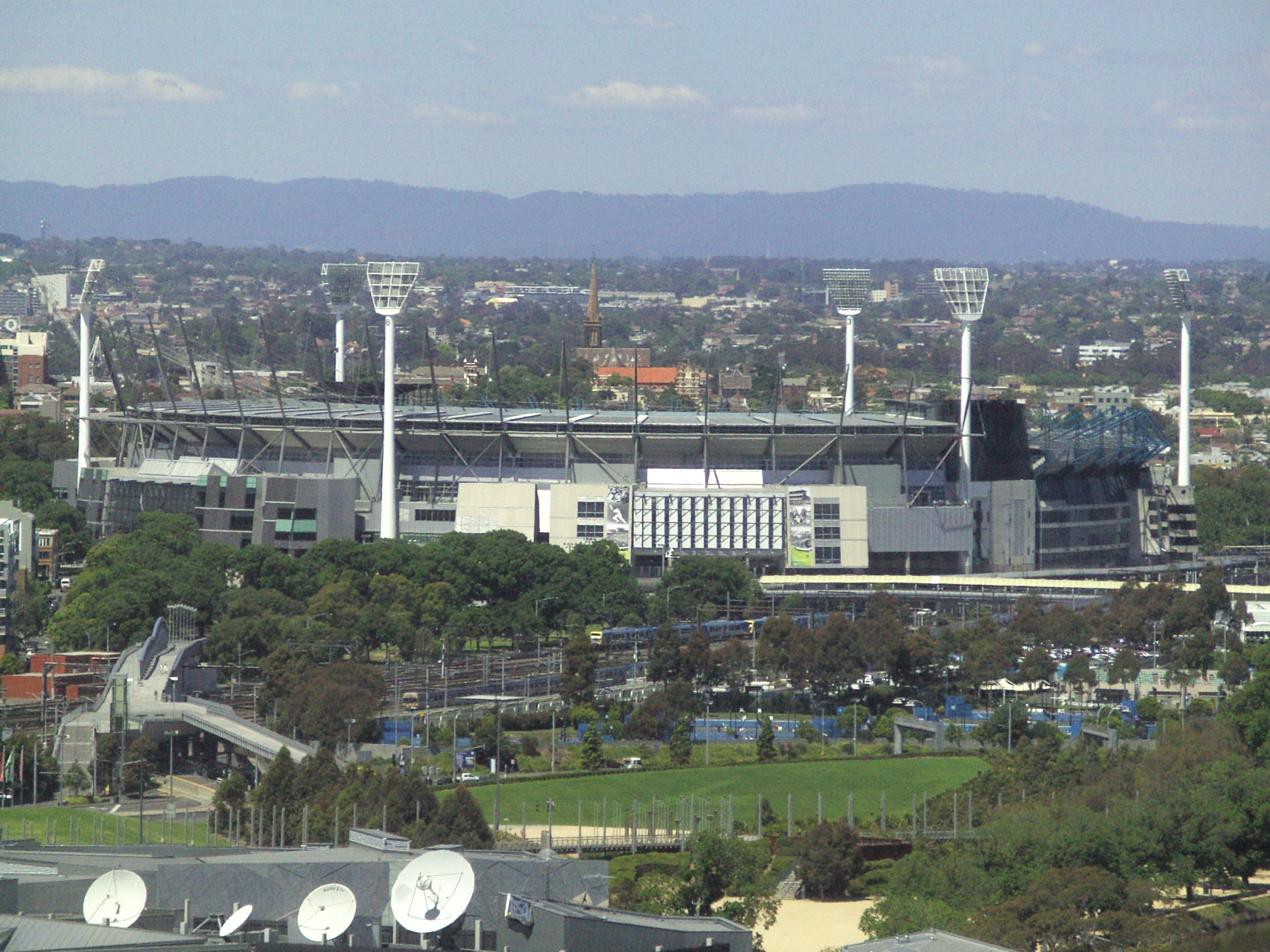
The Melbourne Cricket Ground (MCG), also known locally as '''the 'G'''', is a multi-purpose sports stadium located in Yarra Park, Melbourne, Australia. Founded and managed by the Melbourne Cricket Club, it is the largest stadium in the Southern Hemisphere, the eleventh-largest stadium globally and the second-largest cricket stadium by capacity. The MCG is within walking distance of the Melbourne central business district and is served by Richmond and Jolimont railway stations, as well as the route 70, 75 and 48 trams. It is adjacent to Melbourne Park and is an integral part of the Melbourne Sports and Entertainment Precinct.
Since it was built in 1853, the MCG has undergone numerous renovations. It served as the main stadium for the 1956 Summer Olympics and the 2006 Commonwealth Games, as well as hosting two Cricket World Cup finals: 1992 and 2015. Noted for its role in the development of international cricket, the MCG hosted both the first Test match and the first One Day International, played between Australia and England in 1877 and 1971, respectively. It has also maintained strong ties with Australian rules football since its codification in 1859, and has become the principal venue for Australian Football League (AFL) matches, including the AFL Grand Final, the world's highest attended league championship event.
Home to the Australian Sports Museum, the MCG has hosted other major sporting events, including international rules football matches between Australia and Ireland, international rugby union matches, State of Origin (rugby league) games, and FIFA World Cup qualifiers. Concerts and other cultural events are also held at the venue with the record attendance standing at 143,750 for a Billy Graham evangelistic crusade in 1959. Grandstand redevelopments and occupational health and safety legislation have limited the maximum seating capacity to approximately 95,000 with an additional 5,000 standing room capacity, bringing the total capacity to 100,024.
The MCG is listed on the Victorian Heritage Register and was included on the Australian National Heritage List in 2005. In 2003, journalist Greg Baum called it "a shrine, a citadel, a landmark, a totem" that "symbolises Melbourne to the world".
Early history
The MCG is built atop a Wurundjeri camping ground and site of numerous corroborees. Founded in November 1838 the Melbourne Cricket Club (MCC) selected the current MCG site in 1853 after previously playing at several grounds around Melbourne. The club's first game was against a military team at the Old Mint site, at the corner of William and La Trobe Streets. Burial Hill (now Flagstaff Gardens) became its home ground in January 1839, but the area was already set aside for Botanical Gardens and the club was moved on in October 1846, to an area on the south bank of the Yarra about where the Herald & Weekly Times building is today. The area was subject to flooding, forcing the club to move again, this time to a ground in South Melbourne.
It was not long before the club was forced out again, this time because of the expansion of the railway. The South Melbourne ground was in the path of Victoria's first steam railway line from Melbourne to Sandridge (now Port Melbourne). Governor La Trobe offered the MCC a choice of three sites; an area adjacent to the existing ground, a site at the junction of Flinders and Spring Streets or a ten-acre (about 4 hectares) section of the Government Paddock at Richmond next to Richmond Park.
Between European settlement in 1835 and the early 1860s, this last option, which is now Yarra Park, was known as the Government or Police Paddock and served as a large agistment area for the horses of the Mounted Police, Border Police and Native Police. The north-eastern section also housed the main barracks for the Mounted Police in the Port Phillip district. In 1850 it was part of a 200 acre stretch set aside for public recreation extending from Governor La Trobe's Jolimont Estate to the Yarra River. By 1853 it had become a busy promenade for Melbourne residents.
An MCC sub-committee chose the Richmond Park option because it was level enough for cricket but sloped enough to prevent inundation. That ground was located where the Richmond, or outer, end of the current MCG is now.
At the same time the Richmond Cricket Club was given occupancy rights to 6 acre for another cricket ground on the eastern side of the Government Paddock.
In 1861, a board of trustees was appointed to be responsible for the ground. Over the first forty years, most of the trustees were appointed by the MCC, giving the cricket club relative autonomy over the use of the ground. In 1906, the state governments' Lands ministry appointed five new trustees, putting the government-appointed trustees in the majority; and the government has appointed and overseen the trust since. This gives the state government, via the trust, a level of control over the ground's use.
At the time of the land grant, the Government stipulated that the ground was to be used for cricket and cricket only. This condition technically remained until 1933 when the Melbourne Cricket Ground Act 1933 widened its allowable uses. The 1933 act has been replaced by separate acts in 1989 and 2009.
In 1863, a corridor of land running diagonally across Yarra Park was granted to the Melbourne & Hobson's Bay Railway Company and divided Yarra Park from the river. The Mounted Police barracks were operational until the 1880s when it was subdivided into the current residential precinct bordered by Vale Street. The area closest to the river was also developed for sporting purposes in later years including Olympic venues in 1956.
Stadium development

The first grandstand at the MCG was the original wooden members' stand built in 1854, while the first public grandstand was a 200-metre long 6000-seat temporary structure built in 1861. Another grandstand seating 2000, facing one way to the cricket ground and the other way to the park where football was played, was built in 1876 for the 1877 visit of James Lillywhite's English cricket team. It was during this tour that the MCG hosted the world's first Test match.
In 1881, the original members' stand was sold to the Richmond Cricket Club for £55. A new brick stand, considered at the time to be the world's finest cricket facility, was built in its place. The foundation stone was laid by Prince George of Wales and Prince Albert Victor on 4 July and the stand opened in December that year. It was also in 1881 that a telephone was installed at the ground, and the wickets and goal posts were changed from an east–west orientation to north–south. In 1882 a scoreboard was built which showed details of the batsman's name and how he was dismissed.
When the Lillywhite tour stand burned down in 1884 it was replaced by a new stand which seated 450 members and 4500 public. In 1897, second-storey wings were added to 'The Grandstand', as it was known, increasing capacity to 9,000. In 1900 it was lit with electric light.

More stands were built in the early 20th century. An open wooden stand was on the south side of the ground in 1904 and the 2084-seat Grey Smith Stand (known as the New Stand until 1912) was erected for members in 1906. The 4000-seat Harrison Stand on the ground's southern side was built in 1908 followed by the 8000-seat Wardill Stand in 1912. In the 15 years after 1897 the grandstand capacity at the ground increased to nearly 20,000, while the full ground capacity was almost 60,000.
In 1927, the second brick members' stand was replaced at a cost of £60,000. The Harrison and Wardill Stands were demolished to make way for the Southern Stand which was opened at the end of 1936. The Southern Stand, which spanned almost half of the field's circumference, seated 18,200 under cover and 13,000 in the open and was the main public area of the MCG. The maximum capacity of the ground under this configuration, as advised by the Health Department, was 84,000 seated and 94,000 standing.
The Northern Stand, also known as the Olympic Stand, was built to replace the old Grandstand for the 1956 Olympic Games. By Health Department regulations, this was to increase the stadium's capacity to 120,000; although this was revised down after the 1956 VFL Grand Final, which could not comfortably accommodate its crowd of 115,802. Ten years later, the Grey Smith Stand and the open concrete stand next to it were replaced by the Western Stand; the Duke of Edinburgh laid a foundation stone for the Western Stand on 3 March 1967, and it was completed in 1968; in 1986, it was renamed the W.H. Ponsford Stand in honour of Victorian batsman Bill Ponsford. This was the stadium's highest capacity configuration, and the all-time record crowd for a sporting event at the venue of 121,696 was set under this configuration in the 1970 VFL Grand Final.
The MCG was the home of Australia's first full colour video scoreboard, which replaced the old scoreboard in 1982, located on Level 4 of the Western Stand, which notably caught fire in 1999 and was replaced in 2000. A second video screen added in 1994 almost directly opposite, on Level 4 of the Olympic stand. In 1985, light towers were installed at the ground, allowing for night football and day-night cricket games.
During the 1980s, the Olympic Stand had corporate suites installed which led to the reduction of seating and standing capacity in the stand, the Ponsford Stand had seats installed on the ground level replacing the standing room and both the Southern Stand and Olympic Stand had their wooden bench seats removed and replaced with plastic bucket seats.
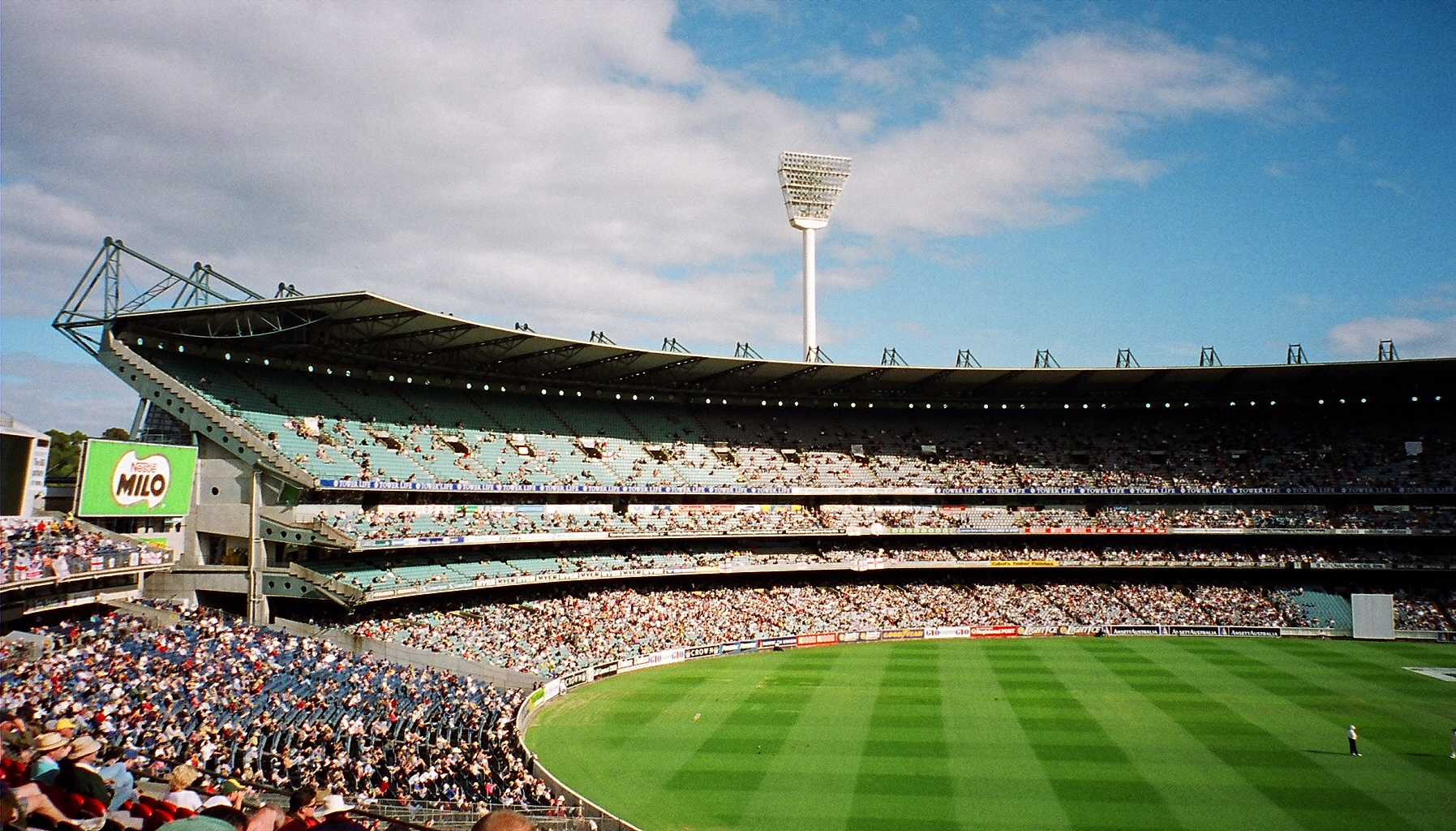
In 1988, inspections of the old Southern Stand found concrete cancer and provided the opportunity to replace the increasingly run-down 50-year-old facility. The projected cost of $100 million was outside what the Melbourne Cricket Club could afford so the Victorian Football League took the opportunity to part fund the project in return for a 30-year deal to share the ground. The new Great Southern Stand was completed in 1992, in time for the 1992 Cricket World Cup, at a final cost of $150 million by John Holland. It was renamed the Shane Warne Stand after Victorian bowler Shane Warne in 2022 shortly after his death.


The 1928 Members' stand, the 1956 Olympic stand and the 1968 W.H. Ponsford stand were demolished one by one between late 2003 to 2005 and replaced with a new structure in time for the 2006 Commonwealth Games. Despite now standing as a single unbroken stand, the individual sections retain the names of W.H. Ponsford, Olympic and Members Stands. The redevelopment cost exceeded 400 million and pushed the ground's capacity to just above 100,000. Since redevelopment, the highest attendance has been 100,024 at the 2022 and 2023 AFL grand finals.
From 2011 until 2013, the Victoria State Government and the Melbourne Cricket Club funded a $55 million refurbishment of the facilities in the Great Southern Stand, including renovations to entrance gates and ticket outlets, food and beverage outlets, etc., without significantly modifying the stand. New scoreboards, more than twice the size of the original ones, were installed in the same positions in late 2013.
From November 2019 until February 2020 all the playing field lights, including those in the light towers, were replaced with LED sports lighting with the lighting under the roof and in two of the light towers completed in time for the Boxing Day Test against New Zealand.
Cricket
Early years
The first cricket match at the venue was played on 30 September 1854, while the first inter-colonial cricket match to be played at the MCG was between Victoria and New South Wales in March 1856. Victoria had played Tasmania (then known as Van Diemen's Land) as early as 1851 but the Victorians had included two professionals in the 1853 team upsetting the Tasmanians and causing a cooling of relations between the two colonies. To replace the disgruntled Tasmanians the Melbourne Cricket Club issued a challenge to play any team in the colonies for £1000. Sydney publican William Tunks accepted the challenge on behalf of New South Wales although the Victorians were criticised for playing for money. Ethics aside, New South Wales could not afford the £1000 and only managed to travel to Melbourne after half the team's travel cost of £181 was put up by Sydney barrister Richard Driver.
The game eventually got under way on 26 March 1856. The Victorians, stung by criticism over the £1000 stake, argued over just about everything; the toss, who should bat first, whether different pitches should be used for the different innings and even what the umpires should wear.
Victoria won the toss but New South Wales captain George Gilbert successfully argued that the visiting team should decide who bats first. The MCG was a grassless desert and Gilbert, considering players fielded without boots, promptly sent Victoria into bat. Needing only 16 to win in the final innings, New South Wales collapsed to be 5 for 5 before Gilbert's batting saved the game and the visitors won by three wickets.
In subsequent years conditions at the MCG improved but the ever-ambitious Melburnians were always on the lookout for more than the usual diet of club and inter-colonial games. In 1861, Felix William Spiers and Christopher Pond, the proprietors of the Cafe de Paris in Bourke Street and caterers to the MCC, sent their agent, W.B. Mallam, to England to arrange for a cricket team to visit Australia.
Mallam found a team and, captained by Heathfield Stephenson, it arrived in Australia on Christmas Eve 1861 to be met by a crowd of more than 3000 people. The team was taken on a parade through the streets wearing white-trimmed hats with blue ribbons given to them for the occasion. Wherever they went they were mobbed and cheered by crowds to the point where the tour sponsors had to take them out of Melbourne so that they could train undisturbed.
Their first game was at the MCG on New Year's Day 1862, against a Victorian XVIII. The Englishmen also wore coloured sashes around their waists to identify each player and were presented with hats to shade them from the sun. Some estimates put the crowd at the MCG that day at 25,000. It must have been quite a picture with a new 6000 seat grandstand, coloured marquees ringing the ground and a carnival outside. Stephenson said that the ground was better than any in England. The Victorians however, were no match for the English at cricket and the visitors won by an innings and 96 runs.

Over the four days of the match more than 45,000 people attended and the profits for Speirs and Pond from this game alone was enough to fund the whole tour. At that time it was the largest number of people to ever watch a cricket match anywhere in the world. Local cricket authorities went out of their way to cater for the needs of the team and the sponsors. They provided grounds and sponsors booths without charge and let the sponsors keep the gate takings. The sponsors however, were not so generous in return. They quibbled with the Melbourne Cricket Club about paying £175 for damages to the MCG despite a prior arrangement to do so.
The last match of the tour was against a Victorian XXII at the MCG after which the English team planted an elm tree outside the ground.
Following the success of this tour, a number of other English teams also visited in subsequent years. George Parr's side came out in 1863–64 and there were two tours by sides led by W. G. Grace. The fourth tour was led by James Lillywhite.
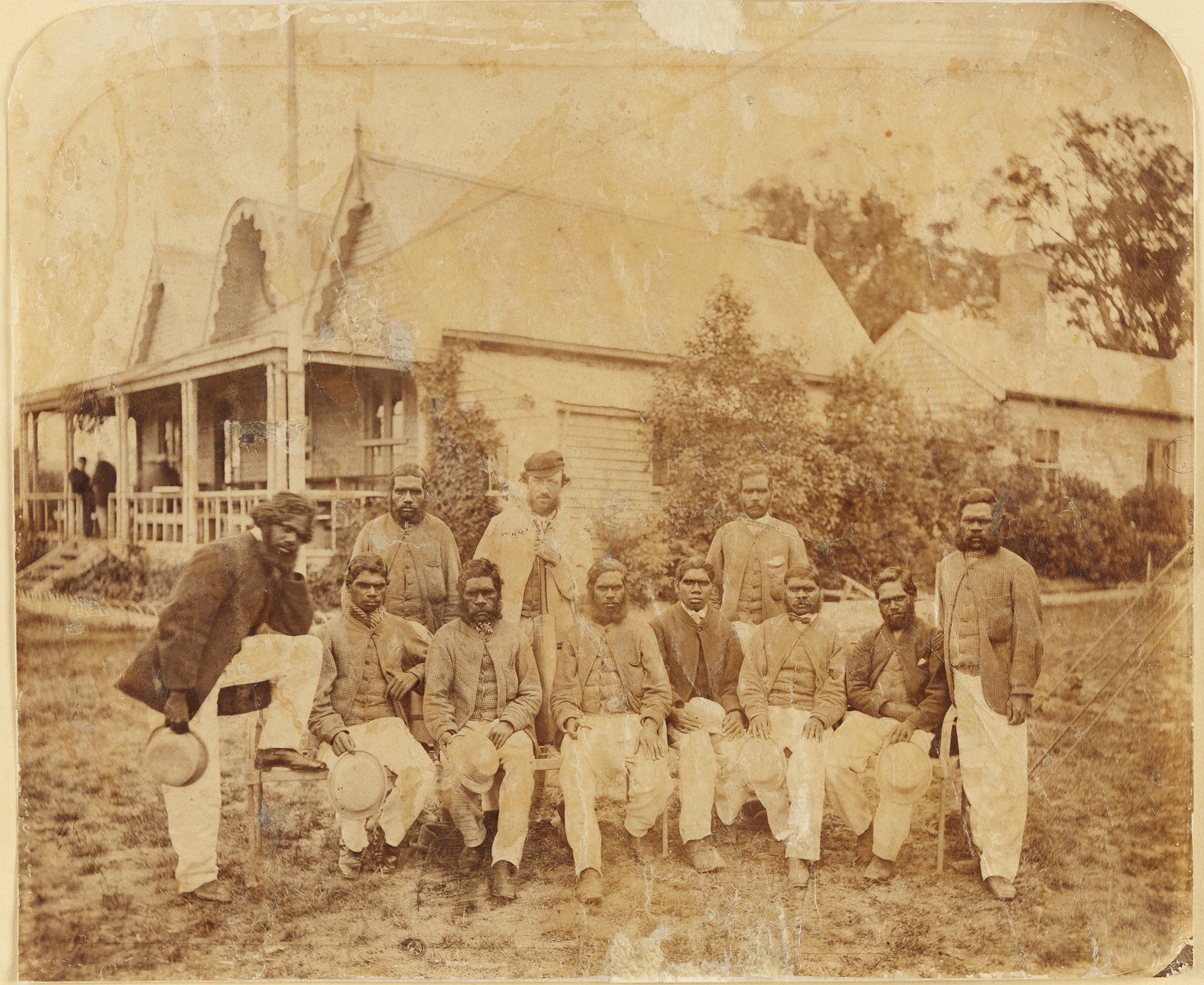
On Boxing Day 1866 an Indigenous Australian cricket team played at the MCG with 11,000 spectators against an MCC team. A few players in that match were in a later team that toured England in 1868. Some also played in three other matches at the ground before 1869.
First Test match

Up until the fourth tour in 1877, led by James Lillywhite, touring teams had played first-class games against the individual colonial sides, but Lillywhite felt that his side had done well enough against New South Wales to warrant a game against an All Australian team.
When Lillywhite headed off to New Zealand he left Melbourne cricketer John Conway to arrange the match for their return. Conway ignored the cricket associations in each colony and selected his own Australian team, negotiating directly with the players. Not only was the team he selected of doubtful representation but it was also probably not the strongest available as some players had declined to take part for various reasons. Demon bowler Fred Spofforth refused to play because wicket-keeper Billy Murdoch was not selected. Paceman Frank Allan was at Warrnambool Agricultural Show and Australia's best all-rounder Edwin Evans could not get away from work. In the end only five Australian-born players were selected.
The same could be said for Lillywhite's team which, being selected from only four counties, meant that some of England's best players did not take part. In addition, the team had a rough voyage back across the Tasman Sea and many members had been seasick. The game was due to be played on 15 March, the day after their arrival, but most had not yet fully recovered. On top of that, wicket-keeper Ted Pooley was still in a New Zealand prison after a brawl in a Christchurch pub.
England was nonetheless favourite to win the game and the first ever Test match began with a crowd of only 1000 watching. The Australians elected Dave Gregory from New South Wales as Australia's first ever captain and on winning the toss he decided to bat.
Charles Bannerman scored an unbeaten 165 before retiring hurt. Sydney Cricket Ground curator, Ned Gregory, playing in his one and only Test for Australia, scored Test cricket's first duck. Australia racked up 245 and 104 while England scored 196 and 108 giving Australia victory by 45 runs. The win hinged on Bannerman's century and a superb bowling performance by Tom Kendall who took 7 for 55 in England's second innings.
A fortnight later there was a return game, although it was really more of a benefit for the English team. Australia included Spofforth, Murdoch and T.J.D. Cooper in the side but this time the honours went to England who won by four wickets.
Two years later Lord Harris brought another England team out and during England's first innings in the Test at the MCG, Fred Spofforth took the first hat-trick in Test cricket. He bagged two hauls of 6 for 48 and 7 for 62 in Australia's ten wicket win.
Cricket uses
Through most of the 20th century, the Melbourne Cricket Ground was one of the two major Test venues in Australia (along with the Sydney Cricket Ground), and it would host one or two Tests in each summer in which Tests were played; since 1982, the Melbourne Cricket Ground has hosted one Test match each summer. Until 1979, the ground almost always hosted its match or one of its matches over the New Year, with the first day's play falling somewhere between 29 December and 1 January; in most years since 1980 and every year since 1995, its test has begun on Boxing Day, and it is now a standard fixture in the Australian cricket calendar and is known as the Boxing Day Test. The venue also hosts one-day international matches each year, and Twenty20 international matches most years. No other venue in Melbourne has hosted a Test, and Docklands Stadium is the only other venue to have hosted a limited-overs international.
The Victorian first-class team plays Sheffield Shield cricket at the venue during the season. Prior to Test cricket being played on Boxing Day, it was a long-standing tradition for Victoria to host New South Wales in a first-class match on Boxing Day. Victoria also played its limited overs matches at the ground. Since the introduction of the domestic Twenty20 Big Bash League (BBL) in 2011, the Melbourne Stars club has played its home matches at the ground. It is also the home ground of the Melbourne Stars Women team, which plays in the Women's Big Bash League (WBBL).
By the 1980s, the integral MCG pitch – grown from Merri Creek black soil – was considered the worst in Australia, in some matches exhibiting wildly inconsistent bounce which could see balls pass through as grubbers or rear dangerously high – a phenomenon which was put down to damage caused by footballers in winter and increased use for cricket during the summers of the 1970s. The integral pitch has since been removed and drop-in pitches have been cultivated and used since 1996, generally offering consistent bounce and a fair balance between bat and ball. The decade-and-a-half-old pitches degraded again through the late 2010s, seeing the pitch receive the first official International Cricket Council 'poor' rating by an Australian pitch in 2017, and saw another Sheffield Shield match abandoned in 2019; a new set of drop-in pitches will be grown and ready for use by the early 2020s. A 150th anniversary Test match between Australia and England, commemorating the first Test match in 1877, is due to be held from 11 to 15 March 2027 and is expected to be the first-ever day and night men's Test at the MCG.
Highlights and lowlights
The highest first-class team score in history was posted at the MCG in the Boxing Day match against New South Wales in 1926–27. Victoria scored 1107 in two days, with Bill Ponsford scoring 352 and Jack Ryder scoring 295.
One of the most sensational incidents in Test cricket occurred at the MCG during the Melbourne test of the 1954–55 England tour of Australia. Big cracks had appeared in the pitch during a very hot Saturday's play and on the rest day Sunday, groundsman Jack House watered the pitch to close them up. This was illegal and the story was leaked by The Age newspaper. The teams agreed to finish the match and England won by 128 runs after Frank Tyson took 7 for 27 in the final innings.
An incident in the second Test of the 1960–61 series involved the West Indies player Joe Solomon being given out after his hat fell on the stumps after being bowled at by Richie Benaud. The crowd sided with the West Indies over the Australians.
Not only was the first Test match played at the MCG, the first One Day International match was also played there, on 5 January 1971, between Australia and England. The match was played on what was originally scheduled to have been the fifth day of a Test match, but the Test was abandoned after the first three days were washed out. Australia won the 40-over match by 5 wickets. The next ODI was played in August 1972, some 19 months later.
In March 1977, a Centenary Test Match was held between Australia and England to mark the 100th anniversary of the first Test match. The match was the idea of former Australian bowler and MCC committee member Hans Ebeling who had been responsible for developing the cricket museum at the MCG. England's Derek Randall scored 174, Australia's Rod Marsh also got a century, Dennis Lillee took 11 wickets, and David Hookes, in his first Test, hit five fours in a row off England captain Tony Greig's bowling. Rick McCosker opened the batting for Australia and suffered a fractured jaw after being hit by a sharply rising delivery. He left the field but came back in the second innings with his head swathed in bandages. Australia won the match by 45 runs, exactly the same margin as the first Test in 1877.

Another incident occurred on 1 February 1981 at the end of a one-day match between Australia and New Zealand. New Zealand, batting second, needed six runs off the last ball of the day to tie the game. Australian captain, Greg Chappell instructed his brother Trevor, who was bowling the last over, to send the last ball down underarm to prevent the New Zealand batsman, Brian McKechnie, from hitting the ball for six. Although not in the spirit of the game, an underarm delivery was quite legal, so long as the arm was kept straight. The Laws of cricket have since been changed to prevent such a thing happening again. The incident has long been a sore point between Australia and New Zealand.
In February and March 1985 the Benson & Hedges World Championship of Cricket was played at the MCG, a One Day International tournament involving all of the then Test match playing countries to celebrate 150 years of the Australian state of Victoria. Some matches were also played at Sydney Cricket Ground.
The MCG hosted the 1992 Cricket World Cup Final between Pakistan and England with a crowd of more than 87,000. Pakistan won the match after an all-round performance by Wasim Akram who scored 33 runs and took 3 wickets to make Pakistan cricket world champions for the first and, to date, only time.
During the 1995 Boxing Day Test at the MCG, Australian umpire Darrell Hair called Sri Lankan spin bowler Muttiah Muralitharan for throwing the ball, rather than bowling it, seven times during the match. The other umpire did not call him once and this caused a controversy, although Muralitharan was later called for throwing by other umpires in different matches.
The MCG is known for its great atmosphere, much of which is generated at Bay 13, situated almost directly opposite to the members stand. In the late 1980s, the crowd at Bay 13 would often mimic the warm up stretches performed by Merv Hughes. In a 1999 One-Day International, the behaviour of Bay 13 was so poor that Shane Warne, donning a helmet for protection, asked the crowd to settle down at the request of opposing England captain Alec Stewart.
.jpg)
The MCG hosted three pool games as part of the 2015 ICC Cricket World Cup as well as a quarter-final, and then the final on 29 March. Australia comfortably defeated New Zealand by seven wickets in front of an Australian record cricket crowd of 93,013.
The 2020 ICC Women's T20 World Cup Final was held on International Women's Day between Australia and India. Australia won by 85 runs in front of a record crowd for women's cricket of 86,174.
| Number | Teams | Match type | Attendance | Date |
|---|---|---|---|---|
| 1 | Australia v England | Test | 94,199 | 26 December 2025 |
| 2 | Australia v New Zealand | 2015 Cricket World Cup Final (ODI) | 93,013 | 29 March 2015 |
| 3 | Australia v England | Test | 91,112 | 26 December 2013 |
| 4 | Australia v West Indies | Test | 90,800 | 11 February 1961 |
| 5 | India v Pakistan | 2022 Men's T20 World Cup (Super 12) | 90,293 | 23 October 2022 |
| 6 | Australia v England | Test | 89,155 | 26 December 2006 |
| 7 | Australia v England | Test | 88,172 | 26 December 2017 |
| 8 | Australia v England | Test | 87,789 | 4 January 1937 |
| 9 | Australia v India | Test | 87,242 | 26 December 2024 |
| 10 | England v Pakistan | 1992 Cricket World Cup Final (ODI) | 87,182 | 25 March 1992 |
| 11 | India v South Africa | 2015 Cricket World Cup Group match | 86,876 | 22 February 2015 |
| 12 | Australia v India | 2020 ICC Women's T20 World Cup Final | 86,174 | 8 March 2020 |
Australian rules football
As of 2024, six AFL teams have deals in place to play home games at the MCG:
- Melbourne Football Club (1858–present) – ten home games per year.
- Richmond Football Club (1965–present) – ten home games per year.
- Essendon Football Club (1991–present) – four home games per year.
- Collingwood Football Club (1993–present) – nine home games per year.
- Hawthorn Football Club (2000–present) – six or seven home games per year.
- Carlton Football Club (2005–present) – five home games per year.
Additionally, the Geelong Football Club plays two home games per year at the MCG, and the St Kilda Football Club plays one home game per year at the MCG; both teams predominantly play home games at Kardinia Park and Docklands Stadium respectively.
Origins

Despite being called the Melbourne Cricket Ground, the stadium has been and continues to be used much more often for Australian rules football. Spectator numbers for football are larger than for any other sport in Australia, and it makes more money for the MCG than any of the other sports played there.
Although the Melbourne Cricket Club members were instrumental in founding Australian Rules Football, there were understandable concerns in the early days about the damage that might be done to the playing surface if football was allowed to be played at the MCG. Therefore, football games were often played in the parklands next to the cricket ground, and this was the case for the first documented football match to be played at the ground. The match which today is considered to be the first Australian rules football, played between Melbourne Grammar and Scotch College over three Saturdays beginning 7 August 1858 was played in this area.
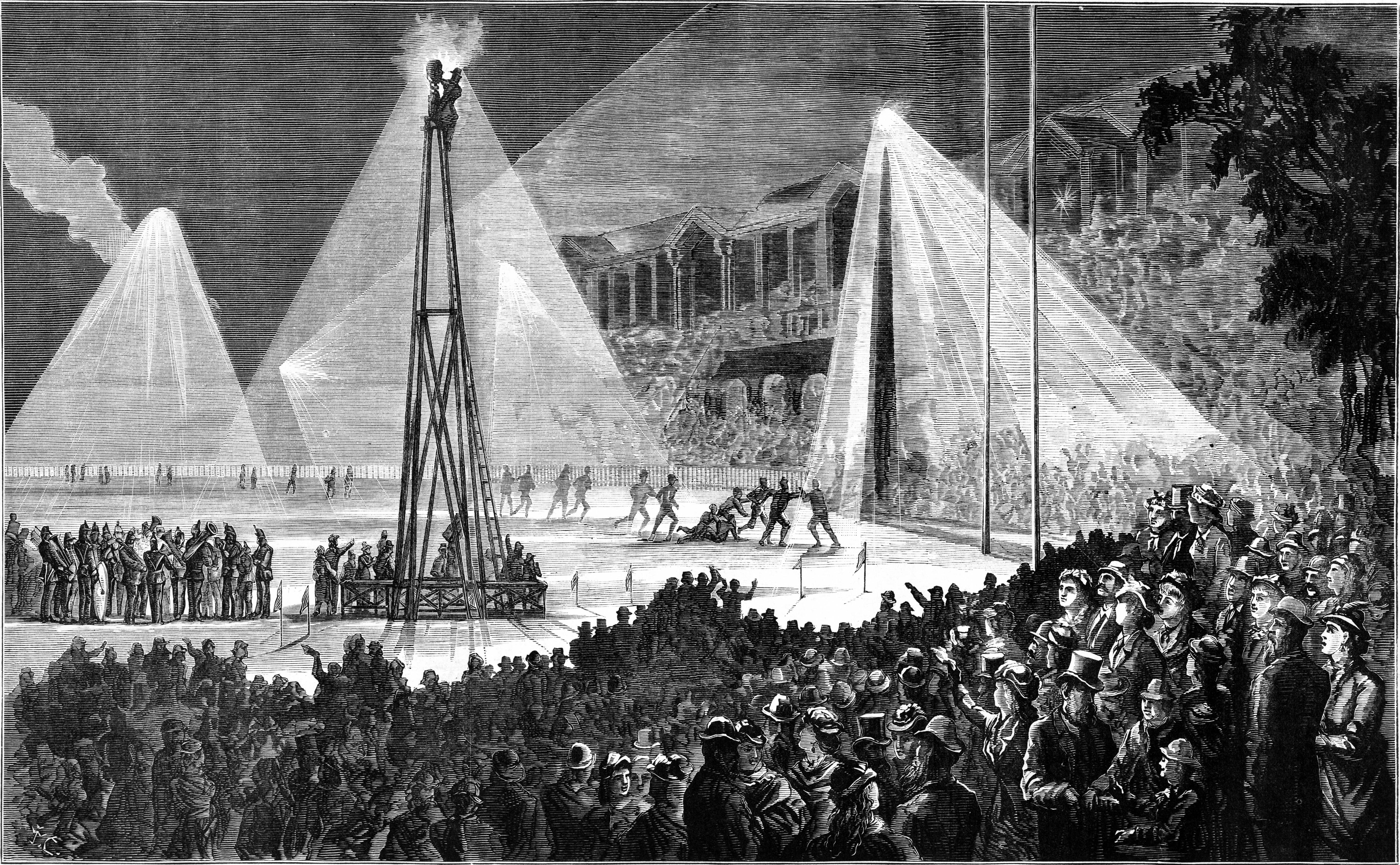
It wasn't until 1869 that football was played on the MCG proper, a trial game involving a police team. It was not for another ten years, in 1879, after the formation of the Victorian Football Association, that the first official match was played on the MCG and the cricket ground itself became a regular venue for football. Two night matches were played on the ground during the year under the newly invented electric light.
In the early years, the MCG was the home ground of Melbourne Football Club, Australia's oldest club, established in 1858 by the founder of the game itself, Thomas Wills. Melbourne won five premierships during the 1870s using the MCG as its home ground.
The first of nearly 3000 Victorian Football League/Australian Football League games to be played at the MCG was on 15 May 1897, with beating 64 to 19.
Melbourne used the venue as its training base until 1984, before being required to move to preserve the venue's surface when North Melbourne began playing there.
Finals and grand finals
The VFL/AFL grand final has been played at the MCG every season since 1902 (except in 1942-1945, when the ground was used by the military during World War II, in 1991 as the construction of the Great Southern Stand had temporarily reduced the ground's capacity below that of Waverley Park, and in 2020-2021, when restrictions in Victoria due to the COVID-19 pandemic required the games to be moved to the Gabba in Queensland and Perth Stadium in Western Australia respectively). All three grand final replays were played at the MCG.

Before the MCG was fully seated, a grand final could draw attendances above 110,000. The record for the highest attendance in the history of the sport was set in the 1970 VFL Grand Final, with 121,696 in attendance.
Since being fully seated, grand final attendances are typically between 95,000 and 100,000, with the record of 100,024 at both the 2022 AFL Grand Final and the 2023 AFL Grand Final, followed by 100,022 at both the 2018 AFL Grand Final and the 2025 AFL Grand Final and 100,021 at the 2017 AFL Grand Final.
In the modern era, most finals games held in Melbourne have been played at the MCG. Under the current contract, 10 finals (excluding the grand final) must be played at the MCG over a five-year period. Under previous contracts, the MCG was entitled to host at least one match in each week of the finals, which on several occasions required non-Victorian clubs to play "home" finals in Victoria. The MCG is contracted to host the grand final every year until 2059.
All Melbourne-based teams (and most of the time Geelong) play their "home" finals at the MCG, unless four Victorian teams win the right to host a final in the first week of the finals.
MCG and the VFL/AFL
For many years the VFL had an uneasy relationship with the MCG trustees and the Melbourne Cricket Club. Both needed the other, but resented the dependence. The VFL made the first move which brought things to a head by beginning the development of VFL Park at Mulgrave in the 1960s as its own home ground and as a potential venue for future grand finals. Then in 1983, president of the VFL, Allen Aylett started to pressure the MCG Trust to give the VFL a greater share of the money it made from using the ground for football.
After negotiations with the MCC in 1964, joined Melbourne playing their home games at the MCG from 1965.
In March 1983 the MCG trustees met to consider a submission from Aylett. Aylett said he wanted the Melbourne Cricket Club's share of revenue cut from 15 per cent to 10 per cent. He threatened to take the following day's opening game of the season, Collingwood vs Melbourne, away from the MCG. The money was held aside until an agreement could be reached.
Different deals, half deals and possible deals were done over the years, with the Premier of Victoria, John Cain, Jr., even becoming involved. Cain was said to have promised the VFL it could use the MCG for six months of the year and then hand it back to the MCC, but this never eventuated, as the MCG Trust did not approve it. In the mid-1980s, a deal was done where the VFL was given its own members area in the Southern Stand.
Against this background of political maneuvering, in 1985 became the third club to make the MCG its home ground. In the same year, North played in the first night football match at the MCG for almost 110 years, against Collingwood on 29 March 1985.
In 1986, only a month after Ross Oakley had taken over as VFL Commissioner, VFL executives met with the MCC and took a big step towards resolving their differences. Changes in the personnel at the MCC also helped. In 1983 John Lill was appointed secretary and Don Cordner its president.
Shortly after the Southern Stand opened in 1992, the Australian Football League moved its headquarters into the complex. The AFL assisted with financing the new stand and came to an agreement that ensures at least 45 AFL games are played at the MCG each year, including the Grand Final in September. Another 45 days of cricket are also played there each year and more than 3.5 million spectators come to watch every year. Also in 1992, became the fourth AFL club to call the MCG home with staging the majority of their home games at the MCG from 1994 onwards before fully moving from Victoria Park to the MCG in 2000. have also used the ground for up to five home games a year since 1992.
After the closure of Waverley Park, moved their home games to the MCG in 2000.
As of the end of 2011, Matthew Richardson holds the records for having scored the most goals on the MCG and as of 2021 Scott Pendlebury holds the record for playing the most matches. Two players have scored 14 goals for an AFL or VFL game in one match at the MCG, Gary Ablett Sr. in 1989 and 1993 and John Longmire in 1990.
Before an AFL match between and on 27 August 1999, the city end scoreboard caught on fire due to an electrical fault, causing the start of play to be delayed by half an hour.
American football
On 6 February 2025, the National Football League officially announced that a multi-season deal had been made between the NFL and the Victoria State Government to bring multiple regular season NFL games to Melbourne, Victoria, Australia. Part of the NFL International Series, the NFL Melbourne Games will be played at the Melbourne Cricket Ground starting in 2026, with the Los Angeles Rams being the designated home team for the first game.
World War II
During World War II, the government requisitioned the MCG for military use. From 1942 until 1945 it was occupied by (in order): the United States Army Air Forces, the Royal Australian Air Force, the United States Marine Corps and again the RAAF. Over the course of the war, more than 200,000 personnel were barracked at the MCG. From April to October 1942, the US Army's Fifth Air Force occupied the ground, naming it "Camp Murphy", in honour of officer Colonel William Murphy, a senior USAAF officer killed in Java. In 1943 the MCG was home to the legendary First Regiment of the First Division of the United States Marine Corps. The First Marine Division were the heroes of the Guadalcanal campaign and used the "cricket grounds", as the marines referred to it, to rest and recuperate. On 14 March 1943 the marines hosted a giant "get together" of American and Australian troops on the arena.
In 1977, Melbourne Cricket Club president Sir Albert Chadwick and Medal of Honor recipient, Colonel Mitchell Paige, unveiled a commemorative plaque recognizing the Americans' time at the ground.
Olympic Games
Main article: 1956 Summer Olympics
The MCG's most famous moment in history was as the main stadium for the 1956 Olympic Games, hosting the opening and closing ceremonies, track and field events, and the finals in field hockey and soccer. The MCG was only one of seven possible venues, including the Melbourne Showgrounds, for the Games' main arena. The MCG was the Federal Government's preferred venue but there was resistance from the MCC. The inability to decide on the central venue nearly caused the Games to be moved from Melbourne. Prime Minister Robert Menzies recognised the potential embarrassment to Australia if this happened and organised a three-day summit meeting to thrash things out. Attending was Victorian Premier John Cain, Sr., the Prime Minister, deputy opposition leader Arthur Calwell, all State political leaders, civic leaders, Olympic officials and trustees and officials of the MCC. Convening the meeting was no small effort considering the calibre of those attending and that many of the sports officials were only part-time amateurs.
As 22 November, the date of the opening ceremony, drew closer, Melbourne was gripped ever more tightly by Olympic fever. At 3 pm the day before the opening ceremony, people began to line up outside the MCG gates. That night a quarter of a million people were in the city to celebrate.
The MCG's capacity was increased by the new Olympic (or Northern) Stand, and on the day itself 103,000 people filled the stadium to capacity. A young up and coming distance runner was chosen to carry the Olympic torch into the stadium for the opening ceremony.
Although Ron Clarke had a number of junior world records for distances of 1500 m, one mile (1.6 km) and two miles (3 km), he was relatively unknown in 1956. Perhaps the opportunity to carry the torch inspired him because he went on to have a career of exceptional brilliance. At one stage he held the world record for every distance from two miles (3 km) to 20 km. His few failures came in Olympic and Commonwealth Games competition. Although favourite for the gold at Tokyo in 1964 he was placed ninth in the 5,000 metres race and the marathon and third in the 10,000 metres. He lost again in the 1966 Commonwealth Games and in 1968 at altitude in Mexico he collapsed at the end of the 10 km race. [[File:Ron Clarke carrying the Olympic Torch during opening ceremony at Melbourne Olympic Games.jpg|thumb|Ron Clarke carrying the Olympic Torch through the MCG at the 1956 Olympic Games' opening ceremony.]]
On that famous day in Melbourne in 1956 the torch spluttered and sparked, showering Clarke with hot magnesium, burning holes in his shirt. When he dipped the torch into the cauldron it burst into flame singeing him further. In the centre of the ground, John Landy, the fastest miler in the world, took the Olympic oath and sculler Merv Wood carried the Australian flag.
The Melbourne Games also saw the high point of Australian female sprinting with Betty Cuthbert winning three gold medals at the MCG. She won the 100 m and 200 m and anchored the winning 4 x 100 m team. Born in Merrylands in Sydney's west she was a champion schoolgirl athlete and had already broken the world record for the 200 m just before the 1956 Games. She was to be overshadowed by her Western Suburbs club member, the Marlene Matthews. When they got to the Games, Matthews was the overwhelming favourite especially for the 100 m a distance over which Cuthbert had beaten her just once.
Both Matthews and Cuthbert won their heats with Matthews setting an Olympic record of 11.5 seconds in hers. Cuthbert broke that record in the following heat with a time of 11.4 seconds. The world record of 11.3 was held by another Australian, Shirley Strickland who was eliminated in her heat. In the final Matthews felt she got a bad start and was last at the 50 metre mark. Cuthbert sensed Isabella Daniels from the USA close behind her and pulled out a little extra to win Australia's first gold at the Games in a time of 11.5 seconds, Matthews was third. The result was repeated in the 200 m final. Cuthbert won her second gold breaking Marjorie Jackson's Olympic record. Matthews was third again.
By the time the 1956 Olympics came around, Shirley Strickland was a mother of 31 years of age but managed to defend her 80 m title, which she had won in Helsinki four years before, winning gold and setting a new Olympic record.
The sensational incident of the track events was the non-selection of Marlene Matthews in the 4 x 100 m relay. Matthews trained with the relay team up until the selection was made but Cuthbert, Strickland, Fleur Mellor and Norma Croker were picked for the team. There was outrage at the selection which increased when Matthews went on to run third in both the 100 m and 200 m finals. Personally she was devastated and felt that she had been overlooked for her poor baton change. Strickland was disappointed with the way Matthews was treated and maintained it was an opinion held in New South Wales that she had baton problems. One of the selectors, Doris Magee from NSW, said that selecting Matthews increased the risk of disqualification at the change. But Cuthbert maintained that the selectors made the right choice saying that Fleur Mellor was fresh, a specialist relay runner and was better around the curves than Matthews.
The men did not fare so well. The 4 x 400 m relay team, including later IOC Committee member Kevan Gosper, won silver. Charles Porter also won silver in the high jump. Hec Hogan won bronze in the 100 m to become the first Australian man to win a medal in a sprint since the turn of the century and despite injury John Landy won bronze in the 1500 m. Allan Lawrence won bronze in the 10,000 m event.
Apart from athletics, the stadium was also used for the soccer finals, the hockey finals, the Opening and Closing Ceremonies, and an exhibition game of baseball between the Australian National Team and a US armed services team at which an estimated crowd of 114,000 attended. This was the Guinness World Record for the largest attendance for any baseball game, which stood until a 29 March 2008 exhibition game between the Boston Red Sox and Los Angeles Dodgers at the Los Angeles Coliseum (also a former Olympic venue in 1932 and 1984) drawing 115,300.
The MCG was also used for another demonstration sport, Australian Rules. The Olympics being an amateur competition meant that only amateurs could play in the demonstration game. A combined team of amateurs from the VFL and VFA were selected to play a state team from the Victorian Amateur Football Association (VAFA). The game was played 7 December 1956 with the VAFA side, wearing white jumpers, green collars and the Olympic rings on their chests, winning easily 81 to 55. One of the players chosen for the VFA side was Lindsay Gaze (although he never got off the bench) who would go on to make his mark in another sport, basketball, rather than Australian Rules.
The MCG's link with its Olympic past continues to this day. Within its walls is the IOC-endorsed Australian Gallery of Sport and Olympic Museum.
Forty-four years later at the 2000 Summer Olympics in Sydney, the ground hosted several soccer preliminaries, making it one of a few venues ever used for more than one Olympics.
Commonwealth Games
Main article: 2006 Commonwealth Games}}{{See also, Athletics at the 2006 Commonwealth Games

The Opening and Closing Ceremonies of the 2006 Commonwealth Games were held at the MCG, as well as athletics events during the games. The games began on 15 March and ended on 26 March.
The seating capacity of the stadium during the games was 80,000. A total of 47 events were contested, of which 24 by male and 23 by female athletes. Furthermore, three men's and three women's disability events were held within the programme. All athletics events took place within the Melbourne Cricket Ground, while the marathon and racewalking events took place on the streets of Melbourne and finished at the main stadium.
The hosts Australia easily won the medals table with 16 golds and 41 medals in total. Jamaica came second with 10 golds and 22 medals, while Kenya and England were the next best performers. A total of eleven Games records were broken over the course of the seven-day competition. Six of the records were broken by Australian athletes.
Rugby union
.jpg)
The first game of Rugby Union to be played on the ground was on Saturday, 29 June 1878, when the Waratah Club of Sydney played Carlton Football Club in a return of the previous year's contests in Sydney where the clubs had competed in both codes of football. The match, watched by a crowd of between 6,000 and 7,000 resulted in a draw; one goal and one try being awarded to each team.
The next Rugby match was held on Wednesday 29 June 1881, when the Wanderers, a team organised under the auspices of the Melbourne Cricket Club, played a team representing a detached Royal Navy squadron then visiting Melbourne. The squadron team won by one goal and one try to nil.
It was not until 19 August 1899 that the MCG was again the venue for a Union match, this time Victoria v the British Lions (as they were later to be called). During the preceding week the Victorians had held several trial and practice matches there, as well as several training sessions, despite which they were defeated 30–0 on the day before a crowd of some 7,000.
Nine years later, on Monday, 10 August 1908, Victoria was again the host, this time to the Australian team en route to Great Britain and soon to be dubbed the First Wallabies. Despite being held on a working day some 1,500 spectators attended to see the visitors win by 26–6.
On Saturday, 6 July 1912 the MCG was the venue, for the only time ever, of a match between two Victorian Rugby Union clubs, Melbourne and East Melbourne, the former winning 9–5 in what was reported to be '... one of the finest exhibitions of the Rugby game ever seen in Victoria.' It was played before a large crowd as a curtain raiser to a State Rules match against South Australia.
On Saturday 18 June 1921, in another curtain raiser, this time to a Melbourne-Fitzroy League game, a team representing Victoria was soundly beaten 51–0 by the South African Springboks in front of a crowd of 11,214.
It was nine years later, on Saturday 13 September 1930, that the British Lions returned to play Victoria, again before a crowd of 7,000, this time defeating the home side 41–36, a surprisingly narrow winning margin.
The first post war match at the MCG was on 21 May 1949 when the NZ Maoris outclassed a Southern States side 35–8 before a crowd of close to 10,000. A year later, on 29 July 1950, for the first and only time, Queensland travelled to Victoria to play an interstate match, defeating their hosts 31–12 before a crowd of 7,479. In the following year the MCG was the venue for a contest between the New Zealand All Blacks and an Australian XV. This was on 30 June 1951 before some 9,000 spectators and resulted in a convincing 56–11 win for the visitors.
Union did not return to the MCG until the late 1990s, for several night time Test matches, both Australia v New Zealand All Blacks as part of the Tri Nations Series. The first, on Saturday 26 July 1997, being notable for an attendance of 90,119, the visitors decisively winning 33–18 and the second, on Saturday 11 July 1998, for a victory to Australia of 24–16 in front of 75,127 spectators . Australia and New Zealand met again at the MCG during the 2007 Tri Nations Series on 30 June, the hosts again winning, this time by 20 points to 15 in front of a crowd of 79,322.
Australia returned to the MCG as part of the 2023 Rugby Championship. They were defeated by New Zealand 38–7 in front of a crowd of 83,944.
In 2025, Australia played the British and Irish Lions in the second test match of the Lions tour at the MCG. The Lions recovered from a 23–5 deficit to win 26–29 in front of a crowd of 90,307; this was the largest ever crowd for a British & Irish Lions match, and the MCG's largest ever rugby union crowd.
Rugby league
Rugby league was first played at the ground on 15 August 1914, with the New South Wales team losing to England 15–21.
The first ever State of Origin match at the MCG (and second in Melbourne) was Game II of the 1994 series, and the attendance of 87,161 set a new record rugby league crowd in Australia. The MCG was also the venue for Game II of the 1995 State of Origin series and drew 52,994 the most of any game that series. The second game of the 1997 State of Origin series, which, due to the Super League war only featured Australian Rugby League-signed players, was played there too, but only attracted 25,105, the lowest in a series that failed to attract over 35,000 to any game.
The Melbourne Storm played two marquee games at the MCG in 2000. This was the first time that they had played outside of their normal home ground of Olympic Park Stadium which held 18,500 people. Their first game was held on 3 March 2000 against the St. George Illawarra Dragons in a rematch of the infamous 1999 NRL Grand Final. Dragons player Anthony Mundine said the Storm were 'not worthy premiers' and they responded by running in 12 tries to two, winning 70–10 in front of 23,239 fans. This was their biggest crowd they had played against until 33,427 turned up to the 2007 Preliminary Final at Docklands Stadium which saw Melbourne defeat the Parramatta Eels 26–10. The record home and away crowd record has also been overhauled, when a match at Docklands in 2010 against St George attracted 25,480 spectators. Their second game attracted only 15,535 spectators and was up against the Cronulla Sharks on 24 June 2000. Once again, the Storm won 22–16.
It was announced in June 2014 that the ground would host its first State of Origin match since 1997. Game II of the 2015 series was played at the venue, with New South Wales defeating Queensland 26-18 in front of an all-time record State of Origin crowd of 91,513. The attendance is 19th on the all time rugby league attendance list and the 4th highest rugby league attendance in Australia.
The MCG hosted its fifth State of Origin match on 6 June 2018. In front of a crowd of 87,122, the third largest State of Origin crowd in Victoria, New South Wales defeated Queensland 22–12.
The 2nd game of the 2024 State of Origin series was played at MCG on 26 June 2024 with New South Wales defeating Queensland 38-18 in front of 90,084 spectators.
Soccer
On 9 February 2006 Victorian premier Steve Bracks and Football Federation Australia chairman Frank Lowy announced that the MCG would host a world class soccer event each year from 2006 until 2009 inclusive.
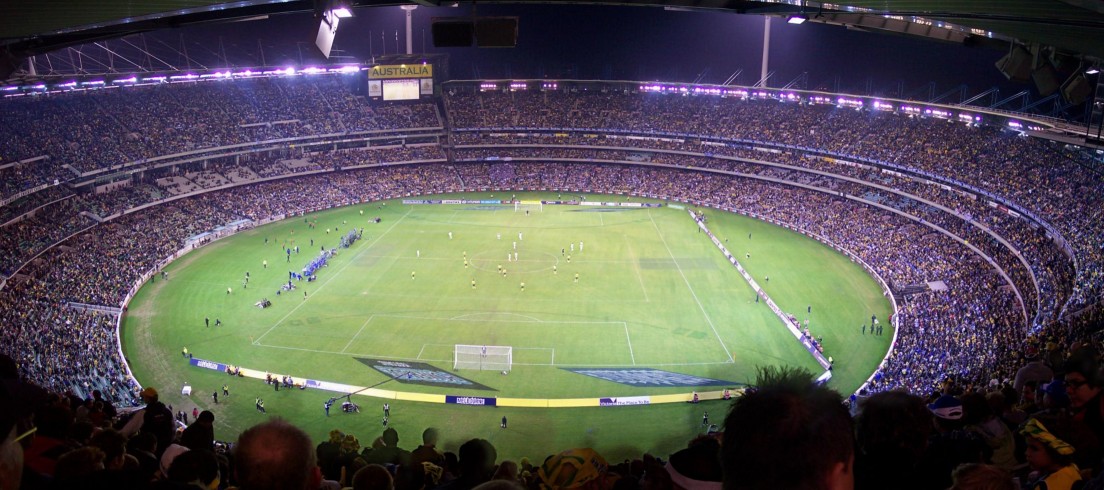
The agreement sees an annual fixture at the MCG, beginning with a clash between Australia and European champions Greece on 25 May 2006 in front of a sell-out crowd of 95,103, before Australia left to contest in the World Cup finals. Australia beat Greece 1–0. The Socceroos also hosted a match in 2007 against Argentina, losing 1–0, as well as 2010 FIFA World Cup qualification matches in 2009 against Japan, which attracted 81,872 fans as Australia beat Japan 2–1 via 2 Tim Cahill headers after falling behind 1–0 late in the 1st half. In 2010 it was announced that as a warm up to the 2010 FIFA World Cup which the Australians had qualified for, they would play fellow qualified nation New Zealand on 24 May at the MCG.
Other matches played at the MCG include the following:
- The Olympic final played between USSR and Yugoslavia on 8 December 1956
- An exhibition match between Australia and Juventus played on 13 June 1984
- A 1998 FIFA World Cup qualifier between Australia and Iran on Saturday 29 November 1997 with 95,000 in attendance. The match was drawn 2–2, with Iran progressing on the away goals rule.
- An exhibition match between Manchester United and Australia on 15 July 1999 with 60,000 people in attendance.
- A friendly match between Brazil B and Australia on 17 November 1999 with 70,795 in attendance.
- An Olympic Tournament group match between Italy and the Olyroos on 13 September 2000 with 93,252 in attendance. Plus other preliminary matches during the Olympics which also included quarter final and the Semi final between Chile and Cameroon who went on to win the gold medal.
- A 2002 FIFA World Cup qualifier between the Australia and Uruguay on 20 November 2001 with 84,656 in attendance. The Socceroos won 1–0, however Uruguay progressed after later winning the second leg 3–0.
- A friendly match between Australia and the then European champions, Greece – which was played as a warmup to the 2006 FIFA World Cup.
- A friendly match between Australia and Argentina with 70,171 in attendance – Argentina had a full strength side with superstars such as Lionel Messi and Carlos Tevez
- A friendly match between Australia and the All Whites as a warm up before the 2010 FIFA World Cup in which Australia won in the last play of the game.
- A pre-season friendly in July 2013 between A-League outfit Melbourne Victory and Premier League side Liverpool, as part of Liverpool's pre-season tour of Australia and South East Asia drawing a crowd of 95,446.
- The final match of the 2015 International Champions Cup in Australia, between Real Madrid and Manchester City, which drew a soccer MCG record crowd of 99,382
- Brasil Global Tour matches between Argentina and Brazil, and Australia and Brazil in June 2017.
- A friendly between Melbourne Victory and Manchester United on July 15, 2022.
- A friendly between Newcastle United F.C. and Tottenham Hotspur F.C. on May 22, 2024, as part of Global Football Week Melbourne. It was the first time two English teams played each other at the ground.
- Some of the 2032 Olympics games, including the quarter-final, are planned to be held at the venue.
Concerts
The MCG is a popular venue for concert acts, with the first rock concert to be held at the ground was one by David Cassidy in 1974, In 1978 David Bowie held a concert there. In 1993, Paul McCartney, U2 and Madonna held three concerts, with the highest attendances for a music concert at MCG, with 147,241 tickets sold. The Rolling Stones held concerts in 1995, Michael Jackson in 1996, the Three Tenors in 1997, Elton John and Billy Joel in 1998.
The MCG hosted the Police with special guests Fergie and Fiction Plane on Australia Day 2008, the first MCG concert in 10 years.
The MCG hosted Sound Relief, a concert donating all revenues to the Red Cross Victorian Bushfire Appeal with performances from Kings of Leon, Midnight Oil, Split Enz, Paul Kelly, Hunters & Collectors, Wolfmother, Jet and Bliss N Eso, among others. It was held on 14 March 2009 with 80,518 in attendance.
The MCG held a Guns N' Roses concert on 14 February 2017 with 73,756 in attendance.
The MCG held a free The Killers concert on 30 September 2017, after the 2017 AFL Grand Final.
On 3 December 2022, the MCG held a Guns N' Roses concert as part of the Guns N' Roses 2020 Tour.
On 10 December 2022, the MCG held a Billy Joel concert as part of the Billy Joel in Concert tour.
The MCG held an Eminem concert on 24 February 2019 with 80,708 tickets sold, at the time the highest attendance for a single concert at the MCG. The concert also marked the highest attended show of Eminem's career.
The MCG hosted two Ed Sheeran concerts on 2 and 3 March 2023 as part of the +–=÷x Tour. Playing in-the-round, the attendance on 2 March was 108,000, Sheeran's biggest concert and 3 March was 109,500, exceeding the previous concert attendance record set by Eminem.
The MCG hosted three Taylor Swift concerts on 16, 17, and 18 February 2024 as part of The Eras Tour. The three concerts were attended by 96,000 people each night, drawing a collective audience of 288,000. The shows broke the MCG's record for the most tickets sold by one artist at the venue, according to the promoter Frontier Touring.
On 23 June 2025, AC/DC announced the Australian Dates of the PWR/UP Tour, which included a concert at the MCG on 12 November 2025, with special guests Amyl and the Sniffers. On 26 June 2025, a second concert was announced for 16 November 2025.
Other uses
Tennis
In 1878 the Melbourne Cricket Club's Lawn Tennis Committee laid an asphalt court at the MCG and Victoria's first game of tennis was played there. A second court of grass was laid in 1879 and the first Victorian Championship played on it in 1880. The first inter-colonial championship was played in 1883 and the first formal inter-state match between NSW and Victoria played in 1884 with Victoria winning.
In 1889 the MCC arranged for tennis to be played at the Warehousemen's Cricket Ground (now known as the Albert Cricket Ground), at Albert Park, rather than at the MCG.
Cycling
It was at the MCG in 1869 that one of Australia's first bicycle races was held. The event was for velocipedes, crude wooden machines with pedals on the front wheels. In 1898 the Austral Wheel Race was held at the MCG attracting a crowd of 30,000 to see cyclists race for a total of £400 in prize money, with 1st, 2nd, and 3rd place winning £240, £120, and £40 respectively.
Miscellaneous
- Queen Elizabeth II visited the MCG in 1954 twice for an assembly and display. She attended a Richmond versus Fitzroy match on 5 April 1970, and also attended the Commonwealth Games Opening Ceremony at the ground on 15 March 2006.
- A record for attendance at the grounds was set by religious leader Billy Graham whose event in 1959 was attended by at least 143,000 people.
- Pope John Paul II held a service at the MCG on 27 November 1986, and a celebration there of the Polish community the next day
- On 5 November 2010, the MCG hosted the Starting Line and opening challenge, where a team member abseiled down one of the light towers, for The Amazing Race Australia 1. This episode aired on 16 May 2011.
- On 6 October 2018, the MCG hosted WWE Super Show-Down.
- On 30 March 2022, the MCG hosted the state memorial service for Shane Warne.
- On 14 October 2025, the MCG hosted a challenge for The Amazing Race US 39 where just like The Amazing Race Australia 1, teams abseiled down one of the light towers.
General records
Sporting records
- First ever Test Cricket match (Australia v England) – 1877
- First ever One day international Cricket match – 1971
- Highest first class cricket score – 1107 (Victoria v NSW, 1926)
- Australia's first international Lacrosse match (Australia v Canada, 1907, 30,000)
- Fastest ball bowled in a Cricket match in Australia, 3rd fastest in the world – 160.7 km/h (Shaun Tait, Australia v Pakistan, 5 February 2010)
Attendance records
| Number | Attendance | Event | Date |
|---|---|---|---|
| 1 | 143,000 | Billy Graham, Crusade | 15 March 1959 |
| 2 | 121,696 | VFL Grand Final, v | 26 September 1970 |
| 3 | 120,000 | 40th Eucharistic Congress | 25 February 1973 |
| 4 | 119,195 | VFL Grand Final, v | 27 September 1969 |
| 5 | 118,192 | VFL Grand Final, v | 25 September 1971 |
- Highest Australian religious event attendance – 143,750 (Billy Graham crusade, 1959)
- Highest VFL/AFL attendance at a home-and-away match – 99,256 (Melbourne v Collingwood, 1958).
- Highest VFL/AFL attendance at a final and highest Australian sporting event attendance – 121,696 (Collingwood v Carlton, 1970)
- Highest soccer crowd at MCG (Clubs International Friendly) – 99,382 (International Champions Cup, Manchester City v Real Madrid, 24 July 2015)
- Highest soccer crowd at MCG (National Team vs National Team) – 97,103 (Australia v Greece, 2006)
- Highest attendance in a single Test Cricket match across all five days – 373,691 (2024 Boxing Day Test, Australia v India)
- Highest single-day attendance in Test Cricket history – 94,199 (2025 Boxing Day Test, Day 1 – Australia v England)
- Highest One Day International Cricket crowd – 93,013 (2015 Cricket World Cup Final, Australia v New Zealand)
- Highest Twenty20 International Cricket crowd – 90,293 (2022 ICC Men's T20 World Cup, Super 12 round – India v Pakistan, 23 October 2022)
- Highest Twenty20 Domestic Cricket crowd – 80,883 (Melbourne Stars v Melbourne Renegades, 2015–16 Big Bash League season)
- Highest women's cricket crowd - 86,174 (2020 ICC Women's T20 World Cup Final, Australia Women v India Women)
- Highest State of Origin rugby league crowd – 91,513 (Game II, 17 June 2015)
- Highest rugby union crowd, and highest attendance in British & Irish Lions history – 90,307 (2025 British & Irish Lions tour to Australia, 26 July 2025)
Stadium records
- World's first all colour cricket scoreboard with instant replays
- World's first electronic sight screens
- World's first super sopper
- World's first scrolling signage at an oval-shaped ground
- First time an international Cricket match was played on a one-piece portable pitch, Boxing Day Test, 2000
- World's tallest floodlights
Test cricket records


.jpg)
Batting
| Runs | Player | Period |
|---|---|---|
| 1,671 (17 innings) | AUS Don Bradman | 1928–1948 |
| 1,338 (28 innings) | AUS Ricky Ponting | 1995–2011 |
| 1,284 (30 innings) | AUS Steve Waugh | 1985–2003 |
| 1,279 (22 innings) | AUS Steve Smith | 2010–2025 |
| 1,272 (36 innings) | AUS Allan Border | 1978–1993 |
| Runs | Player | Period |
|---|---|---|
| 1,178 (18 innings) | ENG Jack Hobbs | 1908–1929 |
| 724 (7 innings) | ENG Herbert Sutcliffe | 1925–1933 |
| 661 (15 innings) | ENG Colin Cowdrey | 1954–1975 |
| 606 (11 innings) | WIN Viv Richards | 1975–1988 |
| 505 (12 innings) | ENG Wally Hammond | 1928–1947 |
| Runs | Player | Date |
|---|---|---|
| 307 v. England | AUS Bob Cowper | 11 Feb 1966 |
| 270 v. England | AUS Don Bradman | 1 Jan 1937 |
| 268 v. Pakistan | AUS Graham Yallop | 26 Dec 1983 |
| 257 v. India | AUS Ricky Ponting | 26 Dec 2003 |
| 250 v. England | AUS Justin Langer | 26 Dec 2002 |
| Centuries | Player | Period |
|---|---|---|
| 9 (17 innings) | AUS Don Bradman | 1928–1948 |
| 6 (19 innings) | AUS Matthew Hayden | 1996–2008 |
| 5 (18 innings) | ENG Jack Hobbs | 1908–1929 |
| 5 (19 innings) | AUS Steve Smith | 2010–2024 |
| 4 (7 innings) | ENG Herbert Sutcliffe | 1925–1933 |
| 4 (13 innings) | AUS Bill Lawry | 1962–1971 |
| 4 (28 innings) | AUS Ricky Ponting | 1995–2011 |
| 4 (31 innings) | AUS Greg Chappell | 1971–1983 |
| 4 (36 innings) | AUS Allan Border | 1978–1993 |
| Average | Player | Period |
|---|---|---|
| 128.53 (17 innings, 4 NO) | AUS Don Bradman | 1928–1948 |
| 103.42 (7 innings, 0 NO) | ENG Herbert Sutcliffe | 1925–1933 |
| 101.20 (5 innings, 0 NO) | AUS Bob Cowper | 1964–1968 |
| 87.00 (6 innings, 1 NO) | ENG Alastair Cook | 2006–2017 |
| 83.20 (7 innings, 2 NO) | AUS Jack Gregory | 1920–1925 |
Bowling
| Wickets | Player | Period |
|---|---|---|
| 82 (26 innings) | AUS Dennis Lillee | 1972–1983 |
| 56 (21 innings) | AUS Shane Warne | 1992–2006 |
| 50 (26 innings) | AUS Nathan Lyon | 2011–2025 |
| 46 (13 innings) | AUS Hugh Trumble | 1894–1904 |
| 45 (14 innings) | AUS Graham McKenzie | 1962–1968 |

| Wickets | Player | Period |
|---|---|---|
| 35 (10 innings) | ENG Sydney Barnes | 1902–1912 |
| 27 (8 innings) | ENG Bobby Peel | 1885–1895 |
| 24 (6 innings) | IND Jasprit Bumrah | 2018–2024 |
| 22 (8 innings) | ENG Billy Bates | 1881–1885 |
| 22 (8 innings) | ENG Alec Bedser | 1947–1951 |
| 22 (8 innings) | PAK Sarfraz Nawaz | 1972–1983 |
| Figures | Player | Date |
|---|---|---|
| 9/86 v. Australia | PAK Sarfraz Nawaz | 10 Mar 1979 |
| 9/121 v. England | AUS Arthur Mailey | 11 Feb 1921 |
| 8/68 v. Australia | ENG Wilfred Rhodes | 1 Jan 1904 |
| 8/71 v. West Indies | AUS Graham McKenzie | 26 Dec 1968 |
| 8/81 v. Australia | ENG Len Braund | 5 Mar 1904 |
| 8/143 v. England | AUS Max Walker | 8 Feb 1975 |
| Figures | Player | Date |
|---|---|---|
| 15/124 v. Australia | ENG Wilfred Rhodes | 1 Jan 1904 |
| 14/102 v. Australia | ENG Billy Bates | 19 Jan 1883 |
| 13/77 v. England | AUS Monty Noble | 1 Jan 1902 |
| 13/110 v. England | AUS Fred Spofforth | 2 Jan 1879 |
| 13/148 v. England | AUS Bruce Reid | 26 Dec 1990 |
| 13/163 v. Australia | ENG Sydney Barnes | 1 Jan 1902 |
| 13/165 v. Australia | RSA Hugh Tayfield | 24 Dec 1952 |
| 13/236 v. England | AUS Arthur Mailey | 11 Feb 1921 |
| Strike rate | Player | Period |
|---|---|---|
| 22.6 (6 wickets) | AUS John Hodges | 1877–1877 |
| 29.4 (7 wickets) | AUS Cameron Green | 2020–2025 |
| 30.5 (21 wickets) | AUS Scott Boland | 2021–2025 |
| 31.1 (10 wickets) | AUS Laurie Nash | 1932–1937 |
| 32.6 (35 wickets) | AUS Bruce Reid | 1985–1991 |
.jpg)
Team records
| Score | Team | Date |
|---|---|---|
| 8/624d | AUS Australia v. Pakistan | 26 Dec 2016 |
| 604 | AUS Australia v. England | 26 Feb 1937 |
| 600 | AUS Australia v. England | 1 Jan 1925 |
| 589 | ENG England v. Australia | 9 Feb 1912 |
| 578 | AUS Australia v. South Africa | 17 Feb 1911 |
| Score | Team | Date |
|---|---|---|
| 36 | RSA South Africa v. Australia | 12 Feb 1932 |
| 45 | RSA South Africa v. Australia | 12 Feb 1932 |
| 61 | ENG England v. Australia | 1 Jan 1902 |
| 61 | ENG England v. Australia | 5 Mar 1904 |
| 67 | IND India v. Australia | 6 Feb 1948 |
Partnership records
| Runs | Wicket | Players | Match | Date |
|---|---|---|---|---|
| 346 | 6th | Don Bradman (270) & Jack Fingleton (136) | AUS Australia v. ENG England | 1 Jan 1937 |
| 323 | 1st | Wilfred Rhodes (179) & Jack Hobbs (178) | ENG England v. AUS Australia | 9 Feb 1912 |
| 298 | 2nd | Bill Lawry (205) & Ian Chappell (165) | AUS Australia v. WIN West Indies | 26 Dec 1968 |
| 283 | 1st | Herbert Sutcliffe (176) & Jack Hobbs (154) | ENG England v. AUS Australia | 1 Jan 1925 |
| 279 | 6th | Andrew Symonds (156) & Matthew Hayden (153) | AUS Australia v. ENG England | 26 Dec 2006 |
| Runs | Wicket | Players | Match | Date |
|---|---|---|---|---|
| 323 | 1st | Wilfred Rhodes (179) & Jack Hobbs (178) | ENG England v. AUS Australia | 9 Feb 1912 |
| 298 | 2nd | Bill Lawry (205) & Ian Chappell (165) | AUS Australia v. WIN West Indies | 26 Dec 1968 |
| 249 | 3rd | Don Bradman (169) & Stan McCabe (112) | AUS Australia v. ENG England | 26 Feb 1937 |
| 262 | 4th | Virat Kohli (169) & Ajinkya Rahane (147) | IND India v. AUS Australia | 26 Dec 2014 |
| 223* | 5th | Don Bradman (127) & Arthur Morris (100) | AUS Australia v. IND India | 1 Jan 1948 |
| 346 | 6th | Don Bradman (270) & Jack Fingleton (136) | AUS Australia v. ENG England | 1 Jan 1937 |
| 185 | 7th | Graham Yallop (268) & Greg Matthews (75) | AUS Australia v. PAK Pakistan | 26 Dec 1983 |
| 173 | 8th | Nip Pellew (116) & Jack Gregory (100) | AUS Australia v. ENG England | 31 Dec 1920 |
| 180 | 9th | JP Duminy (166) & Dale Steyn (76) | RSA South Africa v. AUS Australia | 26 Dec 2008 |
| 120 | 10th | Reggie Duff (104) & Warwick Armstrong (45*) | AUS Australia v. ENG England | 1 Jan 1902 |
All records correct as of 11 January 2026.
ODI records
- Highest ODI Total: 5/355 – Australia vs. England, 22 November 2022
- Highest Individual ODI Score: 180 (151) – Jason Roy, England vs Australia, 14 January 2018
- Best ODI Innings Bowling Figures: 6/42 – Ajit Agarkar, India vs. Australia, 9 January 2004 and Yuzvendra Chahal, India vs. Australia, 18 January 2019
- Highest ODI Partnership: 269 (for the first wicket) – Travis Head & David Warner, Australia vs. England, 22 November 2022 Last updated 26 May 2025.
Twenty20 International records
- Highest Twenty20 Total: 5/186 – India vs. Zimbabwe, 6 November 2022
- Highest Individual Twenty20 Score: 89 (43) – David Warner, Australia vs. South Africa, 11 January 2009
- Best Twenty20 Innings Bowling Figures: 4/30 – Josh Hazlewood, Australia vs. England, 31 January 2014
- Highest Twenty20 Partnership: 113 (for the fifth wicket) – Virat Kohli & Hardik Pandya, India vs. Pakistan, 23 October 2022 Last updated 26 May 2025.
VFL/AFL records
- Highest Team Score:
- 32.24 (216) – vs. , 1 August 1992
- 31.25 (211) – vs. , 13 April 1985
- 32.19 (211) – vs. , 27 May 1989
- 32.17 (209) – vs. , 6 April 1990
- 31.19 (205) – vs. , 30 April 1988
- Largest Winning Margin:
- 165 pts – (197) def. (32), 13 August 2011
- 162 pts – (193) def. (31), 8 July 2012
- 160 pts – (216) def. (56), 1 August 1992
- 151 pts – (187) def. (36), 25 August 1996
- 148 pts – (184) def. (36), 6 April 2013
- Lowest Team Score:
- 0.8 (8) – vs. , 13 July 1912
- 1.2 (8) – vs. , 8 June 1903
- 0.9 (9) – vs. , 13 May 1911
- 0.9 (9) – vs. , 19 August 1911
- 1.6 (12) – vs. , 27 June 1908
- Most Goals in a Game:
- 14 – Gary Ablett Sr., vs. , 1 May 1993
- 14 – Gary Ablett Sr., vs. , 27 May 1989
- 14 – John Longmire, vs. , 7 July 1990
- 13 – Matthew Lloyd, vs. , 10 April 1999
- 12 – Jason Dunstall, vs. , 15 August 1992
- Most Disposals in a Game:
- 54 – Tom Mitchell, vs. , 24 March 2018
- 53 – Gary Ablett, Jr., vs. , 3 June 2012
- 51 – Lachie Neale, vs. , 25 August 2019
- 50 – Tom Mitchell, vs. , 20 May 2017
- 49 – Dane Swan, vs. , 21 July 2012
- Most Games Played:
- 243 – Scott Pendlebury ()
- 200 – Kevin Bartlett ()
- 199 – Steele Sidebottom ()
- 186 – Dustin Fletcher ()
- 176 – Shane Edwards ()
- Most Goals Kicked:
- 464 – Matthew Richardson ()
- 461 – Matthew Lloyd ()
- 408 – Jack Riewoldt ()
- 386 – David Neitz ()
- 380 – Wayne Carey (, ) All records correct as of 16 April 2024.
Statues
Founding statue

| Statue | Sport | Unveiled | Location | Link |
|---|---|---|---|---|
| Tom Wills | ||||
| Commemorative sculpture for the first game of Australian rules football | *Cricket and | |||
| Australian rules football* | 2001 | Outside MCG (between Gates 2 and 3) | Non-MCG |
File:Ron barassi statue.jpg|Ron Barassi File:Leigh matthews statue.jpg|Leigh Matthews File:Dick reynolds statue.jpg|Dick Reynolds File:Bradmanstatue.jpg|Don Bradman File:DennisLilleeStatue.JPG|Dennis Lillee
Tattersall's Parade of Champions
The Tattersall's Parade of the Champions undertaking is a gift to the people of Australia by Tattersall's and is a focal point of the Yarra Park precinct.
The MCG is a magnet for tourists worldwide and the statues reinforce the association between the elite sportsmen and women who have competed here and the stadium that rejoiced in their performances.
| Statue | Sport | Unveiled | Location | Link |
|---|---|---|---|---|
| Sir Donald Bradman | Cricket | 2003, May | Outside gate 5 | MCG |
| Betty Cuthbert | Track and field | 2003, August | Outside gate 3 | MCG |
| Ron Barassi | Australian rules football | 2003, September | Outside gate 4 | MCG |
| Keith Miller | Cricket | 2004, February | Outside gate 5 | MCG |
| Dick Reynolds | Australian rules football | 2004, June | Outside gate 6 | MCG |
| Shirley Strickland | Track and field | 2004, November | Outside gate 3 | MCG |
| Haydn Bunton, Sr. | Australian rules football | 2005, April | Outside gate 6 | MCG |
| Leigh Matthews | Australian rules football | 2005, August | Outside gate 4 | MCG |
| Bill Ponsford | Cricket | 2005, December | Outside gate 1 | MCG |
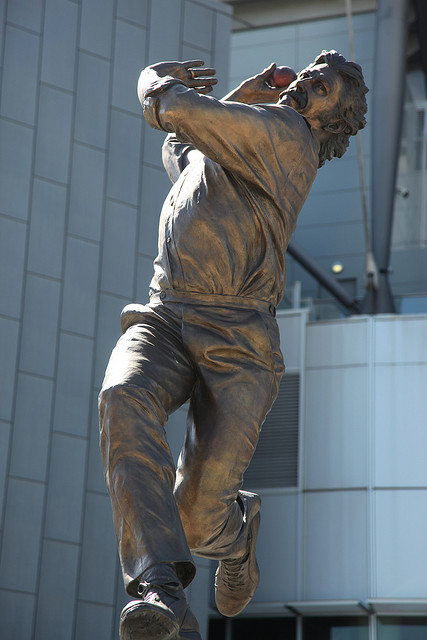
| Dennis Lillee | Cricket | 2006, December | Outside gate 1 | MCG |
Australia Post Avenue of Legends

In 2010, the Melbourne Cricket Club (MCC) announced an expansion to the list of sporting statues placed around the MCG precinct in partnership with Australia Post.
The Australia Post Avenue of Legends project aimed to place a minimum of five statues in Yarra Park, extending from the gate 2 MCC members entrance up the avenue towards Wellington Parade. The most recent addition of Kevin Bartlett was unveiled in March 2017.
| Statue | Sport | Unveiled | Location | Link |
|---|---|---|---|---|
| Shane Warne | Cricket | 2011, December | Outside gate 2 | MCG |
| Norm Smith | Australian rules football | 2012, September | Near Jolimont Station | MCG |
| John Coleman | Australian rules football | 2013, September | Outside gate 2 | MCG |
| Neil Harvey | Cricket | 2014, January | Near Jolimont Station | MCG |
| Jim Stynes | Australian rules football | 2014, September | Outside gate 2 | MCG |
| Kevin Bartlett | Australian rules football | 2017, March | Near Jolimont Station | MCG |
References
References
- (6 February 2021). "Biggest Stadiums in The World By Capacity".
- "Ticket Information".
- "Ed Sheeran Breaks Multiple Australian Records with MCG Concerts".
- "Melbourne Cricket Ground".
- Atkinson, Cody. (15 June 2022). "From the SCG to Kardinia Park — do ground sizes contribute to the end result in AFL games?". Australian Broadcasting Corporation.
- "MCG". Australian Football League.
- "Melbourne Cricket Ground".
- "MCG Reserved Seating Map - Richmond".
- "Melbourne Cricket Ground". [[Government of Victoria]].
- Chappell, Ian. (26 December 2010). "Heroes wanted: Apply at the 'G". [[Herald Sun]].
- Mann, Chris. (24 November 2009). "The 10 largest football stadiums in the world". Sports Lens.
- "Melbourne Cricket Ground".
- {{cite VHD. 1538. Melbourne Cricket Ground
- "Department of the Environment and Energy".
- [[Greg Baum. Baum, Greg]] (24 September 2003). [http://www.theage.com.au/articles/2003/09/23/1064082993440.html "MCG voted as one of the seven wonders of the sporting world"] {{Webarchive. link. (1 November 2016 , ''[[Sydney Morning Herald]]''. Retrieved 10 January 2016.)
- "Places for Decision". Australian Heritage Database.
- "Melbourne Cricket Ground {{!}} Australia {{!}} Cricket Grounds {{!}} ESPNcricinfo.com".
- Mid-on. (30 June 1906). "Melbourne Cricket Ground – the Trustees and the Club". The Leader.
- "Melbourne Cricket Ground".
- "MCG Historical Timeline".
- Levison, Brian. (2016). "Remarkable Cricket Grounds". Pavilion Books.
- Melbourne Cricket Ground Trust. (2020). "Melbourne Cricket Ground Trust Annual Report 2019/20".
- (27 September 1938). "New stands may be needed for Melbourne Cricket Ground". The Argus.
- (18 September 1956). "Only 102,000 will get in for Games". The Argus.
- "Grandstands".
- (28 May 2016). "History of the MCG - Peter Gee (ABC) 1987".
- (2018). "Up for the Challenge: The John Holland Story 1986 - 2016". [[John Holland Group.
- [https://www.afr.com/companies/sport/mcg-stand-to-be-renamed-in-honour-of-shane-warne-20220305-p5a21e MCG stand to be named in honour of Shane Warne] {{Webarchive. link. (5 March 2022 ''[[Australian Financial Review]]'' 5 March 2022)
- Products, Ancon Building. "Projects".
- [http://www.heraldsun.com.au/news/victoria/john-brumby-announces-55m-facelift-for-mcgs-great-southern-stand/story-e6frf7kx-1225923753438 John Brumby announces $55m facelift for MCG's Great Southern Stand] {{Webarchive. link. (15 June 2011 ''Herald Sun'' 15 September 2010)
- "Melbourne Cricket Ground - Largest scoreboards at an Australian stadium unveiled at MCG".
- "Shining Light: MCG Light Towers Set For LED Upgrade".
- "Victoria vs. New South Wales, 1855–56". [[ESPN Inc.]].
- "Records / Melbourne Cricket Ground / Test matches / Match results". ESPN Cricinfo.
- Gideon Haigh. (26 December 2014). "How an overcrowded calendar delivered a Boxing Day Test classic". The Australasian.
- [http://www.melbournestars.com.au/club/our-home-ground OUR HOME GROUND] {{Webarchive. link. (25 January 2016 melbournestars.com.au. Retrieved on 9 January 2016)
- Donald S. McIntyre. (1985). "Problems of the Melbourne Test cricket pitch and their relevance to Australian turf pitches". Journal of the Sports Turf Research Institute.
- "Melbourne Cricket Ground". Cricbuzz.
- [https://www.cricket.com.au/news/mcg-pitch-rating-icc-poor-melbourne-cricket-australia-ashes-test-stripped-boxing-day-fine-warning/2018-01-02 MCG on notice after ICC rates pitch 'poor'] {{Webarchive. link. (4 January 2018 , By Andrew Ramsey, 2 January 2018, cricket.com.au)
- Jon Pierik. (23 December 2020). "'Significant change': MCG pitch to be upgraded". [[The Age]].
- Team, CricOpinion. (2025-03-11). "MCG Night Test: 150 Years of Australia vs England Rivalry".
- "Washout". ESPN Cricinfo.
- List of ODI matches. [http://aus.cricinfo.com/db/STATS/ODIS/MISC/COMPLETE_LIST.html Cricinfo.com] {{Webarchive. link. (7 June 2007)
- (28 March 2018). "Underarm bowling incident: What Trevor Chappell did in 1981".
- (26 December 2020). "'Drastic final step' that sparked cricket chaos".
- (29 March 2015). "ICC Cricket World Cup Final 2015 – the Grand Finale!". ICC.
- (14 August 1879). "Football by electric light". The Argus.
- Peter Pindar. (16 August 1879). "Football Gossip". The Australasian.
- Ashley Browne. (7 July 1994). "$500,000 facelift for Junction Oval". The Age.
- (2 September 2020). "This is a win for Queensland: AFL reveals how QLD won race for historic Grand Final as key fixture details confirmed".
- "Melbourne to host first-ever NFL regular season game in Australia in 2026; Rams designated team".
- "Melbourne Cricket Ground – US Marines at the MCG".
- [http://www.la84foundation.org/6oic/OfficialReports/1956/OR1956.pdf 1956 Summer Olympics official report.] {{webarchive. link. (12 September 2008 p. 40.)
- [http://www.la84foundation.org/6oic/OfficialReports/2000/2000v1.pdf 2000 Summer Olympics official report.] {{webarchive. link. (9 November 2000 Volume 1. p. 393.)
- The Argus (Melbourne) 1 July 1878
- Batchelder, Alf. (2002). "The First Football Matches on the Melbourne Cricket Ground". The Melbourne Cricket Club Library.
- The Argus (Melbourne) 30 June 1881
- The Age, (Melbourne) 21 August 1899
- The Referee, (Sydney) 19 August 1908
- The Herald, (Melbourne) 12 July 1912
- Sydney Morning Herald, 20 June 1921
- "Past Results".
- The Argus (Melbourne) 23 May 1948
- The Argus (Melbourne) 31 July 1950
- The Argus (Melbourne) 2 July 1951
- ESPNScrum; [http://www.espnscrum.com/] {{Webarchive. link. (31 March 2015 Match and Tournament Archives 1997, 1998 and 2007)
- (29 Jul 2023). "All Blacks Retain TRC title with master class in Melbourne".
- "Preview: Lions won't be bowled over by history at the MCG".
- "Australia 26-29 British and Irish Lions - 2nd Test match report".
- "Melbourne Cricket Ground". Shawn Dollin, Andrew Ferguson and Bill Bates.
- Smart, Nick. (2 June 2014). "State of Origin: Rugby league showpiece to return to Melbourne's MCG for game two in 2015".
- Tristan Rayner. (17 June 2015). "MCG sets record Origin crowd of 91,513". The Roar.
- "State Of Origin 2018 Series Game 1".
- "State of Origin fixtures & draw 2024".
- (29 June 2006). "Melbourne football club sees surge in popularity". [[Australian Broadcasting Corporation]].
- Harper, Tony. (2017-11-29). "David Hill reflects on the disastrous night the Socceroos missed out on 1998 World Cup".
- "Steven Gerrard delights the MCG crowd as Liverpool beats Melbourne Victory 2-0".
- (13 July 2021). "Brisbane 2032 Master Plan - Aerial Flythrough". YouTube.
- . (21 July 2021). ["Brisbane 2032 Olympic venues announced"](https://www.austadiums.com/news/921/brisbane-2032-olympic-games-venues-revealed). *AusStadiums*.
- "IOC Future Host Commission Questionnaire Response - Final Submission - May 2021".
- "MCG Attendance Records".
- "Concerts".
- "Ed Sheeran concerts = new record for MCG".
- (2023-06-28). "Taylor Swift adds two 'final' shows to Australian tour after 'historically unprecedented demand'". ABC News.
- Gariano, Francesca. (19 February 2024). "Taylor Swift honors Melbourne crowd after celebrating major 'Eras Tour' milestone". [[Today (American TV program).
- "Melbourne, what do I even say to you after over 288,000 of you came and danced with us in the last 3 nights ??! That was unforgettable. You were on another LEVEL. Thank you for the memories. I'll revisit the ones from this weekend often 🥲🫶". Taylor Swift.
- (13 February 2024). "Taylor Swift {{!}} The Eras Tour new Melbourne + Sydney tickets on sale today".
- (1898-12-14). "The Austral Wheel Race". [[The Referee (newspaper).
- "Memorable Moments". Melbourne Cricket Ground.
- Sherwood Eliot Wirt. (1997). "A Personal Look at Billy Graham, the World's Best-loved Evangelist". Crossway Books.
- (5 November 2010). "Amazing Race Australia filming in Melbourne". The Spy Report.
- "The Age, Monday 16 March 1959, "Crusade Rally At M.C.G. Draws Huge Crowd"".
- See [[1958 VFL season. 1958 VFL Season: Notable Events]]
- (28 September 1970). "Incredible Win by Carlton in VFL". [[Canberra Times]].
- "MCG attendance records". mcg.org.au.
- (16 December 2014). "Top 10 ICC World Cup Cricket Venues in the World".
- "Batting records {{!}} Test matches {{!}} Cricinfo Statsguru {{!}} ESPNcricinfo.com".
- "Batting records {{!}} Test matches {{!}} Cricinfo Statsguru {{!}} ESPNcricinfo.com".
- "Batting records {{!}} Test matches {{!}} Cricinfo Statsguru {{!}} ESPNcricinfo.com".
- "Batting records {{!}} Test matches {{!}} Cricinfo Statsguru {{!}} ESPNcricinfo.com".
- "Batting records {{!}} Test matches {{!}} Cricinfo Statsguru {{!}} ESPNcricinfo.com".
- "Bowling records {{!}} Test matches {{!}} Cricinfo Statsguru {{!}} ESPNcricinfo.com".
- "Bowling records {{!}} Test matches {{!}} Cricinfo Statsguru {{!}} ESPNcricinfo.com".
- "Bowling records {{!}} Test matches {{!}} Cricinfo Statsguru {{!}} ESPNcricinfo.com".
- "Bowling records {{!}} Test matches {{!}} Cricinfo Statsguru {{!}} ESPNcricinfo.com".
- "Bowling records {{!}} Test matches {{!}} Cricinfo Statsguru {{!}} ESPNcricinfo.com".
- "Team records {{!}} Test matches {{!}} Cricinfo Statsguru {{!}} ESPNcricinfo.com".
- "Melbourne Cricket Ground Cricket Team Records & Stats {{!}} ESPNcricinfo.com".
- "Partnership records {{!}} Test matches {{!}} Cricinfo Statsguru {{!}} ESPNcricinfo.com".
- "Partnership records {{!}} Test matches {{!}} Cricinfo Statsguru {{!}} ESPNcricinfo.com".
- "Partnership records {{!}} Test matches {{!}} Cricinfo Statsguru {{!}} ESPNcricinfo.com".
- "Partnership records {{!}} Test matches {{!}} Cricinfo Statsguru {{!}} ESPNcricinfo.com".
- "Partnership records {{!}} Test matches {{!}} Cricinfo Statsguru {{!}} ESPNcricinfo.com".
- "Partnership records {{!}} Test matches {{!}} Cricinfo Statsguru {{!}} ESPNcricinfo.com".
- "Partnership records {{!}} Test matches {{!}} Cricinfo Statsguru {{!}} ESPNcricinfo.com".
- "Partnership records {{!}} Test matches {{!}} Cricinfo Statsguru {{!}} ESPNcricinfo.com".
- "Partnership records {{!}} Test matches {{!}} Cricinfo Statsguru {{!}} ESPNcricinfo.com".
- "Partnership records {{!}} Test matches {{!}} Cricinfo Statsguru {{!}} ESPNcricinfo.com".
- "Partnership records {{!}} Test matches {{!}} Cricinfo Statsguru {{!}} ESPNcricinfo.com".
- "Team records {{!}} One-Day Internationals {{!}} Cricinfo Statsguru {{!}} ESPNcricinfo.com".
- "Batting records {{!}} One-Day Internationals {{!}} Cricinfo Statsguru {{!}} ESPNcricinfo.com".
- "Bowling records {{!}} One-Day Internationals {{!}} Cricinfo Statsguru {{!}} ESPNcricinfo.com".
- "Partnership records {{!}} One-Day Internationals {{!}} Cricinfo Statsguru {{!}} ESPNcricinfo.com".
- "Team records {{!}} Twenty20 Internationals {{!}} Cricinfo Statsguru {{!}} ESPNcricinfo.com".
- "Batting records {{!}} Twenty20 Internationals {{!}} Cricinfo Statsguru {{!}} ESPNcricinfo.com".
- "Bowling records {{!}} Twenty20 Internationals {{!}} Cricinfo Statsguru {{!}} ESPNcricinfo.com".
- "Partnership records {{!}} Twenty20 Internationals {{!}} Cricinfo Statsguru {{!}} ESPNcricinfo.com".
- "AFL Tables - M.C.G".
This article was imported from Wikipedia and is available under the Creative Commons Attribution-ShareAlike 4.0 License. Content has been adapted to SurfDoc format. Original contributors can be found on the article history page.
Ask Mako anything about Melbourne Cricket Ground — get instant answers, deeper analysis, and related topics.
Research with MakoFree with your Surf account
Create a free account to save articles, ask Mako questions, and organize your research.
Sign up freeThis content may have been generated or modified by AI. CloudSurf Software LLC is not responsible for the accuracy, completeness, or reliability of AI-generated content. Always verify important information from primary sources.
Report