From Surf Wiki (app.surf) — the open knowledge base
Mehboob Khan
Film director

Film director
| Field | Value |
|---|---|
| name | Mehboob Khan |
| image | Mehboob Khan in early 1940s.jpg |
| caption | Mehboob Khan in the early 1940s |
| birth_name | Mehboob Khan |
| birth_date | |
| birth_place | Bilimora, Baroda State, British India |
| death_date | |
| death_place | Bombay, Maharashtra, India |
| resting_place | Badakabarastan, Marine Lines, Mumbai |
| occupation | Film director, producer |
| years_active | 1931–1962 |
| spouse | Fatima (separated) |
| Sardar Akhtar | |
| children | 4; One adopted |
| honors | Padma Shri (1963) |
Sardar Akhtar
Mehboob Khan Ramzan Khan (9 September 1907 – 28 May 1964) was a prominent Indian film director and producer. He is best known for directing the social epic Mother India (1957), which won the Filmfare Awards for Best Film and Best Director, two National Film Awards, and was a nominee for the Academy Award for Best Foreign Language Film.{{cite web |access-date = 13 January 2021 |url-status = live |archive-url = https://web.archive.org/web/20150402003629/http://www.oscars.org/oscars/ceremonies/1958 |archive-date = 2 April 2015 | url-status = dead | archive-url = https://web.archive.org/web/20110718051651/http://www.punemirror.in/index.aspx?Page=article§name=News%20-%20Mumbai§id=3&contentid=20081101200811012008337798596fdb6 | archive-date = 18 July 2011 |access-date=13 January 2021 |access-date =13 January 2021 | author-link = B. K. Karanjia
Early life
Khan was born Mehboob Khan Ramzan Khan in Bilimora in Gandevi Taluka of Surat State (now Gujarat) on 9 September 1907.
Career
He was brought to Bombay from his home town in Gujarat by Noor Muhammad Ali Muhammed Shipra Baddhiyawala (producer and horse supplier in Indian cinema) to work as a horseshoe repairer in a stable (owned by Noor Muhammad Ali Muhammed Shipra Baddhiyawala). One day at the shooting of South Indian director Chandrashekhar, Mehboob showed interest in working with Chandrashekhar. After seeing his great interest and skills, Chandrashekhar asked Noor Muhammad Ali Muhammed Shipra Baddhiyawala to allow him to take Mehboob with him to work at small jobs in the film studios of Bombay. He started as an assistant director in the Silent Film era and as an extra in the studios of the Imperial Film Company of Ardeshir Irani, before directing his first film Al Hilal a.k.a. Judgement of Allah (1935), when he started directing films for the Sagar Film Company. Notable films he directed for Sagar Movietone and National Studios included Deccan Queen (1936), Ek Hi Raasta (1939), Alibaba (1940), Aurat (1940) and Bahen (1941).
In 1945, Khan set up his own production house – Mehboob Productions. In 1946, he directed the musical hit Anmol Ghadi, which featured singing stars Surendra, Noor Jehan and Suraiya in leading roles. Khan went on to produce and direct many blockbuster films, the most notable being the romantic drama Andaz (1949), the swashbuckling musical Aan (1951), the melodrama Amar (1954), and the social epic Mother India (1957). The latter was a remake of his 1940 film Aurat and was nominated for an Academy Award in 1957. His earlier works were in Urdu, but his later material, including Mother India, were in Hindustani, a friendlier and softer spoken version of Hindi and Urdu. Several of his films, especially his earlier work on Humayun (1945), the story of a Mogul emperor who ruled India, Anmol Ghadi (1946), and Taqdeer (in which he introduced Nargis, who later married Sunil Dutt), were written by Aghajani Kashmeri. Kashmeri was responsible for picking and training Nargis in Hindustani and Urdu dialogue delivery. His last film as a director was 1962's Son of India.
He died of a heart attack in 1964 at the age of 56 and was buried at Badakabarastan in Marine Lines, Mumbai. His death occurred the day after the death of Jawaharlal Nehru, the Prime Minister of India.{{cite book |access-date = 1 March 2018 |url-status = live |archive-url = https://web.archive.org/web/20180301140436/https://books.google.dk/books?id=fItIAAAAMAAJ |archive-date = 1 March 2018
Industry influence
Khan introduced and helped establish the careers of many actors and actresses who went on to become big stars in the 1940s, 1950s and 1960s such as Surendra, Arun Kumar Ahuja, Dilip Kumar, Raj Kapoor, Sunil Dutt, Rajendra Kumar, Raaj Kumar, Nargis, Nimmi and Nadira. In 1961, he was a member of the jury at the 2nd Moscow International Film Festival.{{cite web | access-date = 4 November 2012 | url-status = dead | archive-url = https://web.archive.org/web/20130116210653/http://www.moscowfilmfestival.ru/miff34/eng/archives/?year=1961 | archive-date = 16 January 2013 |access-date = 28 June 2014 |url-status = live |archive-url = https://web.archive.org/web/20140911130737/http://filmfed.org/PRE-Members.html |archive-date = 11 September 2014
Mehboob Khan was known for having been influenced by Hollywood, and his films often featured lavish sets in the style of the Hollywood at that time. The oppression of the poor, class warfare and rural life are recurring themes in his work.
Mehboob Khan was awarded the title of Hidayat Kar-e-Azam by the Indian government.
Personal life
Mehboob Khan married twice.{{cite news | access-date = 13 January 2021 | url-status = dead | archive-url = https://web.archive.org/web/20160817114707/http://www.tamashha.com/celeb/Mehboob_Khan | archive-date = 17 August 2016
Death and legacy
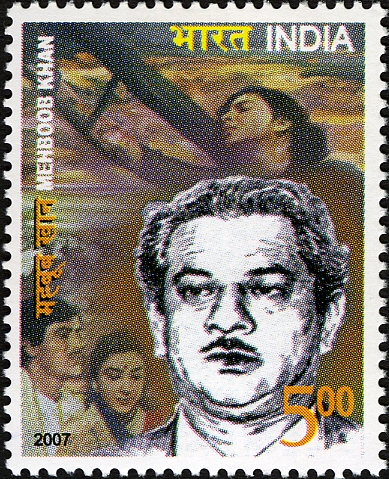
Mehboob Khan died of a heart attack on 28 May 1964. As a part of his birth centenary celebrations, the Indian postal department released a commemorative stamp of Mehboob Khan at a function held at the Mehboob Studios in September 2007.{{cite news
Filmography
As a director
- Son of India (1962)
- A Handful of Grain (1959)
- Mother India (1957)
- Amar (1954)
- Aan (1952)
- Andaz (1949)
- Anokhi Ada (1948)
- Elaan (1947)
- Anmol Ghadi (1946)
- Humayun (1945)
- Najma (1943)
- Taqdeer (1943)
- Roti (1942)
- Huma Gun Anmogaldi (1942){{cite book
- Bahen (1941)
- Alibaba (1940)
- Aurat (1940)
- Ek Hi Raasta (1939)
- Hum Tum Aur Woh (1938)
- Watan (1938)
- Jagirdar (1937)
- Deccan Queen (1936)
- Manmohan (1936)
- Al Hilal a.k.a. Judgement of Allah (1935)
As a producer
- Mother India (1957)
- Amar (1954)
- Aan (1952)
- Anokhi Ada (1948)
- Elaan (1947)
- Anmol Ghadi (1946)
- Zarina (1932)
As an actor
- Chandrahasa (1933)
- Zarina (1932)
- Dilawar (1931)
- Meri Jaan (1931)
As a writer
- Watan (1938) (story)
- Al Hilal a.k.a. Judgement of Allah (1935) (story, screenplay)
Awards and honours
;Academy Awards
- 1958 – Best Foreign Language Film – Mother India (nomination)
;National Film Awards
- 1958 – All India Certificate of Merit for Best Feature Film – Mother India{{cite web |access-date = 2 September 2011 |url-status = live |archive-url = https://web.archive.org/web/20131103222703/http://dff.nic.in/2011/5th_nff.pdf |archive-date = 3 November 2013
- 1958 – Certificate of Merit for Second Best Feature Film in Hindi – Mother India
;Filmfare Awards
- 1958 – Best Film – Mother India
- 1958 – Best Director – Mother India
- 1963 – Best Director – Son of India (nomination)
;Honours
- 1963: Awarded Padma Shri, the fourth highest civilian honour by Government of India.
- 30 March 2007, India Post released a commemorative stamp showing Maheboob Khan and a scene of 'Mother India' depicting Raaj Kumar & Nargis
References
References
- "Padma Awards | Interactive Dashboard".
- [http://www.filmreference.com/Directors-Lu-Mi/Mehboob-Khan.html Mehboob Khan] {{webarchive. link. (21 May 2011 at filmreference.com.)
- Teo, Stephen. (2017). "Eastern Westerns: Film and Genre Outside and Inside Hollywood". [[Taylor & Francis]].
- (13 August 2007). "Historic Mehboob Studio ticks away in anonymity". Hindustan Times (newspaper).
- "BBC - Films - review - Mother India (Bharat Mata)".
- "Padma Awards {{!}} Interactive Dashboard".
- (January 2008). "Philaindia". Philatelia.
This article was imported from Wikipedia and is available under the Creative Commons Attribution-ShareAlike 4.0 License. Content has been adapted to SurfDoc format. Original contributors can be found on the article history page.
Ask Mako anything about Mehboob Khan — get instant answers, deeper analysis, and related topics.
Research with MakoFree with your Surf account
Create a free account to save articles, ask Mako questions, and organize your research.
Sign up freeThis content may have been generated or modified by AI. CloudSurf Software LLC is not responsible for the accuracy, completeness, or reliability of AI-generated content. Always verify important information from primary sources.
Report