From Surf Wiki (app.surf) — the open knowledge base
Medgar Evers
American civil rights activist (1925–1963)

American civil rights activist (1925–1963)
| Field | Value |
|---|---|
| name | Medgar Evers |
| image | Medgar Evers press photo.jpg |
| caption | Evers |
| birth_name | Medgar Wiley Evers |
| birth_date | |
| birth_place | Decatur, Mississippi, U.S. |
| death_date | |
| death_place | Jackson, Mississippi, U.S. |
| death_cause | Murder by gunshot |
| burial_place | Arlington National Cemetery (with full military honors) |
| education | Alcorn State University (BA) |
| occupation | Civil rights activist |
| relations | Charles Evers (brother) |
| spouse | |
| children | 3 |
| module | {{Infobox military person |
| embed | yes |
| allegiance | United States |
| branch | United States army |
| serviceyears | 1943–1946 |
| unit | 657th Port Company |
| rank | Technician fifth grade |
| battles |
- World War II
- Western Front
- Normandy landings
- Western Front
Medgar Wiley Evers (; July 2, 1925June 12, 1963) was an American civil rights activist who was the NAACP's first field secretary in Mississippi. A United States Army veteran who served in World War II, he was engaged in efforts to overturn racial segregation at the University of Mississippi, end the segregation of public facilities, and expand opportunities for African Americans, including the enforcement of voting rights prior to his assassination.
After college, Evers became active in the civil rights movement in the 1950s. Following the 1954 ruling of the United States Supreme Court in Brown v. Board of Education that segregated public schools were unconstitutional, he challenged the segregation of the state-supported public University of Mississippi. Evers applied to law school there, as the state had no public law school for African Americans. He also worked for voting rights, economic opportunity, access to public facilities, and other changes in the segregated society. In 1963, Evers was awarded the NAACP Spingarn Medal.
On June 12, 1963, Evers was murdered at his home in Jackson, Mississippi, now the Medgar and Myrlie Evers Home National Monument, by Byron De La Beckwith, a member of the White Citizens' Council in Jackson. Only hours earlier, Evers was listening to President John F Kennedy’s Speech Report to the American People on Civil Rights.
Evers' murder and the resulting trials inspired civil rights protests. His life and death have inspired numerous works of art, music, and film. Although all-white juries failed to reach verdicts in the first two trials of De La Beckwith in the 1960s, he was convicted in 1994 based on new evidence. Evers' widow, Myrlie, became a noted activist in her own right, and served as national chair of the NAACP. In 1969, after passage of civil rights legislation and the Voting Rights Act of 1965, Medgar's older brother, Charles, was elected as mayor of Fayette, Mississippi. He was the first African American to be elected mayor of a Mississippi city in the post-Reconstruction era.
Early life and education
Medgar Wiley Evers was born on July 2, 1925, in Decatur, Mississippi, the third of five children (including elder brother Charles Evers) of Jesse (Wright) and James Evers. The family included Jesse's two children from a previous marriage. The Evers family owned a small farm and James also worked at a sawmill. Evers and his siblings walked 12 mi a day to attend racially segregated schools; Medgar eventually earned his high school diploma.[[File:Medgar evers army.jpg|thumb|upright|Evers while he was serving in the U.S. Army|left]]
In 1943, Evers enlisted in the United States Army at age 17; he was prompted to do so by the racism that he experienced at home and Charles' prior enlistment in the Army. Evers served in the 657th Port Company, a segregated unit of the Army's Transportation Corps, participating in the Normandy landings in June 1944. In France, Evers' unit was part of the Red Ball Express, which delivered supplies to Allied troops fighting on the frontlines. During his time in the Army, Evers was angered by the segregation and mistreatment endured by African-American troops. Witnessing Black soldiers of the Free French Forces being treated as the equals of white troops, he once told Charles that, "When we get out of the Army, we’re going to straighten this thing out!"
In 1946, Evers was discharged from the Army at the rank of technician fifth grade, having earned the Good Conduct Medal, European–African–Middle Eastern Campaign Medal, and World War II Victory Medal. After returning to Decatur, Evers enrolled at the historically black Alcorn Agricultural and Mechanical College in 1948, majoring in business administration. He also competed on the debate, football, and track teams, sang in the choir, and was elected as junior class president. Evers earned his Bachelor of Arts in 1952. On December 24, 1951, Evers married classmate Myrlie Beasley. They had three children together: Darrell Kenyatta, Reena Denise, and James Van Dyke.
Activism
Evers and his wife moved to Mound Bayou, Mississippi, a town developed by African Americans after the Civil War. Evers became a salesman for T. R. M. Howard's Magnolia Mutual Life Insurance Company.
Becoming active in the civil rights movement, Evers served as president of the Regional Council of Negro Leadership (RCNL), which began to organize actions to end segregation; he helped organize the RCNL's boycott of those gasoline stations that denied blacks the use of the stations' restrooms. Evers and his brother, Charles, attended the RCNL's annual conferences in Mound Bayou between 1952 and 1954, which drew crowds of 10,000 or more.
In 1954, following the U.S. Supreme Court ruling that segregated public schools were unconstitutional, Evers applied to the state-supported University of Mississippi Law School to challenge that practice in the state. His application was rejected due to his race, as the flagship school had long been segregated. Evers submitted his application as part of a test case by the NAACP.
On November 24, 1954, Evers was named as the NAACP's first field secretary for Mississippi. In this position, he helped organize boycotts and set up new local chapters of the NAACP. Evers was also involved with James Meredith's efforts to enroll in the University of Mississippi in the early 1960s.
Evers also encouraged Dr. Gilbert Mason Sr. in his organizing of the Biloxi wade-ins from 1959 to 1963, protests against segregation of the city's public beaches on the Mississippi Gulf Coast. Evers conducted actions to help integrate Jackson's privately owned buses and tried to integrate the public parks. Evers led voter registration drives and used boycotts to integrate Leake County schools and the Mississippi State Fair.
Evers' civil rights leadership, along with his investigative work, made him a target of white supremacists. Following the Brown v. Board of Education decision, local whites founded the White Citizens' Council in Mississippi, and numerous local chapters were started, to resist the integration of schools and facilities. In the weeks before Evers was killed, he encountered new levels of hostility. Evers' public investigations into the 1955 lynching of Chicago teenager Emmett Till in Mississippi, and his vocal support of Clyde Kennard, had made Evers a prominent African-American leader. On May 28, 1963, a Molotov cocktail was thrown into the carport of his home. Ten days later, Evers was nearly run over by a car after he came out of the NAACP office in Jackson, Mississippi.
Assassination

Evers lived with the constant threat of death. A large white supremacist population and the Ku Klux Klan were present in Jackson and its suburbs. The risk was so high that before his death, Evers and his wife, Myrlie, had trained their children on what to do in case of a shooting, bombing, or other kind of attack on their lives. Evers, who was regularly followed home by at least two FBI cars and a police car, arrived at his home on the morning of his death without an escort. None of his usual protection was present, for reasons unspecified by the FBI or local police. There has been speculation that many members of the police force at the time were members of the Klan.
In the early morning of Wednesday, June 12, 1963, just hours after President John F. Kennedy's nationally televised Civil Rights Address, Evers pulled into his driveway after returning from a meeting with NAACP lawyers. His family had worried for his safety that day, and Evers himself had warned his wife that he felt in greater danger than usual.
Emerging from his car and carrying NAACP T-shirts that read "Jim Crow Must Go", Evers was struck in the back with a bullet fired from an Eddystone Enfield 1917 rifle; the bullet passed through his heart. Initially thrown to the ground by the impact of the shot, Evers rose and staggered 30 ft before collapsing outside his front door. His wife, Myrlie, was the first to find him.
Evers was taken to the local hospital in Jackson, where he was initially refused entry because of his race. Evers' family explained who he was, and he was admitted; Evers died in the hospital 50 minutes later, three weeks before his 38th birthday. Evers was the first African-American man to be admitted to an all-white hospital in Mississippi. Mourned nationally, Evers was buried on June 19 in Arlington National Cemetery, where he received full military honors before a crowd of more than 3,000 people.
Aftermath
After Evers was assassinated, an estimated 5,000 people marched from the Masonic Temple on Lynch Street to the Collins Funeral Home on North Farish Street in Jackson. Allen Johnson, Martin Luther King Jr., and other civil rights leaders led the procession. The Mississippi police came to the non-violent protest armed with riot gear and rifles. While tensions were initially high in the stand-off between police and marchers, both in Jackson and in many similar marches around the state, leaders of the movement maintained non-violence among their followers.
Trials
On June 21, 1963, Byron De La Beckwith, a fertilizer salesman and member of the Citizens' Council (and later of the Ku Klux Klan), was arrested for Evers' murder. District Attorney and future governor Bill Waller prosecuted De La Beckwith. All-white juries in February and April 1964 deadlocked on De La Beckwith's guilt and failed to reach a verdict. At the time, most African-Americans were still disenfranchised by Mississippi's constitution and voter registration practices; this meant they were also excluded from juries, which were drawn from the pool of registered voters.
Myrlie Evers did not give up the fight for the conviction of her husband's killer. She waited until a new judge had been assigned in the county to take her case against De La Beckwith back into the courtroom. In 1994, De La Beckwith was prosecuted by the state based on new evidence. Bobby DeLaughter was the prosecutor. During the trial, the body of Evers was exhumed for an autopsy. His body was embalmed, and was in such good condition that his son was allowed to view his father's remains for the first time in 30 years.
On February 5, 1994, De La Beckwith was convicted of murder and sentenced to life in prison, having lived as a free man for much of the three decades following the killing. He had been imprisoned from 1977 to 1980 for conspiring to murder A. I. Botnick. In 1997, De La Beckwith appealed his conviction in the Evers case, but the Mississippi Supreme Court upheld it, and the U.S. Supreme Court declined to hear it. He died at age 80 in prison on January 21, 2001.
Legacy

Evers was memorialized by leading Mississippi and national authors James Baldwin, Margaret Walker, Eudora Welty, and Anne Moody. In 1963, Evers was posthumously awarded the Spingarn Medal by the NAACP. Six years later, Medgar Evers College was established in Brooklyn, New York, as part of the City University of New York.
Evers' widow, Myrlie, co-wrote the 1967 book For Us, the Living with William Peters. In 1983, a television movie was made based on the book. Celebrating Evers's life and career, it starred Howard Rollins Jr. and Irene Cara as Medgar and Myrlie Evers, airing on PBS. The film won the Writers Guild of America award for Best Adapted Drama.
In 1969, a community pool in the Central District neighborhood of Seattle, Washington, was named after Evers, honoring his life.
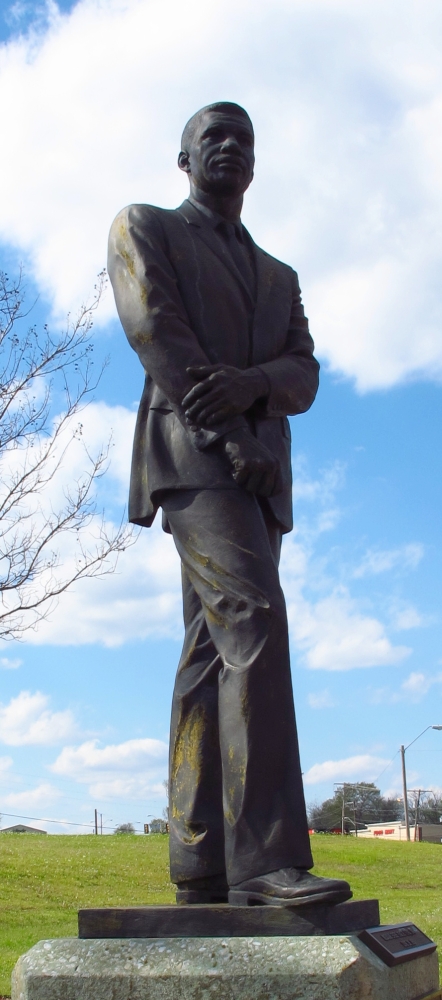
On June 28, 1992, the city of Jackson, Mississippi, erected a statue in honor of Evers. All of Delta Drive (part of U.S. Highway 49) in Jackson was renamed in his honor. In December 2004, the Jackson City Council changed the name of the city's airport to Jackson–Medgar Wiley Evers International Airport in Evers' honor.
Evers' widow, Myrlie Evers, became a noted activist in her own right, eventually serving as national chairperson of the NAACP. Myrlie also founded the Medgar Evers Institute in 1998, with the initial goal of preserving and advancing the legacy of her husband's life's work. Anticipating the commemoration of the 50th anniversary of the assassination of Medgar Evers and recognizing the international leadership role of Myrlie Evers, the Institute's board of directors changed the organization's name to the Medgar and Myrlie Evers Institute.
Evers' brother, Charles, returned to Jackson in July 1963, and served briefly with the NAACP in his brother's place. Charles remained involved in Mississippi civil rights activities for many years, and in 1969, was the first African-American mayor elected in the state. He died on July 22, 2020, at age 97, in nearby Brandon.
On the 40th anniversary of Evers' assassination, hundreds of civil rights veterans, government officials, and students from across the country gathered around his gravesite at Arlington National Cemetery to celebrate his life and legacy. Barry Bradford and three students—Sharmistha Dev, Jajah Wu, and Debra Siegel, formerly of Adlai E. Stevenson High School in Lincolnshire, Illinois—planned and hosted the commemoration in his honor. Evers was the subject of the students' research project.
In October 2009, Navy Secretary Ray Mabus, a former Mississippi governor, announced that , a , would be named in the activist's honor. The ship was christened by Myrlie Evers-Williams on November 12, 2011.
In June 2013, a statue of Evers was erected at his alma mater, Alcorn State University, to commemorate the 50th anniversary of Evers' death. Alumni and guests from around the world gathered to recognize his contributions to American society.
Evers was also honored in a tribute at Arlington National Cemetery on the 50th anniversary of his death. Former President Bill Clinton, Attorney General Eric Holder, Navy Secretary Ray Mabus, Senator Roger Wicker, and NAACP President Benjamin Jealous all spoke commemorating Evers. Evers's widow, Myrlie Evers-Williams, spoke of his contributions to the advancement of civil rights:
Medgar was a man who never wanted adoration, who never wanted to be in the limelight. He was a man who saw a job that needed to be done and he answered the call and the fight for freedom, dignity and justice not just for his people but all people.
Evers was identified as a Freedom hero by The My Hero Project.
In 2017, the Medgar and Myrlie Evers House was named as a National Historic Landmark. Two years later, the site was designated a National Monument.
The Route 3 Bridge over the Hackensack River is dedicated to Evers.
In 2024, Evers was awarded the Presidential Medal of Freedom by President Joe Biden. The following year, as part of a series of Trump administration anti-DEI deletions by the U.S. Department of Defense, a profile of Evers was deleted from the Arlington National Cemetery website.
In popular culture
Music
Musician Bob Dylan wrote his song "Only a Pawn in Their Game" about the assassination on July 2, 1963, on what would have been Evers' 38th birthday. Nina Simone wrote and sang "Mississippi Goddam" about the Evers case. Phil Ochs referred to Evers in the song "Love Me, I'm a Liberal" and wrote the songs "Another Country" and "Too Many Martyrs" (also titled "The Ballad of Medgar Evers") in response to the killing. Malvina Reynolds referenced Evers' murder in her song, "It Isn't Nice". Matthew Jones and the Student Nonviolent Coordinating Committee Freedom Singers recorded a version of the latter song. Wadada Leo Smith's album Ten Freedom Summers contains a track called "Medgar Evers: A Love-Voice of a Thousand Years' Journey for Liberty and Justice". Jackson C. Frank's self-titled debut album, released in 1965, also includes a reference to Medgar Evers in the song "Don't Look Back".
Essays and books
Eudora Welty's short story, "Where Is the Voice Coming From?", in which the speaker is the imagined assassin of Medgar Evers, was published in The New Yorker in July 1963.
Attorney Bobby DeLaughter wrote a first-person narrative article entitled "Mississippi Justice" published in Reader's Digest about his experiences as state prosecutor in the murder trial. He added to this account in a book, Never Too Late: A Prosecutor's Story of Justice in the Medgar Evers Case (2001).
In Remembering Medgar Evers: Writing the Long Civil Rights Movement, Minrose Gwin, then the Kenan Eminent Professor of English at the University of North Carolina at Chapel Hill and coeditor of The Literature of the American South and the Southern Literary Journal, looked at the body of artistic work inspired by Evers' life and death—fiction, poetry, memoir, drama, and songs from James Baldwin, Margaret Walker, Eudora Welty, Lucille Clifton, Bob Dylan, and Willie Morris, among others.
Film
Evers was portrayed by Howard Rollins in the 1983 television film For Us the Living: The Medgar Evers Story.
The 1996 film Ghosts of Mississippi, directed by Rob Reiner, explores the 1994 trial of De La Beckwith in which prosecutor DeLaughter of the Hinds County District Attorney's office secured a conviction in state court. Beckwith and DeLaughter were played by James Woods and Alec Baldwin, respectively, with Whoopi Goldberg as Myrlie Evers. Medgar was portrayed by James Pickens Jr. The film was based on a book of the same name. Preservationist Catherine Fleming Bruce, whose book explored the restoration of the Medgar and Myrlie Evers Home National Monument, opened with a quote from Reiner, who included the site as a location during filming of Ghosts of Mississippi.
In the documentary film I Am Not Your Negro (2016), Evers is one of three Black activists (the other two are Martin Luther King Jr. and Malcolm X) who are the focus of reminiscences by author James Baldwin, who recounts the circumstances of and his reaction to Evers' assassination.
In the 2011 film The Help, a clip of Evers speaking for civil rights is shown on TV, quickly followed by news of his assassination, and a glimpse of an article by his widow published in Life magazine.
The 2020 documentary film The Evers features interviews with his surviving family members.
The 2022 film Till depicts Evers (played by Tosin Cole) assisting Mamie Till-Bradley (Danielle Deadwyler) seek justice for the murder of her son, Emmett Till (Jalyn Hall).
Television
A 2021 episode of Extra History from Extra Credits talks about Evers, his activism, and his assassination.
References
References
- Barnett, Ross. (April 18, 2002). ["The Medgar Evers Assassination]"](https://www.pbs.org/newshour/nation/media-jan-june02-evers_04-18). [[PBS Newshour]].
- (1997). "Have no fear: the Charles Evers story".
- [http://www.blackpast.org/aah/evers-james-charles-1922 "James Charles Evers"] {{Webarchive. link. (September 16, 2017 , ''Black Past'')
- "Medgar W. Evers – Civil Rights Activist". memorial.org.
- Williams, Reggie. (July 2, 2005). "Remembering Medgar". Afro King – American Red Star.
- Sina. (2005). "Freedom Hero: Medgar Wiley Evers". The My Hero Project.
- (2005). "The Autobiography of Medgar Evers: A Hero's Life and Legacy Revealed Through His Writings, Letters and Speeches". [[Basic Books.
- (2006). "Encyclopedia of African-American Culture and History". [[Macmillan Publishers.
- "Evers, Medgar (2 July 1925 – 12 June 1963), Civil Rights Activist, Was ...". [[Harvard University]].
- Padgett, John B.. (2008). "Medgar Evers". [[University of Mississippi]].
- [[THOMAS]], ''[[United States Library of Congress]]''. (June 9, 2003). "Commending Medgar Wiley Evers and his widow, Myrlie Evers-Williams for their lives and accomplishments, designating a Medgar Evers National Week of Remembrance, and for other purposes (Introduced in Senate – IS)". thomas.loc.gov.
- "Eyes on the Prize; Interview with Darrell Evers".
- Cardon, Dustin. (January 21, 2013). "Myrlie Evers-Williams". [[Association of Alternative Newsweeklies]].
- National Association for the Advancement of Colored People. (June 24, 2013). "NAACP HISTORY: MEDGAR EVERS". naacp.org.
- Wesleyan University. (June 24, 2013). "Medgar Evers: July 2, 1925 – June 12, 1963". wesleyan.edu.
- Beito, David T.. (2018). "T.R.M. Howard: Doctor, Entrepreneur, Civil Rights Pioneer". Institute.
- (2001). "The Assassination of Medgar Evers". The Rosen Publishing Group.
- (2008). "The Jim Crow Encyclopedia: Greenwood Milestones in African American History". [[Greenwood Publishing Group]].
- (2011). "Black America: A State-By-State Historical Encyclopedia".
- Randall, Dorian. (June 17, 2013). "Medgar Evers: Direct Action".
- Johnson, Hank. (January 21, 2013). "H.Res.1022 – Honoring the life and sacrifice of Medgar Evers and congratulating the United States Navy for naming a supply ship after Medgar Evers.". beta.congress.gov.
- [http://www.everstribute.org/house_tour.php Medgar Evers home tour] {{webarchive. link. (December 19, 2013 Retrieved December 25, 2013)
- Bates, Karen Grigsby. "Trials & Transformation: Myrlie Evers' 30-Year Fight to Convict Medgar's Accused Killer", ''Emerge'' 02 1994: 35. ''ProQuest. ''Web. May 27, 2017
- Moody, Anne. (1976). "Coming of Age in Mississippi: The Classic Autobiography of Growing Up Poor and Black in the Rural South". [[Dell Publishing]].
- (June 2000). "Civil Rights Since 1787: A Reader on the Black Struggle". NYU Press.
- Orejel, Keith. (Winter–Spring 2012). "The Federal Government's Response to Medgar Evers's Funeral". [[University of Southern Mississippi]].
- (2011). "State of Siege: Mississippi Whites and the Civil Rights Movement". American Public Media.
- (2013). "We Shall Not Be Moved: The Jackson Woolworth's Sit-In and the Movement It Inspired". Univ. Press of Mississippi.
- Dufresne, Marcel. (October 1991). "Exposing the Secrets of Mississippi Racism". [[Philip Merrill College of Journalism]].
- Mitchell, Jerry. (June 2, 2013). "Medgar Evers: Assassin's gun forever changed a family". [[USA Today]].
- (January 7, 1991). "White Supremacist Indicted for Third Time in Shooting Death of Medgar Evers".
- Baden, M. M.. (2006). "Spitz and Fisher's Medicolegal Investigation of Death. Guideline for the Application of Pathology to Crime Investigations". Charles C. Thomas.
- Volk, David. (January 2, 2023). "How long does it take for a body to decompose?".
- (2010). "Gale Encyclopedia of American Law".
- "Deliverance." ''People Weekly'' February 21, 1994: 60. ''ProQuest''. Web. May 27, 2017
- "Unfinished Business". ''U.S. News & World Report'' January 24, 1994: 14. ''ProQuest'' Web. May 27, 2017
- (2008). "Mourning Medgar: Justice, Aesthetics, and the Local". Southern Spaces.
- "NAACP Spingarn Medal". Naacp.org.
- "For Us the Living: The Medgar Evers Story". www.allrovi.com.
- "Seattle Parks and Recreation History of Medgar Evers pool".
- (2013). "Jackson-Medgar Wiley Evers International Airport". Jackson Municipal Airport Authority.
- (March 2, 1998). "NAACP Chairwoman Myrlie Evers-Williams Will Not Seek Re-Election". Jet.
- "Charles Evers's biography, PBS". Pbs.org.
- McFadden, Robert D.. (July 22, 2020). "Charles Evers, Businessman and Civil Rights Leader, Dies at 97". [[The New York Times]].
- [http://www.arlingtoncemetery.net/mwevers.htm "Medgar Evers"] {{Webarchive. link. (February 2, 2012 , Arlingon Cemetery. Note: Bradford later was notable for his work in helping reopen the [[Mississippi Burning]] and [[Clyde Kennard]] cases.)
- Lottie L. Joiner (July 2003), "The nation remembers Medgar Evers", ''The Crisis'', 110(4), 8. Retrieved October 26, 2009 from Research Library Core.
- [https://obamawhitehouse.archives.gov/blog/The-Navy-Honors-a-Civil-Rights-Pioneer Mabus, Ray, "The Navy Honors a Civil Rights Pioneer."] {{Webarchive. link. (October 12, 2009 The White House Blog. October 9, 2009. Retrieved September 2, 2010.)
- "A Memorial for Medgar", ''San Diego Union-Tribune'', November 13, 2011.
- Therese Apel. (June 12, 2013). "Mississippi marks 50th anniversary of Medgar Evers' death". reuters.com.
- Krissah Thompson. (June 5, 2013). "Memorial service for Medgar Evers held at Arlington National Cemetery". washingtonpost.com.
- Ashley Southall. (June 5, 2013). "Paying Tribute to a Seeker of Justice, 50 Years After His Assassination". nytimes.com.
- Valerie Bonk. (June 5, 2013). "HOLDER PRAISES SLAIN BLACK ACTIVIST MEDGAR EVERS". bigstory.ap.org.
- (June 5, 2013). "Medgar Evers honored at Arlington National Cemetery". The Clarion-Ledger.
- (January 11, 2017). "Interior Department Announces 24 New National Historic Landmarks | U.S. Department of the Interior". Doi.gov.
- (May 3, 2024). "President Biden Announces Recipients of the Presidential Medal of Freedom". The White House.
- Mitchell, Jerry. (2025-03-17). "WWII vet Medgar Evers erased from Arlington cemetery website".
- "NAACP Evers biography". Naacp.org.
- "Ten Freedom Summers". Cuneiform Records.
- (November 16, 2016). "Retrospective Reviews II: Jackson C. Frank". Isis Magazine.
- [[Eudora Welty]], [http://www.newyorker.com/archive/1963/07/06/1963_07_06_024_TNY_CARDS_000277124 "Where Is The Voice Coming From?"] {{Webarchive. link. (March 25, 2013 , ''[[The New Yorker]]'', July 6, 1963.)
- (2001). "Never Too Late: A Prosecutor's Story of Justice in the Medgar Evers Case". Simon and Schuster.
- (2013). "Remembering Medgar Evers: Writing the Long Civil Rights Movement by Minrose Gwin". University of Georgia Press.
- Kaltenbach, Chris. (December 10, 1996). "Actor Rollins dies Appreciation: Baltimore native earned acclaim for dramatic film, stage performances.". [[The Baltimore Sun]].
- Vollers, Maryanne. (1995). "Ghosts of Mississippi: the murder of Medgar Evers, the trials of Byron de la Beckwith and the haunting of the new South". Little, Brown.
- (2002). "Biography of Bobby B. DeLaughter".
- Young, Deborah (September 20, 2016). [http://www.hollywoodreporter.com/review/i-am-not-your-negro-931087 "‘I Am Not Your Negro’: Film Review. TIFF 2016"] {{Webarchive. link. (December 4, 2017 . ''[[The Hollywood Reporter]]''.)
- . (February 24, 2012). ["Evers On The Help"](https://www.youtube.com/watch?v=aJhwSA5RlOs&app=desktop).
- . ["The Evers"](https://www.imdb.com/title/tt17014922/).
- (March 27, 2021). "The Assassination of Medgar Evers – A Hero Silenced".
This article was imported from Wikipedia and is available under the Creative Commons Attribution-ShareAlike 4.0 License. Content has been adapted to SurfDoc format. Original contributors can be found on the article history page.
Ask Mako anything about Medgar Evers — get instant answers, deeper analysis, and related topics.
Research with MakoFree with your Surf account
Create a free account to save articles, ask Mako questions, and organize your research.
Sign up freeThis content may have been generated or modified by AI. CloudSurf Software LLC is not responsible for the accuracy, completeness, or reliability of AI-generated content. Always verify important information from primary sources.
Report