From Surf Wiki (app.surf) — the open knowledge base
Mecklenburg County, North Carolina
County in the United States

County in the United States
| Field | Value |
|---|---|
| county | Mecklenburg County |
| state | North Carolina |
| ex image | {{multiple image |
| border | infobox |
| perrow | 1/2/3/1 |
| total_width | 300 |
| caption_align | center |
| image1 | Skyline of Charlotte 2016.jpg |
| caption1 | Uptown Charlotte skyline |
| image2 | Historic Mecklenburg County Courthouse - Charlotte, NC.jpg |
| caption2 | Old Mecklenburg County Courthouse |
| image3 | Governors Island, Lake Norman, NC.jpg |
| caption3 | Governors Island on Lake Norman |
| image4 | First Presbyterian Charlotte NC 1.jpg |
| caption4 | First Presbyterian Church |
| image5 | Main Street, Pineville NC.jpg |
| caption5 | Pineville Historic District |
| image6 | James K. Polk Childhood Log Cabin (Reconstruction).jpg |
| caption6 | President James K. Polk Historic Site |
| image7 | CRI and JRS.jpg |
| caption7 | Charlotte Research Institute campus at UNC Charlotte |
| seal | Mecklenburg_County_Seal.svg |
| flag | Flag of Mecklenburg County, North Carolina.svg |
| founded year | 1762 |
| founded date | December 11 |
| named for | Charlotte of Mecklenburg-Strelitz |
| seat wl | Charlotte |
| largest city wl | Charlotte |
| city type | municipality |
| area_total_sq_mi | 546.09 |
| area_land_sq_mi | 523.61 |
| area_water_sq_mi | 22.48 |
| area percentage | 4.12 |
| population_as_of | 2020 |
| population_total | 1115482 |
| pop_est_as_of | 2024 |
| population_est | 1206285 |
| population_density_sq_mi | auto |
| coordinates | |
| demonym | Mecklenburger |
| time zone | Eastern |
| district | 8th |
| district2 | 12th |
| district3 | 14th |
| web | www.mecknc.gov |
| nickname | Meck County |
Mecklenburg County () is a county located in the southwestern region of the U.S. state of North Carolina, in the United States. As of the 2020 census, the population was 1,115,482, making it the second-most populous county in North Carolina (after Wake County), and the first county in the Carolinas to surpass one million in population. Its county seat is Charlotte, the state's largest municipality.
Mecklenburg County is the central county of the Charlotte-Concord-Gastonia, NC-SC Metropolitan Statistical Area. On September 12, 2013, it was estimated the county surpassed one million residents.
Like its seat, the county is named after Charlotte of Mecklenburg-Strelitz, Queen of the United Kingdom (1761–1818), whose name is derived from the region of Mecklenburg in Germany. It was named for Mecklenburg Castle (Mecklenburg meaning "large castle" in Low German) in the village of Dorf Mecklenburg.
History
Mecklenburg County was formed by English colonists in 1762 from the western part of Anson County, both in the Piedmont section of the state. It was named in commemoration of the marriage of King George III to Charlotte of Mecklenburg-Strelitz, for whom the county seat Charlotte is named. Due to unsure boundaries, a large part of south and western Mecklenburg County extended into areas that would later form part of the state of South Carolina. In 1768, most of this area (the part of Mecklenburg County west of the Catawba River) was designated Tryon County, North Carolina.
Determining the final boundaries of these "western" areas between North and South Carolina was a decades-long process. As population increased in the area following the American Revolutionary War, in 1792 the northeastern part of Mecklenburg County was taken by the North Carolina legislature for Cabarrus County. Finally, in 1842 the southeastern part of Mecklenburg County was combined with the western part of Anson County to form Union County.
The Mecklenburg Declaration of Independence was allegedly signed on May 20, 1775, and if the document is genuine, Mecklenburg County was the first part of the Thirteen Colonies to declare independence from Great Britain. The "Mecklenburg Resolves" were adopted on May 31, 1775. Mecklenburg continues to celebrate the declaration each year in May, the date of which is included on the flag of North Carolina.
The first gold rush in the United States, the Carolina Gold Rush, began after a 12-year-old boy named Conrad Reed discovered a gold nugget in a stream in neighboring Cabarrus County. Many miners and merchants began settling in the county during that time. The first United States branch mint was established in 1837 in Charlotte and continued operations until 1913. The original building was moved from its original site and redeveloped as a museum.
In 1917, during World War I, Camp Greene was established west of Charlotte as an army training camp. In 1919, after the end of WWI, it was decommissioned. Around the 1930s and 1940s, the population began to rapidly increase. During this time, Carolinas Medical Center and Charlotte College (now the University of North Carolina at Charlotte) were built. Lake Norman was also completed in 1964, after a five-year construction period.
In the mid-20th century, the county continued to see rapid growth. Many new government buildings were constructed, and Charlotte Douglas International Airport was expanded in 1954. By 1960, a quarter million people were living in the county, with the population reaching half a million by 1990. A proposal to form a consolidated city-county government with Charlotte was considered, but voted down by residents in 1971. The metropolitan statistical area now includes 11 counties in both North Carolina and South Carolina, and had an estimated combined population of 2,805,115 in 2023.
In mid-2020, the county was the site of the 2020 Colonial Pipeline oil spill, wherein about 2,000,000 U.S.gal of gasoline leaked from the Colonial Pipeline in the Oehler Nature Preserve near Huntersville. It is one of the largest gasoline spills in U.S. history, and cleanup efforts are expected to last for several years.
Geography
According to the U.S. Census Bureau, the county has a total area of 546.09 sqmi, of which 523.61 sqmi is land and 22.48 sqmi (4.12%) is water.
State and local protected areas/sites
- Carolina Raptor Center
- Charlotte Museum of History
- Historic Latta Place
- Historic Rural Hill/Nature Preserve
- Little Sugar Creek Greenway
- Mint Museum Randolph, uses the original Charlotte Mint building
- Mint Museum Uptown
- Oehler Nature Preserve
- President James K. Polk Historic Site
Nature preserves in Charlotte:
- Auten Nature Preserve
- Big Rock Nature Preserve
- Cowans Ford Wildlife Refuge
- Ferrelltown Nature Preserve
- Latta Nature Preserve
- McDowell Nature Preserve
- Possum Walk Nature Preserve
- Reedy Creek Nature Preserve
- Sherman Branch Nature Preserve
- Stevens Creek Nature Preserve
Major water bodies
- Catawba River
- Lake Norman
- Mountain Island Lake
- Rocky River
Adjacent counties
- Iredell County – north
- Cabarrus County – northeast
- Union County – southeast
- Lancaster County, South Carolina – south
- York County, South Carolina – southwest
- Gaston County – west
- Lincoln County – northwest
Demographics
1790–1960 1900–1990 1990–2000 2010–2020 | align-fn = center
2020 census
As of the 2020 census, the county had a population of 1,115,482. The median age was 35.1 years. 22.9% of residents were under the age of 18 and 11.8% of residents were 65 years of age or older. For every 100 females there were 92.8 males, and for every 100 females age 18 and over there were 89.9 males age 18 and over.
The racial makeup of the county was 46.7% White, 29.6% Black or African American, 0.6% American Indian and Alaska Native, 6.5% Asian, 0.1% Native Hawaiian and Pacific Islander, 8.7% from some other race, and 7.8% from two or more races. Hispanic or Latino residents of any race comprised 15.2% of the population.
99.2% of residents lived in urban areas, while 0.8% lived in rural areas.
There were 448,814 households in the county, of which 31.0% had children under the age of 18 living in them. Of all households, 41.3% were married-couple households, 20.0% were households with a male householder and no spouse or partner present, and 31.5% were households with a female householder and no spouse or partner present. About 30.5% of all households were made up of individuals and 7.8% had someone living alone who was 65 years of age or older.
There were 478,966 housing units, of which 6.3% were vacant. Among occupied housing units, 54.4% were owner-occupied and 45.6% were renter-occupied. The homeowner vacancy rate was 1.3% and the rental vacancy rate was 7.7%.
Racial and ethnic composition
| Race / Ethnicity (NH = Non-Hispanic) | title=P004: Hispanic or Latino, and Not Hispanic or Latino by Race – 2000: DEC Summary File 1 – Mecklenburg County, North Carolina | url=https://data.census.gov/table?g=050XX00US37119&tid=DECENNIALSF12000.P004 | publisher=United States Census Bureau | access-date= }} | title=P2: Hispanic or Latino, and Not Hispanic or Latino by Race – 2010: DEC Redistricting Data (PL 94-171) – Mecklenburg County, North Carolina | url=https://data.census.gov/cedsci/table?q=p2&g=050XX00US37119&tid=DECENNIALPL2010.P2 | publisher=United States Census Bureau | access-date= }} | % 2000 | % 2010 |
|---|---|---|---|---|---|---|---|---|---|---|
| White alone (NH) | 425,144 | 465,372 | 498,683 | 61.13% | ||||||
| Black or African American alone (NH) | 192,403 | 278,042 | 324,832 | 27.67% | ||||||
| Native American or Alaska Native alone (NH) | 2,130 | 2,843 | 2,730 | 0.31% | ||||||
| Asian alone (NH) | 21,717 | 41,991 | 71,583 | 3.12% | ||||||
| Native Hawaiian or Pacific Islander alone (NH) | 283 | 518 | 531 | 0.04% | ||||||
| Other Race alone (NH) | 1,022 | 2,407 | 6,889 | 0.15% | ||||||
| Mixed race or Multiracial (NH) | 7,884 | 16,511 | 40,312 | 1.13% | ||||||
| Hispanic or Latino (any race) | 44,871 | 111,944 | 169,922 | 6.45% | ||||||
| Total | 695,454 | 919,628 | 1,115,482 | 100.00% |
2024 ACS
Recent data from the 2024 ACS 1-year estimates show that Mecklenburg County's population total is now 1,206,285, with 486,412 households. The percent of females in the population is 51.7%, and the percent of males is 48.3%, with a ±0.1% margin of error. Mecklenburg County has a larger female population than male population, as is the case worldwide, and, similarly to global trends, the gap between the male and female populations is decreasing. According to the 2020 ACS 5-year estimates, the female population was 568,717, and the male population was 526,453. This means the populations differ by 42,264. In 2024, the female population is estimated at 623,680, and the male population is estimated at 583,605. This means the populations differ by 40,075, a significantly smaller difference than in 2020. Though the 2020 estimates have a margin of error of ±119, and the 2024 estimates have a margin of error of ±283, the margins are not significant enough to undermine the general trend observed in the difference between the female and male populations.
Mecklenburg county has a significantly different racial profile than North Carolina on average. The ACS estimated 44.4% of Mecklenburg county identified as White, 29.3% Black or African American, 9.4% ‘Some Other Race’, 6.6% Asian, and 0.8% American Indian or Alaskan Native. Whereas the ACS estimated all of North Carolina identified as 60.8% White, 19.8% Black or African American, 5.6% ‘Some Other Race’, 3.6% Asian, 1.2% American Indian and Alaskan Native, and 0.1% Native Hawaiian and Other Pacific Islander.
2000 census
At the 2000 census, there were 695,454 people, 273,416 households, and 174,986 families residing in the county. The population density was 1,322 /mi2. There were 292,780 housing units at an average density of 556 /mi2. The racial makeup of the county was 64.02% White, 27.87% Black or African American, 0.35% American Indian/Alaska Native, 3.15% Asian, 0.05% Pacific Islander, 3.01% from other races, and 1.55% from two or more races. 6.45% of the population were Hispanic or Latino of any race.
There were 273,416 households, out of which 32.10% had children under the age of 18 living with them, 47.70% were married couples living together, 12.40% had a female householder with no husband present, and 36.00% were non-families. 27.60% of all households were made up of individuals, and 5.90% had someone living alone who was 65 years of age or older. The average household size was 2.49 and the average family size was 3.06.
In the county, 25.10% of the population was under the age of 18, 9.70% was from 18 to 24, 36.40% from 25 to 44, 20.30% from 45 to 64, and 8.60% was 65 years of age or older. The median age was 33 years. For every 100 females there were 96.50 males. For every 100 females age 18 and over, there were 93.60 males.
The median income for a household in the county was $50,579, and the median income for a family was $60,608. Males had a median income of $40,934 versus $30,100 for females. The per capita income for the county was $27,352. About 6.60% of families and 9.20% of the population were below the poverty line, including 11.50% of those under age 18 and 9.30% of those age 65 or over.
Law and government
Mecklenburg County is a member of the regional Centralina Council of Governments.
The county is governed by the Mecklenburg Board of County Commissioners (BOCC). The BOCC is a nine-member board made up of representatives elected from six single-member districts, and three at-large representatives elected by the entire county. This electoral structure favors at-large candidates who appeal to the majority population of the county. Each District has a population of approximately 165,000 individuals. All seats are partisan and are for 2-year terms (elections occur in even years). The current chair of the Mecklenburg BOCC is Mark Jerrell (D, District 4). The current vice chair is Leigh Altman (D, At-Large).
Members of the Mecklenburg County Commission are required by North Carolina State law to choose a chair and vice-chair once a year (at the first meeting of December). Historically, the individual elected was the 'top-vote-getter', typically one of three at-large members. In 2014 this unofficial rule was changed by the Board to allow any member to serve as Chair or vice-chair as long as they received support from 4 members plus their own vote.
The nine members of the Board of County Commissioners are:
- George Dunlap (D, District 3)
- Elaine Powell (D, District 1)
- Yvette Townsend-Ingram (D, At-Large)
- Leigh Altman (D, At-Large Vice Chair)
- Arthur Griffin (D, At-Large)
- Vilma Leake (D, District 2)
- Mark Jerrell (D, District 4 Chair)
- Laura Meier (D, District 5)
- Susan Rodriguez-McDowell (D, District 6)
Politics
Mecklenburg County was one of the first parts of North Carolina to break away from a Solid South voting pattern. It was a Republican-leaning swing county for most of the second half of the 20th century, supporting the GOP all but three times from 1952 to 2000. However, the county has strongly trended Democratic in the 21st century, particularly in federal and statewide elections. The expansion of the financial and business communities since the late 20th century attracted many newcomers from other areas of the country, with more diverse voting patterns. The more ethnically diverse core and northern sections of Charlotte trend Democratic, while wealthier and whiter suburban areas to the south of the city lean more Republican.
In 2004, John Kerry became only the fourth Democrat to carry Mecklenburg County since Harry Truman in 1948, and the third to win it with a majority since Franklin Roosevelt's last campaign in 1944. In 2008, the county swung dramatically to support Barack Obama, who won 60.8 percent of the county's vote, at the time the strongest showing for a Democrat in the county since Roosevelt's landslides. Obama's 100,100-vote margin in the county helped him become the first Democrat to carry North Carolina since 1976. At the same time, John McCain became the first Republican to win less than 40 percent of the county's vote since 1948.
Obama won the county almost as easily in 2012 despite losing statewide. The county swung even further in favor of Hillary Clinton in 2016, Joe Biden in 2020, and Kamala Harris in 2024, with all three beating Obama's 2008 total. However, Republicans continue to retain some strength in local races.
Courts and policing

Mecklenburg County is in District 26 of the North Carolina Judicial Branch. Mecklenburg County Courthouse is at 832 East Fourth Street in Charlotte. Since 2017, the District Attorney has been Spencer B. Merriweather III.
The post of 'High Sheriff' of Mecklenburg County dates back to 1763 and is mandated in the constitution of North Carolina. The county sheriff is elected for a four year term and heads the Mecklenburg County Sheriff's Office. As of 2018, the sheriff is Garry L. McFadden, who has featured in a number of true crime documentaries.
Economy


The major industries of Mecklenburg County are banking, manufacturing, and professional services, especially those supporting banking and medicine. Mecklenburg County is home to ten Fortune 1000 companies.
| Name | Industry | 2019 Revenue | Rank |
|---|---|---|---|
| 1. | Bank of America | Banking | $110.6 billion |
| 2. | Nucor | Metals | $25.1 billion |
| 3. | Duke Energy | Utilities | $24.1 billion |
| 4. | Sonic Automotive | Automotive retailing | $10.0 billion |
| 5. | Brighthouse Financial | Insurance | $9.0 billion |
| 6. | Sealed Air | Conglomerate | $4.7 billion |
| 7. | Coca-Cola Consolidated | Food Processing | $4.7 billion |
| 8. | JELD-WEN Holding | Building Products | $4.3 billion |
| 9. | Albemarle | Chemicals | $3.4 billion |
| 10. | SPX | Electronics | $2.1 billion |
Wachovia, a former Fortune 500 company, had its headquarters in Charlotte until it was acquired by Wells Fargo for $15.1 billion. Wells Fargo maintains the majority of the former company's operations in Charlotte.
Goodrich Corporation, a former Fortune 500 company, had its headquarters in Charlotte until it was acquired by United Technologies Corporation for $18.4 billion. Charlotte is now the headquarters for UTC Aerospace Systems.
| Name | Industry | Number of employees |
|---|---|---|
| 1. Atrium Health | Health Care and Social Assistance | 35,700 |
| 2. Charlotte-Mecklenburg Schools | Educational Services | 18,495 |
| 3. Bank of America | Finance and Insurance | 15,000 |
| 4. American Airlines | Transportation and Warehousing | 11,000 |
| 5. Harris Teeter | Retail Trade | 8,239 |
| 6. Duke Energy | Utilities | 7,900 |
| 7. City of Charlotte | Public Administration | 6,800 |
| 8. Mecklenburg County Government | Public Administration | 5,512 |
| 9. YMCA of Greater Charlotte | Arts, Entertainment and Recreation | 4,436 |
| 10. Carowinds | Arts, Entertainment and Recreation | 4,100 |
| 11. University of North Carolina at Charlotte | Educational Services | 4,000 |
| 11. United States Postal Service | Transportation and Warehousing | 4,000 |
| 11. TIAA | Finance and Insurance | 4,000 |
| 14. LPL Financial | Finance and Insurance | 2,850 |
| 15. Central Piedmont Community College | Educational Services | 2,700 |
| 16. Belk | Retail Trade | 2,300 |
| 17. DMSI | Transportation and Warehousing | 2,175 |
| 18. IBM | Professional Services | 2,100 |
| 19. Robert Half International | Administrative and Support Services | 2,000 |
| 19. Allstate Insurance | Finance and Insurance | 2,000 |
Transportation
Air
The county's primary commercial aviation airport is Charlotte Douglas International Airport in Charlotte.
Intercity rail
With twenty-five freight trains a day, Mecklenburg is a freight railroad transportation center, largely due to its place on the NS main line between Washington and Atlanta, and the large volumes of freight moving in and out of the county via truck.
Mecklenburg County is served daily by three Amtrak routes. The Crescent train connects Charlotte with New York, Philadelphia, Baltimore, Washington, Charlottesville, and Greensboro to the north, and Atlanta, Birmingham and New Orleans to the southwest.
The Carolinian train connects Charlotte with New York, Philadelphia, Baltimore, Washington, Richmond, Raleigh, Durham and Greensboro.
The Piedmont train connects Charlotte with Raleigh, Durham and Greensboro.
The Amtrak station is located at 1914 North Tryon Street. A new centralized multimodal train station, Gateway Station, has been planned for the city. It is expected to house the future LYNX Purple Line, the new Greyhound bus station, and the Crescent line that passes through Uptown Charlotte.
Mecklenburg County is the proposed southern terminus for the initial segment of the Southeast High Speed Rail Corridor operating between Charlotte and Washington, D.C. Currently in conceptual design, the SEHSR would eventually run from Washington, D.C. to Macon, Georgia.
Light rail and mass transit
Light rail service in Mecklenburg County is provided by LYNX Rapid Transit Services. Currently, the 19 mi Lynx Blue Line runs from University of North Carolina at Charlotte, through Uptown Charlotte, to Pineville; build-out is expected to be complete by 2034. The CityLynx Gold Line, a 1.5 mi streetcar line runs from Sunnyside Avenue, in Plaza-Midwood, through Uptown Charlotte, stopping at the Charlotte Transportation Center and future Charlotte Gateway Station, before continuing to French Street in Biddleville (Charlotte neighborhood), near the campus of Johnson C. Smith University.
Charlotte Area Transit System (CATS) bus service serves all of Mecklenburg County, including Charlotte, and the municipalities of Davidson, Huntersville, Cornelius, Matthews, Pineville, and Mint Hill.
The Lynx Silver Line is a proposed 29 mi east-west light rail line that would connect the outlying cities and towns of Belmont, Matthews, Stallings and Indian Trail to Uptown Charlotte and the Charlotte Douglas International Airport. Originally setup as two separate projects known as the Southeast Corridor and West Corridor, they were merged in 2019 by the Metropolitan Transit Commission. The tentative opening date in 2037.
Freight
Mecklenburg's manufacturing base, its central location on the Eastern Seaboard, and the intersection of two major interstates in the county have made it a hub for the trucking industry. Also located in the county is the Inland Port of Charlotte, which is a major rail corridor for CSX rail lines.
Major highways
Education
School system
The Charlotte-Mecklenburg Schools (CMS) serves the entire county; however, the State of North Carolina also has approved a number of charter schools in Mecklenburg County (independently operated schools financed with tax dollars).
Colleges and universities
Current
- Central Piedmont Community College
- Davidson College
- Johnson C. Smith University
- Johnson & Wales University
- Pfeiffer University
- Queens University of Charlotte
- Union Presbyterian Seminary
- University of North Carolina at Charlotte
- Wake Forest University Charlotte Center
Former
- King's College
Libraries
The Charlotte Mecklenburg Library is the public library that serves residents of Mecklenburg County. Library cards from any branch can be used at all locations and to access digital resources. The library has an extensive collection (over 1.5 million items) of fiction and non-fiction books, eBooks and audiobooks (through Libby, Hoopla, and NC Live), and online databases. The Archives and Special Collections department houses archival collections related to Mecklenburg County, materials related to state and local government and culture, genealogy, and manages the Robinson-Spangler Carolina Room.
The Billy Graham Library contains the papers and memorabilia related to the career of the well-known 20th century evangelist, Billy Graham. It is open for tours, but does not allow materials to be checked out.
Healthcare
Two major healthcare providers exist within Mecklenburg County, Atrium Health, and Novant Health. The two healthcare systems combined offer 14 emergency departments throughout Mecklenburg County, including a psychiatric emergency department and two children's emergency departments. Two hospitals in the region offer trauma services with one level I trauma center and one level II. Atrium Health, legally Charlotte-Mecklenburg Hospital Authority, is the public hospital authority of the county.
The residents of Mecklenburg County are provided emergency medical service by MEDIC, the Mecklenburg EMS Agency. All emergency ambulance service is provided by MEDIC. No other emergency transport companies are allowed to operate within Mecklenburg County. In the fiscal year 2024, MEDIC responded to 157,121 calls for service and transported 113,768 patients. While MEDIC is a division of Mecklenburg County Government, a board guides and directs MEDIC that consists of members affiliated with Atrium Health, Novant Health and a swing vote provided by the Mecklenburg County Board of Commissioners. Atrium and Novant are the two major medical institutions in Charlotte, North Carolina.
Arts and culture
Museums and libraries
- Bechtler Museum of Modern Art
- Billy Graham Library
- Carolinas Aviation Museum
- Charlotte Museum of History
- Charlotte Nature Museum
- Discovery Place
- Discovery Place Kids-Huntersville
- Harvey B. Gantt Center for African-American Arts + Culture
- ImaginOn
- Levine Museum of the New South
- McColl Center for Visual Art
- Mint Museum Randolph
- Mint Museum Uptown
- NASCAR Hall of Fame
- Public Library of Charlotte and Mecklenburg County
Sports and entertainment
- Carolina Panthers
- Charlotte Hornets
- Charlotte Hounds
- Charlotte FC
- Charlotte Checkers
- Charlotte Knights
- Charlotte Independence
- Charlotte Motor Speedway
- Bank of America Stadium
- Truist Field
- Knights Stadium
- American Legion Memorial Stadium
Music and performing arts venues
- Actor's Theatre of Charlotte
- Bojangles' Coliseum
- Carolina Actors Studio Theatre
- ImaginOn
- Knight Theater
- Morrison YMCA Amphitheatre
- The Neighborhood Theatre in NoDa
- North Carolina Blumenthal Performing Arts Center
- Ovens Auditorium
- Skyla Credit Union Amphitheatre at the AvidxChange Music Factory
- Spectrum Center
- Spirit Square
- The Fillmore at the AvidxChange Music Factory
- The Milestone Club
- The Underground at the AvidxChange Music Factory
- Theatre Charlotte
- Truliant Amphitheater
Amusement parks
- Carowinds
- Great Wolf Lodge in Cabarrus County
- Ray's Splash Planet
Other attractions
- Carolina Place Mall
- Carolina Raptor Center
- Concord Mills Mall in Cabarrus County
- Lake Norman
- Lake Wylie
- Latta Plantation Nature Preserve
- Little Sugar Creek Greenway
- Mecklenburg County Aquatic Center
- Northlake Mall
- President James K. Polk Historic Site
- SouthPark Mall
- U.S. National Whitewater Center
- Charlotte Premium Outlets
Communities
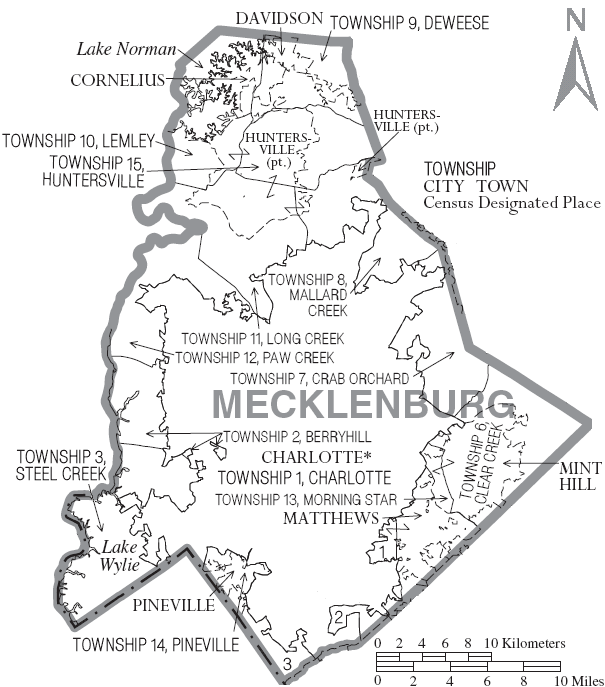
Mecklenburg County contains seven municipalities including the City of Charlotte and the towns of Cornelius, Davidson, and Huntersville (north of Charlotte); and the towns of Matthews, Mint Hill, and Pineville (south and southeast of Charlotte). A small portion of Stallings is also in Mecklenburg County, though most of that town is in Union County. Extraterritorial jurisdictions within the county are annexed by municipalities as soon as they reach sufficient concentrations.
City
- Charlotte (county seat and largest municipality in the county and state)
Towns
- Cornelius
- Davidson (most; small portion extend into Iredell)
- Huntersville
- Matthews
- Mint Hill (most; small portions extend into Union)
- Pineville
- Stallings (parts; mostly in Union)
Unincorporated communities
- Caldwell
- Dixie
- Hopewell
- Newell
Townships
By the requirements of the North Carolina Constitution of 1868, Mecklenburg County was divided into 15 townships. However, one township, Sharon, was later annexed to the Charlotte township and ceased to exist. The townships, which are both numbered and named, are as follows:
- Township 1, Charlotte
- Township 2, Berryhill
- Township 3, Steele Creek
- Township 4, Sharon (extinct)
- Township 5, Providence
- Township 6, Clear Creek
- Township 7, Crab Orchard
- Township 8, Mallard Creek
- Township 9, Deweese
- Township 10, Lemley
- Township 11, Long Creek
- Township 12, Paw Creek
- Township 13, Morning Star
- Township 14, Pineville
- Township 15, Huntersville
Notable people
- Abraham Alexander (1717–1786), on the commission to establish town of Charlotte, North Carolina, North Carolina state legislator
- Evan Shelby Alexander (1767–1809), born in Mecklenburg County, later United States Congressman from North Carolina
- Nathaniel Alexander (1756–1808), born in Mecklenburg County, United States Congressman and governor of North Carolina
- Nellie Ashford (born c. 1943), folk artist born in Mecklenburg County
- Romare Bearden (1911–1988), 20th century African-American artist
- Sarah Frew Davidson (1804-1889), educator
- Brigadier General William Lee Davidson (1746–1781), was a North Carolina militia general during the American Revolutionary War.
- Ric Flair (born 1949), retired professional wrestler
- Anthony Foxx (born 1971), former United States Secretary of Transportation, former mayor of Charlotte.
- Judge Shirley Fulton (1952–2023), chief resident judge in the Superior Court of North Carolina
- Billy Graham (1918–2018), world-famous evangelist
- Eliza Ann Grier (1864–1902), born in Mecklenburg County, first African-American female physician in Georgia
- Anthony Hamilton (born 1971), American R&B/soul singer
- Daniel Harvey Hill (1821–1889), Confederate general during the American Civil War and a Southern scholar.
- Gen. Robert Irwin (1738–1800), a distinguished commander of Patriot (American Revolution) militia forces, who is said to have been a signer of the Mecklenburg Declaration of Independence
- Willie Kirkpatrick Lindsay (1875–1954), Dean of Women, Erskine College; President, North Carolina State Woman's Christian Temperance Union
- Pat McCrory (born 1956), former Governor of North Carolina, former seven-term Mayor of Charlotte.
- James K. Polk (1795–1849), 11th president of the United States. Polk was born in Mecklenburg County in 1795; his family moved to Tennessee when he was an adolescent.
- Colonel William Polk (1758–1834) banker, educational administrator, political leader, renowned Continental officer in the War for American Independence, and survivor of the 1777/1778 encampment at Valley Forge.
- Shannon Spake (born 1976), ESPN NASCAR correspondent
References
References
- "State & County QuickFacts". United States Census Bureau.
- "Find a County". National Association of Counties.
- "Mecklenburg County hits 1 million and counting".
- Gannett, Henry. (1905). "The Origin of Certain Place Names in the United States". U.S. Government Printing Office.
- "Did North Carolina Issue the First Declaration of Independence?". HISTORY.com.
- Williams, James H.. (June 10, 2008). "The Mecklenburg Declaration – History".
- Martin, Jonathan. (July 8, 2011). "Mecklenburg County (1762)".
- Beem, Randi. (March 24, 2023). "World War I And Camp Greene".
- "Mecklenburg County, North Carolina".
- (April 4, 2019). "Atrium Health's Carolinas Medical Center: Where it All Began".
- "History".
- "Charlotte-Mecklenburg Charter Commission records".
- (March 14, 2024). "Metropolitan and Micropolitan Statistical Areas Population Totals: 2020-2023". [[United States Census Bureau]], Population Division.
- (August 23, 2022). "2020 County Gazetteer Files – North Carolina". United States Census Bureau.
- (April 27, 2023). "Carolina Raptor Center".
- "The Charlotte Museum of History".
- "Historic Latta Place".
- "Home".
- Coats, Doug. (May 1, 2023). "The Little Sugar Creek Greenway is connected from NoDa to Pineville. Here are attractions to look for along the way".
- "Mint Museum Randolph".
- "Mint Museum Uptown".
- Duncan, Charles. (August 5, 2022). "N.C. nature preserve, site of the worst onshore fuel spill in the U.S., still closed 2 years later".
- "James K. Polk Memorial {{!}} NCpedia".
- (June 11, 2012). "Park Directory".
- "County Population Totals and Components of Change: 2020-2024". United States Census Bureau.
- "U.S. Decennial Census". United States Census Bureau.
- "Historical Census Browser". University of Virginia Library.
- (March 27, 1995). "Population of Counties by Decennial Census: 1900 to 1990". United States Census Bureau.
- (April 2, 2001). "Census 2000 PHC-T-4. Ranking Tables for Counties: 1990 and 2000". United States Census Bureau.
- "QuickFacts: Mecklenburg County, North Carolina". United States Census Bureau.
- (2021). "2020 Decennial Census Demographic Profile (DP1)".
- (2021). "2020 Decennial Census Redistricting Data (Public Law 94-171)".
- (2023). "2020 Decennial Census Demographic and Housing Characteristics (DHC)".
- "P004: Hispanic or Latino, and Not Hispanic or Latino by Race – 2000: DEC Summary File 1 – Mecklenburg County, North Carolina". [[United States Census Bureau]].
- "P2: Hispanic or Latino, and Not Hispanic or Latino by Race – 2010: DEC Redistricting Data (PL 94-171) – Mecklenburg County, North Carolina". [[United States Census Bureau]].
- "P2: Hispanic or Latino, and Not Hispanic or Latino by Race – 2020: DEC Redistricting Data (PL 94-171) – Mecklenburg County, North Carolina". [[United States Census Bureau]].
- https://data.census.gov/table/ACSDP1Y2024.DP05?q=Mecklenburg+County,+North+Carolina
- https://data.census.gov/table/ACSDP5Y2020.DP05?q=Mecklenburg+County,+North+Carolina
- https://data.census.gov/table/ACSDP1Y2024.DP05?q=Mecklenburg+County,+North+Carolina
- https://data.census.gov/table/ACSDP1Y2024.DP05?q=mecklenburg+county,+North+Carolina
- https://data.census.gov/table/ACSDP1Y2024.DP05?q=North+Carolina.
- "U.S. Census website". [[United States Census Bureau]].
- "Centralina Council of Governments". CCOG.
- "Board of County Commissioners".
- Leip, David. "Dave Leip's Atlas of U.S. Presidential Elections".
- (October 25, 2023). "Battle for the 'Burbs".
- "About the DA".
- "History".
- "Fortune 500 Companies". Charlotte Chamber Web Site.
- "Fortune 500".
- (October 12, 2008). "FRB: Press Release—Approval of proposal by Wells Fargo & Company to acquire Wachovia Corporation". Federal Reserve Board.
- "United Technologies completes Goodrich acquisition".
- "Major Employers in Charlotte Region – Charlotte Area Major Employers (Q2 2018)". Charlotte Regional Business Alliance.
- Boraks, David. (April 29, 2021). "CATS Board OKs Revised Route Map For Proposed Silver Line Light Rail".
- "LYNX Silver Line". Charlotte Area Transit Systems.
- (February 28, 2019). "Commission approves plan for new light rail from Belmont to Matthews". [[WCNC-TV]].
- (June 28, 2021). "Cost increased and timeline pushed back for light rail expansion in Charlotte".
- "Carolinas Medical Center".
- "Atrium Health Carolinas Medical Center {{!}} Hospital in Charlotte, NC".
- "North Carolina Trauma Centers".
- "Atrium Health Financial Information". [[Atrium Health]].
- "Emergency Medical Services Charlotte NC".
- Flipsnack. "AR22 web".
- (1961). "Hornets' Nest: The Story of Charlotte and Mecklenburg County". Public Library of Charlotte and Mecklenburg County.
- "Township 1, Charlotte, Mecklenburg County, NC".
- "Township 2, Berryhill, Mecklenburg County, NC".
- "Township 3, Steele Creek, Mecklenburg County, NC".
- "Township 5, Providence, Mecklenburg County, NC".
- "Township 6, Clear Creek, Mecklenburg County, NC".
- "Township 7, Crab Orchard, Mecklenburg County, NC".
- "Township 8, Mallard Creek, Mecklenburg County, NC".
- "Township 9, Deweese, Mecklenburg County, NC".
- "Township 10, Lemley, Mecklenburg County, NC".
- "Township 11, Long Creek, Mecklenburg County, NC".
- "Township 12, Paw Creek, Mecklenburg County, NC".
- "Township 13, Morning Star, Mecklenburg County, NC".
- "Township 14, Pineville, Mecklenburg County, NC".
- "Township 15, Huntersville, Mecklenburg County, NC".
- (1963). "Who Was Who in America, Historical Volume, 1607–1896". Marquis Who's Who.
- "Nellie Ashford: Life, Liberty, and the Lack Thereof".
- "Home – Bearden Foundation".
- Gordon, Michael. (February 9, 2023). "'Best of the best.' NC Judge Shirley Fulton, legal trailblazer, activist, dies at 71". The News & Observer.
This article was imported from Wikipedia and is available under the Creative Commons Attribution-ShareAlike 4.0 License. Content has been adapted to SurfDoc format. Original contributors can be found on the article history page.
Ask Mako anything about Mecklenburg County, North Carolina — get instant answers, deeper analysis, and related topics.
Research with MakoFree with your Surf account
Create a free account to save articles, ask Mako questions, and organize your research.
Sign up freeThis content may have been generated or modified by AI. CloudSurf Software LLC is not responsible for the accuracy, completeness, or reliability of AI-generated content. Always verify important information from primary sources.
Report