From Surf Wiki (app.surf) — the open knowledge base
Meat industry
People and companies engaged in industrialized livestock agriculture

People and companies engaged in industrialized livestock agriculture
The meat industry are the people and companies engaged in modern industrialized livestock agriculture for the production, packing, preservation and marketing of meat (in contrast to dairy products, wool, etc.). In economics, the meat industry is a fusion of primary (agriculture) and secondary (industry) activity and hard to characterize strictly in terms of either one alone. The greater part of the meat industry is the meat packing industry – the segment that handles the slaughtering, processing, packaging, and distribution of animals such as poultry, cattle, pigs, sheep and other livestock.
A great portion of the ever-growing meat branch in the food industry involves intensive animal farming in which livestock are kept almost entirely indoors or in restricted outdoor settings like pens. Many aspects of the raising of animals for meat have become industrialized, even many practices more associated with smaller family farms, e.g. gourmet foods such as foie gras. This heavy industrialization leads to an outsized environmental impact, responsible for significant greenhouse gas emissions, land use change and degradation, and water, air and soil pollution.
The production of livestock is a heavily vertically integrated industry where the majority of supply chain stages are integrated and owned by one company. Each stage of the process of rearing animals to slaughter, is often concentrated in very few companies -- with some companies dominating multiple stages of the industry; for example in agrochemicals used in animal production 66% of global revenue are concentrated in four firms, in animal pharmaceuticals 58%. For example, Brazil's JBS S.A. have secured market dominance in multiple sectors in the USA and Brazil and is the world's largest animal slaughter company. This large economic influence, both within countries and over international trade, has created significant political influence from the industry. A 2025 review of scholarship found that the animal agriculture industry has played an outsized role in obstructing measures to address climate change, by actively supporting disinformation campaigns, and preventing policy to address climate change.
Global production of meat products
Main article: List of countries by meat production
Global production of meat in 2023 was 362.9 million tons of meat, most of which was produced in industrial supply chains. Meat production is globally dominated by a handful of super producing net exporting countries of meat and meat products, such as China (97.5 million tons in 2023), the United States (47.5 million tons in 2023), and Brazil (31.6 million tons in 2023) which produce, together over 176 million tons or nearly half of global production. A full list of producers can be found at List of countries by meat production.
Companies
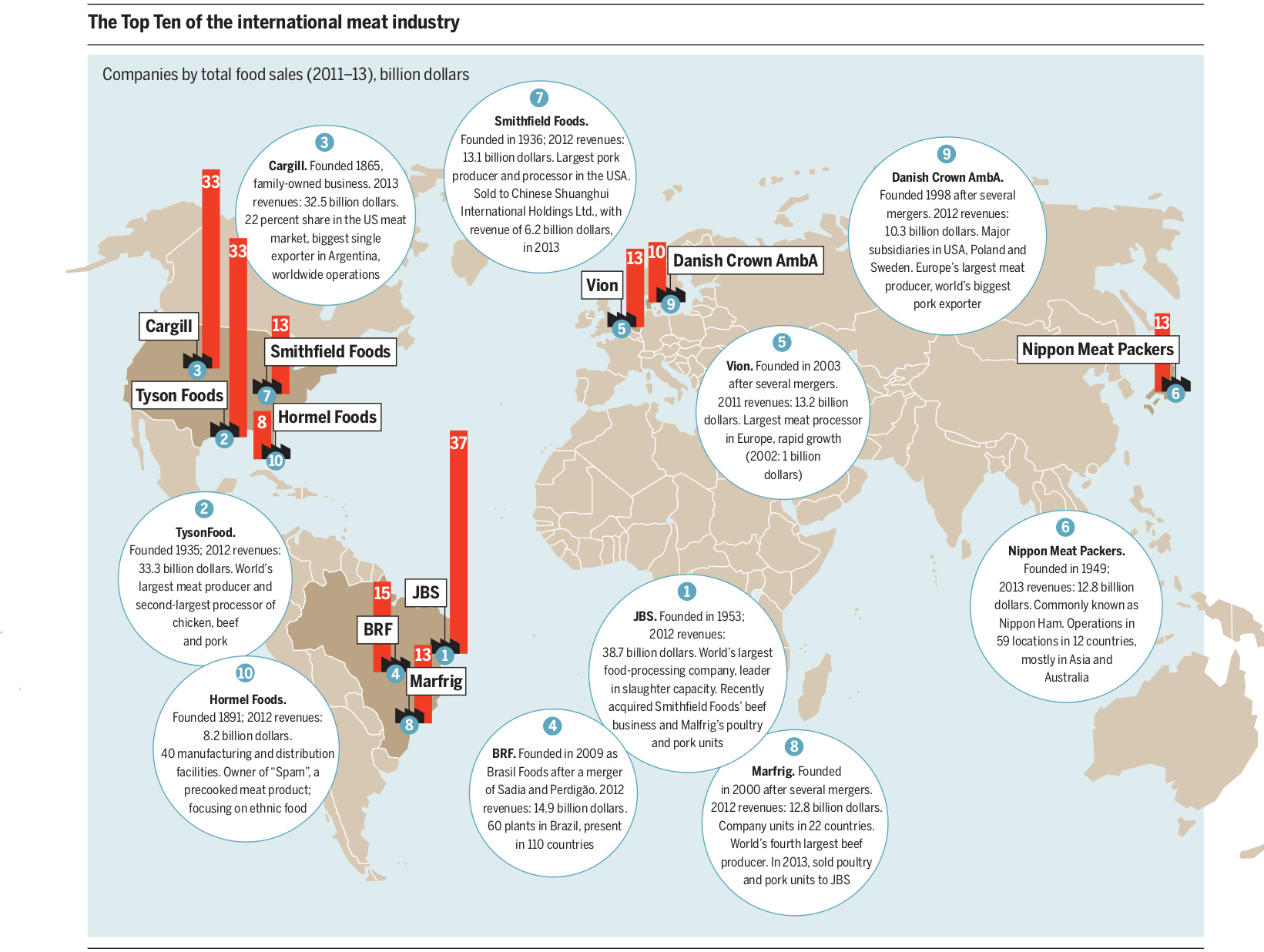
- JBS S.A. (Brazil)
- Tyson Foods (United States)
- Cargill (United States)
- Marfrig (Brazil)
- WH Group (Hong Kong)
- BRF S.A. (Brazil)
- Vion NV (Netherlands)
- Minerva Foods (Brazil)
- Danish Crown (Denmark)
.svg)
Forecasts

A Food and Agriculture Organization and OECD project for meat production across the world, project significant increases in animals slaughter from 2025 to 2034, as global demand for meat increases especially in lower middle income and lower income countries.
Sectors involved
When describing the meat industry, typically the focus is on the steps between breeding and rearing animals, typically in industrial-type operations, and slaughter, through to the processing and distribution of the meat. Like other parts of the food system -- industrial scale companies tend to combine multiple of these items.
Most companies involved in the meat industry, also own businesses, factories or brands focused on using animal by-products, such as slaughterhouse waste used in pet food, or creating inputs for the sector, such as cattle feed.
Animal breeding
Animal production
Meat packing
Meat-packing also includes making processed meat.
Distribution
A meat jobber, also known as a meat wholesaler or meat distributor is an entity that purchases meat products from producers, typically in large quantities, and sells them to retailers.
Meat jobbers came to prominence in the 1940s, as the American highway system began to expand, superseding rail-based branch houses.
Some meat jobbers known as meat breakers or meat boners would further process meat. In preparation for resale to retail, they "broke" the meat down from quarters to subprimal cuts and boned them prior to shipping. Retailers used these meat jobbers since they offered flexibility in cuts, and independent packers used them since they had to do minimal processing, requiring minimal capital investment.
A meat broker is an entity of the meat industry that brokers the buying and selling of meat, carcasses, animal products, and animals such as cattle, sheep, swine, goats, horses, etc. Meat brokers can also be known as poultry brokers or meat and poultry broker depending on their offerings.
Criticism
Criticized aspects and effects of industrial meat production include:
- Hormone treatment such as steroids and the effect of consuming meat from animals raised with these on human consumers (see also Beef hormone controversy)
- Spread of animal diseases, e.g. mad-cow disease (BSE), avian flu, swine influenza (H1N1), avian influenza (H5N1), foot-and-mouth disease, including to human consumers
- The commonness of cruelty to animals in the meat industry
- Certain animal rights advocates and groups believe that the production of meat is unethical and the industry should be abolished
- Contribution of the overconsumption of meat products to obesity
- Spread of human disease associated with animal waste, e.g. through E. coli
- Cost of state services associated with the above, including meat inspection and health care
Spread of human disease associated with workers in meat and poultry processing facilities
Many observers suggest that the expense of dealing with the above is grossly underestimated by present economic metrics and that true cost accounting would drastically raise the price of industrial meat.
Animal welfare
Environmental impacts

Effects on livestock workers
American slaughterhouse workers are three times more likely to suffer serious injury than the average American worker. NPR reports that pig and cattle slaughterhouse workers are nearly seven times more likely to suffer repetitive strain injuries than average. The Guardian reports that, on average, there are two amputations a week involving slaughterhouse workers in the United States. On average, one employee of Tyson Foods, the largest meat producer in America, is injured and amputates a finger or limb per month. The Bureau of Investigative Journalism reported that over a period of six years, in the UK 78 slaughter workers lost fingers, parts of fingers or limbs, more than 800 workers had serious injuries, and at least 4,500 had to take more than three days off after accidents. In a 2018 study in the Italian Journal of Food Safety, slaughterhouse workers are instructed to wear ear protectors to protect their hearing from the constant screams of animals being killed. A 2004 study in the Journal of Occupational and Environmental Medicine found that "excess risks were observed for mortality from all causes, all cancers, and lung cancer" in workers employed in the New Zealand meat processing industry.
The act of slaughtering animals, or of raising or transporting animals for slaughter, may engender psychological stress or trauma in the people involved. A 2016 study in Organization indicates, "Regression analyses of data from 10,605 Danish workers across 44 occupations suggest that slaughterhouse workers consistently experience lower physical and psychological well-being along with increased incidences of negative coping behavior." A 2009 study by criminologist Amy Fitzgerald indicates, "slaughterhouse employment increases total arrest rates, arrests for violent crimes, arrests for rape, and arrests for other sex offenses in comparison with other industries." As authors from the PTSD Journal explain, "These employees are hired to kill animals, such as pigs and cows, that are largely gentle creatures. Carrying out this action requires workers to disconnect from what they are doing and from the creature standing before them. This emotional dissonance can lead to consequences such as domestic violence, social withdrawal, anxiety, drug and alcohol abuse, and PTSD."
Slaughterhouses in the United States commonly illegally employ and exploit underage workers and illegal immigrants. In 2010, Human Rights Watch described slaughterhouse line work in the United States as a human rights crime. In a report by Oxfam America, slaughterhouse workers were observed not being allowed breaks, were often required to wear diapers, and were paid below minimum wage.
Industry for alternative meats
Because of the outsized environmental and social impact of the meat industry, multiple industrial and social movements have proposed alternatives to a meat industry. Notable amongst these are cultured meat and meat alternatives, both industrially manufactured substitutes for meat for people seeking the experience of meat in food, without the associated environmental or ethical impacts. However, neither industry has taken a significant portion of the market. After much hype during the late 2010s and early 2020s, many of the larger companies, such as Beyond Meat, pursuing meat alternatives saw a significant drop in value.
Alternative meat industry
Main article: Meat analogue
Cultured meat industry
References
References
- "Global Meat Production and Consumption Continue to Rise". [[Worldwatch Institute]].
- Paul Ebner. "Modern Livestock Facilities". Purdue University.
- (21 June 2010). "Foie Gras: Cruelty to Ducks and Geese | Ducks and Geese Used for Food | Factory Farming: Misery for Animals | The Issues". PETA.
- "An Animal Equality investigation". Foie Gras farms.
- Lauber, Kathrin. (2025-10-14). "The Animal Agriculture Industry’s Role in Obstructing Climate Action". Oxford University PressNew York.
- "Organic Meat Market Size, Share, Analysis, Trends, Forecast".
- "Companies: dominating the market from farm to display case {{!}} Heinrich Böll Stiftung {{!}} Brussels office - European Union".
- Hannah Ritchie, Pablo Rosado, and Max Roser (2019) - “Meat and Dairy Production” Published online at OurWorldinData.org. Retrieved from: 'https://ourworldindata.org/meat-production' [Online Resource]
- OECD. (2025-07-15). "OECD-FAO Agricultural Outlook 2025-2034". OECD Publishing.
- (14 May 2014). "Encyclopedia of American Business History". Infobase Publishing.
- (1927). "Meat Retailing". Vaughan Company.
- {{USC. 21. 601(c)
- (2015). "Steroid Hormone Implants Used for Growth in Food-Producing Animals". FAO.
- "Definition of veganism". The Vegan Society.
- "The Six Principles of the Abolitionist Approach to Animal Rights – Animal Rights The Abolitionist Approach".
- (8 May 2020). "COVID-19 Among Workers in Meat and Poultry Processing Facilities ― 19 States, April 2020". MMWR. Morbidity and Mortality Weekly Report.
- (2016-12-02). "USDA ERS – Retail Meat Prices & Price Spreads".
- (2014). "Food wastage footprint – Full cost accounting". FAO.
- "Unfair fare: Why prices for meat from small local farms are too high".
- (2009). "Getting Real About the High Price of Cheap Food".
- (2013). "The Triple Whopper Environmental Impact of Global Meat Production".
- "Meatpacking".
- (11 August 2016). "Working 'The Chain,' Slaughterhouse Workers Face Lifelong Injuries". NPR.
- (5 July 2018). "Two amputations a week: the cost of working in a US meat plant".
- Lewis, Cora. (18 February 2018). "America's Largest Meat Producer Averages One Amputation Per Month".
- (29 July 2018). "Revealed: Shocking safety record of UK meat plants".
- (3 July 2018). "Noise assessment in slaughterhouses by means of a smartphone app". Italian Journal of Food Safety.
- (June 2004). "Mortality and cancer incidence in New Zealand meat workers". Journal of Occupational and Environmental Medicine.
- (1997). "Slaughterhouse: The Shocking Story of Greed, Neglect, and Inhumane Treatment Inside the U.S. Meat Industry". Prometheus Books.
- (30 January 2019). "Sheep farmer who felt so guilty about driving his lambs to slaughter rescues them and becomes a vegetarian". The Independent.
- (20 April 2016). "Slaughtering for a living: A hermeneutic phenomenological perspective on the well-being of slaughterhouse employees". International Journal of Qualitative Studies on Health and Well-being.
- (7 February 2012). "PTSD in the Slaughterhouse". [[The Texas Observer]].
- Newkey-Burden, Chas. (19 November 2018). "There's a Christmas crisis going on: no one wants to kill your dinner – Chas Newkey-Burden". [[The Guardian]].
- "Psychological Distress Among Slaughterhouse Workers Warrants Further Study – SPH – Boston University".
- Dillard, Jennifer. (September 2007). "A Slaughterhouse Nightmare: Psychological Harm Suffered by Slaughterhouse Employees and the Possibility of Redress through Legal Reform".
- (2 March 2018). "'I couldn't look them in the eye': Farmer who couldn't slaughter his cows is turning his farm vegan".
- Fox, Katrina. "Meet The Former Livestock Agent Who Started An International Vegan Food Business".
- Lebwohl, Michael. (25 January 2016). "A Call to Action: Psychological Harm in Slaughterhouse Workers".
- Nagesh, Ashitha. (31 December 2017). "The harrowing psychological toll of slaughterhouse work".
- (2016). "Routinized killing of animals: Going beyond dirty work and prestige to understand the well-being of slaughterhouse workers". Organization.
- "The Psychological Damage of Slaughterhouse Work".
- Waldman, Peter. (29 December 2017). "America's Worst Graveyard Shift Is Grinding Up Workers". Bloomberg.com.
- Grabell, Michael. (1 May 2017). "Exploitation and Abuse at the Chicken Plant".
- (11 December 2010). "Rights on the Line". Human Rights Watch.
- Grabell, Michael. (23 May 2018). "Live on the Live".
- Huang, Jeff. (2025-03-10). "How Beyond Meat and the plant-based meat industry lost their allure".
This article was imported from Wikipedia and is available under the Creative Commons Attribution-ShareAlike 4.0 License. Content has been adapted to SurfDoc format. Original contributors can be found on the article history page.
Ask Mako anything about Meat industry — get instant answers, deeper analysis, and related topics.
Research with MakoFree with your Surf account
Create a free account to save articles, ask Mako questions, and organize your research.
Sign up freeThis content may have been generated or modified by AI. CloudSurf Software LLC is not responsible for the accuracy, completeness, or reliability of AI-generated content. Always verify important information from primary sources.
Report