From Surf Wiki (app.surf) — the open knowledge base
Measuring rod
Tool used to physically measure lengths
Tool used to physically measure lengths
A measuring rod is a tool used to physically measure lengths and survey areas of various sizes. Most measuring rods are round or square sectioned; however, they can also be flat boards. Some have markings at regular intervals. It is likely that the measuring rod was used before the line, chain or steel tapes used in modern measurement.
History
Ancient Sumer
The oldest preserved measuring rod is a copper-alloy bar which was found by the German Assyriologist Eckhard Unger while excavating at Nippur (pictured below). The bar dates from c. 2650 BC. and Unger claimed it was used as a measurement standard. This irregularly formed and irregularly marked graduated rule supposedly defined the Sumerian cubit as about 518.5 mm, although this does not agree with other evidence from the statues of Gudea from the same region, five centuries later.

Ancient India
Rulers made from ivory were in use by the Indus Valley Civilization in what today is Pakistan, and in some parts of Western India prior to 1500 BCE. Excavations at Lothal dating to 2400 BCE have yielded one such ruler calibrated to about 1/16 in Ian Whitelaw (2007) holds that 'The Mohenjo-Daro ruler is divided into units corresponding to 1.32 in and these are marked out in decimal subdivisions with remarkable accuracy—to within 0.005 in. Ancient bricks found throughout the region have dimensions that correspond to these units.' The sum total of ten graduations from Lothal is approximate to the angula in the Arthashastra.
Ancient East Asia
Measuring rods for different purposes and sizes (construction, tailoring and land survey) have been found from China and elsewhere dating to the early 2nd millennium B.C.E.
Ancient Egypt

Main article: Ancient Egyptian units of measurement
Cubit-rods of wood or stone were used in Ancient Egypt. Fourteen of these were described and compared by Lepsius in 1865. Flinders Petrie reported on a rod that shows a length of 520.5 mm, a few millimetres less than the Egyptian cubit. A slate measuring rod was also found, divided into fractions of a Royal Cubit and dating to the time of Akhenaten.
Further cubit rods have been found in the tombs of officials. Two examples are known from the tomb of Maya—the treasurer of the 18th dynasty pharaoh Tutankhamun—in Saqqara. Another was found in the tomb of Kha (TT8) in Thebes. These cubits are ca 52.5 cm long and are divided into seven palms, each palm is divided into four fingers and the fingers are further subdivided. Another wooden cubit rod was found in Theban tomb TT40 (Huy) bearing the throne name of Tutankhamun (Nebkheperure).

Egyptian measuring rods also had marks for the Remen measurement of approximately 370 mm, used in construction of the Pyramids.
Ancient Europe
An oak rod from the Iron Age fortified settlement at Borre Fen in Denmark measured 53.15 in, with marks dividing it up into eight parts of 6.64 in, corresponding quite closely to half a Doric Pous (a Greek foot). A hazel measuring rod recovered from a Bronze Age burial mound in Borum Eshøj, East Jutland by P. V. Glob in 1875 measured 30.9 in corresponding remarkably well to the traditional Danish foot. The megalithic structures of Great Britain has been hypothesized to have been built by a "Megalithic Yard", though some authorities believe these structures have been measured out by pacing. Several tentative Bronze Age bone fragments have been suggested as being parts of a measuring rod for this hypothetical measurement.
Roman Empire
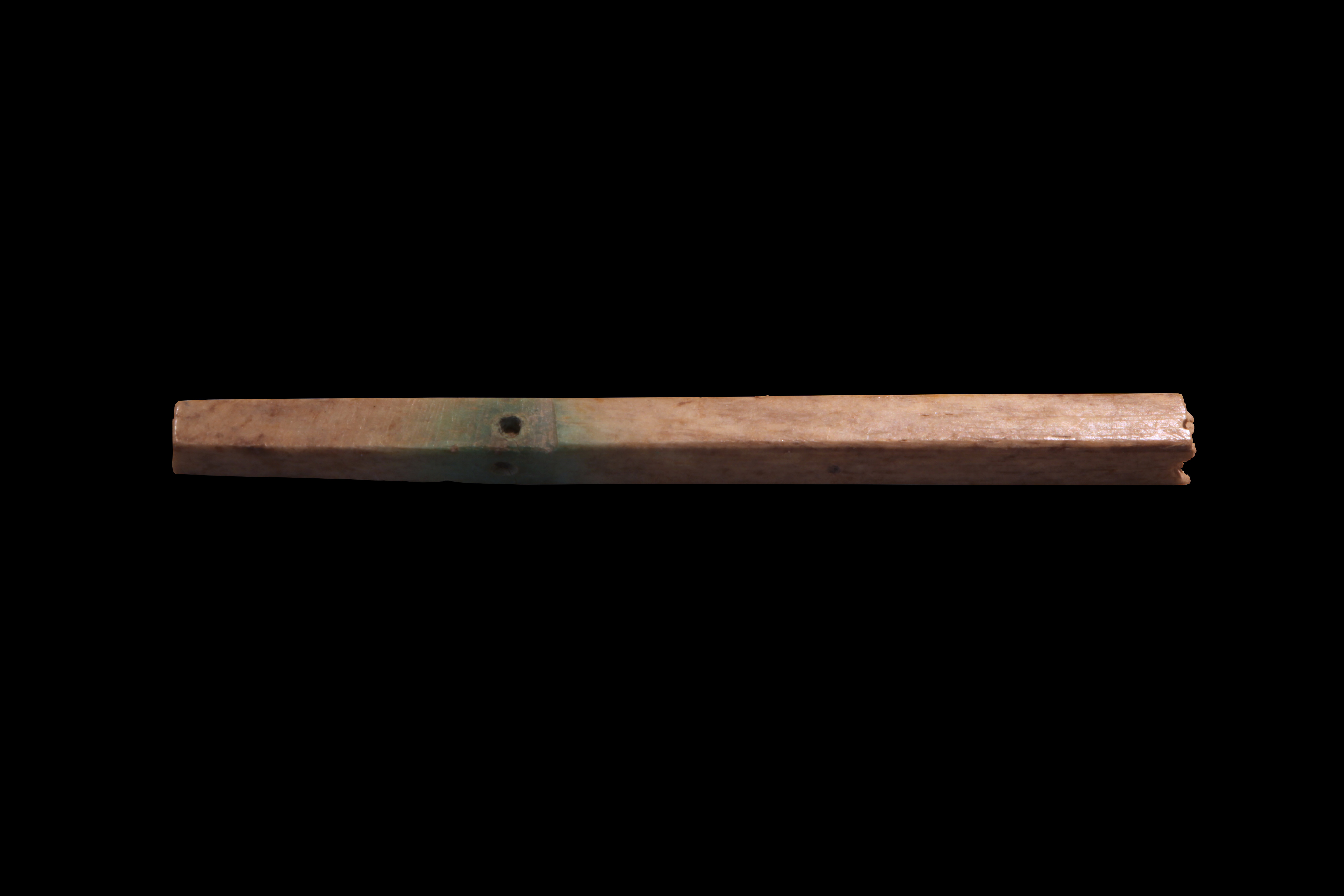
Large public works and imperial expansion, particularly the large network of Roman roads and the many milecastles, made the measuring rod an indispensable part of both the military and civilian aspects of Roman life. Republican Rome used several measures, including the various Greek feet measurements and the Oscan foot of 27.5 cm. Standardisation was introduced by Agrippa in 29 BC, replacing all previous measurements by a Roman foot of 29.6 cm, which became the foot of Imperial Rome.
The Roman measuring rod was 10 Roman feet long, and hence called a decempeda, Latin for 'ten-footer'. It was usually of square section capped at both ends by a metal shoe, and painted in alternating colours. Together with the groma and dioptra, the decempeda formed the basic kit for the Roman surveyors.{{cite web | archive-url = https://web.archive.org/web/20110421082346/http://www.experiment-resources.com/roman-roads.html | archive-date = 21 April 2011 | url-status = dead
Middle Ages
In the Middle Ages, bars were used as standards of length when surveying land. These bars often used a unit of measure called a rod, of length equal to 5.5 yards, 5.0292 metres, 16.5 feet, or of a statute mile.{{cite encyclopedia |url-status=dead
In culture
Iconography
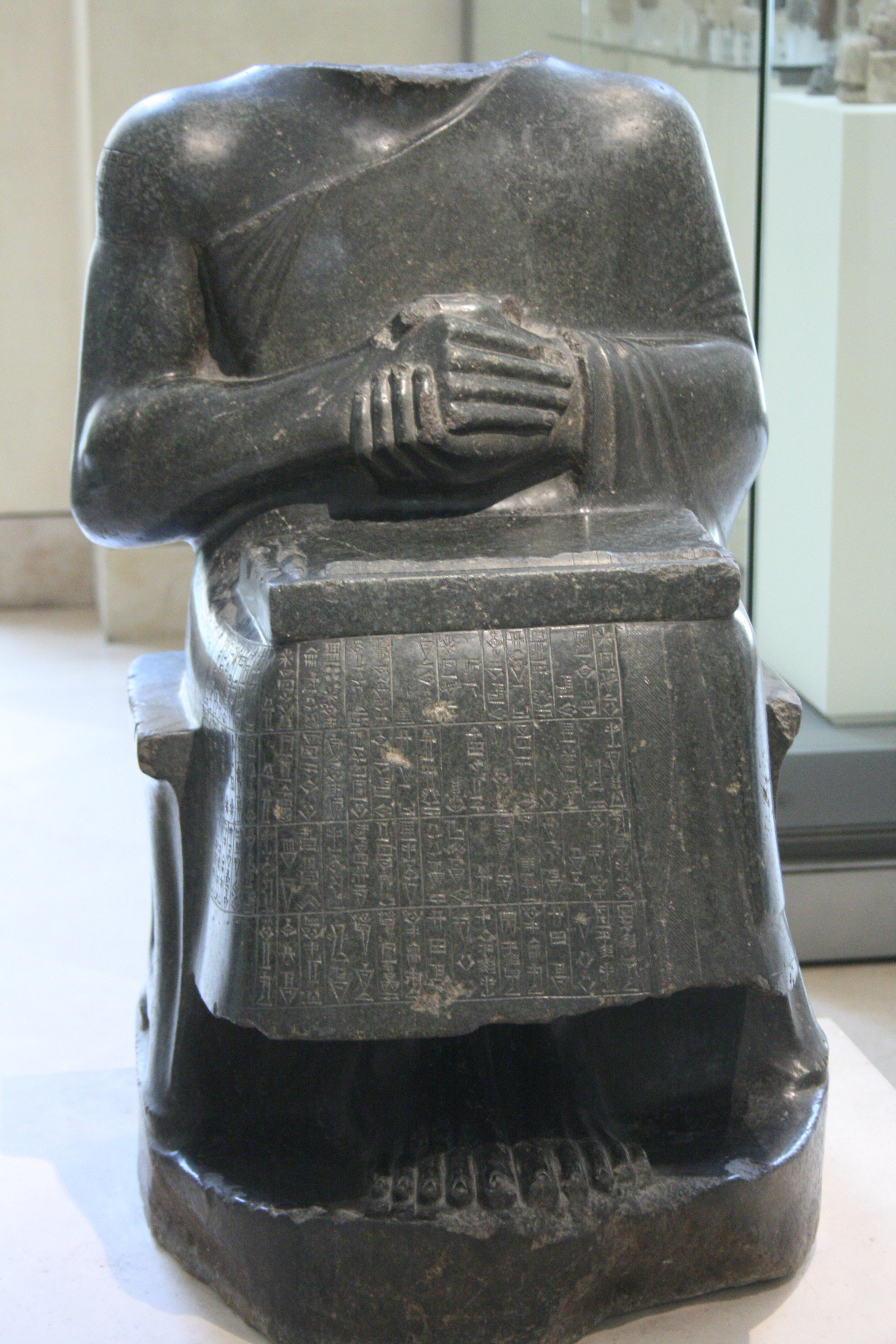
Two statues of Gudea of Lagash in the Louvre depict him sitting with a tablet on his lap, upon which are placed surveyors tools including a measuring rod.
Seal 154 recovered from Alalakh, now in the Biblioteque Nationale show a seated figure with a wedge shaped measuring rod.
The Tablet of Shamash recovered from the ancient Babylonian city of Sippar and dated to the 9th century BC shows Shamash, the Sun God awarding the measuring rod and coiled rope to newly trained surveyors.
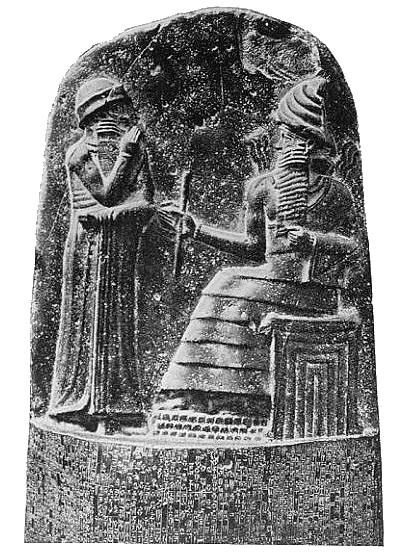
A similar scene with measuring rod and coiled rope is shown on the top part of the diorite stele above the Code of Hammurabi in the Louvre, Paris, dating to ca. 1700 BC.
The "measuring rod" or tally stick is common in the iconography of Greek Goddess Nemesis.
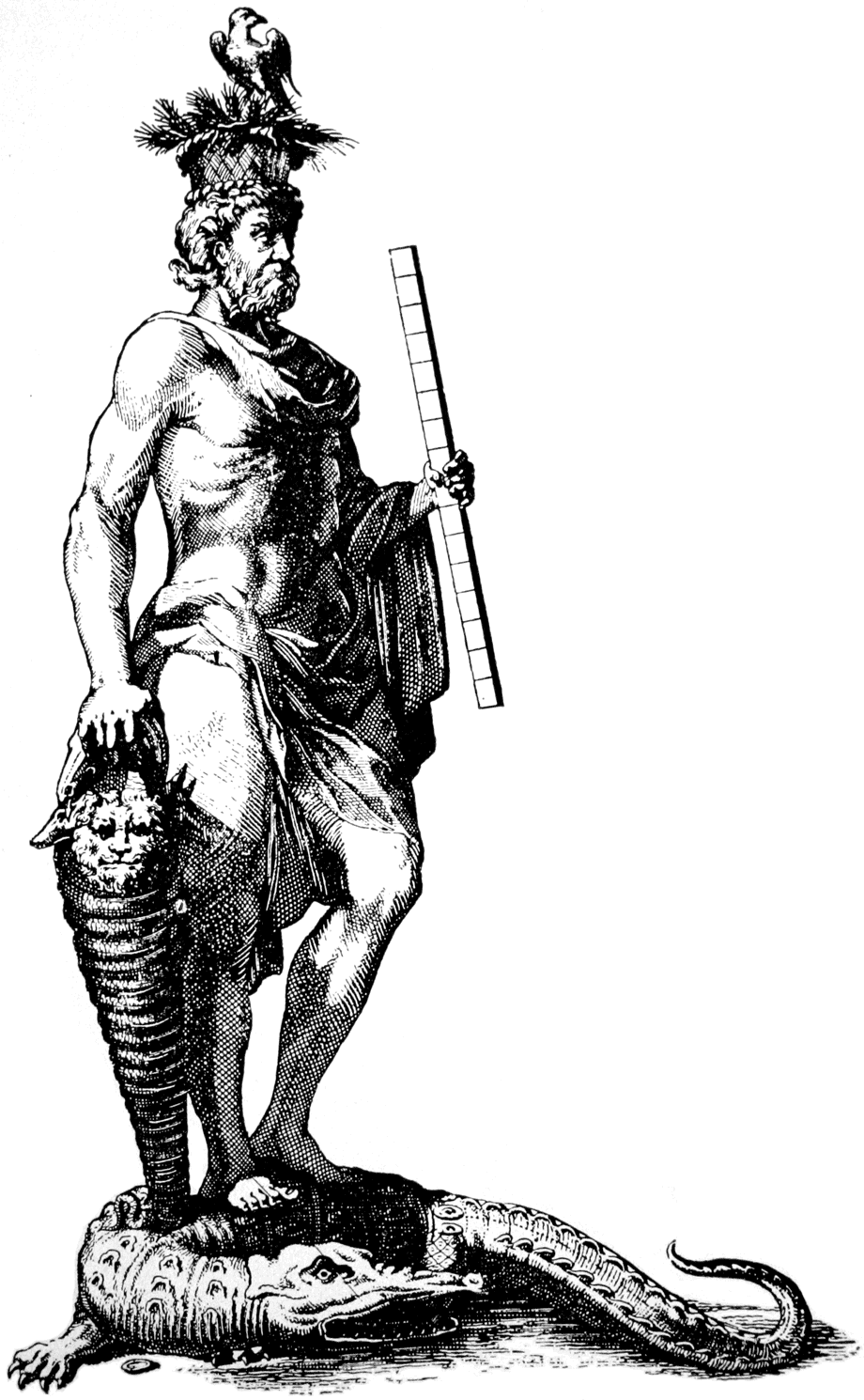
The Graeco-Egyptian God Serapis is also depicted in images and on coins with a measuring rod in hand and a vessel on his head.
The most elaborate depiction is found on the Ur-Nammu-stela, where the winding of the cords has been detailed by the sculptor. This has also been described as a "staff and a chaplet of beads".
Mythology
The myth of Inanna's descent to the nether world describes how the goddess dresses and prepares herself:
Lachesis in Greek mythology was one of the three Moirai (or Fates) and "allotter" (or drawer of lots). She measured the thread of life allotted to each person with her measuring rod. Her Roman equivalent was Decima (the 'Tenth').
Varuna in the Rigveda, is described as using the Sun as a measuring rod to lay out space in a creation myth. W. R. Lethaby has commented on how the measurers were seen as solar deities and noted how Vishnu "measured the regions of the Earth".
Bible
Measuring rods or reeds are mentioned several times in the Bible. In the Old Testament or Hebrew Bible, a measuring rod and line are seen in a vision of Yahweh in Ezekiel 40:2-3: One of the eight visions seen by the prophet Zechariah involves a man with a measuring line.
In the New Testament, Revelation 11:1 says that the author:
And the wall of the [[New Jerusalem
References
References
- American Society of Civil Engineers. (1891). "Transactions of the American Society of Civil Engineers". American Society of Civil Engineers..
- Scandinavian Archaeometry Center. (1993). "Archaeology and natural science, p. 118". P. Åströms.
- Whitelaw, page 14
- Whitelaw, page 15
- S. R. Rao (1985). Lothal. Archaeological Survey of India. pp. 39–40.
- Gang Zhao. (1986). "Man and land in Chinese history: an economic analysis, p. 65". Stanford University Press.
- Lepsius, Richard. (1865). "Die altaegyptische Elle und ihre Eintheilung". Dümmler.
- (1976). "Acta praehistorica et archaeologica". B.Hessling..
- Broadman & Holman Publishers. (15 September 2006). "Holman Illustrated Study Bible-HCSB". B&H Publishing Group.
- Marshall Clagett, Ancient Egyptian Science, A Source Book. Volume Three: Ancient Egyptian Mathematics, American Philosophical Society, 1999
- Frances Welsh. (2008). "Tutankhamun's Egypt". Osprey Publishing.
- (1969). "Acta archaeologica". Levin & Munksgaard.
- Martin Brennan. (1980). "The Boyne Valley vision". Dolmen Press.
- Tauber, H. (1964): Copenhagen radiocarbon dates VI, ''Radiocarbon'' no. 6, pp 215-25.
- Boye, V. (1896): Fund av Egekister fra Bronzealderen i Danmark. Et monografisk Bidrag til Belysning af Bronzealderens Kultur. Kopenhagen.
- Margaret Ponting. (2003). "Records in Stone: Papers in Memory of Alexander Thom". Cambridge University Press.
- Heggie, Douglas C.. (1981). "Megalithic Science: Ancient Mathematics and Astronomy in North-west Europe". Thames and Hudson.
- (1974). "The Place of astronomy in the ancient world: a joint symposium of the Royal Society and the British Academy, Hunting Quanta, p. 258". Oxford University Press for the British Academy.
- Soren, D. & Soren, N. (1999): A Roman villa and a late Roman infant cemetery : excavation at Poggio Gramignano, Lugnano in Teverina. Bibliotheca archaeologica (Rome, Italy), no. 23. L'Erma di Bretschneider, Rome [https://books.google.com/books?id=U8Muzx1VrbwC&dq=roman+measuring+rod&pg=PA184 p 184] from [[Google books]]
- Main Limes Museum: [http://www.museen-mainlimes.de/content/2-museen/fund.en.php?id=48 Measuring rod]
- (1977). "The principles and practice of surveying". Wiley.
- Donald Preziosi. (1983). "Minoan architectural design: formation and signification, p. 498". Mouton.
- Dominique Collon. (1975). "The seal impressions from Tell Atchana/Alalakh". Butzon & Bercker.
- [https://www.britishmuseum.org/explore/highlights/highlight_objects/me/t/tablet_of_shamash.aspx The British Museum - Tablet of Shamash]
- (1905). "The Biblical world p. 120". University of Chicago Press.
- Amélie Kuhrt. (1995). "The ancient Near East, c. 3000-330 BC". Routledge.
- Lucinda Dirven. (1999). "The Palmyrenes of Dura-Europos: a study of religious interaction in Roman Syria p. 329". BRILL.
- Johann Joachim Eschenburg. (1836). "Manual of classical literature". Key and Biddle.
- (1979). "Studies in Hellenistic religions". Brill Archive.
- Jeremy Black, Anthony Green, ''Gods, Demons and Symbols of Ancient Mesopotamia'', Rod and Ring, p 156.
- cf. [http://etcsl.orinst.ox.ac.uk/cgi-bin/etcsl.cgi?text=t.1.4.1 Inana's descent to the nether world] line 25. The Sumerian has: gi-diš-'''nindan''' '''eš2-gana2''' za-gin3 šu ba-ni-in-du8 i.e. taken literally the rod would have the length of one ''nindan'' (6 cubit = 5.94m) and the eš2-gana2 the surveyor's line - would be ten ''nindan'' in length.
- Robert Graves. (1957). "The Greek myths, p. 30". G. Braziller.
- [http://www.sacred-texts.com/hin/rigveda/rv05085.htm Rig Veda, Book 5, Hymn 85, Verse 5 tr. by Ralph T.H. Griffith, [1896], at sacred-texts.com]
- Edward Washburn Hopkins. (2007). "The Religions of India". Echo Library.
- W. R. Lethaby. (December 2005). "Architecture, Mysticism and Myth". Cosimo, Inc..
- (1984). "BIBLE: New International Version".
- {{bibleverse. Zechariah. 2:1-5. NKJV: [[NKJV]] (English verse numbering)
- Foundation Publication Inc. (1 March 1997). "New American Standard Bible". Foundation Publications, publisher for the Lockman Foundation.
This article was imported from Wikipedia and is available under the Creative Commons Attribution-ShareAlike 4.0 License. Content has been adapted to SurfDoc format. Original contributors can be found on the article history page.
Ask Mako anything about Measuring rod — get instant answers, deeper analysis, and related topics.
Research with MakoFree with your Surf account
Create a free account to save articles, ask Mako questions, and organize your research.
Sign up freeThis content may have been generated or modified by AI. CloudSurf Software LLC is not responsible for the accuracy, completeness, or reliability of AI-generated content. Always verify important information from primary sources.
Report